REVIEW 4 major objections 5 minor 76 references
Probing scalarized wormholes through quasi-periodic oscillations and spinning particle dynamics
T0 review · 4 major / 5 minor · reviewed 2026-08-15 · deepseek-v4-flash
Pith's one-line read In a scalarized wormhole, the scalar coupling $g_s$ pushes the ISCO and the 3:2 QPO resonance outward, and anti-aligned spins raise collision energies, giving observable signatures that could distinguish the wormhole from a black hole.
desk verdict A standard-methods parameter study with a load-bearing inconsistency in the spinning-particle section and a direct contradiction between the QPO analysis and the conclusions. read the letter →
The pith
A machine-rendered reading of the paper's core claim, the machinery that carries it, and where it could break.
The reading
What carries the argument
The load-bearing objects are the three-parameter scalarized wormhole metric of Ref. [23]—a static, spherically symmetric solution of Einstein-scalar theory with mass $M$, throat radius $r_0$, and scalar charge $\sigma$—and the coupling $g_s$ that enters the particle action through the effective mass $m(1+g_s\varphi)$. The spinless analysis runs on the effective potential $U(r)=f(1+g_s\varphi)^2+L^2 f/(r^2+2Mr+r_0^2)$, whose second derivatives about circular orbits give the orbital and epicyclic frequencies $\nu_\phi$, $\nu_r$, $\nu_\theta$ that feed the ER3 and ER4 epicyclic resonance models (QPO models in which the twin-peak frequencies are combinations of the vertical and radial epicyclic frequencies). The spinning-particle analysis runs on the Mathisson–Papapetrou–Dixon equations—the equations of motion for a spinning test particle that couple its spin to spacetime curvature—supplemented by the Tulczyjew spin supplementary condition; these yield a two-branch effective potential $V_{\mathrm{eff}}^{\pm}$, the superluminal bound $u^\alpha u_\alpha=0$ that fixes the maximum allowed spin, and the center-of-mass energy formula for head-on collisions. The scalar coupling $g_s$ is the dial that moves the ISCO, the resonance radius, the maximal spin, and the collision energies relative to the $g_s=0$ limit.
What would settle it
Evaluate numerically the dropped scalar-force term in the Mathisson–Papapetrou–Dixon equations at $g_s=0.1$, the largest coupling used in the figures: if its magnitude is not small compared with the spin-curvature term at the same spin values, then the effective potentials, ISCO shifts, superluminal bounds, and collision energies reported for spinning particles do not follow from the paper's stated approximation.
Extended reading notes
Core claim
On the paper's own terms, the central discovery is that the three-parameter scalarized wormhole—characterized by mass $M$, throat radius $r_0$, and scalar charge $\sigma$—produces a systematic pattern in the motion of test particles, with the scalar–particle coupling $g_s$ acting as a dial on that pattern. For spinless particles, increasing $g_s$ moves the ISCO to larger radii, modifies the orbital and epicyclic frequencies, and shifts the radius at which the ER3 and ER4 twin-peak QPO models realize the 3:2 frequency ratio outward, with the shift growing for larger throat radii and scalar charges. For spinning particles, the spin–curvature interaction changes the two-branch effective potential, moves the ISCO radius and energy upward and the ISCO angular momentum downward as $g_s$ grows, and increases the maximum spin a particle can carry before its trajectory becomes superluminal. In head-on collisions near the throat, larger $g_s$ and anti-aligned spin orientations both raise the center-of-mass energy, while larger throat radius and scalar charge lower it. The paper's bottom line is that the combined imprints on QPO frequencies and collision energetics could serve as observable signatures distinguishing scalarized wormholes from standard black holes.
Load-bearing premise
The load-bearing premise is that for spinning particles the direct scalar-field force on the particle can be dropped as a higher-order correction in the weak-coupling regime ($|g_s|\ll 1$), leaving only the effective mass $m(1+g_s\varphi)$ inside the standard Mathisson–Papapetrou–Dixon equations; if that force is not actually small at $g_s=0.1$, the largest value used in the figures, then the paper's spinning-particle effective potential, ISCO shifts, superluminal bounds, and collision energies would not be valid.
Editorial extensions
If this is right
- For a fixed observed twin-peak ratio, the 3:2 resonance radius is pushed outward as $g_s$ grows, so QPO observations translate directly into constraints on the combination of throat radius, scalar charge, and coupling.
- The maximum spin a particle can carry before its trajectory becomes superluminal rises monotonically with $g_s$, so stronger scalar coupling widens the range of physically allowed spinning-particle orbits.
- Head-on collisions with anti-aligned spins are substantially more energetic than aligned ones, with the effect growing with the spin magnitudes, making spin orientation a major factor in collision energetics near the throat.
- Collision energy decreases as the throat radius and scalar charge increase, so more compact wormholes act as more efficient particle accelerators, and $g_s$ enhances the energy at all radii.
Reading between the lines
- The analysis is restricted to a static, spherically symmetric wormhole, while the microquasars that anchor the observed 3:2 ratio are believed to be rapidly rotating; extending the same frequency machinery to a rotating scalarized wormhole is a necessary next step before direct observational comparison is possible.
- Nothing in the method requires the central object to be a wormhole; the same effective-potential and epicyclic-frequency pipeline could map the QPO and collision signatures of other exotic geometries, effectively providing a template for distinguishing exotic compact-object families by their particle-dynamics fingerprints.
- A testable extension the paper does not perform is to evaluate the scalar-force term it drops from the MPD equations at $g_s=0.1$ and verify numerically that it stays small relative to the spin-curvature term; until such a check, the spinning-particle ISCO, superluminal bound, and collision energies should be read as conditional on the weak-coupling approximation.
Signed reviews
Editorial analysis
A structured set of objections, weighed in public.
Referee Report
Summary. This paper studies test-particle motion in a three-parameter scalarized wormhole spacetime of Einstein-scalar theory. For spinless particles it derives effective potentials, ISCO radii, fundamental frequencies, and ER3/ER4 QPO spectra; for spinning particles it applies the Mathisson-Papapetrou-Dixon formalism to obtain effective potentials, ISCOs, superluminal bounds, and collision energies. The intended central claim is that scalar coupling and spin-curvature effects leave observable signatures that can distinguish scalarized wormholes from black holes.
Significance. The QPO part is a standard application of known resonance models to a concrete wormhole solution; no phenomenological fitting parameters enter the frequency-ratio predictions, and the paper is explicit that the resonance interpretation applies only outside the ISCO. If the derivations were correct, the computed ISCO shifts and 3:2-resonance locations would be useful quantitative predictions. However, the spinning-particle analysis rests on an internally inconsistent truncation of the equations of motion, and the direction of the g_s effect on the spinless frequencies is stated contradictorily in Section IV.A and Section VI, so the claimed observational signatures are not established.
major comments (4)
- [Section V.A, Eqs. (42)-(46)] The paper states that the scalar-field force on a spinning particle can be neglected as a higher-order correction in the weak-coupling regime, but Eq. (10) shows that this force is proportional to g_s/(1+g_s φ), i.e., first order in g_s, the same order as the retained mass-variation effects. Moreover, the standard MPD equations conserve p^2 along the trajectory, while Eq. (46) imposes p^2 = -m^2(1+g_s φ)^2 with φ varying along the orbit; these two conditions are incompatible unless the scalar force is kept in the momentum evolution equation. Consequently, the effective potential, ISCO radii, superluminal bounds, and center-of-mass energies in Section V are not derived from a consistent set of equations, and the spinning-particle signatures highlighted in the abstract and conclusions are not supported.
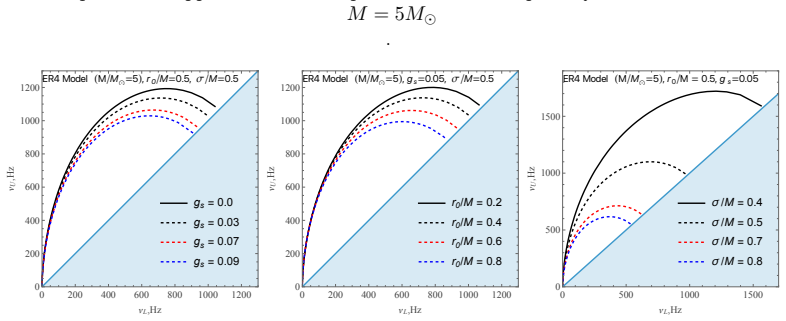
- [Section IV.A and Section VI] The text accompanying Fig. 2 states that increasing g_s, from the solid to the dashed and dotted curves, enhances both the azimuthal and radial epicyclic frequencies, while the Conclusion states that the scalar coupling generally suppresses both characteristic frequencies. These statements are mutually contradictory; since the qualitative direction of the g_s effect is one of the paper's main observable predictions, this contradiction must be resolved before the QPO claims can be accepted.
- [Section III, Eq. (22)] The effective potential displayed in Eq. (22) does not follow from the conserved energy and angular momentum definitions in Eqs. (18)-(19) and the four-velocity normalization. Using u^t = E/[(1+g_s φ) f] and u^φ = L f/[(1+g_s φ) Δ], the normalization gives E^2 = f(1+g_s φ)^2 + (1+g_s φ)^2 \dot{r}^2 + L^2 f^2/Δ, so the angular-momentum term in Eq. (22) is missing one factor of f. This error propagates into the critical energy and angular momentum, the ISCO condition, and the epicyclic frequencies, and therefore into the QPO figures.
- [Section III, Eq. (25)] The zero-coupling ISCO formula (25) is inconsistent with the numerical spinless results reported later in the paper. For the parameter values r_0/M=0.5 and σ/M=0.7 used in Section V.C, Eq. (25) gives r_ISCO ≈ 4.40, whereas Table I with g_s=0 and s=0 gives r_ISCO ≈ 2.40. If the table uses different parameter values, this is not stated; as written, the inconsistency indicates that Eq. (25) is not a reliable specialization of the critical-orbit equations.
minor comments (5)
- [Section III] The text refers to "Fig. 9" when discussing the spinless-particle ISCO plot, but that plot is actually Fig. 1; all figure cross-references should be checked.
- [Throughout] Equation numbering is duplicated: the Einstein and metric equations are both numbered (8), and the scalar-field solution and the particle equation of motion are both numbered (10). The manuscript should be renumbered.
- [Section IV.A] The perturbation expansion refers to "equation (34)", but no such equation exists in the vicinity of Eqs. (29)-(33); the intended reference appears to be Eq. (29) or Eq. (30).
- [Keywords] The keyword "Spining Particles" contains a typo and should read "Spinning Particles".
- [Section IV.A, Eq. (31)] The perturbed radial and vertical oscillations are written as a single equation containing both δr and δθ; if two separate oscillator equations are intended, they should be written as a system so that the claimed harmonic-oscillator reduction is transparent.
Circularity Check
No circular reduction: the ISCO, QPO frequencies, and 3:2 resonance locations are computed from the stated action and spacetime, not fitted; the only notable self-citation is the background wormhole solution, which is reproduced and used externally.
full rationale
The derivation chain is self-contained: starting from the action (4) and the metric (8)-(10), the paper derives the effective potential (21)-(22), orbital and epicyclic frequencies (27)-(28), (32)-(33), and then evaluates twin-peak QPO frequencies using the ER3 and ER4 models, which are external prescriptions rather than fitted relations. The 3:2 resonance radii are obtained by solving the computed frequency ratio, not by matching data. The background wormhole solution is indeed a self-citation (Ref. [23] includes coauthor A. Alimova), but the paper explicitly reproduces the metric and scalar field in Eqs. (8)-(10) and uses them as a starting point; no conclusion in the QPO or ISCO analysis follows from the act of citation itself. In Sec. V, the spin dynamics are computed from the MPD equations with the stated assumption that the scalar-field force 'can be neglected as a higher-order correction' and that the scalar enters through m* = m(1+g_s phi) in the momentum normalization (46). This is a physical approximation whose validity at |g_s| ~ 0.1 is a correctness concern, not a circularity: the g_s-dependent ISCO shifts, superluminal bounds, and collision energies are mathematical consequences of the assumed equations rather than fitted or renamed inputs. No fitted parameter is relabeled as a prediction, no uniqueness theorem is imported from the authors' prior work, and no ansatz is smuggled in solely through self-citation. Thus no significant circularity is identified.
Assumptions & free parameters
free parameters (4)
- gs =
scanned over [-0.10, 0.10] in figures
- r0/M =
scanned over [0.1, 0.8] in figures
- sigma/M =
scanned over [0.2, 0.8] in figures
- s =
scanned over [-1, 2] in spin dynamics figures
assumptions (5)
- domain assumption The background metric and scalar field (eqs. 9, 10) solve the Einstein-scalar field equations.
- domain assumption The massive particle couples to the scalar field through m* = m(1 + gs phi).
- ad hoc to paper For spinning particles, the scalar field force can be neglected as a higher-order correction in the weak-coupling limit (|gs| << 1) and standard MPD equations apply.
- domain assumption The ER3 and ER4 epicyclic resonance models correctly describe observed twin-peak QPOs.
- domain assumption The spacetime is static and spherically symmetric, so motion is confined to the equatorial plane.
Cite this review
Pith. "Pith review of Probing scalarized wormholes through quasi-periodic oscillations and spinning particle dynamics." pith.science (2026). https://pith.science/paper/WNF32XYE
@misc{pith2026260810469,
  author       = {Pith},
  title        = {Pith review of: Probing scalarized wormholes through quasi-periodic oscillations and spinning particle dynamics},
  year         = {2026},
  howpublished = {\url{https://pith.science/paper/WNF32XYE}},
  note         = {Machine review of arXiv:2608.10469}
}
abstract
We investigate the dynamics of test particles in a three-parameter scalarized wormhole spacetime within Einstein-scalar field theory. For spinless particles, we derive the orbital and epicyclic frequencies and compute twin-peak QPO spectra using the ER3 and ER4 resonance models. The scalar coupling parameter $g_s$ shifts the innermost stable circular orbit to larger radii and systematically modifies the characteristic 3:2 resonance condition. Extending to spinning particles via the Mathisson-Papapetrou-Dixon formalism, we find that spin-curvature coupling significantly alters the effective potential and innermost stable circular orbit parameters. The maximum physically admissible spin increases monotonically with the scalar coupling. Analysis of particle collisions near the wormhole throat reveals that both scalar coupling and relative spin orientation determine collision energetics, with anti-aligned spin configurations producing substantially higher energies. Our results suggest that the combined effects of scalar coupling and spin-curvature interaction leave distinct imprints on QPO frequencies and collision processes, potentially providing observable signatures for distinguishing scalarized wormholes from standard black holes.
Figures


Figures from the paper (8 more)





Reference graph
Works this paper leans on
- [23]
-
[1]
C. M. Will,Theory and Experiment in Gravitational Physics, 2nd ed. (Cambridge University Press, 2014)
work page 2014
-
[2]
Penrose, Physical Review Letters14, 57 (1965)
R. Penrose, Physical Review Letters14, 57 (1965)
1965
-
[3]
S. W. Hawking and R. Penrose, Proceedings of the Royal Society of London A314, 529 (1970)
work page 1970
-
[4]
J. M. Bardeen, Proceedings of the International Confer- ence GR5 , 174 (1968)
work page 1968
-
[5]
E. Ay´ on-Beato and A. Garc´ ıa, Physical Review Letters 80, 5056 (1998)
work page 1998
-
[6]
S. A. Hayward, Physical Review Letters96, 031103 (2006)
2006
-
[7]
M. S. Morris and K. S. Thorne, American Journal of Physics56, 395 (1988)
1988
Show all 76 references
-
[8]
M. S. Morris, K. S. Thorne, and U. Yurtsever, Physical Review Letters61, 1446 (1988)
1988
-
[9]
Visser,Lorentzian Wormholes: From Einstein to Hawking(AIP Press, New York, 1995)
M. Visser,Lorentzian Wormholes: From Einstein to Hawking(AIP Press, New York, 1995)
1995
-
[10]
F. S. N. Lobo, Classical and Quantum Gravity25, 225006 (2008)
2008
-
[11]
Cataldo, P
M. Cataldo, P. Meza, and P. Minning, Physical Review D83, 044050 (2011)
2011
-
[12]
Brans and R
C. Brans and R. H. Dicke, Physical Review124, 925 (1961)
1961
-
[13]
Faraoni,Cosmology in Scalar-Tensor Gravity (Springer, Dordrecht, 2004)
V. Faraoni,Cosmology in Scalar-Tensor Gravity (Springer, Dordrecht, 2004)
2004
-
[14]
Clifton, P
T. Clifton, P. G. Ferreira, A. Padilla, and C. Skordis, Physics Reports513, 1 (2012)
2012
-
[15]
G. W. Horndeski, International Journal of Theoretical Physics10, 363 (1974)
1974
-
[16]
Deffayet, X
C. Deffayet, X. Gao, D. A. Steer, and G. Zahariade, Physical Review D84, 064039 (2011)
2011
-
[17]
Kobayashi, Reports on Progress in Physics82, 086901 16 (2019)
T. Kobayashi, Reports on Progress in Physics82, 086901 16 (2019)
2019
-
[18]
Damour and G
T. Damour and G. Esposito-Far` ese, Classical and Quan- tum Gravity9, 2093 (1992)
1992
-
[19]
Perivolaropoulos, Physical Review D81, 047501 (2010)
L. Perivolaropoulos, Physical Review D81, 047501 (2010)
2010
-
[20]
K. A. Bronnikov, Acta Physica Polonica B4, 251 (1973)
1973
-
[21]
H. G. Ellis, Journal of Mathematical Physics14, 104 (1973)
1973
-
[22]
M. S. Volkov, Physical Review D103, 104035 (2021)
2021
-
[24]
Psaltis, Living Reviews in Relativity11, 9 (2008)
D. Psaltis, Living Reviews in Relativity11, 9 (2008)
2008
-
[25]
Johannsen, D
T. Johannsen, D. Psaltis, S. S. Ozel, and R. F. L. Holley- Bockelmann, Physical Review D87, 124017 (2013)
2013
-
[26]
Berti, E
E. Berti, E. Barausse, V. Cardoso, L. Gualtieri, P. Pani, U. Sperhake, L. C. Stein, N. Wex, K. Yagi, T. Baker, et al., Classical and Quantum Gravity32, 243001 (2015)
2015
-
[27]
R. A. Remillard and J. E. McClintock, Annual Review of Astronomy and Astrophysics44, 49 (2006)
2006
-
[28]
Ingram and S
A. Ingram and S. E. Motta, New Astronomy Reviews85, 101524 (2019)
2019
-
[29]
Stella and M
L. Stella and M. Vietri, The Astrophysical Journal Let- ters492, L59 (1998)
1998
-
[30]
M. A. Abramowicz and W. Klu´ zniak, Astrophysics and Space Science300, 127 (2005)
2005
-
[31]
Kato, Publications of the Astronomical Society of Japan42, 99 (1990)
S. Kato, Publications of the Astronomical Society of Japan42, 99 (1990)
1990
-
[32]
A. N. Aliev and D. V. Galtsov, General Relativity and Gravitation13, 883 (1981)
1981
-
[33]
A. S. Silbergleit and R. V. Wagoner, The Astrophysical Journal524, 489 (1999)
1999
-
[34]
S. L. Shapiro and S. A. Teukolsky, American Journal of Physics52, 770 (1984)
1984
-
[35]
T¨ or¨ ok, M
G. T¨ or¨ ok, M. A. Abramowicz, W. Klu´ zniak, and Z. Stuchl´ ık, Astronomy and Astrophysics436, 1 (2005)
2005
-
[36]
Stella, M
L. Stella, M. Vietri, and S. M. Morsink, The Astrophys- ical Journal Letters524, L63 (1999)
1999
-
[37]
Klu´ zniak and M
W. Klu´ zniak and M. A. Abramowicz, Astrophysics and Space Science300, 143 (2005)
2005
-
[38]
M. A. Abramowicz and W. Klu´ zniak, Astronomy and Astrophysics Letters374, L19 (2001)
2001
-
[39]
Klu´ zniak and M
W. Klu´ zniak and M. A. Abramowicz, Acta Physica Polonica B32, 3605 (2001)
2001
-
[40]
M. A. Abramowicz, V. Karas, W. Klu´ zniak, and S. Rez- zolla, Physical Review Letters90, 171101 (2003)
2003
-
[41]
Rezzolla, M
S. Rezzolla, M. A. Abramowicz, W. Klu´ zniak, and V. Karas, Classical and Quantum Gravity20, L191 (2003)
2003
-
[42]
J. E. McClintock and R. A. Remillard, Compact Stellar X-ray Sources , 157 (2006)
2006
-
[43]
Belloni, J
T. Belloni, J. Homan, S. Motta, E. Ratti, and M. M´ endez, Monthly Notices of the Royal Astronomical Society366, 1039 (2006)
2006
-
[44]
Stiele, S
H. Stiele, S. Motta, T. Belloni, and M. M´ endez, Monthly Notices of the Royal Astronomical Society418, 1459 (2011)
2011
-
[45]
R. A. Remillard, J. E. McClintock, G. J. Sobczak, C. Bai- lyn, J. A. Orosz, and E. H. Morgan, The Astrophysical Journal564, 962 (2002)
2002
-
[46]
J. E. McClintock, R. Narayan, and A. J. Steiner, The Astrophysical Journal801, 92 (2015)
2015
-
[47]
S. E. Motta, T. M. Belloni, L. Stella, T. Mu˜ noz-Darias, and R. Fender, Monthly Notices of the Royal Astronom- ical Society437, 2554 (2014)
2014
-
[48]
Bambi, Modern Physics Letters A28, 1330014 (2013)
C. Bambi, Modern Physics Letters A28, 1330014 (2013)
2013
-
[49]
Barausse, V
E. Barausse, V. Cardoso, and P. Pani, Physical Review D89, 104059 (2014)
2014
-
[50]
Krawczynski, General Relativity and Gravitation50, 100 (2018)
H. Krawczynski, General Relativity and Gravitation50, 100 (2018)
2018
-
[51]
Davlataliev, F
A. Davlataliev, F. Atamurotov, A. Abdujabbarov, N. Ju- raeva, and V. Khamidov, Phys. Dark Univ.46, 101603 (2024)
2024
-
[52]
Mustafa, E
G. Mustafa, E. Demir, A. Davlataliev, H. Chaudhary, F. Atamurotov, and E. G¨ udekli, Phys. Dark Univ.46, 101644 (2024)
2024
-
[53]
Ghorani, S
E. Ghorani, S. Mitra, J. Rayimbaev, B. Puli¸ ce, F. Ata- murotov, A. Abdujabbarov, and D. Demir, Eur. Phys. J. C84, 1022 (2024), arXiv:2410.04993 [gr-qc]
2024 arXiv
-
[54]
Naseer, A
T. Naseer, A. Ditta, A. Ashraf, K. A. Yasir, S. K. Mau- rya, G. Rakhimova, and F. Atamurotov, Nucl. Phys. B 1021, 117186 (2025)
2025
-
[55]
Mustafa, A
G. Mustafa, A. Alimova, F. Atamurotov, A. A. Ibraheem, P. Channuie, and G. Bahaddinova, Eur. Phys. J. C85, 741 (2025)
2025
-
[56]
Ashraf, A
A. Ashraf, A. Bouzenada, S. K. Maurya, A. A. Ibraheem, B. C ¸˙IL, E. G¨ udekli, and F. Atamurotov, Phys. Dark Univ.48, 101874 (2025)
2025
-
[57]
D. Bini, F. de Felice, and A. Geralico, Classical and Quantum Gravity26, 225010 (2009)
2009
-
[58]
Semer´ ak, Physical Review D59, 104014 (1999)
O. Semer´ ak, Physical Review D59, 104014 (1999)
1999
-
[59]
A. A. Deriglazov and W. G. Ram´ ırez, Advances in High Energy Physics2017, 7397159 (2017)
2017
-
[60]
Rakhimova, F
G. Rakhimova, F. Atamurotov, N. Juraeva, A. Abdujab- barov, and G. Mustafa, Phys. Dark Univ.47, 101721 (2025)
2025
-
[61]
Umarov, F
D. Umarov, F. Atamurotov, S. G. Ghosh, A. Abdujab- barov, and G. Mustafa, Eur. Phys. J. C85, 800 (2025)
2025
-
[62]
Mannobova, F
S. Mannobova, F. Atamurotov, A. Abdujabbarov, B. S. Alkahtani, and G. Mustafa, Eur. Phys. J. C85, 586 (2025)
2025
-
[63]
Abdukayumova, F
G. Abdukayumova, F. Atamurotov, A. Abdujabbarov, P. Channuie, and G. Mustafa, Nucl. Phys. B1019, 117121 (2025)
2025
-
[64]
Abdukayumova, F
G. Abdukayumova, F. Atamurotov, A. Abdujabbarov, P. Channuie, and G. Mustafa, Nucl. Phys. B1024, 117353 (2026)
2026
-
[65]
J. Kunz, P. Kanti, S. T. McWilliams, and H. P. Nollert, Physical Review D92, 104003 (2015)
2015
-
[66]
T. P. Sotiriou, Classical and Quantum Gravity32, 214002 (2015)
2015
-
[67]
Minamitsuji and K
M. Minamitsuji and K. I. Nakao, Physical Review D93, 104040 (2016)
2016
-
[68]
L. D. Landau and E. M. Lifshitz,The Classical Theory of Fields, 4th ed., Course of Theoretical Physics, Vol. 2 (Butterworth-Heinemann, 1980)
1980
-
[69]
R. A. Breuer,Gravitational Perturbation Theory and Synchrotron Radiation(Springer, Berlin, 1973)
1973
-
[70]
C. W. Misner, K. S. Thorne, and J. A. Wheeler,Gravi- tation(1973)
1973
-
[71]
Turimov, A
B. Turimov, A. Davlataliev, A. Abdujabbarov, and B. Ahmedov, Physical Review D110, 084053 (2024)
2024
-
[72]
Mathisson, Acta Physica Polonica6, 163 (1937)
M. Mathisson, Acta Physica Polonica6, 163 (1937)
1937
-
[73]
Papapetrou, Proceedings of the Royal Society of Lon- don A209, 248 (1951)
A. Papapetrou, Proceedings of the Royal Society of Lon- don A209, 248 (1951)
1951
-
[74]
Tulczyjew, Bulletin de l’Acad´ emie Polonaise des Sci- ences7, 11 (1959)
W. Tulczyjew, Bulletin de l’Acad´ emie Polonaise des Sci- ences7, 11 (1959)
1959
-
[75]
Abdulxamidov, C
F. Abdulxamidov, C. A. Benavides-Gallego, B. Narzil- 17 loev, I. Hussain, A. Abdujabbarov, B. Ahmedov, and H. Xu, The European Physical Journal Plus138, 635 (2023)
2023
-
[76]
Mo- tion of spinning particles around black holes,
J. M. Ladino, C. A. del Valle, and E. Larra˜ naga, “Mo- tion of spinning particles around black holes,” (2023), arXiv:2302.12352 [gr-qc]
2023 arXiv
Reviewed August 15, 2026 · model on record in the stance chip above.
Discussion (0). Continue with ORCID to comment.