REVIEW 2 major objections 3 minor 33 references
State-Dependent Visibility of Non-Commutative Ordering in Quantum Dynamics
T0 review · 2 major / 3 minor · reviewed 2026-08-15 · deepseek-v4-flash
Pith's one-line read A nonzero commutator does not guarantee that two orderings can be distinguished: the same fixed non-commuting pair can be invisible on one quantum state and visible on another.
desk verdict Exact state-dependence proof is sound; the many-body persistence claim is overreaching without an out-of-sample operator test. read the letter →
The pith
A machine-rendered reading of the paper's core claim, the machinery that carries it, and where it could break.
The reading
What carries the argument
The central object is the overlap $A_\psi(\tau)=\langle\psi|e^{+i\widetilde M\tau}e^{-iM\tau}|\psi\rangle$ and its magnitude $F_\psi$, together with the window visibility $V_\psi(U)=1-\min_{0\le u\le U}\tilde F_\psi(u)$, where $u=\Omega\tau$ and $\Omega=\|M\|_{\mathrm{op}}$. This object carries the argument because the trace distance between the two evolved states equals $\sqrt{1-F_\psi^2}$, so $F_\psi$ close to one forces every observable to nearly agree. The short-time expansion $F_\psi(\tau)=1-\frac{\tau^2}{2}\left(\langle K^2\rangle_\psi-\langle K\rangle_\psi^2\right)+O(\tau^3)$ with $K=2i[B,C]$ identifies $\mathrm{Var}_\psi(K)$ as the leading state-dependent rate, while higher ordered moments produce later separation; the exactly invisible case occurs when the initial state is an eigenstate of $K$ with a fixed eigenvalue, making $K$ act as a constant phase along the trajectory.
What would settle it
Draw new operator pairs at random, without trying to separate the two endpoint states, and check whether most still show a large visibility gap at U=20; if not, the reported pair was overfit to the endpoints.
Extended reading notes
Core claim
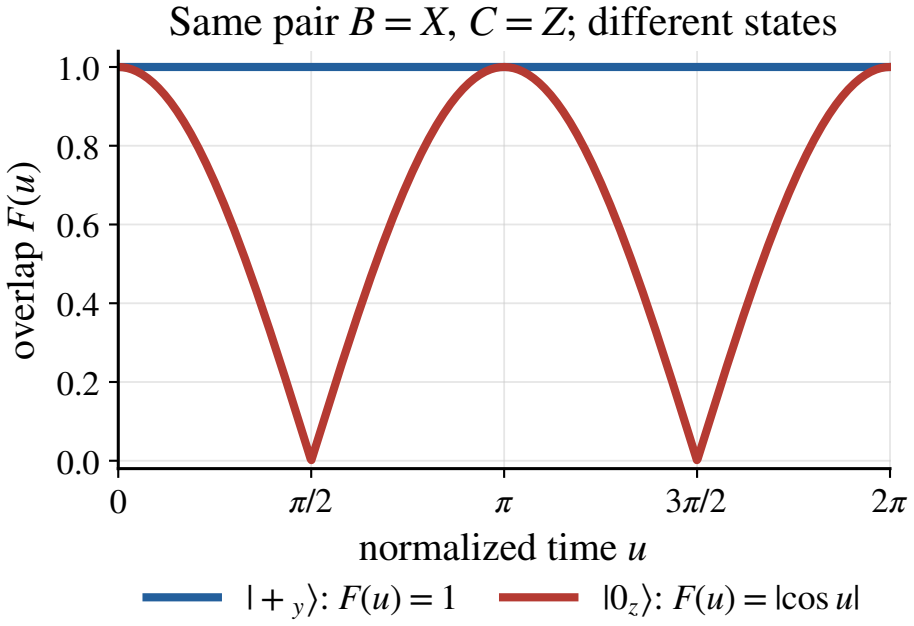
The paper's central claim is that non-Abelian ordering information can be operationally inaccessible even when $[B,C]\neq 0$. For Hermitian $B,C$, compare $M=(B+iC)(B-iC)$ and $\widetilde M=(B-iC)(B+iC)$, and define $F_\psi(\tau)=|\langle\psi|e^{+i\widetilde M\tau}e^{-iM\tau}|\psi\rangle|$; the visibility $V_\psi(U)=1-\min_{0\le u\le U}\tilde F_\psi(u)$ measures the largest loss of overlap in a normalized window and bounds all observable differences via trace distance. The one-qubit pair $B=X$, $C=Z$ gives $F=1$ for a $Y$ eigenstate and $F=|\cos u|$ for a $Z$ eigenstate, so the same pair is perfectly invisible in one state and visible in another. On an 18-qubit $\mathbb{Z}_2$ lattice with a fixed operator pair, $V_{0.05}(20)=0.032098$ and $V_{3.20}(20)=0.792679$, while both states have the same commutator variance $\mathrm{Var}_\psi(K)=16$; their first resolved difference is fourth order. The conclusion is that dynamical Abelianization is a property of the state-dependent process, not of the operator algebra alone.
Load-bearing premise
The many-body result depends on the operator pair being a fair sample rather than one carefully picked to make the two chosen states look different.
Editorial extensions
If this is right
- A nonzero commutator alone is never enough to declare that two orderings are dynamically distinguishable; any such claim must specify the input state and the time window.
- If $F_\psi$ is near one on the chosen window, no observable can tell the two orderings apart: the bound $|\mathrm{Tr}[O(\rho_M-\rho_{\widetilde M})]|\le 2\|O\|_{\mathrm{op}}\sqrt{1-F_\psi^2}$ makes that rigorous.
- States with identical leading quadratic decay, meaning the same $\mathrm{Var}_\psi(K)$, can separate sharply later, so short-time commutator-variance diagnostics can miss the real visibility.
- In product-formula simulation and coherent control, reordering non-commuting factors may produce no detectable error on some target states, so error bounds should be state-dependent.
- Across a quantum phase transition the same ordering test can go from nearly invisible to clearly visible, so visibility can act as a state-family diagnostic.
Reading between the lines
- The exact invisible-state condition, that the initial state be an eigenstate of $K=2i[B,C]$ with the whole trajectory in that eigenspace, suggests a practical way to suppress ordering errors in simulation: prepare states in $K$-eigenspaces rather than trying to make commutators small.
- The numerical contrast was found by a language-model-guided search that rewarded exactly that contrast; whether random or physically motivated operator pairs show the same state-dependence is not established by the paper and is a direct test of genericity.
- If the mechanism carries over to plaquette operators in a non-Abelian lattice gauge theory, Abelian dominance could partly be a dynamical or state-selection effect rather than an operator-algebra fact; the paper leaves this connection open.
- The visibility could serve as an order parameter for dynamical phases or as a probe of phase transitions, since it jumps sharply across the transition region near $\lambda=0.4$.
Signed reviews
Editorial analysis
A structured set of objections, weighed in public.
Referee Report
Summary. The paper introduces an operational test of whether non-commuting orderings of the same Hermitian factors can be dynamically distinguished. For Hermitian B and C, the authors compare evolutions generated by M=(B+iC)(B−iC) and M̃=(B−iC)(B+iC), defining a state- and time-dependent overlap whose minimum over a normalized time window gives an operational visibility. They prove an exact one-qubit example (F=1 for a Y eigenstate and F=|cos u| for a Z eigenstate), give a short-time expansion in powers of the commutator variance, and then study an 18-qubit Z2 lattice Hamiltonian over seven ground states with a fixed operator pair. They report a large visibility contrast between the λ=0.05 and λ=3.20 states (0.032 vs 0.793 at U=20), similar behavior for nine search-selected operator pairs, and local stability under coefficient perturbations.
Significance. The central existence claim—that state-dependent operational invisibility of non-commuting orderings occurs—is established by the exact one-qubit solution and the analytic short-time expansion, which are internally consistent and independent of the numerical search. The visibility definition with its measurement bound is clean and useful, and the paper is transparent about the search procedure and provides data and code. The main weakness is that the many-body persistence claim rests on operator pairs selected by an objective that directly rewards the reported contrast, so the evidence for genericity is weaker than the abstract states.
major comments (2)
- [Section III B, Eq. (27), Fig. 6, Table II] The claim that the effect persists across distinct operator pairs is not supported out-of-sample. The nine pairs A–I in Table II are selected outputs of the search whose score is S=m_{0.05}(m_{0.05}-m_{3.20}), and this score explicitly rewards a high λ=0.05 overlap and a large visibility drop in the λ=3.20 state—exactly the property later reported. The paper's own caption states that these pairs are "selected outputs of the search..., not a random sample," so the near-universal contrast among them only verifies that the optimizer found candidates with the target property. To support the abstract's statement that "the effect persists across distinct operator pairs," an out-of-sample evaluation on pairs not used in the search (e.g., randomly generated or predetermined operator pairs) is needed; alternatively, the claim should be restricted to the selected pairs.
- [Section IV D, Fig. 8] The coefficient-perturbation analysis is local to the main pair of Eq. (24). Varying the four coefficients by at most 10% does not explore the structural choices that the search varied, such as support sets, Pauli alphabet, and plaquette geometry, so it addresses the numerical sensitivity of one selected point rather than the possibility that the contrast is an artifact of selecting that geometry. The conclusion that the result is "not restricted to one finely chosen operator" (Sec. V) therefore overstates the reach of the numerical evidence; the robustness statement should be limited to the tested local neighborhood of the selected pairs.
minor comments (3)
- [Section V] The conclusion says "Other nine inequivalent pairs," but Table II contains nine pairs total, including the main pair A; the phrase should read "eight other pairs" or "nine inequivalent pairs, including the main pair."
- [Table II and Fig. 6] Several pairs (A–D and I) report identical visibilities to six decimal places; the text should state whether this reflects lattice symmetries of the ground states or numerical coincidence, since identical values reduce the effective number of independent demonstrations.
- [Section II D, Eq. (16)] The phrase "first loss of overlap" is slightly misleading because Eq. (16) gives Fψ(τ)=1−(τ^2/2)Varψ(K)+O(τ^3), so the first loss is quadratic; the text should say "leading quadratic loss" consistently throughout.
Circularity Check
One-qubit proof is independent, but the many-body persistence claim is selection-circular: Eq. (27)'s search objective is exactly the contrast later reported.
-
fitted input called prediction
[Sec. III B, Eq. (27); Sec. IV A, Eq. (28)]
"Since 1−m λ is the largest loss of overlap on the sampled grid, the second factor rewards a large visibility contrast. The prefactor rewards m 0.05≃1 and therefore penalizes candidates whose ordering difference is already visible in |ψ(0.05)⟩. A high score thus requires both properties."
The search score is S=m0.05(m0.05−m3.20)=m0.05[(1−m3.20)−(1−m0.05)], which is precisely m0.05 times the sampled-grid visibility contrast V3.20−V0.05. The headline many-body result, Eq. (28) (V0.05=0.032098, V3.20=0.792679), is obtained after re-evaluating this same selected pair with the visibility of Eq. (9). The near-invisibility in |ψ(0.05)⟩ and clear visibility in |ψ(3.20)⟩ are therefore the optimized objective, not an out-of-sample prediction from a fixed pair. The fixed-pair computation is honest, but it cannot independently establish the generic state-dependence claim.
-
fitted input called prediction
[Sec. IV B, Fig. 6 caption; Table II]
"These pairs are selected outputs of the search in Sec. III B, not a random sample."
Table II's nine additional pairs are described as the highest-scoring symmetry-inequivalent candidates under the same score S. Reporting that all of them show larger visibility in |ψ(3.20)⟩ than in |ψ(0.05)⟩ confirms that the optimizer found multiple instances of the property it was asked to maximize. It does not sample rejected or unselected operator geometries, so the abstract's 'The effect persists across distinct operator pairs' is an in-sample statement about search outputs rather than independent persistence evidence.
full rationale
The exact one-qubit solution (Sec. II C) and the operator-level bound and short-time expansion (Secs. II A and II D) are self-contained: F_{|+y⟩}=1 and F_{|0z⟩}=|cos u| follow directly from M and M~ for B=bX, C=cZ, with no fitted input. The short-time expansion Eq. (16) is a Taylor expansion of the overlap, and Eq. (31) is a numerical description, not a predictive fit. The self-citation [26] for the finite-size transition location is not load-bearing: it only motivates including λ=0.40 in the sampled set, and the visibility contrast does not rest on that citation. The selection-circular content is confined to the many-body persistence narrative: the main pair and the nine additional pairs were chosen by Eq. (27) for the exact property then reported (Secs. III B, IV A, IV B). The coefficient-perturbation study (Sec. IV D) is a legitimate local robustness check and retains every case, but because it perturbs coefficients of already-selected operators, it cannot repair the absence of an out-of-sample operator test. Thus the existence claim is sound and independently proven, while the generic-persistence claim is partially circular.
Assumptions & free parameters
free parameters (1)
- Operator pair (B,C) coefficients and supports in Eq. (24) =
B = -2(P^Z_{1,0}+P^Z_{1,1}+P^Z_{1,2}); C = (1/2) product over H8 of Y
assumptions (3)
- standard math M and M~ have identical nonzero spectra, allowing the common normalization Omega = ||M||_op.
- domain assumption Ground states |psi(lambda)> of H(lambda) in Eq. (20) are computed correctly by exact diagonalization and faithfully represent the relevant phases.
- domain assumption The finite-size crossover at lambda approximately 0.40 is the relevant quantum phase transition.
Cite this review
Pith. "Pith review of State-Dependent Visibility of Non-Commutative Ordering in Quantum Dynamics." pith.science (2026). https://pith.science/paper/SKHQ52DE
@misc{pith2026260810540,
  author       = {Pith},
  title        = {Pith review of: State-Dependent Visibility of Non-Commutative Ordering in Quantum Dynamics},
  year         = {2026},
  howpublished = {\url{https://pith.science/paper/SKHQ52DE}},
  note         = {Machine review of arXiv:2608.10540}
}
abstract
A nonzero commutator proves that two orderings differ as operators, but it does not ensure that a physical state can reveal the difference. We ask when non-Abelian ordering information becomes dynamically invisible. For Hermitian operators $B$ and $C$, we compare the evolutions generated by the opposite-order products $M=(B+iC)(B-iC)$ and $\widetilde M=(B-iC)(B+iC)$, and define their operational visibility from the minimum overlap of the output states over a normalized time window. This visibility bounds the difference produced by the two orderings in every observable on the chosen state. An exact one-qubit solution shows that the same fixed pair can be perfectly invisible in one state and visible in another. We then keep the ordered generators fixed and vary only the many-body ground state across a quantum phase transition. The same ordering difference is nearly invisible in one regime and clearly visible in the other. Moreover, states with identical leading quadratic decay can develop sharply different finite-time visibility because their first distinction appears at higher order. The effect persists across distinct operator pairs and coefficient perturbations. Thus dynamical Abelianization is a property of the state-dependent process, i.e., non-Abelian ordering information can become operationally inaccessible even though the underlying operators remain non-commuting.
Figures


Figures from the paper (5 more)


Reference graph
Works this paper leans on
-
[1]
ThenM=A 1A2 and fM=A 2A1 are both Hermitian, whileM̸= fMwhenever [B,C]̸= 0. They generate two unitary operations, U(t) =e −itM and eU(t) =e −it fM. Starting from the same pure state|ψ⟩, we compare the final statesU(t)|ψ⟩and eU(t)|ψ⟩. The loss of their overlap measures the operational visibility introduced above. It vanishes when the two orderings produce ...
-
[2]
T. Suzuki and I. Yotsuyanagi, Possible evidence for Abelian dominance in quark confinement, Phys. Rev. D42, 4257 (1990)
work page 1990
-
[3]
H. Shiba and T. Suzuki, Monopoles and string tension in SU(2) QCD, Phys. Lett. B333, 461 (1994)
work page 1994
-
[4]
J. D. Stack, S. D. Neiman, and R. J. Wensley, String tension from monopoles in SU(2) lattice gauge theory, Phys. Rev. D50, 3399 (1994). 22
work page 1994
-
[5]
G. S. Bali, V. Bornyakov, M. M¨ uller-Preussker, and K. Schilling, Dual superconductor scenario of confinement: A systematic study of Gribov copy effects, Phys. Rev. D54, 2863 (1996)
work page 1996
-
[6]
G. ’t Hooft, Topology of the gauge condition and new confinement phases in non-Abelian gauge theories, Nucl. Phys. B190, 455 (1981)
work page 1981
-
[7]
A. S. Kronfeld, M. L. Laursen, G. Schierholz, and U.-J. Wiese, Monopole condensation and color confinement, Phys. Lett. B198, 516 (1987)
work page 1987
-
[8]
A. Di Giacomo, B. Lucini, L. Montesi, and G. Paffuti, Color confinement and dual supercon- ductivity of the vacuum. I, Phys. Rev. D61, 034503 (2000)
work page 2000
Show all 33 references
-
[9]
D’Alessandro, M
A. D’Alessandro, M. D’Elia, and L. Tagliacozzo, Dual superconductivity and vacuum proper- ties in Yang–Mills theories, Nucl. Phys. B774, 168 (2007)
2007
-
[10]
Kondo, Abelian magnetic monopole dominance in quark confinement, Phys
K.-I. Kondo, Abelian magnetic monopole dominance in quark confinement, Phys. Rev. D58, 105016 (1998)
1998
-
[11]
Amemiya and H
K. Amemiya and H. Suganuma, Off-diagonal gluon mass generation and infrared Abelian dominance in the maximally Abelian gauge in lattice QCD, Phys. Rev. D60, 114509 (1999)
1999
-
[12]
Peres, Stability of quantum motion in chaotic and regular systems, Phys
A. Peres, Stability of quantum motion in chaotic and regular systems, Phys. Rev. A30, 1610 (1984)
1984
-
[13]
R. A. Jalabert and H. M. Pastawski, Environment-independent decoherence rate in classically chaotic systems, Phys. Rev. Lett.86, 2490 (2001)
2001
-
[14]
Gorin, T
T. Gorin, T. Prosen, T. H. Seligman, and M. ˇZnidariˇ c, Dynamics of Loschmidt echoes and fidelity decay, Phys. Rep.435, 33 (2006)
2006
-
[15]
H. T. Quan, Z. Song, X. F. Liu, P. Zanardi, and C. P. Sun, Decay of Loschmidt echo enhanced by quantum criticality, Phys. Rev. Lett.96, 140604 (2006)
2006
-
[16]
X. Wang, Z. Sun, and Z. D. Wang, Operator fidelity susceptibility: An indicator of quantum criticality, Phys. Rev. A79, 012105 (2009)
2009
-
[17]
Jozsa, Fidelity for mixed quantum states, J
R. Jozsa, Fidelity for mixed quantum states, J. Mod. Opt.41, 2315 (1994)
1994
-
[18]
Zanardi and N
P. Zanardi and N. Paunkoviˇ c, Ground state overlap and quantum phase transitions, Phys. Rev. E74, 031123 (2006)
2006
-
[19]
Maldacena, S
J. Maldacena, S. H. Shenker, and D. Stanford, A bound on chaos, JHEP2016(08), 106
-
[20]
Swingle, Unscrambling the physics of out-of-time-order correlators, Nat
B. Swingle, Unscrambling the physics of out-of-time-order correlators, Nat. Phys.14, 988 (2018). 23
2018
-
[21]
Hashimoto, K
K. Hashimoto, K. Murata, and R. Yoshii, Out-of-time-order correlators in quantum mechanics, JHEP2017(10), 138
-
[22]
F. J. Wegner, Duality in generalized Ising models and phase transitions without local order parameters, J. Math. Phys.12, 2259 (1971)
1971
-
[23]
J. B. Kogut, An introduction to lattice gauge theory and spin systems, Rev. Mod. Phys.51, 659 (1979)
1979
-
[24]
Fradkin and L
E. Fradkin and L. Susskind, Order and disorder in gauge systems and magnets, Phys. Rev. D 17, 2637 (1978)
1978
-
[25]
K. G. Wilson, Confinement of quarks, Phys. Rev. D10, 2445 (1974)
1974
-
[26]
Kogut and L
J. Kogut and L. Susskind, Hamiltonian formulation of Wilson’s lattice gauge theories, Phys. Rev. D11, 395 (1975)
1975
-
[27]
X. Cui, Y. Shi, and J.-C. Yang, Circuit-based digital adiabatic quantum simulation and pseudoquantum simulation as new approaches to lattice gauge theory, JHEP08, 160, arXiv:1910.08020 [quant-ph]
1910 arXiv
-
[28]
Romera-Paredes, M
B. Romera-Paredes, M. Barekatain, A. Novikov, M. Balog, M. P. Kumar, E. Dupont, F. J. R. Ruiz, J. S. Ellenberg, P. Wang, O. Fawzi, P. Kohli, and A. Fawzi, Mathematical discoveries from program search with large language models, Nature625, 468 (2024)
2024
-
[29]
Song, T.-Z
Z.-Y. Song, T.-Z. Yang, Q.-H. Cao, M.-x. Luo, and H. X. Zhu, Explainable AI-assisted opti- mization for Feynman integral reduction, JHEP06, 225, arXiv:2502.09544 [hep-ph]
-
[30]
Cao, Z.-Y
Q.-H. Cao, Z.-Y. Hou, Y.-Y. Li, X. Liu, Z.-Y. Song, L.-Q. Zhang, S. Zhang, and K. Zhao, Scalable Quantum State Preparation via Large-Language-Model-Driven Discovery (2025) arXiv:2505.06347 [quant-ph]
2025
-
[31]
Cao, J.-N
Q.-H. Cao, J.-N. Ding, Y. Liu, and J.-L. Yuan, Probing CP violation through vector boson fusion at high-energy muon colliders, Phys. Rev. D113, 035029 (2026), arXiv:2510.23257 [hep-ph]
2026
-
[32]
A. M. Childs, Y. Su, M. C. Tran, N. Wiebe, and S. Zhu, Theory of Trotter error with com- mutator scaling, Phys. Rev. X11, 011020 (2021)
2021
-
[33]
Blanes, F
S. Blanes, F. Casas, J. A. Oteo, and J. Ros, The Magnus expansion and some of its applications, Phys. Rep.470, 151 (2009). 24
2009
Reviewed August 15, 2026 · model on record in the stance chip above.
Discussion (0). Continue with ORCID to comment.