REVIEW 1 major objections 1 minor 109 references
Mitigating Context Interference for Reliable and Efficient Search Agents
T0 review · 1 major / 1 minor · reviewed 2026-08-12 · deepseek-v4-flash
Pith's one-line read A multi-turn search agent's accuracy and speed are improved by refining the newest retrieved documents, not the accumulated history, and the paper shows how to train a small refiner and fold it into reinforcement learning.
desk verdict Solid empirical study of context interference in multi-turn search agents; the distilled refiner works, but the RL-training benefit is confounded with inference-time refinement. read the letter →
The pith
A machine-rendered reading of the paper's core claim, the machinery that carries it, and where it could break.
The reading
What carries the argument
Two components carry the argument. The first is the context refiner $F$: a small instruction-tuned language model fine-tuned to map a search query $q_{i-1}$ and a retrieved document set $\mathbf{d}_i$ to a short refined text $\tilde{\mathbf{d}}_i$ containing only the information relevant to answering $q_{i-1}$, trained on distilled teacher extractions that an entailment check keeps faithful to the source. The second is CRRL, a GRPO-based RL procedure whose rollouts use refined observations $\tilde{\mathbf{d}}_i$ instead of raw documents, so the policy learns search and reasoning behaviour on interference-free contexts while token-level loss masking keeps retrieved tokens out of the policy gradient. The refiner is what removes the noise identified in the causal analysis; CRRL is what makes refinement part of learning rather than a separate preprocessing step.
What would settle it
Train Search-GRPO exactly as in the paper and then run it at inference with the context refiner switched on, without any refinement-aware training. If that control matches CRRL's exact-match scores, the paper's claim that refinement must enter RL training is not supported; if CRRL still wins, the training-time contribution is real.
Extended reading notes
Core claim
Context interference in a multi-turn search agent is caused mainly by the latest observation—the top-$K$ documents returned by the most recent retrieval—rather than by older retrieved documents, past search queries, or old reasoning steps, which the paper shows by masking segments of the history one at a time. On that basis the authors introduce a context refiner $F$ trained by supervised fine-tuning on a distilled dataset of query-relevant extractions produced by a stronger teacher and verified by an entailment model to stay strictly inside the source documents. The refiner replaces each observation $\mathbf{d}_i$ with $\tilde{\mathbf{d}}_i=F(q_{i-1},\mathbf{d}_i)$, and the resulting cleaned contexts are used both at inference and inside GRPO rollouts in the proposed CRRL; the claim is that refinement during RL training further improves reliability (exact match) and efficiency (average retrieval times, context length, and inference time) over retrieval-based and RL baselines on all seven datasets.
Load-bearing premise
The central comparison assumes that CRRL's gains come from refinement during RL training, since the refiner is switched on at CRRL inference but not at the baseline's inference, and no baseline-plus-refiner control is reported.
Editorial extensions
If this is right
- Search-agent accuracy can be improved by fixing the input context, not only by scaling the policy model.
- Average retrieval calls drop, so per-question latency and cost fall even after accounting for the refiner's extra inference.
- A weak model can approximate a strong teacher's context refinement via distillation, reducing dependence on expensive teacher calls at inference time.
- Rollout quality in RL training matters enough that context hygiene during training yields better final policies than applying refinement only at inference.
Reading between the lines
- The localization of interference to the latest retrieved documents suggests a cheap diagnostic for deployed agents: if accuracy collapses just after a retrieval turn, the problem is likely the newest documents, not the accumulated history.
- The same distillation-plus-entailment recipe could transfer to other observation-heavy agent settings, such as tool outputs or code execution logs, but the interference source would have to be re-localized for each setting rather than assumed to be the latest observation.
- A direct control that applies the refiner at inference time to the RL-trained baseline without refinement-aware training would separate the value of training on clean contexts from the value of reading clean contexts; this is the comparison the current table does not report.
- If the refiner is also used at inference for CRRL, its efficiency gains may partly reflect a shorter effective context length rather than a better policy, which matters for how the method would port to agents with longer action budgets.
Editorial analysis
A structured set of objections, weighed in public.
Referee Report
Summary. This paper studies context interference in multi-turn LLM search agents, addressing three questions: which parts of the context cause interference, how to refine contexts to mitigate it, and whether incorporating context refinement into RL training improves search agents. The authors report that masking previous retrieved documents, queries, and thinking steps yields only small gains, from which they conclude that the latest retrieved documents are the primary source of interference. They then distill a context refinement dataset from GPT-4 and train a small context refiner that extracts query-relevant information from retrieved documents. Finally, they integrate this refiner into a GRPO-based RL training pipeline (CRRL), where rollouts refine retrieved documents before the policy generates actions. Experiments on seven QA benchmarks with two Qwen models compare inference-time refinement methods and training-based methods, reporting improvements in Exact Match and reductions in average retrieval times, context length, and inference time. The paper also includes an analysis of recall rate versus recall accuracy and a discussion of data contamination.
Significance. If the conclusions hold, the paper provides a clear and actionable finding: in multi-turn search agents, the latest retrieved documents are the dominant source of context interference, and a distilled, relatively small context refiner can mitigate it at inference time and during RL training. The strengths are the breadth of evaluation (seven QA datasets, two model sizes, multiple efficiency metrics), the consistency of improvements in the inference-time refinement results (Table 2), the release of code, and the careful separation of training and test data. The paper also draws attention to an important problem—context interference in agentic search—that is less studied than in single-turn RAG. However, the central claim about the benefit of incorporating refinement into RL training is not cleanly isolated: the CRRL comparison in Table 3 varies both the training contexts and the inference-time context processing, and no control separates these factors. The causal attribution to 'latest documents' in Section 3.2 is also indirect.
major comments (1)
- [Sec. 4.3, Tables 3] The main training results are reported without variance or multiple seeds. The differences between CRRL and Search-o1 in Table 3 are small (36.6 vs 36.2 EM for Qwen2.5-7b; 31.5 vs 30.3 for Qwen2.5-3b), and the 2.0-point improvement over Search-GRPO on the 7b model could be within run-to-run noise, especially given that the Appendix D training details mention instability ('In cases where training diverges, we evaluate at the most recent stable checkpoint'). Reporting the mean and standard deviation over at least three seeds for the headline comparisons, or at least for CRRL and the strongest baselines, is necessary to support the 'significantly improve' language used in the abstract and Section 4.3.
minor comments (1)
- [Sec. 3.3] Minor typo: 'close performance to GPT-Refine' should be 'close performance to GPT-Refine' or 'performance close to GPT-Refine's'; also 'a distill dataset' is more naturally 'a distilled dataset'.
Circularity Check
No circular derivation: the refiner is trained by distillation and compared with its teacher, and CRRL is a standard GRPO extension; the missing inference-refinement control is an experimental confound, not circularity.
full rationale
Walking the paper's derivation chain, no claim reduces by construction to its own inputs. The RQ i conclusion that interference primarily arises from the latest retrieved documents is supported by masking ablations (IRCoT-o, IRCoT-oq, IRCoT-oqp in Sec. 3.2), not by defining the latest document as the cause. The context refiner is trained via SFT on a distilled dataset produced by GPT-4 with entailment verification, and is then evaluated against GPT-Refine, GPT-Compress, and Self-Refine (Table 2); this is a standard distillation comparison, and the close match to the teacher is an empirical result rather than a circular equivalence. CRRL (Sec. 4.1) applies a fixed auxiliary refiner during GRPO rollouts and at inference; its loss is a standard group-relative policy objective over refined contexts, and no equation reintroduces the target metric as a fitted parameter. The paper's own limitation section notes that the refiner is an auxiliary module rather than being integrated into the agent's training pipeline, which accurately characterizes the method and does not create a circular step. The only substantive experimental weakness is that CRRL is evaluated with the refiner active at inference whereas Search-GRPO is not, and Table 2 shows inference-only refinement already provides most of the observed gain, so the marginal benefit of training on refined contexts is not cleanly isolated. That is a confound in attribution, not circular reasoning, and the paper's self-citations are background references rather than load-bearing justifications of the empirical claims. Therefore the circularity score is 0.
Assumptions & free parameters
free parameters (4)
- Number of retrieved documents K =
3
- Ranking filter thresholds =
0.2, 0.5
- Training corpus size for CRRL vs baselines =
40k for CRRL; 60k for training baselines
- GRPO hyperparameters =
beta=0.001, clip=0.2, temperature=0.7, top_p=1.0, max action budget=8
assumptions (5)
- domain assumption Generated search queries and retrieved documents in a history are mutually independent with rarely sequential dependencies, so masking older components is a valid way to isolate interference sources.
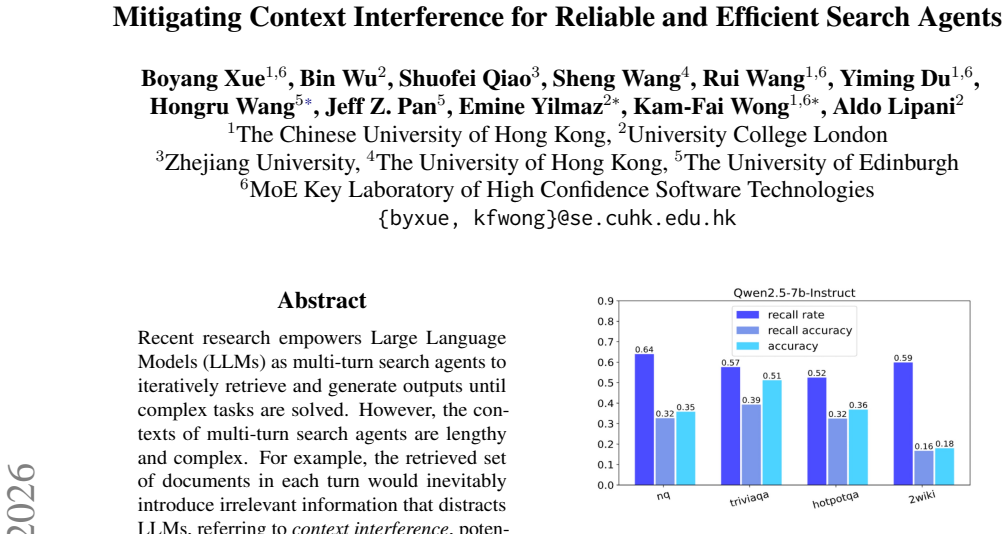
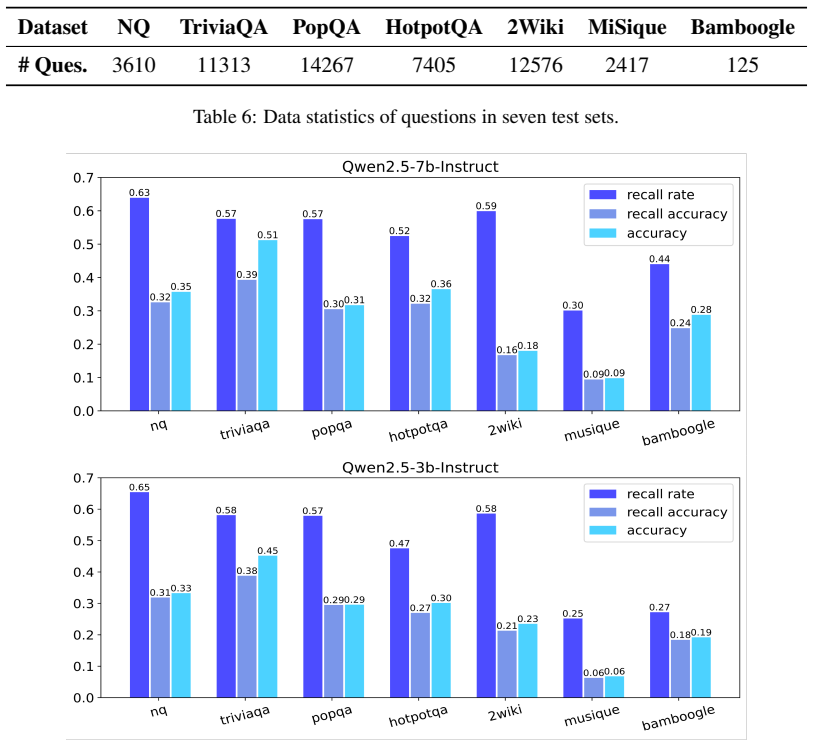
- domain assumption The persistence of the recall-rate versus recall-accuracy gap after removing older documents and queries is attributable to context interference in the latest observation, rather than to the LLM's inability to extract an embedded answer from relevant documents.
- domain assumption The 2018 Wikipedia dump is timeline-synchronized with the test sets, so the retrieved knowledge base serves as ground truth and does not contaminate parametric knowledge.
- domain assumption Exact Match and Average Retrieval Times are sufficient proxies for reliability and efficiency.
- domain assumption The entailment model correctly verifies that refined texts are fully entailed by the original documents and add no extra knowledge.
Cite this review
Pith. "Pith review of Mitigating Context Interference for Reliable and Efficient Search Agents." pith.science (2026). https://pith.science/paper/VUAZDUBM
@misc{pith2026260810743,
  author       = {Pith},
  title        = {Pith review of: Mitigating Context Interference for Reliable and Efficient Search Agents},
  year         = {2026},
  howpublished = {\url{https://pith.science/paper/VUAZDUBM}},
  note         = {Machine review of arXiv:2608.10743}
}
read the original abstract
Recent research empowers Large Language Models (LLMs) as multi-turn search agents to iteratively retrieve and generate outputs until complex tasks are solved. However, the contexts of multi-turn search agents are lengthy and complex. For example, the retrieved set of documents in each turn would inevitably introduce irrelevant information that distracts LLMs, referring to \textit{context interference}, potentially hindering the reliability and efficiency of search agents. Therefore, we conduct a systematic study on context interference in multi-turn search agents, focusing on investigating i) which parts of the context of search agents will contribute to the context interference, ii) how to refine the contexts of search agents to mitigate the interference, and iii) can incorporating context refinement into search agent training yield further improvements. We reveal that interference primarily arises from the latest retrieved documents. Based on the explored findings, we then introduce a distill-based context refiner to dynamically mitigate context interference for multi-turn search agents. Finally, we validate that incorporating context refinement into RL training pipelines of search agents can significantly enhance both reliability and efficiency. This study highlights the importance of mitigating context interference of search agents, inspiring a novel paradigm of ``refine context and then generate'' for AI agents.
Figures


Figures from the paper (4 more)


Reference graph
Works this paper leans on
-
[1]
Yin, Xunjian and Zhang, Xu and Ruan, Jie and Wan, Xiaojun. Benchmarking Knowledge Boundary for Large Language Models: A Different Perspective on Model Evaluation. Proceedings of the 62nd Annual Meeting of the Association for Computational Linguistics (Volume 1: Long Papers). 2024. doi:10.18653/v1/2024.acl-long.124
-
[2]
Knowledge Boundary of Large Language Models: A Survey
Li, Moxin and Zhao, Yong and Zhang, Wenxuan and Li, Shuaiyi and Xie, Wenya and Ng, See-Kiong and Chua, Tat-Seng and Deng, Yang. Knowledge Boundary of Large Language Models: A Survey. Proceedings of the 63rd Annual Meeting of the Association for Computational Linguistics (Volume 1: Long Papers). 2025. doi:10.18653/v1/2025.acl-long.256
-
[3]
Give Me the Facts! A Survey on Factual Knowledge Probing in Pre-trained Language Models
Youssef, Paul and Kora. Give Me the Facts! A Survey on Factual Knowledge Probing in Pre-trained Language Models. Findings of the Association for Computational Linguistics: EMNLP 2023. 2023. doi:10.18653/v1/2023.findings-emnlp.1043
-
[4]
Investigating the Factual Knowledge Boundary of Large Language Models with Retrieval Augmentation
Ren, Ruiyang and Wang, Yuhao and Qu, Yingqi and Zhao, Wayne Xin and Liu, Jing and Wu, Hua and Wen, Ji-Rong and Wang, Haifeng. Investigating the Factual Knowledge Boundary of Large Language Models with Retrieval Augmentation. Proceedings of the 31st International Conference on Computational Linguistics. 2025
2025
-
[5]
2025 , eprint=
Fast, Slow, and Tool-augmented Thinking for LLMs: A Review , author=. 2025 , eprint=
2025
-
[6]
2025 , eprint=
LLMs Get Lost In Multi-Turn Conversation , author=. 2025 , eprint=
2025
-
[7]
2025 , eprint=
Beyond Single-Turn: A Survey on Multi-Turn Interactions with Large Language Models , author=. 2025 , eprint=
2025
-
[8]
2025 , eprint=
Enhancing Robustness in Large Language Models: Prompting for Mitigating the Impact of Irrelevant Information , author=. 2025 , eprint=
2025
Show all 109 references
-
[9]
2025 , eprint=
MA-RAG: Multi-Agent Retrieval-Augmented Generation via Collaborative Chain-of-Thought Reasoning , author=. 2025 , eprint=
2025
-
[10]
2024 , eprint=
RankRAG: Unifying Context Ranking with Retrieval-Augmented Generation in LLMs , author=. 2024 , eprint=
2024
-
[11]
2025 , eprint=
Context Engineering for Multi-Agent LLM Code Assistants Using Elicit, NotebookLM, ChatGPT, and Claude Code , author=. 2025 , eprint=
2025
-
[12]
2025 , eprint=
A Survey on Recent Advances in LLM-Based Multi-turn Dialogue Systems , author=. 2025 , eprint=
2025
-
[13]
2018 , eprint=
High-Dimensional Continuous Control Using Generalized Advantage Estimation , author=. 2018 , eprint=
2018
-
[14]
Li and Y
Zhihong Shao and Peiyi Wang and Qihao Zhu, Runxin Xu and Junxiao Song and Mingchuan Zhang and Y.K. Li and Y. Wu and Daya Guo , title =. CoRR , volume =. 2024 , url =
2024
-
[15]
2023 , eprint=
ReAct: Synergizing Reasoning and Acting in Language Models , author=. 2023 , eprint=
2023
-
[16]
2025 , eprint=
DeepSeek-R1: Incentivizing Reasoning Capability in LLMs via Reinforcement Learning , author=. 2025 , eprint=
2025
-
[17]
2025 , eprint=
Search-R1: Training LLMs to Reason and Leverage Search Engines with Reinforcement Learning , author=. 2025 , eprint=
2025
-
[18]
2025 , eprint=
R1-Searcher: Incentivizing the Search Capability in LLMs via Reinforcement Learning , author=. 2025 , eprint=
2025
-
[19]
Proceedings of the ACM on Web Conference 2025 , pages =
Dong, Guanting and Zhu, Yutao and Zhang, Chenghao and Wang, Zechen and Wen, Ji-Rong and Dou, Zhicheng , title =. Proceedings of the ACM on Web Conference 2025 , pages =. 2025 , isbn =. doi:10.1145/3696410.3714717 , abstract =
2025
-
[20]
2023 , eprint=
In-context Interference in Chat-based Large Language Models , author=. 2023 , eprint=
2023
-
[21]
LLM Task Interference: An Initial Study on the Impact of Task-Switch in Conversational History
Gupta, Akash and Sheth, Ivaxi and Raina, Vyas and Gales, Mark and Fritz, Mario. LLM Task Interference: An Initial Study on the Impact of Task-Switch in Conversational History. Proceedings of the 2024 Conference on Empirical Methods in Natural Language Processing. 2024. doi:10....
2024 doi
-
[22]
2025 , eprint=
Unable to Forget: Proactive Interference Reveals Working Memory Limits in LLMs Beyond Context Length , author=. 2025 , eprint=
2025
-
[23]
NPJ digital medicine , volume=
A study of generative large language model for medical research and healthcare , author=. NPJ digital medicine , volume=. 2023 , publisher=
2023
-
[24]
Proceedings of the Fourth ACM International Conference on AI in Finance , pages =
Li, Yinheng and Wang, Shaofei and Ding, Han and Chen, Hang , title =. Proceedings of the Fourth ACM International Conference on AI in Finance , pages =. 2023 , isbn =. doi:10.1145/3604237.3626869 , abstract =
2023
-
[25]
ACM computing surveys , volume=
Survey of hallucination in natural language generation , author=. ACM computing surveys , volume=. 2023 , publisher=
2023
-
[26]
ACM Transactions on Information Systems , volume=
Dense text retrieval based on pretrained language models: A survey , author=. ACM Transactions on Information Systems , volume=. 2024 , publisher=
2024
-
[27]
2024 , eprint=
Retrieval-Augmented Generation for Large Language Models: A Survey , author=. 2024 , eprint=
2024
-
[28]
Advances in neural information processing systems , volume=
Retrieval-augmented generation for knowledge-intensive nlp tasks , author=. Advances in neural information processing systems , volume=
-
[29]
2025 , eprint=
RAG-Gym: Systematic Optimization of Language Agents for Retrieval-Augmented Generation , author=. 2025 , eprint=
2025
-
[30]
Advances in Neural Information Processing Systems , volume=
Toolformer: Language models can teach themselves to use tools , author=. Advances in Neural Information Processing Systems , volume=
-
[31]
Interleaving Retrieval with Chain-of-Thought Reasoning for Knowledge-Intensive Multi-Step Questions
Trivedi, Harsh and Balasubramanian, Niranjan and Khot, Tushar and Sabharwal, Ashish. Interleaving Retrieval with Chain-of-Thought Reasoning for Knowledge-Intensive Multi-Step Questions. Proceedings of the 61st Annual Meeting of the Association for Computational Linguistics (Vo...
2023 doi
-
[32]
ICLR , author =
ReAct: Synergizing Reasoning and Acting in Language Models , url =. ICLR , author =. 2023 , pages=
2023
-
[33]
Journal of artificial intelligence research , volume=
Reinforcement learning: A survey , author=. Journal of artificial intelligence research , volume=
-
[34]
Advances in neural information processing systems , volume=
Training language models to follow instructions with human feedback , author=. Advances in neural information processing systems , volume=
-
[35]
Advances in neural information processing systems , volume=
Direct preference optimization: Your language model is secretly a reward model , author=. Advances in neural information processing systems , volume=
-
[36]
Proceedings of the 62nd Annual Meeting of the Association for Computational Linguistics (Volume 1: Long Papers),
Arash Ahmadian and Chris Cremer and Matthias Gall. Proceedings of the 62nd Annual Meeting of the Association for Computational Linguistics (Volume 1: Long Papers),
-
[37]
2025 , eprint=
ReSearch: Learning to Reason with Search for LLMs via Reinforcement Learning , author=. 2025 , eprint=
2025
-
[38]
and Favre, Benoit
Jacqmin, L \'e o and Rojas Barahona, Lina M. and Favre, Benoit. ``Do you follow me?'': A Survey of Recent Approaches in Dialogue State Tracking. Proceedings of the 23rd Annual Meeting of the Special Interest Group on Discourse and Dialogue. 2022. doi:10.18653/v1/2022.sigdial-1.33
2022 doi
-
[39]
R e2 G : Retrieve, Rerank, Generate
Glass, Michael and Rossiello, Gaetano and Chowdhury, Md Faisal Mahbub and Naik, Ankita and Cai, Pengshan and Gliozzo, Alfio. R e2 G : Retrieve, Rerank, Generate. Proceedings of the 2022 Conference of the North American Chapter of the Association for Computational Linguistics: ...
2022 doi
-
[40]
LLML ingua: Compressing Prompts for Accelerated Inference of Large Language Models
Jiang, Huiqiang and Wu, Qianhui and Lin, Chin-Yew and Yang, Yuqing and Qiu, Lili. LLML ingua: Compressing Prompts for Accelerated Inference of Large Language Models. Proceedings of the 2023 Conference on Empirical Methods in Natural Language Processing. 2023. doi:10.18653/v1/2...
2023 doi
-
[41]
2025 , eprint=
Cats Confuse Reasoning LLM: Query Agnostic Adversarial Triggers for Reasoning Models , author=. 2025 , eprint=
2025
-
[42]
arXiv preprint arXiv:1803.05457 , year=
Think you have solved question answering? try arc, the ai2 reasoning challenge , author=. arXiv preprint arXiv:1803.05457 , year=
-
[43]
arXiv preprint arXiv:2009.03300 , year=
Measuring massive multitask language understanding , author=. arXiv preprint arXiv:2009.03300 , year=
2009 arXiv
-
[44]
Dense Passage Retrieval for Open-Domain Question Answering
Karpukhin, Vladimir and Oguz, Barlas and Min, Sewon and Lewis, Patrick and Wu, Ledell and Edunov, Sergey and Chen, Danqi and Yih, Wen-tau. Dense Passage Retrieval for Open-Domain Question Answering. Proceedings of the 2020 Conference on Empirical Methods in Natural Language Pr...
2020 doi
-
[45]
Transactions of the Association for Computational Linguistics , volume=
Natural questions: a benchmark for question answering research , author=. Transactions of the Association for Computational Linguistics , volume=. 2019 , publisher=
2019
-
[46]
T rivia QA : A Large Scale Distantly Supervised Challenge Dataset for Reading Comprehension
Joshi, Mandar and Choi, Eunsol and Weld, Daniel and Zettlemoyer, Luke. T rivia QA : A Large Scale Distantly Supervised Challenge Dataset for Reading Comprehension. Proceedings of the 55th Annual Meeting of the Association for Computational Linguistics (Volume 1: Long Papers). ...
2017 doi
-
[47]
When Not to Trust Language Models: Investigating Effectiveness of Parametric and Non-Parametric Memories
Mallen, Alex and Asai, Akari and Zhong, Victor and Das, Rajarshi and Khashabi, Daniel and Hajishirzi, Hannaneh. When Not to Trust Language Models: Investigating Effectiveness of Parametric and Non-Parametric Memories. Proceedings of the 61st Annual Meeting of the Association f...
2023 doi
-
[48]
Proceedings of the 2013 conference on empirical methods in natural language processing , pages=
Semantic parsing on freebase from question-answer pairs , author=. Proceedings of the 2013 conference on empirical methods in natural language processing , pages=
2013
-
[49]
H otpot QA : A Dataset for Diverse, Explainable Multi-hop Question Answering
Yang, Zhilin and Qi, Peng and Zhang, Saizheng and Bengio, Yoshua and Cohen, William and Salakhutdinov, Ruslan and Manning, Christopher D. H otpot QA : A Dataset for Diverse, Explainable Multi-hop Question Answering. Proceedings of the 2018 Conference on Empirical Methods in Na...
2018 doi
-
[50]
Constructing A Multi-hop QA Dataset for Comprehensive Evaluation of Reasoning Steps
Ho, Xanh and Duong Nguyen, Anh-Khoa and Sugawara, Saku and Aizawa, Akiko. Constructing A Multi-hop QA Dataset for Comprehensive Evaluation of Reasoning Steps. Proceedings of the 28th International Conference on Computational Linguistics. 2020. doi:10.18653/v1/2020.coling-main.580
2020 doi
-
[51]
Transactions of the Association for Computational Linguistics , volume=
MuSiQue: Multihop Questions via Single-hop Question Composition , author=. Transactions of the Association for Computational Linguistics , volume=. 2022 , publisher=
2022
-
[52]
Measuring and Narrowing the Compositionality Gap in Language Models
Press, Ofir and Zhang, Muru and Min, Sewon and Schmidt, Ludwig and Smith, Noah and Lewis, Mike. Measuring and Narrowing the Compositionality Gap in Language Models. Findings of the Association for Computational Linguistics: EMNLP 2023. 2023. doi:10.18653/v1/2023.findings-emnlp.378
2023 doi
-
[53]
Transactions of the Association for Computational Linguistics , volume=
Did aristotle use a laptop? a question answering benchmark with implicit reasoning strategies , author=. Transactions of the Association for Computational Linguistics , volume=. 2021 , publisher=
2021
-
[54]
arXiv preprint arXiv:2304.04675 , year=
Multilingual machine translation with large language models: Empirical results and analysis , author=. arXiv preprint arXiv:2304.04675 , year=
-
[55]
Transactions of the Association for Computational Linguistics , volume=
Benchmarking large language models for news summarization , author=. Transactions of the Association for Computational Linguistics , volume=. 2024 , publisher=
2024
-
[56]
Advances in Neural Information Processing Systems , volume=
Camel: Communicative agents for" mind" exploration of large language model society , author=. Advances in Neural Information Processing Systems , volume=
-
[57]
2017 , eprint=
Proximal Policy Optimization Algorithms , author=. 2017 , eprint=
2017
-
[58]
arXiv preprint arXiv:2501.12948 , year=
Deepseek-r1: Incentivizing reasoning capability in llms via reinforcement learning , author=. arXiv preprint arXiv:2501.12948 , year=
-
[59]
arXiv preprint arXiv:2312.14925 , volume=
A survey of reinforcement learning from human feedback , author=. arXiv preprint arXiv:2312.14925 , volume=
-
[60]
Advances in neural information processing systems , volume=
Chain-of-thought prompting elicits reasoning in large language models , author=. Advances in neural information processing systems , volume=
-
[61]
arXiv preprint arXiv:2501.05366 , year=
Search-o1: Agentic search-enhanced large reasoning models , author=. arXiv preprint arXiv:2501.05366 , year=
-
[62]
Journal of Machine Learning Research , volume=
Scaling instruction-finetuned language models , author=. Journal of Machine Learning Research , volume=
-
[63]
Advances in Neural Information Processing Systems , volume=
Simpo: Simple preference optimization with a reference-free reward , author=. Advances in Neural Information Processing Systems , volume=
-
[64]
arXiv preprint arXiv:2412.16720 , year=
Openai o1 system card , author=. arXiv preprint arXiv:2412.16720 , year=
-
[65]
2025 , eprint=
Qwen2.5 Technical Report , author=. 2025 , eprint=
2025
-
[66]
arXiv preprint arXiv:2407.21783 , year=
The llama 3 herd of models , author=. arXiv preprint arXiv:2407.21783 , year=
-
[67]
arXiv preprint arXiv:2303.18223 , volume=
A survey of large language models , author=. arXiv preprint arXiv:2303.18223 , volume=
-
[68]
arXiv preprint arXiv:2401.14196 , year=
DeepSeek-Coder: When the Large Language Model Meets Programming--The Rise of Code Intelligence , author=. arXiv preprint arXiv:2401.14196 , year=
-
[69]
arXiv preprint arXiv:2303.08774 , year=
Gpt-4 technical report , author=. arXiv preprint arXiv:2303.08774 , year=
-
[70]
arXiv preprint arXiv:2403.05530 , year=
Gemini 1.5: Unlocking multimodal understanding across millions of tokens of context , author=. arXiv preprint arXiv:2403.05530 , year=
-
[71]
arXiv preprint arXiv:2212.10403 , year=
Towards reasoning in large language models: A survey , author=. arXiv preprint arXiv:2212.10403 , year=
-
[72]
arXiv preprint arXiv:2309.01219 , year=
Siren's song in the AI ocean: a survey on hallucination in large language models , author=. arXiv preprint arXiv:2309.01219 , year=
-
[73]
arXiv preprint arXiv:2312.10997 , volume=
Retrieval-augmented generation for large language models: A survey , author=. arXiv preprint arXiv:2312.10997 , volume=
-
[74]
The Thirteenth International Conference on Learning Representations , year=
Long-context llms meet rag: Overcoming challenges for long inputs in rag , author=. The Thirteenth International Conference on Learning Representations , year=
-
[75]
ICLR , pages=
Xi Victoria Lin and Xilun Chen and Mingda Chen and Weijia Shi and Maria Lomeli and Richard James and Pedro Rodriguez and Jacob Kahn and Gergely Szilvasy and Mike Lewis and Luke Zettlemoyer and Wen-tau Yih , title=. ICLR , pages=. 2024 , cdate=
2024
-
[76]
2024 , eprint=
Text Embeddings by Weakly-Supervised Contrastive Pre-training , author=. 2024 , eprint=
2024
-
[77]
Proceedings of the 2023 Conference on Empirical Methods in Natural Language Processing , pages=
Active retrieval augmented generation , author=. Proceedings of the 2023 Conference on Empirical Methods in Natural Language Processing , pages=
2023
-
[78]
International Conference on Learning Representations (ICLR) , year=
React: Synergizing reasoning and acting in language models , author=. International Conference on Learning Representations (ICLR) , year=
-
[79]
arXiv preprint arXiv:2501.17161 , year=
Sft memorizes, rl generalizes: A comparative study of foundation model post-training , author=. arXiv preprint arXiv:2501.17161 , year=
-
[80]
Advances in Neural Information Processing Systems , volume=
Rankrag: Unifying context ranking with retrieval-augmented generation in llms , author=. Advances in Neural Information Processing Systems , volume=
-
[81]
2025 , howpublished=
7B Model and 8K Examples: Emerging Reasoning with Reinforcement Learning is Both Effective and Efficient , author=. 2025 , howpublished=
2025
-
[82]
Journal of Cognitive Neuroscience , volume=
Reinforcement learning , author=. Journal of Cognitive Neuroscience , volume=
-
[83]
arXiv preprint arXiv:2403.13787 , year=
Rewardbench: Evaluating reward models for language modeling , author=. arXiv preprint arXiv:2403.13787 , year=
-
[84]
Advances in Neural Information Processing Systems , volume=
Iterative reasoning preference optimization , author=. Advances in Neural Information Processing Systems , volume=
-
[85]
Machine learning , volume=
Simple statistical gradient-following algorithms for connectionist reinforcement learning , author=. Machine learning , volume=. 1992 , publisher=
1992
-
[86]
arXiv preprint arXiv:2501.11651 , year=
Advancing Language Model Reasoning through Reinforcement Learning and Inference Scaling , author=. arXiv preprint arXiv:2501.11651 , year=
-
[87]
arXiv preprint arXiv:2502.14768 , year=
Logic-RL: Unleashing LLM Reasoning with Rule-Based Reinforcement Learning , author=. arXiv preprint arXiv:2502.14768 , year=
-
[88]
arXiv preprint arXiv:2212.09561 , year=
Large language models are better reasoners with self-verification , author=. arXiv preprint arXiv:2212.09561 , year=
-
[89]
arXiv preprint arXiv:2409.12917 , year=
Training language models to self-correct via reinforcement learning , author=. arXiv preprint arXiv:2409.12917 , year=
-
[90]
Frontiers of Computer Science , volume=
Tool learning with large language models: A survey , author=. Frontiers of Computer Science , volume=. 2025 , publisher=
2025
-
[91]
arXiv preprint arXiv:2410.04343 , year=
Inference scaling for long-context retrieval augmented generation , author=. arXiv preprint arXiv:2410.04343 , year=
-
[92]
arXiv preprint arXiv:2409.19256 , year=
Hybridflow: A flexible and efficient rlhf framework , author=. arXiv preprint arXiv:2409.19256 , year=
-
[93]
arXiv preprint arXiv:2207.06300 , year=
Re2G: Retrieve, rerank, generate , author=. arXiv preprint arXiv:2207.06300 , year=
-
[94]
arXiv preprint arXiv:2412.11919 , year=
Retrollm: Empowering large language models to retrieve fine-grained evidence within generation , author=. arXiv preprint arXiv:2412.11919 , year=
-
[95]
arXiv preprint arXiv:2410.23214 , year=
Grounding by trying: Llms with reinforcement learning-enhanced retrieval , author=. arXiv preprint arXiv:2410.23214 , year=
-
[96]
2024 , publisher=
Self-rag: Learning to retrieve, generate, and critique through self-reflection , author=. 2024 , publisher=
2024
-
[97]
Large Language Models for Mathematical Reasoning: Progresses and Challenges
Ahn, Janice and Verma, Rishu and Lou, Renze and Liu, Di and Zhang, Rui and Yin, Wenpeng. Large Language Models for Mathematical Reasoning: Progresses and Challenges. Proceedings of the 18th Conference of the European Chapter of the Association for Computational Linguistics: St...
2024 doi
-
[98]
2025 , eprint=
Toward a Theory of Agents as Tool-Use Decision-Makers , author=. 2025 , eprint=
2025
-
[99]
2023 , eprint=
Scaling Relationship on Learning Mathematical Reasoning with Large Language Models , author=. 2023 , eprint=
2023
-
[100]
Advances in Information Retrieval: 47th European Conference on Information Retrieval, ECIR 2025, Lucca, Italy, April 6–10, 2025, Proceedings, Part III , pages =
Razavi, Amirhossein and Soltangheis, Mina and Arabzadeh, Negar and Salamat, Sara and Zihayat, Morteza and Bagheri, Ebrahim , title =. Advances in Information Retrieval: 47th European Conference on Information Retrieval, ECIR 2025, Lucca, Italy, April 6–10, 2025, Proceedings, P...
2025 doi
-
[101]
Ask Again, Then Fail: Large Language Models' Vacillations in Judgment
Xie, Qiming and Wang, Zengzhi and Feng, Yi and Xia, Rui. Ask Again, Then Fail: Large Language Models' Vacillations in Judgment. Proceedings of the 62nd Annual Meeting of the Association for Computational Linguistics (Volume 1: Long Papers). 2024. doi:10.18653/v1/2024.acl-long.577
2024 doi
-
[102]
2025 , eprint=
Reinforced Internal-External Knowledge Synergistic Reasoning for Efficient Adaptive Search Agent , author=. 2025 , eprint=
2025
-
[103]
Proceedings of the AAAI Conference on Artificial Intelligence , author=
MemoryBank: Enhancing Large Language Models with Long-Term Memory , volume=. Proceedings of the AAAI Conference on Artificial Intelligence , author=. 2024 , month=. doi:10.1609/aaai.v38i17.29946 , abstractNote=
2024 doi
-
[104]
Proceedings of the Twentieth European Conference on Computer Systems , pages =
Sheng, Guangming and Zhang, Chi and Ye, Zilingfeng and Wu, Xibin and Zhang, Wang and Zhang, Ru and Peng, Yanghua and Lin, Haibin and Wu, Chuan , title =. Proceedings of the Twentieth European Conference on Computer Systems , pages =. 2025 , isbn =. doi:10.1145/3689031.3696075 ...
2025
-
[105]
Proceedings of the ACM SIGOPS 29th Symposium on Operating Systems Principles , year=
Efficient Memory Management for Large Language Model Serving with PagedAttention , author=. Proceedings of the ACM SIGOPS 29th Symposium on Operating Systems Principles , year=
-
[106]
2025 , eprint=
Cognitive Kernel-Pro: A Framework for Deep Research Agents and Agent Foundation Models Training , author=. 2025 , eprint=
2025
-
[107]
2025 , eprint=
Explore to Evolve: Scaling Evolved Aggregation Logic via Proactive Online Exploration for Deep Research Agents , author=. 2025 , eprint=
2025
- [108]
-
[109]
Search-o1: Agentic Search-Enhanced Large Reasoning Models
Li, Xiaoxi and Dong, Guanting and Jin, Jiajie and Zhang, Yuyao and Zhou, Yujia and Zhu, Yutao and Zhang, Peitian and Dou, Zhicheng. Search-o1: Agentic Search-Enhanced Large Reasoning Models. Proceedings of the 2025 Conference on Empirical Methods in Natural Language Processing...
2025 doi
Reviewed August 12, 2026 · model on record in the stance chip above.
Discussion (0). Continue with ORCID to comment.