REVIEW 4 major objections 6 minor 47 references
Scalable Size- and Shape-Selective Purification of Colloidal Building Blocks via Excluded Volume Interactions
T0 review · 4 major / 6 minor · reviewed 2026-08-12 · deepseek-v4-flash
Pith's one-line read By exploiting the finite width of the depletion-driven mixing–demixing transition, the paper shows that colloidal tetramers can be enriched fifteenfold over free spheres in a single sedimentation step, with sorting efficiency governed by…
desk verdict Solid experimental extension of the Bibette method to colloidal clusters, with a genuinely new shape-selectivity observation, but the statistics are thin and a settling control is missing. read the letter →
The pith
A machine-rendered reading of the paper's core claim, the machinery that carries it, and where it could break.
The reading
What carries the argument
The central mechanism is the excluded-volume (depletion) interaction between colloidal surfaces and surfactant micelles, quantified by the overlap of depletion volumes. When two convex surfaces approach, micelles are expelled from the gap, creating an osmotic pressure that pushes the objects together. The paper's geometric model counts the overlapping depletion volumes for three contact configurations: sphere–sphere (1 overlap unit), sphere–tetramer (3 or 4 units), and tetramer–tetramer (6 units in the face-to-face orientation). This hierarchy, together with the measured width of the mixing–demixing transition, is the device that carries the argument: it explains why clusters are sorted from spheres and why weakly fused, lobe-bearing tetramers are sorted more efficiently than fused, sphere-like clusters.
What would settle it
Under density-matched conditions that eliminate gravitational sedimentation, measure the tetramer-to-sphere ratio in the depleted sediment as a function of fusion degree. If the preferential enrichment of weakly fused tetramers disappears when sedimentation is removed, the claim that shape-dependent excluded-volume overlap drives sorting would be refuted; alternatively, directly measuring the depletion force between a single sphere and a tetramer across fusion states would test the predicted 1, 3–4, and 6 overlap-unit hierarchy.
Extended reading notes
Core claim
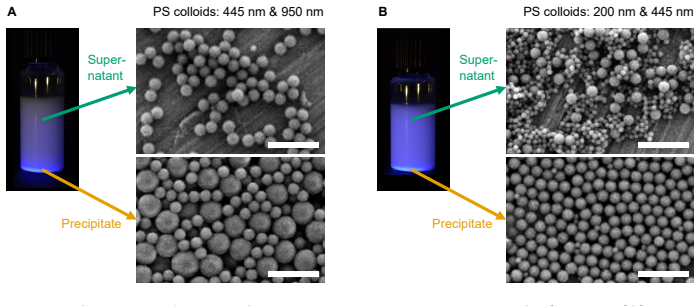
Depletion interactions, mediated by surfactant micelles, drive larger or more strongly overlapping colloidal objects to aggregate and sediment while smaller, less attractive objects remain suspended. The authors construct phase diagrams showing that the transition from mixed to demixed suspension occurs over a range of surfactant concentrations rather than at a single critical value. This transition width permits single-step purification of binary sphere mixtures at size ratios down to about 1.6 by choosing a surfactant concentration inside the transition window of one population and outside that of the other. For tetrameric colloidal clusters, the same procedure produces a sediment roughly 15 times enriched in tetramers relative to isolated spheres. The authors further show that the enrichment is shape-dependent: tetramers with four distinct lobes (low deformation) are recovered preferentially in the sediment, whereas highly fused, more spherical tetramers remain in the supernatant, consistent with a picture in which the number of overlapping depletion volumes scales with the contact geometry of convex surfaces.
Load-bearing premise
The load-bearing premise is that the geometric excluded-volume overlap model captures the dominant sorting physics, so the observed enrichment differences reflect shape rather than size or unequal gravitational settling.
Editorial extensions
If this is right
- Binary sphere mixtures at size ratios as low as about 1.6 can be purified in a single depletion step by selecting surfactant concentration within the transition window of one population and outside that of the other.
- Tetrameric clusters are enriched roughly fifteenfold in the sediment relative to uncoordinated spheres under the tested conditions, and fully fused spherical tetramers can still be separated from free spheres by choosing parameters carefully.
- Weakly fused, lobe-bearing tetramers sort more efficiently than strongly fused, spherical clusters, consistent with the number of overlapping depletion volumes set by contact geometry.
- Separating clusters of different coordination numbers (trimers versus pentamers) was not achieved within statistical error, indicating that coordination-number sorting is harder than sphere-versus-cluster sorting and may require repeated steps or different conditions.
- Repeating the segregation step should improve both yield and purity, making the method a practical purification route for colloidal building blocks.
Reading between the lines
- The 15-fold enrichment is probably a lower bound on the true thermodynamic selectivity: because gravitational settling removes uncoordinated spheres from the supernatant, the observed sediment-to-supernatant ratio understates the shape advantage the geometric model predicts.
- The geometric overlap hierarchy (1, 3–4, and 6 depletion-volume units) implies that mixtures of trimers, tetramers, and pentamers could in principle be separated from each other with a finer surfactant-concentration scan than the one used here, provided kinetic barriers are removed.
- The transition-width concept should transfer to other depletants with different micelle sizes: smaller micelles should allow finer size discrimination because they shift the phase boundary more sharply, while larger micelles broaden the window and may ease purification of clusters with small effective-size differences.
- A density-matched version of this protocol, which the authors suggest, would both test the shape-selectivity claim and provide a practical route to higher-purity cluster fractions for colloidal diamond assembly.
Editorial analysis
A structured set of objections, weighed in public.
Referee Report
Summary. The manuscript revisits Bibette-style depletion fractionation and applies it to purify colloidal clusters. The authors construct phase diagrams for three surfactants and five polystyrene sizes, identify a finite mixing-demixing transition window, use it to purify binary sphere mixtures at size ratios around 2.2 and (via fused clusters) around 1.6, and then apply the method to tetrameric clusters. They report a 15-fold enrichment of tetramers in the sediment and claim that sorting efficiency depends on aggregate geometry, with weakly fused anisotropic tetramers enriched over strongly fused spherical tetramers. A qualitative excluded-volume overlap hierarchy is proposed to rationalize the shape dependence.
Significance. If the key claims hold, this is a useful extension of the Bibette method to non-spherical and partially fused building blocks, with potential practical value for hierarchical assembly. The systematic phase diagrams over three surfactants and the explicit attention to the transition width are valuable; the geometric overlap model is parameter-free and is not fitted, and the authors are candid about kinetic and thermodynamic limitations, including rotational entropy and the possible role of gravitational sedimentation. However, the central shape-selectivity claim currently rests on an unsupported assumption about gravitational settling and on manual counts without reported error bars, so the significance cannot yet be fully assessed.
major comments (4)
- [§5, Sample preparation; Fig. 4D] The assertion that "gravitational sedimentation is the same for all degrees of deformation because they originate from the same PS and TPM batches" is not justified and is physically questionable: clusters of equal mass but different shape have different orientationally averaged translational drag coefficients and hence different sedimentation velocities. Since the cluster-sorting experiment (0.8% w/v Triton X-100, 24 h) was not run with the vial-flipping or density-matched protocol described in the same section, the preferential enrichment of low-deformation tetramers in the sediment (Fig. 4D) could be caused, at least in part, by differential gravitational settling rather than by geometry-dependent excluded-volume interactions. A no-surfactant control, or a density-matched or vial-flipped repetition, is required to separate size and shape contributions; without it, the main claim of shape-selective sorting is not quantitatively established.
- [Fig. 4C,D; Tables S1-S3] The quantitative claims of a 15-fold tetramer enrichment and of fusion-state-dependent partitioning are based on manual SEM counting without reported error bars, confidence intervals, or numbers of independent replicate analyses. The statement that coordination-number differences are "within statistical error" is not supported by any statistical test. Please provide raw counts, replicate analyses, and error bars, or qualify the claims accordingly.
- [Fig. 2B,C,E; Eqs. (1)-(2)] The finite width of the mixing-demixing transition is a central element of the proposed single-step sorting protocol, but it is currently derived from a single visual classification into seven bins. The error bars in Fig. 2E are weighted standard deviations of that one binned series, not measures of run-to-run variability or measurement uncertainty. An independent, quantitative measure of turbidity or sediment height, with replicate samples, is needed to support the claim that the transition occurs over a finite, reproducible concentration window.
- [Abstract; Conclusions; Fig. S5] The abstract and conclusions claim size-ratio discrimination "as low as 1.6" in a single step, but the supporting experiment appears only in the supplementary material (Fig. S5) and is not quantified in the main text. Either present the main-text quantitative evidence or qualify the abstract to match what is demonstrated in the main text.
minor comments (6)
- [Fig. 2 caption] Please remove the placeholder text "Lorem ipsum" from the figure caption.
- [Conclusions] The unresolved reference "Fig. ref-fig:DepletionVolume" should be corrected to a proper citation or deleted.
- [§5, Sample preparation] The sentence "The reduced liquid volume due to the presence of the polystyrene coresulting from was accounted foen calculating salt and surfactant concentrations" is garbled and should be rewritten.
- [Discussion] The phrase "the effective excluded volume decreases from a factor of six to 3√4 (i.e., by a factor of 3.8)" is imprecise; since 6/4^(1/3) ≈ 3.8, the wording should be changed to "decreases by a factor of about 3.8" or similar.
- [Fig. 5A] The caption refers to a "15 nm micelle" while the text reports the F127 micelle diameter as 20 nm; please make these numbers consistent.
- [Section 2, cluster classification] The definitions of η_c and η_s are garbled ("Fig˙S3The size ratio η_s = b/a..."); please rewrite this passage for clarity.
Circularity Check
No significant circularity: the sorting results are new measurements; the phase diagram is empirical and the geometric excluded-volume model is parameter-free.
full rationale
The paper does not derive its central sorting claim from a fitted theory or from a load-bearing self-citation. The phase diagrams in Fig. 2E are direct measurements of the demixing window in surfactant concentration for monodisperse PS spheres; the subsequent binary-mixture separations and the tetramer/sphere separation are performed at surfactant concentrations selected from those measured windows. This is an application or consistency check, not a circular prediction. The excluded-volume overlap model in Fig. 5 is a geometric construction that counts contact points between spheres and idealized tetramers; it is not fitted to the enrichment data, and the paper explicitly labels it qualitative and notes that rotational entropy and kinetics are not included. The 15-fold tetramer enrichment and the fusion-state dependence in Fig. 4C,D are SEM-based counts, not outputs of the model. Self-citations to prior work on cluster synthesis and characterization are method references and do not carry the sorting claim. The only notable weakness is an unsupported physical assumption in the Experimental Section, namely that gravitational sedimentation is the same for all degrees of deformation because the clusters originate from the same PS and TPM batches; this could bias the shape-selective interpretation, but it is an empirical or correctness concern, not a circular derivation. No step in the paper's claimed derivation chain reduces by construction to its own inputs.
Assumptions & free parameters
free parameters (2)
- Fusion classification thresholds =
eta_c in [0.6, 0.8] for medium deformation; low and high ranges not precisely specified
- Phase transition bin weights =
0 to 6 linear scale for N, M0-M4, Y
assumptions (5)
- domain assumption Depletion interactions are well described by Asakura-Oosawa excluded volume for the colloid-micelle mixtures used here
- domain assumption Micelle radii for F127, SDS, and Triton X-100 are as cited from literature
- domain assumption At 100 mM NaCl, the Debye screening length is below 1 nm, so Coulomb repulsion is negligible compared with depletion
- domain assumption Gravitational sedimentation affects all fusion states equally because they come from the same PS and TPM batches
- domain assumption Clusters can be treated as rigid assemblies of hard spheres for the geometrical excluded-volume overlap estimates (Fig. 5)
Cite this review
Pith. "Pith review of Scalable Size- and Shape-Selective Purification of Colloidal Building Blocks via Excluded Volume Interactions." pith.science (2026). https://pith.science/paper/X2ENLZOD
@misc{pith2026260810759,
  author       = {Pith},
  title        = {Pith review of: Scalable Size- and Shape-Selective Purification of Colloidal Building Blocks via Excluded Volume Interactions},
  year         = {2026},
  howpublished = {\url{https://pith.science/paper/X2ENLZOD}},
  note         = {Machine review of arXiv:2608.10759}
}
read the original abstract
Excluded-volume interactions, arising solely from steric constraints, play a crucial role in determining the structure, dynamics, and phase behaviour of colloidal suspensions. This is particularly important for non-spherical particles, where orientation-dependent effects also become significant. In this study, we employ depletion-driven phase separation to develop a scalable, size-selective method for purifying spherical and non-spherical colloidal clusters that exhibit an interplay of concave and convex surface areas. Phase diagrams of charge-stabilised polystyrene spheres ranging in size from 267 to 1008 nm demonstrate that the mixing-demixing transition occurs across a range of surfactant concentrations rather than at a single threshold. Taking advantage of this transition width enables the purification of a single component from binary mixtures at size ratios as low as 1.6 in a single step. When the same approach is applied to tetrameric colloidal clusters, these are enriched fifteenfold relative to uncoordinated spheres. Importantly, the efficiency of sorting depends not only on the effective size but also on the geometry of the aggregate. For instance, anisotropic, weakly fused clusters separate more efficiently than spherical aggregates because their concave surface curvature is reduced compared to unfused clusters. These findings establish excluded-volume-driven sorting as a practical and scalable route for purifying colloidal building blocks for hierarchical assembly.
Figures


Figures from the paper (2 more)


Reference graph
Works this paper leans on
-
[1]
W. C. K. Poon, Colloids as big atoms, Science 304 (2004) 830–831.doi: 10.1126/science.1096549
-
[2]
L. Kang, T. Gibaud, Z. Dogic, T. C. Lubensky, Entropic forces stabilize diverse emergent structures in colloidal membranes, Soft Matter 12 (2016) 386–401.doi:10.1039/C5SM02038G. URLhttp://dx.doi.org/10.1039/C5SM02038G
-
[3]
D. Frenkel, Entropy-driven phase transitions, Physica A 154 (3) (1988) 424–440.doi:10.1016/0378-4371(88)90066-7
-
[4]
N. Ballard, A. D. Law, S. A. F. Bon, Colloidal particles at fluid interfaces: behaviour of isolated particles, Soft Matter 15 (2019) 1186–1199.doi: 10.1039/C8SM02048E. URLhttp://dx.doi.org/10.1039/C8SM02048E 18
-
[5]
E. J. W. Verwey, J. T. G. Overbeek, Theory of the Stability of Lyophobic Colloids, Elsevier, 1948
work page 1948
-
[6]
W. C. K. Poon, The physics of a model colloid–polymer mixture, Journal of Physics: Condensed Matter 14 (2002) R859–R880
work page 2002
-
[7]
S. C. Glotzer, M. J. Solomon, Anisotropy of building blocks and their assembly into complex structures, Nature Materials 6 (2007) 557–562
work page 2007
-
[8]
L. Onsager, The effects of shape on the interaction of colloidal particles, Annals of the New York Academy of Sciences 51 (4) (1949) 627–659.doi: 10.1111/j.1749-6632.1949.tb27296.x
arXiv 1949
Show all 47 references
-
[9]
M. Doi, S. F. Edwards, The Theory of Polymer Dynamics, Oxford Univer- sity Press, Oxford, 1986
1986
-
[10]
Avendaño, F
C. Avendaño, F. A. Escobedo, Packing, entropic patchiness, and self-assembly of non-convex colloidal particles: A simulation perspec- tive, Current Opinion in Colloid & Interface Science 30 (2017) 62–69. doi:https://doi.org/10.1016/j.cocis.2017.05.005. URLhttps://www.sciencedi...
2017 doi
-
[11]
Frenkel, Entropy-driven ordering in colloids, Physica A 263 (1999) 26– 38.doi:10.1016/S0378-4371(98)00487-5
D. Frenkel, Entropy-driven ordering in colloids, Physica A 263 (1999) 26– 38.doi:10.1016/S0378-4371(98)00487-5
1999 doi
-
[12]
V. N. Manoharan, Colloidal matter: Packing, geometry, and entropy, Sci- ence 349 (6251) (2015) 1253751.arXiv:https://www.science.org/doi/ pdf/10.1126/science.1253751,doi:10.1126/science.1253751. URLhttps://www.science.org/doi/abs/10.1126/science.1253751
2015 doi
-
[13]
Asakura, F
S. Asakura, F. Oosawa, On interaction between two bodies immersed in a solution of macromolecules, The Journal of Chemical Physics 22 (7) (1954) 1255–1256.arXiv:https://pubs.aip.org/aip/jcp/article-pdf/22/7/ 1255/18805169/1255_2_online.pdf,doi:10.1063/1.1740347. URLhttps://doi...
1954 doi
-
[14]
H. N. W. Lekkerkerker, R. Tuinier, Colloids and the Depletion Interaction, Springer, 2011
2011
-
[15]
H. N. W. Lekkerkerker, R. Tuinier, M. Vis, Colloids and the Depletion Interaction, 2nd Edition, Vol. 1026 of Lecture Notes in Physics, Springer, Cham, 2024.doi:10.1007/978-3-031-52131-7
2024 doi
-
[16]
J. V. Sanders, Colour of precious opal, Nature 204 (4964) (1964) 1151– 1153.doi:10.1038/2041151a0. URLhttps://www.academia.edu/download/48107817/ 2041151a020160816-12727-1nyt4dm.pdf 19
1964
-
[17]
P. N. Pusey, W. van Megen, Phase behaviour of concentrated suspensions of nearly hard colloidal spheres, Nature 320 (6060) (1986) 340–342.doi: 10.1038/320340a0. URLhttps://doi.org/10.1038/320340a0
1986 doi
-
[18]
Asakura, F
S. Asakura, F. Oosawa, Interaction between particles suspended in solutions of macromolecules, Journal of Polymer Science 33 (126) (1958) 183–192.arXiv:https://onlinelibrary.wiley.com/doi/pdf/ 10.1002/pol.1958.1203312618,doi:https://doi.org/10.1002/pol. 1958.1203312618. URLhtt...
1958
-
[19]
J. N. Israelachvili, Intermolecular and Surface Forces, 3rd Edition, Aca- demic Press, 2011
2011
-
[20]
J. Bibette, Depletion interactions and fractionated crystallization for poly- disperse emulsion purification, Journal of Colloid and Interface Science 147 (2) (1991) 474–478.doi:https://doi.org/10.1016/0021-9797(91) 90181-7. URLhttps://www.sciencedirect.com/science/article/pii...
1991 doi
-
[21]
Steiner, A
U. Steiner, A. Meller, J. Stavans, Entropy driven phase separation in bi- nary emulsions, Phys. Rev. Lett. 74 (1995) 4750–4753.doi:10.1103/ PhysRevLett.74.4750. URLhttps://link.aps.org/doi/10.1103/PhysRevLett.74.4750
1995 doi
-
[22]
M. J. Rosen, J. T. Kunjappu, Surfactants and Interfacial Phenomena, 4th Edition, Wiley, 2012
2012
-
[23]
Vrij, Polymers at interfaces and the interactions in colloidal dispersions, Pure and Applied Chemistry 48 (1976) 471–483
A. Vrij, Polymers at interfaces and the interactions in colloidal dispersions, Pure and Applied Chemistry 48 (1976) 471–483
1976
-
[24]
X. Xing, L. Hua, T. Ngai, Depletion versus stabilization in- duced by polymers and nanoparticles: The state of the art, Cur- rent Opinion in Colloid & Interface Science 20 (1) (2015) 54–59. doi:https://doi.org/10.1016/j.cocis.2014.11.012. URLhttps://www.sciencedirect.com/scien...
2015 doi
-
[25]
W. H. Briscoe, Depletion forces between particles immersed in nanofluids, Current Opinion in Colloid & Interface Science 20 (1) (2015) 46–53. doi:https://doi.org/10.1016/j.cocis.2014.12.002. URLhttps://www.sciencedirect.com/science/article/pii/ S1359029414001472
2015 doi
-
[26]
C. K. Ofosu, T. A. Wilcoxson, T.-L. Lee, W. D. Brackett, J. Choi, T. M. Truskett, D. J. Milliron, Assessing depletion attractions between colloidal 20 nanocrystals, Science Advances 11 (15) (2025) eadv2216.doi:10.1126/ sciadv.adv2216
2025
-
[27]
Sacanna, W
S. Sacanna, W. T. M. Irvine, P. M. Chaikin, D. J. Pine, Lock and key colloids, Nature 464 (2010) 575–578
2010
-
[28]
M. He, J. P. Gales, É. Ducrot, Z. Gong, G.-R. Yi, S. Sacanna, D. J. Pine, Colloidal diamond, Nature 585 (7826) (2020) 524–529.doi:10.1038/ s41586-020-2718-6. URLhttps://doi.org/10.1038/s41586-020-2718-6
2020 doi
-
[29]
Kim, J.-B
Y.-J. Kim, J.-B. Moon, H. Hwang, Y. S. Kim, G.-R. Yi, Advances in col- loidal building blocks: Toward patchy colloidal clusters, Advanced Materi- als 35 (4) (2023) 2203045.doi:10.1002/adma.202203045
2023 doi
-
[30]
K. Zhao, T. G. Mason, Directing colloidal self-assembly through roughness- controlled depletion attractions, Phys. Rev. Lett. 99 (2007) 268301.doi: 10.1103/PhysRevLett.99.268301. URLhttps://link.aps.org/doi/10.1103/PhysRevLett.99.268301
2007 doi
-
[31]
R. J. Hunter, Foundations of Colloid Science, Oxford University Press, 2001
2001
-
[32]
Y. He, Y. Qiao, L. Ding, T. Cheng, J. Tu, Recent advances in droplet se- quential monitoring methods for droplet sorting, Biomicrofluidics 17 (6) (2023) 061501.arXiv:https://pubs.aip.org/aip/bmf/article-pdf/ doi/10.1063/5.0173340/18208129/061501_1_5.0173340.pdf,doi:10. 1063/5....
2023 doi
-
[33]
Gentile, G
L. Gentile, G. De Luca, F. E. Antunes, C. O. Rossi, G. A. Ranieri, et al., Thermogelation analysis of f127-water mixtures by physical chemistry tech- niques, Appl. Rheol 20 (5) (2010) 52081–1
2010
-
[34]
Mirgorod, A
Y. Mirgorod, A. Chekadanov, T. Dolenko, Structure of micelles of sodium dodecyl sulphate in water: An x-ray and dynamic light scattering study, Chemistry journal of Moldova 14 (1) (2019) 107–119
2019
-
[35]
Stubičar, J
N. Stubičar, J. Matejaš, P. Zipper, R. Wilfing, Size, shape and internal structure of triton x-100 micelles determined by light and small-angle x- ray scattering techniques, in: Surfactants in solution, Springer, 1989, pp. 181–195
1989
-
[36]
F. Li, D. P. Josephson, A. Stein, Colloidal assembly: The road from particles to colloidal molecules and crystals, Angewandte Chemie International Edition 50 (2) (2011) 360–388.arXiv:https: //onlinelibrary.wiley.com/doi/pdf/10.1002/anie.201001451, doi:https://doi.org/10.1002/a...
2011 doi
-
[37]
Sacanna, D
S. Sacanna, D. J. Pine, Shape-anisotropic colloids: Building blocks for complex assemblies, Current Opinion in Colloid & Interface Science 18 (2013) 484–488
2013
-
[38]
A.Neophytou, D.Chakrabarti, F.Sciortino, Facileself-assemblyofcolloidal diamond from tetrahedral patchy particles via ring selection, Proceedings of the National Academy of Sciences 118 (48) (2021) e2109776118.doi: 10.1073/pnas.2109776118
2021 doi
-
[39]
Baran, D
Ł. Baran, D. Tarasewicz, D. M. Kamiński, W. Rżysko, Pursuing colloidal diamonds, Nanoscale 15 (2023) 10623–10633.doi:10.1039/D3NR01771K
2023 doi
-
[40]
Q. Chen, S. C. Bae, S. Granick, Directed self-assembly of a colloidal kagome lattice, Nature 469 (2011) 381–384
2011
-
[41]
J. Tong, S. Zang, X. Dou, X. Chen, C. Chen, Z. Xu, C. Ma, J. Huang, Surface-dictated sorting in colloidal mixtures, Journal of Colloid and Inter- face Science 717 (2026) 140421.doi:10.1016/j.jcis.2026.140421
2026
-
[42]
van Kesteren, P
S. van Kesteren, P. Diethelm, L. Isa, Fluorescence-activated cell sorting (FACS) for purifying colloidal clusters, Soft Matter 20 (13) (2024) 2881– 2886.doi:10.1039/D4SM00122B
2024 doi
-
[43]
M. P. Robin, R. K. O’Reilly, Strategies for preparing fluorescently labelled polymer nanoparticles, Polymer International 64 (2) (2015) 174–182. arXiv:https://scijournals.onlinelibrary.wiley.com/doi/pdf/10. 1002/pi.4842,doi:https://doi.org/10.1002/pi.4842. URLhttps://scijourna...
2015 doi
-
[44]
S. Yang, S. Park, Y. Jung, Y. G. Kim, J. Lee, S.-H. Kim, Fractional crys- tallization of colloids by sequential tuning of depletion forces, Nature Com- munications 17 (2026) 2026.doi:10.1038/s41467-026-72000-y
2026 doi
-
[45]
Schindelin, I
J. Schindelin, I. Arganda-Carreras, E. Frise, V. Kaynig, M. Longair, T. Pietzsch, S. Preibisch, C. Rueden, S. Saalfeld, B. Schmid, J.-Y. Tin- evez, D. J. White, V. Hartenstein, K. Eliceiri, P. Tomancak, A. Cardona, Fiji: an open-source platform for biological-image analysis, N...
2012
-
[46]
van der Wel, R
C. van der Wel, R. K. Bhan, R. W. Verweij, H. C. Frijters, Z. Gong, A. D. Hollingsworth, S.Sacanna, D.J.Kraft, Preparationofcolloidal organosilica spheres through spontaneous emulsification, Langmuir 33 (33) (2017) 8174– 8180.doi:10.1021/acs.langmuir.7b01398. URLhttps://doi.or...
2017 doi
-
[47]
Minelli, A
C. Minelli, A. Sikora, R. Garcia-Diez, K. Sparnacci, C. Gollwitzer, M. Krumrey, A. G. Shard, Measuring the size and density of nanoparti- cles by centrifugal sedimentation and flotation, Anal. Methods 10 (2018) 22 1725–1732.doi:10.1039/C8AY00237A. URLhttp://dx.doi.org/10.1039/...
2018 doi
Reviewed August 12, 2026 · model on record in the stance chip above.
Discussion (0). Continue with ORCID to comment.