REVIEW 3 major objections 5 minor 34 references
Superfluid He-4 as Dark Matter Detectors
T0 review · 3 major / 5 minor · reviewed 2026-08-12 · deepseek-v4-flash
Pith's one-line read A single axion quark nugget crossing the LHC would leave a detectable thermal trace in the superfluid helium and the metal enclosure.
desk verdict Genuinely novel parasitic detector concept, but the paper's own rate arithmetic makes it a flux limit, not a near-term detector; deserves peer review with major revision. read the letter →
The pith
A machine-rendered reading of the paper's core claim, the machinery that carries it, and where it could break.
The reading
What carries the argument
The load-bearing objects are the AQN itself—a macroscopic, roughly $0.1\,\mu$m nuclear-density lump of antiquark matter with baryon charge $B\sim 10^{26\pm 2}$ that annihilates nucleons and emits roughly 100 keV X-rays from its positron electrosphere—and the energy-loss law $-dE/dx \approx \kappa \pi R^2 \cdot 2\,\mathrm{GeV}\cdot n$ (Eq. 1), with $\kappa\approx 10^{-2}$ in dense media. The radial temperature profile comes from an exponential-attenuation model in which the deposited energy density $\varepsilon(r)=E_0/(2\pi R r)\,e^{-r/R}$ diverges as $1/r$ near the track, making the central temperature formally unbounded and yielding extreme heating within millimeters. Monte Carlo and finite-element thermal simulations connect this energy release to a roughly $4.4$ mK helium temperature rise and a heat wave propagating at about $20$ m/s.
What would settle it
Go through the LHC cryogenic temperature, quench, and vacuum records from 2011 onward and look for a localized superfluid-helium temperature jump of $1$ mK or more accompanied by a simultaneous metal-temperature or quench signature along one magnet. Finding zero such events over the roughly seven years of stored data would, at the paper's central flux value, rule out the predicted detection rate; finding one event matching the predicted $4.4$ mK rise and the $\sim 20$ m/s heat-wave spread would confirm it.
Extended reading notes
Core claim
The paper's central claim is that an AQN crossing the LHC cryogenic ring leaves a detectable thermal trace: the energy-loss formula with $\kappa\simeq 10^{-2}$ in dense media gives about $3\times 10^5$ J deposited over $0.8$ m of iron, and Monte Carlo transport distributes that energy so the superfluid helium absorbs about $60$ J/cm and warms by roughly $4.4$ mK. The radial energy profile $\varepsilon(r)=E_0/(2\pi R r)\,e^{-r/R}$ heats the metal to about $3\times 10^3$ K at $1$ mm from the track and above $10^7$ K within about $0.1\,\mu$m. The authors further argue that no such event has apparently occurred in the LHC's roughly 20-year history, which sets an upper limit of about $3$ events per km$^2$ per year, comparable to the estimated AQN flux of about $0.04\,(10^{25}/B)$ events per km$^2$ per year. With an exposed surface area of about $0.015$ km$^2$ and about seven years of stored operation data, they conclude that a search of archival LHC cryogenic records could plausibly find or further constrain AQNs.
Load-bearing premise
The signal rate and size both rest on AQN model numbers taken from earlier work: a flux of about $0.04\,(10^{25}/B)$ per km$^2$ per year, an energy-loss suppression factor $\kappa$ of about $10^{-2}$ in dense media, and a nugget radius near $0.1\,\mu$m; if the true flux is at the low end or $\kappa$ is smaller, the LHC would see nothing in its lifetime.
Editorial extensions
If this is right
- A search through archived LHC cryogenic thermometry since 2011 could find a recorded $4.4$ mK or larger superfluid-helium temperature excursion, since the expected exposure is about one event every several years at the central flux.
- If no such event is found, the LHC data alone set an upper limit of roughly $3$ events per km$^2$ per year on the AQN flux, tightening with each additional year of operation.
- The predicted local heating of metal to thousands of kelvin means an AQN passage could also appear in maintenance records as unexplained melting, vacuum leaks, or quench triggers near the cryostat.
- Gravitational focusing by the Sun, Moon, or planets could temporarily boost the local AQN flux, so multiple events would be expected to show a planetary-period time structure.
Reading between the lines
- Editorial inference: the same thermometry search could constrain any macroscopic strongly interacting dark-matter candidate, because the signal is set mainly by the deposited energy per path length, not by details specific to AQNs.
- Editorial inference: a null result would most cleanly bound the product of flux and the energy-loss suppression factor $\kappa$, and combining it with acoustic or seismic searches could break the degeneracy between the two.
- Editorial inference: the method transfers to future colliders with larger helium inventories, such as a future circular collider, whose planned cryogenic volume is more than twice the LHC's, shortening the expected time to a first event.
Editorial analysis
A structured set of objections, weighed in public.
Referee Report
Summary. The paper proposes using the superfluid helium-4 (SF He-4) cooling system of the LHC as a parasitic dark-matter detector for axion antiquark nuggets (AQNs). It argues that an AQN crossing the LHC cryogenic ring deposits a large amount of energy in the metallic enclosure and the helium, producing temperature increases detectable with existing thermometry and potentially striking structural signatures. The paper includes FLUKA/GEANT4 Monte Carlo simulations of energy deposition, an analytical model for radial energy density in metal, and COMSOL thermal simulations of the subsequent heat propagation. The central claim is that, with the LHC's SF He-4 volume and monitoring infrastructure, one can expect an AQN event within several years, and that existing LHC operational data could be re-analyzed to search for such events.
Significance. If the central claim were correct, the paper would open a genuinely novel and inexpensive channel for AQN dark-matter searches, leveraging a unique 400-m3 SF He-4 volume and a 27-km instrumented cryogenic system. The idea of retroactively using LHC machine data is interesting and, in principle, of value. However, the significance is substantially undercut by an internal inconsistency in the event-rate arithmetic and by the lack of validation or uncertainty quantification for the central simulations. The paper's own numbers imply an expected event count far below one over the LHC's operational history, so the proposed detector cannot, on the author's assumptions, deliver the promised 'several years' detection. The contribution is therefore more a speculative proposal than a demonstrated detection method, and its main quantitative conclusion does not follow from the stated inputs.
major comments (3)
- [Sec. 6] The expected event rate claimed in Sec. 6 is inconsistent with the paper's own inputs. With the flux Φ ≈ 0.04 (10^25/B) km^-2 yr^-1 quoted in Secs. 1, 3, and 6, and the exposure area A ≈ 0.015 km^2 stated in Sec. 6 (or A ≈ 7.45×10^-3 km^2 from Sec. 2), the expected rate is ΦA ≈ 6×10^-4 yr^-1 at B=10^25, 6×10^-5 yr^-1 at B=10^26, and only 6×10^-3 yr^-1 even at the optimistic edge B=10^24 of the stated range 10^{26±2}. Over the ~7 years of stored LHC data, the expected number of events is <0.05, so the Poisson probability of observing even one event is <5%. The sentence 'one can expect an AQN event during several years' is therefore contradicted by the very same flux and area quoted in the paper. This arithmetic error directly undermines the paper's primary motivation and its claim that 'direct detection of AQNs using LHC machine data becomes possible.'
- [Sec. 4 and Sec. 5] The Monte Carlo and COMSOL simulations are presented without any uncertainty estimates, error bars, or validation against experimental benchmarks. The key quantitative results—the ~60 J/cm energy absorption in SF He-4, the 4.4 mK temperature rise, and the dramatic heating of the metallic enclosure to ~3000 K at 1 mm and >10^7 K near the track—depend on several model assumptions that are not varied or justified with sensitivity studies. These include the initial heating-zone radii (1 cm in metal, 10 cm in helium) in the COMSOL model, the exponential absorption law in Eq. (2), and the arbitrary cutoff radius of 0.1 µm in Eq. (4) that regularizes the 1/r divergence. The claim of 'spectacular' or 'damage' signatures relies entirely on this untreated short-distance divergence, while the macroscopic temperature rise (4.4 mK) is modest. The authors should provide a systematic parameter scan, at least an order-of-magnitude uncertainty estimate, and a statement of which results are robust.
- [Sec. 3 and Sec. 6] The central model inputs—the flux normalization Φ, the suppression factor κ in Eq. (1), and the baryon charge B—are imported from references [1,15,22], which include the present authors. While self-consistency with prior work is not by itself a flaw, the paper does not quantify how its conclusions depend on the substantial uncertainties in these parameters. The stated range B = 10^{26±2} spans four orders of magnitude in flux, and κ is quoted as '~10^-2 or smaller' for dense media, giving a wide range of possible energy depositions. The authors should state explicitly what combination of B and κ would make a detection plausible within, say, 7 years, and whether the 20-year LHC null (which they translate to an upper limit of ~3 events/km^2/yr) is consistent with that combination. As written, the proposal cannot be evaluated against the model's uncertainty, and the absence of observed events does not yet provide a meaningful constraint.
minor comments (5)
- [Sec. 1 (Introduction)] There is a typo in the sentence 'why there ere nearly no visible antibaryons in the Universe'—'ere' should be 'are'.
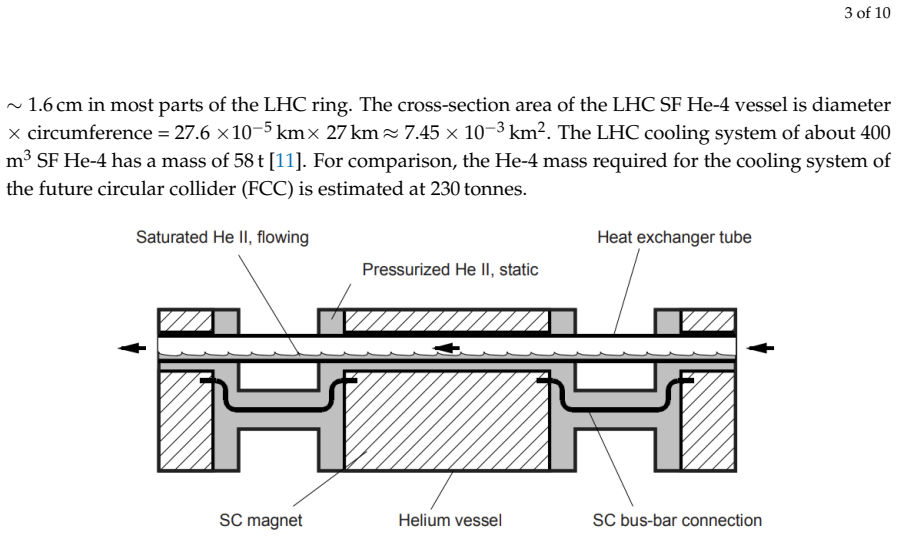
- [Sec. 2] The cross-section area calculation '27.6 ×10^{-5} km × 27 km' is confusing; expressing the diameter as 27.6 cm or 0.276 m would be clearer, and the derivation of 7.45×10^-3 km^2 should be made explicit.
- [Sec. 4] The sentence 'if the energy is absorbed uniformly by the most conservative estimate, if energy is immediately absorbed uniformly in SF He-4' is redundant and awkwardly phrased; it should be rewritten for clarity.
- [Fig. 4 and Fig. 5] The red marker and blue shaded regions in these figures are not easily discernible in a black-and-white print; consider adding axis labels, a log-scale temperature axis, or a zoomed inset to show the behavior near the cutoff radius.
- [Eq. (2) and Sec. 5] The characteristic absorption length R in the exponential model is not explicitly defined for the metallic enclosure—presumably it is the 100-keV photon attenuation length in iron, but this should be stated and distinguished from the value used in helium.
Circularity Check
No significant circularity: the AQN flux and energy-loss inputs are external self-cited model parameters, not fits to the paper's own conclusions.
full rationale
The paper's load-bearing numerical results (the ~3e5 J energy release, ~4.4 mK helium temperature excursion, and ~3000 K metal heating) are computed from Eq. (1) with the stated AQN parameters (kappa~1e-2, R~0.1 um, flux~0.04 (10^25/B) km^-2 yr^-1), then propagated through independent FLUKA/GEANT4 and COMSOL simulations. None of these parameters is fitted to the asserted detectability conclusion, and no LHC observable is inverted to set them; the 20-year LHC null is used as an upper limit on flux, not as a detection claim. The AQN flux and kappa are indeed imported from prior works with overlapping authorship (refs. [2,15,22]), but this is reliance on an external theoretical model, giving a conditional prediction rather than a logical circle. The Sec. 6 statement that 'one can expect an AQN event during several years' is arithmetically inconsistent with the paper's own flux and area (0.04/km^2/yr times 0.015 km^2 gives ~6e-4/yr, or ~1 event per 1700 yr), but that is a numerical consistency error rather than a circular reduction of the conclusion to its inputs.
Assumptions & free parameters
free parameters (5)
- kappa (kappa) =
~1 (atmosphere), ~10^-2 (dense media)
- Baryon charge B =
10^26 +/- 2
- AQN radius =
~0.1 um
- Initial heating-zone radius in metal =
~1 cm
- Initial heating-zone radius in helium =
~10 cm
assumptions (4)
- domain assumption AQN existence with B approximately 10^26 +/- 2 and radius approximately 0.1 um
- domain assumption Energy-loss formula Eq. (1) with kappa approximately 10^-2 for dense media
- ad hoc to paper Azimuthal symmetry and exponential radial absorption of emitted photons around the AQN track
- ad hoc to paper Cutoff at r = 0.1 um to regularize the 1/r divergence in Eq. (4)
Cite this review
Pith. "Pith review of Superfluid He-4 as Dark Matter Detectors." pith.science (2026). https://pith.science/paper/WIAZZXPL
@misc{pith2026260810761,
  author       = {Pith},
  title        = {Pith review of: Superfluid He-4 as Dark Matter Detectors},
  year         = {2026},
  howpublished = {\url{https://pith.science/paper/WIAZZXPL}},
  note         = {Machine review of arXiv:2608.10761}
}
read the original abstract
Superfluid helium-4 is an attractive medium for high-sensitivity detection of dark matter (DM) candidates (as well as other particles). There are several collaborations that have built and tested superfluid helium detectors, particularly focusing on the sub-GeV DM mass range. In this paper we discuss a novel idea for detecting Axion (Anti)Quark Nuggets (AQN) by using parasitically the superfluid helium-4 LHC cooling system as a unique large-scale earth bound DM detector. In the case of the AQN, we address the question of propagation in the metal parts surrounding the helium. An AQN induces significant heating around the propagation track that damages the enclosure.
Figures


Figures from the paper (3 more)


Reference graph
Works this paper leans on
-
[1]
Search for anti-quark nuggets via their interaction with the LHC beam
Zioutas, K.; Zhitnitsky, A.; Zamantzas, C.; Semertzidis, Y.K.; Ruimi, O.M.; Ozbozduman, K.; Maroudas, M.; Kryemadhi, A.; Karuza, M.; Horns, D.; et al. Search for anti-quark nuggets via their interaction with the LHC beam, 2025, [arXiv:hep-ex/2403.05608]
work page Pith review arXiv 2025
-
[2]
‘Nonbaryonic’ dark matter as baryonic color superconductor.JCAP2003,10, 010, [hep- ph/0202161]
Zhitnitsky, A.R. ‘Nonbaryonic’ dark matter as baryonic color superconductor.JCAP2003,10, 010, [hep- ph/0202161]. https://doi.org/10.1088/1475-7516/2003/10/010
-
[3]
DELight Collaboration. The DELight experiment. https://web.etp.kit.edu/~delight/experiment.html
-
[4]
Foster, J.W.; Gao, C.; Halperin, W.; Kahn, Y.; Mande, A.; Nguyen, M.; Schütte-Engel, J.; Scott, J.W. Statistics and sensitivity of axion wind detection with the homogeneous precession domain of superfluid helium-3. Phys. Rev. D2024,110, 115020. https://doi.org/10.1103/PhysRevD.110.115020
-
[5]
Demonstration of the HeRALD superfluid helium detector concept
Anthony-Petersen, R.; Biekert, A.; Chang, C.L.; Chang, Y.; Chaplinsky, L.; Dushkin, A.; Fink, C.W.; Garcia- Sciveres, M.; Guo, W.; Hertel, S.A.; et al. Demonstration of the HeRALD superfluid helium detector concept. Phys. Rev. D2024,110, 072006. https://doi.org/10.1103/PhysRevD.110.072006
-
[7]
DELight: A direct search experiment for light dark matter with superfluid helium
von Krosigk, B.; Eitel, K.; Enss, C.; Ferber, T.; Gastaldo, L.; Kahlhoefer, F.; Kempf, S.; Klute, M.; Lindemann, S.; Schumann, M.; et al. DELight: A direct search experiment for light dark matter with superfluid helium. SciPost Phys. Proc.2023, p. 016. https://doi.org/10.21468/SciPostPhysProc.12.016
-
[8]
InLow Energy Solar Neutrino Detection; World Scientific, 2001; pp
Adams, J.S.; Huang, Y.H.; Kim, Y.H.; Lanou, R.E.; Maris, H.J.; Seidel, G.M., The HERON project. InLow Energy Solar Neutrino Detection; World Scientific, 2001; pp. 70–80. https://doi.org/10.1142/9789812778000_ 0008
-
[9]
Zhitnitsky, A. Axion quark nuggets. Dark matter and matter–antimatter asymmetry: Theory, observations and future experiments.Mod. Phys. Lett. A2021,36, 2130017, [arXiv:hep-ph/2105.08719]. https://doi.org/ 10.1142/S0217732321300172
Show all 34 references
-
[10]
Superfluid helium cryogenics for the large hadron collider project at CERN.Cryogenics1994, 34, 1–8
Lebrun, P . Superfluid helium cryogenics for the large hadron collider project at CERN.Cryogenics1994, 34, 1–8. Fifteenth International Cryogenic Engineering Conference, https://doi.org/https://doi.org/10.101 6/S0011-2275(05)80003-7
-
[11]
https://doi.org/10.5170/CERN-2004-003-V-1
Brüning, O.S.; Collier, P .; Lebrun, P .; Myers, S.; Ostojic, R.; Poole, J.; Proudlock, P .LHC design report; CERN Yellow Reports: Monographs, CERN: Geneva, 2004. https://doi.org/10.5170/CERN-2004-003-V-1
2004 doi
-
[12]
The technology of superfluid helium
Lebrun, P .; Tavian, L. The technology of superfluid helium. In Proceedings of the Proceedings of the CERN Accelerator School: Superconductivity and Cryogenics for Accelerators and Detectors; Russenschuck, S.; Vandoni, G., Eds., 2004, Vol. CERN-2004-008,CERN Y ellow Report, p. 375
2004
-
[13]
Diffuse x-rays: directly observing dark matter?JCAP2008,2008, 023
Forbes, M.M.; Zhitnitsky, A.R. Diffuse x-rays: directly observing dark matter?JCAP2008,2008, 023. https://doi.org/10.1088/1475-7516/2008/01/023
2008 doi
-
[14]
X-ray annual modulation observed by XMM-Newton and axion quark nugget dark matter.Phys
Ge, S.; Rachmat, H.; Siddiqui, M.S.R.; Van Waerbeke, L.; Zhitnitsky, A. X-ray annual modulation observed by XMM-Newton and axion quark nugget dark matter.Phys. Dark Universe2022,36, 101031. https: //doi.org/10.1016/j.dark.2022.101031
-
[15]
Infrasonic, acoustic and seismic waves produced by the axion quark nuggets.Symmetry2022,14, 459
Budker, D.; Flambaum, V .V .; Zhitnitsky, A. Infrasonic, acoustic and seismic waves produced by the axion quark nuggets.Symmetry2022,14, 459. https://doi.org/10.3390/sym14030459. 10 of 10
-
[16]
New capabilities of the FLUKA multi-purpose code.Front
Ahdida, C.; Bozzato, D.; Calzolari, D.; Cerutti, F.; Charitonidis, N.; Cimmino, A.; Coronetti, A.; D’Alessandro, G.L.; Donadon Servelle, A.; Esposito, L.S.; et al. New capabilities of the FLUKA multi-purpose code.Front. Phys.2022,9, 788253. https://doi.org/10.3389/fphy.2021.788253
2022
-
[17]
Recent developments in Geant4.Nucl
Allison, J.; Amako, K.; Apostolakis, J.; Arce, P .; Asai, M.; Aso, T.; Bagli, E.; Bagulya, A.; Banerjee, S.; Barrand, G.; et al. Recent developments in Geant4.Nucl. Instrum. Methods Phys. Res. A2016,835, 186–225. https://doi.org/https://doi.org/10.1016/j.nima.2016.06.125
-
[18]
The physics of superfluid helium
Vinen, W.F. The physics of superfluid helium. In Proceedings of the Proceedings of the CERN Accelerator School: Superconductivity and Cryogenics for Accelerators and Detectors; Russenschuck, S.; Vandoni, G., Eds., 2004, Vol. CERN-2004-008,CERN Y ellow Report, pp. 363–374. http...
2004 doi
-
[19]
COMSOL Multiphysics ® v
COMSOL AB. COMSOL Multiphysics ® v. 6.4. https://www.comsol.com, 2024. Stockholm, Sweden
2024
-
[20]
The observed properties of liquid helium at the saturated vapor pressure.J
Donnelly, R.J.; Barenghi, C.F. The observed properties of liquid helium at the saturated vapor pressure.J. Phys. Chem. Ref. Data1998,27, 1217–1274, [https://pubs.aip.org/aip/jpr/article-pdf/27/6/1217/11342901/1217_- 1_online.pdf]. https://doi.org/10.1063/1.556028
-
[21]
Chapter III: The nature of the λ-transition in liquid helium
Buckingham, M.J.; Fairbank, W.M. Chapter III: The nature of the λ-transition in liquid helium. InProgress in Low T emperature Physics; Gorter, C.J., Ed.; Elsevier, 1961; Vol. 3,Prog. Low T emp. Phys., pp. 80–112. https://doi.org/https://doi.org/10.1016/S0079-6417(08)60134-1
1961 doi
-
[22]
Axion quark nuggets and how a global network can discover them.Phys
Budker, D.; Flambaum, V .V .; Liang, X.; Zhitnitsky, A. Axion quark nuggets and how a global network can discover them.Phys. Rev. D2020,101, 043012. https://doi.org/10.1103/PhysRevD.101.043012
-
[23]
Streams and caustics: the fine-grained structure of Λ cold dark matter haloes.Mon
Vogelsberger, M.; White, S.D.M. Streams and caustics: the fine-grained structure of Λ cold dark matter haloes.Mon. Not. R. Astron. Soc.2011,413, 1419–1438, [https://academic.oup.com/mnras/article- pdf/413/2/1419/18595473/mnras0413-1419.pdf]. https://doi.org/10.1111/j.1365-2966...
2011
-
[24]
On the possibility of Bose-star formation.Phys
Tkachev, I.I. On the possibility of Bose-star formation.Phys. Lett. B1991,261, 289–293. https://doi.org/https: //doi.org/10.1016/0370-2693(91)90330-S
-
[25]
Axion miniclusters and Bose stars.Phys
Kolb, E.W.; Tkachev, I.I. Axion miniclusters and Bose stars.Phys. Rev. Lett.1993,71, 3051–3054. https: //doi.org/10.1103/PhysRevLett.71.3051
1993 doi
-
[26]
Gravitational focusing effects on streaming dark matter as a new detection concept.Phys
Kryemadhi, A.; Maroudas, M.; Mastronikolis, A.; Zioutas, K. Gravitational focusing effects on streaming dark matter as a new detection concept.Phys. Rev. D2023,108, 123043. https://doi.org/10.1103/PhysRevD. 108.123043
-
[27]
Gravitational lensing by the Sun of non-relativistic penetrating particles.Astropart
Hoffmann, D.H.H.; Jacoby, J.; Zioutas, K. Gravitational lensing by the Sun of non-relativistic penetrating particles.Astropart. Phys.2003,20, 73–78. https://doi.org/10.1016/S0927-6505(03)00138-5
2003 doi
-
[28]
Flux enhancement of slow-moving particles by Sun or Jupiter: Can they be detected on Earth?Astrophys
Patla, B.R.; Nemiroff, R.J.; Hoffmann, D.H.H.; Zioutas, K. Flux enhancement of slow-moving particles by Sun or Jupiter: Can they be detected on Earth?Astrophys. J.2013,780, 158. https://doi.org/10.1088/0004-6 37X/780/2/158
2013 doi
-
[29]
Gravitational focusing of low-velocity dark matter on the Earth’s surface.Galaxies2020,8
Sofue, Y. Gravitational focusing of low-velocity dark matter on the Earth’s surface.Galaxies2020,8. https://doi.org/10.3390/galaxies8020042
-
[30]
Dense dark matter hairs spreading out from Earth, Jupiter, and other compact bodies.Astrophys
Prézeau, G. Dense dark matter hairs spreading out from Earth, Jupiter, and other compact bodies.Astrophys. J.2015,814, 122. https://doi.org/10.1088/0004-637X/814/2/122
2015 doi
-
[31]
Searching for axion streams with the echo method.Phys
Arza, A.; Kryemadhi, A.; Zioutas, K. Searching for axion streams with the echo method.Phys. Rev. D2023, 108, 083001. https://doi.org/10.1103/PhysRevD.108.083001
-
[32]
The Sun and its planets as detectors for invisible matter, 2017, [arXiv:astro-ph.SR/1602.03666]
Bertolucci, S.; Zioutas, K.; Hofmann, S.; Maroudas, M. The Sun and its planets as detectors for invisible matter, 2017, [arXiv:astro-ph.SR/1602.03666]
2017 arXiv
-
[33]
Mysterious anomalies in Earth’s atmosphere and strongly interacting dark matter.Symmetry2025,17
Zhitnitsky, A.; Maroudas, M. Mysterious anomalies in Earth’s atmosphere and strongly interacting dark matter.Symmetry2025,17. https://doi.org/10.3390/sym17010079
-
[34]
The 27-day variations of plasma densities and temperatures in the topside ionosphere.J
Rich, F.; Sultan, J.; Burke, W. The 27-day variations of plasma densities and temperatures in the topside ionosphere.J. Geophys. Res.2003,108, 1297. https://doi.org/10.1029/2002JA009731
2003 doi
-
[35]
Unidentified falling objects in the LHC as dark matter signals2026
Liang, X.; Zhitnitsky, A. Unidentified falling objects in the LHC as dark matter signals2026. [arXiv:hep- ph/2602.10562]. https://doi.org/10.1103/dm21-8tvz. Disclaimer/Publisher’s Note:The statements, opinions and data contained in all publications are solely those of the indi...
Reviewed August 12, 2026 · model on record in the stance chip above.
Discussion (0). Continue with ORCID to comment.