REVIEW 5 minor 72 references
Spectral Embeddings of Degree-$\alpha$ Laplacians in Random Dot Product Graphs
T0 review · 0 major / 5 minor · reviewed 2026-08-12 · deepseek-v4-flash
Pith's one-line read The degree-α Laplacian family of spectral embeddings has explicit Gaussian limits whose covariance explains when degree normalization helps community detection.
desk verdict A solid, careful CLT for the degree-alpha Laplacian family under RDPG, with explicit covariances and an honest practical comparison; the central claim holds up. read the letter →
The pith
A machine-rendered reading of the paper's core claim, the machinery that carries it, and where it could break.
The reading
What carries the argument
The object is the degree-α Laplacian family $\hat L_\alpha=D^{-\alpha}AD^{-\alpha}$ for $\alpha\in[0,1]$, with population analogue $L_\alpha=T^{-\alpha}PT^{-\alpha}$; the embedding is $\hat X_\alpha=\hat U_\alpha\hat\Lambda_\alpha^{1/2}$ from the rank-$R$ eigendecomposition. The proof expands the perturbation $\hat L_\alpha-L_\alpha$ via a Taylor expansion of $D^{-\alpha}$ around $T^{-\alpha}$, identifies the leading row-wise terms as a sum of independent mean-zero vectors, and applies the Lindeberg–Feller central limit theorem; the main technical difficulty is that $\Lambda_\alpha^{-1/2}$ has norm $O(\delta_n^{\alpha-1/2})$, which diverges when $\alpha>1/2$ and requires sharper remainder control. The covariance formula $\Sigma_\alpha(x)$ is the load-bearing output: it encodes how degree normalization reweights both the population latent positions (through $T^{-\alpha}$) and the local noise (through $\Gamma_{\rho,\alpha}$), and the projected-Gaussian Bayes-error diagnostic built on it becomes the tool for comparing normalizations in community detection.
What would settle it
Simulate an RDPG with latent positions drawn from a distribution satisfying Condition 1, fix $\alpha=0.75$, and for one node with known $\xi_i$ compute the scaled residual $n^{\alpha+1/2}\rho_n^\alpha[(\hat X_\alpha Q_n)_{i*}-(X_\alpha)_{i*}]^T$ across many replicates, then test its empirical distribution against $N(0,\Sigma_\alpha(\xi_i))$; a systematic mismatch would show the covariance formula or the CLT is wrong.
Extended reading notes
Core claim
The central claim is Theorem 1: fix $\alpha\in[0,1]$ and assume Condition 1; under the random dot product graph model, there exist orthogonal matrices $Q_n$ such that for each fixed row $i$, conditional on the latent position $\xi_i$, the scaled embedding residual $n^{\alpha+1/2}\rho_n^\alpha[(\hat X_\alpha Q_n)_{i*}-(X_\alpha)_{i*}]^T$ converges in distribution to a mean-zero Gaussian with covariance $\Sigma_\alpha(\xi_i)=\Upsilon_\alpha^{-1}\Gamma_{\rho,\alpha}(\xi_i)\Upsilon_\alpha^{-1}/\langle\xi_i,\mu\rangle^{2\alpha}$, where $\mu$ is the mean latent position and $\Upsilon_\alpha=\mathbb{E}[\xi\xi^T/\langle\xi,\mu\rangle^{2\alpha}]$. The covariance is explicit and separates into a population-geometric part (depending on the distribution of latent positions) and a fluctuation part $\Gamma_{\rho,\alpha}$ that changes between the dense and sparse regimes. Specializing to the degree-corrected stochastic block model, the paper shows that spherical row normalization makes the limiting population centers identical across $\alpha$, while the limiting covariance remains $\alpha$-dependent and can flatten toward the hyperplane containing those centers. The authors then use the projected Gaussian approximations to compute Bayes errors and find that the preferred $\alpha$ shifts with network density, community imbalance, and block-probability structure.
Load-bearing premise
The load-bearing premise is Condition 1(c): every latent position must have a dot product with the mean latent position bounded uniformly away from zero, so no node can be nearly orthogonal to the typical direction; otherwise the inverse degree normalization is unstable and the Gaussian limit may break down.
Editorial extensions
If this is right
- For any fixed $\alpha$, the degree-α spectral embedding is comparable to the population target $X_\alpha=T^{-\alpha}X$ up to rotation, with Gaussian row-wise errors of scale $n^{-\alpha-1/2}\rho_n^{-\alpha}$.
- After spherical row normalization in a degree-corrected stochastic block model, the population community directions are identical for all $\alpha$, so any performance difference across $\alpha$ comes from second-order covariance differences, not first-order geometry.
- In the balanced symmetric two-community SBM, the variance ratio $F_\alpha=\sigma^2_{N,\alpha}/\sigma^2_{T,\alpha}$ is strictly decreasing in $\alpha$ and reaches zero at $\alpha=1$, meaning stronger normalization flattens the covariance toward the hyperplane of the population centers.
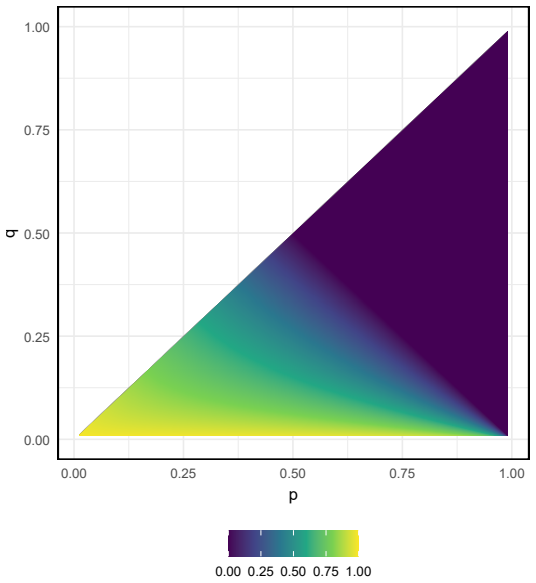
- The Bayes-error diagnostic and finite-sample simulations show that stronger normalization is preferred in sparser or more imbalanced networks, while adjacency spectral clustering ($\alpha=0$) is preferred when block probabilities are large and communities are balanced.
Reading between the lines
- The explicit covariance formula suggests a principled way to estimate an optimal $\alpha$ from a single network by plugging in estimated latent positions or block parameters, although the paper itself only tunes $\alpha$ through a subsampling procedure in a companion work.
- The Bayes-error diagnostic treats the asymptotic Gaussian approximation as exact at finite $n$; one testable extension is to replace the limiting covariance by the finite-sample covariance from the proof, which would reveal whether the recommended $\alpha$ shifts when higher-order terms are included.
- The restriction to positive-semidefinite block matrices, noted by the authors, means disassortative structures are excluded; extending the covariance formula to the generalized RDPG would likely introduce additional terms from an indefinite population matrix, and it is plausible that the qualitative ordering across $\alpha$ would change.
Signed reviews
Editorial analysis
A structured set of objections, weighed in public.
Referee Report
Summary. This paper studies the family of degree-normalized graph matrices D^{-α}AD^{-α}, α∈[0,1], in the random dot product graph model. The main result is a conditional row-wise central limit theorem for the rank-r spectral embedding: after a suitable orthogonal alignment, each row is asymptotically Gaussian with mean equal to the corresponding row of the population embedding and covariance given explicitly in terms of the latent-position distribution. The theorem covers both dense graphs and sparse graphs with expected degree growing faster than (log n)^2. The authors specialize the result to degree-corrected stochastic block models, describe how degree normalization changes the population geometry and the covariance shape, and introduce a projected-Gaussian Bayes-error diagnostic to compare values of α for two-community SBMs. The predicted ordering is checked against simulations of row-normalized spectral clustering.
Significance. The result is significant because it unifies and extends the known CLTs for adjacency and symmetric Laplacian embeddings and makes the dependence on α explicit at the second order, which is exactly the order needed to compare normalizations after row normalization. The appendix contains a complete proof with the key algebra spelled out; the covariance formulas are internally consistent, and the finite-sample discrepancy between α* and the empirical minimizer is reported honestly rather than explained away. The paper also makes falsifiable predictions about when stronger normalization helps, and it confronts those predictions with simulations. No parameters are fitted to force agreement between theory and simulations.
minor comments (5)
- [Section 3, paragraph after Model 1] The claim that an intermediate limit ρ_n→ρ*∈(0,1] can be absorbed into the latent distribution is not literally covered by Theorem 1 as stated: the dense covariance formula has the factor 1−⟨x,ξ'⟩, the sparse formula has ⟨x,ξ'⟩, and an intermediate limit would produce 1−ρ*⟨x,ξ'⟩. Please either extend the theorem to this case or restrict the claim to the two regimes actually used in the applications.
- [Condition 1(c)] The uniform lower bound ⟨x,μ⟩≥c is a genuine structural restriction; it excludes latent positions with ⟨x,μ⟩=0, such as a support containing 0, even when the support spans R^r. A remark connecting this condition to the DCSBM requirements (Θ bounded away from zero and γ_k>0) would help readers assess when the theorem applies.
- [Section 4.2] The statement that Cauchy–Schwarz gives 0≤r_α≤1 is correct but not immediate; including the log-convexity argument (EΘ^{2−2α})^2≤EΘ·EΘ^{3−4α} would improve verifiability.
- [Figures 2 and 3] The captions describe shading, but the figures also need explicit legends or marker descriptions for grayscale/print reproduction, particularly to identify which curve corresponds to which α in the finite-sample panels.
- [References] The Ali and Couillet (2018) entry is listed as JMLR 18:1–49, 2018; please verify the volume and year, since JMLR volume 18 appeared in 2017.
Circularity Check
No circular derivation: the CLT and the Bayes-error diagnostic are derived from stated model assumptions, and the self-citations are contextual rather than load-bearing.
full rationale
The paper's central claim is Theorem 1, a row-wise CLT for the degree-alpha spectral embedding under the RDPG model. The proof proceeds from the model primitives: it expands E_alpha = D^{-alpha} A D^{-alpha} - T^{-alpha} P T^{-alpha}, bounds spectral remainders (Lemmas 1-10, Proposition 1), and applies a Lindeberg-Feller CLT to the leading sum of independent centered edge indicators. The limiting covariance Sigma_alpha(x) is an explicit function of the latent-position distribution F, the sparsity factor rho_n, and alpha; no parameter is fitted to make the theorem match any simulation. Condition 1(c) is a stated structural assumption used to control degree-normalization factors, not an output of the proof, and it is not borrowed from a self-citation. Corollaries 1 and 2 are algebraic specializations of Theorem 1, and the population-geometry collapse at alpha = 1 follows from the factorization X_alpha = T^{-alpha} X plus the DCSBM structure. The Section 5 diagnostic is explicitly idealizational: it treats the asymptotic Gaussian approximation from Corollary 1 as exact and uses the Bayes rule for projected densities. This is a post-theorem computation, not a fitted prediction; the paper acknowledges that alpha* need not match finite-sample spectral clustering error (Section 6) and reports actual discrepancies (Figure 3b), which is the opposite of forcing agreement by construction. The two self-citations (Park, 2025; Park and Hao, 2026) appear only in the literature review and are not used to supply assumptions, theorems, or uniqueness claims. No circular step reduces the central result to its own inputs.
Assumptions & free parameters
assumptions (4)
- standard math Bernstein inequality and matrix Bernstein inequality are used for the concentration of degrees and adjacency noise.
- standard math Davis-Kahan sin θ theorem bounds the distance between sample and population eigenspaces.
- standard math Lindeberg-Feller central limit theorem and Slutsky's theorem establish the row-wise Gaussian limit.
- domain assumption The random dot product graph model with Condition 1 (bounded support, δ_n >> (log n)^2, <x, μ> ≥ c, support spanning R^r) is the generative setup.
Cite this review
Pith. "Pith review of Spectral Embeddings of Degree-$\alpha$ Laplacians in Random Dot Product Graphs." pith.science (2026). https://pith.science/paper/NT3FFYDM
@misc{pith2026260810845,
  author       = {Pith},
  title        = {Pith review of: Spectral Embeddings of Degree-$\alpha$ Laplacians in Random Dot Product Graphs},
  year         = {2026},
  howpublished = {\url{https://pith.science/paper/NT3FFYDM}},
  note         = {Machine review of arXiv:2608.10845}
}
read the original abstract
Spectral clustering methods for network data are commonly based on a few matrix representations, such as the adjacency matrix and the symmetric Laplacian. We study a continuum of degree-normalized spectral embeddings that includes these commonly used choices as special cases. Under a random dot product graph model, we establish a row-wise central limit theorem for this family of embeddings. The result provides an explicit description of how degree normalization affects both population geometry and the local uncertainty of embedded nodes. We use the limiting distributions to compare different normalizations in two-community stochastic block models through a projected-Gaussian Bayes-error diagnostic. These comparisons show that no single normalization is uniformly preferred. Instead, the favored normalization depends on network density, community imbalance, and block-probability structure. Typically, stronger normalization is favored in lower-density or more imbalanced settings. These results provide a unified distributional understanding of when and why alternative normalizations may improve spectral clustering.
Figures


Figures from the paper (2 more)

Reference graph
Works this paper leans on
-
[1]
The Annals of Mathematical Statistics , volume=
Random graphs , author=. The Annals of Mathematical Statistics , volume=. 1959 , publisher=
1959
-
[2]
The Annals of Statistics , pages=
Spectral clustering and the high-dimensional stochastic blockmodel , author=. The Annals of Statistics , pages=. 2011 , publisher=
work page 2011
-
[3]
Journal of Machine Learning Research , volume=
Achieving optimal misclassification proportion in stochastic block models , author=. Journal of Machine Learning Research , volume=
-
[4]
The Annals of Statistics , volume=
Impact of regularization on spectral clustering , author=. The Annals of Statistics , volume=
-
[5]
Community detection in sparse networks using the symmetrized
Jing, Bing-Yi and Li, Ting and Ying, Ningchen and Yu, Xianshi , journal=. Community detection in sparse networks using the symmetrized. 2022 , publisher=
work page 2022
-
[6]
Physical Review E—Statistical, Nonlinear, and Soft Matter Physics , volume=
Finding community structure in very large networks , author=. Physical Review E—Statistical, Nonlinear, and Soft Matter Physics , volume=. 2004 , publisher=
2004
-
[7]
Social Networks , volume=
Stochastic blockmodels: First steps , author=. Social Networks , volume=. 1983 , publisher=
1983
-
[8]
Rubin-Delanchy, Patrick and Cape, Joshua and Tang, Minh and Priebe, Carey E. , title =. Journal of the Royal Statistical Society Series B: Statistical Methodology , volume =. 2022 , month =. doi:10.1111/rssb.12509 , url =
Show all 72 references
-
[9]
Limit Theorems for Eigenvectors of the Normalized
Tang, Minh and Priebe, Carey E , journal=. Limit Theorems for Eigenvectors of the Normalized
-
[10]
Spectral clustering under degree heterogeneity: a case for the random walk
Alexander Modell and Patrick Rubin-Delanchy , year=. Spectral clustering under degree heterogeneity: a case for the random walk. 2105.00987 , archivePrefix=
-
[11]
The Annals of Statistics , volume=
Consistency of Spectral Clustering in Stochastic Block Models , author =. The Annals of Statistics , volume=
-
[12]
Asymptotic Theory of Eigenvectors for Latent Embeddings With Generalized
Fan, Jianqing and Fan, Yingying and Lv, Jinchi and Yang, Fan and Yu, Diwen , journal=. Asymptotic Theory of Eigenvectors for Latent Embeddings With Generalized. 2026 , volume=
2026
-
[13]
Regularized Spectral Clustering under the Degree-Corrected Stochastic Blockmodel , booktitle =
Qin, Tai and Rohe, Karl , editor =. Regularized Spectral Clustering under the Degree-Corrected Stochastic Blockmodel , booktitle =. 2013 , volume =
2013
-
[14]
Applications of Dual Regularized
Qing, Huan and Wang, Jingli , year =. Applications of Dual Regularized. Advances in Data Analysis and Classification , volume =. doi:10.1007/s11634-023-00565-3 , urldate =
-
[15]
The Electronic Journal of Combinatorics , pages=
On the spectra of general random graphs , author=. The Electronic Journal of Combinatorics , pages=
-
[16]
Journal of Machine Learning Research , volume=
Statistical inference on random dot product graphs: a survey , author=. Journal of Machine Learning Research , volume=
-
[17]
Journal of the American Statistical Association , volume =
Peter D Hoff and Adrian E Raftery and Mark S Handcock , title =. Journal of the American Statistical Association , volume =. 2002 , publisher =
2002
-
[18]
Physical Review E—Statistical, Nonlinear, and Soft Matter Physics , volume=
Stochastic blockmodels and community structure in networks , author=. Physical Review E—Statistical, Nonlinear, and Soft Matter Physics , volume=. 2011 , publisher=
2011
-
[19]
Journal of Anthropological Research , volume=
An information flow model for conflict and fission in small groups , author=. Journal of Anthropological Research , volume=. 1977 , publisher=
1977
-
[20]
Proceedings of the National Academy of Sciences , volume=
Community structure in social and biological networks , author=. Proceedings of the National Academy of Sciences , volume=. 2002 , publisher=
2002
-
[21]
Fuzzy communities and the concept of bridgeness in complex networks , author =. Phys. Rev. E , volume =. 2008 , month =. doi:10.1103/PhysRevE.77.016107 , url =
2008 doi
-
[22]
Donath, W. E. and Hoffman, A. J. , journal=. Lower Bounds for the Partitioning of Graphs , year=
-
[23]
, journal=
Jianbo Shi and Malik, J. , journal=. Normalized cuts and image segmentation , year=
-
[24]
Advances in Neural Information Processing Systems , volume=
Mixed membership stochastic blockmodels , author=. Advances in Neural Information Processing Systems , volume=
-
[25]
Journal of Statistical Mechanics: Theory and Experiment , volume=
Fast unfolding of communities in large networks , author=. Journal of Statistical Mechanics: Theory and Experiment , volume=. 2008 , publisher=
2008
-
[26]
The Annals of Statistics , volume=
Convexified modularity maximization for degree-corrected stochastic block models , author=. The Annals of Statistics , volume=
-
[27]
ICASSP 2019-2019 IEEE International Conference on Acoustics, Speech and Signal Processing (ICASSP) , pages=
Scalable MCMC in degree corrected stochastic block model , author=. ICASSP 2019-2019 IEEE International Conference on Acoustics, Speech and Signal Processing (ICASSP) , pages=. 2019 , organization=
2019
-
[28]
Journal of the American Statistical Association , volume=
Stochastic blockmodels for directed graphs , author=. Journal of the American Statistical Association , volume=. 1987 , publisher=
1987
-
[29]
Advances in Neural Information Processing Systems , volume=
On spectral clustering: Analysis and an algorithm , author=. Advances in Neural Information Processing Systems , volume=
-
[30]
Statistics and computing , volume=
A tutorial on spectral clustering , author=. Statistics and computing , volume=. 2007 , publisher=
2007
-
[31]
Fast Community Detection by
Jin, Jiashun , journal=. Fast Community Detection by
-
[32]
Network Science , volume=
On spectral embedding performance and elucidating network structure in stochastic blockmodel graphs , author=. Network Science , volume=. 2019 , publisher=
2019
-
[33]
Statistical Science , volume=
An overview of asymptotic normality in stochastic blockmodels: Cluster analysis and inference , author=. Statistical Science , volume=. 2026 , publisher=
2026
-
[34]
Foundations of Computational Mathematics , volume=
User-friendly tail bounds for sums of random matrices , author=. Foundations of Computational Mathematics , volume=. 2012 , publisher=
2012
-
[35]
2018 , publisher=
High-dimensional probability: An introduction with applications in data science , author=. 2018 , publisher=
2018
-
[36]
The Annals of Statistics , pages=
Role of normalization in spectral clustering for stochastic blockmodels , author=. The Annals of Statistics , pages=. 2015 , publisher=
2015
-
[37]
2013 , publisher =
Concentration Inequalities: A Nonasymptotic Theory of Independence , author =. 2013 , publisher =
2013
-
[38]
The Annals of Statistics , volume=
The two-to-infinity norm and singular subspace geometry with applications to high-dimensional statistics , author=. The Annals of Statistics , volume=
-
[39]
Journal of the Royal Statistical Society Series B: Statistical Methodology , volume=
A statistical interpretation of spectral embedding: the generalised random dot product graph , author=. Journal of the Royal Statistical Society Series B: Statistical Methodology , volume=. 2022 , publisher=
2022
-
[40]
The Annals of Statistics , pages=
Pseudo-likelihood methods for community detection in large sparse networks , author=. The Annals of Statistics , pages=
-
[41]
Conference on Learning Theory , pages=
Spectral clustering of graphs with general degrees in the extended planted partition model , author=. Conference on Learning Theory , pages=. 2012 , organization=
2012
-
[42]
A Limit Theorem for Scaled Eigenvectors of Random Dot Product Graphs , author=. Sankhy. 2016 , publisher=
2016
-
[43]
Journal of Machine Learning Research , volume=
Improved spectral community detection in large heterogeneous networks , author=. Journal of Machine Learning Research , volume=
-
[44]
2025 , url =
Park, John Jeongsoo , title =. 2025 , url =
2025
-
[45]
On the evolution of random graphs , author=. Publ. Math. Inst. Hungar. Acad. Sci , volume=
-
[46]
Journal of Machine Learning Research , volume=
Community detection and stochastic block models: recent developments , author=. Journal of Machine Learning Research , volume=
-
[47]
A useful variant of the
Yu, Yi and Wang, Tengyao and Samworth, Richard J , journal=. A useful variant of the. 2015 , publisher=
2015
-
[48]
The Electronic Journal of Combinatorics , volume=
Spectra of edge-independent random graphs , author=. The Electronic Journal of Combinatorics , volume=
-
[49]
Improvements on
Jin, Jiashun and Ke, Zheng Tracy and Luo, Shengming , journal=. Improvements on. 2022 , publisher=
2022
-
[50]
Complex graphs and Networks , publisher=
Lu, Linyuan and Chung, Fan , year=. Complex graphs and Networks , publisher=
-
[51]
High-dimensional probability: An introduction with applications in Data Science , publisher=
Vershynin, Roman , year=. High-dimensional probability: An introduction with applications in Data Science , publisher=
-
[52]
and Johnson, Charles R
Horn, Roger A. and Johnson, Charles R. , year=. Matrix Analysis , publisher=
-
[53]
Annals of Statistics , volume=
Entrywise eigenvector analysis of random matrices with low expected rank , author=. Annals of Statistics , volume=
-
[54]
IEEE Transactions on Information Theory , volume=
On divergences and informations in statistics and information theory , author=. IEEE Transactions on Information Theory , volume=. 2006 , publisher=
2006
-
[55]
Proceedings of the National Academy of Sciences , volume=
On a two-truths phenomenon in spectral graph clustering , author=. Proceedings of the National Academy of Sciences , volume=. 2019 , publisher=
2019
-
[56]
Journal of the Royal Statistical Society Series A: Statistics in Society , volume=
Model-based clustering for social networks , author=. Journal of the Royal Statistical Society Series A: Statistics in Society , volume=. 2007 , publisher=
2007
-
[57]
International workshop on algorithms and models for the web-graph , pages=
Random dot product graph models for social networks , author=. International workshop on algorithms and models for the web-graph , pages=. 2007 , organization=
2007
-
[58]
Proceedings of the 3rd international workshop on Link discovery , pages=
The political blogosphere and the 2004 US election: divided they blog , author=. Proceedings of the 3rd international workshop on Link discovery , pages=
2004
-
[59]
Stat , volume=
A Note on the Identifiability of the Degree-Corrected Stochastic Block Model , author=. Stat , volume=. 2025 , publisher=
2025
-
[60]
manuscript , year=
Degree-Corrected Spectral Clustering for Heterogeneous and Imbalanced Networks , author=. manuscript , year=
-
[61]
Journal of the American Statistical Association , volume=
Reaching a consensus , author=. Journal of the American Statistical Association , volume=. 1974 , publisher=
1974
-
[62]
Nature Biotechnology , volume=
How does gene expression clustering work? , author=. Nature Biotechnology , volume=. 2005 , publisher=
2005
-
[63]
Nature , volume=
Compartments revealed in food-web structure , author=. Nature , volume=. 2003 , publisher=
2003
-
[64]
2025 ASEE Annual Conference & Exposition , year=
Understanding Research Dynamics at the University of Arizona: An AI-Driven Metadata Analysis , author=. 2025 ASEE Annual Conference & Exposition , year=
2025
-
[65]
The Annals of Mathematical Statistics , pages=
A measure of asymptotic efficiency for tests of a hypothesis based on the sum of observations , author=. The Annals of Mathematical Statistics , pages=. 1952 , publisher=
1952
-
[66]
Journal of the American Statistical Association , volume=
Network cross-validation for determining the number of communities in network data , author=. Journal of the American Statistical Association , volume=. 2018 , publisher=
2018
-
[67]
Sparse random graphs: regularization and concentration of the
Le, Can M and Levina, Elizaveta and Vershynin, Roman , journal=. Sparse random graphs: regularization and concentration of the
-
[68]
Bernoulli , volume=
Entrywise limit theorems for eigenvectors of signal-plus-noise matrix models with weak signals , author=. Bernoulli , volume=. 2024 , publisher=
2024
-
[69]
On the problem of the most efficient tests of statistical hypotheses , author=
IX. On the problem of the most efficient tests of statistical hypotheses , author=. Philosophical Transactions of the Royal Society of London. Series A, Containing Papers of a Mathematical or Physical Character , volume=. 1933 , publisher=
1933
-
[70]
1997 , publisher=
Spectral graph theory , author=. 1997 , publisher=
1997
-
[71]
Random Structures & Algorithms , volume=
Concentration and regularization of random graphs , author=. Random Structures & Algorithms , volume=. 2017 , publisher=
2017
-
[72]
IEEE transactions on computer-aided design of integrated circuits and systems , volume=
New spectral methods for ratio cut partitioning and clustering , author=. IEEE transactions on computer-aided design of integrated circuits and systems , volume=. 1992 , publisher=
1992
Reviewed August 12, 2026 · model on record in the stance chip above.
Discussion (0). Continue with ORCID to comment.