REVIEW 3 major objections 4 minor 142 references
FiGuRO: Intrinsic Dimension Estimation for Multi-Modal Data
T0 review · 3 major / 4 minor · reviewed 2026-08-12 · deepseek-v4-flash
Pith's one-line read FiGuRO estimates intrinsic dimension by letting bottleneck ranks grow or shrink under a fidelity budget; in multi-modal data, the converged ranks match the shared and private subspace IDs.
desk verdict Useful practical method for multi-modal rank estimation, but the theoretical ID claim is not supported as stated; still deserves peer review with major revision. read the letter →
The pith
A machine-rendered reading of the paper's core claim, the machinery that carries it, and where it could break.
The reading
What carries the argument
The load-bearing mechanism is the bidirectional rank-update rule coupled to a rate-distortion objective: minimize total rank (the rate proxy) subject to per-modality reconstruction fidelity (distortion) below a budget λ. The implementation uses low-rank weight matrices $W \approx U^{(k^*)}S^{(k^*)}V^{(k^*)^\top}$ from truncated singular value decomposition, with ranks reduced by a cumulative energy threshold γ and increased by unmasking, checked every τ epochs with patience π. The coefficient of determination R² is the distortion metric, defining the minimum acceptable fidelity as $D_0 - \lambda$, and the explicit shared/private split of the latent space makes each subspace's rank interpretable as its ID. Theorem A.1.7 shows that this process converges to the manifold dimension, and Theorem A.2.2 shows that the unique stable optimum is the disentangled allocation of shared and private information.
What would settle it
Simulate two modalities with a known shared latent s and independent private latents p1 and p2, then add a strong linear correlation between s and p1 so that one low-rank direction carries much of both; if FiGuRO's converged total rank drops well below the true ks+k1 while the mutual-information-based split still requires separate dimensions, the rank-proxy assumption is falsified. A simpler check is to compare FiGuRO's ranks against direct mutual-information estimates on data with known generative variables: any disagreement in ordering between rank and mutual information would break the core equivalence.
Extended reading notes
Core claim
FiGuRO is a fidelity-guided rank optimization algorithm. It places truncated-SVD low-rank layers in the bottleneck of an autoencoder, then periodically checks whether reconstruction fidelity, measured by the coefficient of determination R², has dropped more than a user-set distortion budget λ from its pretrained baseline. If fidelity is still acceptable, ranks are pruned by a cumulative singular-energy threshold γ; if it has degraded too much, ranks are increased. The paper's central assertion, formalized in Theorem A.1.7, is that for a sufficiently small budget λ the final rank satisfies $E[k^*] \approx r$, the true intrinsic dimension of the data manifold, provided the autoencoder is a sufficient approximator and R² is a valid fidelity proxy. In the multi-modal architecture with shared and private latent subspaces, Theorem A.2.2 states that minimizing total rank subject to reconstruction fidelity makes the unique stable optimum the disentangled allocation, so the converged ranks $(k_s,k_1,k_2)$ estimate the IDs of the shared and private subspaces. Empirically the paper reports that FiGuRO outperforms existing ID estimators on noisy and nonlinear data and can be applied post-hoc to frozen pretrained encoders.
Load-bearing premise
The load-bearing premise is that a subspace's rank measures its information content (rate, proportional to mutual information), so minimizing total rank under a fidelity budget separates shared from private information; if rank is not proportional to mutual information, the returned ranks are just compression dimensions at a user-chosen fidelity level.
Editorial extensions
If this is right
- Under sufficient model capacity and sample size, the final rank equals the true intrinsic dimension for small distortion budgets, and the algorithm terminates in finite time.
- In multi-modal data, the converged shared and private ranks estimate the IDs of the shared and modality-specific subspaces, with disentanglement emerging without auxiliary orthogonality or sparsity losses.
- FiGuRO shows greater stability to hyperparameter changes than existing rank-reduction baselines and outperforms classical and neural ID estimators on noisy and nonlinear data.
- The framework can be applied post-hoc to frozen pretrained uni-modal encoders, providing a scalable latent probe for large models.
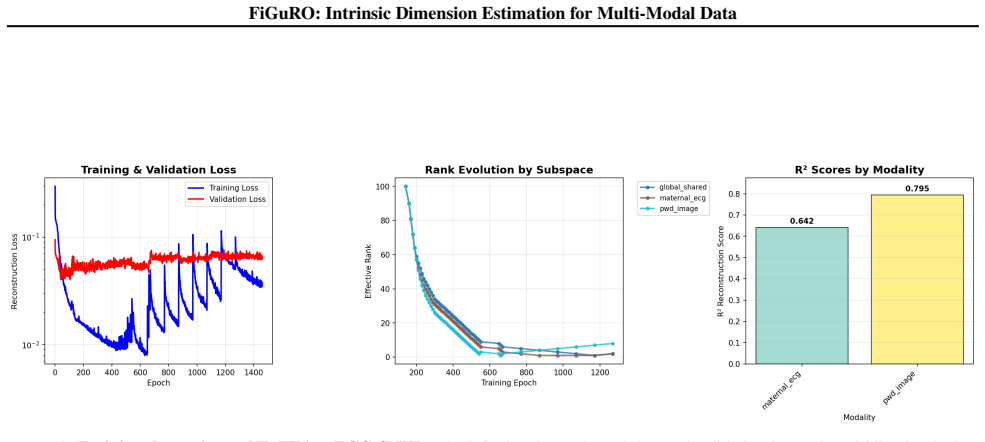
- Subspace ratios and shared-to-private scales are recovered on synthetic and real data, and downstream classification on the shared subspace matches or exceeds uni-modal embeddings.
Reading between the lines
- The paper's own failure modes (underestimation on correlated generative variables, overestimation at low signal-to-noise ratios) suggest that FiGuRO estimates an effective rank at a chosen fidelity level rather than a universal manifold dimension; reporting an ID interval across a range of λ values would make this explicit.
- If the rank-proxy assumption holds, the same machinery could serve as a principled data-dependent rank selector for low-rank adaptations, replacing fixed ranks in parameter-efficient fine-tuning.
- Because the optimization runs online and bids ranks both up and down, FiGuRO is a natural fit for continual learning, where latent capacity must resize as new modalities or distributions arrive.
- The sensitivity of the final ranks to the chosen distortion metric (the paper finds R² most robust) means any published ID estimate should include the metric and budget used to obtain it.
Editorial analysis
A structured set of objections, weighed in public.
Referee Report
Summary. The paper introduces FiGuRO, a fidelity-guided rank optimization framework that estimates the intrinsic dimension (ID) of uni- and multi-modal data. The method embeds low-rank decomposable layers in an autoencoder, then iteratively reduces or increases subspace ranks based on reconstruction fidelity relative to a user-chosen distortion budget lambda and an SVD energy threshold gamma. The authors claim convergence to the true ID (Theorem A.1.7), emergent disentanglement of shared and private subspaces (Theorem A.2.2), and support these claims with an extensive empirical study: a 1080-run hyperparameter sweep, simulated datasets with known IDs, comparisons to classical and neural ID estimators and multi-view decomposition baselines, ablations, and applications to Audio MNIST, So2Sat, NYU Depth V2, and NInFEA. The central theoretical and conceptual claims are that the returned ranks equal the data's intrinsic dimensions and that rank minimization naturally separates shared from private information without auxiliary losses.
Significance. If the central claims held, FiGuRO would be a valuable contribution: it is one of the first neural methods to explicitly estimate shared and private subspace IDs in multi-modal data, and the demonstration on frozen pretrained encoders is practically appealing. The paper reports substantial empirical work, including diverse simulated datasets, a large hyperparameter sweep, multiple baselines, ablations, and publicly available code. These strengths are real and should be credited. However, the theoretical guarantees are not rigorous, and the interpretation of the returned ranks as information-theoretic intrinsic dimensions rests on an unproved equivalence between SVD-energy ranks and rate/information content. The empirical results, while showing improvements over baselines, are more consistent with the method finding a lambda-dependent operating point on a rate-distortion curve than with recovering a ground-truth generative dimension.
major comments (3)
- [Appendix A.1, Theorem A.1.7] The proof of Theorem A.1.7 is a heuristic rate-distortion argument, not a quantitative guarantee. It assumes a sharp 'cliff' at the true rank r, but under Assumption A.1.1, additive Gaussian noise makes the reconstruction distortion decrease smoothly with rank, so the returned rank is scale-dependent. More importantly, the theorem's 'there exists a sufficiently small lambda' is non-operational: lambda is a user-chosen hyperparameter, and in Section 4.2 and Appendix C.1 it is selected using dataset A with known ID=5. Figure 3A shows that estimates vary substantially with lambda (e.g., Bi2 shared, GT=2, returns about 7 at lambda=0.05), and Supplementary Table 1 shows monotone under-estimation as lambda increases. Without a data-driven rule for choosing lambda, the existence claim is circular, because the lambda that recovers r depends on the unknown r. Please either provide a quantitative bound linking lambda to r, noise variance, and manifold geometry, or explicitly reframe Theorem A.1.7 as a statement about the algorithm's operating point on the rate-distortion curve rather than about intrinsic dimension.
- [Appendix A.2, Assumption A.2.1 and Theorem A.2.2] The entire disentanglement theorem rests on Assumption A.2.1, which asserts that the learned rank k* is proportional to the information-theoretic rate R, approximately equal to I(Z;X). This equivalence is not proved and is doubtful in this setting: Algorithm 1 computes ranks via a cumulative SVD energy threshold on learned weight matrices (Algorithm 1, line 21), and a variance-explained rank is not an information-theoretic quantity. Supplementary Table 3 itself provides evidence of the mismatch: the Bi1 shared generative matrix has 20 generative variables but an effective rank of only 6.61. In addition, the proof of Theorem A.2.2 concedes that the 'all-shared' solution is rank-equivalent to the disentangled solution, so the claimed 'unique optimal' solution is not unique under the stated objective; the argument that the all-shared solution is 'optimizationally unstable' is informal. Please prove the rank-information equivalence under explicit assumptions, or soften the conclusions to describe FiGuRO as finding low-rank compressions that are useful for downstream tasks rather than as recovering intrinsic information dimensions.
- [Section 5.2, Table 2 and Table 3] The claim that FiGuRO 'outperforms' existing ID estimation techniques should be qualified by the actual numerical accuracy. In Table 3, on dataset Bs FiGuRO returns (3.6, 1.0, 6.2) for ground truth (2, 3, 5); on Bi1 the shared rank is 13.4 versus GT 20; and on Bl the private ranks are 12.8 and 15.2 versus GT 20. These results are better than the baselines' average deviations, but they are not close enough to support the interpretation that the returned ranks are the true generative dimensions. The paper's own text acknowledges underestimation and information leakage, but the abstract and introduction state the stronger claim without these caveats. Please report per-subspace deviations from ground truth consistently and adjust the central claim to match the observed accuracy.
minor comments (4)
- [Section 3.1, Preliminaries] The statement that the Minimum Description Length principle 'formalizes' a linear proportionality between description length and latent dimension is imprecise; MDL concerns code length and model complexity, not a simple linear relation. Please clarify or remove the appeal to MDL as a formal basis.
- [Section 5.1 / Appendix C.1] The choice of lambda=0.05 is justified by a sweep on dataset A with known ID=5. Since the paper correctly identifies lambda as the main driver of the estimate, the main text should explicitly state that lambda selection currently requires prior knowledge or a validation procedure, and should discuss how a practitioner without ground truth would choose it.
- [Table 2] The table formatting is difficult to parse: several rows have misaligned or overlapping values across the JIVE, AJIVE, SLIDE, ShIndICA, and FiGuRO columns. Please reformat the table so each reported rank is unambiguously associated with its method and subspace.
- [Appendix B.8.2, ARD-VAE] The ARD-VAE implementation is described as using 'a corrected loss function to ensure mathematical validity,' but the precise objective and hyperparameters are not fully specified. Please provide the exact ELBO formulation used, or a reference to the code, to make the baseline reproducible.
Circularity Check
FiGuRO's ranks are user-tuned rate-distortion operating points; Theorem A.1.7's 'exists a suitable λ' is non-operational because λ was selected on known-ID data, and the disentanglement theorem assumes the rank=information bridge it claims to prove.
-
fitted input called prediction
[Section 4.2 / Appendix A.1 Theorem A.1.7 / Supplementary Table 1]
"Our hyperparameter sweep allowed us to select a single configuration balancing performance and speed {λ= 0.05, τ= 10, γ= 0.01, π= 10} for subsequent experiments unless stated otherwise. ... Theorem A.1.7. ... there exists a sufficiently small distortion budget λ such that the rank k∗ returned by FiGuRO satisfies E[k∗]≈r."
The only operational content of the existence claim is that some λ reproduces r, yet λ was chosen on dataset A whose true ID is known (5); Supplementary Table 1 shows the estimate is strongly monotone in λ (6.56 at λ=0.005, 5.02 at λ=0.05, 3.57 at λ=0.2). The tuned λ=0.05 is exactly the value that makes the known-ID dataset come out at 5. The theorem therefore does not establish that FiGuRO measures r; it states that a user who already knows r can pick a tolerance that returns r. Estimating r on the same dataset used to select the tolerance is circular, and no data-driven rule for λ is provided.
-
self definitional
[Section 3.2, Algorithm 1 (lines 11-12 and 21)]
"Our approach can be framed as a greedy algorithm for finding an efficient operating point on the rate-distortion curve. ... k t+1,i ←min(k: Pk j Ej ≥1−γ)."
By the algorithm's own update rule, the final rank is the smallest k whose SVD energy reaches 1−γ, kept only if R2 stays above D0−λ. That is, by construction, the rate-distortion operating point R(D0−λ) for a user-chosen distortion budget, not an estimate of manifold dimension independent of the user's tolerance. Calling this quantity the 'intrinsic dimension' equates the estimator's output with its definition: the rank is literally defined as the minimal rank achieving a chosen reconstruction fidelity threshold. The thresholds λ and γ are external inputs, so the estimate inherits their arbitrariness.
1 more flagged steps
-
self definitional
[Appendix A.2, Assumption A.2.1 / Theorem A.2.2]
"We assume that the rank k∗ of a latent subspace, as estimated by FiGuRO, serves as a proxy for its information content, or Rate R. This is an extension of the Minimum Description Length (MDL) principle, where the rank k∗ is the minimal number of parameters (degrees of freedom) required to describe the data, such that k∗ ∝ R ≈ I(Z;X)."
The disentanglement theorem concludes I(Hs)→S, I(H1)→P1, I(H2)→P2, but its proof works by equating rank sums with information sums (R_total≈ks+k1+k2≈I(Hs)+I(H1)+I(H2)). That equation is precisely Assumption A.2.1, assumed rather than proved. A rank obtained from an SVD energy threshold (1−γ) and a fidelity budget λ has no proven relation to mutual information; the paper's own Table 3 shows divergence (Bi1 shared: 20 generative variables vs effective rank 6.61). Thus the central disentanglement claim reduces to the assumption that rank equals information, i.e., the conclusion is imported by definition.
full rationale
FiGuRO's central numerical claim is not self-contained: the returned rank is, by Algorithm 1's own update rules, the smallest rank satisfying a cumulative SVD energy threshold (1−γ) subject to a user-chosen fidelity tolerance R2_0−λ. The paper itself describes this as finding an efficient operating point on the rate-distortion curve. Consequently k* is a rate-distortion point R(D0−λ), not an estimator of a manifold dimension independent of the user's tolerance. Theorem A.1.7 asserts existence of a λ making E[k*]≈r; but the configuration λ=0.05 was selected precisely because the sweep on dataset A (known ID 5) returned about 5.02, and Supplementary Table 1 shows the estimate is strongly monotone in λ (6.56 at λ=0.005 down to 3.57 at λ=0.2). The 'exists a suitable λ' claim is therefore non-operational and does not establish that the algorithm recovers r without using r. The disentanglement theorem similarly rests on Assumption A.2.1, which postulates k*∝R≈I(Z;X); the proof's rank-sum comparisons simply re-label information quantities as ranks. Table 3's own effective-rank numbers (20 generative variables vs effective rank 6.61 for Bi1 shared) show that SVD-energy rank and generative/information content diverge, so the assumption is not a harmless definition but the load-bearing conclusion. The empirical comparison against baselines is legitimate evidence of competitiveness, but it does not rescue the definitional identification. No significant self-citation chain is involved; the circularity is in the definition of the estimator and the tuned λ.
Assumptions & free parameters
free parameters (5)
- λ (distortion budget) =
0.05 (selected via grid search on dataset A with GT ID=5)
- γ (energy threshold) =
0.01 (default; swept over 1e-4 to 0.1)
- τ (reduction frequency) =
10 (default; swept over 5-20)
- π (patience) =
10 (default; swept over 5-100)
- α (sample-to-capacity load) =
≥10 (from Schuster & Krogh 2021)
assumptions (5)
- domain assumption Assumption A.1.1: observed data X = Y + ε with Y on an r-dimensional compact manifold and zero-mean noise with covariance σ²I, σ² smaller than manifold geometric variance.
- domain assumption Assumption A.1.3: the autoencoder family is a sufficient function approximator such that reconstruction distortion can be brought arbitrarily close to the noise floor σ²+ε.
- ad hoc to paper Assumption A.1.4: R2 (or chosen metric) is a stable proxy for reconstruction fidelity, so R2 ≥ R0² - λ bounds the true distortion.
- ad hoc to paper Assumption A.2.1: the learned rank k* is proportional to the information content/rate R≈I(Z;X).
- domain assumption Assumption A.1.5: manifold is compact and generative variables are i.i.d.
Cite this review
Pith. "Pith review of FiGuRO: Intrinsic Dimension Estimation for Multi-Modal Data." pith.science (2026). https://pith.science/paper/6FCE5PEH
@misc{pith2026260810857,
  author       = {Pith},
  title        = {Pith review of: FiGuRO: Intrinsic Dimension Estimation for Multi-Modal Data},
  year         = {2026},
  howpublished = {\url{https://pith.science/paper/6FCE5PEH}},
  note         = {Machine review of arXiv:2608.10857}
}
read the original abstract
Determining the complexity, or Intrinsic Dimension (ID), of data is fundamental to efficient and interpretable representation learning. This is particularly challenging in multi-modal settings when trying to learn disentangled representations for shared and private information. Existing techniques leave a critical gap: they are often static, uni-modal, or in the case of contrastive methods, adapt only to the shared ID implicitly. We introduce Fidelity-Guided Rank Optimization (FiGuRO), a framework for approximating the ID of uni- and multi-modal data under constraints of model capacity and hyperparameters. FiGuRO learns the dimensions of low-rank projections using truncated singular value decomposition and an algorithm that determines when to reduce or increase dimension and in which latent space. Disentanglement of shared and private information arises as an emergent property of this optimization, eliminating the need for complex auxiliary loss functions. We demonstrate that FiGuRO outperforms existing ID estimation techniques and is more robust to hyperparameter changes. Across simulations and real-world data, FiGuRO captures distinct ID scales and varying subspace ratios, and decomposes shared and private information successfully. Furthermore, we show that FiGuRO can be applied to modern uni-modal pretrained models, enabling efficient, post-hoc disentanglement of multi-modal representations.
Figures


Figures from the paper (16 more)




Reference graph
Works this paper leans on
-
[1]
Yeats, Eric and Jacobson, Aaron and Hannan, Darryl and Jia, Yiran and Doster, Timothy and Kvinge, Henry and Mahan, Scott , year = 2025, month = nov, number =. A. doi:10.48550/arXiv.2510.12975 , urldate =. arXiv , keywords =:2510.12975 , primaryclass =
-
[2]
Nature Computational Science , volume =
Partially shared multi-modal embedding learns holistic representation of cell state , author =. Nature Computational Science , volume =
-
[3]
An information criterion for controlled disentanglement of multimodal data , booktitle =
-
[4]
Advances in Neural Information Processing Systems , volume =
Unpaired multi-domain causal representation learning , author =. Advances in Neural Information Processing Systems , volume =
-
[5]
Proceedings of the IEEE , volume =
Machine learning approaches to single-cell data integration and translation , author =. Proceedings of the IEEE , volume =
-
[6]
npj Digital Medicine , volume=
A Representation Fusion Framework for Decoupling Diagnostic Information in Multimodal Learning , author=. npj Digital Medicine , volume=. 2025 , publisher=
2025
-
[7]
and Hosseinzadeh, Rasa and Cresswell, Jesse C
Kamkari, Hamidreza and Ross, Brendan L. and Hosseinzadeh, Rasa and Cresswell, Jesse C. and. A. Advances in Neural Information Processing Systems , volume =. doi:10.52202/079017-1211 , urldate =
-
[8]
, year = 1960, month = jan, journal =
Mirsky, L. , year = 1960, month = jan, journal =. doi:10.1093/qmath/11.1.50 , urldate =
Show all 142 references
-
[9]
Eckart, Carl and Young, Gale , year = 1936, month = sep, journal =. The. doi:10.1007/BF02288367 , urldate =
1936 doi
-
[10]
Learning
Tsai, Yao-Hung Hubert and Liang, Paul Pu and Zadeh, Amir and Morency, Louis-Philippe and Salakhutdinov, Ruslan , year = 2018, month = sep, urldate =. Learning. International
2018
- [11]
- [12]
-
[13]
Intrinsic Dimension of Data Representations in Deep Neural Networks , booktitle =
Ansuini, Alessio and Laio, Alessandro and Macke, Jakob H and Zoccolan, Davide , year =. Intrinsic Dimension of Data Representations in Deep Neural Networks , booktitle =
-
[14]
2019 , journal =
Intrinsic Dimension of Data Representations in Deep Neural Networks , author =. 2019 , journal =
2019
-
[15]
Learning
Bachman, Philip and Hjelm, R Devon and Buchwalter, William , year =. Learning. Advances in
-
[16]
Dimension
Bahadur, Nitish and Paffenroth, Randy , year =. Dimension. 2020 19th. doi:10.1109/ICMLA51294.2020.00088 , urldate =
2020
-
[17]
1998 , month = oct, journal =
The Minimum Description Length Principle in Coding and Modeling , author =. 1998 , month = oct, journal =. doi:10.1109/18.720554 , urldate =
1998 doi
- [18]
-
[19]
Rethinking
Blau, Yochai and Michaeli, Tomer , year =. Rethinking. Proceedings of the 36th
-
[20]
Bonheme, Lisa and Grzes, Marek , year =
- [21]
-
[22]
and Gallusser, Fabian and Koehler, Jim and Remy, Nicolas and Scott, Steven L
Brodersen, Kay H. and Gallusser, Fabian and Koehler, Jim and Remy, Nicolas and Scott, Steven L. , year =. Inferring Causal Impact Using. The Annals of Applied Statistics , volume =. doi:10.1214/14-AOAS788 , urldate =
-
[23]
2010 , month = oct, journal =
Data-Driven Approach for Creating Synthetic Electronic Medical Records , author =. 2010 , month = oct, journal =. doi:10.1186/1472-6947-10-59 , urldate =
2010 doi
-
[24]
and Casiraghi, E
Campadelli, P. and Casiraghi, E. and Ceruti, C. and Rozza, A. , year =. Intrinsic. Mathematical Problems in Engineering , volume =. doi:10.1155/2015/759567 , urldate =
2015 doi
-
[25]
2025 , month = feb, journal =
Robust Estimation of the Intrinsic Dimension of Data Sets with Quantum Cognition Machine Learning , author =. 2025 , month = feb, journal =. doi:10.1038/s41598-025-91676-8 , urldate =
2025 doi
-
[26]
Orthogonality-
Cha, Jaehoon and Thiyagalingam, Jeyan , year =. Orthogonality-. Proceedings of the 40th
- [27]
-
[28]
, year =
Davisson, L. , year =. Rate. IEEE Transactions on Communications , volume =. doi:10.1109/TCOM.1972.1091311 , urldate =
1972
-
[29]
Dubois, Yann and. Lossy. Advances in. 2021 , volume =
2021
-
[30]
Modality
Du, Chenzhuang and Teng, Jiaye and Li, Tingle and Liu, Yichen and Wang, Yue and Yuan, Yang and Zhao, Hang , year =. Modality
-
[31]
Huang, Yu and Du, Chenzhuang and Xue, Zihui and Chen, Xuanyao and Zhao, Hang and Huang, Longbo , year = 2021, month = nov, urldate =. What. Advances in
2021
-
[32]
Du, Chenzhuang and Teng, Jiaye and Li, Tingle and Liu, Yichen and Yuan, Tianyuan and Wang, Yue and Yuan, Yang and Zhao, Hang , year =. On. Proceedings of the 40th
-
[33]
MIT Press , urldate =
Elements of. MIT Press , urldate =
- [34]
-
[35]
and Paige, Brooks and Brooks, Dana H
Esmaeili, Babak and Wu, Hao and Jain, Sarthak and Bozkurt, Alican and Siddharth, N. and Paige, Brooks and Brooks, Dana H. and Dy, Jennifer and Meent, Jan-Willem , year =. Structured. Proceedings of the
-
[36]
2016 , month = oct, journal =
Testing the Manifold Hypothesis , author =. 2016 , month = oct, journal =. doi:10.1090/jams/852 , urldate =
2016 doi
-
[37]
2014 , month = apr, journal =
Plasmode Simulation for the Evaluation of Pharmacoepidemiologic Methods in Complex Healthcare Databases , author =. 2014 , month = apr, journal =. doi:10.1016/j.csda.2013.10.018 , urldate =
2014 doi
-
[38]
2022 , month = aug, journal =
Low-Rank Tensor Approximation with Local Structure for Multi-View Intrinsic Subspace Clustering , author =. 2022 , month = aug, journal =. doi:10.1016/j.ins.2022.05.091 , urldate =
2022 doi
-
[39]
Geiger, Atticus and Lu, Hanson and Icard, Thomas and Potts, Christopher , year =. Causal. Advances in
-
[40]
2025 , month = feb, journal =
Intrinsic-Dimension Analysis for Guiding Dimensionality Reduction and Data Fusion in Multi-Omics Data Processing , author =. 2025 , month = feb, journal =. doi:10.1016/j.artmed.2024.103049 , urldate =
2025
-
[41]
2018 , month = dec, series =
Image-to-Image Translation for Cross-Domain Disentanglement , booktitle =. 2018 , month = dec, series =
2018
-
[42]
Grunwald, Peter and Vitanyi, Paul , year =. Shannon. doi:10.48550/arXiv.cs/0410002 , urldate =. arXiv , keywords =:cs/0410002 , publisher =
- [43]
- [44]
-
[45]
and Shen, Yelong and Wallis, Phillip and
Hu, Edward J. and Shen, Yelong and Wallis, Phillip and. International. 2021 , month = oct, urldate =
2021
-
[46]
, year =
Ijishakin, Ayodeji and Ang, Ming Liang and Baljer, Levente and Tan, Daniel Chee Hian and Fry, Hugo Laurence and Abdulaal, Ahmed and Lynch, Aengus and Cole, James H. , year =. H-. Neurips
- [47]
-
[48]
Johnson and Harris, Greg A
Jr, Peter D. Johnson and Harris, Greg A. and Hankerson, D. C. , year =. Introduction to. doi:10.1201/9781420035278 , abstract =
-
[49]
1994 , month = sep, journal =
The Rate-Distortion Dimension of Sets and Measures , author =. 1994 , month = sep, journal =. doi:10.1109/18.333868 , urldate =
1994 doi
-
[50]
Estimation of the
Ke, Zheng Tracy and , Yucong, Ma and. Estimation of the. 2023 , month = jan, journal =. doi:10.1080/01621459.2021.1933497 , urldate =
2023
- [51]
-
[53]
Krakovsk. Simple. 2023 , month = apr, number =. doi:10.2139/ssrn.4414901 , urldate =. Social Science Research Network , langid =:4414901 , publisher =
2023 doi
- [54]
-
[55]
Synergies between
Lachapelle, Sebastien and Deleu, Tristan and Mahajan, Divyat and Mitliagkas, Ioannis and Bengio, Yoshua and. Synergies between. Proceedings of the 40th. 2023 , month = jul, pages =
2023
- [56]
-
[57]
Private-
Lee, Mihee and Pavlovic, Vladimir , year =. Private-. 2021. doi:10.1109/CVPRW53098.2021.00185 , urldate =
2021
- [58]
-
[59]
and Deng, Zihao and Allen, Nicholas and Auerbach, Randy and Mahmood, Faisal and Salakhutdinov, Ruslan and Morency, Louis-Philippe , year =
Liang, Paul Pu and Cheng, Yun and Fan, Xiang and Ling, Chun Kai and Nie, Suzanne and Chen, Richard J. and Deng, Zihao and Allen, Nicholas and Auerbach, Randy and Mahmood, Faisal and Salakhutdinov, Ruslan and Morency, Louis-Philippe , year =. Quantifying &. Thirty-Seventh
- [60]
-
[61]
, year =
Manduchi, Laura and Vandenhirtz, Moritz and Ryser, Alain and Vogt, Julia E. , year =. Tree
-
[62]
and Teh, Yee Whye , year =
Mathieu, Emile and Rainforth, Tom and Siddharth, N. and Teh, Yee Whye , year =. Disentangling. Proceedings of the 36th
-
[63]
and Fenton, Norman , editor =
McLachlan, Scott and Dube, Kudakwashe and Gallagher, Thomas and Simmonds, Jennifer A. and Fenton, Norman , editor =. Realistic. Biomedical. 2019 , pages =. doi:10.1007/978-3-030-29196-9_25 , abstract =
2019 doi
-
[64]
Using the
McLachlan, Scott and Dube, Kudakwashe and Gallagher, Thomas , year =. Using the. 2016. doi:10.1109/ICHI.2016.83 , urldate =
2016 doi
- [65]
- [66]
- [67]
-
[68]
Niu, Xueyan and Bai, Bo and Guo, Nian and Zhang, Weixi and Han, Wei , year =. Rate--. Entropy , volume =. doi:10.3390/e27040373 , urldate =
-
[69]
Disentangled
Pandey, Arun and Fanuel, Micha. Disentangled. 2022 , month = sep, journal =. doi:10.1162/neco_a_01528 , urldate =
2022 doi
-
[70]
Balanced
Peng, Xiaokang and Wei, Yake and Deng, Andong and Wang, Dong and Hu, Di , year =. Balanced. 2022. doi:10.1109/CVPR52688.2022.00806 , urldate =
2022
-
[71]
2002 , month = apr, journal =
Neural Networks for Estimating Intrinsic Dimension , author =. 2002 , month = apr, journal =. doi:10.1103/PhysRevE.65.046212 , urldate =
2002 doi
-
[72]
Rao and Ning, Ning , year =
Qiu, Jinwen and Jammalamadaka, S. Rao and Ning, Ning , year =. Multivariate. Journal of Machine Learning Research , volume =
-
[73]
Learning
Radford, Alec and Kim, Jong Wook and Hallacy, Chris and Ramesh, Aditya and Goh, Gabriel and Agarwal, Sandhini and Sastry, Girish and Askell, Amanda and Mishkin, Pamela and Clark, Jack and Krueger, Gretchen and Sutskever, Ilya , year =. Learning. Proceedings of the 38th
-
[74]
Orthogonal
Ranasinghe, Kanchana and Naseer, Muzammal and Hayat, Munawar and Khan, Salman and Khan, Fahad Shahbaz , year =. Orthogonal. Proceedings of the
-
[75]
, year =
Reddy, Abbavaram Gowtham and L, Benin Godfrey and Balasubramanian, Vineeth N. , year =. On. Proceedings of the AAAI Conference on Artificial Intelligence , volume =. doi:10.1609/aaai.v36i7.20781 , urldate =
-
[76]
Vincent , year =
Rezagah, Farideh Ebrahim and Jalali, Shirin and Erkip, Elza and Poor, H. Vincent , year =. Rate-Distortion Dimension of Stochastic Processes , booktitle =. doi:10.1109/ISIT.2016.7541665 , urldate =
2016
-
[77]
Contractive Auto-Encoders: Explicit Invariance during Feature Extraction , shorttitle =
Rifai, Salah and Vincent, Pascal and Muller, Xavier and Glorot, Xavier and Bengio, Yoshua , year =. Contractive Auto-Encoders: Explicit Invariance during Feature Extraction , shorttitle =. Proceedings of the 28th
- [78]
- [79]
- [80]
- [81]
-
[82]
Shwartz Ziv, Ravid and LeCun, Yann , year =. To. Entropy , volume =. doi:10.3390/e26030252 , urldate =
-
[83]
and Williamson, Robert C
Smola, Alex J. and Williamson, Robert C. and Mika, Sebastian and Sch. Regularized. Computational. 1999 , pages =. doi:10.1007/3-540-49097-3_17 , abstract =
1999 doi
-
[84]
Multimodal Deep Learning for Biomedical Data Fusion: A Review , shorttitle =
Stahlschmidt, S. Multimodal Deep Learning for Biomedical Data Fusion: A Review , shorttitle =. 2022 , month = mar, journal =. doi:10.1093/bib/bbab569 , urldate =
2022 doi
- [85]
-
[86]
and Meng, Yang and Agostini, Andrea and Chopard, Daphn
Sutter, Thomas M. and Meng, Yang and Agostini, Andrea and Chopard, Daphn. Unity by. 2024 , month = dec, journal =
2024
- [87]
-
[88]
and Meng, Yang and Agostini, Andrea and Chopard, Daphn
Sutter, Thomas M. and Meng, Yang and Agostini, Andrea and Chopard, Daphn. Unity by. The
-
[89]
Tian, Yonglong and Sun, Chen and Poole, Ben and Krishnan, Dilip and Schmid, Cordelia and Isola, Phillip , year =. What. Advances in
- [90]
-
[91]
Synthea:
Walonoski, Jason and Kramer, Mark and Nichols, Joseph and Quina, Andre and Moesel, Chris and Hall, Dylan and Duffett, Carlton and Dube, Kudakwashe and Gallagher, Thomas and McLachlan, Scott , year =. Synthea:. Journal of the American Medical Informatics Association , volume =....
-
[92]
Wang, Weiran and Arora, Raman and Livescu, Karen and Bilmes, Jeff , year =. On. Proceedings of the 32nd
-
[93]
Wang, Weiyao and Tran, Du and Feiszli, Matt , year =. What. Proceedings of the
- [94]
- [95]
-
[96]
Xu, Chang and Tao, Dacheng and Xu, Chao , year =. Large-. IEEE Transactions on Pattern Analysis and Machine Intelligence , volume =. doi:10.1109/TPAMI.2013.2296528 , urldate =
2013
-
[97]
Estimating the
Yang, Yibo and Eckstein, Stephan and Nutz, Marcel and Mandt, Stephan , year =. Estimating the. Advances in Neural Information Processing Systems , volume =
- [98]
-
[99]
Multimodal
Zhang, Xiaohui and Yoon, Jaehong and Bansal, Mohit and Yao, Huaxiu , year =. Multimodal. 2024. doi:10.1109/CVPR52733.2024.02592 , urldate =
2024
- [100]
-
[101]
, year =
Zhang, George and Qian, Jingjing and Chen, Jun and Khisti, Ashish J. , year =. Universal. Advances in
-
[102]
Schuster, Viktoria and Krogh, Anders , year =. A. Entropy , volume =. doi:10.3390/e23111403 , urldate =
-
[103]
Proceedings of the 25th
Optuna: A Next-generation Hyperparameter Optimization Framework , author=. Proceedings of the 25th
-
[104]
Extracting and Composing Robust Features with Denoising Autoencoders , booktitle =
Vincent, Pascal and Larochelle, Hugo and Bengio, Yoshua and Manzagol, Pierre-Antoine , year =. Extracting and Composing Robust Features with Denoising Autoencoders , booktitle =. doi:10.1145/1390156.1390294 , urldate =
-
[105]
A Non-Invasive Multimodal Foetal
Sulas, Eleonora and Urru, Monica and Tumbarello, Roberto and Raffo, Luigi and Sameni, Reza and Pani, Danilo , year =. A Non-Invasive Multimodal Foetal. Scientific Data , volume =. doi:10.1038/s41597-021-00811-3 , urldate =
-
[106]
Respiratory
Yasuma, Fumihiko and Hayano, Jun-ichiro , year =. Respiratory. CHEST , volume =. doi:10.1378/chest.125.2.683 , urldate =
-
[107]
, year =
Moody, G. , year =. Derivation of
-
[108]
and Zhu, Yuke and Salakhutdinov, Ruslan and Morency, Louis-Philippe , year =
Liang, Paul Pu and Lyu, Yiwei and Fan, Xiang and Wu, Zetian and Cheng, Yun and Wu, Jason and Chen, Leslie and Wu, Peter and Lee, Michelle A. and Zhu, Yuke and Salakhutdinov, Ruslan and Morency, Louis-Philippe , year =. doi:10.48550/arXiv.2107.07502 , urldate =. arXiv , keyword...
-
[109]
Pope, Phil and Zhu, Chen and Abdelkader, Ahmed and Goldblum, Micah and Goldstein, Tom , year =. The. International
-
[110]
Intrinsic
Tulchinskii, Eduard and Kuznetsov, Kristian and Kushnareva, Laida and Cherniavskii, Daniil and Nikolenko, Sergey and Burnaev, Evgeny and Barannikov, Serguei and Piontkovskaya, Irina , year =. Intrinsic. Advances in Neural Information Processing Systems , volume =
-
[111]
Amsaleg, Laurent and Bailey, James and Barbe, Am. High. 2021 , journal =. doi:10.1109/TIFS.2020.3023274 , urldate =
2021
- [112]
-
[113]
IEEE Signal Processing Magazine , volume=
The mnist database of handwritten digit images for machine learning research , author=. IEEE Signal Processing Magazine , volume=. 2012 , publisher=
2012
-
[114]
2018 , publisher=
Jakobovski/free-spoken-digit-dataset: v1.0.8 , author=. 2018 , publisher=
2018
-
[115]
doi:10.5281/zenodo.1342401 , url =
Zohar Jackson and César Souza and Jason Flaks and Yuxin Pan and Hereman Nicolas and Adhish Thite , title =. doi:10.5281/zenodo.1342401 , url =
-
[116]
2017 , month = sep, journal =
Estimating the Intrinsic Dimension of Datasets by a Minimal Neighborhood Information , author =. 2017 , month = sep, journal =. doi:10.1038/s41598-017-11873-y , urldate =
2017 doi
-
[117]
Levina, Elizaveta and Bickel, Peter , year =. Maximum. Advances in
-
[118]
2012 , month = oct, journal =
Novel High Intrinsic Dimensionality Estimators , author =. 2012 , month = oct, journal =. doi:10.1007/s10994-012-5294-7 , urldate =
2012 doi
- [119]
-
[120]
2002 , month = oct, journal =
Estimating the Intrinsic Dimension of Data with a Fractal-Based Method , author =. 2002 , month = oct, journal =. doi:10.1109/TPAMI.2002.1039212 , urldate =
2002 arXiv
-
[121]
Estimating the Effective Dimension of Large Biological Datasets Using
Albergante, Luca and Bac, Jonathan and Zinovyev, Andrei , year =. Estimating the Effective Dimension of Large Biological Datasets Using. doi:10.48550/arXiv.1901.06328 , urldate =. arXiv , keywords =:1901.06328 , primaryclass =
-
[122]
, year =
Kambhatla, Nandakishore and Leen, Todd K. , year =. Dimension. Neural Computation , volume =. doi:10.1162/neco.1997.9.7.1493 , urldate =
1997 doi
- [123]
-
[124]
Gr. The. 2007 , month = apr, publisher =
2007
-
[125]
Berger, Toby , year =. Rate-. Wiley. doi:10.1002/0471219282.eot142 , urldate =
-
[126]
Berger, Toby , editor =. Rate. Advances in. doi:10.1007/978-3-7091-2928-9_1 , urldate =
- [127]
-
[128]
AudioMNIST: Exploring Explainable Artificial Intelligence for audio analysis on a simple benchmark , journal =
Sören Becker and Johanna Vielhaben and Marcel Ackermann and Klaus-Robert Müller and Sebastian Lapuschkin and Wojciech Samek , keywords =. AudioMNIST: Exploring Explainable Artificial Intelligence for audio analysis on a simple benchmark , journal =. 2023 , issn =. doi:https://...
2023 doi
-
[129]
Parameter
Paischer, Fabian and Hauzenberger, Lukas and Schmied, Thomas and Alkin, Benedikt and Deisenroth, Marc Peter and Hochreiter, Sepp , year =. Parameter. doi:10.48550/arXiv.2410.07170 , urldate =. arXiv , keywords =:2410.07170 , primaryclass =
-
[130]
Biometrika , volume =
Hotelling,. Biometrika , volume =. doi:10.1093/biomet/28.3-4.321 , urldate =
-
[131]
Data Integration via Analysis of Subspaces (
Prothero, Jack and Jiang, Meilei and Hannig, Jan and. Data Integration via Analysis of Subspaces (. TEST , volume =. doi:10.1007/s11749-024-00923-z , urldate =
-
[132]
Journal of Multivariate Analysis , volume =
Angle-Based Joint and Individual Variation Explained , author =. Journal of Multivariate Analysis , volume =. doi:10.1016/j.jmva.2018.03.008 , urldate =
2018 doi
-
[133]
and Hoadley, Katherine A
Lock, Eric F. and Hoadley, Katherine A. and Marron, J. S. and Nobel, Andrew B. , year = 2013, month = mar, journal =. Joint and Individual Variation Explained (. doi:10.1214/12-AOAS597 , urldate =
2013 doi
- [134]
- [135]
-
[136]
Pandeva, Teodora and Forr. Multi-. Proceedings of the
-
[137]
Efficient
Mikolov, Tomas and Chen, Kai and Corrado, Greg and Dean, Jeffrey , year = 2013, month = jan, journal =. Efficient
2013
-
[138]
Simonyan, Karen and Zisserman, Andrew , year = 2014, month = sep, journal =. Very
2014
- [139]
- [140]
-
[141]
doi:10.1109/MGRS.2020.2964708 , urldate =
Zhu, Xiao Xiang and Hu, Jingliang and Qiu, Chunping and Shi, Yilei and Kang, Jian and Mou, Lichao and Bagheri, Hossein and Haberle, Matthias and Hua, Yuansheng and Huang, Rong and Hughes, Lloyd and Li, Hao and Sun, Yao and Zhang, Guichen and Han, Shiyao and Schmitt, Michael an...
2020
-
[142]
ECCV , year =
Nathan Silberman, Derek Hoiem, Pushmeet Kohli and Rob Fergus , title =. ECCV , year =
-
[143]
2021 , eprint=
High-Resolution Image Synthesis with Latent Diffusion Models , author=. 2021 , eprint=
2021
Reviewed August 12, 2026 · model on record in the stance chip above.
Discussion (0). Continue with ORCID to comment.