REVIEW 3 major objections 6 minor 78 references
Constraining ModMax Black Holes with EHT and GRAVITY Observations: Optical Signatures and Accretion Disk Properties
T0 review · 3 major / 6 minor · reviewed 2026-08-12 · deepseek-v4-flash
Pith's one-line read This paper argues that Event Horizon Telescope shadows and GRAVITY astrometry already bound the charge and nonlinearity parameters of ModMax black holes, with the tightest limits $Q<0.391$ and $v<4.153$ at 95% credibility.
desk verdict The separate Q and v constraints are not identifiable from shadow data; the paper's main quantitative claim is a prior artifact, though the geometry and disk calculations are competently done. read the letter →
The pith
A machine-rendered reading of the paper's core claim, the machinery that carries it, and where it could break.
The reading
What carries the argument
The central object is the ModMax black hole metric $f(r)=1-2M/r+e^{-v}Q^2/r^2$, where $v$ acts as an exponential charge-screening factor on the total dyonic charge $Q$. The shadow is carried by the effective potential for null geodesics and the critical impact parameter $R_{\rm sh}=b_c=r_{\rm ph}/\sqrt{f(r_{\rm ph})}$, converted to an angular diameter by $\theta_{\rm sh}=R_{\rm sh}(2GM/c^2D)$. Parameter estimation is carried by a Gaussian log-likelihood, Gaussian priors on $M$ and $D$, uniform priors on $Q\in[0,1]$ and $v\in[0,10]$, and an MCMC sampler. The disk side is carried by the Novikov-Thorne flux integral that converts circular-orbit energies into radiation profiles, plus backward ray tracing that assigns Doppler- and redshift-corrected fluxes to image pixels.
What would settle it
Compute a full ray-traced image of a magnetized accretion flow in the ModMax metric and compare the resulting ring diameter with the photon-sphere shadow diameter used in Eq. (35); if they differ by more than the EHT measurement uncertainty for M87* or Sgr A*, the central mapping is biased and the quoted limits on $Q$ and $v$ would not follow.
Extended reading notes
Core claim
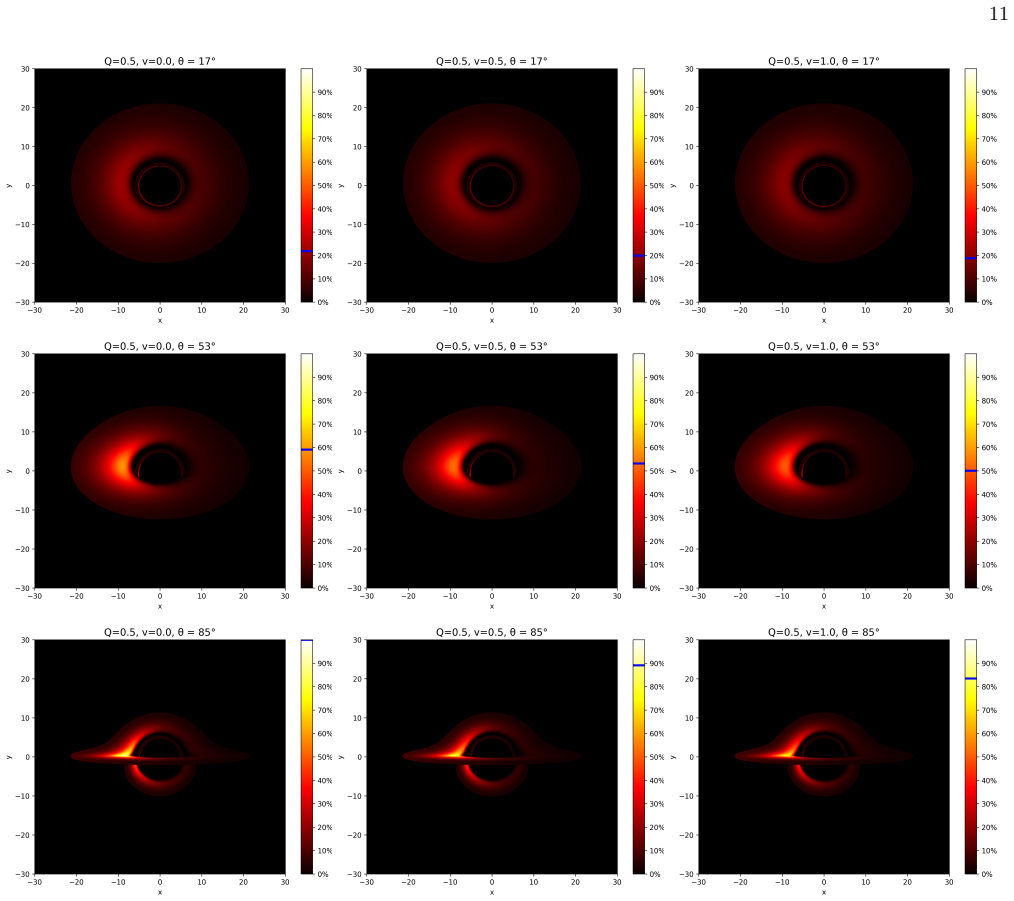
The paper's central claim is that in the ModMax black hole spacetime $f(r)=1-2M/r+e^{-v}Q^2/r^2$, the parameters $Q$ and $v$ leave opposite imprints on observables: increasing $Q$ decreases the horizon, photon-sphere, and shadow radii, while increasing $v$ pushes all three back toward their Schwarzschild values because $v$ exponentially screens the charge. Using the EHT shadow angular diameters for M87* and Sgr A*, GRAVITY's mass and distance measurements for Sgr A*, and an MCMC fit to the four parameters $(M,D,Q,v)$, the paper finds best-fit values of $Q$ and $v$ consistent with zero and derives 95% upper limits, the tightest being $Q<0.391$ from M87* and $v<4.153$ from Sgr A* GRAVITY data. In the ray-traced thin-disk images, the observed flux increases with $Q$ and slightly decreases with $v$; at $85^\circ$ inclination the Schwarzschild image reaches about 65% of the $Q=1$, $v=1$ reference brightness, and at fixed $Q=0.5$ the $v=1$ image is about 85% as bright as the $v=0$ image.
Load-bearing premise
The whole constraint rests on assuming the observed bright ring has the same angular size as the theoretical shadow of a static, spherically symmetric ModMax black hole; if the glowing accretion flow shifts the apparent ring size, the quoted limits shift with it.
Editorial extensions
If this is right
- The EHT and GRAVITY data, under the paper's shadow-diameter mapping, exclude ModMax charges $Q\gtrsim0.4$ and nonlinearity parameters $v\gtrsim4.2$ at 95% credibility for the two supermassive black holes studied.
- M87* gives the tighter charge bound, while Sgr A* GRAVITY data give the tighter $v$ bound, so combining shadow and astrometric data sets does more than repeating the same measurement.
- A larger total charge makes the shadow smaller and the disk brighter, so the same ModMax parameters that would hide the shadow would make the accretion flow easier to see.
- The best-fit mass and distance recovered from the MCMC agree with the independently measured values, indicating the constraints are not driven by forcing the masses away from their observed values.
- Because increasing $v$ shifts observables back toward Schwarzschild values, large $v$ values are harder to exclude than large $Q$ values; the data bound $v$ from above at $4.153$.
Reading between the lines
- The paper leaves implicit that, since $v$ enters only through $e^{-v}Q^2$, the constraints really bound the screened charge combination, not $Q$ and $v$ separately; a large charge hidden behind a large $v$ remains compatible with the data and would require a different probe to uncover.
- The monotone increase of disk flux with $Q$ suggests that continuum spectra of bright, well-modeled accretion disks could provide an independent test of ModMax-like charge, something the paper does not fit.
- A next-generation interferometric image resolving the photon ring rather than the shadow edge could directly test the assumed equality between observed ring diameter and the photon-sphere shadow diameter, potentially tightening or overturning the quoted limits.
- The same MCMC pipeline could be applied to other nonlinear electrodynamics metrics that reduce to the same screened-charge form, giving a uniform comparison of observational bounds.
Editorial analysis
A structured set of objections, weighed in public.
Referee Report
Summary. The paper studies a static, spherically symmetric ModMax black hole with metric function f(r)=1-2M/r+e^{-v}Q^2/r^2, computes the photon-sphere and shadow radii, and uses EHT shadow-size measurements of M87* and Sgr A* together with GRAVITY mass and distance determinations to fit the parameters (M,D,Q,v) via MCMC with emcee. The reported headline constraints are Q<0.391 and v<4.153 at 95% credibility. The paper also constructs Novikov-Thorne thin-disk flux and temperature profiles and produces backward ray-traced images, finding that the observed disk brightness increases with Q and slightly decreases with v.
Significance. If the reported separate constraints on Q and v were data-driven, the paper would provide a useful observational test of ModMax nonlinear electrodynamics. The geodesic, shadow, and ray-tracing calculations are standard and appear correctly implemented, and the qualitative dependence of the shadow radius on the model parameters is a helpful illustration. However, the central quantitative claim is undermined by an exact parameter degeneracy: every observable considered depends only on the combination C=Q^2 e^{-v}, so the separate 95% upper limits on Q and v are prior artifacts rather than independent measurements. The GRAVITY-only posterior presented in Table II and Fig. 3 is also not defined by the stated likelihood, since Table I lists no shadow diameter for that row. The disk-flux results inherit the same degeneracy. With a reparameterization in terms of C and a clarification of the data entering each posterior, the paper could become a valid constraint study; in its present form the headline claims are not supported.
major comments (3)
- [Section III, Eqs. (19), (31), (36), (38)] The metric (19) contains Q and v only through the combination C=Q^2 e^{-v}. Therefore the photon-sphere radius, the shadow radius R_sh in Eq. (31), and the likelihood in Eq. (36) are all invariant along lines of constant C. The MCMC posterior is hence completely flat in the degenerate direction, and the separate 95% upper limits in Table II are projections of the arbitrary uniform prior (38) onto the Q and v axes. For any allowed effective charge C, one can move to Q=sqrt(C e^v) with v up to -ln C without changing the likelihood at all; the reported v<4.153 limit simply reflects the prior boundary Q<=1. The abstract's claim of 'strongest upper limits' on Q and v is therefore not supported by the data. The authors should reparameterize the analysis to constrain C directly, or explicitly identify an observable that separates Q from v; none is presented. The same degeneracy affects the accretion-disk analysis in Section IV, since F(r) also depends only on C.
- [Table I and Section III] The 'Sgr A* (GRAVITY)' row in Table I has no angular shadow diameter (em dash), so the log-likelihood (36) cannot be evaluated for that dataset. Nevertheless, Table II and Fig. 3 report a posterior labeled 'Sgr A* (GRAVITY)' with best-fit values and v<4.153. Either the GRAVITY-only analysis silently used the EHT shadow diameter together with the GRAVITY mass and distance, in which case the labeling is incorrect, or the likelihood was constructed differently and its definition is missing. The paper must specify exactly which value of theta_sh and sigma_sh enters each of the four posterior rows and justify the label.
- [Section III, Eq. (35) with Table I] The analysis equates the EHT-measured ring angular diameter theta_sh with the photon-sphere shadow radius of the static, spherically symmetric ModMax metric. This mapping is a strong simplification: the EHT ring size depends on the accretion flow morphology, the black hole spin, and the emission region, and the ring is not identical to the photon-sphere shadow. Because the Gaussian uncertainties in Table I are at the few-percent level, a systematic error of that order could shift the reported bounds by more than their statistical uncertainty. The authors should either use a more conservative shadow-size likelihood informed by EHT image modeling, or add and propagate a systematic error term and discuss its effect on the limits.
minor comments (6)
- [Eq. (3)] Equation (3) writes F_{\mu\nu} as \partial_\mu A_\nu \partial_\nu A_\mu without the antisymmetrization; it should be F_{\mu\nu}=\partial_\mu A_\nu - \partial_\nu A_\mu.
- [Abstract and Table II] The abstract uses '95% credible level' while Table II and Fig. 3 use '95% confidence level'; please choose one terminology consistently.
- [Table II] The combined Sgr A* (EHT+GRAVITY) upper limit on v (4.277) is weaker than the GRAVITY-only limit (4.153), which is unexpected for a combined dataset and is likely a further symptom of the degeneracy; this should be discussed or explained.
- [References] References [7] and [66] are the same paper (H. M. Siahaan, Phys. Lett. B865, 139479 (2025), arXiv:2409.13967); please merge them or distinguish the specific results being cited.
- [Section IV, Eq. (46)] The redshift factor in Eq. (46) uses \Omega without explicitly noting that it is the circular-orbit angular velocity from Eq. (43); please define it just before or within the equation.
- [Throughout] The collaboration name appears as 'GRA VITY' with a space in several places (e.g., Introduction and Table I caption); it should be 'GRAVITY'.
Circularity Check
Separate Q and v upper limits are not identifiable: the likelihood depends only on C=Q²e^{-v}, so the headline v<4.153 (and Q<0.391) are largely projections of the adopted uniform prior, not independent data-driven constraints.
-
self definitional
[Section III, Eqs. (19), (31), (35), (36), (38); Table II]
"f(r)=1−2M/r+e^{-v}Q²/r² ... R_sh=b_c=r_ph/√f(r_ph) ... θsh=R_sh 2GM/(c²D) ... logL(M,D,Q,v)=−1/2[(θtheory_sh(M,D,Q,v)−θobs_sh)/σobs_sh]^2 ... π(Q,v)=1, 0≤Q≤1, 0≤v≤10. ... v(95% C.L.): v<4.153."
The metric (19) enters every shadow observable only through C=Q²e^{-v}; thus R_sh in (31), θsh in (35), and the likelihood (36) are invariant along curves of constant C. The posterior (39) is therefore the uniform prior (38) times a 1D likelihood on C, so Q and v are not separately identifiable from the EHT/GRAVITY shadow size. The reported 95% upper limits in Table II, including the headline v<4.153, are the prior box projected along the degenerate direction (with Q≤1 imposing v≲−ln C), not an independent measurement of v. Changing the Q prior would move the v bound; the 'prediction' is constructed from the prior input rather than derived from the data alone.
full rationale
The only substantial circular/constructed step is the separate Q and v bounds. Because f(r) depends on the combination Q²e^{-v}, the shadow radius, angular diameter, likelihood, and disk flux all depend only on C. The MCMC therefore constrains C (together with M and D); the marginal credible intervals on Q and v are prior-dominated, so the abstract's claim of 'Q<0.391 and v<4.153' as separate constraints reduces by construction to the choice of the uniform prior in Eq. (38). This is a partial circularity: the headline numbers are not free-standing empirical limits. In addition, Table I lists no θ_sh for the Sgr A* (GRAVITY) row, yet Table II reports the tightest v bound from that row; Eq. (36) cannot produce a Q,v constraint without a shadow measurement, so either an unstated EHT shadow value was reused or that row is unsupported. No load-bearing self-citation chain was found: the cited ModMax metric and ray-tracing method come from prior literature, and the authors' own earlier papers are used as methodology rather than as the sole justification of the central result. The disk-image section is a standard forward-model application and is not self-referential. Score 6 reflects the reduction of the main parameter-constraint claim to a prior-dependent degeneracy, while acknowledging that the underlying C constraint and disk calculations are not circular.
Assumptions & free parameters
free parameters (5)
- Q (total dyonic charge) =
0.00092 or 0.00128 depending on dataset; 95% upper limit 0.391
- v (ModMax nonlinearity parameter) =
0.00243-0.00346; 95% upper limit 4.153
- M (black hole mass) =
varies per dataset, consistent with priors
- D (distance) =
varies per dataset
- M_dot0 (mass accretion rate)
assumptions (4)
- domain assumption ModMax Lagrangian (Eq. 1) is the correct nonlinear electrodynamics theory and the static spherically symmetric solution (Eq. 19) is the corresponding black hole metric.
- domain assumption The EHT observed angular diameter theta_sh equals the photon-sphere shadow angular diameter R_sh * 2GM/(c^2 D).
- domain assumption The Novikov-Thorne thin-disk model (Eq. 40) describes the accretion flow around M87* and Sgr A*.
- ad hoc to paper Uniform priors Q in [0,1], v in [0,10] (Eq. 38) are appropriate bounds for the model parameters.
Cite this review
Pith. "Pith review of Constraining ModMax Black Holes with EHT and GRAVITY Observations: Optical Signatures and Accretion Disk Properties." pith.science (2026). https://pith.science/paper/LGVGWEZ2
@misc{pith2026260810859,
  author       = {Pith},
  title        = {Pith review of: Constraining ModMax Black Holes with EHT and GRAVITY Observations: Optical Signatures and Accretion Disk Properties},
  year         = {2026},
  howpublished = {\url{https://pith.science/paper/LGVGWEZ2}},
  note         = {Machine review of arXiv:2608.10859}
}
abstract
In this work, we study photon propagation and the radiative properties of a thin accretion disk around a ModMax black hole and examine the effects of the charge $Q$ (i.e. $Q^2 = Q^2_e +Q^2_m$ is the total dyonic charge, with $Q_e$ and $Q_m$ denoting the electric and magnetic charges, respectively) and the nonlinearity parameter $v$. We determine the event-horizon, photon-sphere, and shadow radii and find that increasing $Q$ decreases these radii, whereas increasing $v$ shifts them toward their Schwarzschild values. Using the EHT shadow measurements of M87$^\star$ and Sgr~A$^\star$, together with the available mass and distance measurements, we perform an MCMC analysis to constrain the ModMax parameters. The strongest upper limits are found to be $Q<0.391$ and $v<4.153$ at the 95\% credible level. We also investigate a Novikov-Thorne thin accretion disk and generate simulated disk images using backward ray tracing. The observed flux increases with $Q$, while increasing $v$ produces a slight decrease in the disk brightness. These results show how the ModMax parameters affect the black-hole shadow and thin-disk emission and provide observational constraints on $Q$ and $v$.
Figures


Figures from the paper (3 more)


Reference graph
Works this paper leans on
-
[1]
Y. Ni, J. Jiang, and C. Bambi, JCAP09, 014 (2016), arXiv:1607.04893 [gr-qc]
arXiv 2016
-
[2]
P. Sheoran, A. Herrera-Aguilar, and U. Nucamendi, Phys. Rev. D97, 124049 (2018), arXiv:1712.03344 [gr- qc]
arXiv 2018
-
[3]
S. E. Gralla, A. Lupsasca, and D. P. Marrone, Phys. Rev. D102, 124004 (2020), arXiv:2008.03879 [gr-qc]
arXiv 2020
-
[4]
S. E. Gralla, D. E. Holz, and R. M. Wald, Phys. Rev. D 100, 024018 (2019), arXiv:1906.00873 [astro-ph.HE]. 10 FIG. 5. Observed flux distributionsF obs in the direct and secondary images of a thin accretion disk around a ModMax BH forθ= 17 ◦,θ= 53 ◦, andθ= 85 ◦. The total charge is varied asQ= 0,Q= 0.5, andQ= 1, while the nonlinearity parameter is fixed atv= 1
arXiv 2019
-
[5]
D. Flores-Alfonso, B. A. Gonz´ alez-Morales, R. Linares, and M. Maceda, Phys. Lett. B812, 136011 (2021), arXiv:2011.10836 [gr-qc]
arXiv 2021
- [6]
-
[8]
R. C. Pantig, L. Mastrototaro, G. Lambiase, and A. ¨Ovg¨ un, Eur. Phys. J. C82, 1155 (2022), arXiv:2208.06664 [gr-qc]
arXiv 2022
-
[9]
J. Barrientos, A. Cisterna, D. Kubiznak, and J. Oliva, Phys. Lett. B834, 137447 (2022), arXiv:2205.15777 [gr- qc]
arXiv 2022
Show all 78 references
-
[10]
Eslam Panah and N
B. Eslam Panah and N. Heidari, JHEAp45, 181 (2025)
2025
-
[11]
Sekhmani, S
Y. Sekhmani, S. K. Maurya, J. Rayimbaev, M. Altanji, I. Ibragimov, and S. Muminov, Phys. Dark Univ.50, 102079 (2025)
2025
-
[12]
Tsukamoto, Z
N. Tsukamoto, Z. Li, and C. Bambi, JCAP06, 043 (2014), arXiv:1403.0371 [gr-qc]
2014 arXiv
-
[13]
Wei, Y.-C
S.-W. Wei, Y.-C. Zou, Y.-X. Liu, and R. B. Mann, JCAP 08, 030 (2019), arXiv:1904.07710 [gr-qc]
2019 arXiv
-
[14]
Psaltis, C
D. Psaltis, C. Talbot, E. Payne, and I. Mandel, Phys. Rev. D103, 104036 (2021), arXiv:2012.02117 [gr-qc]
2021 arXiv
-
[15]
Jiang, C
J. Jiang, C. Bambi, and J. F. Steiner, JCAP05, 025 (2015), arXiv:1406.5677 [gr-qc]
2015 arXiv
-
[16]
Jiang, C
J. Jiang, C. Bambi, and J. F. Steiner, Astrophys. J.811, 130 (2015), arXiv:1504.01970 [gr-qc]
2015 arXiv
-
[17]
J. Wang, A. B. Abdikamalov, D. Ayzenberg, C. Bambi, T. Dauser, J. A. Garc ´ ıa, S. Nampalliwar, and J. F. Steiner, JCAP05, 026 (2020), arXiv:1806.00126 [gr-qc]
2020 arXiv
-
[18]
Tripathi, S
A. Tripathi, S. Nampalliwar, A. B. Abdikamalov, D. Ayzenberg, J. Jiang, and C. Bambi, Phys. Rev. D 98, 023018 (2018), arXiv:1804.10380 [gr-qc]. 11 FIG. 6. Observed flux distributionsF obs in the direct and secondary images of a thin accretion disk around a ModMax BH forθ= 17 ◦...
2018 arXiv
-
[19]
Tripathi, A
A. Tripathi, A. B. Abdikamalov, D. Ayzenberg, C. Bambi, V. Grinberg, H. Liu, and M. Zhou, JCAP 01, 019 (2022), arXiv:2106.10982 [astro-ph.HE]
2022 arXiv
-
[20]
Akiyamaet al.(Event Horizon Telescope), Astrophys
K. Akiyamaet al.(Event Horizon Telescope), Astrophys. J. Lett.875, L1 (2019), arXiv:1906.11238 [astro-ph.GA]
2019 arXiv
-
[22]
Akiyamaet al.(Event Horizon Telescope), Astrophys
K. Akiyamaet al.(Event Horizon Telescope), Astrophys. J. Lett.930, L12 (2022), arXiv:2311.08680 [astro-ph.HE]
2022 arXiv
-
[23]
Akiyamaet al.(Event Horizon Telescope), Astrophys
K. Akiyamaet al.(Event Horizon Telescope), Astrophys. J. Lett.930, L17 (2022), arXiv:2311.09484 [astro-ph.HE]
2022 arXiv
-
[24]
Sturmet al.(GRA VITY), Nature (London)563, 657 (2018), arXiv:1811.11195 [astro-ph.GA]
E. Sturmet al.(GRA VITY), Nature (London)563, 657 (2018), arXiv:1811.11195 [astro-ph.GA]
2018 arXiv
-
[25]
Abuteret al.(GRA VITY), Astron
R. Abuteret al.(GRA VITY), Astron. Astrophys.636, L5 (2020), arXiv:2004.07187 [astro-ph.GA]
2020 arXiv
-
[26]
M. D. Johnsonet al., Galaxies11, 61 (2023), arXiv:2304.11188 [astro-ph.HE]
2023 arXiv
-
[27]
Uniyal, I
A. Uniyal, I. K. Dihingia, Y. Mizuno, and L. Rezzolla, Nature Astron.1, 8 (2025), arXiv:2511.03789 [gr-qc]
2025
-
[28]
B. P. Kosyakov, Phys. Lett. B810, 135840 (2020), arXiv:2007.13878 [hep-th]
2020 arXiv
-
[29]
D. P. Sorokin, Fortsch. Phys.70, 2200092 (2022), arXiv:2112.12118 [hep-th]
2022 arXiv
-
[30]
J. G. Russo and P. K. Townsend, JHEP06, 191 (2024), arXiv:2404.09994 [hep-th]
2024 arXiv
-
[31]
Eslam Panah, Phys
B. Eslam Panah, Phys. Lett. B868, 139711 (2025), arXiv:2507.05864 [gr-qc]
2025 arXiv
-
[32]
Guzman-Herrera and N
E. Guzman-Herrera and N. Breton, JCAP01, 041 (2024), arXiv:2308.12572 [gr-qc]
2024 arXiv
-
[33]
Amirabi, Annals Phys.443, 168990 (2022)
Z. Amirabi, Annals Phys.443, 168990 (2022)
2022
-
[34]
M. R. Shahzad, R. H. Ali, G. Abbas, and W.-X. Ma, Eur. Phys. J. Plus139, 453 (2024)
2024
-
[35]
Al-Badawi, Y
A. Al-Badawi, Y. Sekhmani, and K. Boshkayev, Phys. Dark Univ.48, 101865 (2025). 12
2025
-
[36]
Hassanabadi, A
H. Hassanabadi, A. Guvendi, D. J. Gogoi, S. G. Dogan, and F. Hosseinifar, (2026), arXiv:2606.28468 [gr-qc]
2026 arXiv
-
[37]
Jafarzade, Z
K. Jafarzade, Z. Bazyar, and M. Jamil, Phys. Lett. B 864, 139390 (2025), arXiv:2411.15757 [gr-qc]
2025 arXiv
-
[38]
Hoshimov, A
H. Hoshimov, A. Davlataliev, F. Atamurotov, A. Abdu- jabbarov, and A. ¨Ovg¨ un, JHEAp45, 306 (2025)
2025
-
[39]
Karshiboev, F
K. Karshiboev, F. Atamurotov, A. ¨Ovg¨ un, A. Abdujab- barov, and E. Karimbaev, New Astron.109, 102200 (2024)
2024
-
[40]
Sharipov, M
J. Sharipov, M. Alloqulov, P. Sheoran, and S. Shayma- tov, Chin. J. Phys.99, 461 (2026)
2026
-
[41]
A. A. Nucita, F. De Paolis, G. Ingrosso, A. Qadir, and A. F. Zakharov, PASP119, 349 (2007), arXiv:0705.0494 [astro-ph]
2007 arXiv
-
[42]
Optical properties of euler-heisenberg black hole in the cold dark matter halo,
L. You, R. bo Wang, S.-J. Ma, J.-B. Deng, and X.-R. Hu, “Optical properties of euler-heisenberg black hole in the cold dark matter halo,” (2024), arXiv:2403.12840 [gr-qc]
2024 arXiv
-
[43]
A. M. Ghez, S. Salim, S. D. Hornstein, A. Tanner, J. R. Lu, M. Morris, E. E. Becklin, and G. Duchˆ ene, Astro- phys. J.620, 744 (2005), arXiv:astro-ph/0306130 [astro- ph]
2005 arXiv
-
[44]
A. M. Ghez, M. Morris, E. E. Becklin, A. Tanner, and T. Kremenek, Nature407, 349 (2000), arXiv:astro- ph/0009339 [astro-ph]
2000
-
[45]
˙I. ˙I. C ¸ imdiker, A.¨Ovg¨ un, and D. Demir, Class. Quantum Gravity40, 184001 (2023), arXiv:2308.03947 [gr-qc]
2023 arXiv
-
[46]
Vagnozzi, R
S. Vagnozzi, R. Roy, Y.-D. Tsai, L. Visinelli, M. Afrin, A. Allahyari, P. Bambhaniya, D. Dey, S. G. Ghosh, P. S. Joshi, K. Jusufi, M. Khodadi, R. K. Walia, A. vgn, and C. Bambi, Class. Quantum Gravity40, 165007 (2023)
2023
-
[47]
Afrin, S
M. Afrin, S. Vagnozzi, and S. G. Ghosh, Astrophys. J. 944, 149 (2023)
2023
-
[48]
Shaymatov, K
S. Shaymatov, K. Jusufi, M. Alloqulov, and B. Ahmedov, Eur. Phys. J. Plus138, 997 (2023)
2023
-
[49]
Boshkayev, A
K. Boshkayev, A. Idrissov, O. Luongo, and D. Mala- farina, Mon. Not. Roy. Astron. Soc.496, 1115 (2020), arXiv:2006.01269 [astro-ph.HE]
2020 arXiv
-
[50]
L. G. Collodel, D. D. Doneva, and S. S. Yazadjiev, As- trophys. J.910, 52 (2021)
2021
-
[51]
Alloqulov, S
M. Alloqulov, S. Shaymatov, B. Ahmedov, and A. Jawad, Chin. Phys. C48, 025101 (2024)
2024
-
[52]
Boshkayev, T
K. Boshkayev, T. Konysbayev, E. Kurmanov, O. Lu- ongo, D. Malafarina, and H. Quevedo, Phys. Rev. D 104(2021), 10.1103/physrevd.104.084009
2021 doi
-
[53]
S. Hu, C. Deng, S. Guo, X. Wu, and E. Liang, Eur. Phys. J. C83, 264 (2023)
2023
-
[54]
Alloqulov and S
M. Alloqulov and S. Shaymatov, Eur. Phys. J. Plus139, 731 (2024)
2024
-
[55]
Y.-H. Cui, S. Guo, Y.-X. Huang, Y. Liang, and K. Lin, Eur. Phys. J. C84, 772 (2024), arXiv:2408.03387 [gr-qc]
2024 arXiv
-
[56]
Mirkhaydarov, M
M. Mirkhaydarov, M. Alloqulov, and S. Shaymatov, Chin. Phys. C49, 125107 (2025)
2025
-
[57]
Z. Cai, Z. Ban, L. Wang, H. Feng, and Z.-W. Long, J. Cosmol. Astropart. Phys.2025, 101 (2025)
2025
-
[58]
Nozari, S
K. Nozari, S. Saghafi, and F. Aliyan, Eur. Phys. J. C 85, 735 (2025), arXiv:2506.17986 [gr-qc]
2025 arXiv
-
[59]
Igata, M
T. Igata, M. Omamiuda, and Y. Takamori, Phys. Rev. D111, 084062 (2025), arXiv:2502.11755 [gr-qc]
2025 arXiv
-
[60]
Xamidov, J
T. Xamidov, J. Sharipov, and S. Shaymatov, arXiv e- prints , arXiv:2509.10953 (2025), arXiv:2509.10953 [gr- qc]
2025 arXiv
-
[61]
Sharipov, P
J. Sharipov, P. Sheoran, and S. Shaymatov, arXiv e- prints , arXiv:2603.25210 (2026), arXiv:2603.25210 [gr- qc]
2026
-
[62]
Dadhich and S
N. Dadhich and S. Shaymatov, Phys. Dark Universe35, 100986 (2022), arXiv:2104.00427 [gr-qc]
2022 arXiv
-
[63]
Dadhich and S
N. Dadhich and S. Shaymatov, Int. J. Mod. Phys. D31, 2150120 (2022)
2022
-
[64]
Bandos, K
I. Bandos, K. Lechner, D. Sorokin, and P. K. Townsend, JHEP03, 022 (2021), arXiv:2012.09286 [hep-th]
2021 arXiv
-
[65]
Ballon Bordo, D
A. Ballon Bordo, D. Kubizˇ n´ ak, and T. R. Perche, Phys. Lett. B817, 136312 (2021), arXiv:2011.13398 [hep-th]
2021 arXiv
-
[66]
H. M. Siahaan, Phys. Lett. B865, 139479 (2025), arXiv:2409.13967 [gr-qc]
2025 arXiv
-
[67]
S. Chandrasekhar,General Relativity and Gravitation: Invited Papers and Discussion Reports of the 10th In- ternational Conference on General Relativity and Grav- itation, Padua, July 3–8, 1983, edited by B. Bertotti, F. de Felice, and A. Pascolini (Springer Netherlands, Dordre...
1983
-
[68]
C. W. Misner, K. S. Thorne, and J. A. Wheeler,Gravi- tation(W. H. Freeman, San Francisco, 1973)
1973
-
[69]
J.875, L6 (2019), arXiv:1906.11243 [astro- ph.GA]
Event Horizon Telescope Collaboration and Akiyama, Astrophys. J.875, L6 (2019), arXiv:1906.11243 [astro- ph.GA]
2019 arXiv
-
[70]
Akiyama, Astrophys
Event Horizon Telescope Collaboration and K. Akiyama, Astrophys. J. Lett.930, L12 (2022)
2022
-
[71]
Abd El Dayem, Astron
Gravity Collaboration and K. Abd El Dayem, Astron. Astrophys.692, A242 (2024), arXiv:2409.12261 [astro- ph.GA]
2024 arXiv
-
[72]
Foreman-Mackey, D
D. Foreman-Mackey, D. W. Hogg, D. Lang, and J. Goodman, Publ. Astron. Soc. Pac.125, 306 (2013), arXiv:1202.3665 [astro-ph.IM]
2013 arXiv
-
[73]
I. D. Novikov and K. S. Thorne,Les Houches Summer School of Theoretical Physics: Black Holes, , 343 (1973)
1973
-
[74]
N. I. Shakura and R. A. Sunyaev, Astron. Astrophys.24, 337 (1973)
1973
-
[75]
K. S. Thorne, Astrophys. J.191, 507 (1974)
1974
-
[76]
S. L. Shapiro and S. A. Teukolsky,Black Holes, White Dwarfs, and Neutron Stars(John Wiley & Sons, New York, 1983)
1983
-
[77]
Shaymatov, P
S. Shaymatov, P. Sheoran, and S. Siwach, Phys. Rev. D 105, 104059 (2022), arXiv:2110.10610 [gr-qc]
2022 arXiv
-
[78]
Heydari-Fard, S
M. Heydari-Fard, S. G. Honarvar, and M. Heydari- Fard, Mon. Not. Roy. Astron. Soc.521, 708 (2023), arXiv:2210.04173 [gr-qc]
2023 arXiv
-
[79]
J. P. Luminet, Astron. Astrophys.75, 228 (1979)
1979
-
[80]
Sharipov, T
J. Sharipov, T. Xamidov, Q. Wu, S. Shaymatov, and T. Zhu, Chinese Physics C50, 085105 (2026), arXiv:2511.10043 [gr-qc]
2026
Reviewed August 12, 2026 · model on record in the stance chip above.
Discussion (0). Continue with ORCID to comment.