REVIEW 5 major objections 6 minor
Flex-$\pi$: A Multi-Stream World-Action Model with Compute Flexibility
T0 review · 5 major / 6 minor · reviewed 2026-08-12 · deepseek-v4-flash
Pith's one-line read The paper shows that a frozen video-generation VAE that encodes RGB also encodes 3D pointmaps almost losslessly, letting a world-action model be supervised on RGB, 3D geometry, and semantics with no extra sensors or latency.
desk verdict A serious WAM systems paper with a plausible free-lunch claim, but the two load-bearing assertions—VAE pointmap encoding and stream-attribution—need stronger support before the 2-7x margins can be taken at face value. read the letter →
The pith
A machine-rendered reading of the paper's core claim, the machinery that carries it, and where it could break.
The reading
What carries the argument
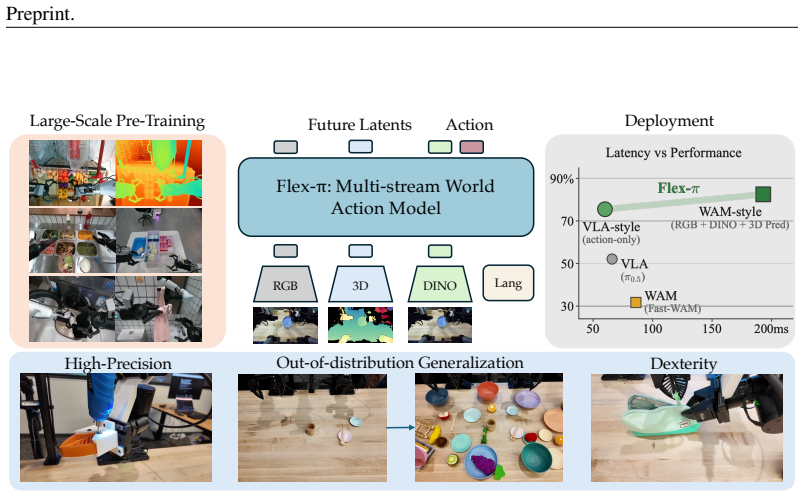
The load-bearing object is the shared latent space of the frozen Wan-2.2 video VAE, which maps both RGB frames and 3D pointmaps (dense per-pixel 3D coordinate images) to the same token space. Around it, Flex-π layers a Mixture-of-Transformers backbone—a shared visual transformer with a separate, narrower action expert—that jointly denoises all four streams under a flow-matching loss, with stream-specific adapters mapping DINO features and actions into and out of the trunk. The training regime that makes compute flexibility possible is per-stream dropout with cross-modality forcing: input presence masks and output attention masks are drawn independently per sample, so a stream absent from the input is still generated, and a single checkpoint can be invoked at inference with any subset of visual inputs and outputs.
What would settle it
The decisive check is to run the Figure 11a ablation at full scale: fine-tune the 6B model with video-only supervision, with video plus DINO, and with all three streams, using the same AGIBOT World pre-training and real-world fine-tuning protocol. If the success gap from adding pointmaps and DINO does not persist at this scale, the paper's attribution of Flex-π's gains to multi-stream world-action supervision would not be supported.
Extended reading notes
Core claim
The central discovery is that the latent space of a video-generation VAE is not specific to RGB: the frozen Wan-2.2 VAE used by Flex-π reconstructs 3D pointmaps with PSNR around 38 and MSE around 0.0001, even though it was only ever trained to reconstruct images. Because pointmaps are image-shaped, the same encoder, the same latent tokens, and the same decoder handle both modalities in a shared space, so a world-action model can be trained to denoise future pointmaps alongside future RGB latents and DINO semantic tokens without any modality-specific autoencoder. Flex-π couples this with per-stream input dropout and cross-modality forcing: each visual stream is dropped from the input half the time but is still always denoised at the output, so the model must predict every modality from the others. The paper argues that this produces a stronger internal representation for action generation, and that the resulting policy is exceptionally demonstration-efficient and robust to distribution shift.
Load-bearing premise
The paper assumes that the gains from the DINO and pointmap streams, measured in small from-scratch RoboTwin ablations, transfer to the full 6B model pre-trained on AGIBOT World and fine-tuned on real bimanual tasks.
Editorial extensions
If this is right
- One trained checkpoint covers the whole latency–accuracy frontier: action-only runs at about 60 ms per call, while full joint generation costs about 193 ms and adds roughly 24 points of success in the RoboTwin ablation sweep.
- Demonstration efficiency improves sharply: at 50 demonstrations per task in RoboTwin, Flex-π reaches 78.8% success versus 31.4% for π0.5, and the gap narrows as data increases.
- Depth sensing is optional at deployment: withholding the pointmap input on Put Plate on Rack costs only about 3 points, because cross-modality forcing lets the model generate geometry from RGB and DINO.
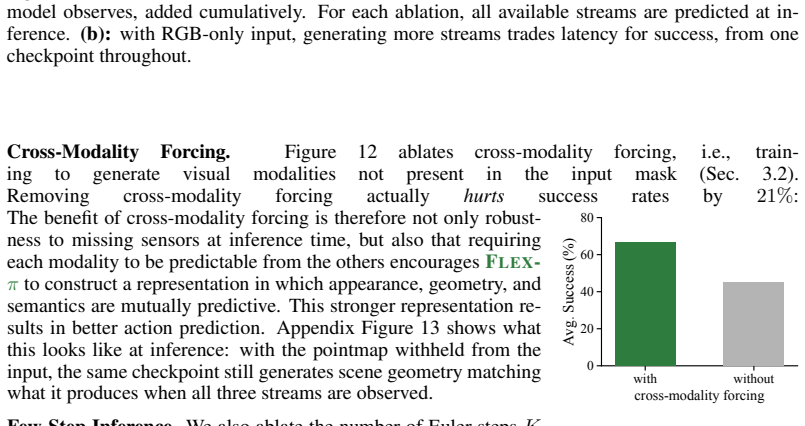
- Additional visual streams matter mainly through training supervision, not at test time: removing cross-modality forcing drops RoboTwin success by about 21%, and removing the pointmap stream from training costs about 20%.
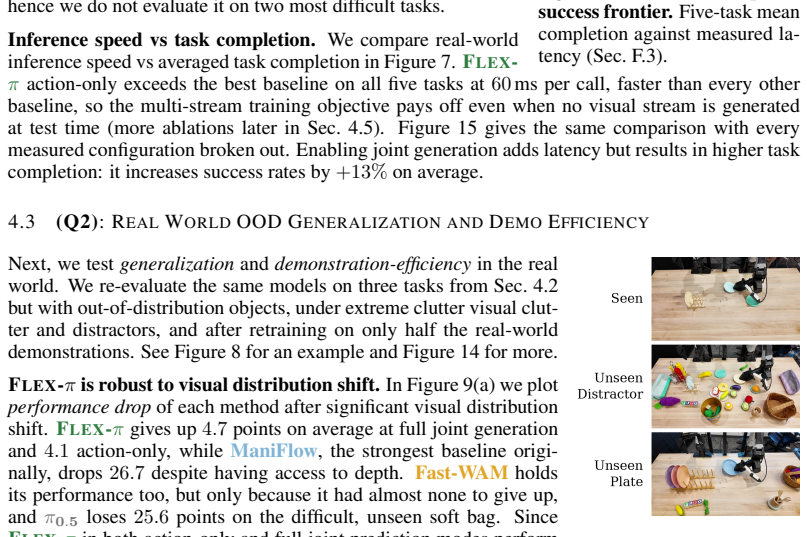
- Out-of-distribution robustness improves: under unseen objects and distractors, Flex-π drops about 4–5 points while the strongest baseline, ManiFlow, drops 26.7 points despite having depth input.
Reading between the lines
- If the free-lunch VAE phenomenon is general, other video-generation VAEs may also encode depth, normal maps, or segmentation maps with little retraining; that would make multi-modal world-action supervision a cheap add-on for existing video-pretrained policies.
- The compute-flexibility design suggests an adaptive deployment policy: a robot could run action-only for routine subtasks and switch on joint generation for high-risk phases, reallocating latency only where it buys safety.
- A testable extension, not stated in the paper, is to use the pointmap stream as a self-supervised 3D pretraining signal for vision-language-action models that currently require explicit depth encoders, potentially replacing them with a frozen RGB VAE.
- The from-scratch ablation scale leaves open whether pre-training data volume, rather than the multi-stream objective, explains part of the real-robot gains; a full-scale controlled comparison would settle which factor dominates.
Editorial analysis
A structured set of objections, weighed in public.
Referee Report
Summary. The paper introduces FLEX-π, a 6B-parameter world-action model that jointly denoises latent streams for RGB, 3D pointmaps, and DINO semantic features alongside actions. The core empirical claim is that a frozen video-generation VAE (Wan-2.2) encodes 3D pointmaps almost losslessly even though it was trained only on RGB, so the same latent space can supervise geometry and semantics without new sensors, new pre-training, or added inference latency. The model uses per-stream dropout and cross-modality forcing to make a single checkpoint switchable between action-only and full-joint generation at deployment. Experiments cover RoboTwin, LIBERO, LIBERO-Plus, and five real-world bimanual tasks, with claims of large gains over VLA and WAM baselines, particularly in low-data regimes. The paper also provides a detailed latency-optimization ladder showing that action-only inference is faster than π0.5 and that joint generation trades latency for success.
Significance. If the central claims hold, the paper would make a valuable empirical contribution: it identifies a genuinely unexpected property of a frozen RGB-trained VAE, and it shows a practical way to inject geometric and semantic supervision into world-action models without any extra deployment cost. The paper is unusually careful in several respects: the training hyperparameters are fixed a priori and not fitted to the headline results; the K=4 Euler-step choice is selected by an explicit sweep on a separate benchmark, not tuned on the real-world tasks; the latency comparisons use a transparent optimization ladder with numerical fidelity checks; and the appendices give enough implementation detail to reproduce the main pipeline. The real-world evaluation is also broader than typical, with partial-credit rubrics and out-of-distribution conditions.
major comments (5)
- [Sec. 4.5, Figure 11a] The paper's central policy-level claim—that the DINO and pointmap streams causally produce the large simulation and real-world gains—relies on ablations run from scratch on five RoboTwin tasks with 50 demonstrations and 5 epochs, while the headline results use a 6B model pre-trained on AGIBOT World and then fine-tuned. Nothing in the paper shows that the +6.8% (DINO) and +20% (pointmap) stepwise gains, or the 21% cross-modality-forcing effect in Figure 12, survive initialization from the pretrained checkpoint. If the pretrained model already encodes geometry and semantics through its video prior, the extra streams may contribute little, and the 2–7× real-world margins could be driven by pre-training scale, the MoT architecture, or fine-tuning protocol rather than by multi-stream supervision. This is a load-bearing assumption for the abstract's causal framing. A pretrained-initialized ablation on the same five-task recipe, or an explicit demonstration that from-scratch transfer is established elsewhere in the literature, would settle the point.
- [Sec. 3.1, Figure 3] The free-lunch claim—that the frozen Wan-2.2 VAE encodes 3D pointmaps 'almost losslessly' with no pointmap-specific training—is supported only by a single reconstructed pointmap image with PSNR 38 and MSE 0.0001. There is no dataset-wide error metric, no comparison against a pointmap-trained VAE, and no report of how the metric is computed (e.g., which views, which depth range, which spatial resolution). Because this claim is the foundation for the whole multi-stream supervision scheme, it needs a quantitative evaluation across a representative sample of the actual pre-training data (AGIBOT World) or a benchmark such as RoboTwin, including failure modes such as depth discontinuities and occluded regions. Without that, 'almost losslessly' is not established beyond a single anecdote.
- [Sec. 4.5, Figure 12] The cross-modality-forcing ablation is described by a single sentence: removing it 'hurt success rates by 21%.' The paper does not specify what 'without cross-modality forcing' means operationally—whether the output mask becomes tied to the input mask, whether a dropped input stream is also dropped from the loss, or whether the dropout probabilities change. Since this mechanism is one of the two key design choices (the other being the multi-stream supervision itself), the ablation needs a precise description of the control condition and ideally a second variant that dissociates the attention-mask effect from the loss-mask effect. The current presentation makes the 21% figure difficult to interpret or reproduce.
- [Sec. 4.2, Figure 6] The real-world comparison is weakened by selective baseline coverage: Fast-WAM is not evaluated on Self-Repair Gripper or Soft-Bag Zipping, with the justification that its performance on the other three tasks indicated it would not reach a scoreable level. This is a reasonable practical decision, but it means the 2–7× margins in the abstract are computed over different baseline sets on different tasks. The paper should state explicitly, for each task, which baselines contribute to the reported margins, and should report the corresponding per-task baseline set in the summary figure or a table. The current Figure 6 is visually clear but does not make this dependence transparent.
- [Sec. 4.4, Table 2] The LIBERO results are presented with a footnote-style distinction between FLEX-π and FLEX-π*, where the asterisk denotes fine-tuning without stream dropout. The headline claim that 'one FLEX-π checkpoint outperforms all existing VLA or WAM methods' is only true for FLEX-π* (99.2%), not for the flexible-dropout variant (98.5%), which is tied with or below several baselines. The abstract's phrase 'outperforms all existing VLA or WAM methods' should be qualified to distinguish the fixed-mode variant from the flexible-mode variant, or the claim should be restricted to the specific variant that actually achieves it.
minor comments (6)
- [Abstract and Sec. 4.2] The '2–7×' improvement is reported ambiguously: it is a ratio of success rates or task-completion scores, not a ratio of episode completions with a common baseline set. The abstract should specify what the denominator is, or the paper should cite the exact figure and baseline pairing.
- [Sec. 3] There are several typographical and formatting issues: 'readibility' appears in the problem statement, and the mathematical notation around Eq. (1) has an awkward nested expectation with a misplaced line break. These are minor but worth cleaning up.
- [Sec. 3.2, Figure 4] The 'cross-modality forcing' example in Figure 4 is difficult to parse: the caption says the pointmap input is not attended to, yet the joint generation 'still conditions on generated pointmap futures.' The arrow convention should be clarified, ideally with a one-sentence definition of what it means for a generated future to condition on another generated future that was not observed as input.
- [Sec. 4.1] The paper says Fast-WAM is 'not competitive on any of these tasks' and therefore omits it from the two most difficult real-world tasks. This is a legitimate choice, but the sentence should also state that Fast-WAM was nevertheless trained and evaluated on the other three tasks under the same protocol, so readers do not infer that it was skipped after an informal pilot.
- [Sec. B] The pre-training description says the pointmaps are annotated with Depth Anything 3 and 'tiled into the same three-view composite canvas.' It is not clear whether the same tiling and canvas resolution are used for the pointmap stream as for the RGB stream, which matters for the VAE encoding. A one-sentence clarification of the exact resolution and tiling would remove the ambiguity.
- [Sec. I.1] The K=1 column in Table 11 is described as a latency floor rather than an operating point, and the paper notes that success collapses to 51–53%. This is a useful honesty check, but the caption should also mention that the 49 ms at K=1 is not a deployable configuration, so readers do not misread it as part of the speed–accuracy frontier.
Circularity Check
No significant circularity: the 'free lunch' is an empirical observation, and the policy attribution rests on independent ablations rather than fitted or self-cited inputs.
full rationale
The paper's central claim—that the frozen Wan VAE encodes pointmaps—is an empirical measurement (Figure 3), not a consequence of how the VAE or pointmaps are defined: pointmaps come from the external Depth Anything 3 model and are not part of the VAE's training distribution, so the reconstruction result is not true by construction. The multi-stream policy gains are supported by ablations (Figures 11a, 12) that vary inputs and training rules while holding the task set fixed; these are independent measurements rather than fitted parameters renamed as predictions. Loss weights are fixed at 1, stream dropout probabilities are fixed at 0.5, and the K=4 Euler step count is a latency/success trade-off chosen by sweep, not a constant fit to the headline real-world results. The only self-citation is the ManiFlow baseline, which is used comparatively and was deliberately strengthened ('we ran ManiFlow both ways and found RGB plus pointmaps performs much better'), so it does not supply a load-bearing premise. Concerns that the from-scratch ablations may not transfer to the pre-trained model are external-validity issues, not circularity.
Assumptions & free parameters
free parameters (6)
- Per-stream input dropout probability p(observed) =
0.5
- Per-stream output attention probability p(read by action) =
0.5
- Loss weights λa, λo, λd, λp =
1.0 each
- Flow-matching shift =
6.0 visual, 1.0 action
- Pointmap depth clip =
2 m
- Euler steps K =
4
assumptions (5)
- domain assumption Depth Anything 3 produces metric pointmaps accurate enough to supervise policies.
- domain assumption DINOv3 features provide object-centric semantics that improve manipulation policy learning.
- ad hoc to paper From-scratch ablations transfer to the pre-trained model.
- domain assumption The frozen Wan-2.2 VAE latent space is well-conditioned for pointmap inputs.
- standard math Flow-matching Euler integration with K steps is a sufficient approximation of the generative path.
Cite this review
Pith. "Pith review of Flex-$\pi$: A Multi-Stream World-Action Model with Compute Flexibility." pith.science (2026). https://pith.science/paper/THPHAJID
@misc{pith2026260810860,
  author       = {Pith},
  title        = {Pith review of: Flex-$\pi$: A Multi-Stream World-Action Model with Compute Flexibility},
  year         = {2026},
  howpublished = {\url{https://pith.science/paper/THPHAJID}},
  note         = {Machine review of arXiv:2608.10860}
}
abstract
World-action models (WAMs) predict the future to act better, but nearly all of them predict only RGB latents, trained purely for pixel reconstruction, with no explicit signal for the 3D geometry or object semantics manipulation needs. We find a surprising free lunch: the same frozen video-generation VAE that encodes RGB also encodes 3D pointmaps almost losslessly, with no pointmap-specific training at all. This lets us supervise Flex-$\pi$, a 6B-parameter WAM, on 3D geometry and object-centric DINO semantics alongside RGB, at no cost in new sensors, new pre-training, or inference latency. Every visual signal is projected into this shared latent space and denoised jointly with actions inside a Mixture-of-Transformers backbone; per-stream dropout with cross-modality forcing then lets a single trained checkpoint run on any subset of these streams, from a fast action-only mode to full joint generation. The result is a policy that is exceptionally demonstration-efficient and generalizes well, beating the strongest baselines by up to 2-7$\times$ on dexterous, precise, real-world bimanual manipulation tasks both in and out of distribution, all while running faster than $\pi_{0.5}$. Our project website: https://flex-pi.github.io/
Figures


Figures from the paper (16 more)






Reviewed August 12, 2026 · model on record in the stance chip above.
Discussion (0). Continue with ORCID to comment.