REVIEW 4 major objections 5 minor 16 references
Self-Normalized Inference for Constant-Stepsize Temporal-Difference Learning under Markovian Sampling
T0 review · 4 major / 5 minor · reviewed 2026-08-12 · deepseek-v4-flash
Pith's one-line read Fixed-stepsize TD learning under Markovian sampling admits asymptotically pivotal confidence regions for prespecified state-value contrasts without estimating the long-run covariance, via a Brownian-bridge self-normalizer.
desk verdict Solid, genuinely new inference recipe for constant-stepsize TD—but the load-bearing Poisson-equation proof is only in an unavailable appendix, so treat the FCLTs as conditional. read the letter →
The pith
A machine-rendered reading of the paper's core claim, the machinery that carries it, and where it could break.
The reading
What carries the argument
The load-bearing object is the Brownian-bridge self-normalizer $\hat V^{SN}_n = n^{-2}\sum_{s=1}^n (S_s - s\bar\vartheta_n)(S_s - s\bar\vartheta_n)^\top$: it is the sample analogue of the integrated squared Brownian bridge, and because the unknown long-run covariance $\Omega$ multiplies both the endpoint and the bridge in the weak limit, it cancels from $T^{SN}_n = n(R\bar\vartheta_n - c)^\top (R\hat V^{SN}_n R^\top)^{-1}(R\bar\vartheta_n - c)$. The proof chain that carries the claim is a sequence of reductions: Theorem 1's Lyapunov block contraction shows exponential forgetting uniform in the chain's starting state; Theorem 2's pullback stationary solution supplies the exact stationary law and the innovation $\phi^\alpha_t = \xi_t - \tilde A_t h^\alpha_{t-1} - \bar A \bar h^\alpha$; the augmented-chain Poisson equation (Proposition 3) splits that innovation into a martingale difference plus a telescoping remainder that determines $\Omega_\alpha$; and the horizon-indexed reduction (36) shows that inside the Assumption 4 rate window the RR partial sums converge to $\bar A^{-1}$ times the additive Markov-noise partial sums. Proposition 10 then transfers any such FCLT to the same pivotal quadratic form without estimating the covariance.
What would settle it
Numerically evaluate the uniform block-contraction inequality (11) on a slow-mixing finite-state Markov chain across many starting states $y$ and admissible stepsizes $\alpha$; if any pair violates the stated exponential decay, the stationary-recursion construction and therefore the self-normalized coverage claim collapse.
Extended reading notes
Core claim
On the paper's own terms, the discovery is a distributional limit theorem plus a cancellation device. For a fixed stepsize $\alpha$, the centered partial sums of the stationary TD recursion converge to the Brownian motion limit $n^{-1/2}\sum_{t=1}^{\lfloor nr \rfloor}(\theta^{\alpha,\circ}_t - \theta^\alpha) \Rightarrow \Omega_\alpha^{1/2} W_d(r)$, where the innovation process $\phi^\alpha_t = \xi_t - \tilde A_t h^\alpha_{t-1} - \bar A \bar h^\alpha$ keeps the multiplicative term induced by the random TD matrix in the first-order path law. For $L$ Richardson–Romberg recursions driven by the same trajectory, the joint partial-sum process converges with cross-level covariance blocks, and the Brownian-bridge self-normalizer $\hat V^{SN}_n$ cancels the unknown covariance in the quadratic form, giving the pivotal law $W_q(1)^\top [\int \bar W_q \bar W_q^\top]^{-1} W_q(1)$. The paper claims this yields asymptotically valid confidence regions for $R\theta_{RR,\alpha}$ at fixed stepsize and, under the horizon-indexed rate conditions in Assumption 4, for $R\theta_*$ as the residual RR target shift, multiplicative remainder, and initialization effect become root-$n$ negligible.
Load-bearing premise
Everything rests on the claim that the TD recursion forgets its starting point exponentially fast, uniformly over every starting state of the Markov chain and every small fixed stepsize; if that claim fails, the stationary solution and all downstream confidence regions collapse.
Editorial extensions
If this is right
- At a fixed stepsize, confidence regions for the RR stationary target $R\theta_{RR,\alpha}$ have asymptotic coverage $1-\eta$ with no long-run covariance estimator, bandwidth, or batch-length selection.
- The same Brownian-bridge critical values cover the projected Bellman solution $R\theta_*$ under the horizon-indexed rate window $\alpha_n = n^{-\nu}$ with $1/(2(q_{RR}+1)) < \nu < \min\{1/2, 1-2/p\}$.
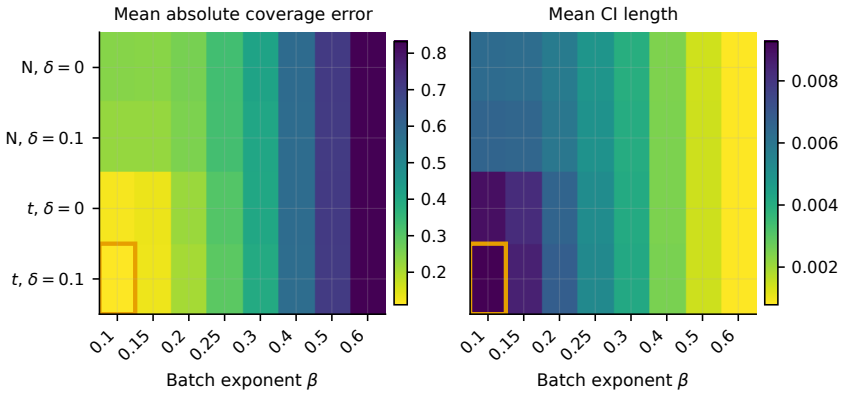
- The one-pass recursion keeps memory independent of the trajectory length, with $O(Ld+qd+q^2)$ persistent storage for a dense contrast and a reported $0.180$ MB online state at $d=10$, $n=10^6$.
- First-order RR with nodes $(1,2)$ and weights $(2,-1)$ cuts the target shift from roughly $1.75\times 10^{-2}$ to $4.9\times 10^{-4}$ in the evaluated Garnet designs, with interval length essentially unchanged.
- In the horizon-indexed regime the leading stochastic term is additive Markov noise $\xi_t = b_t - A_t\theta_*$, so the long-run covariance reduces to $\bar{A}^{-1}\Sigma_\xi \bar{A}^{-\top}$.
Reading between the lines
- Beyond the paper, the same Brownian-bridge transfer should apply to any constant-stepsize stochastic-approximation recursion with a Hurwitz mean matrix and a stationary pullback solution, making the method a template for linear LSA inference rather than a TD-specific device.
- The paper fixes the contrast $R$ before the run; tracking several contrasts simultaneously would amount to keeping one self-normalizer per contrast, though simultaneous coverage would need a stronger argument than pointwise asymptotic pivotality.
- The lower endpoint of the rate window pushes toward higher RR cancellation order to reach $\theta_*$ at practical horizons, but larger signed weights may inflate finite-sample variance; the experiments' pattern of slower stabilization in smaller-stepsize, higher-dimensional cells suggests the practical window may be narrower than the sufficient proof window.
Signed reviews
Editorial analysis
A structured set of objections, weighed in public.
Referee Report
Summary. The paper develops asymptotic inference for constant-stepsize linear temporal-difference learning under Markovian sampling. It constructs a stationary fixed-stepsize recursion, proves a fixed-stepsize functional central limit theorem whose covariance retains the multiplicative TD noise, derives a joint FCLT for parallel Richardson–Romberg recursions sharing one trajectory, and shows that a Brownian-bridge self-normalizer yields asymptotically pivotal confidence regions for prespecified contrasts without estimating the long-run covariance or choosing a bandwidth or batch length. A horizon-indexed regime, with stepsize constant within each run and decreasing across runs, is proposed for inference on the projected Bellman solution. The main theoretical results in Sections 4 and 6 rest on stability and Poisson-equation arguments whose proofs are deferred to Online Appendix 1, which is not part of the distributed text; the visible Appendix B gives a complete proof of the self-normalization transfer.
Significance. If the deferred proofs are correct, the paper makes a substantial contribution: it provides a one-pass, memory-bounded confidence-region method for constant-stepsize TD that avoids the notoriously difficult long-run covariance estimation step, and it clarifies that the inferential center is the RR stationary target at fixed stepsize and the projected Bellman solution only under the separate horizon-indexed rate conditions. The visible part of the paper is strong: Lemma 9 and Proposition 10 are proved carefully, the related-work table is informative, the numerical section reports honest finite-sample diagnostics including under-coverage and initialization sensitivity, and a reproducibility repository is provided. The main weakness is verifiability: Theorem 1, Proposition 3, and the horizon-indexed reduction (36) are load-bearing and are not proved in the reviewed text. I found no circularity in the target definition: the paper explicitly defines θ_RR,α as the stationary mean of the RR recursion and claims coverage for that object at fixed stepsize, while using external bias bounds and rate conditions to move to θ_* in the horizon-indexed regime.
major comments (4)
- [§1.2, §4.1, §6.2] The load-bearing technical inputs—Theorem 1's uniform block-contraction bound (11), Proposition 3's Poisson solution (15)–(17), and the horizon-indexed reduction (36)—are proved only in Online Appendix 1, which is not distributed with the reviewed text. I was able to verify Appendix B, Lemma 9, and Proposition 10, but not the stability and Poisson-equation steps on which Theorems 4, 5, 7 and their corollaries depend. Theorem 1's uniformity in the starting state y and in α is used to construct the stationary recursion and to transfer limits from stationary starts to fixed deterministic initializations; Proposition 3 supplies the covariance formula (18); and (36) is the step that makes the multiplicative component and the TD boundary negligible in the horizon-indexed regime. This is a missing-support issue for the central claim, not a presentation detail.
- [§4.2, Proposition 3] Proposition 3 asserts an L2 solution Vα to Vα − PαVα = φα for the augmented chain Z_t^α = (Y_t, h_{t−1}^α), where h^α is unbounded and forgets at rate cα. Uniform geometric ergodicity of Y_t alone does not imply the Poisson equation for the product chain, so the finite-memory approximation and projective summability argument must be supplied. Since equation (17), the martingale-difference covariance (18), and the fixed-stepsize FCLT all pass through this proposition, the current text cannot support Theorem 4 without that argument.
- [§6.2, Eq. (36)] The central reduction (36) is asserted with proof deferred to Online Appendix 1. It is exactly the statement that the centered multiplicative component ζ^RR_{t,n}, the TD boundary term, and the residual RR target shift are uniformly o_p(√n), and it identifies the limiting additive covariance Ω0 in (34). The rate assumptions in Assumption 4(i)–(iii) do not by themselves visibly deliver the displayed uniform-in-r Lp statement; the proof must show the projective maximal controls. Without this reduction, Theorem 7 and Corollary 8 are unsupported.
- [§4.3, Eq. (21)] The RR bias bound (21), which is essential for the horizon-indexed inference for θ*, is imported from Huo et al. [2026] and translated in Online Appendix 1. The main text gives no statement of the bias expansion's order, the dependence of its remainder constant on the fixed cancellation order, or the exact stepsize threshold under which it holds. Since the fixed-stepsize results do not need (21) but Corollary 8 does, the paper should either state the expansion in the main text with its constants and thresholds or include the proof in the distributed version.
minor comments (5)
- [§4.2, Eq. (13)] The claim E[φ_t^α] = 0 is correct but deserves a one-line derivation using stationarity of the TD recursion and E[b_t] = Aθ*; as written the reader must reconstruct the algebra.
- [§6.3 and Table 5] The rate window is stated with strict inequalities, but Table 5 labels ν = 1/2 as the 'upper boundary' even though Assumption 4(iv) requires α_n√n → ∞; the table should state explicitly that ν = 1/2 is outside the admissible regime.
- [§7.1] The FrozenLake reset convention—after a terminal transition the process resets to the designated start state while the terminal feature remains in the TD update—needs a formal description of the induced transition kernel to justify treating the resulting sequence as a stationary Markov chain for the asymptotic analysis.
- [§4.3, Theorem 5] The sentence 'Both convergences above remain valid pointwise...' is ambiguous: if it means finite-dimensional convergence only, that is weaker than what Corollary 6 needs, and if it means weak convergence in D, the word 'pointwise' is misleading. The statement should be clarified.
- [§5] The one-pass implementation is clearly explained, but the paper does not report the simulated Brownian critical values κ_{q,1−η} used in the experiments; including a small table or the simulation code in the main text or Online Appendix 2 would make the procedure fully reproducible from the paper alone.
Circularity Check
No circular reduction: the self-normalized inference transfer is proved in-paper, and the only significant concern is deferred proof support, not circularity.
full rationale
The paper's fixed-stepsize target theta_RR,alpha is a population parameter (the stationary mean of the RR recursion) rather than a fitted quantity; Corollaries 6 and 8 obtain pivotal limits by applying an in-paper transfer theorem (Proposition 10) to FCLTs, with the covariance factor canceled algebraically in the quadratic form, not by estimating it from the same data. The horizon-indexed inference for theta* does not fit the target to the data: it requires the external RR bias bound (21) plus explicit rate conditions (Assumption 4), and the target theta* is defined independently through the projected Bellman equation. No equation in the submitted text is equivalent to its own input by construction, and no fitted parameter is renamed as a prediction. The Shao 2010 citation for Brownian-bridge self-normalization is a non-load-bearing attribution because Proposition 10 and Lemma 9 provide a self-contained proof. The main verifiability concern is that Theorem 1's uniform Lyapunov bound, Proposition 3's augmented-chain Poisson equation, and the central reduction (36) are asserted to be proved in Online Appendix 1, which is absent from the distributed text; that is an omitted-proof support gap, not a circularity. There is no observed circular step, so the score is 0.
Assumptions & free parameters
free parameters (3)
- base stepsize alpha
- RR design (a_l, w_l) =
(1,2) with weights (2,-1) in experiments
- horizon-indexed exponent nu =
0.2, 1/4, 1/3, 1/2, 0.6 in diagnostics
assumptions (6)
- domain assumption Assumption 1: stationary, irreducible, aperiodic Markov chain that is uniformly geometrically ergodic, with bounded maps A and B.
- domain assumption Assumption 2: mean update matrix A-bar is positive stable.
- domain assumption Assumption 3: every recursion stepsize lies below the problem-dependent stability threshold alpha_stab,p.
- domain assumption Assumption 4: horizon-indexed rate conditions on alpha_n (n^{1-2/p} alpha_n -> infinity, sqrt(n) alpha_n^{qRR+1} -> 0, alpha_n sqrt(n) -> infinity).
- standard math Finite-order stationary-bias expansion of Huo et al. [2024, 2026] (bound (21)).
- standard math Classical Poisson-equation solution for bounded additive Markov noise xi_t.
Cite this review
Pith. "Pith review of Self-Normalized Inference for Constant-Stepsize Temporal-Difference Learning under Markovian Sampling." pith.science (2026). https://pith.science/paper/HOMMGM5O
@misc{pith2026260810896,
  author       = {Pith},
  title        = {Pith review of: Self-Normalized Inference for Constant-Stepsize Temporal-Difference Learning under Markovian Sampling},
  year         = {2026},
  howpublished = {\url{https://pith.science/paper/HOMMGM5O}},
  note         = {Machine review of arXiv:2608.10896}
}
abstract
Constant-stepsize temporal-difference (TD) learning is attractive for policy evaluation, but inference from a single Markov trajectory must account for serial dependence and a stepsize-dependent stationary target. For fixed-stepsize linear TD, we establish a functional central limit theorem whose covariance retains the multiplicative component induced by the random TD matrix and the stationary iterate error. We then derive a joint functional limit for parallel Richardson--Romberg (RR) recursions driven by the same trajectory. A Brownian-bridge self-normalizer yields asymptotically pivotal confidence regions for prespecified state-value contrasts without estimating the long-run covariance or selecting a bandwidth or batch length. For such a contrast, the procedure admits a one-pass implementation whose memory does not grow with the trajectory length. At a fixed stepsize, the inferential center is the RR stationary target. We also study horizon-indexed designs in which the stepsize remains constant within each run and decreases across longer horizons. Under an explicit RR-dependent rate window, the residual RR target shift, multiplicative remainder, and initialization effect are negligible at the root-$n$ scale, yielding inference for the projected Bellman solution. Experiments on FrozenLake and Garnet illustrate stationary-target coverage, RR target correction, and the finite-sample behavior of the horizon-indexed design.
Figures


Figures from the paper (3 more)


Reference graph
Works this paper leans on
-
[2026]
Revisiting the Constant Stepsize Stochastic Approximation with Decision-Dependent Markovian Noise
URLhttps://doi. org/10.48550/arXiv.2604.13378. Dongyan Lucy Huo, Yudong Chen, and Qiaomin Xie. Effectiveness of constant stepsize in Markovian LSA and statistical inference.Proceedings of the AAAI Conference on Artificial Intelligence, 38 (18):20447–20455,
-
[4]
Dongyan Lucy Huo, Yudong Chen, and Qiaomin Xie
doi: 10.1609/aaai.v38i18.30028. Dongyan Lucy Huo, Yudong Chen, and Qiaomin Xie. Bias and extrapolation in Markovian linear stochastic approximation with constant step sizes.Mathematics of Operations Research,
-
[5]
doi: 10.1287/moor.2024.0471. Nicholas M. Kiefer, Timothy J. Vogelsang, and Helle Bunzel. Simple robust testing of regression hypotheses.Econometrica, 68(3):695–714,
-
[7]
Sokbae Lee, Yuan Liao, Myung Hwan Seo, and Youngki Shin
URLhttps://doi.org/10.48550/arXiv.2405.17834. Sokbae Lee, Yuan Liao, Myung Hwan Seo, and Youngki Shin. Fast and robust online inference with stochastic gradient descent via random scaling.Proceedings of the AAAI Conference on Artificial Intelligence, 36(7):7381–7389,
-
[9]
Jiaqi Li, Zhipeng Lou, Stefan Richter, and Wei Biao Wu
doi: 10.1609/aaai.v40i43.40994. Jiaqi Li, Zhipeng Lou, Stefan Richter, and Wei Biao Wu. The stochastic gradient descent from a nonlinear time series perspective,
-
[13]
doi: 10.52202/085713-5807. Xiaofeng Shao. A self-normalized approach to confidence interval construction in time series.Journal of the Royal Statistical Society: Series B, 72(3):343–366,
-
[1988]
doi: 10.1007/BF00115009. Richard S. Sutton and Andrew G. Barto.Reinforcement learning: An introduction. MIT Press, Cambridge, Massachusetts, second edition,
-
[1997]
Weichen Wu, Gen Li, Yuting Wei, and Alessandro Rinaldo
doi: 10.1109/9.580874. Weichen Wu, Gen Li, Yuting Wei, and Alessandro Rinaldo. Statistical inference for policy evaluation with temporal-difference learning, 2026a. URLhttps://doi.org/10.48550/arXiv.2410.16106. 28 Weichen Wu, Yuting Wei, and Alessandro Rinaldo. Uncertainty quantification for Markov chain induced martingales with application to temporal-di...
Show all 16 references
-
[2000]
Caio Kalil Lauand and Sean Meyn
doi: 10.1111/1468-0262.00128. Caio Kalil Lauand and Sean Meyn. Revisiting step-size assumptions in stochastic approximation,
-
[2010]
doi: 10.1111/j.1467-9868.2009. 00737.x. R. Srikant and Lei Ying. Finite-time error bounds for linear stochastic approximation and TD learning. InProceedings of the 32nd Conference on Learning Theory, volume 99 ofProceedings of Machine Learning Research, pages 2803–2830,
2009
-
[2020]
Wenlong Mou, Ashwin Pananjady, Martin J
URLhttps://proceedings.mlr.press/ v125/mou20a.html. Wenlong Mou, Ashwin Pananjady, Martin J. Wainwright, and Peter L. Bartlett. Optimal and instance-dependent guarantees for Markovian linear stochastic approximation. InProceedings of the 35th Conference on Learning Theory, vol...
-
[2021]
Christoph Dann, Gerhard Neumann, and Jan Peters
doi: 10.1287/opre.2020.2024. Christoph Dann, Gerhard Neumann, and Jan Peters. Policy evaluation with temporal differences: A survey and comparison.Journal of Machine Learning Research, 15(24):809–883,
2020
-
[2022]
27 Ilya Levin, Alexey Naumov, and Sergey Samsonov
doi: 10.1609/aaai.v36i7.20701. 27 Ilya Levin, Alexey Naumov, and Sergey Samsonov. High-order error bounds for Markovian LSA with Richardson–Romberg extrapolation.Proceedings of the AAAI Conference on Artificial Intelligence, 40(43):36696–36704,
-
[2023]
URL https://doi.org/10.48550/arXiv.2302. 07690. Wenlong Mou, Chris Junchi Li, Martin J. Wainwright, Peter L. Bartlett, and Michael I. Jordan. On linear stochastic approximation: Fine-grained Polyak–Ruppert and non-asymptotic concentra- tion. InProceedings of the 33rd Conferenc...
-
[2024]
Jalaj Bhandari, Daniel Russo, and Raghav Singal
doi: 10.52202/079017-4379. Jalaj Bhandari, Daniel Russo, and Raghav Singal. A finite-time analysis of temporal-difference learning with linear function approximation.Operations Research, 69(3):950–973,
-
[2025]
Xiang Li, Jiadong Liang, and Zhihua Zhang
doi: 10.52202/085713-3171. Xiang Li, Jiadong Liang, and Zhihua Zhang. Online statistical inference for nonlinear stochastic approximation with Markovian data,
Reviewed August 12, 2026 · model on record in the stance chip above.
Discussion (0). Continue with ORCID to comment.