REVIEW 1 major objections 4 minor 34 references
Verifying full quantum network nonlocality in arbitrary configurations by nonlinear Bell-like inequalities
T0 review · 1 major / 4 minor · reviewed 2026-08-12 · deepseek-v4-flash
Pith's one-line read This paper claims that full quantum network nonlocality can be certified in any network topology by violating a single nonlinear Bell-like inequality after enlarging the network with auxiliary local sources and parties.
desk verdict Clever auxiliary-source construction, but Theorem 1 hinges on a false factorization step, so the central claim is unproven as written. read the letter →
The pith
A machine-rendered reading of the paper's core claim, the machinery that carries it, and where it could break.
The reading
What carries the argument
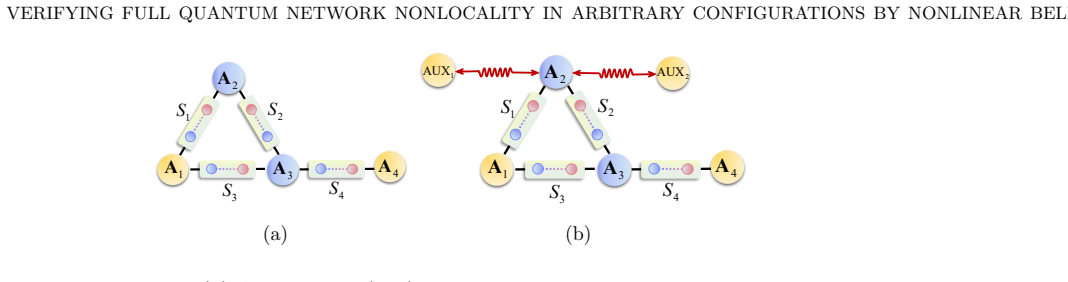
The central objects are independent parties (spatially separated parties sharing no common source), the independence number $h$ of the network, and the topological parameter $w$: the minimum number of local sources that forces some independent party to receive only local sources. The paper defines $N(n,m)=w-1$ from the source-sharing sets, adds that many auxiliary local sources and parties, and builds a nonlinear inequality whose left-hand side is an $h$-th-root sum of two correlation products $I$ and $J$ built from binary observables $A^\pm_{x_i}$. The bound $|I|^{1/h}+|J|^{1/h}\le 2^{(h-1)/(2h)}$ is tight enough to certify that a violating network has at most $w-1$ local sources.
What would settle it
Take the triangular-network construction of Example 1 and set all five sources in the enlarged network to local Werner states with $p_i=1/3$, then apply the same SLSQP optimization to inequality (2.7): if the left-hand side exceeds $2^{1/3}$, the claim that violation forces at most two local sources is false, and the central criterion collapses.
Extended reading notes
Core claim
The central claim is that full quantum network nonlocality of an arbitrary network $\Xi(n,m)$ can be certified by a single nonlinear Bell-like inequality, provided the network is first expanded to $\Xi_{\mathrm{new}}(n,m)$ by adding $N(n,m)$ auxiliary local sources and corresponding parties to a chosen non-independent party. With $h$ the independence number of the original network and $\Gamma$ a maximum independent set, the enlarged network has $h+N(n,m)$ independent parties and the test reads $|I_{\mathrm{gen}}|^{1/(h+N(n,m))}+|J_{\mathrm{gen}}|^{1/(h+N(n,m))}\le 2^{(h+N(n,m)-1)/(2(h+N(n,m)))}$. A violation means the enlarged network contains at most $w-1=N(n,m)$ local sources; since $N(n,m)$ local sources were deliberately inserted, every original source must be nonlocal. The authors present this as a constructive, topology-independent replacement for decomposing networks into star-shaped pieces.
Load-bearing premise
The argument hinges on assuming in Eq. (2.2) that one party's measurement statistics can be pulled out as a product from the rest of the network's statistics, and this is not guaranteed when that party shares a local source with the other parties; if that step fails, the derived inequality bound and the full-network-nonlocality certification do not follow.
Editorial extensions
If this is right
- A single violation of one Bell-like inequality would certify full quantum network nonlocality for arbitrary network topologies, eliminating the need for repeated star-subnetwork tests.
- For chain, cyclic, and tree-shaped networks, the construction specifies exactly how many auxiliary local sources and parties to add, so the test is directly implementable.
- Numerical examples with Werner states of visibility around 0.9–0.96 and auxiliary local sources at $p=1/3$ violate the relevant inequalities, indicating a concrete experimental route.
- If the criterion holds, it provides an efficient fault-detection tool for large quantum networks: one inequality would reveal whether any source has degenerated into a classical source.
- The inequality parameter depends only on network topology, so for any given network the test can be precomputed from its source-sharing structure.
Reading between the lines
- Beyond the paper's examples, the same expansion strategy could likely certify higher-level hierarchical network nonlocality by inserting $w-l$ auxiliary local sources and testing the corresponding $l$-level inequality; the authors only treat the $l=1$ full-nonlocality case.
- The auxiliary-source count $N(n,m)$ depends on the chosen maximum independent set, so minimizing the overhead over valid choices is an open optimization problem the paper does not address.
- Because the auxiliary sources are local classical resources, the added experimental cost is classical rather than quantum; whether the single-inequality search remains practical for much larger networks would require studying the scaling of the SLSQP optimization, which the paper does not do.
Editorial analysis
A structured set of objections, weighed in public.
Referee Report
Summary. The manuscript proposes a method to certify full quantum network nonlocality (FQNN) in arbitrary quantum networks by adding auxiliary local sources and parties, and then testing a single nonlinear Bell-like inequality on the enlarged network. The central theoretical result is Theorem 1, which asserts an l-QNL inequality for arbitrary networks, and Corollary 5, which uses this inequality to certify FQNN. The paper illustrates the method on triangular, chain, cyclic, and tree-shaped networks, using Werner states and SLSQP optimization to exhibit violations.
Significance. If Theorem 1 were correct, the paper would provide a significant advance: a single-inequality test for FQNN in arbitrary network topologies, improving on existing star-specific or decomposition-based methods. The constructive idea of adding auxiliary local sources to increase the independence number is appealing, and the paper contains explicit constructions for several network families. However, the central proof contains a load-bearing error in Eq. (2.2), and the paper does not provide a valid derivation of the main inequality. Consequently, the claimed FQNN certification criterion and all numerical demonstrations that rely on it are not established. The significance is therefore contingent on a substantial repair of the proof.
major comments (1)
- [Section II, Eq. (2.2), proof of Theorem 1] The proof also states, immediately after Eq. (2.2), that removing the independent party A_t leaves a network that is (h−1)-independent. This is not true in general. For example, in the triangular network with h=1, removing the independent party A1 leaves parties A2 and A3 connected by a source, so the remaining network has independence number 1, not 0. In the 4-cycle with Γ={1,3}, removing vertex 1 leaves a path on vertices 2,3,4, which has independence number 2, not h−1=1. Therefore the appeal to Ref. [24] for an (h−1)-independent network is not valid when the remaining network has a larger independence number.
minor comments (4)
- [Section II, Eq. (2.6)] The closed-form expression for w is asserted without proof. Since w appears in the right-hand side of Ineq. (2.1) and in the number of auxiliary sources to be added, this formula is load-bearing for the examples and Corollary 5. A derivation or an explicit reference is needed.
- [Examples 1–5] The numerical results report SLSQP maxima (e.g., |I1|^{1/3}+|J1|^{1/3}=1.357 in Example 1) without providing the optimized measurement coefficients or a global optimality certificate. While a single explicit violating assignment would be sufficient to demonstrate a violation, as written the reader cannot verify the reported values. The statement in Example 1 that SLSQP 'can always' find suitable measurements is an unsupported heuristic claim.
- [Section II, repeated paragraph] The paragraph beginning 'Based on the preceding analysis, we first introduce an l-QNL inequality...' appears twice verbatim in the text; one occurrence should be removed.
- [Eq. (2.9)] There is a typographical error in Eq. (2.9): 'α11_{r1,r2}=0' should likely be 'α11_{r1,r2}', and the equation is missing the summation structure present in Eq. (2.8).
Circularity Check
No significant circularity: the FQNN certification is a valid conditional inference, not a definitional reduction; the main flagged issue is the unjustified factorization in Eq. (2.2), a correctness gap rather than circularity.
full rationale
The FQNN certification argument is conditional: if the enlarged network Ξnew violates inequality (3.18), then by the contrapositive of Theorem 1 the enlarged network has at most w−1 = N(n,m) local sources; since N(n,m) auxiliary local sources were explicitly inserted, all original sources must be nonlocal. This is a genuine inference, not an equivalence by construction. Inequality (2.1) is a Bell-like bound on w-QNL correlations, not a definition of FQNN, so Corollary 5 does not define the target property into the inequality. The numerical examples use SLSQP to exhibit measurement settings that violate the inequalities for Werner states; they are existence demonstrations, not fitted parameters renamed as predictions. The main self-citation is Ref. [24] (coauthor Ming-Xing Luo), which supplies the (h−1)-independent network bound used in the proof of Theorem 1; it is load-bearing but is a published external PRL and is not a uniqueness theorem or ansatz, so it does not by itself make the derivation circular. A separate concern is that Eq. (2.2) factorizes |⟨A_t^+ B0⟩| ≤ |⟨A_t^+⟩| |⟨B0⟩| using only the statement 'A_t is independent'; this is not justified because A_t may share local sources with parties in Γ̄, so this is a major correctness gap in the proof, but it is not a circular reduction of the result to its inputs. Overall the paper contains minor self-citation and an unproven factorization step, but no step of the claimed derivation is equivalent to its inputs by construction; score 2 reflects the self-citation and the proof gap without treating them as circularity.
Assumptions & free parameters
free parameters (2)
- Original-source Werner visibilities p_i =
0.90, 0.95, 0.96 in the examples
- SLSQP measurement coefficients =
not reported
assumptions (4)
- domain assumption Ref. 24 provides a bound of the form |...|^{1/(h-1)} + |...|^{1/(h-1)} <= sqrt(2) for any (h-1)-independent network.
- ad hoc to paper For a chosen maximum independent set Γ, the value w from Eq. (2.6) is the minimal number of local sources that guarantees condition (P).
- domain assumption Auxiliary sources can be implemented as Werner states at p=1/3, which are local.
- ad hoc to paper SLSQP converges to a value above the bound, so a violation is certified.
Cite this review
Pith. "Pith review of Verifying full quantum network nonlocality in arbitrary configurations by nonlinear Bell-like inequalities." pith.science (2026). https://pith.science/paper/XW6OMVO7
@misc{pith2026260810972,
  author       = {Pith},
  title        = {Pith review of: Verifying full quantum network nonlocality in arbitrary configurations by nonlinear Bell-like inequalities},
  year         = {2026},
  howpublished = {\url{https://pith.science/paper/XW6OMVO7}},
  note         = {Machine review of arXiv:2608.10972}
}
read the original abstract
Full quantum network nonlocality (FQNN) describes a scenario where all sources in a network are nonlocal. Existing criteria of FQNN can only be verified in star networks by violating a single Bell-like inequality. Here we propose a method that certifies FQNN in general quantum networks using only a single Bell-like inequality. We show that the topological obstacle to one-shot detection can be overcome by expanding the original network with a carefully chosen number of auxiliary local sources and parties. The correlations of the enlarged network are then tested with a single inequality; a violation implies that all original sources must be nonlocal. Our approach provides an efficient, experimentally friendly way to verify FQNN in any network topology.
Figures


Figures from the paper (3 more)


Reference graph
Works this paper leans on
-
[24]
Computationally efficient nonlinear bell inequalities for quantum networks.Phys
Ming-Xing Luo. Computationally efficient nonlinear bell inequalities for quantum networks.Phys. Rev. Lett., 120:140402, Apr 2018
work page 2018
-
[1]
D. Lago-Rivera, J. V. Rakonjac, S. Grandi, et al. Long distance multiplexed quantum teleportation from a telecom photon to a solid-state qubit.Nature Communications, 14:1889, 2023
work page 2023
-
[2]
J. I. Cirac, A. K. Ekert, S. F. Huelga, and C. Macchiavello. Distributed quantum computation over noisy channels.Phys. Rev. A, 59:4249, 1999
work page 1999
-
[3]
N. Gisin and R. Thew. Quantum communication.Nat. Photonics, 1:165–171, 2007
work page 2007
-
[4]
H. J. Kimble. The quantum internet.Nature, 453:1023–1030, 2008
2008
-
[5]
Scarani, Bechmann-Pasquinucci H., N
V. Scarani, Bechmann-Pasquinucci H., N. J. Cerf, M. Duˇ sek, N. L¨ utkenhaus, and M. Peev. The security of practical quantum key distribution.Rev. Mod. Phys., 81:1301, 2009
work page 2009
-
[6]
T. J. Proctor, P. A. Knott, and J. A. Dunningham. Multi-parameter estimation in networked quantum sensors.Phys. Rev. Lett., 120:080501, 2018
work page 2018
-
[7]
F. Xu, X. Ma, Q. Zhang, H. K. Lo, and J. W Pan. Secure quantum key distribution with realistic devices.Rev. Mod. Phys., 92:025002, 2020
work page 2020
Show all 34 references
-
[8]
Y. A. Chen, Q. Z. Zhang, T. Y. Chen, S. K. Liao, et al. An integrated space-to-ground quantum communication network over 4,600 kilometres.Nature, 589:214–219, 2021
2021
-
[9]
Zhang and Q
Z. Zhang and Q. Zhang. Distributed quantum sensing.Quantum Sci. Technol., 6:043001, 2021
2021
-
[10]
J. F. Clauser, M. A. Horne, A. Shimony, and R. A. Holt. Proposed experiment to test local hidden-variable theories.Phys. Rev. Lett., 23:880, 1969
1969
-
[11]
Bell non- locality in networks.Reports on Progress in Physics, 85(5):056001, mar 2022
Armin Tavakoli, Alejandro Pozas-Kerstjens, Ming-Xing Luo, and Marc-Olivier Renou. Bell non- locality in networks.Reports on Progress in Physics, 85(5):056001, mar 2022
2022
-
[12]
Entanglement witnesses constructed by permutation pairs
Jin-Chuan Hou and Wen-Li Wang. Entanglement witnesses constructed by permutation pairs. Acta Math. Sci., 41:843–874, 2021
2021
-
[13]
Positive maps constructed from permutation pairs.Acta Math
Jin-Chuan Hou and Hai-Li Zhao. Positive maps constructed from permutation pairs.Acta Math. Sci., 39:148–164, 2019
2019
-
[14]
Branciard, N
C. Branciard, N. Gisin, and S. Pironio. Characterizing the nonlocal correlations created via en- tanglement swapping.Phys. Rev. Lett., 104:170401, Apr 2010
2010
-
[15]
Bilocal versus nonbilocal cor- relations in entanglement-swapping experiments.Phys
Cyril Branciard, Denis Rosset, Nicolas Gisin, and Stefano Pironio. Bilocal versus nonbilocal cor- relations in entanglement-swapping experiments.Phys. Rev. A, 85:032119, Mar 2012
2012
-
[16]
Mukherjee, B
K. Mukherjee, B. Paul, and D. Sarkar. Correlations inn-local scenario.Quantum Inf Process, 14:2025–2042, June 2015. VERIFYING FULL QUANTUM NETWORK NONLOCALITY IN ARBITRARY CONFIGURATIONS BY NONLINEAR BELL-LIKE INEQUALITIES 19
2025
-
[17]
Maximal qubit violation ofn-local inequalities in a quantum network.Phys
Amit Kundu, Mostak Kamal Molla, Indrani Chattopadhyay, and Debasis Sarkar. Maximal qubit violation ofn-local inequalities in a quantum network.Phys. Rev. A, 102:052222, Nov 2020
2020
-
[18]
Nonlocal correlations in the star-network configuration.Phys
Armin Tavakoli, Paul Skrzypczyk, Daniel Cavalcanti, and Antonio Ac ´ ın. Nonlocal correlations in the star-network configuration.Phys. Rev. A, 90:062109, Dec 2014
2014
-
[19]
Genuine quantum nonlocality in the triangle network.Phys
Marc-Olivier Renou, Elisa B¨ aumer, Sadra Boreiri, Nicolas Brunner, Nicolas Gisin, and Salman Beigi. Genuine quantum nonlocality in the triangle network.Phys. Rev. Lett., 123:140401, Sep 2019
2019
-
[20]
Jing, X.J
B. Jing, X.J. Wang, Y. Yu, P.F. Sun, Y. Jiang, S.J. Yang, W.H. Jiang, X.Y. Luo, J. Zhang, X. Jiang, X.H. Bao, and J.W. Pan. Entanglement of three quantum memories via interference of three single photons.Nature Photonics, 13:210–213, March 2019
2019
-
[21]
Nonlocal correlations in the tree-tensor-network con- figuration.Phys
Lihua Yang, Xiaofei Qi, and Jinchuan Hou. Nonlocal correlations in the tree-tensor-network con- figuration.Phys. Rev. A, 104:042405, Oct 2021
2021
-
[22]
Polynomial bell inequalities.Phys
Rafael Chaves. Polynomial bell inequalities.Phys. Rev. Lett., 116:010402, Jan 2016
2016
-
[23]
Bell-type inequalities for arbitrary noncyclic networks.Phys
Armin Tavakoli. Bell-type inequalities for arbitrary noncyclic networks.Phys. Rev. A, 93:030101, Mar 2016
2016
-
[25]
Full network nonlocality.Phys
Alejandro Pozas-Kerstjens, Nicolas Gisin, and Armin Tavakoli. Full network nonlocality.Phys. Rev. Lett., 128:010403, Jan 2022
2022
-
[26]
Lee and Matty J
Ciar´ an M. Lee and Matty J. Hoban. Towards device-independent information processing on general quantum networks.Phys. Rev. Lett., 120:020504, Jan 2018
2018
-
[27]
Quantum random number generators
Miguel Herrero-Collantes and Juan Carlos Garcia-Escartin. Quantum random number generators. Rev. Mod. Phys., 89:015004, Feb 2017
2017
-
[28]
Piveteau E
A. Piveteau E. H ˚ akansson, S. Muhammad, and M. Bourennane. Experimental demonstration of full network nonlocality in the bilocal scenario.Arxiv, 2022
2022
-
[29]
Entanglement swapping and quantum correlations via symmetric joint measurements.Phys
Cen-Xiao Huang, Xiao-Min Hu, Yu Guo, Chao Zhang, Bi-Heng Liu, Yun-Feng Huang, Chuan-Feng Li, Guang-Can Guo, Nicolas Gisin, Cyril Branciard, and Armin Tavakoli. Entanglement swapping and quantum correlations via symmetric joint measurements.Phys. Rev. Lett., 129:030502, Jul 2022
2022
-
[30]
Experimental full network nonlocality with independent sources and strict locality con- straints.Phys
Xue-Mei Gu, Liang Huang, Alejandro Pozas-Kerstjens, Yang-Fan Jiang, Dian Wu, Bing Bai, Qi- Chao Sun, Ming-Cheng Chen, Jun Zhang, Sixia Yu, Qiang Zhang, Chao-Yang Lu, and Jian-Wei Pan. Experimental full network nonlocality with independent sources and strict locality con- strai...
2023
-
[31]
N.-N. Wang, A. Pozas-Kerstjens, C. Zhang, B.-H. Liu, Y.-F. Huang, C.-F. Li, G.-C. Guo, N. Gisin, and A. Tavakoli. Certification of non-classicality in all links of a photonic star network without assuming quantum mechanics.Nature Communications, 14:2153, April 2023
2023
-
[32]
Hierarchical certification of nonclas- sical network correlations.Phys
Ming-Xing Luo, Xue Yang, and Alejandro Pozas-Kerstjens. Hierarchical certification of nonclas- sical network correlations.Phys. Rev. A, 110:022617, Aug 2024
2024
-
[33]
Verifying hierarchic multipartite and network nonlocalities with a unified method.Advanced Quantum Technologies, page 202400021, 2024
Ming-Xing Luo and Shao-Ming Fei. Verifying hierarchic multipartite and network nonlocalities with a unified method.Advanced Quantum Technologies, page 202400021, 2024. Article number 202400021
2024
-
[34]
Verifying hierarchical network nonlocality in general quantum networks.Chinese Physics B, 33(7):070304, jun 2024
Shu-Yuan Yang, Jin-Chuan Hou, and Kan He. Verifying hierarchical network nonlocality in general quantum networks.Chinese Physics B, 33(7):070304, jun 2024. 20 SHUYUAN YANG, JINCHUAN HOU, KAN HE ∗, MINGXING LUO∗ (Shuyuan Yang)School of Mathematics, North University of China, Ta...
2024
Reviewed August 12, 2026 · model on record in the stance chip above.
Discussion (0). Continue with ORCID to comment.