REVIEW 4 major objections 5 minor 35 references
Ultracompact Anisotropic Stars and Gravastars in General Relativity
T0 review · 4 major / 5 minor · reviewed 2026-08-12 · deepseek-v4-flash
Pith's one-line read Static, horizonless stars in general relativity can reach compactness arbitrarily close to a black hole if their pressure is anisotropic.
desk verdict A mostly solid analytical construction of ultracompact anisotropic stars and gravastars, with a couple of presentation issues that need fixing before publication. read the letter →
The pith
A machine-rendered reading of the paper's core claim, the machinery that carries it, and where it could break.
The reading
What carries the argument
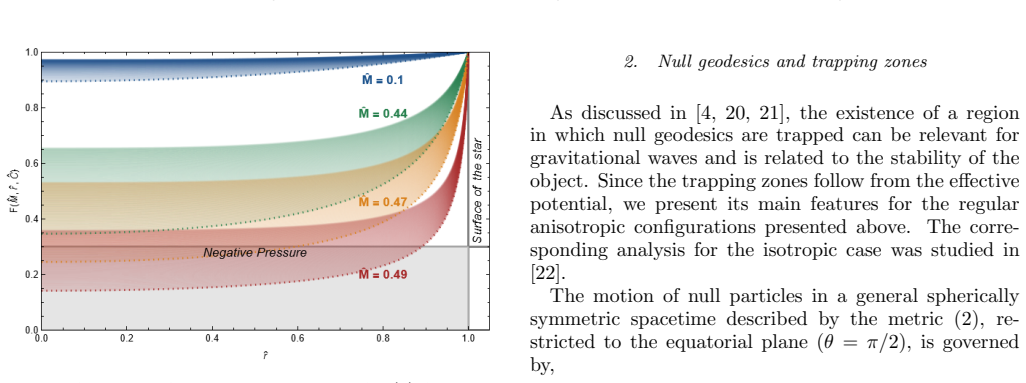
The central object is the covariant anisotropic equation of state $\Delta = C f(\rho)\, k^\mu \nabla_\mu P_r$ (with $f(\rho)=\rho$), which ties the pressure anisotropy $\Delta = P_t - P_r$ to the radial gradient of the radial pressure. Combined with a constant density profile, it turns the Tolman-Oppenheimer-Volkoff equation into a first-order ODE whose solution is the analytical pressure profile $\hat P_r(\hat r) = \hat\rho_* (F-1)/(1-3F)$, with the explicit function $F(\hat M,\hat r,\hat C)$ given in Eq. (12). The condition $F=1/3$ marks the divergence of the central pressure and defines the critical curve separating regular from singular configurations; in the large-$\hat C$ limit $F\to 1$ and $\hat P_r\to 0$, which is what allows the compactness to approach $1/2$.
What would settle it
Numerically integrate the Tolman-Oppenheimer-Volkoff equations with the sign of $k^\mu$ in Eq. (7) reversed (equivalently, the plus sign in Eq. (8) changed to a minus) and look for roots of the central-pressure denominator; if no root exists above $\hat M=4/9$, the near-black-hole branch is an artifact of the sign choice.
Extended reading notes
Core claim
The central claim is that, using the covariant anisotropic equation of state (7) with $f(\rho)=\rho$ and a homogeneous density profile, a mostly analytical model yields ultracompact configurations with compactness arbitrarily close to $1/2$. Two regimes exist: for sufficiently large anisotropy the central pressure stays positive and the star is regular; for arbitrary anisotropy the central pressure is negative and the pressure diverges at a finite radius inside the fluid. Replacing the region around that divergence with a constant-pressure thick shell removes the singularity, giving a three-layer gravastar with a negative-pressure interior and no event horizon. The same thick-shell procedure also produces fully isotropic gravastars, although these violate the null energy condition and have discontinuous pressure across the shell.
Load-bearing premise
The result depends on a particular anisotropic pressure rule—the pressure difference is proportional to the radial gradient of the radial pressure, with a fixed sign—together with a strictly constant density interior; change the sign or allow the density to vary, and the claimed near-black-hole solutions no longer follow.
Editorial extensions
If this is right
- Regular anisotropic stars with positive central pressure exist for compactness $\hat M$ between $4/9$ and arbitrarily close to $1/2$, provided the anisotropy parameter $\hat C$ is large enough.
- The negative-central-pressure branch gives singular configurations at any anisotropy, and the singularity is a curvature singularity with divergent Kretschmann scalar, so without the shell these are not viable astrophysical objects.
- Replacing the divergent region by a thick shell yields regular ultracompact gravastars with compactness arbitrarily close to $1/2$; as $\hat M\to 1/2$ the shell moves toward the surface and the interior tends to a de Sitter-like constant negative pressure.
- Fully isotropic gravastars are possible within this construction, but they violate the null energy condition in the inner region and have discontinuous pressure, so they do not contradict earlier results that gravastars must have anisotropic pressures.
- The outer photon ring of these objects sits at the Schwarzschild value $3M$, identical to a black hole's, so observations of the photon ring alone cannot distinguish them from black holes.
Reading between the lines
- Beyond the paper: the near-black-hole branch likely depends on the constant-density ansatz; testing the same covariant equation of state with a polytropic density profile would show whether the effect survives when the density is not uniform.
- Beyond the paper: the paper does not analyze dynamical stability, and its own note that high-compactness configurations have a shallower effective potential suggests a radial-oscillation or axial perturbation study could determine which, if any, of these mimickers are stable.
- Beyond the paper: taking the zero-thickness limit of the thick shell, which the paper leaves for future work, would connect this construction to thin-shell gravastar models and could reveal whether the interior final state is always de Sitter-like.
Editorial analysis
A structured set of objections, weighed in public.
Referee Report
Summary. The paper constructs static, spherically symmetric, constant-density stars in general relativity with anisotropic pressure governed by the covariant equation of state Δ = C ρ k^μ ∇_μ P_r. It derives closed-form expressions for the radial and tangential pressures, identifies a critical curve in the (M̂, Ĉ) plane where the central pressure diverges, and separates the parameter space into positive- and negative-central-pressure branches. The positive-pressure branch is claimed to admit compactness beyond the Buchdahl bound and arbitrarily close to the black-hole value for large anisotropy. The negative-pressure branch is singular but is regularized by replacing the divergent region with a constant-pressure thick shell, yielding anisotropic and isotropic gravastar configurations. The paper also analyzes energy conditions, photon orbits, trapping zones, and junction conditions for the thick-shell construction.
Significance. If the construction is sound, the paper provides a mostly analytical family of horizonless, ultracompact configurations in general relativity, including models with compactness M/R arbitrarily close to 1/2 and a three-layer gravastar realization. The pressure solutions are explicit, the isotropic limit correctly reduces to the interior Schwarzschild solution and the Buchdahl bound, and the junction conditions are written out in detail. The work is a useful addition to the black-hole-mimicker and gravastar literature, although it does not provide a microphysical derivation of the equation of state, a stability analysis, or a general existence proof for the thick-shell solutions.
major comments (4)
- [Section II, Eqs. (7)-(8)] The orientation of the unit spacelike vector k^μ is never stated. With k^r = +e^{-B/2}, Eq. (7) gives Δ = +Cρ e^{-B/2} P_r' and the TOV equation (5) produces a denominator 1 − 2Cρ√(1−2m/r)/r in Eq. (8); the printed plus sign requires k^r = −e^{-B/2}, i.e., an inward orientation. Since the sign of the anisotropy term controls the existence of the ultracompact and negative-pressure branches, this convention must be stated explicitly and its robustness to the opposite orientation should be discussed.
- [Section II, Eqs. (16) and (19)] There appears to be a sign error in the expression for A(r) and hence in the effective potential. From Eq. (9), A'(r) = 4M r/[(3F−1)(1−2M r²)] > 0 on the regular branch, so matching to the exterior Schwarzschild solution at r=1 gives A(r)=ln(1−2M) − 4M∫_r^1 x dx/[(3F−1)(1−2M x²)], not plus. The printed plus sign makes Eq. (19) inconsistent with the exact isotropic effective potential in Eq. (A2); for example, at M=0.3 and r=0.5 the plus sign gives V≈2.93 instead of the exact V≈0.874. Although the photon-orbit condition (20) is unchanged, the quantitative effective-potential curves and trapped-region statements in Fig. 5 need to be recomputed with the corrected sign.
- [Section III and final remarks] The paper contradicts its own parameter-space classification. Section II and Fig. 1 define the red region as positive central pressure and the blue region as negative central pressure, but Section III states that configurations with P_c<0 "fall under the red (regular) region in Fig. 1." Additionally, the final remarks state that in the positive-central-pressure ultracompact branch "the tangential pressure is negative in the interior," whereas Section II.1 concludes P_t ≥ P_r ≥ 0 for that branch and Fig. 3 shows P_t > 0. These statements must be reconciled and the region labels corrected.
- [Section III.A and Appendix B] The thick-shell gravastar construction is demonstrated only for selected parameter values. Equation (B14) is a nonlinear condition for r2 given r1, and the paper does not show that a solution with r1 < r_d < r2 < 1 exists for a non-empty range of (M̂, Ĉ, γ), nor does it discuss uniqueness. The examples in Figs. 11-14 are valuable, but the paper should either provide an existence argument or explicitly state that only representative numerical solutions are being exhibited and that no general existence proof is claimed.
minor comments (5)
- [Figure 14 caption] The caption contains an unresolved placeholder "Same as Fig.??"; please fill in the reference.
- [Section III, Fig. 10] The text says the metric coefficient g_tt "has a zero at r̂_d but remains positive everywhere"; since it vanishes at r̂_d, the wording should be 'non-negative' or 'vanishes only at r̂_d'.
- [Section II, Eq. (12)-(14)] The displayed formulas for F and P̂_c are typeset in a very compressed way, with exponents and arguments running together; this makes independent verification difficult and should be cleaned up.
- [General notation] The paper mixes hatted and unhatted variables in the shell discussion around Eqs. (24)-(26); please make the use of hats consistent there.
- [Abstract and Section IV] The claim of compactness 'arbitrarily close to the black-hole value' should specify that, for the positive-pressure branch, this requires Ĉ to grow without bound as M̂ approaches 1/2; as written it may be misread as a finite-parameter statement.
Circularity Check
No significant circularity: the derivation is self-contained given the explicitly assumed anisotropic equation of state.
full rationale
The paper's central construction starts from the covariant anisotropic equation of state (7), imported explicitly from Ref. [14], together with the constant-density ansatz. This is an assumption, not a claim derived from the target result; Eq. (8) is an algebraic substitution of (7) into the TOV equation, and Eqs. (11)-(15) are closed-form consequences of that system. No parameter is fitted to the quantity being predicted: the compactness Mhat and anisotropy Chat are free parameters that are scanned, and the critical curve in Fig. 1 is obtained by solving the vanishing of the denominator of the central-pressure expression (14), not by imposing the desired compactness by hand. The claim of compactness arbitrarily close to 1/2 follows from taking limits in the explicit formulas, rather than from any circular reduction. The cited prior work [14] is external to the present authors and is used only as the source of the equation of state; the paper explicitly says it studies the consequences of that EOS, so no ansatz is smuggled in as a derivation. The only notable internal defect is a labeling mismatch in Section III, where singular negative-central-pressure configurations are said to fall under the red (regular) region although Fig. 1 assigns red to positive central pressure; this is an inconsistency in presentation, not a circular step. Because the derivation is self-contained conditional on its stated assumptions and does not rename or fit its inputs, no circularity is present.
Assumptions & free parameters
free parameters (4)
- C/R (dimensionless anisotropy)
- M/R (compactness)
- gamma (shell EOS parameter) =
-2 (stiff matter) and 0 (isotropic examples)
- r1 (inner shell radius) =
values not greater than r_d
assumptions (5)
- ad hoc to paper The covariant anisotropic EOS (7), Delta = C f(rho) k^mu grad_mu P_r with f(rho) = rho, is assumed to describe the matter.
- domain assumption Constant homogeneous energy density rho = constant in all fluid regions.
- ad hoc to paper The unit spacelike vector k^mu is oriented inward so that Eq. (8) has a plus sign in the denominator.
- domain assumption The stellar surface is defined by P_r(R) = 0, and the exterior is Schwarzschild. Israel junction conditions with zero energy density and non-zero tension are used for the gravastar shell.
- ad hoc to paper The pressure divergence in the negative-central-pressure branch is excised and replaced by a thick shell, defining a gravastar.
Cite this review
Pith. "Pith review of Ultracompact Anisotropic Stars and Gravastars in General Relativity." pith.science (2026). https://pith.science/paper/O3SXPDKE
@misc{pith2026260810991,
  author       = {Pith},
  title        = {Pith review of: Ultracompact Anisotropic Stars and Gravastars in General Relativity},
  year         = {2026},
  howpublished = {\url{https://pith.science/paper/O3SXPDKE}},
  note         = {Machine review of arXiv:2608.10991}
}
read the original abstract
We study static, spherically symmetric ultracompact objects in General Relativity with anisotropic stress. Using the covariant anisotropic equation of state and assuming homogeneous density, we construct a mostly analytical model admitting configurations beyond the Buchdahl limit and with compactness arbitrarily close to the black hole value. The solutions exhibit two regimes separated by a critical curve in the parameter space of compactness and anisotropy, associated with the divergence of the central pressure: regular anisotropic configurations with positive central pressure, and singular configurations with negative central pressure for arbitrary anisotropy. In the latter case, we show that introducing a thick shell removes the pressure divergence, yielding regular ultracompact gravastar configurations. We further construct both anisotropic and isotropic gravastar models using this thick-shell construction.
Figures


Figures from the paper (10 more)



Reference graph
Works this paper leans on
-
[1]
Energy conditions Before the examination of the standard pointwise en- ergy conditions for the anisotropic regular configurations, we study the behaviour of the functionF(ˆr, ˆM ,ˆC), which determines the pressures. From Eq.(11) it follows that the radial pressure ˆPr(ˆr) is positive and finite for 1≥F( ˆM ,ˆr,ˆC)> 1 3 .(17) At the surface of the star,Fre...
-
[2]
Null geodesics and trapping zones As discussed in [4, 20, 21], the existence of a region in which null geodesics are trapped can be relevant for gravitational waves and is related to the stability of the object. Since the trapping zones follow from the effective potential, we present its main features for the regular anisotropic configurations presented a...
-
[3]
In region III, defined by ˆr 2 <ˆr <1, we adopt the anisotropic solution, as given in region I, with an integration constantk III fixed by matchingA III to Schwarzschild’s solution at the surface. As a simplifying assumption, in the models described here we choose to fixk I in such a way thatA I takes at ˆr= 0 the value of the isotropic model, given by Eq...
work page 2025
-
[4]
Region I, defined by 0<ˆr <ˆr1, is described by the anisotropic solution, namely, AI(ˆr) = 4ˆM Z ˆr′dˆr′ (3F(ˆr′)−1)(1−2 ˆMˆr′2) +k I ,(30) ˆPrI = ˆρ∗ F(r)−1 1−3F(r) ,(31) wherek I is an integration constant to be fixed by the boundary condition at the center
-
[5]
Hence, the presence of the shell does not alter the Misner-Sharp mass of the object
The constant density and constant radial pressure solution is adopted in region II (ˆr 1 <ˆr <ˆr 2), namely eAII =K II(1−2 ˆMˆr2)γ,(32) PrII =− ˆρ∗ 3 (2γ+ 1),(33) ˆPtII = − ˆM(2γ+ 1) + 2 ˆM 2ˆr2(γ2 +γ+ 1) 4π(1−2 ˆMˆr2) .(34) 2 e−B = 1−2 ˆMˆr2 in all three regions. Hence, the presence of the shell does not alter the Misner-Sharp mass of the object
-
[6]
For fixed ˆM, the higher the value of ˆC, smaller the divergence radius
For a fixed anisotropy parameter ˆC, increasing the compactness shifts the divergence radius outward to the surface of the star. For fixed ˆM, the higher the value of ˆC, smaller the divergence radius. This behaviour is seen in Figs.7(a) and 7(b) (along with the tangential pressure profile in Fig.7(c)), which show that both pressures for configurations wi...
-
[7]
B. R. Iyer, C. V. Vishveshwara, and S. V. Dhurandhar, Ultracompact (R¡3 M) objects in general relativity, Clas- sical and Quantum Gravity2, 219 (1985)
work page 1985
- [8]
Show all 35 references
-
[9]
Vagnozziet al., Horizon-scale tests of gravity theories and fundamental physics from the Event Horizon Tele- scope image of Sagittarius A, Class
S. Vagnozziet al., Horizon-scale tests of gravity theories and fundamental physics from the Event Horizon Tele- scope image of Sagittarius A, Class. Quant. Grav.40, 165007 (2023), arXiv:2205.07787 [gr-qc]
2023 arXiv
-
[10]
Cardoso, L
V. Cardoso, L. C. B. Crispino, C. F. B. Macedo, H. Okawa, and P. Pani, Light rings as observational ev- idence for event horizons: long-lived modes, ergoregions and nonlinear instabilities of ultracompact objects, Phys. Rev. D90, 044069 (2014), arXiv:1406.5510 [gr-qc]
2014 arXiv
-
[11]
Cardoso and P
V. Cardoso and P. Pani, Testing the nature of dark com- pact objects: a status report, Living Rev. Rel.22, 4 (2019), arXiv:1904.05363 [gr-qc]
2019 arXiv
-
[12]
H. A. Buchdahl, General Relativistic Fluid Spheres, Phys. Rev.116, 1027 (1959)
1959
-
[13]
S. L. Liebling and C. Palenzuela, Dynamical boson stars, Living Rev. Rel.26, 1 (2023), arXiv:1202.5809 [gr-qc]
2023 arXiv
-
[14]
Bueno, R
P. Bueno, R. A. Hennigar, ´A. J. Murcia, and A. Vicente-Cano, Buchdahl limits in theories with reg- ular black holes, Phys. Rev. D113, 084008 (2026), arXiv:2512.19796 [gr-qc]
2026
-
[15]
Andreasson, Sharp bounds on 2m/r of general spher- ically symmetric static objects, J
H. Andreasson, Sharp bounds on 2m/r of general spher- ically symmetric static objects, J. Diff. Eq.245, 2243 (2008), arXiv:gr-qc/0702137
2008 arXiv
-
[16]
R. L. Bowers and E. P. T. Liang, Anisotropic Spheres in General Relativity, Astrophys. J.188, 657 (1974)
1974
-
[17]
Herrera and N
L. Herrera and N. O. Santos, Local anisotropy in self- gravitating systems, Phys. Rept.286, 53 (1997)
1997
-
[18]
S. Y. Lau, S. Ajith, V. Guedes, and K. Yagi, Nonradial instabilities in anisotropic neutron stars, Phys. Rev. D 110, 083020 (2024), arXiv:2405.04653 [gr-qc]
2024 arXiv
-
[19]
Guedes, S
V. Guedes, S. Ajith, S. Y. Lau, and K. Yagi, Gravitational-wave constraints on neutron-star pressure anisotropy via universal relations, Phys. Rev. D113, 043025 (2026), arXiv:2510.26042 [astro-ph.HE]
2026
-
[20]
Raposo, P
G. Raposo, P. Pani, M. Bezares, C. Palenzuela, and V. Cardoso, Anisotropic stars as ultracompact objects in General Relativity, Phys. Rev. D99, 104072 (2019), arXiv:1811.07917 [gr-qc]
2019 arXiv
-
[21]
Cattoen, T
C. Cattoen, T. Faber, and M. Visser, Gravastars must have anisotropic pressures, Class. Quant. Grav.22, 4189 (2005), arXiv:gr-qc/0505137
2005 arXiv
-
[22]
Jampolski and L
D. Jampolski and L. Rezzolla, Nested solutions of gravi- tational condensate stars, Class. Quant. Grav.41, 065014 (2024), arXiv:2310.13946 [gr-qc]
2024 arXiv
-
[23]
Jampolski and L
D. Jampolski and L. Rezzolla, Formation of gravastars, Phys. Rev. D113, L121502 (2026), arXiv:2509.15302 [gr- qc]
2026 arXiv
-
[24]
Dev and M
K. Dev and M. Gleiser, Anisotropic stars: Exact so- lutions, Gen. Rel. Grav.34, 1793 (2002), arXiv:astro- ph/0012265
2002
-
[25]
Schwarzschild, On the gravitational field of a sphere 13 of incompressible fluid according to Einstein’s theory, Sitzungsber
K. Schwarzschild, On the gravitational field of a sphere 13 of incompressible fluid according to Einstein’s theory, Sitzungsber. Preuss. Akad. Wiss. Berlin (Math. Phys. ) 1916, 424 (1916), arXiv:physics/9912033
1916 arXiv
-
[26]
M. A. Abramowicz, Gravitational radiation in optical ge- ometry applied to super-compact stars, Phys. Rept.311, 325 (1999)
1999
-
[27]
Stuchl ´ ık, J
Z. Stuchl ´ ık, J. Schee, B. Toshmatov, J. Hlad ´ ık, and J. Novotn´ y, Gravitational instability of polytropic spheres containing region of trapped null geodesics: a possible explanation of central supermassive black holes in galactic halos, JCAP06, 056, arXiv:1704.07713 [gr- qc]
-
[28]
Stuchlik, S
Z. Stuchlik, S. Hledik, J. Soltes, and E. Ostgaard, Null geodesics and embedding diagrams of the interior Schwarzschild-de Sitter space-times with uniform density, Phys. Rev. D64, 044004 (2001)
2001
-
[29]
P. O. Mazur and E. Mottola, Surface tension and nega- tive pressure interior of a non-singular ‘black hole’, Class. Quant. Grav.32, 215024 (2015), arXiv:1501.03806 [gr- qc]
2015 arXiv
-
[30]
P. O. Mazur and E. Mottola, Gravitational Condensate Stars: An Alternative to Black Holes, Universe9, 88 (2023), arXiv:gr-qc/0109035
2023 arXiv
-
[31]
Posada and C
C. Posada and C. Chirenti, On the radial stability of ultra compact Schwarzschild stars beyond the Buchdahl limit, Class. Quant. Grav.36, 065004 (2019), arXiv:1811.09589 [gr-qc]
2019 arXiv
-
[32]
Visser and D
M. Visser and D. L. Wiltshire, Stable gravastars: An Alternative to black holes?, Class. Quant. Grav.21, 1135 (2004), arXiv:gr-qc/0310107
2004 arXiv
-
[33]
Beltracchi and C
P. Beltracchi and C. Posada, Slowly rotating covariant anisotropic objects, Phys. Rev. D112, 084046 (2025), arXiv:2505.00139 [gr-qc]
2025
-
[34]
Israel, Singular hypersurfaces and thin shells in gen- eral relativity, Nuovo Cim
W. Israel, Singular hypersurfaces and thin shells in gen- eral relativity, Nuovo Cim. B44S10, 1 (1966), [Erratum: Nuovo Cim.B 48, 463 (1967)]
1966
-
[35]
Visser,Lorentzian wormholes: From Einstein to Hawking(1995)
M. Visser,Lorentzian wormholes: From Einstein to Hawking(1995)
1995
Reviewed August 12, 2026 · model on record in the stance chip above.
Discussion (0). Continue with ORCID to comment.