REVIEW 1 major objections 4 minor 23 references
Entanglement depth and ancilla efficiency in quantum channel estimation
T0 review · 1 major / 4 minor · reviewed 2026-08-12 · deepseek-v4-flash
Pith's one-line read The minimal ancilla dimension needed to saturate the quantum channel Fisher information is exactly the minimum rank among the maximizers of a concave functional over input states.
desk verdict A clean rank-based characterization of ancilla dimension, with one zero-gap theorem that is proved only under an unstated attainability assumption. read the letter →
The pith
A machine-rendered reading of the paper's core claim, the machinery that carries it, and where it could break.
The reading
What carries the argument
The load-bearing identity is the variational formula $J_k(\Phi_\theta)=\max_{\sigma\in S_k(\mathcal{H})} g(\sigma)$, where $g(\sigma)=\min_{X\in u(q)} f_{\theta_0}(\sigma,X)$ with $f_{\theta_0}(\sigma,X)=\sum_k \operatorname{Tr}[\sigma \dot B_k^\dagger \dot B_k]-\operatorname{Tr}[iC(\sigma)X]+\operatorname{Tr}[XG(\sigma)X]$, and $G(\sigma)_{k\ell}=\operatorname{Tr}[\sigma B_k^\dagger B_\ell]$, $C(\sigma)_{\ell k}=\operatorname{Tr}[\sigma(\dot B_k^\dagger B_\ell - B_k^\dagger \dot B_\ell)]$ for a reference Kraus generator $B(\theta)$. The minimization over $X$ solves a continuous Lyapunov equation with a unique Hermitian solution when $G(\sigma)$ is positive definite. The function $g$ is concave, so its maximizer set is convex and compact; Theorem 2 uses that structure to identify $k^*$ as the minimum rank among maximizers. The rank constraint $S_k(\mathcal{H})$ inherits all information about the ancilla because every pure state on $\mathcal{H}_k\otimes\mathcal{H}$ reduces to a state of rank at most $k$, and every such state has a purification.
What would settle it
For the qubit depolarizing family $\Phi_\theta(\rho)=(1-\theta)\rho+\frac{\theta}{2}\mathbb{1}$ at $\theta=0.1$, compute $\max_{\operatorname{rank}\sigma\le 1}g(\sigma)$ and $g(\mathbb{1}/2)$; the paper predicts the first is strictly smaller and equals $J_1<J_2=J_d$, so agreement would falsify the rank formula. More generally, any channel family whose minimum-rank maximizer has rank $r$ should show a strict jump in $J_k$ at $k=r$; absence of that jump would falsify Theorem 2.
Extended reading notes
Core claim
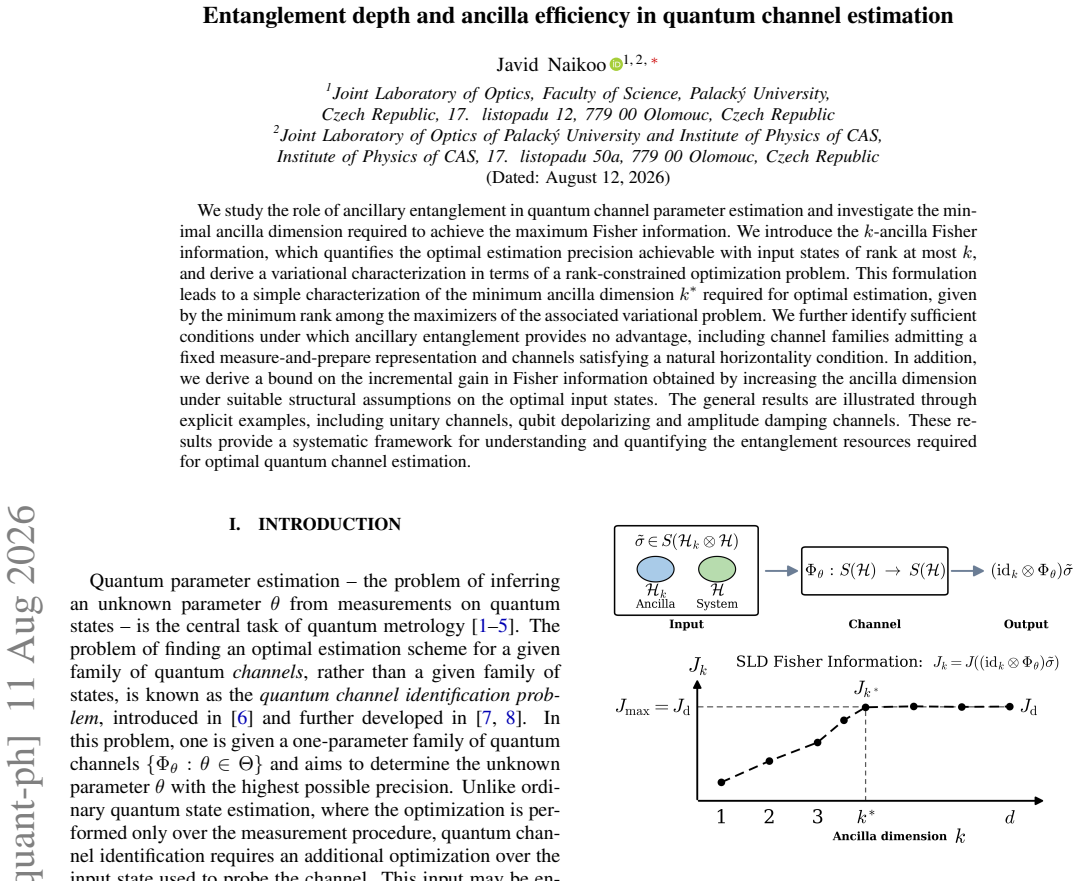
On the paper's own terms, the discovery is a rank formula for entanglement depth in quantum channel estimation. For a one-parameter family $\Phi_\theta$, define the $k$-ancilla Fisher information $J_k(\Phi_\theta)$ as the best SLD Fisher information attainable with a $k$-dimensional ancilla. Theorem 1 states $J_k = \max_{\operatorname{rank}\sigma \le k} g(\sigma)$, where $g$ is obtained by minimizing the channel-generator cost $f(\sigma,X)$ over Hermitian generator corrections $X$; $g$ is concave and continuous, so its maximizer set $\mathcal{M}$ is nonempty, convex, and compact. Theorem 2 then shows $k^* = \min_{\sigma\in\mathcal{M}} \operatorname{rank}\sigma$. In words: the minimum ancilla dimension sufficient to saturate the fully extended Fisher information is exactly the smallest rank among optimal reduced probe states, so entanglement depth is a rank property of a concave variational problem.
Load-bearing premise
The load-bearing premise is that, for a channel family written in fixed measure-and-prepare form, each prepared state $\xi_{i,\theta}$ is itself the output $\Phi_\theta(\rho_i)$ of a single $\theta$-independent input state $\rho_i$; this attainability condition is added in the proof of Theorem 3(i) after Eq. (35) and is not part of the theorem's stated assumptions. If it fails, the convexity argument for $J_d\le J_1$ does not go through.
Editorial extensions
If this is right
- For any one-parameter channel family, the whole sequence $J_1\le J_2\le\cdots\le J_d$ is controlled by the single concave function $g$, so finding the optimal ancilla dimension becomes a finite-dimensional rank-constrained convex optimization problem.
- The optimal ancilla dimension is determined by purity of the optimizer: if a minimum-rank maximizer of $g$ is pure then $k^*=1$ and entanglement buys nothing; if all maximizers are full-rank then the full ancilla $k^*=d$ is required.
- Channel families admitting a fixed measure-and-prepare representation with the same POVM for all $\theta$, and families with horizontal generator curves, have zero gap $J_d=J_1$ under the stated attainability condition.
- The incremental bound $J_{k+1}-J_k \ge t(g(\tau)-J_k)$ quantifies the marginal value of an extra ancilla dimension when successive optimal states are convex mixtures.
- The worked examples give concrete resource answers: unitary channels need $k^*=1$, qubit depolarizing needs $k^*=2$, and amplitude damping needs $k^*=1$.
Reading between the lines
- Editorial extension: Theorem 2 suggests a practical numerical recipe—evaluate $g$ via the Lyapunov solution and increase the allowed rank until the maximum stops changing; the first saturating rank is $k^*$. The paper does not spell out this algorithm.
- Editorial extension: The proof distinction between fixed measure-and-prepare and merely entanglement-breaking families points to a concrete test: a family of entanglement-breaking channels whose Holevo POVM varies with $\theta$ may show $J_d>J_1$, with the classical Fisher term of the varying probabilities being the obstruction.
- Editorial extension: Because rank is a discontinuous function of the state, small perturbations of a channel family can make $k^*$ jump sharply even when $J_d$ changes little, so minimal-ancilla metrology could be fragile to model error.
- Editorial extension: In the multiparameter case, the rank characterization would likely make the required ancilla dimension depend on the chosen estimation direction, since the matrix-valued Fisher information has no single scalar optimum; the paper lists multiparameter extension as open.
Editorial analysis
A structured set of objections, weighed in public.
Referee Report
Summary. The paper studies the minimal ancilla dimension needed to attain the maximum SLD Fisher information in one-parameter quantum channel estimation. It defines a k-ancilla Fisher information J_k, proves a variational formula J_k = max_{\sigma \in S_k(H)} g(\sigma) based on the Fujiwara–Imai functional, and derives a rank characterization k^* = rank(\sigma^*) where \sigma^* is a minimum-rank global maximizer of the concave functional g. It then gives sufficient conditions for k^* = 1, namely a fixed measure-and-prepare representation and a horizontality condition, and derives a conditional lower bound on incremental gains J_{k+1} - J_k. The results are illustrated on unitary channels, qubit depolarizing, and amplitude damping channels.
Significance. The paper offers a clean and potentially useful reformulation of the ancilla-resource problem: the optimal ancilla dimension is determined entirely by the rank structure of maximizers of a concave functional. Theorem 1 and Theorem 2 appear logically sound and are built on the established Fujiwara–Imai variational formula. The examples are instructive and the writing is generally clear. The main defect is that one of the two advertised zero-gap criteria, Theorem 3(i), is not proven as stated, because the proof introduces an unstated attainability condition. Since the abstract and conclusions repeat the stronger claim, this is a load-bearing issue that must be fixed before publication.
major comments (1)
- [Sec. V, Theorem 3(i) and proof after Eq. (35)] The theorem statement claims that a fixed measure-and-prepare representation (a θ-independent POVM {M_i} and states ξ_{i,θ}) suffices for k^* = 1. However, the proof adds the additional assumption that for every i there exists a θ-independent state ρ_i with Φ_θ(ρ_i) = ξ_{i,θ}. This condition is not stated in the theorem and is not implied by the fixed-POVM representation alone: the states ξ_{i,θ} in a measure-and-prepare representation need not belong to the image of Φ_θ. The step J(ξ_{i,θ}) = J(Φ_θ(ρ_i)) ≤ J_1 at Eq. (40) relies exactly on this added attainability assumption. Without it, the convexity argument only gives J(ω_θ) ≤ Σ_i p_i J(ξ_{i,θ}), which can exceed J_1 because a prepared state can in principle carry more Fisher information than any unassisted channel output. Consequently, the theorem as stated is not established, and the abstract and conclusions repeat the stronger claim that a fixed measure-and-prepare representation alone suffices for k^* = 1. Please either add the attainability condition to the statement, prove that it follows from the fixed-POVM representation, or provide a counterexample and adjust the narrative accordingly.
minor comments (4)
- [Abstract] The phrase 'input states of rank at most k' is imprecise: in Eq. (14) the input is a state on H_k ⊗ H whose rank is not constrained to be at most k. The rank constraint applies to the reduced state σ = Tr_1 |ψ⟩⟨ψ| after the reduction to pure inputs. Please clarify this wording.
- [Sec. III, proof of Theorem 1, step (iii)] In the sentence 'if ψ⟩= Pk i= 1√λi |ei⟩ ⊗ |fi⟩, is the Schmidt decomposition', a backslash before “psi” is missing and the equation is typeset incorrectly.
- [Sec. V, Eq. (37)] The notation 'p_i, τ_i' in the display after Eq. (37) is confusing; the comma appears to be a typographical artifact. Please use the standard notation p_i τ_i ⊗ ξ_{i,θ}.
- [Sec. V, discussion after Theorem 3(i)] The paragraph distinguishing condition (i) from entanglement-breaking channels is useful, but it does not address the additional attainability assumption in the proof. Please reconcile this discussion with the revised theorem statement.
Circularity Check
No circular derivation: the central results follow from the external Fujiwara-Imai variational formula plus convexity/rank arguments; the Theorem 3(i) proof gap is an omitted hypothesis, not a circular step.
full rationale
The paper's derivation chain is not circular. Theorem 1 builds on the externally established Fujiwara-Imai variational formula (Eq. (2), Theorem 4 of [8]) and extends it to k-dimensional ancillas by a Schmidt-decomposition argument; Theorem 2 then follows from the definitions of J_k, S_k(H), and g by a standard min-rank/maximizer argument. No parameter is fitted to data, and no 'prediction' is an input renamed; the author cites no prior work of his own, so there is no load-bearing self-citation chain. The one flagged issue is in Sec. V, in the proof of Theorem 3(i) after Eq. (35), where the proof silently adds the attainability condition 'In addition, assume that for every i there exists a θ-independent state ρ_i ... such that Φθ(ρ_i)=ξ_{i,θ}' to the stated fixed-measure-and-prepare hypothesis. This is a genuine proof gap and a missing hypothesis in the theorem statement, but it is not circular: the conclusion k*=1 is not contained in or equivalent to the added condition. Rather, the added condition is a stronger sufficient hypothesis that makes the convexity argument go through, and Appendix A correctly emphasizes that the fixed-measurement assumption is stronger than mere entanglement-breaking. Thus no circular step is present, and the circularity score is 0; the Theorem 3(i) concern is a correctness risk, not a circularity risk.
Assumptions & free parameters
assumptions (4)
- domain assumption Fujiwara-Imai variational formula for the fully extended Fisher information (Eq. (2))
- standard math SLD Fisher information is convex in the state for θ-independent convex combinations
- standard math Every state of rank at most k on H can be purified with a k-dimensional ancilla, and every pure state on H_k ⊗ H reduces to a rank at most k state
- domain assumption The channel family is smooth and piecewise-regular so that the variational formulas apply
Cite this review
Pith. "Pith review of Entanglement depth and ancilla efficiency in quantum channel estimation." pith.science (2026). https://pith.science/paper/SIWNBHKK
@misc{pith2026260811042,
  author       = {Pith},
  title        = {Pith review of: Entanglement depth and ancilla efficiency in quantum channel estimation},
  year         = {2026},
  howpublished = {\url{https://pith.science/paper/SIWNBHKK}},
  note         = {Machine review of arXiv:2608.11042}
}
abstract
We study the role of ancillary entanglement in quantum channel parameter estimation and investigate the minimal ancilla dimension required to achieve the maximum Fisher information. We introduce the $k$-ancilla Fisher information, which quantifies the optimal estimation precision achievable with input states of rank at most $k$, and derive a variational characterization in terms of a rank-constrained optimization problem. This formulation leads to a simple characterization of the minimum ancilla dimension $k^*$ required for optimal estimation, given by the minimum rank among the maximizers of the associated variational problem. We further identify sufficient conditions under which ancillary entanglement provides no advantage, including channel families admitting a fixed measure-and-prepare representation and channels satisfying a natural horizontality condition. In addition, we derive a bound on the incremental gain in Fisher information obtained by increasing the ancilla dimension under suitable structural assumptions on the optimal input states. The general results are illustrated through explicit examples, including unitary channels, qubit depolarizing and amplitude damping channels. These results provide a systematic framework for understanding and quantifying the entanglement resources required for optimal quantum channel estimation.
Figures
Reference graph
Works this paper leans on
-
[1]
C. W. Helstrom,Quantum Detection and Estimation Theory, Math. Sci. Eng., V ol. 123 (Academic Press, New York, 1976)
work page 1976
-
[2]
A. S. Holevo,Probabilistic and Statistical Aspects of Quantum Theory, Stud. Math. Appl., V ol. 1 (North-Holland, Amsterdam, 1982)
work page 1982
-
[3]
Statistical distance and the geometry of quantum states,
S. L. Braunstein and C. M. Caves,“Statistical distance and the geometry of quantum states, ”Phys. Rev. Lett.72, 3439 (1994)
work page 1994
-
[4]
Quantum-enhanced measurements: Beating the standard quantum limit,
V . Giovannetti, S. Lloyd and L. Maccone,“Quantum-enhanced measurements: Beating the standard quantum limit, ”Science 306, 1330 (2004)
work page 2004
-
[5]
V . Giovannetti, S. Lloyd and L. Maccone,“Quantum metrol- ogy, ”Phys. Rev. Lett.96, 010401 (2006)
work page 2006
-
[6]
Quantum channel identification problem,
A. Fujiwara,“Quantum channel identification problem, ”Phys. Rev. A63, 042304 (2001)
work page 2001
-
[7]
Quantum parameter estimation of a generalized pauli channel,
A. Fujiwara and H. Imai,“Quantum parameter estimation of a generalized pauli channel, ”J. Phys. A: Math. Gen.36, 8093 (2003)
work page 2003
-
[8]
A fibre bundle over manifolds of quantum channels and its application to quantum statistics,
A. Fujiwara and H. Imai,“A fibre bundle over manifolds of quantum channels and its application to quantum statistics, ” J. Phys. A: Math. Theor.41, 255304 (2008)
work page 2008
Show all 23 references
-
[9]
Gen- eral framework for estimating the ultimate precision limit in noisy quantum-enhanced metrology,
B. M. Escher, R. L. de Matos Filho and L. Davidovich,“Gen- eral framework for estimating the ultimate precision limit in noisy quantum-enhanced metrology, ”Nat. Phys.7, 406 (2011)
2011
-
[10]
Using entangle- ment against noise in quantum metrology,
R. Demkowicz-Dobrza ´nski and L. Maccone,“Using entangle- ment against noise in quantum metrology, ”Phys. Rev. Lett.113, 250801 (2014)
2014
-
[11]
Quantum limits in optical interferometry,
R. Demkowicz-Dobrza ´nski, M. Jarzyna and J. Kołody ´nski, “Quantum limits in optical interferometry, ”Progress in Optics 9 60, 345 (2015)
2015
-
[12]
Usefulness of entanglement-assisted quantum metrology,
Z. Huang, C. Macchiavello and L. Maccone,“Usefulness of entanglement-assisted quantum metrology, ”Phys. Rev. A94, 012101 (2016)
2016
-
[13]
Quantum metrology from a quantum information science perspective,
G. T ´oth and I. Apellaniz,“Quantum metrology from a quantum information science perspective, ”J. Phys. A: Math. Theor.47, 424006 (2014)
2014
-
[14]
Quantum metrology with nonclassical states of atomic ensembles,
L. Pezz `e, A. Smerzi, M. K. Oberthaler, R. Schmied and P. Treutlein,“Quantum metrology with nonclassical states of atomic ensembles, ”Rev. Mod. Phys.90, 035005 (2018)
2018
-
[15]
Kraus,States, Effects, and Operations: Fundamental No- tions of Quantum Theory, Lecture Notes in Physics, V ol
K. Kraus,States, Effects, and Operations: Fundamental No- tions of Quantum Theory, Lecture Notes in Physics, V ol. 190 (Springer, Berlin, 1983)
1983
-
[16]
Algorithm 432: Solution of the matrix equationax+xb=c,
R. H. Bartels and G. W. Stewart,“Algorithm 432: Solution of the matrix equationax+xb=c, ”Commun. ACM15, 820 (1972)
1972
-
[17]
N. J. Higham,Functions of Matrices: Theory and Computation (SIAM, Philadelphia, 2008)
2008
-
[18]
R. R. Phelps,Lectures on Choquet’s Theorem, 2nd ed., Lecture Notes in Mathematics, V ol. 1757 (Springer-Verlag, Berlin, Hei- delberg, 2001)
2001
-
[19]
Bengtsson and K
I. Bengtsson and K. ˙Zyczkowski,Geometry of Quantum States: An Introduction to Quantum Entanglement, 2nd ed. (Cambridge University Press, Cambridge, 2017)
2017
-
[20]
D. P. Bertsekas,Nonlinear Programming, 2nd ed. (Athena Sci- entific, Belmont, MA, 1999)
1999
-
[21]
Boyd and L
S. Boyd and L. Vandenberghe,Convex Optimization(Cam- bridge University Press, Cambridge, 2004)
2004
-
[22]
Quantum coding theorems,
A. S. Holevo,“Quantum coding theorems, ”Russ. Math. Surv. 53, 1295 (1998)
1998
-
[23]
Extended convexity of quan- tum fisher information in quantum metrology,
S. Alipour and A. T. Rezakhani,“Extended convexity of quan- tum fisher information in quantum metrology, ”Phys. Rev. A91, 042104 (2015). Appendix A: Further remarks on Theorem 3(i) The proof of Theorem 3(i) relies on the assertion that, for every input state˜σ∈S(H ⊗ H), the ou...
2015
Reviewed August 12, 2026 · model on record in the stance chip above.
Discussion (0). Continue with ORCID to comment.