REVIEW 5 major objections 5 minor
Many-Body Destabilization of Intermediate Oxygen-Hole States
T0 review · 5 major / 5 minor · reviewed 2026-08-15 · deepseek-v4-flash
Pith's one-line read Diffusion quantum Monte Carlo reverses hybrid DFT's energetic ordering of oxygen-hole polarons in Na2-xMn3O7, stabilizing a localized polaron by about 1 eV.
desk verdict The DMC reversal of the HSE split-polaron preference in Na2-xMn3O7 is a new and plausible result, but the single-determinant fixed-node limitation and the absence of reported error bars keep it a conditional benchmark rather than a settled ordering. read the letter →
The pith
A machine-rendered reading of the paper's core claim, the machinery that carries it, and where it could break.
The reading
What carries the argument
The key machinery is fixed-node diffusion quantum Monte Carlo (DMC) with single-determinant Slater-Jastrow trial wavefunctions, evaluated at DFT-relaxed geometries. DMC provides an explicit many-body treatment of electron correlation and yields variational energies with respect to the trial nodal surface. The comparison relies on twist-averaged finite-size extrapolation and on varying the exact-exchange fraction (for HSE) and Hubbard U and inter-site V parameters (for PBE+U+V) to optimize trial wavefunctions. Many-body spin densities, obtained via mixed-estimator extrapolation, serve as the observable fingerprint distinguishing localized from split polarons.
What would settle it
Run fixed-node DMC with multideterminant trial wavefunctions (e.g., generated from complete-active-space or selected-CI calculations) for both polaron configurations in NaMn3O7; if the split-polaron state becomes lower in energy by more than about 0.5 eV, the claimed reversal is an artifact of the fixed-node approximation.
Extended reading notes
Core claim
The central claim is that explicit many-body treatment destabilizes the split-polaron state in Na2-xMn3O7: while hybrid DFT (HSE) favors a split oxygen-hole polaron across all tested exact-exchange fractions, DMC predicts the localized-polaron configuration to be lower in energy by approximately 1 eV, reversing the ordering by more than 1 eV relative to HSE. The reversal is robust to the class of trial wavefunctions used. Many-body spin densities additionally show that the nominal split state partially collapses toward a localized polaron, indicating that the split state is not a stable many-body configuration. The paper therefore establishes Na2-xMn3O7 as a benchmark where hybrid functionals qualitatively mis-rank competing oxygen-hole localization motifs.
Load-bearing premise
The verdict rests on single-determinant fixed-node DMC trial wavefunctions faithfully bracketing the two near-degenerate hole states, and on the DFT-relaxed geometries remaining valid for the many-body ground state.
Editorial extensions
If this is right
- If the DMC ordering is correct, hybrid DFT can qualitatively mis-rank competing oxygen-hole localization motifs in correlated oxides when localization, hybridization, and Coulomb interactions compete on similar energy scales.
- The low-energy oxygen-hole state in Na2-xMn3O7 after Na removal is a localized polaron, not a split polaron, with consequences for the redox mechanism and reversible capacity of this cathode material.
- Conventional O K-edge X-ray absorption signatures are insufficient to identify the microscopic character of oxygen-hole states; spin-resolved probes or many-body benchmarks are required.
- DMC provides a practical energetic benchmark for defect states in correlated oxides, with finite-size and trial-wavefunction uncertainties controlled enough to discriminate competing polarons.
Reading between the lines
- Beyond the paper, hybrid functionals used to model battery cathodes or electrocatalysts may systematically overpredict delocalized ligand-hole intermediates; re-examining other oxygen-redox materials with DMC could reveal a broader failure mode.
- The spin-density collapse of the split state suggests that spin-resolved X-ray or magnetic measurements could distinguish polaron characters where total charge densities look alike, a testable experimental extension.
- The sensitivity of DFT+U+V results to the O-O inter-site interaction parameter hints that a functional correcting inter-site correlation might reproduce the DMC ordering without the cost of QMC, pointing a direction for functional development.
Signed reviews
Editorial analysis
A structured set of objections, weighed in public.
Referee Report
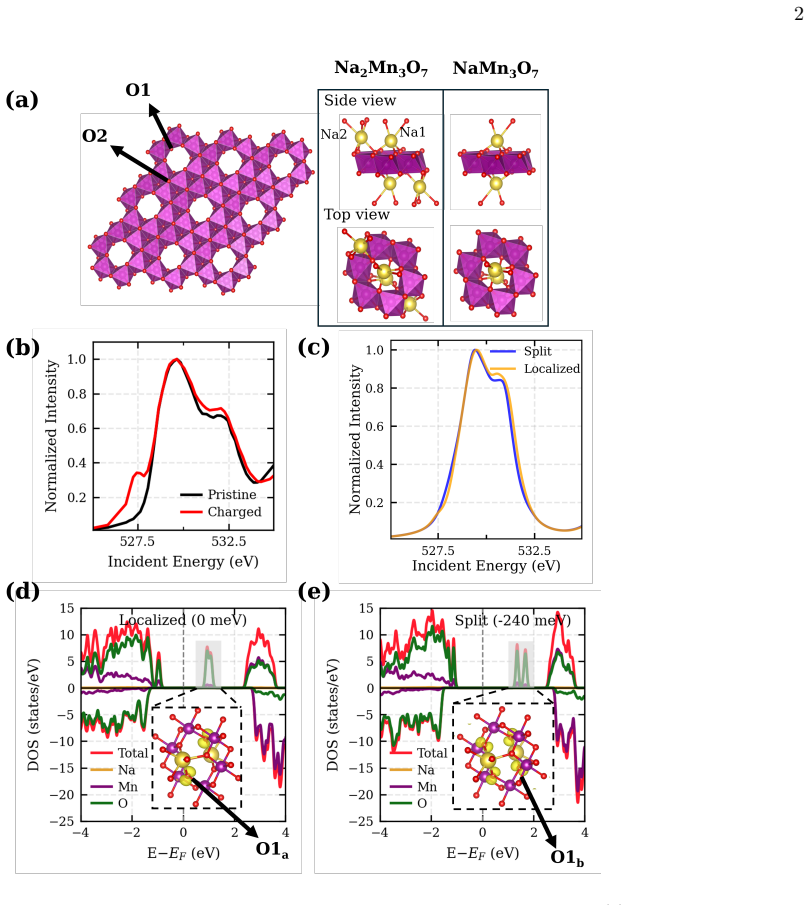
Summary. The manuscript reports fixed-node diffusion Monte Carlo (DMC) calculations for two competing oxygen-hole configurations in layered Na2-xMn3O7: a localized oxygen polaron and a bond-centered split polaron. Hybrid HSE calculations favor the split state by about 0.28 eV at the DMC-optimized exact-exchange fraction alpha≈0.15, whereas DMC reverses the ordering, placing the localized polaron lower by approximately 1 eV. The authors show that the reversal is reproduced with HSE- and PBE+U+V-generated trial wavefunctions, that the DMC[HSE] spin density of the nominal split state partially collapses onto one oxygen site, and that the two configurations have similar calculated O K-edge spectra, so X-ray absorption alone cannot distinguish them. They conclude that hybrid functionals can qualitatively mis-rank competing oxygen-hole localization motifs and propose Na2-xMn3O7 as a benchmark system.
Significance. If the energetic reversal is correct, the paper is a valuable demonstration that hybrid DFT can stabilize an intermediate oxygen-hole state that is not the many-body ground state, and it provides a clear benchmark for correlated methods. The work uses state-of-the-art DMC with correlation-consistent effective core potentials, tests two trial-wavefunction classes, employs twist averaging, and presents spin-density analyses that go beyond energy differences. The identification of a spectroscopic ambiguity for localized versus split oxygen holes is an important methodological insight. However, because the central claim rests on fixed-node DMC with single-determinant trial wavefunctions whose parameters were optimized against DMC energies, the result should be regarded as a strong conditional benchmark rather than a definitive many-body ordering.
major comments (5)
- [Fig. 2(d), main text 'DMC instead predicts...'] No error bars are reported for the DMC total-energy differences. The central quantitative claim is a ~1 eV reversal, yet the stochastic uncertainty of DMC, the timestep error, and the twist-averaging/finite-size corrections are not combined into an uncertainty on ΔE. Please report the statistical error on each DMC energy and on ΔE, and state which systematic contributions have been estimated.
- [Supplemental Section V, main text Section V] The trial-wavefunction parameters were optimized by minimizing DMC energies: alpha for HSE and U,V for PBE+U+V. Because fixed-node DMC energies are variational with respect to the nodal surface, optimizing parameters separately for the localized and split configurations can differentially improve the nodes and thereby bias the energy gap. The manuscript itself concedes that single-determinant trial wavefunctions may not provide a sufficiently flexible description. I request (i) a demonstration that ΔE remains negative when a single common parameter set is used for both configurations, (ii) a report of ΔE across the full scanned parameter range rather than at per-configuration minima, and (iii) a discussion of possible fixed-node bias, ideally with a multideterminant or orbital-optimized trial wavefunction test.
- [Fig. 3(c,d), Fig. 3(e,f)] The DMC[HSE] spin density for the nominal split-polaron state collapses onto a single oxygen site, and the paper states that the system yields two localized variants. The energy comparison is therefore not between a stable delocalized split state and a localized state, but between two states whose character changes under the many-body projection. This collapse is consistent with the fixed-node concern raised above and should be addressed explicitly: would a balanced trial wavefunction restore a split density, and if so, what would happen to the ordering? Without this, the statement that DMC 'destabilizes' the split state is ambiguous.
- [Supplemental Section VI, Fig. S8] The finite-size test uses only one 2x2x2 supercell, so no actual extrapolation is performed; the main text refers to 'supercell extrapolation procedures' and 'finite-size extrapolation' but only one supercell size is presented. Please provide additional supercell sizes or a quantitative estimate of the residual finite-size error.
- [Supplemental Section I (Computational Details)] The DMC energies are evaluated at DFT-relaxed geometries for each polaron configuration; no many-body geometry relaxation or force calculation is reported. Since polaron stability is intimately tied to lattice distortion, the 1 eV reversal could be modified by geometry relaxation in the many-body state. Please state the sensitivity of ΔE to the geometries or test with DMC-based relaxation.
minor comments (5)
- [Main text and Supplemental Material] The figure numbering is inconsistent: the main text refers to 'Supplemental Material Fig. S5' for finite-size extrapolation, while the Supplemental Material labels that figure as Fig. S8 (and Fig. S5 is the DFT+U energy landscape). Please correct the cross-references.
- [Main text, Fig. 3(e,f)] The phrase 'DMC calculations based on PBE trial wavefunctions' should read 'PBE+U+V trial wavefunctions' to match the rest of the manuscript and the parameter scans reported in Fig. 2(e,f).
- [Fig. 1(c) caption and abstract] The caption says that neither the localized nor the split configuration reproduces the experimentally observed pre-edge feature well, while the abstract emphasizes that the two configurations produce similar O K-edge features; please clarify that the similarity is between the two calculated spectra, not with experiment.
- [Throughout] The manuscript alternates between Na2-xMn3O7 and NaMn3O7; please specify the exact supercell composition, number of formula units, and net charge used in the DMC calculations, since the hole count is central to the comparison.
- [Fig. 2(d-f)] Consider reporting the DMC energy differences in a table with statistical uncertainties and the corresponding parameter values, as the figures are difficult to read at the resolution provided.
Circularity Check
No significant circularity: the DMC reversal is an ab initio result, not a refit of the hybrid-DFT ordering.
full rationale
The paper's derivation chain is: (i) DFT approximations predict different oxygen-hole polarons; (ii) fixed-node DMC total energies are computed for both configurations using HSE- and PBE+U+V-generated trial wavefunctions; (iii) DMC favors the localized polaron; (iv) spin densities show the nominal split state partially collapses. Step (iii) is not equivalent to any input. The DMC energies are ab initio many-body energies; the trial-wavefunction parameters were varied to minimize the DMC total energy (Supplemental Section V: 'using the DMC energy as a benchmark'), which is standard variational optimization of a trial state rather than a fit of the energy difference. The paper reports that both HSE trial states have DMC minima at the same alpha approximately 0.15, so the HSE-based comparison is made at a common parameter value, and the PBE+U+V comparison uses minima over V scans without constraining the sign of the gap. The DFT/HSE preference is computed independently (Fig. 2a) and conflicts with the DMC result, so the reversal is not imported from reference [24]. The acknowledged single-determinant fixed-node limitation (Section V and Supplemental IX) is an accuracy caveat about nodal bias, not a circular reduction. The self-citation [24] supplies experimental spectra and earlier DFT context that is recomputed here; it is not load-bearing for the DMC conclusion. No step reduces to its own input by construction.
Assumptions & free parameters
free parameters (2)
- HSE exact-exchange fraction alpha =
alpha ~ 0.15 (DMC energy minimum)
- PBE+U+V parameters (U_Mn-3d, U_O-2p, V_Mn-3d/O-2p, V_O-2p/O-2p) =
U fixed at (3, 2) eV; V values scanned, full grid not reported
assumptions (4)
- domain assumption Fixed-node approximation in DMC
- domain assumption Single-determinant trial wavefunctions adequately represent both polaron states
- domain assumption DFT-relaxed geometries for each polaron configuration are accurate
- domain assumption ccECP pseudopotentials accurately represent core-valence interactions
Cite this review
Pith. "Pith review of Many-Body Destabilization of Intermediate Oxygen-Hole States." pith.science (2026). https://pith.science/paper/WISWQN5B
@misc{pith2026260811388,
  author       = {Pith},
  title        = {Pith review of: Many-Body Destabilization of Intermediate Oxygen-Hole States},
  year         = {2026},
  howpublished = {\url{https://pith.science/paper/WISWQN5B}},
  note         = {Machine review of arXiv:2608.11388}
}
abstract
Oxygen holes in transition-metal oxides can appear as localized polarons, symmetry-delocalized ligand holes, or intermediate states whose stability is controlled by subtle electron-correlation effects. In layered Na$_{2-x}$Mn$_3$O$_7$, hybrid density functional theory (DFT) predicts an unusual bond-centered split oxygen-hole polaron stabilized near ordered Mn vacancies. Here we resolve the nature of this state using diffusion Quantum Monte Carlo (QMC). Although hybrid DFT favors the split configuration, QMC reverses the energetic ordering and identifies the localized oxygen polaron as the lower-energy state. The result is robust to the class of trial wavefunctions used, including hybrid and generalized-gradient DFT wavefunctions. Many-body spin densities further show that the nominal split state partially collapses toward a localized polaron. Because localized and split configurations produce similar O K-edge spectral features, this qualitative failure is not resolved by conventional X-ray absorption signatures alone. These findings identify Na$_{2-x}$Mn$_3$O$_7$ as a stringent benchmark for oxygen-hole polarons and reveal a failure mode of hybrid functionals in correlated oxides.
Figures


Reviewed August 15, 2026 · model on record in the stance chip above.
Discussion (0). Continue with ORCID to comment.