REVIEW 5 major objections 4 minor 50 references
AutoGrable: What Is a Good Graph for a Table?
T0 review · 5 major / 4 minor · reviewed 2026-08-15 · deepseek-v4-flash
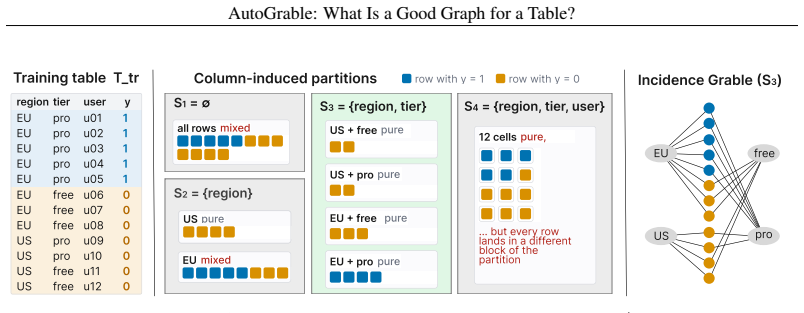
Pith's one-line read For a 1-WL-bounded GNN, a table-to-graph construction is seen only as a partition of the rows, so a good graph is one whose row groups align with the labels.
desk verdict AutoGrable's reduction of table-to-graph construction to column selection is real and clean; the weak link between its J score and downstream GNN performance is the main thing to push on. read the letter →
The pith
A machine-rendered reading of the paper's core claim, the machinery that carries it, and where it could break.
The reading
What carries the argument
The load-bearing object is the incidence grable $G_S(T)$: a bipartite graph with one row node per table row, one value node per occurring value of each selected column, and a typed edge connecting a row node to each value it takes. Colour refinement (1-WL) on this graph stabilises to a partition of the row nodes, and Lemma 1 states that in the row-feature-erased reduct this stable partition is exactly $\pi_S$, the partition of training rows by their projection onto $S$. That equality is what turns graph construction into column selection. The optimisation target is $J(\pi_S) = \widehat{\mathrm{Risk}}_{\mathrm{val}}(\hat h_S) + \lambda \Omega(T^{tr},\pi_S)$, with $\hat h_S$ the empirical label distribution on each cell and $\Omega(T^{tr},\pi_S) = \frac{1}{n_{tr}}\sum_u \sqrt{N_{S,u}}$ the occupancy penalty; $J$ is evaluated by a group-by and a validation pass, with no GNN trained.
What would settle it
Enumerate all $2^{|F|}$ column subsets for a fixed table and label, compute $J$ for each, and train a fixed 1-WL-bounded GNN on each incidence grable under a fixed hyperparameter budget. The criterion's claim is that low $J$ is necessary for strong downstream AUC; a single subset with low $J$ and poor test AUC, or a subset with high $J$ and top test AUC, would refute it. The paper's own test-split correlations are weak, so this direct enumeration is the decisive check.
Extended reading notes
Core claim
The central claim is that a table-to-graph construction is, for a 1-WL-bounded message-passing GNN, nothing more than a way of grouping rows, and the right grouping is one aligned with the label: separate different labels, do not split same labels without cause. The paper proves this for the incidence grable $G_S(T)$: with row features erased, its stable colour-refinement partition on row nodes equals the projection partition $\pi_S = \{r|_S\}$ of the rows onto the selected columns. Consequently, searching over graphs is equivalent to searching over column subsets, and the quality of a subset can be judged in table space by the alignment score $J(\pi_S) = \widehat{\mathrm{Risk}}_{\mathrm{val}}(\hat h_S) + \lambda \Omega(T^{tr},\pi_S)$, where $\hat h_S$ is the best cell-constant predictor and $\Omega$ penalises sparsely populated cells. The selected columns are then expanded into value nodes to form the graph on which a GNN is trained; the block predictor is only the selection criterion, not the final model.
Load-bearing premise
The load-bearing premise is that the score $J$, the held-out risk of a cell-constant block predictor plus an occupancy penalty, is a reliable enough proxy for the downstream performance of a GNN trained on the selected graph; the paper's correlation evidence is weak and one-sided, and its generalisation bound applies to the block predictor, not the trained GNN.
Editorial extensions
If this is right
- Graph construction can be taken out of the training loop: every candidate score is one group-by over the training rows plus one validation pass, so searching costs $O(|F|^2(n_{\mathrm{tr}}+n_{\mathrm{val}}))$ in the worst case.
- For incidence constructions, the graph itself adds no row-distinguishing power beyond the selected columns' projection partition; it contributes cross-row evidence inside each cell, while unexpanded row features remain local to each row.
- The same table has different good graphs for different tasks, and if the labels are row-local the good output may be no graph at all.
- The trivial grable is an admissible and sometimes best output, and declining to build a graph avoids the validation-gain/test-loss overfitting observed when all columns are exposed on i.i.d. rows.
- Even the weaker objective of separating all differently labelled rows with at most $k$ columns is NP-complete, so approximate greedy search is the practical route.
Reading between the lines
- Any two constructions that induce the same 1-WL row partition should be interchangeable for a 1-WL-bounded learner; this equivalence is implicit and could be tested by rewiring edges within a cell and checking that attainable accuracy is unchanged.
- Because $J$ is label-relative and training-free, it doubles as a regularised tabular feature-selection criterion: among all column subsets it picks those whose row groups can support a cell-constant predictor, independently of any graph.
- Since $J$ is optimised for a block predictor, tasks whose labels depend on evidence a cell-constant predictor cannot see may be underserved; a score that also rewarded cross-cell interactions is a natural extension the paper does not explore.
- The empty-selection behaviour suggests a deployment rule: run the score before deciding whether graph learning is worth it, and fall back to row-local models when it returns the empty set; the paper demonstrates this pattern but does not claim it as a universal law.
Signed reviews
Editorial analysis
A structured set of objections, weighed in public.
Referee Report
Summary. The manuscript proposes AutoGrable, a training-free method for choosing which columns of a table (or foreign-key schema) to expand into an incidence graph before applying a GNN. The argument is that for a message-passing GNN bounded by 1-WL, the only information a construction conveys is the colour-refinement partition of the row nodes; under the row-feature-erased incidence grable this partition equals the projection partition onto the selected columns (Lemma 1). The paper defines an alignment score J(pi_S) equal to the validation risk of a block-constant predictor plus lambda times an occupancy penalty, proves a Rademacher-style estimation bound and a uniform validation guarantee for this score, and searches over column subsets by greedy forward/backward local search (Algorithm 1). The same score is applied to materialised joins over foreign-key paths. Experiments address column recovery on synthetic tasks, correlation of J with downstream GraphSAGE AUC on RDB2G-Bench candidate graphs, and comparison with trivial, full-incidence, random, REG, and auGraph constructors on transactional and RelBench tasks.
Significance. If the main claim were fully established, the paper would make a genuinely useful contribution: it offers a training-free, interpretable criterion for graph construction, with the attractive consequence that the constructor can decline to build a graph. The theoretical apparatus around the block predictor (Lemmas 3-5 and Proposition 1) is largely sound, and the experiments are extensive, with a fixed predictor and multiple baselines. However, the bridge from the block-predictor score to the actual downstream GNN is the weakest link: Lemma 1 concerns only the feature-erased reduct, the correlations in Table 2 are weak and only one-sided, and the multi-table extension has no theoretical anchor. The paper is best read as proposing a heuristic screening criterion with a partial theoretical justification; the current evidence does not support the stronger claim that minimizing J selects graphs that are optimal or near-optimal for GNN training.
major comments (5)
- [Section 4, Lemma 1 and 'What the downstream GNN receives'] Lemma 1 is stated without proof and applies only to the row-feature-erased reduct G°_S(T_tr). The graph actually trained on is G_S(T), whose row nodes carry the unexpanded attributes r|A\S; as the paper notes in Section 4, pi_CR(G_S(T)) refines pi_S. Therefore the equivalence that reduces construction to column selection does not hold for the real object of learning. A GNN can separate rows within a cell of pi_S using row-local features, while the block predictor used by J cannot; the occupancy penalty in J charges for exactly this within-cell refinement. Consequently J can systematically undervalue constructions whose benefit is to enable message passing between rows with informative local features. The generalisation bound in Lemma 5 and the oracle inequality in Proposition 1 apply to the block predictor, not to a GNN trained on the constructed graph. Please prove Lemma 1, give the precise relation between pi_CR(G_S(T)) and pi_S, and either extend the theory to the full graph or explicitly restrict the claims to the feature-erased setting.
- [Section 5.2, Table 2] The empirical support for J as a proxy for downstream performance is weak. On the test split, Spearman's rho between J and AUC is -0.118 and -0.251 for driver-top3 and -0.158 and -0.287 for study-outcome, with Kendall's tau_b between -0.082 and -0.219. These correlations are consistent with a one-sided screen only in the loose sense that no high-J graph performs well; the paper reports no threshold-selection procedure, no operating-characteristic analysis of the screen, and no comparison between graphs selected by minimizing J and graphs selected by other thresholds. Since Algorithm 1 greedily minimises J, a weak or biased proxy can drive selection to suboptimal graphs while still preserving a negative correlation. The RQ2 evidence should be supplemented by an explicit threshold analysis and by a direct evaluation of the downstream AUC of the graphs that Algorithm 1 actually returns.
- [Section 3, 'Extension to relational databases'] No analogue of Lemma 1 is given for the multi-table setting. After left-joining along foreign-key paths of length < d and collapsing duplicate appearances with weight 1/k_i(S), the paper does not show that the colour-refinement partition of the resulting multi-table incidence graph equals the weighted projection partition on which J is evaluated. The relational results in Table 3 and Table 9 therefore rest on an unverified assertion. Either provide the corresponding equivalence, with the multiplicity weighting made explicit, or present the multi-table procedure as a heuristic and temper the claims accordingly.
- [Sections 2 and 5; Appendix D.6.1] J is computed on T_val and used to select S*, and the same validation split is used for early stopping and checkpoint selection of the final GNN. Proposition 1 provides a uniform guarantee for the block-predictor score on the validation set, but not for the downstream GNN's test risk after selection. Because AutoGrable's construction choice is made by inspecting validation labels, its reported test performance is not obtained under the same selection protocol as the fixed baselines. Please report results with a three-way split, or nested validation, so that the construction-selection validation set is disjoint from the early-stopping validation set, or provide an argument that the validation reuse does not favour AutoGrable.
- [Tables 1, 7, and 8] The method's behaviour is heavily controlled by the signature, direction, and lambda axes. Under frequency encoding, the row-local families Single-val, Conj, and XOR return the empty set in most configurations (Table 1), and the fixed setup reported in Table 3 (forward direction, lambda=1, frequency encoding) cannot recover these row-local tasks. The paper does not provide a principled rule for choosing signature, direction, and lambda, and the abstract's unqualified claim that AutoGrable recovers the generating columns is only true when the axes are matched to the task family. This is a practical gap for a method whose advertised advantage is being training-free; at minimum the claims should be restricted to the configuration actually recommended.
minor comments (4)
- [Equation (2)] The paragraph introducing FREQENCODE uses both 'frequency-recoded copy' and 'frequency encoding'; please clarify that the encoding is applied only to candidate columns, while the label and the attributes outside F are unchanged.
- [Figure 2] The x-axis label appears garbled ('J score of label versus color with = 1'); please fix the caption and the axis label.
- [Appendix C.7] There is an incomplete sentence: 'We therefore use the greedy local search in' followed by the heading 'Search strategy.' Please repair this typo.
- [Table 1] The cell format '∅(0) †' is not explained in the caption; please clarify what the dagger denotes when the selected set is empty, since an objective-metric mismatch against the empty set needs a separate definition.
Circularity Check
No significant circularity: the J-score proxy gap is a validity and selection-bias concern, not a circular reduction.
full rationale
The paper's derivation chain is self-contained. The 1-WL bound that motivates the partition criterion is cited to external prior work [7,8]; Lemma 1 is a direct colour-refinement property of the incidence construction (with row features erased) and is not assumed as the desired conclusion; the alignment criterion and the J score are explicit definitions supported by bounds proved in the paper (Lemma 5 and Proposition 1); and the empirical claims are checked against external benchmarks (RDB2G-Bench, RelBench, TabArena) under a fixed predictor. The weakest link identified by the reader—J's weak, one-sided correlation with downstream GNN AUC, and the use of the same validation split for both selection and early stopping—is a real validity and experimental-design concern, but it does not amount to circularity under the required standard: no equation in the paper makes downstream GNN risk equal to J, and the paper explicitly characterises J as a one-sided screen rather than a ranking. The self-citations in the paper ([6], [9], [17], [18], [31]) supply terminology, baselines, or background context; they are not load-bearing for the central reduction of construction to column selection. Thus no circular step can be exhibited.
Assumptions & free parameters
free parameters (5)
- lambda (occupancy penalty weight) =
1 (for real tasks)
- tau (tolerance for greedy search) =
0 (default)
- foreign-key path length d =
not specified in main text
- signature (value vs frequency encoding) =
frequencies (for real tasks)
- search direction (forward vs backward) =
forward (for real tasks)
assumptions (5)
- domain assumption Message-passing GNNs are bounded by 1-WL colour refinement
- standard math Colour refinement on the incidence grable with erased row features equals the projection partition onto selected columns
- domain assumption Validation rows are i.i.d. and independent of training rows
- standard math The occupancy penalty controls the estimation error of the block predictor
- ad hoc to paper The multi-table join materialisation preserves the partition correspondence
Cite this review
Pith. "Pith review of AutoGrable: What Is a Good Graph for a Table?." pith.science (2026). https://pith.science/paper/EY2IL36X
@misc{pith2026260811431,
  author       = {Pith},
  title        = {Pith review of: AutoGrable: What Is a Good Graph for a Table?},
  year         = {2026},
  howpublished = {\url{https://pith.science/paper/EY2IL36X}},
  note         = {Machine review of arXiv:2608.11431}
}
read the original abstract
Graph learning presupposes a graph, and tables and relational databases do not come with one. Applying a GNN to them requires deciding which entities become nodes, which of them to connect, and through which relations---a decision made by hand, by schema heuristics, or by training a model on every candidate graph and keeping the best. We give a criterion that requires no trained graph model. In the minimal table-to-graph abstraction each row is a node, so a message-passing GNN, bounded by 1-WL, sees a construction only as a partition of the rows into colour-refinement classes: a construction is good for a task when that partition separates rows with different labels and does not split rows that share one. AutoGrable turns this criterion into a construction procedure. For incidence constructions the partition is fixed by the selected columns, so building a graph reduces to choosing them, and we score a candidate subset by a label-alignment risk: the held-out risk of the best predictor constant on its blocks, penalised by an occupancy term measuring how thinly the blocks are populated. The score materialises no graph and trains no GNN, so AutoGrable can search the space of subsets greedily and cheaply, and returns the resulting grable for single tables and for foreign-key schemas alike. Our experiments show that over a space of candidate graphs the score discards a large fraction while retaining the best; that AutoGrable recovers the columns that generate the label on controlled tasks and outperforms fixed, random, and task-aware constructors on real tasks under a fixed predictor; and that it is the only method compared that can decline to build a graph when none helps.
Figures


Figures from the paper (1 more)

Reference graph
Works this paper leans on
-
[1]
Learning discrete structures for graph neural networks
Luca Franceschi, Mathias Niepert, Massimiliano Pontil, and Xiao He. Learning discrete structures for graph neural networks. In Kamalika Chaudhuri and Ruslan Salakhutdinov, editors,Proceedings of the 36th International Conference on Machine Learning, volume 97 of Proceedings of Machine Learning Research, pages 1972–1982. PMLR, 09–15 Jun 2019. URL https://p...
work page 1972
-
[2]
Anees Kazi, Luca Cosmo, Seyed-Ahmad Ahmadi, Nassir Navab, and Michael M Bronstein. Differentiable graph module (dgm) for graph convolutional networks.IEEE Transactions on Pattern Analysis and Machine Intelligence, 45(2):1606–1617, 2022. 9, 13
work page 2022
-
[3]
OpenGSL: A comprehensive benchmark for graph structure learning
Zhiyao Zhou, Sheng Zhou, Bochao Mao, Xuanyi Zhou, Jiawei Chen, Qiaoyu Tan, Daochen Zha, Yan Feng, Chun Chen, and Can Wang. OpenGSL: A comprehensive benchmark for graph structure learning. InThirty-seventh Conference on Neural Information Processing Systems Datasets and Benchmarks Track, 2023. URL https://openreview.net/forum? id=yXLyhKvK4D. 1, 9, 13
work page 2023
-
[4]
Position: Relational deep learning - graph representation learning on relational databases
Matthias Fey, Weihua Hu, Kexin Huang, Jan Eric Lenssen, Rishabh Ranjan, Joshua Robin- son, Rex Ying, Jiaxuan You, and Jure Leskovec. Position: Relational deep learning - graph representation learning on relational databases. In Ruslan Salakhutdinov, Zico Kolter, Kather- ine Heller, Adrian Weller, Nuria Oliver, Jonathan Scarlett, and Felix Berkenkamp, edit...
work page 2024
-
[5]
Autog: Towards automatic graph construction from tabular data
Zhikai Chen, Han Xie, Jian Zhang, Xiang song, Jiliang Tang, Huzefa Rangwala, and George Karypis. Autog: Towards automatic graph construction from tabular data. InThe Thirteenth International Conference on Learning Representations, 2025. URL https://openreview. net/forum?id=hovDbX4Gh6. 9, 14
work page 2025
-
[6]
Tamara Cucumides and Floris Geerts. From features to structure: Task-aware graph construction for relational and tabular learning with gnns.arXiv preprint arXiv:2506.02243, 2025. 1, 7, 9, 14
arXiv 2025
-
[7]
How powerful are graph neural networks? InInternational Conference on Learning Representations, 2019
Keyulu Xu, Weihua Hu, Jure Leskovec, and Stefanie Jegelka. How powerful are graph neural networks? InInternational Conference on Learning Representations, 2019. URL https: //openreview.net/forum?id=ryGs6iA5Km. 2, 5, 9, 13
work page 2019
-
[8]
Hamilton, Jan Eric Lenssen, Gaurav Rattan, and Martin Grohe
Christopher Morris, Martin Ritzert, Matthias Fey, William L. Hamilton, Jan Eric Lenssen, Gaurav Rattan, and Martin Grohe. Weisfeiler and leman go neural: Higher-order graph neural networks.Proceedings of the AAAI Conference on Artificial Intelligence, 33(01):4602–4609, Jul. 2019. doi: 10.1609/aaai.v33i01.33014602. URL https://ojs.aaai.org/index.php/ AAAI/...
Show all 50 references
-
[9]
Grables: Tabular learning beyond independent rows
Tamara Cucumides and Floris Geerts. Grables: Tabular learning beyond independent rows. arXiv preprint arXiv:2602.03945, 2026. 5, 7, 13, 14
2026
-
[10]
Barry Becker and Ronny Kohavi. Adult. UCI Machine Learning Repository, 1996. DOI: https://doi.org/10.24432/C5XW20. 6, 23
1996 doi
-
[11]
RDB2g-bench: A comprehensive benchmark for au- tomatic graph modeling of relational databases
Dongwon Choi, Sunwoo Kim, Juyeon Kim, Kyungho Kim, Geon Lee, Shinhwan Kang, Myunghwan Kim, and Kijung Shin. RDB2g-bench: A comprehensive benchmark for au- tomatic graph modeling of relational databases. InThe Thirty-ninth Annual Conference on Neural Information Processing Syst...
2025
-
[12]
Relbench: A benchmark for deep learning on relational databases.Advances in Neural Information Processing Systems, 37: 21330–21341, 2024
Joshua Robinson, Rishabh Ranjan, Weihua Hu, Kexin Huang, Jiaqi Han, Alejandro Dobles, Matthias Fey, Jan E Lenssen, Yiwen Yuan, Zecheng Zhang, et al. Relbench: A benchmark for deep learning on relational databases.Advances in Neural Information Processing Systems, 37: 21330–213...
2024
-
[13]
Relbench v2: A large-scale benchmark and repository for relational data.arXiv preprint arXiv:2602.12606,
Justin Gu, Rishabh Ranjan, Charilaos Kanatsoulis, Haiming Tang, Martin Jurkovic, Valter Hudovernik, Mark Znidar, Pranshu Chaturvedi, Parth Shroff, Fengyu Li, et al. Relbench v2: A large-scale benchmark and repository for relational data.arXiv preprint arXiv:2602.12606,
-
[14]
Fraud dataset benchmark and applications, 2023
Prince Grover, Julia Xu, Justin Tittelfitz, Anqi Cheng, Zheng Li, Jakub Zablocki, Jianbo Liu, and Hao Zhou. Fraud dataset benchmark and applications, 2023. URL https://arxiv.org/ abs/2208.14417. 7 10 AutoGrable: What Is a Good Graph for a Table?
2023 arXiv
-
[15]
Tabarena: A living benchmark for machine learning on tabular data
Nick Erickson, Lennart Purucker, Andrej Tschalzev, David Holzmüller, Prateek Mutalik Desai, David Salinas, and Frank Hutter. Tabarena: A living benchmark for machine learning on tabular data. InThe Thirty-ninth Annual Conference on Neural Information Processing Systems Dataset...
2025
-
[16]
word2vec, node2vec, graph2vec, x2vec: Towards a theory of vector embeddings of structured data
Martin Grohe. word2vec, node2vec, graph2vec, x2vec: Towards a theory of vector embeddings of structured data. InProceedings of the 39th ACM SIGMOD-SIGACT-SIGAI Symposium on Principles of Database Systems, PODS’20, page 1–16. ACM, 2020. URL https://doi.org/ 10.1145/3375395.3387...
2020
-
[17]
WL meet VC
Christopher Morris, Floris Geerts, Jan Tönshoff, and Martin Grohe. WL meet VC. In Andreas Krause, Emma Brunskill, Kyunghyun Cho, Barbara Engelhardt, Sivan Sabato, and Jonathan Scarlett, editors,Proceedings of the 40th International Conference on Machine Learning, volume 202 of...
2023
-
[18]
Towards bridging generalization and expressivity of graph neural networks
Shouheng Li, Floris Geerts, Dongwoo Kim, and Qing Wang. Towards bridging generalization and expressivity of graph neural networks. InThe Thirteenth International Conference on Learning Representations, 2025. URL https://openreview.net/forum?id=BOQpRtI4F5. 9, 13
2025
-
[19]
Lutzeyer
Sohir Maskey, Raffaele Paolino, Fabian Jogl, Gitta Kutyniok, and Johannes F. Lutzeyer. Graph representational learning: When does more expressivity hurt generalization? InThe Fourteenth International Conference on Learning Representations, 2026. URL https://openreview. net/for...
2026
-
[20]
Slaps: Self-supervision improves structure learning for graph neural networks
Bahare Fatemi, Layla El Asri, and Seyed Mehran Kazemi. Slaps: Self-supervision improves structure learning for graph neural networks. In M. Ranzato, A. Beygelz- imer, Y . Dauphin, P.S. Liang, and J. Wortman Vaughan, editors,Advances in Neu- ral Information Processing Systems, ...
2021
-
[21]
Understanding over-squashing and bottlenecks on graphs via curvature
Jake Topping, Francesco Di Giovanni, Benjamin Paul Chamberlain, Xiaowen Dong, and Michael M Bronstein. Understanding over-squashing and bottlenecks on graphs via curvature. arXiv preprint arXiv:2111.14522, 2021. 9, 13
2021 arXiv
-
[22]
Fosr: First-order spectral rewiring for addressing oversquashing in gnns.arXiv preprint arXiv:2210.11790, 2022
Kedar Karhadkar, Pradeep Kr Banerjee, and Guido Montúfar. Fosr: First-order spectral rewiring for addressing oversquashing in gnns.arXiv preprint arXiv:2210.11790, 2022. 9, 13
2022 arXiv
-
[23]
Understanding oversquash- ing in GNNs through the lens of effective resistance
Mitchell Black, Zhengchao Wan, Amir Nayyeri, and Yusu Wang. Understanding oversquash- ing in GNNs through the lens of effective resistance. In Andreas Krause, Emma Brunskill, Kyunghyun Cho, Barbara Engelhardt, Sivan Sabato, and Jonathan Scarlett, editors,Pro- ceedings of the 4...
2023
-
[24]
Graph neural networks for tabular data learning: A survey with taxonomy and directions
Cheng-Te Li, Yu-Che Tsai, Chih-Yao Chen, and Jay Chiehen Liao. Graph neural networks for tabular data learning: A survey with taxonomy and directions. 58(1), September 2025. ISSN 0360-0300. doi: 10.1145/3744918. URLhttps://doi.org/10.1145/3744918. 9, 13
2025 doi
-
[25]
RelGNN: Composite message passing for relational deep learning
Tianlang Chen, Charilaos Kanatsoulis, and Jure Leskovec. RelGNN: Composite message passing for relational deep learning. InForty-second International Conference on Machine Learning, 2025. URLhttps://openreview.net/forum?id=XXh3zmw2Uy. 9, 13
2025
-
[26]
Kanatsoulis, Rishi Puri, Matthias Fey, and Jure Leskovec
Vijay Prakash Dwivedi, Sri Jaladi, Yangyi Shen, Federico Lopez, Charilaos I. Kanatsoulis, Rishi Puri, Matthias Fey, and Jure Leskovec. Relational graph transformer. InThe Fourteenth International Conference on Learning Representations, 2026. URL https://openreview. net/forum?i...
2026
-
[27]
4dbinfer: A 4d benchmarking toolbox for graph-centric predictive modeling on rdbs
Minjie Wang, Quan Gan, David Wipf, Zhenkun Cai, Ning Li, Jianheng Tang, Yan- lin Zhang, Zizhao Zhang, Zunyao Mao, Yakun Song, Yanbo Wang, Jiahang Li, Han Zhang, Guang Yang, Xiao Qin, Chuan Lei, Muhan Zhang, Weinan Zhang, Christos Faloutsos, and Zheng Zhang. 4dbinfer: A 4d benc...
2024
-
[28]
Relatron: Automating relational machine learning over relational databases
Zhikai Chen, Han Xie, Jian Zhang, Jiliang Tang, Xiang song, and Huzefa Rangwala. Relatron: Automating relational machine learning over relational databases. InThe Fourteenth Inter- national Conference on Learning Representations, 2026. URL https://openreview.net/ forum?id=59av...
2026
-
[29]
Kostylev, Mikael Monet, Jorge Pérez, Juan Reutter, and Juan Pablo Silva
Pablo Barceló, Egor V . Kostylev, Mikael Monet, Jorge Pérez, Juan Reutter, and Juan Pablo Silva. The logical expressiveness of graph neural networks. InInternational Conference on Learning Representations, 2020. URLhttps://openreview.net/forum?id=r1lZ7AEKvB. 13
2020
-
[30]
Deberaldini Netto, Vahan A
Martin Carrasco, Caio F. Deberaldini Netto, Vahan A. Martirosyan, Ehimare Okoyomon, and Caterina Graziani. On the rademacher complexity of graph neural networks: Unifying expressivity and geometry, 2026. URLhttps://arxiv.org/abs/2510.10101. 13
2026 arXiv
-
[31]
Weisfeiler-leman at the margin: When more expressivity matters
Billy Joe Franks, Christopher Morris, Ameya Velingker, and Floris Geerts. Weisfeiler-leman at the margin: When more expressivity matters. InForty-first International Conference on Machine Learning, 2024. URLhttps://openreview.net/forum?id=HTNgNt8CTJ. 13
2024
-
[32]
Iterative deep graph learning for graph neural networks: Better and robust node embeddings
Yu Chen, Lingfei Wu, and Mohammed Zaki. Iterative deep graph learning for graph neural networks: Better and robust node embeddings. In H. Larochelle, M. Ran- zato, R. Hadsell, M.F. Balcan, and H. Lin, editors,Advances in Neural Informa- tion Processing Systems, volume 33, page...
-
[33]
A survey on graph structure learning: Progress and opportunities.arXiv preprint arXiv:2103.03036, 2021
Yanqiao Zhu, Weizhi Xu, Jinghao Zhang, Yuanqi Du, Jieyu Zhang, Qiang Liu, Carl Yang, and Shu Wu. A survey on graph structure learning: Progress and opportunities.arXiv preprint arXiv:2103.03036, 2021. 13
2021 arXiv
-
[34]
On the bottleneck of graph neural networks and its practical implications
Uri Alon and Eran Yahav. On the bottleneck of graph neural networks and its practical implications. InInternational Conference on Learning Representations, 2021. URL https: //openreview.net/forum?id=i80OPhOCVH2. 13
2021
-
[35]
Accurate predictions on small data with a tabular foundation model.Nature, 637(8045):319–326, 2025
Noah Hollmann, Samuel Müller, Lennart Purucker, Arjun Krishnakumar, Max Körfer, Shi Bin Hoo, Robin Tibor Schirrmeister, and Frank Hutter. Accurate predictions on small data with a tabular foundation model.Nature, 637(8045):319–326, 2025. URL https://doi.org/10. 1038/s41586-024...
2025
-
[36]
TabICL: A tabular foundation model for in-context learning on large data
Jingang Qu, David Holzmüller, Gaël Varoquaux, and Marine Le Morvan. TabICL: A tabular foundation model for in-context learning on large data. InForty-second International Conference on Machine Learning, 2025. URL https://openreview.net/forum?id=0VvD1PmNzM. 13
2025
-
[37]
Graphland: Evaluating graph machine learning models on diverse industrial data
Gleb Bazhenov, Oleg Platonov, and Liudmila Prokhorenkova. Graphland: Evaluating graph machine learning models on diverse industrial data. InThe Thirty-ninth Annual Conference on Neural Information Processing Systems Datasets and Benchmarks Track, 2025. URL https://openreview.n...
2025
-
[38]
Database views as explanations for relational deep learning.arXiv preprint arXiv:2509.09482, 2025
Agapi Rissaki, Ilias Fountalis, Wolfgang Gatterbauer, and Benny Kimelfeld. Database views as explanations for relational deep learning.arXiv preprint arXiv:2509.09482, 2025. 14
2025
-
[39]
Np-completeness of searches for smallest possible feature sets
Scott Davies and Stuart Russell. Np-completeness of searches for smallest possible feature sets. InAAAI Symposium on Intelligent Relevance, pages 37–39. AAAI Press Menlo Park, 1994. 15
1994
-
[40]
Garey and David S
Michael R. Garey and David S. Johnson.Computers and Intractability: A Guide to the Theory of NP-Completeness. W. H. Freeman and Company, San Francisco, CA, 1979. ISBN 0-7167-1045-5. 15 12 AutoGrable: What Is a Good Graph for a Table? GenAI Usage Statement In this work, we used...
1979
-
[42]
The presupposition throughout is geometric: an edge means proximity in some feature space
survey the area and its benchmarks. The presupposition throughout is geometric: an edge means proximity in some feature space. A table’s native relation is exact agreement on a categorical value, which is combinatorial, and its node set is not given. Rewiring addresses a diffe...
-
[43]
In our setting, the selected columns are not features but structure: they become value nodes, and what they contribute is cross-row communication rather than row-local signal
-
[44]
The downstream GNN also receives the unexpanded row features, so it can separate rows within a cell;J scores what the construction contributes, not the full model
The partition scored byJ is not a convenient proxy: it is exactly the structural row partition the selected construction induces, and hence the component of the downstream learner’s expressive ceiling that the construction controls. The downstream GNN also receives the unexpan...
-
[45]
partition the training rows according to their values onS; 15 AutoGrable: What Is a Good Graph for a Table?
-
[46]
attach to each resulting cell the simplest possible predictor, namely its empirical label distribu- tion
-
[47]
measure how strongly the partition fragments the training sample through an occupancy penalty; and
-
[48]
Thus, adding columns creates a more expressive predictor, but also produces finer and potentially less well-supported cells
combine this penalty with the predictor’s loss on a held-out validation set. Thus, adding columns creates a more expressive predictor, but also produces finer and potentially less well-supported cells. The score makes this trade-off explicit. We first define the cells, predict...
-
[49]
one hash group-by overTtr to constructπS, accumulate per-cell label counts, and compute ˆpS, ˆp0, andΩ
-
[50]
Simulated Credit Card Transactions generated using Sparkov
one pass overT val to accumulate the validation loss. 22 AutoGrable: What Is a Good Graph for a Table? Each score evaluation therefore requires O(ntr +n val) hash operations. At a subset of sizek, backward elimination evaluatesk neighbours, whereas forward selection evaluates|...
-
[2020]
URL https://proceedings.neurips.cc/paper_files/paper/2020/file/ e05c7ba4e087beea9410929698dc41a6-Paper.pdf. 13
2020
Reviewed August 15, 2026 · model on record in the stance chip above.
Discussion (0). Continue with ORCID to comment.