REVIEW 2 major objections 5 minor 57 references
RelShap: Relationally Consistent Shapley Explanations
T0 review · 2 major / 5 minor · reviewed 2026-08-15 · deepseek-v4-flash
Pith's one-line read RelShap restricts Shapley explanations to relationally valid feature combinations, and in controlled settings it is the only tested method that correctly identifies the dominant feature.
desk verdict RelShap's core idea is good and the controlled experiments are clean, but the paper overclaims that quotient mode accelerates sampling estimators without changing Shapley values; Prop. 1 only covers exact enumeration. read the letter →
The pith
A machine-rendered reading of the paper's core claim, the machinery that carries it, and where it could break.
The reading
What carries the argument
Three objects carry the argument. The relationally consistent background distribution (Def. 1) places probability mass only on completions that satisfy the extracted constraint set $\Sigma$; the $\Sigma$-equivalence relation (Def. 3) declares two coalitions equivalent when they induce the same set of relationally valid completions; and quotient-space coalition projection (Def. 2) maps every sampled coalition to its canonical representative, so equivalent coalitions share one cached evaluation. Functional dependencies do the heavy lifting: discovered from the data, declared by the schema, or induced by the query (a GROUP BY makes the grouping key determine the aggregates), they force certain features to be included in a coalition once others are, and their closure under Armstrong's axioms defines the lattice of equivalence classes. Counting those classes (Prop. 2, building on known closed-set counts) feeds the expected-speedup formula (Thm. 1), $E[K_M]=\sum_{C\in\mathcal{C}_\Sigma}\left(1-(1-q(C))^M\right)$, which predicts runtime reduction from the interaction of the estimator's coalition-size distribution with the FD-induced collapse counts.
What would settle it
Run Kernel SHAP (or Monte Carlo) on a small dataset with a known functional dependency at a fixed sampling budget, once with quotient-mode deduplication and once without, and compare the estimated Shapley values. If the two estimates differ beyond sampling noise for any estimator, Proposition 1 fails as stated for that estimator; if they agree, the invariance claim holds.
Extended reading notes
Core claim
The paper's central claim is that Shapley-value explanations of models trained on flattened relational data are calculated wrong: the standard computation evaluates the model on feature combinations that violate the database structure that generated the data. RelShap changes the admissible space of the explanation itself, extracting constraints — functional dependencies, domain and denial constraints, and identifier-induced dependencies recovered through provenance — from the database schema, the query, and the data, and restricting both background data and coalition evaluation to configurations that satisfy them. In the running loan-approval example, the functional dependency $\mathrm{age}\to\mathrm{life\_stage}$ makes the latter feature redundant once age is observed: under RelShap, life_stage receives exactly zero attribution, down from +0.2299 under Kernel SHAP, and age becomes the top-ranked feature. In a controlled two-feature experiment with the predictor $g(x)=\mathbf{1}\{\mathrm{age}>50\}+\delta\, r(\mathrm{life\_stage})\,\mathbf{1}\{x\nvDash\Sigma\}$, where the perturbation term activates only on relationally invalid combinations, RelShap is the only method among Kernel SHAP, Conditional SHAP, and ManifoldShap that consistently assigns the larger attribution to age as $\delta$ grows. The paper further claims that functional dependencies induce equivalence classes over coalitions, and that projecting sampled coalitions onto these classes (quotient mode) leaves Shapley values unchanged while provably reducing runtime.
Load-bearing premise
The load-bearing premise is that skipping coalitions already evaluated in canonical form leaves Shapley values unchanged for every estimator, a claim the paper proves only for exact full enumeration, not for the sampling-based estimators it is used with in practice.
Editorial extensions
If this is right
- When a feature is functionally determined by others, RelShap transfers its attribution to the determining features, so the top-ranked feature can change even when Shapley values are computed exactly rather than sampled.
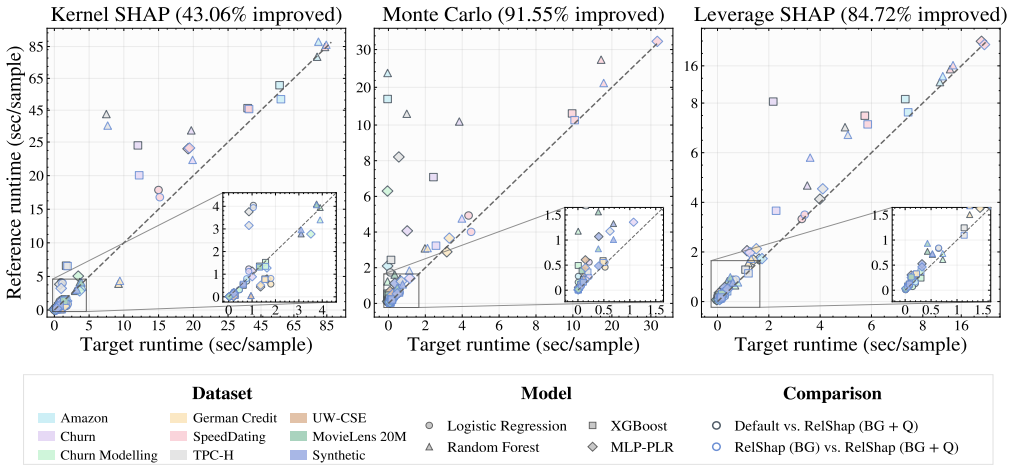
- Quotient mode reduces the number of model evaluations with Shapley values unchanged; the speedup is largest for Kernel SHAP when the data has many low-arity functional dependencies, because Kernel SHAP concentrates its sampling on the small coalitions that most often collapse together.
- Relational consistency composes with any coalition estimator and any model type, making the choice of background semantics and the choice of estimator independent design decisions rather than competing ones.
- In the controlled ground-truth setting, RelShap's explanations are insensitive to relationally invalid perturbations as their strength δ grows from 0 to 10, while Kernel SHAP, Conditional SHAP, and ManifoldShap increasingly misattribute importance to the redundant feature.
Reading between the lines
- A direct corollary of the paper's violation-prevalence numbers is a new diagnostic: practitioners could report the fraction of relationally invalid coalitions an explanation method queries as a data-quality signal for the explanation itself.
- The framework's own machinery supports approximate functional dependencies, so the natural stability test is whether a small violation tolerance preserves the correct top-feature identification on noisy or incomplete real-world schemas.
- The expected-speedup analysis is a coupon-collector formula over whatever relation induces coalition equivalence; the same formula should transfer to equivalence classes derived from causal structure, so the runtime argument is not specific to functional dependencies.
- Because the paper validates correctness only against synthetic ground truth (it explicitly defers a user study), the decisive open question is whether humans make better decisions with relationally consistent attributions.
Signed reviews
Editorial analysis
A structured set of objections, weighed in public.
Referee Report
Summary. The paper introduces RelShap, a framework for computing Shapley-value explanations on machine-learning predictions made from flattened relational data. RelShap derives constraints (functional dependencies, domain constraints, denial constraints, and provenance) from the relational schema, the flattening query, and the data, and uses them to restrict both the background data used for completion and the coalition space evaluated. The authors further propose a quotient mode in which coalitions equivalent under the discovered functional dependencies are canonicalized and deduplicated, claiming that this preserves Shapley values exactly while reducing runtime; the expected speedup is characterized combinatorially (Theorem 1). The experimental section evaluates RelShap on nine datasets and multiple models/estimators, including controlled settings with synthetic ground truth, and reports substantial changes in explanations and runtime reductions.
Significance. If the technical claims are established, RelShap addresses a real and under-explored problem: standard Shapley estimators freely evaluate feature combinations that violate relational integrity, and this can change attributions in ways that are hard to detect. The framework's separation of background selection from coalition restriction is conceptually clean, and the combinatorial analysis of FD-induced equivalence classes is a useful contribution. The paper also ships reproducible code, provides a broad empirical evaluation, and is honest about several limitations. However, the central claim that quotient mode preserves Shapley values for all estimators is not proven for sampling-based estimators, and the controlled ground-truth validation is partly circular. These issues affect the paper's main advertised contributions and should be resolved before publication.
major comments (2)
- Prop. 1 states that quotient-space coalition projection leaves Shapley values unchanged for all coalition estimators, but the proof in Appendix F.1 only reasons about exact summation over equivalence classes. Algorithm 1, however, is a post-sampling procedure: it draws M raw coalitions, canonicalizes each, and then skips any canonical representative already in Seen (lines 15–18). For the Monte Carlo estimator, which averages over all M Shapley-weighted draws, dropping duplicates without reweighting changes the empirical average and generally introduces bias. For Kernel SHAP, Appendix C.1 explicitly states that duplicate coalitions are handled by increasing the regression weight of the existing row; Algorithm 1 instead discards the duplicate, so the weighted regression design matrix differs from the base estimator's. For Leverage SHAP, canonicalization can change the coalition size (e.g., the FD a→b maps {a} to {a,b}), altering the stratified-without-replacement sample design and the effective stratum counts. Thus the statement in Section 3.2 that the base estimator's sampling distribution, weighting scheme, and accuracy guarantees are preserved is unsupported for sampling-based estimators. Please either prove an appropriate reweighting that preserves each estimator's target quantity, restrict Prop. 1 to exact enumeration and to estimators that are provably invariant under deduplication, or modify Algorithm 1 to accumulate duplicate weights rather than skip them.
- The controlled experiment defines ground truth as the model's behavior on the relationally valid domain, which is exactly the space to which RelShap restricts. Since g(x)=1{age>50}+δ r(life_stage)1{x does not satisfy Σ} only deviates from the label-generating rule on relationally invalid inputs, and since all training and test instances satisfy Σ, any method that never evaluates invalid completions will trivially attribute the prediction to age. RelShap is the only method in the comparison that enforces Σ exactly, so the result that RelShap ranks age first is partly by construction. The experiment still usefully demonstrates that invalid completions can distort standard estimators, but it should be framed as a sanity check of the proposed semantics rather than as independent evidence of correctness. Please add a validation setting where the ground truth is not defined by the same constraint set passed to RelShap (for example, a known generative mechanism whose relational constraints are hidden from the explainer), or explicitly discuss this circularity in the limitations section.
minor comments (5)
- The phrase "post-sampling procedure" is ambiguous about whether duplicate draws are removed, reweighted, or both; given that Prop. 1 and Algorithm 1 hinge on this, the definition should state explicitly what happens to the sampling distribution and to the estimator's weights.
- The y-axis label "Top attribution frequency" is not defined precisely; please clarify whether it is the fraction of instances in which each feature has the largest absolute Shapley value and how ties are handled.
- The columns "Top-3 Jaccard", "1−RBO", "Δ Jaccard", and "Δ RBO" are introduced without definitions in the table caption; please define them there or provide an explicit pointer to Appendix J where the null-baseline construction is described.
- The default thresholds (left-hand-side size bound of 2, domain cardinality bound of 20, provenance candidate threshold τ) are presented without sensitivity analysis; since the framework's behavior depends on these choices, a brief robustness study or at least a discussion of their influence would improve reproducibility.
- Several references list only partial author information (e.g., "GitHub. 2023" and multiple entries with "et al." without author names); please complete the bibliographic details before the final version.
Circularity Check
Controlled 'dominant feature' validation is self-definitional: the ground truth is defined on the same Σ-valid domain to which RelShap restricts by construction; the main framework and runtime analysis remain independent.
-
self definitional
[Section 4.1 'Validation with Ground Truth'; Figure 3; abstract claim 'correctly identifying the dominant feature in controlled settings']
"Since every data instance satisfies Σ, the second perturbation term is inactive during training and testing and is triggered only by relationally invalid combinations generated during Shapley computation. Thus, predictions on the valid domain depend only on age, and a semantically intuitive explanation should assign greater importance to age than to life_stage regardless of δ."
The synthetic ground truth is built from the very validity notion RelShap enforces: the δ·r(life_stage) term is nonzero only when the completed input violates Σ, and all real data points satisfy Σ. RelShap (Def. 1) restricts background completions to Σ-valid configurations and, via FD canonicalization, forces life_stage to be determined by age. Therefore RelShap's evaluations never activate the perturbation term, and the advertised conclusion that RelShap 'correctly identifies the dominant feature' while baselines do not is a direct consequence of the method's definition, not an independent empirical discovery. The experiment's success criterion is exactly the restricted inference space the method is defined to use, making this validation self-consistent by construction.
full rationale
The core framework is not circular: constraint extraction from schema/query/data is a genuine input, Definition 1 is an explicit restriction of the background distribution, and the exact Shapley invariance (Prop. 1) is an algebraic partition of the Shapley sum by Σ-equivalence classes. Theorem 1's speedup formula is a coupon-collector calculation, not a relabeling of an input. No load-bearing self-citation chain appears. The one circular element is the controlled ground-truth experiment in Section 4.1: the synthetic model is constructed so that 'correct' behavior is defined as behavior on the Σ-valid domain, and RelShap is defined to operate only on that domain, so its success there is by construction rather than by independent test. Separately, the claim that Prop. 1 extends to all sampling estimators is under-supported: the proof in Appendix F.1 uses exact summation, while Algorithm 1 skips duplicate canonical coalitions without reweighting, which can alter the empirical sampling distribution of MC and Kernel SHAP estimators. This is a correctness gap rather than a circularity, so it does not raise the circularity score. Because the partial circularity is confined to the synthetic validation and the framework, runtime analysis, and real-data comparisons retain independent content, a moderate score is appropriate.
Assumptions & free parameters
free parameters (6)
- FD left-hand-side size bound =
2 (default; 3 for UW-CSE)
- Domain cardinality threshold for conditional rules =
20
- Provenance candidate threshold tau =
Not specified numerically
- Coalition budget M_conv =
Per dataset, Table 4 (2^5 to 2^9)
- Background sample size B =
Per dataset, Table 4 (112 to 400,000)
- Controlled-test perturbation constants delta and r(life_stage) =
delta in [0,10] step 0.5, r in {0.3,0.6,0.9}
assumptions (5)
- domain assumption Shapley values are a valid method for feature attribution.
- domain assumption Relationally invalid completions are meaningless for explanations and should receive zero weight.
- domain assumption Extracted relational constraints (schema, query, data-driven FDs, domain, denial) are correct and complete.
- ad hoc to paper Quotient deduplication preserves the base estimator's sampling distribution and accuracy guarantees.
- standard math FD closure systems and Demetrovics lattice counting results apply to the coalition quotient space.
Cite this review
Pith. "Pith review of RelShap: Relationally Consistent Shapley Explanations." pith.science (2026). https://pith.science/paper/QYYJI4HF
@misc{pith2026260811508,
  author       = {Pith},
  title        = {Pith review of: RelShap: Relationally Consistent Shapley Explanations},
  year         = {2026},
  howpublished = {\url{https://pith.science/paper/QYYJI4HF}},
  note         = {Machine review of arXiv:2608.11508}
}
read the original abstract
Machine learning pipelines commonly flatten relational data into single-table representations, discarding structural constraints. Widely used Shapley value-based feature attributions then rely on feature independence, evaluating the model on combinations that could never arise in the underlying data, producing misleading explanations. We propose RelShap, a framework that incorporates relational constraints and data provenance into Shapley value computation, restricting both background data and coalition evaluation to relationally valid configurations. The framework is estimator-agnostic and composes with Kernel SHAP, Monte Carlo, and Leverage SHAP without altering their sampling or weighting properties. Functional dependencies further induce equivalence classes over feature coalitions, which RelShap exploits to reduce runtime without changing Shapley values; we provide a combinatorial characterization of the expected speedup. Experiments across multiple datasets, models, and estimators show that RelShap produces explanations that are more faithful to the data-generating process, correctly identifying the dominant feature in controlled settings where existing methods, including Conditional SHAP and ManifoldShap, do not. Our code is available at: https://github.com/duneag2/relshap.
Figures


Figures from the paper (15 more)




Reference graph
Works this paper leans on
- [1]
-
[2]
Foundations and Trends in Databases , volume =
Cheney, James and others , title =. Foundations and Trends in Databases , volume =
-
[3]
Motwani, Rajeev and others , title =
-
[4]
Discrete Applied Mathematics , volume =
Flajolet, Philippe and others , title =. Discrete Applied Mathematics , volume =
-
[5]
Green, Todd J. and others , title =. Proceedings of the Twenty-Sixth ACM SIGMOD-SIGACT-SIGART Symposium on Principles of Database Systems , pages =. 2007 , isbn =. doi:10.1145/1265530.1265535 , abstract =
-
[6]
Lundberg and Su
Scott M. Lundberg and Su. A Unified Approach to Interpreting Model Predictions , booktitle =. 2017 , url =
2017
-
[7]
Anupam Datta and others , title =. 2016 , url =. doi:10.1109/SP.2016.42 , timestamp =
-
[8]
Artificial Intelligence , volume=
Explaining individual predictions when features are dependent: More accurate approximations to Shapley values , author=. Artificial Intelligence , volume=. 2021 , publisher=
work page 2021
Show all 57 references
-
[9]
Advances in neural information processing systems , volume=
Causal shapley values: Exploiting causal knowledge to explain individual predictions of complex models , author=. Advances in neural information processing systems , volume=
-
[10]
Proceedings of the AAAI Conference on Artificial Intelligence , volume=
Interventional SHAP values and interaction values for piecewise linear regression trees , author=. Proceedings of the AAAI Conference on Artificial Intelligence , volume=
-
[11]
International Conference on Artificial Intelligence and Statistics , pages=
Manifold restricted interventional shapley values , author=. International Conference on Artificial Intelligence and Statistics , pages=. 2023 , organization=
2023
-
[12]
International conference on machine learning , pages=
The many Shapley values for model explanation , author=. International conference on machine learning , pages=. 2020 , organization=
2020
-
[13]
International Conference on artificial intelligence and statistics , pages=
Feature relevance quantification in explainable AI: A causal problem , author=. International Conference on artificial intelligence and statistics , pages=. 2020 , organization=
2020
-
[14]
International Conference on Learning Representations , year=
Shapley explainability on the data manifold , author=. International Conference on Learning Representations , year=
-
[15]
Advances in neural information processing systems , volume=
Asymmetric shapley values: incorporating causal knowledge into model-agnostic explainability , author=. Advances in neural information processing systems , volume=
-
[16]
arXiv preprint arXiv:2006.16234 , year=
True to the model or true to the data? , author=. arXiv preprint arXiv:2006.16234 , year=
2006 arXiv
-
[17]
IFIP congress , volume=
Dependency structures of data base relationships , author=. IFIP congress , volume=. 1974 , organization=
1974
-
[18]
arXiv preprint arXiv:2205.15419 , year=
Fool shap with stealthily biased sampling , author=. arXiv preprint arXiv:2205.15419 , year=
-
[19]
Pima Indians Diabetes Database , author=
-
[20]
Advances in Neural Information Processing Systems , volume=
Data-Faithful Feature Attribution: Mitigating Unobservable Confounders via Instrumental Variables , author=. Advances in Neural Information Processing Systems , volume=
-
[21]
Communications of the ACM , volume=
A relational model of data for large shared data banks , author=. Communications of the ACM , volume=. 1970 , publisher=
1970
-
[22]
Proceedings of the 1974 ACM SIGFIDET (now SIGMOD) workshop on Data description, access and control , pages=
SEQUEL: A structured English query language , author=. Proceedings of the 1974 ACM SIGFIDET (now SIGMOD) workshop on Data description, access and control , pages=
1974
-
[23]
Foundations and Trends
Architecture of a database system , author=. Foundations and Trends. 2007 , publisher=
2007
-
[24]
Proceedings of the 41st International Conference on Machine Learning , pages =
Position: Relational Deep Learning - Graph Representation Learning on Relational Databases , author =. Proceedings of the 41st International Conference on Machine Learning , pages =. 2024 , volume =
2024
-
[25]
NeurIPS , volume=
Relbench: A benchmark for deep learning on relational databases , author=. NeurIPS , volume=
-
[26]
Proceedings of the 31st ACM SIGKDD Conference on Knowledge Discovery and Data Mining V
Relational deep learning: Challenges, foundations and next-generation architectures , author=. Proceedings of the 31st ACM SIGKDD Conference on Knowledge Discovery and Data Mining V. 2 , pages=
-
[27]
1953 , journal=
A value for n-person games , author=. 1953 , journal=
1953
-
[28]
The Thirteenth International Conference on Learning Representations , year=
Provably Accurate Shapley Value Estimation via Leverage Score Sampling , author=. The Thirteenth International Conference on Learning Representations , year=
-
[29]
ACM Sigmod Record , volume=
The Shapley value in database management , author=. ACM Sigmod Record , volume=. 2023 , publisher=
2023
-
[30]
Logical Methods in Computer Science , volume=
The Shapley value of tuples in query answering , author=. Logical Methods in Computer Science , volume=. 2021 , publisher=
2021
-
[31]
Proceedings of the 2022 International Conference on Management of Data , pages=
Shapgraph: An holistic view of explanations through provenance graphs and shapley values , author=. Proceedings of the 2022 International Conference on Management of Data , pages=
2022
-
[32]
Proceedings of the 2022 International Conference on Management of Data , pages=
Computing the shapley value of facts in query answering , author=. Proceedings of the 2022 International Conference on Management of Data , pages=
2022
-
[33]
arXiv preprint arXiv:2511.22035 , year=
Relation-Stratified Sampling for Shapley Values Estimation in Relational Databases , author=. arXiv preprint arXiv:2511.22035 , year=
-
[34]
Discrete Applied Mathematics , volume=
Functional dependencies in relational databases: A lattice point of view , author=. Discrete Applied Mathematics , volume=. 1992 , publisher=
1992
-
[35]
arXiv preprint arXiv:2602.01399 , year=
An Odd Estimator for Shapley Values , author=. arXiv preprint arXiv:2602.01399 , year=
-
[36]
The Thirty-ninth Annual Conference on Neural Information Processing Systems , year=
Regression-adjusted Monte Carlo Estimators for Shapley Values and Probabilistic Values , author=. The Thirty-ninth Annual Conference on Neural Information Processing Systems , year=
-
[37]
arXiv preprint arXiv:2601.18608 , year=
PolySHAP: Extending KernelSHAP with Interaction-Informed Polynomial Regression , author=. arXiv preprint arXiv:2601.18608 , year=
-
[38]
arXiv preprint arXiv:2602.07203 , year =
Exactly Computing do-Shapley Values , author =. arXiv preprint arXiv:2602.07203 , year =
-
[39]
Advances in Neural Information Processing Systems , volume=
When do neural nets outperform boosted trees on tabular data? , author=. Advances in Neural Information Processing Systems , volume=
-
[40]
International Conference on Learning Representations , year=
Tabred: Analyzing pitfalls and filling the gaps in tabular deep learning benchmarks , author=. International Conference on Learning Representations , year=
-
[41]
Proceedings of the NeurIPS 2021 Datasets and Benchmarks Track , year=
OpenML Benchmarking Suites , author=. Proceedings of the NeurIPS 2021 Datasets and Benchmarks Track , year=
2021
-
[42]
ACM SIGKDD Explorations Newsletter , volume=
OpenML: networked science in machine learning , author=. ACM SIGKDD Explorations Newsletter , volume=. 2014 , publisher=
2014
-
[43]
arXiv preprint arXiv:1511.03086 , year=
The CTU prague relational learning repository , author=. arXiv preprint arXiv:1511.03086 , year=
-
[44]
Brazilian E-Commerce Public Dataset by Olist , url=
Olist and André Sionek , year=. Brazilian E-Commerce Public Dataset by Olist , url=. doi:10.34740/KAGGLE/DSV/195341 , publisher=
-
[45]
Discrete Applied Mathematics , volume=
Algorithms for computing the Shapley value of cooperative games on lattices , author=. Discrete Applied Mathematics , volume=. 2018 , publisher=
2018
-
[46]
Discrete Applied Mathematics , volume=
Minimum matrix representation of closure operations , author=. Discrete Applied Mathematics , volume=. 1985 , publisher=
1985
-
[47]
Proceedings of the 22nd acm sigkdd international conference on knowledge discovery and data mining , pages=
Xgboost: A scalable tree boosting system , author=. Proceedings of the 22nd acm sigkdd international conference on knowledge discovery and data mining , pages=
-
[48]
R news , volume=
Classification and regression by randomForest , author=. R news , volume=
-
[49]
Advances in Neural Information Processing Systems , volume=
On embeddings for numerical features in tabular deep learning , author=. Advances in Neural Information Processing Systems , volume=
-
[50]
arXiv preprint arXiv:2012.01536 , year=
Improving kernelshap: Practical shapley value estimation via linear regression , author=. arXiv preprint arXiv:2012.01536 , year=
2012 arXiv
-
[51]
arXiv preprint arXiv:2601.12654 , year=
Explanation Multiplicity in SHAP: Characterization and Assessment , author=. arXiv preprint arXiv:2601.12654 , year=
-
[52]
ACM Transactions on Information Systems (TOIS) , volume=
A similarity measure for indefinite rankings , author=. ACM Transactions on Information Systems (TOIS) , volume=. 2010 , publisher=
2010
-
[53]
arXiv preprint arXiv:2204.11351 , year=
An empirical study of the effect of background data size on the stability of SHapley Additive exPlanations (SHAP) for deep learning models , author=. arXiv preprint arXiv:2204.11351 , year=
-
[54]
, author=
Data-driven Schema Normalization. , author=. EDBT , volume=
-
[55]
PVLDB , volume=
Functional dependency discovery: An experimental evaluation of seven algorithms , author=. PVLDB , volume=. 2015 , publisher=
2015
-
[56]
Proceedings of the VLDB Endowment , volume=
Discovery of approximate (and exact) denial constraints , author=. Proceedings of the VLDB Endowment , volume=. 2019 , publisher=
2019
-
[57]
The VLDB Journal , volume=
Profiling relational data: a survey , author=. The VLDB Journal , volume=. 2015 , publisher=
2015
Reviewed August 15, 2026 · model on record in the stance chip above.
Discussion (0). Continue with ORCID to comment.