REVIEW 3 major objections 3 minor 58 references
Efficient Compilation for Hamiltonian Simulation via Global Binary Symplectic Form Simplification
T0 review · 3 major / 3 minor · reviewed 2026-08-16 · deepseek-v4-flash
Pith's one-line read A compiler that treats every Pauli term in one global tableau cuts two-qubit gates by 59% and circuit depth by 91% on average.
desk verdict Novel holistic BSF compiler with a likely semantic bug in the weight-2 emission step; the headline numbers may not be for the same unitary. read the letter →
The pith
A machine-rendered reading of the paper's core claim, the machinery that carries it, and where it could break.
The reading
What carries the argument
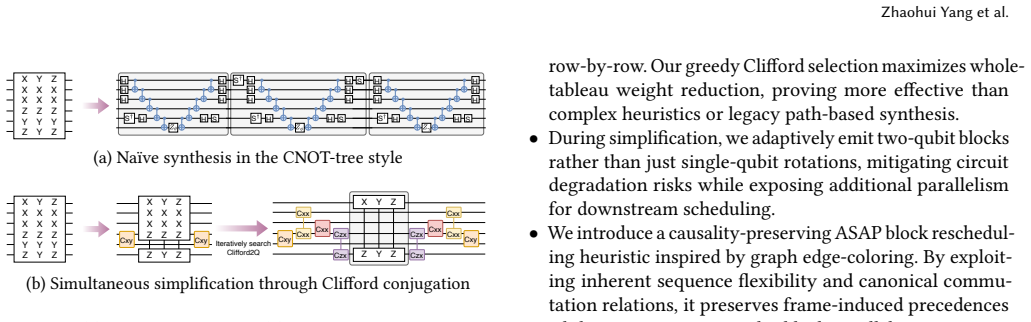
The load-bearing object is the binary symplectic form tableau, an m by 2n binary matrix encoding m Pauli strings on n qubits, together with the universal controlled gate family C(P,Q), CNOT-equivalent Clifford gates with Pauli axes P and Q in {X, Y, Z} that update four tableau columns but act on every row simultaneously. This representation lets support, weight, overlap, and commutation be computed by F2-linear arithmetic, so a greedy Clifford search can be scored globally in polynomial time. The adaptive emission rule, emitting weight-one rows unconditionally and weight-two blocks only when the average residual density rho_A falls below rho = 0.35, prevents collateral inflation of unresolved rows. The as-soon-as-possible scheduler, inspired by graph edge-coloring, applies the paper's two commutation propositions to pull blocks earlier without violating the forward Clifford frame. The interaction-rank criterion, showing that an exact two-qubit Pauli-evolution block needs at most two CNOTs whenever its interaction matrix has rank at most two, justifies emitting weight-two blocks cheaply.
What would settle it
Run the same 100 benchmarking Hamiltonians with only weight-one emission (the rho = 0 endpoint) and with unconditional weight-two emission (the rho = 1 endpoint): if either endpoint matches or beats the default rho = 0.35 configuration in aggregate two-qubit gate count and depth, the paper's claim that adaptive density-based emission is necessary would be falsified.
Extended reading notes
Core claim
The central claim is that grouping-free, holistic tableau simplification strictly outperforms prior Pauli-intermediate-representation compilers in both gate count and depth. Symphony maintains all Pauli strings as rows of the binary symplectic form tableau; at each step it picks the lowest-weight active row and searches the nine CNOT-equivalent controlled-Pauli Clifford gates (the universal controlled gates) acting on its support qubits, scoring each candidate by its effect on the whole tableau through total weight decrease, number of rows reduced, and number of rows inflated. Once a row reaches weight one it is emitted as a single-qubit rotation; weight-two rows are emitted as two-qubit blocks only when the average residual tableau density falls below a threshold rho = 0.35. The emitted stream is then rescheduled by an as-soon-as-possible heuristic that uses exact commutation rules for controlled-Pauli gates and Pauli rotations to preserve causal precedences while exposing parallelism. The paper reports geometric-mean optimization rates of 0.411 in two-qubit gate count and 0.09 in two-qubit depth on the benchmark suite, corresponding to the 59% and 91% reductions.
Load-bearing premise
The headline numbers depend on a density threshold, set to 0.35, that decides when weight-two two-qubit blocks may be emitted instead of being simplified further, and the paper's ablation shows strong sensitivity to this threshold while also recommending it be swept per instance, so the reported averages assume the threshold can be chosen well for each workload.
Editorial extensions
If this is right
- Pauli-exponential workloads can be compiled with polynomial worst-case overhead, O(m^2 n^3), while matching or beating compilers that rely on long-horizon searches.
- Because two-qubit depth is reduced across every benchmark family, the block parallelism exposed by the scheduler is a consistent, not incidental, source of gain.
- For expectation-value workloads, the terminal Clifford sequence can be absorbed into measurement observables, removing part of the output circuit entirely.
- The logical-level advantage persists on limited-connectivity hardware: the paper reports lower two-qubit depth than all baselines even on a heavy-hex topology, despite larger routing overhead than topology-aware compilers.
- In the early fault-tolerant regime, T-count stays roughly compiler-invariant while T-depth is reduced by a factor of up to 2.73x over one baseline, so the depth improvement carries over to non-Clifford rotation schedules.
Reading between the lines
- The method's reliance on global algebraic structure suggests it should transfer to fermionic encodings with irregular locality, such as Bravyi-Kitaev tree encodings, where cross-group correlations are abundant; this is a testable extension beyond the paper's chemistry and spin-model instances.
- The density threshold rho is a per-instance tuning knob, and the paper's own ablation implies the reported averages come from a best-of-sweep policy rather than one fixed pre-registered setting, which is worth keeping in mind when comparing against fixed-strategy compilers.
- The interaction-rank criterion for two-qubit Pauli-evolution blocks could be used outside compilation, for example as a cheap analytic substitute for numerical KAK decomposition in other circuit-synthesis contexts.
- The exact local commutation tests for controlled-Pauli gates and Pauli rotations could be adopted by other peephole optimizers as a way to reorder Clifford and rotation operations without building a full dependency graph.
Signed reviews
Editorial analysis
A structured set of objections, weighed in public.
Referee Report
Summary. The paper introduces Symphony, a compiler for Hamiltonian-simulation workloads expressed as Pauli-IR sequences. Symphony represents all Pauli exponentials in a global binary symplectic form (BSF) tableau and iteratively applies controlled-Pauli Clifford conjugations to reduce row weights, adaptively emitting weight-1 and weight-2 rows as blocks, followed by a causality-preserving ASAP block scheduler. The authors report average reductions of 59% in two-qubit gate count and 91% in two-qubit depth on 100 HamLib benchmarks plus scaled UCCSD workloads, and claim that Symphony strictly Pareto-dominates six prior compilers, with 1.14-1.58x fewer two-qubit gates and 1.87-5.67x shallower depth.
Significance. The holistic BSF simplification framework, the adaptive two-qubit block emission idea, and the commutativity-aware scheduling are potentially valuable contributions to quantum circuit compilation for Pauli-IR workloads. The algebraic lemmas (Theorem 3.1, Propositions 4.1 and 4.2) are sound, the complexity analysis is explicit, and the empirical scope is broad. If the semantic-correctness issue identified below is resolved and the empirical claims are restated accurately, the work would be of substantial interest to the quantum compilation community.
major comments (3)
- [Algorithm 1, lines 20-29; Theorem 3.1] The Emit function retires all rows with weight at most two into a single emitted block E_l without checking whether the rows commute or share the same qubit pair. Theorem 3.1 applies only to an exact two-qubit unitary exp(-i H_J) for a single pair's interaction matrix H_J = sum J_mu_nu sigma_mu tensor sigma_nu. A product of rotations prod exp(-i theta P) is not equal to exp(-i sum theta P) when the Pauli rows do not commute, and rows on different qubit pairs cannot be represented by a 3x3 interaction matrix at all. The paper therefore does not establish that the emitted block implements the input Pauli-IR semantics, and the reported gate-count and depth reductions in Tables 3-4 and Figures 6-7 may be comparing circuits that implement different unitaries. Appendix B, Lemma B.1 bounds only the first commutator and does not close this gap. The authors should either add an explicit commutation and same-pair check before grouping rows into a block, or implement each block as a product of individual rotations and re-derive the cost model accordingly, and then rerun the evaluation.
- [Abstract; Section 5.2] The abstract's claim that Symphony 'strictly Pareto-dominates prior state-of-the-art compilers' is contradicted by the paper's own data in Section 5.2, which acknowledges that Paulihedral retains marginal gate-count advantages on binary and discrete optimization workloads. Strict Pareto dominance is a strong per-instance statement and is not supported by the reported aggregate or category-level results. The claim should be weakened to aggregate dominance or restated as separate per-metric improvements.
- [Table 5; Section 5.5.1] The reported headline reductions depend on the density threshold rho, and the ablation in Table 5 shows strong sensitivity: rho = 0 degrades aggregate two-qubit depth by 112.5% and rho = 1 degrades aggregate gate count by 8.8% and chemistry gate count by 27.9%. Since Section 5.5.1 suggests sweeping rho in parallel to select the optimal value, the published aggregate numbers may be based on per-instance or per-category selection after seeing the data rather than on a fixed, pre-specified policy. The authors should report the exact rho choices used for each instance or category, or adopt a validation protocol such as cross-validation, before presenting the 59% and 91% reductions as the performance of a single compiler configuration.
minor comments (3)
- [Section 3.3] The phrase 'an two-qubit Pauli-evolution block' contains a typo and should be 'a two-qubit Pauli-evolution block'.
- [Section 2.3] The equivalence formula for C(P,Q) in terms of single-qubit Cliffords and CNOT appears twice in nearly identical form; one copy should be removed to avoid duplication.
- [Section 5.4] The statement that the non-Clifford rotation count requires 'a median of 102.5 T gates per rotation' is unclear: the median T-gate cost is an artifact of the GridSynth approximation at precision 10^-10, not an intrinsic property of the Hamiltonian, and should be worded accordingly.
Circularity Check
No substantive circularity; the core BSF-simplification claims are measured against external HamLib benchmarks and the supporting theorems are proved in-text.
full rationale
Symphony's central claim—that global BSF simplification plus adaptive emission plus causality-preserving scheduling reduces two-qubit gate count and depth—is an empirical result evaluated on the external HamLib suite and UCCSD workloads. The algebraic engine (Algorithm 1) is self-contained: UCG update rules are derived in Appendix A, and Theorem 3.1's interaction-rank criterion is proved in Appendix B via SVD/Cartan reduction; it does not presuppose the benchmark outcomes. The rho emission threshold is a fixed design hyperparameter (rho=0.35) with an ablation (Table 5); the sentence about sweeping rho in parallel is a practical suggestion, not a report of tuned results, so the headline numbers are not a fit renamed as prediction. Self-citations to Phoenix [50], Paulihedral [24], and the authors' routing work [51] are prior-work comparisons and are not used to justify the uniqueness or correctness of the simplification steps. One genuine concern is semantic rather than circular: grouping noncommuting weight-2 rows into a single emitted block is justified by Theorem 3.1, which bounds exp(-iH_J), while the input Pauli-IR is a product of rotations; if the rows do not commute, the block may not implement the required unitary. This is a correctness risk, not a circular derivation, and is outside the scope of this pass.
Assumptions & free parameters
free parameters (2)
- density threshold rho =
0.35 (default)
- greedy benefit weights beta = (-Delta W, N-, -N+) =
lexicographic ranking
assumptions (5)
- standard math Pauli commutation is captured by the binary symplectic inner product
- standard math KAK/Cartan decomposition of SU(4): rank(J) <= 2 implies at most 2 CNOTs for a two-qubit Pauli-evolution block
- domain assumption The compiler may reorder Pauli exponentials within a simulation step subject to commutation
- standard math The nine UCG gates generate the two-qubit Clifford group
- domain assumption Two-qubit gate count and depth are the correct primary cost model, with single-qubit gates ignored
Cite this review
Pith. "Pith review of Efficient Compilation for Hamiltonian Simulation via Global Binary Symplectic Form Simplification." pith.science (2026). https://pith.science/paper/6PUX7PUW
@misc{pith2026260811579,
  author       = {Pith},
  title        = {Pith review of: Efficient Compilation for Hamiltonian Simulation via Global Binary Symplectic Form Simplification},
  year         = {2026},
  howpublished = {\url{https://pith.science/paper/6PUX7PUW}},
  note         = {Machine review of arXiv:2608.11579}
}
abstract
Hamiltonian simulation is a core quantum workload, underpinning variational quantum algorithms and Trotterized time evolution. Such programs are expressed as Pauli exponential sequences, exhibiting structural patterns that are highly amenable to high-level synthesis and optimization. Existing compilers, however, fail to fully unlock the optimization potential of their global algebraic structure, even when employing advanced graph- or tableau-based methods. We present Symphony, a holistic compilation approach built on the binary symplectic form (BSF) representation of Pauli strings. Unlike prior group-wise BSF simplification and path-based Pauli network synthesis, Symphony applies generalized controlled-Pauli Clifford transformations directly to a global BSF tableau, adaptively reducing active Pauli rows and emitting eligible two-qubit blocks other than single-qubit rotations in a forward Clifford frame. Following algebraic simplification, Symphony performs a causality-preserving block rescheduling heuristic that respects frame-induced dependencies while exposing extensive two-qubit block parallelism opportunities. This streamlined compilation style comprehensively exploits simultaneous simplification and commutativity opportunities, achieving efficient global optimization without relying on computationally expensive heuristics or long-horizon searches. Across the generic Hamiltonian simulation benchmarks in HamLib, Symphony achieves average reductions of 59% in two-qubit gate count and 91% in circuit depth. It strictly Pareto-dominates prior state-of-the-art compilers, requiring 1.14--1.58$\times$ fewer two-qubit gates and especially shrinking two-qubit circuit depth by a substantial factor of 1.87--5.67$\times$ on average.
Figures


Figures from the paper (5 more)


Reference graph
Works this paper leans on
-
[1]
Scott Aaronson and Daniel Gottesman. 2004. Improved Simulation of Stabilizer Circuits.Physical Review A70, 5 (2004), 052328
work page 2004
-
[2]
Amira Abbas, Andris Ambainis, Brandon Augustino, Andreas Bärtschi, Harry Buhrman, Carleton Coffrin, Giorgio Cortiana, Vedran Dunjko, Daniel J. Egger, Bruce G. Elmegreen, Nicola Franco, Filippo Fratini, Bryce Fuller, Julien Gacon, Constantin Gonciulea, Sander Gribling, Swati Gupta, Stuart Hadfield, Raoul Heese, Gerhard Kircher, Thomas Kleinert, Thorsten Ko...
work page 2024
-
[3]
Brown, Giuseppe Carleo, Lincoln D
Ehud Altman, Kenneth R. Brown, Giuseppe Carleo, Lincoln D. Carr, Eugene Demler, Cheng Chin, Brian DeMarco, Sophia E. Economou, Mark A. Eriksson, Kai-Mei C. Fu, Markus Greiner, Kaden R. A. Haz- zard, Randall G. Hulet, Alicia J. Kollár, Benjamin L. Lev, Mikhail D. Lukin, Ruichao Ma, Xiao Mi, Shashank Misra, Christopher Monroe, Kater Murch, Zaira Nazario, Ka...
work page 2021
-
[4]
Matthew Amy, Dmitri Maslov, Michele Mosca, and Martin Roetteler
-
[5]
Bela Bauer, Sergey Bravyi, Mario Motta, and Garnet Kin-Lic Chan
-
[6]
Sergey Bravyi and Alexei Kitaev. 2005. Universal quantum computa- tion with ideal Clifford gates and noisy ancillas.Physical Review A71, 2 (2005), 022316
work page 2005
-
[7]
Sergey Bravyi and Dmitri Maslov. 2021. Hadamard-Free Circuits Expose the Structure of the Clifford Group.IEEE Transactions on Information Theory67, 7 (2021), 4546–4563
work page 2021
-
[8]
Olson, Matthias Degroote, Peter D
Yudong Cao, Jonathan Romero, Jonathan P. Olson, Matthias Degroote, Peter D. Johnson, Mária Kieferová, Ian D. Kivlichan, Tim Menke, Borja Peropadre, Nicolas P. D. Sawaya, Sukin Sim, Libor Veis, and Alán Aspuru-Guzik. 2019. Quantum chemistry in the age of quantum computing.Chemical Reviews119, 19 (2019), 10856–10915
work page 2019
Show all 58 references
-
[9]
Childs, Dmitri Maslov, Yunseong Nam, Neil J
Andrew M. Childs, Dmitri Maslov, Yunseong Nam, Neil J. Ross, and Yuan Su. 2018. Toward the first quantum simulation with quantum speedup.Proceedings of the National Academy of Sciences115, 38 (2018), 9456–9461
2018
-
[10]
Alexander Cowtan, Silas Dilkes, Ross Duncan, Will Simmons, and Seyon Sivarajah. 2019. Phase gadget synthesis for shallow circuits. InProceedings 16th International Conference on Quantum Physics and Logic, Vol. 318. Open Publishing Association, 213–228
2019
-
[11]
Dalzell, Sam McArdle, Mario Berta, Przemyslaw Bi- enias, Chi-Fang Chen, András Gilyén, Connor T
Alexander M. Dalzell, Sam McArdle, Mario Berta, Przemyslaw Bi- enias, Chi-Fang Chen, András Gilyén, Connor T. Hann, Michael J. Kastoryano, Emil T. Khabiboulline, Aleksander Kubica, Grant Salton, Samson Wang, and Fernando G. S. L. Brandão. 2025.Quantum algo- rithms: A survey of...
2025
-
[12]
Ayushi Dubal, David Kremer, Simon Martiel, Victor Villar, Derek Wang, and Juan Cruz-Benito. 2025. Pauli Network Circuit Synthesis with Reinforcement Learning.arXiv preprint arXiv:2503.14448(2025)
2025 arXiv
-
[13]
Edward Farhi, Jeffrey Goldstone, and Sam Gutmann. 2014. A quantum approximate optimization algorithm.arXiv preprint arXiv:1411.4028 (2014)
2014 arXiv
-
[14]
Richard P Feynman. 1982. Simulating physics with computers.Inter- national journal of theoretical physics21, 6 (1982), 467–488
1982
-
[15]
I. M. Georgescu, S. Ashhab, and Franco Nori. 2014. Quantum simula- tion.Reviews of Modern Physics86, 1 (2014), 153–185
2014
-
[16]
Timothée Goubault de Brugière and Simon Martiel. 2024. Faster and shorter synthesis of Hamiltonian simulation circuits.arXiv preprint arXiv:2404.03280(2024)
2024 arXiv
-
[17]
Daniel Grier and Luke Schaeffer. 2022. The Classification of Clifford Gates over Qubits.Quantum6 (2022), 734
2022
-
[18]
Aram W Harrow, Avinatan Hassidim, and Seth Lloyd. 2009. Quantum algorithm for linear systems of equations.Physical review letters103, 15 (2009), 150502
2009
-
[19]
Yuwei Jin, Zirui Li, Fei Hua, Tianyi Hao, Huiyang Zhou, Yipeng Huang, and Eddy Z Zhang. 2024. Tetris: A Compilation Framework for VQA Applications in Quantum Computing. In2024 ACM/IEEE 51st Annual International Symposium on Computer Architecture (ISCA). IEEE, 277– 292
2024
-
[20]
Aleks Kissinger and Arianne Meijer-van de Griend. 2020. CNOT circuit extraction for topologically-constrained quantum memories. Quantum Information and Computation20, 7&8 (2020), 581–596
2020
-
[21]
Yi-Hsiang Kuo, Hsiang-Chun Yang, Hsin-Yu Chen, and Chung- Yang Ric Huang. 2026. Unified Pauli-Rotation Synthesis for Relieving CX-Count Overhead in Tableau-Based Quantum Circuit Optimization Flow. In2026 Design, Automation & Test in Europe Conference (DATE). IEEE, 1–7
2026
-
[22]
Lingling Lao and Dan E Browne. 2022. 2qan: A quantum compiler for 2-local qubit hamiltonian simulation algorithms. InProceedings of the 49th Annual International Symposium on Computer Architecture. 351–365
2022
-
[23]
Gushu Li, Yufei Ding, and Yuan Xie. 2019. Tackling the qubit map- ping problem for NISQ-era quantum devices. InProceedings of the twenty-fourth international conference on architectural support for pro- gramming languages and operating systems. 1001–1014
2019
-
[24]
Gushu Li, Anbang Wu, Yunong Shi, Ali Javadi-Abhari, Yufei Ding, and Yuan Xie. 2022. Paulihedral: a generalized block-wise compiler opti- mization framework for quantum simulation kernels. InProceedings of the 27th ACM International Conference on Architectural Support for Progr...
2022
-
[25]
Yongshang Li, Yu Zhang, Haoning Deng, Mingyu Chen, and Zhenyu Li
-
[26]
Daniel Litinski. 2019. A game of surface codes: Large-scale quantum computing with lattice surgery.Quantum3 (2019), 128. 12 Efficient Compilation for Hamiltonian Simulation via Global Binary Symplectic Form Simplification
2019
-
[27]
Daniel Litinski. 2019. Magic state distillation: Not as costly as you think.Quantum3 (2019), 205
2019
-
[28]
Ji Liu, Alvin Gonzales, Benchen Huang, Zain Hamid Saleem, and Paul D Hovland. 2025. QuCLEAR: Clifford Extraction and Absorp- tion for Quantum Circuit Optimization. In2025 IEEE International Symposium on High Performance Computer Architecture (HPCA). IEEE, 158–172
2025
-
[29]
Seth Lloyd. 1996. Universal quantum simulators.Science273, 5278 (1996), 1073–1078
1996
-
[30]
Guang Hao Low and Isaac L. Chuang. 2019. Hamiltonian simulation by qubitization.Quantum3 (2019), 163
2019
-
[31]
Mulundano Machiya, Matt Menickelly, Paul Hovland, and Ji Liu. 2026. MonteQ: A Monte Carlo Tree Search Based Quantum Circuit Synthesis Framework. InISC High Performance 2026 Research Paper Proceedings (41st International Conference). IEEE, 1–12
2026
-
[32]
Dmitri Maslov and Martin Roetteler. 2018. Shorter Stabilizer Circuits via Bruhat Decomposition and Quantum Circuit Transformations. IEEE Transactions on Information Theory64, 7 (2018), 4729–4738
2018
-
[33]
Benjamin, and Xiao Yuan
Sam McArdle, Suguru Endo, Alán Aspuru-Guzik, Simon C. Benjamin, and Xiao Yuan. 2020. Quantum computational chemistry.Reviews of Modern Physics92, 1 (2020), 015003
2020
-
[34]
Priyanka Mukhopadhyay, Nathan Wiebe, and Hong Tao Zhang. 2023. Synthesizing efficient circuits for Hamiltonian simulation.npj Quan- tum Information9, 1 (2023), 31
2023
-
[35]
Nation, Abdullah Ash Saki, Sebastian Brandhofer, Luciano Bello, Shelly Garion, Matthew Treinish, and Ali Javadi-Abhari
Paul D. Nation, Abdullah Ash Saki, Sebastian Brandhofer, Luciano Bello, Shelly Garion, Matthew Treinish, and Ali Javadi-Abhari. 2025. Benchmarking the performance of quantum computing software for quantum circuit creation, manipulation and compilation.Nature Com- putational Sc...
2025
-
[36]
2010.Quantum computation and quantum information
Michael A Nielsen and Isaac L Chuang. 2010.Quantum computation and quantum information. Cambridge university press
2010
-
[37]
Jennifer Paykin, Albert T Schmitz, Mohannad Ibrahim, Xin-Chuan Wu, and Anne Y Matsuura. 2023. PCOAST: a Pauli-based quantum circuit optimization framework. In2023 IEEE International Conference on Quantum Computing and Engineering (QCE), Vol. 1. IEEE, 715–726
2023
-
[38]
Alberto Peruzzo, Jarrod McClean, Peter Shadbolt, Man-Hong Yung, Xiao-Qi Zhou, Peter J Love, Alán Aspuru-Guzik, and Jeremy L O’brien
-
[39]
McClean, Cornelius Hempel, Peter J
Jonathan Romero, Ryan Babbush, Jarrod R. McClean, Cornelius Hempel, Peter J. Love, and Alán Aspuru-Guzik. 2018. Strategies for quantum computing molecular energies using the unitary coupled cluster ansatz.Quantum Science and Technology4, 1 (2018), 014008
2018
-
[40]
Ross and Peter Selinger
Neil J. Ross and Peter Selinger. 2016. Optimal ancilla-free Clifford+T approximation of z-rotations.Quantum Information & Computation 16, 11–12 (2016), 901–953
2016
-
[41]
Nicolas PD Sawaya, Daniel Marti-Dafcik, Yang Ho, Daniel P Ta- bor, David E Bernal Neira, Alicia B Magann, Shavindra Premaratne, Pradeep Dubey, Anne Matsuura, Nathan Bishop, Wibe A de Jong, Simon Benjamin, Ojas Parekh, Norm Tubman, Katherine Klymko, and Daan Camps. 2024. HamLib...
2024
-
[42]
Albert T Schmitz, Nicolas P D Sawaya, Sonika Johri, and A Y Matsuura
-
[43]
Peter W Shor. 1994. Algorithms for quantum computation: discrete logarithms and factoring. InProceedings 35th annual symposium on foundations of computer science. Ieee, 124–134
1994
-
[44]
Yuan Su, Dominic W Berry, Nathan Wiebe, Nicholas Rubin, and Ryan Babbush. 2021. Fault-tolerant quantum simulations of chemistry in first quantization.PRX Quantum2, 4 (2021), 040332
2021
-
[45]
Masuo Suzuki. 1990. Fractal decomposition of exponential operators with applications to many-body theories and Monte Carlo simulations. Physics Letters A146, 6 (1990), 319–323
1990
-
[46]
Teague Tomesh, Kaiwen Gui, Pranav Gokhale, Yunong Shi, Frederic T Chong, Margaret Martonosi, and Martin Suchara. 2021. Optimized quantum program execution ordering to mitigate errors in simulations of quantum systems. In2021 IEEE International Conference on Rebooting Computing...
2021
-
[47]
H. F. Trotter. 1959. On the product of semi-groups of operators.Proc. Amer. Math. Soc.10, 4 (1959), 545–551
1959
-
[48]
Ewout Van Den Berg and Kristan Temme. 2020. Circuit optimization of Hamiltonian simulation by simultaneous diagonalization of Pauli clusters.Quantum4 (2020), 322
2020
-
[49]
Vivien Vandaele, Simon Martiel, and Timothée Goubault de Brugière
-
[50]
Zhaohui Yang, Dawei Ding, Chenghong Zhu, Jianxin Chen, and Yuan Xie. 2025. PHOENIX: Pauli-Based High-Level Optimization Engine for Instruction Execution on NISQ Devices. In2025 62nd ACM/IEEE Design Automation Conference (DAC). IEEE, 1–7
2025
-
[51]
Zhaohui Yang, Kai Zhang, Xinyang Tian, Xiangyu Ren, Yingjian Liu, Yunfeng Li, Dawei Ding, Jianxin Chen, and Yuan Xie. 2026. Unifying qubit routing across diverse quantum isas via canonical representation. In2026 ACM/IEEE 53rd Annual International Symposium on Computer Architec...
2026
-
[52]
Henry Zou, Matthew Treinish, Kevin Hartman, Alexander Ivrii, and Jake Lishman. 2024. LightSABRE: A Lightweight and Enhanced SABRE Algorithm.arXiv preprint arXiv:2409.08368(2024). A Clifford formalism based on Universal Controlled Gate A.1 Generalized CNOT Gate Definition We de...
2024 arXiv
-
[2013]
A meet-in-the-middle algorithm for fast synthesis of depth- optimal quantum circuits.IEEE Transactions on Computer-Aided Design of Integrated Circuits and Systems32, 6 (2013), 818–830
2013
-
[2014]
Nature communications5, 1 (2014), 4213
A variational eigenvalue solver on a photonic quantum processor. Nature communications5, 1 (2014), 4213
2014
-
[2020]
Quantum algorithms for quantum chemistry and quantum materials science.Chemical Reviews120, 22 (2020), 12685–12717
2020
-
[2022]
Phase polynomials synthesis algorithms for NISQ architectures and beyond.Quantum Science & Technology7, 4 (2022), 045027
2022
-
[2024]
Graph optimization perspective for low-depth Trotter-Suzuki decomposition.Physical Review A109, 4 (2024), 042418
2024
-
[2025]
PauliForest: Connectivity-Aware Synthesis and Pauli-Oriented Qubit Mapping for Near-Term Quantum Simulation.IEEE Transactions on Computer-Aided Design of Integrated Circuits and Systems44, 6 (2025), 2119–2129
2025
Reviewed August 16, 2026 · model on record in the stance chip above.
Discussion (0). Continue with ORCID to comment.