REVIEW 3 major objections 4 minor 61 references
EGM-Det: Entropy-Guided Multimodal Adaptive Fusion for UAV RGB-IR Object Detection
T0 review · 3 major / 4 minor · reviewed 2026-08-16 · deepseek-v4-flash
Pith's one-line read EGM-Det claims that entropy-guided, spatially adaptive RGB-IR fusion outperforms prior multimodal detectors on DroneVehicle, LLVIP, and VEDAI, with a 12.0-point gain over the next-best available VEDAI result.
desk verdict A genuinely new fusion recipe for RGB-IR detection, with an overclaimed SOTA statement: the DroneVehicle comparison rests on a manually refined protocol, and the paper's own Table 4 contradicts the abstract's unqualified SOTA claim. read the letter →
The pith
A machine-rendered reading of the paper's core claim, the machinery that carries it, and where it could break.
The reading
What carries the argument
The central object is the Entropy Offset Gate Fusion (EOGF) module, a per-level fusion cell that compresses intensity maps, local entropy maps, and a cross-modal discrepancy map into an entropy prior $P_l$, then uses that prior to condition two operations: an offset field $\Delta_l$ with alignment confidence $C_l$ that warps RGB features onto the infrared reference, and a softmax spatial gate $G_l=[g^{rgb}_l,g^{ir}_l]$ together with channel gates $c^{rgb}_l,c^{ir}_l$ that weight the aligned RGB and infrared features before summation. The training-side counterpart is the adaptive gate distillation loss $\mathcal{L}^{\mathrm{adapt}}_{\mathrm{gate}}$, in which teacher maximum-class-confidence maps are normalized into a soft preference target $Q_l$, multiplied by a reliability weight $R_l$ and a student-entropy weight $\omega_l$, and then matched to the student gate through $\mathrm{KL}(Q_l\|G_l)$; this makes ambiguous student choices at confident teacher locations the most strongly supervised points.
What would settle it
Retrain EGM-Det and every Table 4 competitor on the original DroneVehicle annotations with the same schedule and report mAP50-95; if the ordering and margins shrink or invert, the headline DroneVehicle result is an artifact of the label refinement rather than the fusion mechanism. Separately, apply temperature scaling or reliability-diagram calibration to the teacher probabilities before building $Q_l$: if the gate-supervision target shifts materially and performance drops, the claim that max confidence encodes modality reliability fails.
Extended reading notes
Core claim
On its own terms, the paper's discovery is that spatially varying modality reliability can be made an explicit, supervised quantity rather than an implicit by-product of the detection loss. EGM-Det claims that an entropy prior derived from intensity, local entropy, and cross-modal discrepancy carries enough scene-level signal to predict where RGB and IR cues are trustworthy; that a learned offset field with an alignment-confidence estimate corrects local cross-modal misalignment; and that a spatial gate trained to imitate relative teacher confidence—weighted more heavily where the student is undecided—produces fused features that are more robust than static or attention-only fusion. If accepted, the quantitative claim is 71.4% mAP50-95 and 85.6% mAP50 on the refined DroneVehicle protocol, 64.2% mAP50-95 on LLVIP, and 60.3% mAP50-95 on VEDAI, each the best among the methods compared.
Load-bearing premise
The load-bearing premise is that the manually refined DroneVehicle labels are the correct ground truth for retraining and judging every method, and that each teacher's maximum class confidence faithfully measures how much that modality should be trusted at each pixel.
Editorial extensions
If this is right
- Under the refined DroneVehicle protocol, the largest gains appear at stricter IoU thresholds: EGM-Det leads the strongest comparison by 5.9 points in mAP50-95 even where mAP50 is roughly tied.
- The trained detector keeps only the dual-stream student at inference, so the adaptive fusion and gate supervision add training-time complexity but no extra teacher or distillation path at run time.
- The ablation attributes most of the gain to the entropy-guided fusion architecture itself, with dual-teacher distillation and entropy weighting contributing smaller but consistent increments; removing all three drops mAP50-95 from 71.4% to 68.4%.
- Annotation quality is not neutral: switching from original to refined DroneVehicle labels raises EGM-Det's own mAP50 by 5.2 points and van AP50 by 11.8 points, so method comparisons under the refined protocol should be read as conditional on that refinement.
- On VEDAI's oriented-box protocol, the reported 12.0-point gap over the next-best available method indicates the adaptive fusion transfers to a different aerial benchmark, though the comparison set has fewer complete results.
Reading between the lines
- The same entropy-prior-plus-offset-gating recipe could be tested on other paired modalities (visible-thermal, SAR-optical, depth-RGB), since nothing in the formulation is specific to infrared beyond the pairing; the paper only evaluates RGB-IR.
- Because the alignment-confidence map and gate entropy are computed at inference, EGM-Det could be extended to output per-pixel modality trust as a by-product for downstream tasks such as active sensing or uncertainty-aware planning; the paper does not claim this.
- A direct test of whether the VEDAI margin is structural would be to run every recent RGB-IR detector under the same OBB protocol at 1024 resolution; some of the 12-point gap may reflect protocol rather than fusion quality.
- If teacher confidence is miscalibrated (a limitation the paper acknowledges), the preference target $Q_l$ will inherit that bias; a temperature-scaled or calibration-aware teacher would show whether the distillation gain survives better-calibrated targets.
Signed reviews
Editorial analysis
A structured set of objections, weighed in public.
Referee Report
Summary. The paper proposes EGM-Det, a dual-stream RGB-IR object detector whose fusion is driven by entropy-derived priors. An Entropy Offset Gate Fusion (EOGF) module uses shallow intensity, local-entropy, and cross-modal discrepancy cues to predict alignment offsets, alignment confidence, spatial modality gates, and channel gates. During training, two frozen unimodal teachers provide dense confidence maps that are converted into soft modality-preference targets, and the student's own gate entropy is used to reweight the gate-distillation loss. The authors evaluate on DroneVehicle, LLVIP, and VEDAI, and they also manually refine the DroneVehicle annotations and retrain all compared methods on the refined protocol. The paper claims state-of-the-art performance on all three benchmarks and a margin of more than 10 percentage points on VEDAI.
Significance. If the claimed results are reproducible under a fair protocol, the EOGF design and the entropy-adaptive gate distillation form a useful recipe for RGB-IR fusion in UAV-view detection. The paper has genuine strengths: it reports category-wise AP on DroneVehicle, separates annotation-protocol sensitivity from architectural gains in Table 3, and provides ablations isolating the fusion architecture, the distillation, and the entropy weighting. The mAP50-95 improvement on DroneVehicle (71.4% versus 65.5% for the strongest baseline) is the most credible specific contribution. The significance is currently undercut, however, by an abstract that overstates the results: Table 4 shows EGM-Det is not the mAP50 leader on DroneVehicle, and the VEDAI margin is computed against an incomplete comparison set. The manual annotation refinement is the load-bearing assumption for the primary benchmark claim, and it is not yet independently verifiable because no repository link is given. These issues are fixable with revised claims and additional release/validation material, so I view the contribution as potentially solid rather than invalid.
major comments (3)
- [Abstract; §4.3, Table 4] The unqualified claim that EGM-Det 'achieves state-of-the-art performance across all three benchmarks' is not supported by Table 4. Under the refined DroneVehicle protocol, EGM-Det's mAP50 is 85.6%, which is below ICAFusion (86.2%) and COMO (85.9%); the method is best only in mAP50-95 (71.4% versus 65.5% for COMO). Please make the SOTA claim metric-specific, for example 'best mAP50-95 on DroneVehicle,' or provide a summary statistic that justifies an unqualified SOTA statement.
- [§4.2, Tables 1-3] The DroneVehicle SOTA comparison rests entirely on the manually refined annotation protocol. Table 3 shows that moving from the original to the refined protocol raises EGM-Det's mAP50 by 5.2 points and van AP50 by 11.8 points. The paper asserts the refined labels are more correct than the public ones, but it provides no inter-annotator agreement statistics, no quantitative error taxonomy, and no repository URL for independent inspection. Because the refinement changes training labels and evaluation targets simultaneously, an independent reader cannot currently verify that the refinement is unbiased with respect to EGM-Det. Please release the refined annotations, describe the exact retraining configuration for every method in Table 4, and report the annotation-protocol sensitivity for the baselines (analogous to Table 3) so the fairness of the refined-protocol comparison can be assessed.
- [§4.4, Table 5] The VEDAI claim of outperforming prior approaches by more than 10 percentage points is based on a non-exhaustive comparison set. Table 5 lists several methods with dash entries (no available VEDAI result), reports only mAP50-95, and the text itself says EGM-Det is best 'among the methods with available results.' This is not the same as global SOTA on VEDAI. Please qualify the abstract and Section 4.4 accordingly, and either extend the table to cover all recent RGB-IR detectors under the adopted OBB protocol or explicitly state which methods are excluded and why.
minor comments (4)
- [Table 4; Table 5] Some table cells appear to have lost column separators: in Table 4 the ICAFusion row reads '82.386.262.4' and in Table 5 the Ours row reads 'RGB+IR64.2 60.3'. Please check the generated tables and ensure all values are separated consistently.
- [§3.3, Eq. (9); §4.1] The hyperparameters β_pos, β_neg, τ, ω_min, and ω_max in Eq. (9), as well as the epoch-dependent schedule λ(e) in Eq. (12), are never specified. Please report their values or the schedule used in the experiments.
- [Data availability; §4.2] The paper states that the code and the refined DroneVehicle annotations are available in a public project repository, but the manuscript contains no repository URL or identifier. Please add a direct link or a stable DOI.
- [§5; Eq. (5)] The acknowledged limitation that teacher max-class confidence is only a proxy for modality reliability is relevant to the gate-distillation objective. Please quantify this risk, for example by reporting teacher calibration error or by comparing against an oracle-mask version of the gate supervision, so readers can judge how sensitive the adaptive gate loss is to miscalibrated teacher confidence.
Circularity Check
No equation-level circularity found; entropy prior, teacher targets, and stop-gradient gate weighting are all external to the predicted output. The only self-citation is background, and the DroneVehicle SOTA concern is a label-fairness issue, not a circular derivation.
full rationale
The method's derivation is self-contained at the equation level. The entropy prior P (Eq. 1) is a function of input intensity, local entropy, and cross-modal discrepancy; all are inputs, not the detection target. The gate G_l (Eq. 3) is a learned softmax over aligned features, and its supervision target Q_l (Eq. 6) comes from frozen unimodal teachers' dense confidence maps, which are external to the student and are not fitted parameters in the student loss. The adaptive weight omega_l (Eq. 9) uses stop-gradient on the student gate entropy, so the student cannot alter its entropy merely to change the loss weight; this explicitly blocks the one plausible self-referential loop in the gate-distillation design. The total objective (Eq. 12) combines detection loss with distillation terms, none of which define the predicted detector output in terms of itself. The paper's only clear self-citation (Li et al. 2025, co-authored by Fan and Zhang) supports background motivation and is not load-bearing for the architecture or the experiments. The more serious issue — that the DroneVehicle SOTA claim depends on the authors' manually refined annotations (Sec. 4.2), and that Table 4 shows EGM-Det is not mAP50-best (ICAFusion 86.2, COMO 85.9 vs EGM-Det 85.6) — is a benchmark-fairness and claim-consistency concern, not a circularity: the refined labels are not defined from EGM-Det's outputs, and the paper explicitly states that the original-vs-refined difference is annotation sensitivity, not architectural gain. Thus no circular step can be exhibited by reduction of equations or by a fitted parameter renamed as a prediction; the low score reflects only the minor, non-load-bearing self-citation.
Assumptions & free parameters
free parameters (8)
- beta_pos =
not reported
- beta_neg =
not reported
- tau =
not reported
- omega_min =
not reported
- omega_max =
not reported
- alpha =
not reported
- lambda(e) =
not reported
- local entropy window size =
not reported
assumptions (3)
- domain assumption Teacher max-class confidence is a valid proxy for per-pixel modality reliability.
- domain assumption RGB and IR features at each fusion level can be locally aligned by a learned offset field after warping.
- ad hoc to paper The refined DroneVehicle annotations are more correct than the original public labels.
Cite this review
Pith. "Pith review of EGM-Det: Entropy-Guided Multimodal Adaptive Fusion for UAV RGB-IR Object Detection." pith.science (2026). https://pith.science/paper/SLCIKLSO
@misc{pith2026260811685,
  author       = {Pith},
  title        = {Pith review of: EGM-Det: Entropy-Guided Multimodal Adaptive Fusion for UAV RGB-IR Object Detection},
  year         = {2026},
  howpublished = {\url{https://pith.science/paper/SLCIKLSO}},
  note         = {Machine review of arXiv:2608.11685}
}
read the original abstract
Joint use of RGB and infrared (IR) imagery can improve UAV-view object detection, but most existing methods fuse multimodal features with static or fixed weights and therefore overlook spatially varying modality reliability. We propose EGM-Det, an entropy-guided multimodal adaptive fusion framework for RGB-IR object detection. EGM-Det employs a dual-stream architecture to preserve modality-specific representations and introduces an Entropy Offset Gate Fusion module for adaptive multi-scale fusion. The module derives shallow entropy priors from input intensity, local entropy, and cross-modal discrepancy, and uses them to guide local offset alignment and spatial-channel gated fusion. It therefore selectively aggregates reliable RGB and infrared cues instead of uniformly combining heterogeneous features. We further introduce cross-modal distillation to regularize the learned fusion gates and reduce fusion degradation. Each student branch extracts complementary knowledge from the cross-modality teacher branch matched to the main branch, while entropy-adaptive supervision emphasizes uncertain modality decisions. Experiments on DroneVehicle, LLVIP, and VEDAI demonstrate state-of-the-art performance across all three benchmarks; in particular, EGM-Det outperforms prior approaches by more than 10 percentage points on VEDAI.
Figures


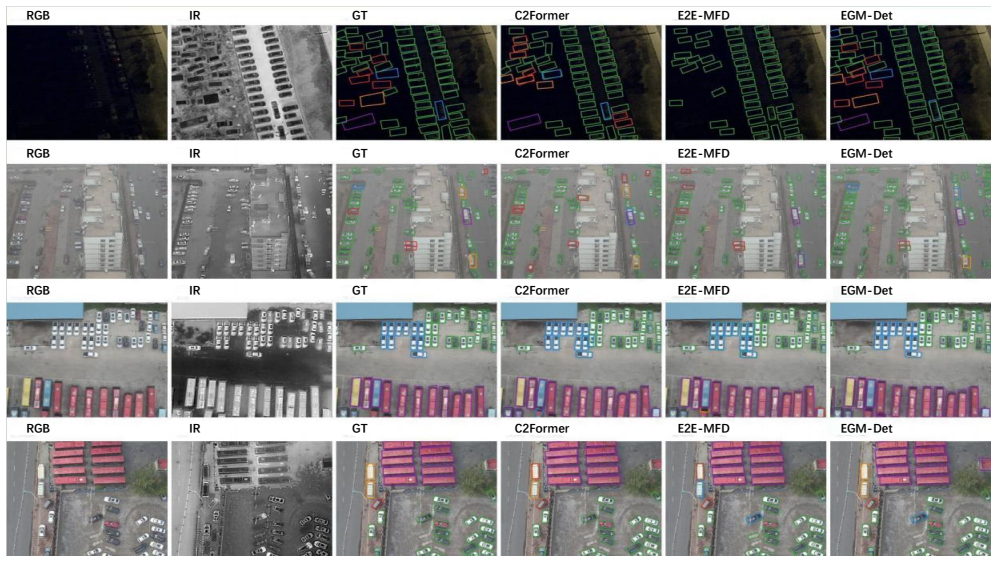
Figures from the paper (3 more)


Reference graph
Works this paper leans on
-
[1]
Sun, Yiming and Cao, Bing and Zhu, Pengfei and Hu, Qinghua , journal=. Drone-Based. 2022 , doi=
work page 2022
-
[2]
Jia, Xinyu and Zhu, Chuang and Li, Minzhen and Tang, Wenqi and Zhou, Wenli , booktitle=
-
[3]
IEEE Conference on Computer Vision and Pattern Recognition , pages=
DOTA: A large-scale dataset for object detection in aerial images , author=. IEEE Conference on Computer Vision and Pattern Recognition , pages=
-
[4]
IEEE Transactions on Pattern Analysis and Machine Intelligence , volume=
Object detection in aerial images: A large-scale benchmark and challenges , author=. IEEE Transactions on Pattern Analysis and Machine Intelligence , volume=. 2021 , publisher=
work page 2021
-
[5]
arXiv preprint arXiv:1804.07437 , year=
Vision meets drones: A challenge , author=. arXiv preprint arXiv:1804.07437 , year=
-
[6]
Journal of Visual Communication and Image Representation , volume=
Vehicle detection in aerial imagery: A small target detection benchmark , author=. Journal of Visual Communication and Image Representation , volume=. 2016 , publisher=
work page 2016
-
[7]
Lightweight Modal-Guided Cross-Attention Fusion Network for Visible-Infrared Object Detection , author=. Pattern Recognition , volume=. 2026 , doi=
work page 2026
-
[8]
31st ACM International Conference on Multimedia , pages=
Multispectral object detection via cross-modal conflict-aware learning , author=. 31st ACM International Conference on Multimedia , pages=
Show all 61 references
-
[9]
IEEE Transactions on Intelligent Vehicles , volume=
Misaligned Visible-Thermal Object Detection: A Drone-Based Benchmark and Baseline , author=. IEEE Transactions on Intelligent Vehicles , volume=. 2024 , doi=
2024
-
[10]
arXiv preprint arXiv:2111.00273 , year=
Cross-modality fusion transformer for multispectral object detection , author=. arXiv preprint arXiv:2111.00273 , year=
-
[11]
Pattern Recognition , volume=
Cross-Modality Attentive Feature Fusion for Object Detection in Multispectral Remote Sensing Imagery , author=. Pattern Recognition , volume=. 2022 , doi=
2022
-
[12]
2023 , note=
Zhang, Jiaqing and Lei, Jie and Xie, Weiying and Fang, Zhenman and Li, Yunsong and Du, Qian , journal=. 2023 , note=
2023
-
[13]
Translation, Scale and Rotation: Cross-Modal Alignment Meets
Yuan, Maoxun and Wang, Yinyan and Wei, Xingxing , booktitle=. Translation, Scale and Rotation: Cross-Modal Alignment Meets. 2022 , publisher=
2022
-
[14]
IEEE Transactions on Geoscience and Remote Sensing , volume=
C ^2 former: Calibrated and complementary transformer for rgb-infrared object detection , author=. IEEE Transactions on Geoscience and Remote Sensing , volume=. 2024 , publisher=
2024
-
[15]
2024 , doi=
Shen, Jifeng and Chen, Yifei and Liu, Yue and Zuo, Xin and Fan, Heng and Yang, Wankou , journal=. 2024 , doi=
2024
-
[16]
Advances in Neural Information Processing Systems , volume=
E2e-mfd: Towards end-to-end synchronous multimodal fusion detection , author=. Advances in Neural Information Processing Systems , volume=
-
[17]
2026 , doi=
Liu, Chang and Ma, Xin and Yang, Xiaochen and Zhang, Yuxiang and Dong, Yanni , journal=. 2026 , doi=
2026
-
[18]
arXiv preprint arXiv:2506.16737 , year=
Cross-modal offset-guided dynamic alignment and fusion for weakly aligned UAV object detection , author=. arXiv preprint arXiv:2506.16737 , year=
-
[19]
arXiv preprint arXiv:1503.02531 , year=
Distilling the knowledge in a neural network , author=. arXiv preprint arXiv:1503.02531 , year=
-
[20]
IEEE/CVF Conference on Computer Vision and Pattern Recognition , pages=
General Instance Distillation for Object Detection , author=. IEEE/CVF Conference on Computer Vision and Pattern Recognition , pages=
-
[21]
IEEE/CVF Conference on Computer Vision and Pattern Recognition , pages=
Focal and Global Knowledge Distillation for Detectors , author=. IEEE/CVF Conference on Computer Vision and Pattern Recognition , pages=
-
[22]
Wang, Jiabao and Chen, Yuming and Zheng, Zhaohui and Li, Xiang and Cheng, Ming-Ming and Hou, Qibin , booktitle=
-
[23]
IEEE/CVF International Conference on Computer Vision , pages=
Channel-Wise Knowledge Distillation for Dense Prediction , author=. IEEE/CVF International Conference on Computer Vision , pages=
-
[24]
IEEE/CVF Conference on Computer Vision and Pattern Recognition , pages=
Distilling Object Detectors via Decoupled Features , author=. IEEE/CVF Conference on Computer Vision and Pattern Recognition , pages=
-
[25]
arXiv preprint arXiv:2205.01529 , year=
Masked generative distillation , author=. arXiv preprint arXiv:2205.01529 , year=
-
[26]
European conference on computer vision , pages=
End-to-end object detection with transformers , author=. European conference on computer vision , pages=. 2020 , organization=
2020
-
[27]
and Shum, Heung-Yeung , booktitle=
Zhang, Hao and Li, Feng and Liu, Shilong and Zhang, Lei and Su, Hang and Zhu, Jun and Ni, Lionel M. and Shum, Heung-Yeung , booktitle=. 2023 , publisher=
2023
-
[28]
arXiv preprint arXiv:2510.09653 , year=
Ultralytics YOLO Evolution: An Overview of YOLO26, YOLO11, YOLOv8 and YOLOv5 Object Detectors for Computer Vision and Pattern Recognition , author=. arXiv preprint arXiv:2510.09653 , year=
-
[29]
Advances in neural information processing systems , volume=
Spatial transformer networks , author=. Advances in neural information processing systems , volume=
-
[30]
IEEE International Conference on Computer Vision , pages=
Deformable convolutional networks , author=. IEEE International Conference on Computer Vision , pages=
-
[31]
Proceedings of the computer vision and pattern recognition conference , pages=
Deim: Detr with improved matching for fast convergence , author=. Proceedings of the computer vision and pattern recognition conference , pages=
-
[32]
arXiv preprint arXiv:2503.11780 , year=
Rethinking multi-modal object detection from the perspective of mono-modality feature learning , author=. arXiv preprint arXiv:2503.11780 , year=
-
[33]
ISPRS Journal of Photogrammetry and Remote Sensing , volume=
A survey on object detection in optical remote sensing images , author=. ISPRS Journal of Photogrammetry and Remote Sensing , volume=. 2016 , publisher=
2016
-
[34]
ISPRS Journal of Photogrammetry and Remote Sensing , volume=
Object detection in optical remote sensing images: A survey and a new benchmark , author=. ISPRS Journal of Photogrammetry and Remote Sensing , volume=. 2020 , publisher=
2020
-
[35]
arXiv preprint arXiv:1812.00155 , year=
Learning RoI transformer for detecting oriented objects in aerial images , author=. arXiv preprint arXiv:1812.00155 , year=
-
[36]
Yang, Xue and Yan, Junchi and Feng, Ziming and He, Tao , booktitle=
-
[37]
IEEE transactions on geoscience and remote sensing , volume=
Align deep features for oriented object detection , author=. IEEE transactions on geoscience and remote sensing , volume=. 2021 , publisher=
2021
-
[38]
IEEE Conference on Computer Vision and Pattern Recognition , pages=
Multispectral Pedestrian Detection: Benchmark Dataset and Baseline , author=. IEEE Conference on Computer Vision and Pattern Recognition , pages=
-
[39]
British Machine Vision Conference , year=
Multispectral Deep Neural Networks for Pedestrian Detection , author=. British Machine Vision Conference , year=
-
[40]
Illumination-aware Faster
Li, Chengyang and Song, Dan and Tong, Ruofeng and Tang, Min , journal=. Illumination-aware Faster. 2019 , publisher=
2019
-
[41]
IEEE/CVF Conference on Computer Vision and Pattern Recognition , year=
Target-aware Dual Adversarial Learning and a Multi-scenario Multi-Modality Benchmark to Fuse Infrared and Visible for Object Detection , author=. IEEE/CVF Conference on Computer Vision and Pattern Recognition , year=
-
[42]
IEEE Conference on Computer Vision and Pattern Recognition , pages=
Squeeze-and-Excitation Networks , author=. IEEE Conference on Computer Vision and Pattern Recognition , pages=
-
[43]
Woo, Sanghyun and Park, Jongchan and Lee, Joon-Young and Kweon, In So , booktitle=
-
[44]
Deformable
Zhu, Xizhou and Hu, Han and Lin, Stephen and Dai, Jifeng , booktitle=. Deformable
-
[45]
arXiv preprint arXiv:2010.04159 , year=
Deformable detr: Deformable transformers for end-to-end object detection , author=. arXiv preprint arXiv:2010.04159 , year=
2010 arXiv
-
[46]
arXiv preprint arXiv:1612.03928 , year=
Paying more attention to attention: Improving the performance of convolutional neural networks via attention transfer , author=. arXiv preprint arXiv:1612.03928 , year=
-
[47]
Advances in Neural Information Processing Systems , pages=
Learning Efficient Object Detection Models with Knowledge Distillation , author=. Advances in Neural Information Processing Systems , pages=
-
[48]
IEEE/CVF Conference on Computer Vision and Pattern Recognition , pages=
Distilling Object Detectors with Fine-Grained Feature Imitation , author=. IEEE/CVF Conference on Computer Vision and Pattern Recognition , pages=
-
[49]
The Bell System Technical Journal , volume=
A Mathematical Theory of Communication , author=. The Bell System Technical Journal , volume=
-
[50]
34th International Conference on Machine Learning , series=
On Calibration of Modern Neural Networks , author=. 34th International Conference on Machine Learning , series=. 2017 , publisher=
2017
-
[51]
Advances in Neural Information Processing Systems , volume=
What Uncertainties Do We Need in Bayesian Deep Learning for Computer Vision? , author=. Advances in Neural Information Processing Systems , volume=
-
[52]
Journal of Artificial Intelligence Research , volume=
Confident Learning: Estimating Uncertainty in Dataset Labels , author=. Journal of Artificial Intelligence Research , volume=
-
[53]
2023 , howpublished=
Jocher, Glenn and Chaurasia, Ayush and Qiu, Jing , title=. 2023 , howpublished=
2023
-
[54]
Drones , volume=
Infrared and Visible Image Fusion Techniques for UAVs: A Comprehensive Review , author=. Drones , volume=. 2025 , doi=
2025
-
[55]
2020 , howpublished=
Jocher, Glenn , title=. 2020 , howpublished=. doi:10.5281/zenodo.3983579 , url=
2020 doi
-
[56]
Proceedings of the IEEE/CVF International Conference on Computer Vision , pages=
WaveMamba: Wavelet-driven mamba fusion for RGB-infrared object detection , author=. Proceedings of the IEEE/CVF International Conference on Computer Vision , pages=
-
[57]
Sensors , year =
Weng, Tianhang and Niu, Xiaopeng , title =. Sensors , year =
-
[58]
Remote Sensing , year =
Gao, Yaoyue and Cheng, Xinru and Li, Yimeng and Xu, Dawei and Sun, Desheng and Hu, Yaoyi , title =. Remote Sensing , year =
-
[59]
IEEE Journal of Selected Topics in Applied Earth Observations and Remote Sensing , year =
Peng, Sijia and Xue, Ruxiang and Tong, Yunfei and Wang, Zhe and Yang, Hai , title =. IEEE Journal of Selected Topics in Applied Earth Observations and Remote Sensing , year =
-
[60]
Remote Sensing , year =
Meng, Fangzhou and Hong, Aoping and Tang, Hongying and Tong, Guanjun , title =. Remote Sensing , year =
-
[61]
Sensors , year =
Yang, Xiang and Yang, Mengyue and Xie, Xiaolan , title =. Sensors , year =
Reviewed August 16, 2026 · model on record in the stance chip above.
Discussion (0). Continue with ORCID to comment.