REVIEW 5 major objections 5 minor 36 references
Cherenkov light as a mechanism for light flashes seen by astronauts in space
T0 review · 5 major / 5 minor · reviewed 2026-08-16 · deepseek-v4-flash
Pith's one-line read Cherenkov light generated inside the eye by heavy cosmic-ray nuclei explains the light flashes astronauts see in space, the paper argues.
desk verdict Plausible mechanism, reproducible code, but the paper's own predicted flash rates are an order of magnitude above the observed rates, so the central consistency claim fails as written. read the letter →
The pith
A machine-rendered reading of the paper's core claim, the machinery that carries it, and where it could break.
The reading
What carries the argument
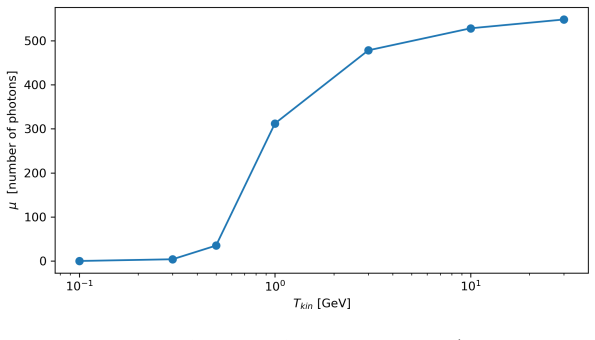
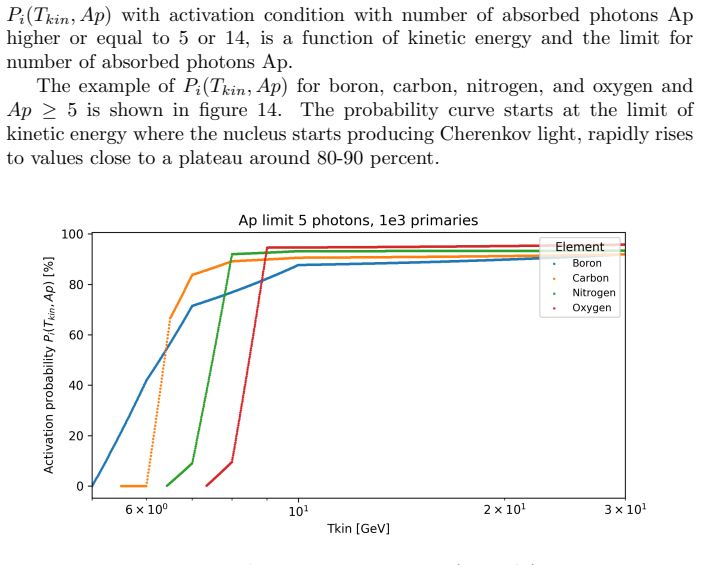
The load-bearing machinery is the Cherenkov light production model: a Frank–Tamm calculation of visible photon yield (380–700 nm) for the first thirty elements, evaluated over the average straight-line path of 1.667 cm in a 2.5 cm water sphere and weighted by energy-differential cosmic-ray intensities. For a single nucleus the yield climbs from about 300 photons for a proton to about 19,500 for oxygen and about 56,000 for iron at high energy, but raw photon number is not the deciding factor. The model then projects photon trajectories onto the retinal surface, treats each rod-photon encounter as absorption with 29% probability, and requires that some patch of roughly 500 rods (0.044 mm × 0.044 mm) absorb at least $A_p = 5$ or 14 photons before a flash is registered. This defines the activation probability $P_i(T_{\mathrm{kin}}, A_p)$, and the predicted flash rate for element $i$ is $N_{\mathrm{LF},i} = G \int_0^{500\,\mathrm{GeV}} I_{\mathrm{CR},i}(T) \, P_i(T, A_p) \, dT$, with $G$ the eye surface area times the retinal fraction times the $2\pi$ inward solid angle. The same machinery applied to the measured ground-level muon spectrum and its $\cos^2\theta$ angular distribution produces the predicted null result at Earth's surface.
What would settle it
Measure astronaut light-flash rates over a region of low vertical geomagnetic cutoff (below 1 GV, such as high-latitude North America) and over a high-cutoff region (above 14 GV, such as the Indian Ocean at low latitude); the model predicts roughly a tenfold reduction in flash rate, and the paper itself states that if no such difference is observed the Cherenkov model is challenged.
Extended reading notes
Core claim
The paper's central claim is that one mechanism—Cherenkov emission by cosmic-ray nuclei moving through the water-like interior of the eye—accounts for the light flashes reported by astronauts in interplanetary space and in most of low Earth orbit. Iron nuclei dominate the perceived events because a single iron nucleus produces tens of thousands of visible photons along its roughly 1.7-centimeter average path, and among the lighter nuclei only carbon and oxygen concentrate enough photons on a roughly 500-rod retinal patch to meet the activation condition of at least five absorbed photons. Hydrogen and helium, although vastly more numerous, are effectively invisible because their few hundred photons arrive spread over too wide a retinal area. The paper explicitly exempts the South Atlantic Anomaly, where trapped protons would give less than one flash per week and another mechanism must operate, and it shows that ground-level muons cannot activate the retina despite producing bright Cherenkov tracks.
Load-bearing premise
The load-bearing premise is that a cosmic-ray nucleus crossing the eye off-center or at an angle deposits Cherenkov photons onto the retina just as efficiently as the straight-through, central-axis tracks used to calibrate the activation probability; a second factor of two sits in the geometry constant that counts the incoming flux, and either overestimate would lower the predicted flash rate toward the observed values.
Editorial extensions
If this is right
- Outside the South Atlantic Anomaly, the light-flash rate becomes a predictable function of geomagnetic cutoff: the model gives about a tenfold reduction between low-cutoff regions (below 1 GV, such as high-latitude North America) and high-cutoff regions (above 14 GV, such as the equatorial Indian Ocean).
- Iron nuclei above roughly 40 GeV should be perceived as diffuse 'cloud' flashes, because a single nucleus activates tens to hundreds of separate 500-rod patches at once; this explains why cloud flashes are a minority of astronaut reports.
- Looking toward zenith versus nadir in high-latitude low Earth orbit should change the flash rate, since Earth blocks roughly half the inward cosmic-ray hemisphere and the retinal area exposed to inward tracks differs.
- At aircraft altitudes, flashes should be heavy-nucleus events rather than muon events, so the mechanism observed in space also accounts for the rare high-altitude reports.
- Muon-induced Cherenkov flashes at ground level should remain unobservable, with an upper limit near one flash per 24 hours of continuous viewing, because individual muons cannot concentrate enough photons on one retinal patch.
Reading between the lines
- If the mechanism is Cherenkov emission, the astronaut retina is effectively a composition-sensitive cosmic-ray detector; pairing flash reports with an on-board particle telescope could yield an independent iron-to-carbon abundance measurement.
- The activation logic predicts a sharp elemental threshold: single-particle flashes should occur only for nuclei at least as heavy as carbon, regardless of how high the proton flux is; an instrument that records both the charge of each crossing nucleus and the astronaut's response could map this threshold directly.
- The model's spatial-concentration claim is testable in a laboratory: a dark-adapted eye placed in a beam of heavy ions at tens of GeV per nucleon should perceive spot and cloud flashes matching the predicted retinal activation patterns.
Signed reviews
Editorial analysis
A structured set of objections, weighed in public.
Referee Report
Summary. The paper proposes that Cherenkov radiation produced by cosmic-ray nuclei in the ocular fluid is the mechanism behind the light flashes reported by astronauts. It combines Geant4 simulations of particle passage through simplified water-eye models with a Frank–Tamm Cherenkov yield model, physiological inputs (rod quantum efficiency 29%, Hecht-style thresholds of 5 or 14 absorbed photons in ~500-rod patches), and AMS-02/PAMELA/BESS spectra to predict light-flash rates in interplanetary space, low Earth orbit, and at ground level. The central quantitative claim is that predicted rates are consistent with Apollo/Skylab/ISS observations and that the dominant contributors are heavy nuclei, primarily iron, with carbon and oxygen also contributing. The paper also argues that muon-induced Cherenkov light is insufficient to produce flashes at Earth's surface and that South Atlantic Anomaly flashes require a different mechanism.
Significance. If the quantitative claim held, the paper would resolve a long-standing puzzle in space radiation biology and would identify iron, carbon, and oxygen as the flash-producing primaries, with testable predictions for geomagnetic-cutoff dependence. The work has notable strengths: the simulation code and Cherenkov model are publicly archived, the Geant4 and Frank–Tamm yields are cross-checked against each other, no parameter is fitted to the observed flash rates, and the model makes a falsifiable prediction about the decrease of flash rate with geomagnetic cutoff rigidity. However, the headline claim of consistency with observed flash rates is contradicted by the paper's own Table 5, and several modeling choices further inflate the predicted rates. The qualitative idea is plausible and worth pursuing, but the central quantitative result is not supported as written.
major comments (5)
- [Table 5 vs. Table 1; §3.2.1] The predicted rates do not match the observed rates quoted in the paper. Table 5 gives 5.51 LF/min for Ap≥5 and 1.86 LF/min for Ap≥14 for elements hydrogen through oxygen, while Table 1 lists observed rates of 0.048–0.343 LF/min for Apollo, Skylab-1, Sileye, and ALTEA (the single Skylab-2 value 2.618 LF/min is a clear outlier). Even against the highest typical point, 0.343 LF/min, the Ap≥14 prediction is about 5.4 times too high and the Ap≥5 prediction is about 16 times too high; against the ALTEA value of 0.048 LF/min the overprediction is roughly 40–115 times. The abstract's statement that results are "consistent with the observed frequency" is therefore not supported by the paper's own numbers, and the text in §3.2.1 explicitly concedes "one order of magnitude more particles creating light flashes ... than Apollo numbers." Since the model has no free parameters fitted to the flash rates, this discrepancy is a direct failure of the central quantitative claim; an error budget or a revised, honest statement of the predicted-to-observed ratio is required.
- [§3.2.1, Eq. (1)] The geometry constant G in Eq. (1) overcounts the cosmic-ray crossing rate. G is defined as eye surface 19.6 cm² × 2/3 × solid angle 2π = 82.1 cm²·sr, but for isotropic intensity I [cm⁻² s⁻¹ sr⁻¹] the correct crossing-rate coefficient for a sphere of radius R=1.25 cm is 4π²R² = 61.7 cm²·sr if particles arrive from all 4π sr, or 2π²R² = 30.9 cm²·sr if they arrive from one exposed hemisphere, as is the case for an astronaut's eye in space. The manuscript's G is therefore larger than the full-sky coefficient by a factor of 1.33 and larger than the one-hemisphere coefficient by a factor of 2.66. Moreover, the 2/3 retinal factor belongs in the probability of perception, not in the particle-crossing rate. Correcting G would lower all predicted LF rates, which only widens the discrepancy with Table 1; it cannot rescue the consistency claim.
- [§3.2 and §3.2.1] The activation probability P_i(Tkin,Ap) is derived from Geant4 tracks that cross the eye along the central axis with a full 2.5-cm path in water, but in Eq. (1) it is applied to isotropically incident particles whose mean chord length is only 4r/3 = 1.667 cm. The paper itself uses the 1.667-cm mean chord for the yield model in §3.2 and for the N. of photons per particle in Table 5, yet the P_i curves used in the flash-rate integral come from the axial 2.5-cm simulations described in §3.2.1 and Figures 12–13. Because Cherenkov photon number scales with track length, the activation probability for a typical off-axis or grazing crossing is overestimated, and no convolution over impact parameter or chord-length distribution is provided. This is a load-bearing inconsistency in the rate calculation and should be corrected before the predicted rates can be accepted.
- [Abstract, §3.2.3, Table 5] The stated conclusion that iron is the dominant flash-producing primary is inconsistent with the paper's own Table 5. For Ap≥5, the predicted rates are carbon 1.84 LF/min, oxygen 1.81 LF/min, helium 0.67 LF/min, and iron 0.13 LF/min; for Ap≥14 the rates are oxygen 1.19, carbon 0.39, and iron 0.13. Thus carbon and oxygen dominate the predicted rate by more than an order of magnitude over iron, and even helium out-predicts iron at Ap≥5. The abstract and conclusion should be revised to state that carbon and oxygen are the dominant contributors, with iron contributing only a small fraction of the predicted rate; alternatively, the model that produces the iron-dominated result should be specified and reconciled with Table 5.
- [§3.2.1, paragraph beginning "This could also mean"] The manuscript contains an explicit, unresolved admission that undermines the central claim: "There are not enough particles creating higher numbers of photons by Cherenkovov radiations to reproduce Apollo results. If light flash experience need few hundred thousand or million or more photons, than light flashes are not Cherenkovov light effect." This passage should be treated as part of the paper's evidence, and it directly contradicts the abstract's claim of consistency. Either the model must be shown to reproduce the observed rates with the stated thresholds, or the conclusion must be reframed as an upper limit or as a qualitative mechanism rather than a quantitative explanation.
minor comments (5)
- [Table 5] The column header "N. of flashes per minute Ap≥5-Ap≥14" is ambiguous; separate columns for Ap≥5 and Ap≥14 should be used, and the iron row should explicitly state both values.
- [Throughout] There are numerous typos and inconsistent spellings, e.g., "Cherenkovov," "simmilar," "parrallel," "vacuume," and "CUBE GMA"; the manuscript needs careful proofreading.
- [§3.2.1] The placeholder phrase "setup x from table y" should be replaced with the actual simulation setup designation, and the callouts to Figures 12 and 13 should list the exact configurations used.
- [References] The in-text citation "Aguilar et al. (2021)" for iron is listed with a January 2021 date while "Aguilar et al. (2021a)" is used for the Physics Reports spectra; the reference style should be made consistent so that the reader can identify which AMS-02 data were used for each element.
- [§3.2.1, Eq. (1)] The units of the solid angle should be written explicitly as sr, and the decimal comma in "19,6cm2" should be replaced with a decimal point for consistency with the rest of the paper.
Circularity Check
No circular derivation: the predicted light-flash rates are forward-computed from external spectra, published physiology thresholds, and Geant4 simulations, with no parameter fitted to the observed flash rates. The paper itself concedes an order-of-magnitude overprediction, which is inconsistent with a circular fit.
full rationale
The derivation chain is: (1) Cherenkov photon yield per nucleus is computed from the standard Frank–Tamm formula and independently validated against Geant4 in Fig. 8; (2) cosmic-ray fluxes are taken from AMS-02 and BESS; (3) retinal activation probabilities Pi(Tkin,Ap) are obtained from Geant4 photon-tracking simulations using the Hecht 5–14 photon threshold and the Phan 29% rod quantum efficiency; (4) Eq. (1) integrates flux × probability × a geometry factor; (5) the resulting rates in Table 5 are compared with observed rates in Table 1. At no point are the observed flash rates used to calibrate a parameter. The predicted totals (5.51 min−1 for Ap≥5 and 1.86 min−1 for Ap≥14 for H–O, plus ~0.13–0.17 min−1 for Fe) exceed the Apollo/ALTEA observed rates (0.048–0.343 min−1), and the text explicitly states 'one order of magnitude more particles creating light flashes ... than Apollo numbers' — an admission that the model was not tuned to match the data. The activation probability is derived from simulated photon spatial distributions, not from observed flash frequencies. The self-citations to earlier eye simulations (Gecášek et al. 2023; Švecová et al. 2022) are re-derived in this paper's own Figure 2, and the COR-system citation (Gecášek et al. 2022) is a supporting computational tool, not a load-bearing premise. Modeling approximations — e.g., applying an axial 2.5-cm-track activation probability to an isotropic flux with a 1.667-cm mean chord, and a geometry constant that overcounts the isotropic crossing rate — are accuracy issues, not circular reductions. The central quantitative claim is therefore falsifiable and, on the paper's own numbers, partially falsified, which is the opposite of a circular prediction. Score 2 reflects only the presence of non-load-bearing self-citations; no circular step is present.
Assumptions & free parameters
free parameters (3)
- Activation threshold Ap =
5 and 14 absorbed photons
- Rod quantum efficiency =
0.29
- Geometry factor G =
19.6 cm^2 x (2/3) x 2π sr
assumptions (4)
- domain assumption The eye can be approximated as a homogeneous water sphere with refractive index about 1.35 for Cherenkov emission.
- domain assumption Activation probabilities Pi measured from central-axis, full-diameter tracks apply to all impact parameters.
- domain assumption Cosmic rays at 1 AU can be treated as isotropically incident over the exposed hemisphere, with the flux described by AMS-02 2011-2018 averages.
- standard math The Frank-Tamm formula with a fixed water refractive index reproduces Geant4 Cherenkov yields for all nuclei up to 500 GeV.
Cite this review
Pith. "Pith review of Cherenkov light as a mechanism for light flashes seen by astronauts in space." pith.science (2026). https://pith.science/paper/SXNJYSKN
@misc{pith2026260811761,
  author       = {Pith},
  title        = {Pith review of: Cherenkov light as a mechanism for light flashes seen by astronauts in space},
  year         = {2026},
  howpublished = {\url{https://pith.science/paper/SXNJYSKN}},
  note         = {Machine review of arXiv:2608.11761}
}
read the original abstract
Astronauts first reported light flashes during the Apollo 11 mission. These events have since been associated with cosmic rays, although their underlying mechanism remains uncertain. This study investigates possible formation processes using Geant4 simulations of cosmic ray interactions in a simplified model of the human eye. We apply published models of human visual perception to the simulated particle induced photons and compare the resulting light flash rates with experimental observations. Our results indicate that, in interplanetary space and in low Earth orbit outside the South Atlantic Anomaly, Cherenkov radiation generated in the eye produces retinal responses consistent with the observed frequency of astronaut light flashes. The dominant contributing primaries are found to be high Z nuclei, primarily iron, with additional contributions from oxygen and carbon nuclei. In contrast, conditions in the South Atlantic Anomaly suggest that additional mechanisms may be required to explain observed light flashes. We also find that the absence of light flashes at Earth's surface is consistent with insufficient retinal stimulation from muon induced Cherenkov radiation under typical geometrical and flux conditions.
Figures


Figures from the paper (19 more)





Reference graph
Works this paper leans on
- [1]
-
[2]
International Cosmic Ray Conference , year = 2003, volume =
Light Flashes Observations on Board Mir and ISS with Sileye Experiments. International Cosmic Ray Conference , year = 2003, volume =
work page 2003
-
[3]
Advances in Space Research , year = 2000, volume =
Study of Cosmic Rays and Light Flashes on Board Space Station MIR: The Sileye Experiment. Advances in Space Research , year = 2000, volume =. doi:10.1016/S0273-1177(99)01017-0 , adsurl =
-
[4]
Nuclear Instruments and Methods in Physics Research A , year = 2007, month = oct, volume =
Using the human eye to image space radiation or the history and status of the light flash phenomena. Nuclear Instruments and Methods in Physics Research A , year = 2007, month = oct, volume =. doi:10.1016/j.nima.2007.06.095 , adsurl =
-
[5]
Nature , year = 2003, volume =
Space travel: Dual origins of light flashes seen in space. Nature , year = 2003, volume =. doi:10.1038/422680a , adsurl =
-
[6]
Geant4: Book For Application Developers, Release 10.7 , author =
-
[7]
FLUKA Manual , author =
-
[8]
The Journal of Aviation Medicine , year = 1952, volume =
Radiation hazards in high altitude aviation. The Journal of Aviation Medicine , year = 1952, volume =
work page 1952
Show all 36 references
-
[9]
NASA SP-377
Biomedical Results from Skylab. NASA SP-377
-
[10]
1942 , volume =
Energy, Quanta, and Vision , journal =. 1942 , volume =
1942
-
[11]
Can a Human See a Single Photon? , year =
-
[12]
Advances in Space Research , year = 2004, volume =
The ALTEA/ALTEINO projects: studying functional effects of microgravity and cosmic radiation. Advances in Space Research , year = 2004, volume =. doi:10.1016/j.asr.2003.09.052 , adsurl =
2004 doi
-
[13]
New Journal of Physics , year =
Narici, L , title =. New Journal of Physics , year =
-
[14]
, title =
Hecht, S. , title =. Nature , year =
-
[15]
2016 , volume=
Direct detection of a single photon by humans , journal=. 2016 , volume=
2016
-
[16]
Introduction to Geant4 , author =
-
[17]
Journal of Ophthalmology , year = 2014, month = nov, volume =
Variations in eyeball diameters of the healthy adults. Journal of Ophthalmology , year = 2014, month = nov, volume =
2014
-
[18]
Journal of Physics Conference Series , year = 2014, volume =
Geant4 studies of the CNAO facility system for hadrontherapy treatment of uveal melanomas. Journal of Physics Conference Series , year = 2014, volume =. doi:10.1088/1742-6596/513/2/022028 , adsurl =
2014 doi
-
[19]
doi:10.22323/1.444.0102 , journal =
Simulation of Cosmic Rays Interaction With Simple Human Eye Model in. doi:10.22323/1.444.0102 , journal =
-
[20]
2022 , pages =
Simulation of cosmic rays interaction with simple human eye model in Geant4 package, in Proceedings of 26th Conference of Slovak Physicists: Proceedings, Editors. 2022 , pages =
2022
-
[21]
Physical Review Letters , year = 2021, volume =
Periodicities in the Daily Proton Fluxes from 2011 to 2019 Measured by the Alpha Magnetic Spectrometer on the International Space Station from 1 to 100 GV. Physical Review Letters , year = 2021, volume =. doi:10.1103/PhysRevLett.127.271102 , adsurl =
2011 doi
-
[22]
1998 , isbn =
The First Steps in Seeing , publisher =. 1998 , isbn =
1998
-
[23]
Interaction of Fixed Number of Photons with Retinal Rod Cells , author =. Phys. Rev. Lett. , volume =. 2014 , month =. doi:10.1103/PhysRevLett.112.213601 , url =
2014 doi
-
[24]
Properties of Iron Primary Cosmic Rays: Results from the Alpha Magnetic Spectrometer , author =. Phys. Rev. Lett. , volume =. 2021 , month =. doi:10.1103/PhysRevLett.126.041104 , url =
2021 doi
-
[25]
ESA Special Publication , year = 1996, series =
Biomedical Aspects of Light Flashes Observed by Astronauts during Spaceflight. ESA Special Publication , year = 1996, series =
1996
-
[26]
Physics Reports , keywords =
The Alpha Magnetic Spectrometer (AMS) on the international space station: Part II - Results from the first seven years. Physics Reports , keywords =. doi:10.1016/j.physrep.2020.09.003 , adsurl =
2020 doi
-
[27]
Advances in Space Research , keywords =
COR system: A tool to evaluate cosmic ray trajectories in the Earth's magnetosphere. Advances in Space Research , keywords =. doi:10.1016/j.asr.2022.06.001 , adsurl =
2022 doi
-
[28]
Properties of Daily Helium Fluxes , author =. Phys. Rev. Lett. , volume =. 2022 , month =. doi:10.1103/PhysRevLett.128.231102 , url =
2022 doi
-
[29]
International Geomagnetic Reference Field: the 12th generation
Th. International Geomagnetic Reference Field: the 12th generation. Earth, Planets and Space , keywords =. doi:10.1186/s40623-015-0228-9 , adsurl =
-
[30]
Astrophysical Journal Letters , keywords =
Trapped Proton Fluxes at Low Earth Orbits Measured by the PAMELA Experiment. Astrophysical Journal Letters , keywords =. doi:10.1088/2041-8205/799/1/L4 , archivePrefix =. 1412.1258 , primaryClass =
-
[31]
Astroparticle Physics , publisher=
Motoki, M and Sanuki, T and Orito, S and others 2003 , title=. Astroparticle Physics , publisher=. 2003 , month=Apr, pages=. doi:10.1016/s0927-6505(02)00195-0 , url=
2003 doi
-
[32]
doi:10.5281/zenodo.15187815 , url =
-
[33]
doi:10.5281/zenodo.21415633 , url =
NikaSvec/OpticApro-SG-Vac: OpticApro-SG-Vac. doi:10.5281/zenodo.21415633 , url =
-
[34]
doi:10.5281/zenodo.15187836 , url =
-
[35]
Cherenkov Light Production Model for Cosmic Ray Nuclei
Bob. Cherenkov Light Production Model for Cosmic Ray Nuclei. 2026 , url =
2026
-
[36]
doi:10.5281/zenodo.21394616 , url =
Bobik, Pavol and Švecová, Dominika and Pastircak, Blahoslav , title =. doi:10.5281/zenodo.21394616 , url =
Reviewed August 16, 2026 · model on record in the stance chip above.
Discussion (0). Continue with ORCID to comment.