REVIEW 4 major objections 4 minor 19 references
PolarSym: Polar Geometry-aware Attention for CAD Floorplan Parsing
T0 review · 4 major / 4 minor · reviewed 2026-08-16 · deepseek-v4-flash
Pith's one-line read PolarSym claims that explicitly splitting CAD floorplan geometry into direction and distance—modeled by SF-RoPE and a resonant distance bias inside attention—improves long-range symmetric correspondence and beats a reproduced SymPoint V2…
desk verdict The geometric attention idea is sensible and worth a referee, but the paper's headline gains rest on a flawed comparison: Table 2 uses different batch sizes for baseline and PolarSym, contradicting the 'identical training settings' claim. read the letter →
The pith
A machine-rendered reading of the paper's core claim, the machinery that carries it, and where it could break.
The reading
What carries the argument
The load-bearing mechanism is the polar decomposition of pairwise geometry into a direction term and a distance term, injected additively into attention rather than into feature vectors. SF-RoPE (Split-Feature Rotary Position Embedding) partitions feature channels into two halves and applies cross-half rotation matrices with angle $\theta_k = \lambda \phi(p_i)$, alternating horizontal and vertical coordinate axes across attention heads, producing the directional increment $\Delta_{\mathrm{dir}}$. RDB (Resonant Distance Bias) maps Euclidean distance $d_{ij}$ through Fourier features $\gamma(d) = (d, \sin(2^0\pi d), \cos(2^0\pi d), \ldots, \sin(2^{L-1}\pi d), \cos(2^{L-1}\pi d))$ and a lightweight MLP, allowing several distance peaks so that distant symmetric pairs can receive high bias; this forms the radial branch $B_{\mathrm{rad}}$. Learnable gates $\alpha = \tanh(g_\alpha)$ and $\beta = \tanh(g_\beta)$ fuse the two into the final score $S = S_{\mathrm{sem}} + \alpha\Delta_{\mathrm{dir}} + \beta B_{\mathrm{rad}}$, preserving the vanilla Transformer architecture while changing only how attention scores are computed.
What would settle it
Train PolarSym and the reproduced SymPoint V2 baseline under the official SymPoint V2 protocol (250 epochs, eight GPUs, batch size 16) and compare on the same test split; if PolarSym fails to match the official 90.1% PQ or the margin over the baseline shrinks to near zero, the claimed advantage would be shown to depend on the constrained training budget rather than on the geometric attention itself.
Extended reading notes
Core claim
The paper's central claim is that replacing unified positional encodings with two independent geometric attention modifiers yields more accurate and faster-converging CAD floorplan parsing. Directional consistency is captured by SF-RoPE, which splits a query or key feature into two halves and rotates them across halves with angles derived from physical coordinates; the radial branch learns a non-monotonic 'resonant' distance bias by Fourier-encoding Euclidean distance and passing it through a small MLP. A dynamic gating mechanism adds these two terms to the semantic attention score through $S = S_{\mathrm{sem}} + \alpha \Delta_{\mathrm{dir}} + \beta B_{\mathrm{rad}}$, with $\alpha$ and $\beta$ initialized so direction acts early and distance enters later. The result, under identical constrained training settings, is a consistent improvement over the reproduced SymPoint V2 baseline on PQ, RQ, SQ, and especially mIoU, together with faster early convergence, which the paper interprets as evidence that the geometric prior helps the network establish global structural correspondences early in training.
Load-bearing premise
The load-bearing premise is that the reproduced SymPoint V2 baseline, trained for 50 epochs on two GPUs, is a faithful and reasonably strong implementation of the official SymPoint V2, so the reported gains reflect PolarSym's geometric attention rather than a weakened comparison point.
Editorial extensions
If this is right
- Under the same 50-epoch, two-GPU training schedule, applying PolarSym to a reproduced Point Transformer baseline yields higher panoptic and semantic quality, with the largest relative gain in mIoU (+4.31 points).
- Because the geometric terms are additive attention modifications, the method can in principle be dropped into any Transformer-based CAD parsing or vector graphics model without retraining the backbone from scratch.
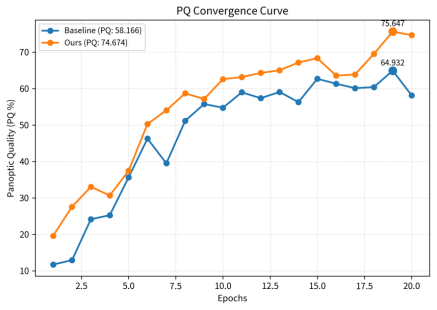
- Faster convergence—PolarSym reaches 74.6% PQ at epoch 20 versus 58.1% for the baseline—implies that explicit geometric priors can reduce the epoch budget needed to reach usable parsing quality, addressing a known pain point of point-based Transformers.
- Ablation results indicate that direction and distance contribute differently: SF-RoPE alone raises PQ from 85.42% to 86.83% and mIoU by 2.60 points, while adding RDB raises PQ to 87.15% and mIoU to 70.87%, supporting the claim that the two branches are complementary.
- If the polar decomposition is the cause of the gains rather than a side effect of extra parameters, the same additive geometric-attention recipe should transfer to other structured domains with repeated symmetric layouts, such as mechanical drawings or indoor scene layouts.
Reading between the lines
- A testable extension is to run PolarSym under the official SymPoint V2 protocol (250 epochs, eight GPUs, batch size 16); if the official 90.1% PQ remains higher than PolarSym's 87.15% under that setting, the paper's claim reduces to an efficiency advantage under constrained budgets, not an accuracy advantage over the official model.
- The RDB's Fourier encoding is a generic periodic-basis trick; one could replace it with alternative bases such as learned periodic functions or random Fourier features to test whether the resonant non-monotonic form or simply the extra expressiveness drives the distance-branch gains.
- The paper's framing suggests that the gate initializations might be re-tuned per dataset: in mirror-heavy layouts a larger initial $\alpha$ could be optimal, while in scattered layouts $\beta$ could be raised earlier; this is a prediction the authors do not test.
- Since the method is architecture-agnostic at the attention level, a natural next step would be to pair PolarSym with linear attention or graph-based backbones to see whether the geometric bias compensates for their reduced global receptive fields.
Signed reviews
Editorial analysis
A structured set of objections, weighed in public.
Referee Report
Summary. The paper proposes PolarSym, a polar-coordinate geometry-aware attention framework for CAD floorplan parsing. It decouples geometric relationships into a direction branch (SF-RoPE) and a distance branch (RDB), fused through a dynamic gating mechanism that modulates the semantic self-attention scores. The authors claim that, under identical training settings, PolarSym outperforms a reproduced SymPoint V2 baseline by +1.73% PQ, +1.54% RQ, +0.30% SQ, and +4.31% mIoU on a public benchmark, while also converging faster. Ablation experiments are presented to show the complementary contributions of the direction and distance branches.
Significance. If the empirical claims hold, PolarSym offers a conceptually interesting and computationally light way to inject explicit geometric priors into Transformer attention for CAD parsing, and the decoupling of direction and distance is a sensible design choice for architectural symmetry. However, the paper currently does not provide code, pre-trained models, or machine-checkable artifacts, and the core empirical validation rests on a single controlled comparison whose protocol is internally inconsistent. The central contribution is therefore plausible but not yet convincingly established.
major comments (4)
- [§4.2, Table 2] The abstract, §4.2, and Table 2 all state that PolarSym and the reproduced SymPoint V2 baseline are compared 'under identical training settings,' but Table 2 lists the GPU/Batch column as 2/8 for SymPoint V2 (Reproduction) and 2/6 for PolarSym. If these numbers denote the number of GPUs and total batch size, then the comparison is not controlled: total batch size affects the effective learning rate, gradient noise, and optimization trajectory, so the reported gains may be partly attributable to the batch-size difference rather than to the proposed geometric attention. If 'GPU / Batch' has a different intended meaning, this must be clarified explicitly. As written, the headline improvement of +1.73% PQ and the related claims of 'identical training settings' are invalidated, which is load-bearing for the paper's central assertion.
- [§3.2.1, Eq. (2)] The directional branch is underspecified. Equation (2) defines the rotation angle as θ_k = λ φ(p_i), but the function φ is never defined anywhere in the text. The only description is that 'different attention heads alternately adopt horizontal and vertical coordinates to encode directional information along the two primary axes.' This leaves the actual mapping from a point's coordinates to θ_k ambiguous, making the method non-reproducible. Please specify φ precisely (e.g., φ(p_i) = x_i for some heads and φ(p_i) = y_i for others) and describe exactly how the head alternation is implemented.
- [§4.3, Tables 2 and 3] All reported improvements are based on single-run comparisons without any error bars, confidence intervals, or significance tests. The gain in SQ is only +0.30 percentage points, which is within typical run-to-run variance for such models. Without multiple seeds or a significance analysis, the claim that PolarSym consistently outperforms the baseline across all metrics is not statistically supported. Please provide repeated runs (at least three seeds) or otherwise justify the robustness of the reported numeric differences.
- [§4.3, Table 4] Table 4 and its surrounding text are confusing and appear internally inconsistent. The baseline PQ in Table 3 is 85.420, while the 'Strong Baseline' baseline PQ in Table 4 is 85.21; moreover, the 'Weak Baseline' uses a different geometry implementation ('Standard Axial + Linear Dist') rather than merely a different initialization, yet the text says the comparison involves 'suboptimal initialization.' The relationship between the weak/strong baselines and the earlier ablation settings is unclear, and the reported final PQ values (83.57 vs. 87.15) are compared without explaining how these baselines relate to the SymPoint V2 reproduction in Table 2. Please clarify the experimental protocol for Table 4 or remove it if it does not support a well-defined claim.
minor comments (4)
- [§3.2.3] The paper claims that the gating mechanism adds 'negligible extra computation' but does not report FLOPs, parameter counts, or runtime comparisons. Please provide a quantitative complexity or efficiency analysis.
- [Section 2.3 and §3.2.2] The acronym RDB is inconsistently expanded: Section 2.3 calls it 'Resonance Distance Deviation,' while §3.2.2 calls it 'Resonant Distance Bias.' Please use a single consistent name and abbreviation throughout.
- [Section 2.1.2] There is a typo in the section heading 'V ector-Based Methods'; the space after 'V' should be removed.
- [§3.1] The text says 'LFEM' is used but does not define the abbreviation; define it at first use, even if it refers to the SymPoint-V2 Layer Feature Enhancement Module.
Circularity Check
No circularity: PolarSym's geometric attention terms are explicit additive architectural modifications with trainable parameters, and the reported gains are measured against an external reproduced baseline rather than being fitted or defined by construction.
full rationale
The claimed derivation chain is self-contained. PolarSym defines its final attention score in Eq. (6) as S = S_sem + αΔ_dir + βB_rad, where S_sem is standard QK^T/√d, Δ_dir = S_dir − S_sem is obtained by rotating split query/key features with Eq. (2) using coordinate-derived angles, and B_rad is an MLP applied to Fourier-encoded Euclidean distances in Eqs. (4)-(5). Each term is an explicit architectural modification with trainable parameters; no component is defined in terms of the target metric, fitted to the test set, or renamed from a previously fitted result. The central empirical claim is an external comparison against a reproduced SymPoint V2 baseline under a constrained training setup, and the ablations independently vary the components to show their effects. There are no load-bearing self-citations: the cited SymPoint works are prior external papers, and no uniqueness theorem or prior author result is invoked to force the design. The only notable inconsistency is that Table 2 reports 'GPU / Batch' as 2/8 for the reproduction and 2/6 for PolarSym despite the text claiming 'identical training configurations'; that is an experimental-control concern affecting the validity of the comparison, not a definitional or fitted-input circularity, so it does not raise the circularity score.
Assumptions & free parameters
free parameters (3)
- gating initialization g_alpha, g_beta =
g_alpha=2.0, g_beta=0 (alpha=tanh(2.0)=0.96, beta=0)
- frequency scaling factor lambda
- number of frequency bands L
assumptions (4)
- domain assumption Architectural floorplans are dominated by axisymmetric and repetitive layouts along a primary building axis.
- domain assumption Euclidean distance ||p_i - p_j||_2 is the right scalar for radial correspondence in building symmetry.
- domain assumption Attention modulation can be applied additively to raw semantic scores as S = S_sem + alpha * Delta_dir + beta * B_rad (Eq. 6) without changing the normalization behavior expected by the Transformer.
- domain assumption The reproduced SymPoint V2 baseline is a faithful implementation under the constrained setup.
Cite this review
Pith. "Pith review of PolarSym: Polar Geometry-aware Attention for CAD Floorplan Parsing." pith.science (2026). https://pith.science/paper/7EBP62XR
@misc{pith2026260811793,
  author       = {Pith},
  title        = {Pith review of: PolarSym: Polar Geometry-aware Attention for CAD Floorplan Parsing},
  year         = {2026},
  howpublished = {\url{https://pith.science/paper/7EBP62XR}},
  note         = {Machine review of arXiv:2608.11793}
}
read the original abstract
CAD plan parsing is a fundamental task in Building Information Modeling (BIM), aiming to automatically extract architectural elements including walls, doors, windows, and furniture from 2D engineering drawings. Existing Transformer-based methods capture global semantic dependencies via self-attention, yet they infer spatial relationships merely from semantic features without explicitly characterizing the intrinsic geometric symmetry of building layouts. Such methods tend to produce mismatched correspondences in long-range matching and complex symmetric spatial layouts. To tackle this limitation, we propose PolarSym, a polar-coordinate geometry-aware attention framework for CAD plan parsing. The framework decouples geometric relationships of buildings into two complementary components, direction and distance, which are modeled independently. Structural consistency is strengthened by directional constraints, while long-range symmetric correspondences are built with distance constraints. A dynamic gating mechanism is adopted to synergistically fuse the two geometric information branches while maintaining the vanilla Transformer architecture. This design boosts geometric modeling capacity with negligible extra computation. Experiments on a public CAD plan parsing dataset show that PolarSym surpasses the reproduced SymPoint V2 baseline by 1.73% PQ, 1.54% RQ and 4.31% mIoU under identical training settings. PolarSym also converges faster and yields more stable optimization. Ablation experiments verify the complementary effects of direction and distance modeling. Our results reveal that PolarSym improves the geometric awareness of Transformers at low computational cost, offering an effective geometric modeling paradigm for CAD plan parsing.
Figures


Figures from the paper (4 more)



Reference graph
Works this paper leans on
-
[1]
IPSJ Transactions on Computer Vision and Applications , volume=
Symbol spotting for architectural drawings: state-of-the-art and new industry-driven developments , author=. IPSJ Transactions on Computer Vision and Applications , volume=. 2019 , publisher=
work page 2019
-
[2]
Automation in Construction , volume=
Multimodal integration for advanced floor plan symbol spotting , author=. Automation in Construction , volume=. 2026 , publisher=
work page 2026
-
[3]
2017 IEEE international conference on computer vision (ICCV) , pages=
Raster-to-vector: Revisiting floorplan transformation , author=. 2017 IEEE international conference on computer vision (ICCV) , pages=. 2017 , organization=
work page 2017
-
[4]
Advances in Neural Information Processing Systems , volume=
Recognizing vector graphics without rasterization , author=. Advances in Neural Information Processing Systems , volume=
-
[5]
IEEE Transactions on Pattern Analysis and Machine Intelligence , volume=
Hierarchically recognizing vector graphics and a new chart-based vector graphics dataset , author=. IEEE Transactions on Pattern Analysis and Machine Intelligence , volume=. 2024 , publisher=
work page 2024
-
[6]
ReGroup: Recursive Neural Networks for Hierarchical Grouping of Vector Graphic Primitives
Regroup: Recursive neural networks for hierarchical grouping of vector graphic primitives , author=. arXiv preprint arXiv:2111.11759 , year=
-
[7]
2021 IEEE/CVF International Conference on Computer Vision (ICCV) , pages=
Floorplancad: A large-scale cad drawing dataset for panoptic symbol spotting , author=. 2021 IEEE/CVF International Conference on Computer Vision (ICCV) , pages=. 2021 , organization=
work page 2021
-
[8]
2022 IEEE/CVF Conference on Computer Vision and Pattern Recognition (CVPR) , pages=
GAT-CADNet: Graph attention network for panoptic symbol spotting in CAD drawings , author=. 2022 IEEE/CVF Conference on Computer Vision and Pattern Recognition (CVPR) , pages=. 2022 , organization=
work page 2022
Show all 19 references
-
[9]
2023 IEEE/CVF Conference on Computer Vision and Pattern Recognition (CVPR) , pages=
Vectorfloorseg: Two-stream graph attention network for vectorized roughcast floorplan segmentation , author=. 2023 IEEE/CVF Conference on Computer Vision and Pattern Recognition (CVPR) , pages=. 2023 , organization=
2023
-
[10]
arXiv preprint arXiv:2412.07377 , year=
Cadspotting: Robust panoptic symbol spotting on large-scale cad drawings , author=. arXiv preprint arXiv:2412.07377 , year=
-
[11]
International Conference on Learning Representations , volume=
Symbol as points: Panoptic symbol spotting via point-based representation , author=. International Conference on Learning Representations , volume=
-
[12]
arXiv preprint arXiv:2407.01928 , year=
Sympoint revolutionized: boosting panoptic symbol spotting with layer feature enhancement , author=. arXiv preprint arXiv:2407.01928 , year=
-
[13]
European Conference on Computer Vision , pages=
Floornet: A unified framework for floorplan reconstruction from 3d scans , author=. European Conference on Computer Vision , pages=. 2018 , organization=
2018
-
[14]
Proceedings of the IEEE/CVF conference on computer vision and pattern recognition , pages=
Im2vec: Synthesizing vector graphics without vector supervision , author=. Proceedings of the IEEE/CVF conference on computer vision and pattern recognition , pages=
-
[15]
2022 IEEE/CVF Conference on Computer Vision and Pattern Recognition (CVPR) , pages=
Rendnet: Unified 2d/3d recognizer with latent space rendering , author=. 2022 IEEE/CVF Conference on Computer Vision and Pattern Recognition (CVPR) , pages=. 2022 , organization=
2022
-
[16]
Advances in Neural Information Processing Systems , volume=
Deepsvg: A hierarchical generative network for vector graphics animation , author=. Advances in Neural Information Processing Systems , volume=
-
[17]
2022 IEEE/CVF Conference on Computer Vision and Pattern Recognition (CVPR) , pages=
Cadtransformer: Panoptic symbol spotting transformer for cad drawings , author=. 2022 IEEE/CVF Conference on Computer Vision and Pattern Recognition (CVPR) , pages=. 2022 , organization=
2022
-
[18]
International Conference on Learning Representations , volume=
Gated delta networks: Improving mamba2 with delta rule , author=. International Conference on Learning Representations , volume=
-
[19]
Neurocomputing , volume=
Roformer: Enhanced transformer with rotary position embedding , author=. Neurocomputing , volume=. 2024 , publisher=
2024
Reviewed August 16, 2026 · model on record in the stance chip above.
Discussion (0). Continue with ORCID to comment.