REVIEW 3 major objections 7 minor 46 references
Hybrid Gated Attention
T0 review · 3 major / 7 minor · reviewed 2026-08-16 · deepseek-v4-flash
Pith's one-line read HyGA replaces Gated attention's single gate with three coordinated gates, claiming lower loss, better benchmarks, and cheaper gating on MLA and GQA backbones.
desk verdict HyGA is a clean, well-ablated extension of Gated Attention; the all-14-benchmark consistency outweighs the single-run worry, but the §4.4 efficiency claim is missing a matched low-rank control. read the letter →
The pith
A machine-rendered reading of the paper's core claim, the machinery that carries it, and where it could break.
The reading
What carries the argument
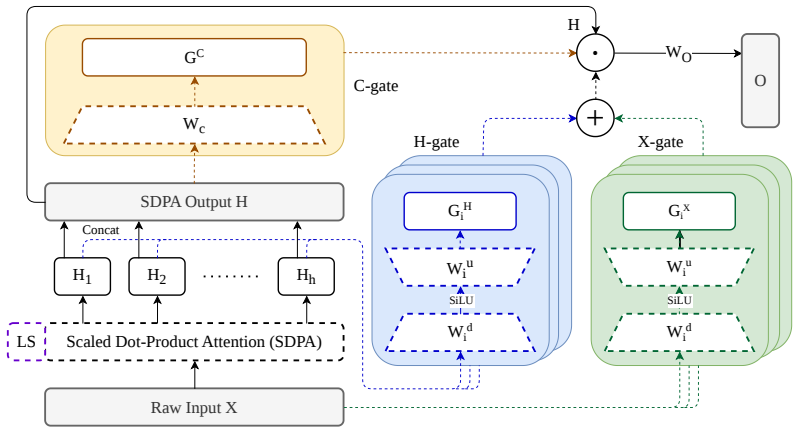
The central mechanism is the three-gate design with additive gate fusion. The X-gate conditions on the raw input $X$ before the attention layer; the H-gate conditions on each head's scaled dot-product attention output $H_i$, carrying post-interaction context; and the C-gate maps the concatenated head outputs to one scalar per head, broadcasting it to give coarse head-level reweighting. Instead of multiplying the sigmoid outputs of multiple gates, HyGA adds their pre-activation logits and applies a single sigmoid, which the paper argues avoids excessive suppression of the output. Low-rank matrix factorization (a down-projection to an intermediate dimension $d_{\mathrm{int}}$ followed by an up-projection) is applied to both the X- and H-gate projections, allowing the maximum gate rank to control the computational cost. A learnable attention sink adds a learnable vector to the SDPA scores to absorb excess attention, further dampening attention sinks and massive activations.
What would settle it
Retrain Gated attention and HyGA on the same data with at least three random seeds per configuration and compare the spreads of final training loss and downstream averages; if the 0.012 loss gap and the roughly 1.5-point benchmark gap are within the seed-to-seed spread, the central claim is unsupported. As a second check, ablate the learnable attention sink and verify whether the remaining X-, H-, and C-gates alone still lower late-layer BOS-token scores, since the paper credits the sink for much of the stability effect.
Extended reading notes
Core claim
On the paper's own terms, the central discovery is that gating with multiple sources of information—before attention, after attention, and across heads—extends the effectiveness–efficiency Pareto frontier of Gated attention. Concretely, on a 5B-parameter MoE model with MLA trained on 500B tokens, HyGA reaches a final training loss about 0.012 lower than Gated attention and improves the average across 14 benchmarks from 40.70 to 42.23, with gains on most tasks. On a 0.6B dense GQA model trained on 200B tokens, HyGA raises the six-benchmark average from 29.44 to 30.56 while avoiding the loss spikes seen in the Gated baseline. The paper further reports that with an intermediate dimension of $d_{\mathrm{int}}=32$, HyGA uses roughly 26% of Gated attention's gating parameters while achieving slightly lower training loss, and that the learnable attention sink reduces BOS-token attention scores and massive activations, indicating more stable training.
Load-bearing premise
The load-bearing premise is that the reported improvements are larger than run-to-run noise: every configuration was trained once, and if retraining with a different random seed changes a 500B-token training loss by as much as the claimed 0.012 advantage, the central comparison could flip.
Editorial extensions
If this is right
- On MoE-5B, HyGA's average across 14 benchmarks rises from 40.70 to 42.23 while final training loss drops by about 0.012.
- With $d_{\mathrm{int}}=32$, HyGA achieves slightly better training loss than Gated attention using about 26% of its gating parameters, showing the Pareto frontier is extended.
- On dense GQA (Qwen3-0.6B), HyGA improves the six-benchmark average from 29.44 to 30.56 and shows no loss spikes at the same learning rate where Gated GQA spikes.
- Ablations attribute steady gains to each component: +0.24% average from the learnable sink, +1.21% from the H-gate, and +1.53% when the C-gate and gate fusion are included.
- Layer-wise BOS-token scores fall substantially in late layers with the learnable sink, a sign that HyGA mitigates the attention-sink phenomenon more thoroughly than Gated attention.
Reading between the lines
- If the H-gate's benefit stems from conditioning on post-attention features, the same principle could apply to other attention families: gating on intermediate states such as value states or the KV latent may add complementary control in linear or sparse attention.
- The additive fusion of gate logits before one sigmoid suggests a broader design pattern: treating multiple gates as contributions to a single logit rather than as independent multipliers may preserve information flow when many gates stack.
- Because the C-gate produces a single scalar per head, its scores could double as a cheap measure of head importance, potentially enabling dynamic head pruning or routing without extra computation.
- The low-rank result predicts a scaling trend worth testing: as model width grows, the optimal gate rank for two synchronized gates may fall below that for a single gate, making hybrid gating increasingly cost-competitive at scale.
Signed reviews
Editorial analysis
A structured set of objections, weighed in public.
Referee Report
Summary. The paper proposes Hybrid Gated Attention (HyGA), which augments Gated attention with three coordinated gates: an X-gate conditioned on the raw input, an H-gate conditioned on the SDPA output, and a C-gate performing cross-head reweighting. It further introduces low-rank factorization of the element-wise gates and a learnable attention sink for efficiency and stability. The authors evaluate HyGA on a 5B-parameter MoE model with MLA (500B tokens) and a 0.6B dense GQA model (200B tokens), reporting lower training loss, higher scores on 14 (or 6) benchmarks, improved training stability, and an extended effectiveness-efficiency frontier.
Significance. If the reported gains are real, HyGA would extend the effectiveness-efficiency frontier of Gated attention, a plausible and practically useful contribution. The architecture is clearly specified, the ablation shows monotonic gains on 14 benchmarks, and the evaluation spans two modern backbones. The main limitations are the lack of variance estimates, the confounding X-gate upgrade, and the missing low-rank control in the efficiency comparison; these are addressable but currently leave the core claims under-supported. The paper does not mention code or model release, which would aid reproducibility.
major comments (3)
- [§4.2, Tables 1–2, Figure 3] All comparative claims rest on single training runs per configuration, without error bars or multiple seeds. The average benchmark gain on MoE-5B is 1.53 points (42.23 vs 40.70), but several per-task gains are small (e.g., CMMLU +0.14, SIQA +0.41, HellaSwag +0.26), and the training-loss advantage at 60k steps is about 0.012. In 200B–500B-token pretraining, run-to-run variance from data order, initialization, and optimizer noise can plausibly be of this magnitude, so the claimed comprehensive improvement in the Abstract is not yet distinguishable from noise. The stability observations in §4.5 (Figures 6–7) similarly rely on single trajectories and should be framed as preliminary.
- [§3.2, Eq. (5) vs Eq. (2)] In the main experiments, HyGA replaces the linear X-gate of Gated attention, σ(XW_i) in Eq. (2), with a two-layer SiLU MLP gate in Eq. (5), even when d_int = d. The ablation in §4.3 compares the original baseline (Eq. 2) with baseline + H-gate (Eq. 3), but never isolates the effect of changing the X-gate parameterization from linear to SiLU-MLP. Consequently, the improvement attributed to hybrid gating could partly stem from the more expressive X-gate, and the claim that each gate contributes distinct information is not cleanly established. An ablation with the SiLU-MLP X-gate alone (no H-gate, no C-gate) is needed.
- [§4.4, Figure 5] The efficiency experiment compares HyGA with low-rank X/H gates at d_int=32, using approximately 26% of Gated attention's gating parameters, only against full-rank Gated attention. There is no low-rank Gated attention baseline matched for parameter count (e.g., the same SiLU MLP X-gate with d_int=32 but no H-gate). Therefore, the reported Pareto-frontier advantage may reflect low-rank compression per se rather than hybrid gating. In addition, the Abstract's claim of 'best performance at different computation costs' is strong given that no other gated attention variants are compared at matched costs.
minor comments (7)
- [§3.4] The learnable attention sink is motivated by GPT-OSS but its implementation is not described; please provide the formula or a precise description of how it is integrated into the SDPA in Eq. (1), and how it interacts with the gating operations.
- [§4.3 / Figure 4] The caption reports sequential gains (+0.24% → +1.21% → +1.53%) but does not define the component set for each step; please spell out exactly which of {learnable sink, X-gate, H-gate, C-gate, gate fusion} are present in each variant, and indicate at which step the SiLU MLP X-gate is introduced.
- [§3.2, Eq. (5)] Please state the dimensions of all matrices in Eq. (5), such as W_i^d ∈ R^(d×d_int), W_i^u ∈ R^(d_int×d), and the corresponding barred matrices, to aid reproducibility.
- [§4.1 / Figure 3] Please specify the token-to-step relationship (batch size, sequence length) so that '60k steps' can be mapped to the reported '500B tokens'.
- [Table 1] GPQA-D results (13–15%) are near random guessing; the reported improvement there should be interpreted with caution, and confidence intervals would help across all tasks.
- [§4.4] The sentence 'its does not bring in many additional parameters' contains a typo; it should read 'it does not bring in many additional parameters'.
- [Figure 5] The caption does not state the axes of the Pareto plot; please indicate whether the y-axis is final training loss or average benchmark score and how computation cost is measured.
Circularity Check
No circularity: HyGA's claims are empirical architecture comparisons against external baselines and benchmarks, with no fitted parameter renamed as a prediction or self-citation chain doing load-bearing work.
full rationale
The paper's central claims are empirical: HyGA is an architecture specified by Eqs. (3)–(6), and its effectiveness is evaluated by training loss curves and 14 external benchmarks against Gated attention on MLA and GQA backbones. No equation defines a prediction in terms of a fitted constant, and no reported quantity is constructed from the benchmark scores it is said to predict. The low-rank intermediate dimension d_int is a design knob chosen for compression, not a parameter fitted to target outcomes; the paper evaluates several values and reports the resulting Pareto trade-off rather than reverse-engineering a value to match a claimed result. The learnable attention sink is adopted from an independent external citation (GPT-OSS) and is analyzed empirically for sink ratios and training stability. No uniqueness theorem is invoked, and no load-bearing claim is justified solely by a self-citation whose content is assumed rather than demonstrated. The main weaknesses identified by the skeptic—single training runs without error bars and the absence of a matched low-rank Gated attention control in the efficiency comparison—are experimental robustness concerns, not circularity under the required criteria. Accordingly, the derivation chain is self-contained with respect to the circularity definitions, and no circular step can be exhibited from the paper's own equations or citations.
Assumptions & free parameters
free parameters (1)
- d_int (intermediate dimension of low-rank gates) =
192 (full width), 64, 32, 16
assumptions (4)
- domain assumption The 14 benchmark suites are reliable indicators of LLM capability.
- domain assumption The Gated Attention baseline is a faithful implementation matching the original method.
- domain assumption Single-run training curves and scores are representative of model quality.
- domain assumption The learnable attention sink from GPT-OSS transfers correctly to HyGA.
Cite this review
Pith. "Pith review of Hybrid Gated Attention." pith.science (2026). https://pith.science/paper/CC4B4BRZ
@misc{pith2026260811805,
  author       = {Pith},
  title        = {Pith review of: Hybrid Gated Attention},
  year         = {2026},
  howpublished = {\url{https://pith.science/paper/CC4B4BRZ}},
  note         = {Machine review of arXiv:2608.11805}
}
read the original abstract
Gated attention is an effective approach to mitigate attention sinks and enhance the representational capacity of attention. To further extend its effectiveness-efficiency Pareto frontier, we propose a Hybrid Gated Attention (HyGA) framework that contains three types of gating strategies. Specifically, these gates leverage diverse information from multiple stages of attention, and collaboratively build element-wise/head-wise gating from multiple perspectives, capturing intra-head and cross-head information interactions. Through our hybrid gating components, HyGA could provide multi-source modulation signals, enabling more comprehensive control over information flow and improving the representational capacity of attention. We also introduce low-rank matrix decomposition and learnable attention sink to further enhance training efficiency and stability. In experiments, we evaluate HyGA on widely-used benchmarks based on different backbones. The experimental results show that our HyGA comprehensively improves both training loss and various downstream performances compared with Gated attention. HyGA has also been verified to achieve the best performance at different computation costs, with comprehensive model analyses for better understanding. The proposed HyGA sheds light on a more effective, efficient, and stable attention mechanism.
Figures


Figures from the paper (4 more)


Reference graph
Works this paper leans on
- [1]
-
[2]
Gqa: Training generalized multi-query transformer models from multi-head checkpoints , author=. Proceedings of EMNLP , year=
-
[3]
arXiv preprint arXiv:2405.04434 , year=
Deepseek-v2: A strong, economical, and efficient mixture-of-experts language model , author=. arXiv preprint arXiv:2405.04434 , year=
-
[4]
Gated attention for large language models: Non-linearity, sparsity, and attention-sink-free , author=. Advances in NIPS , year=
-
[5]
Efficient streaming language models with attention sinks , author=. Proceedings of ICLR , year=
-
[6]
Sigmoid-weighted linear units for neural network function approximation in reinforcement learning , author=. Neural networks , year=
-
[7]
arXiv preprint arXiv:2002.05202 , year=
Glu variants improve transformer , author=. arXiv preprint arXiv:2002.05202 , year=
arXiv 2002
-
[8]
arXiv preprint arXiv:2508.10925 , year=
gpt-oss-120b & gpt-oss-20b model card , author=. arXiv preprint arXiv:2508.10925 , year=
Show all 46 references
-
[9]
arXiv preprint arXiv:2401.04088 , year=
Mixtral of experts , author=. arXiv preprint arXiv:2401.04088 , year=
-
[10]
arXiv preprint arXiv:2505.09388 , year=
Qwen3 technical report , author=. arXiv preprint arXiv:2505.09388 , year=
-
[11]
arXiv preprint arXiv:1711.05101 , year=
Decoupled weight decay regularization , author=. arXiv preprint arXiv:1711.05101 , year=
-
[12]
2024 , url =
Keller Jordan and Yuchen Jin and Vlado Boza and Jiacheng You and Franz Cesista and Laker Newhouse and Jeremy Bernstein , title =. 2024 , url =
2024
-
[13]
Neural computation , year=
Long short-term memory , author=. Neural computation , year=
-
[14]
Proceedings of EMNLP , year=
Learning phrase representations using RNN encoder--decoder for statistical machine translation , author=. Proceedings of EMNLP , year=
-
[15]
ICML , year=
Language modeling with gated convolutional networks , author=. ICML , year=
-
[16]
arXiv preprint arXiv:2312.06635 , year=
Gated linear attention transformers with hardware-efficient training , author=. arXiv preprint arXiv:2312.06635 , year=
-
[17]
ICLR , year=
Gated delta networks: Improving mamba2 with delta rule , author=. ICLR , year=
-
[18]
arXiv preprint arXiv:2510.09017 , year=
Value-State Gated Attention for Mitigating Extreme-Token Phenomena in Transformers , author=. arXiv preprint arXiv:2510.09017 , year=
-
[19]
arXiv preprint arXiv:2402.19427 , year=
Griffin: Mixing gated linear recurrences with local attention for efficient language models , author=. arXiv preprint arXiv:2402.19427 , year=
-
[20]
arXiv preprint arXiv:2009.03300 , year=
Measuring massive multitask language understanding , author=. arXiv preprint arXiv:2009.03300 , year=
2009 arXiv
-
[21]
Findings of ACL , year=
Cmmlu: Measuring massive multitask language understanding in chinese , author=. Findings of ACL , year=
-
[22]
Proceedings of ACL , year=
Hellaswag: Can a machine really finish your sentence? , author=. Proceedings of ACL , year=
-
[23]
Advances in NIPS , year=
C-eval: A multi-level multi-discipline chinese evaluation suite for foundation models , author=. Advances in NIPS , year=
-
[24]
arXiv preprint arXiv:2110.14168 , year=
Training verifiers to solve math word problems , author=. arXiv preprint arXiv:2110.14168 , year=
-
[25]
arXiv preprint arXiv:2108.07732 , year=
Program synthesis with large language models , author=. arXiv preprint arXiv:2108.07732 , year=
-
[26]
Advances in NIPS , year=
Is your code generated by chatgpt really correct? rigorous evaluation of large language models for code generation , author=. Advances in NIPS , year=
-
[27]
arXiv preprint arXiv:1803.05457 , year=
Think you have solved question answering? try arc, the ai2 reasoning challenge , author=. arXiv preprint arXiv:1803.05457 , year=
-
[28]
arXiv preprint arXiv:2103.03874 , year=
Measuring mathematical problem solving with the math dataset , author=. arXiv preprint arXiv:2103.03874 , year=
-
[29]
arXiv preprint arXiv:2311.12022 , year=
Gpqa: A graduate-level google-proof q&a benchmark , author=. arXiv preprint arXiv:2311.12022 , year=
-
[30]
Proceedings of AAAI , year=
Piqa: Reasoning about physical commonsense in natural language , author=. Proceedings of AAAI , year=
-
[31]
Transactions of the ACL , year=
Natural questions: a benchmark for question answering research , author=. Transactions of the ACL , year=
-
[32]
Findings of NAACL , year=
Agieval: A human-centric benchmark for evaluating foundation models , author=. Findings of NAACL , year=
-
[33]
Proceedings of ACL , year=
Triviaqa: A large scale distantly supervised challenge dataset for reading comprehension , author=. Proceedings of ACL , year=
-
[34]
Proceedings of EMNLP-IJCNLP , year=
Social IQa: Commonsense reasoning about social interactions , author=. Proceedings of EMNLP-IJCNLP , year=
-
[35]
arXiv preprint arXiv:2604.10098 , year=
Attention sink in transformers: A survey on utilization, interpretation, and mitigation , author=. arXiv preprint arXiv:2604.10098 , year=
-
[36]
ICLR , year=
When attention sink emerges in language models: An empirical view , author=. ICLR , year=
-
[37]
arXiv preprint arXiv:2504.02732 , year=
Why do LLMs attend to the first token? , author=. arXiv preprint arXiv:2504.02732 , year=
-
[38]
arXiv preprint arXiv:2111.00396 , year=
Efficiently modeling long sequences with structured state spaces , author=. arXiv preprint arXiv:2111.00396 , year=
-
[39]
arXiv preprint arXiv:2312.00752 , year=
Mamba: Linear-time sequence modeling with selective state spaces , author=. arXiv preprint arXiv:2312.00752 , year=
-
[40]
arXiv preprint arXiv:2405.21060 , year=
Transformers are ssms: Generalized models and efficient algorithms through structured state space duality , author=. arXiv preprint arXiv:2405.21060 , year=
-
[41]
arXiv preprint arXiv:2601.22966 , year=
A Unified View of Attention and Residual Sinks: Outlier-Driven Rescaling is Essential for Transformer Training , author=. arXiv preprint arXiv:2601.22966 , year=
-
[42]
ICLR , year=
Forgetting transformer: Softmax attention with a forget gate , author=. ICLR , year=
-
[43]
2: Pushing the frontier of open large language models , author=
Deepseek-v3. 2: Pushing the frontier of open large language models , author=. arXiv preprint arXiv:2512.02556 , year=
-
[44]
arXiv preprint arXiv:2606.19348 , year=
Deepseek-v4: Towards highly efficient million-token context intelligence , author=. arXiv preprint arXiv:2606.19348 , year=
-
[45]
Proceedings of ACL , year=
Native sparse attention: Hardware-aligned and natively trainable sparse attention , author=. Proceedings of ACL , year=
-
[46]
arXiv preprint arXiv:2603.05498 , year=
The spike, the sparse and the sink: Anatomy of massive activations and attention sinks , author=. arXiv preprint arXiv:2603.05498 , year=
Reviewed August 16, 2026 · model on record in the stance chip above.
Discussion (0). Continue with ORCID to comment.