REVIEW 4 major objections 6 minor 62 references
Surfsvr: 2D Surface Priors as 3D Geometric Regularizers for Sparse Voxel Reconstruction
T0 review · 4 major / 6 minor · reviewed 2026-08-16 · deepseek-v4-flash
Pith's one-line read SurfSVR claims that replacing pixel-wise geometric priors with coherent 2D surface regions—fit as planar or quadratic inverse-depth polynomials and lifted into 3D as explicit constraints—improves sparse voxel reconstruction, achieving…
desk verdict Solid surface-region regularization paper with a genuinely useful idea; missing metric-alignment and monocular-estimator details block independent reimplementation as written, but the core is sound and fixable. read the letter →
The pith
A machine-rendered reading of the paper's core claim, the machinery that carries it, and where it could break.
The reading
What carries the argument
The central object is the fitted low-order inverse-depth surface region: each refined superpixel R is represented by $s_R(p) = \theta_R^T \phi_k(\tilde{p})$ with normalized coordinates $\tilde{p} = (p - \mu_R)/\sigma_R$ and a planar ($\phi_1 = [1,x,y]$) or quadratic ($\phi_2 = [1,x,y,x^2,xy,y^2]$) basis, chosen by fitting reliability and geometric complexity with RANSAC and Tukey-biweight IRLS, with confidence $c_R = r_R \exp(-e_R/\tau_e) \min(1, n_R/\tau_n)$. What carries the argument is the lift of these regions to 3D: every voxel receives a class vote $\ell(x) \in \{\text{plane}, \text{quadratic}, \text{complex}, \text{unknown}\}$ from the views in which it projects, and that class gates the maximum octree level, subdivision priority, pruning protection, and the late-stage consensus filter. The losses $L_d$, $L_{\text{sub}}$, $L_n$, and $L_{\text{cov}}$ then supervise the voxel field at continuous coordinates using the same region parameters, so the polynomial surfaces act as persistent regularizers throughout optimization rather than one-off supervision signals.
What would settle it
Take a DTU scan the paper reports (for example scan 63) and rerun the pipeline with the monocular depth priors deliberately corrupted by a 3% global scale error after the alignment step; if the final Chamfer distance shifts by less than the reported 0.02 margin over GeoSVR, the regularizer absorbs prior error, while a shift several times that margin would show the method's gains depend on the undocumented alignment.
Extended reading notes
Core claim
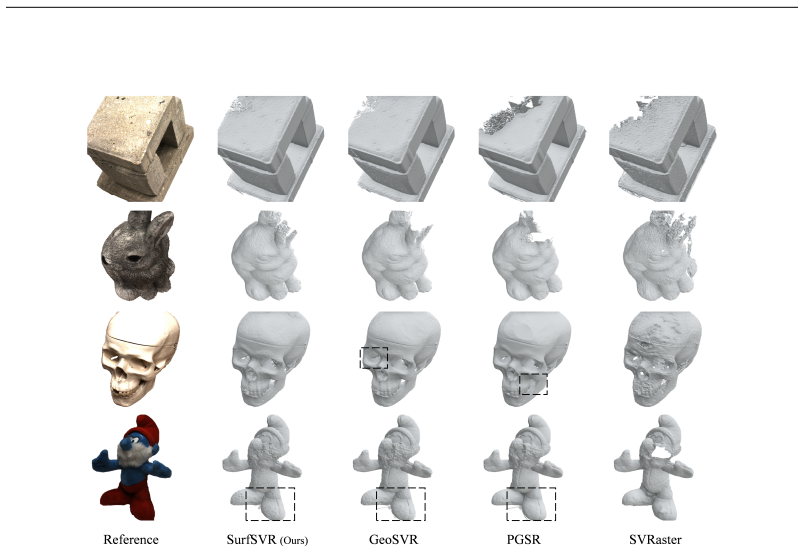
In the paper's own terms, the central claim is that a 2D surface prior organized into coherent regions is the right interface between image-space foundation-model predictions and 3D sparse voxel geometry. Rather than penalizing pixels against raw monocular depth, SurfSVR first fits each refined superpixel region R with an adaptively chosen polynomial model of inverse depth $s_R(p) = \theta^T \phi_k(\tilde{p})$, where $\phi_1=[1,x,y]$ is planar and $\phi_2$ adds $x^2, xy, y^2$, and only regions that satisfy reliability gates become geometric constraints. The fitted parameters yield continuous subpixel depth targets, camera-space normals, per-region confidence $c_R$, and a per-voxel surface class $\ell(x) \in \{\text{plane}, \text{quadratic}, \text{complex}, \text{unknown}\}$ obtained by cross-view voting. These classes then drive four concrete mechanisms: level-capped surface-adaptive subdivision, confidence-weighted log-depth plus normal plus coverage losses, conditional pruning protection for supported sparsely observed surfaces, and a free-space consensus filter that removes a voxel only when several reliable views vote it off-surface and no reliable view supports it. The reported headline result is a mean DTU Chamfer distance of 0.45 with best-or-tied numbers on 9 of 15 scans, a mean TnT F1 of 0.62, and rendering quality on Mip-NeRF 360 that stays competitive while geometry improves.
Load-bearing premise
The entire surface-region construction starts from monocular depth and normal predictions that undergo an undocumented 'Metric Depth Alignment' step, and if that alignment leaves a systematic bias on the test scenes, the region priors inject that bias directly into the voxel geometry.
Editorial extensions
If this is right
- Surface classes can gate octree subdivision autonomously, so voxel resolution is naturally conserved: flat regions stay coarse and complex regions keep the full budget.
- Confidence-weighted region-level depth supervision lets valid low-opacity surfaces receive geometry gradients, meaning thin and sparsely observed structures no longer depend solely on visibility statistics.
- The consensus free-space filter removes floaters while protecting supported geometry, making aggressive pruning safe without sacrificing thin structures.
- Because the priors provide continuous subpixel targets, geometry is supervised at arbitrary continuous image coordinates rather than only voxel or pixel centers, tightening the optimization.
- The framework transfers the same 2D surface construction to any voxel-based radiance field renderer, since the region votes operate on voxel centers and view projections independently of the specific rasterizer.
Reading between the lines
- The ablation stages suggest most of the gain comes from the continuous confidence-weighted supervision and the consensus floater removal (Rows B and D), while appearance-region fitting and cross-view evidence add only small margins; a cheap testable variant would keep only continuous pixel-level supervision from the same estimator and skip superpixels.
- The observation that 67% of DTU and 89% of TnT regions are planar hints that the quadratic branch is a safety net rather than the engine; replacing it with local subpatches of planar fits would test whether the reported gains survive without the extra polynomial.
- The same region-vote and consensus free-space removal idea could plausibly transfer to Gaussian surfel reconstruction, where floaters are a known artifact; the paper only applies it to sparse voxels, so that extension is untested.
- The paper does not ablate the unstated Metric Depth Alignment step, so its sensitivity to alignment bias is unknown; a direct probe would corrupt the aligned depths with a controlled global scale error and measure the resulting Chamfer shift.
Signed reviews
Editorial analysis
A structured set of objections, weighed in public.
Referee Report
Summary. The paper introduces SurfSVR, a sparse-voxel surface reconstruction method built on SVRaster and GeoSVR. It constructs 2D surface regions by refining appearance-based superpixels with monocular depth, normals, semantic boundaries, and cross-view geometric consistency, fits each region with an adaptively selected planar or quadratic inverse-depth model, and uses these fits to guide voxel subdivision, depth/normal/coverage supervision, pruning, and floater removal. Experiments on DTU, Tanks and Temples, and Mip-NeRF 360 report a mean DTU Chamfer distance of 0.45, a TnT F1-score of 0.62, and competitive rendering metrics, with ablations in Table 5 attributing the gains to the individual proposed components.
Significance. If the implementation details are fully specified, the core idea is a plausible and useful contribution: using coherent 2D surface regions rather than pixel-wise predictions as persistent 3D regularizers for sparse voxel reconstruction. The paper's strengths include evaluation on three established public benchmarks, an ablation design that isolates the contribution of each proposed mechanism, and a runtime (0.9 h on DTU) that is close to the base method. However, the manuscript as written is not independently testable because the monocular estimator, the metric alignment step, and many thresholds are either unnamed or deferred to a non-included supplement. The reported margins over the strongest baselines are also small, so the central state-of-the-art claim depends on specification and statistical care that the current text does not provide.
major comments (4)
- [§3.3 and Figure 2] The 'Metric Depth Alignment' step shown in Figure 2 is load-bearing but never defined in the text. Equations (3)–(4) fit inverse depths in what must be the COLMAP metric frame, and Eqs. (9), (12), and (15)–(17) use those fits as regression targets and free-space votes; if the monocular predictions are not correctly scaled and shifted, all of these constraints inherit a systematic error. The manuscript neither names the monocular depth/normal estimator nor states how scale and shift are recovered (e.g., least-squares fit to sparse SfM points, median ratio, or per-scene tuning). Because the reported DTU improvement over GeoSVR and AmbiSuR is only 0.01–0.02 Chamfer, the gains could in principle reflect the undocumented alignment and estimator choice rather than the proposed surface-regularization components. This specification must be supplied before the central claim can be evaluated.
- [§3.3] The geometry-aware region refinement is described only qualitatively. The text does not specify the thresholds for relative-depth jumps, normal discontinuities, semantic boundaries, or depth-validity transitions, nor the semantic model used to obtain those boundaries, nor the criteria for recursive division and merging, nor the rule for rejecting cross-view projected depth samples. Because the constructed 2D surface priors are the entire basis of the method, these details are needed in the paper or in a supplement; without them, the ablation results in Table 5 cannot be reproduced.
- [§3.5, §3.6, and Table 5] Many hyperparameters that determine the behavior of the proposed losses and filters are deferred: tau_e, tau_n (only the 128-sample reference is given), alpha*, lambda_d, lambda_s, lambda_n, lambda_c, eta(t), tau_s, tau_f, n_f, tau_r, and the level caps L_l. The ablations report small margins, for example DTU Chamfer 0.464 to 0.454 for floater suppression and 0.457 versus 0.454 for the cross-view evidence term. Without reporting these values and ideally some sensitivity analysis, the reader cannot determine whether the reported gains are robust or represent tuned operating points. The full set of parameters should be listed in the main text or a supplement.
- [§4.3 and Table 5] The paper reports no repeated-run statistics for any condition, yet several differences that support the central claims are very small. In Table 5, the full pipeline is 0.454 on DTU while the variant without cross-view surface evidence is 0.457, and the TnT F1 differences are 0.001–0.002 in several rows. In Table 1, the mean DTU Chamfer margin over AmbiSuR and GeoSVR is 0.01–0.02. A single training run per condition cannot establish that these differences are significant. The authors should state whether results are averaged over multiple runs and, if so, report the variance or per-seed values.
minor comments (6)
- [Table 2] The row label 'AmbiSuRM' in Table 2 is inconsistent with the text's reference to 'mono-AmbiSuR'; the method name should be identical in both places.
- [Figure 4 caption] The caption contains the typo 'visulization'; it should read 'visualization'.
- [References and §4.1] The reference to Gauen & Chan (2025) is listed as a 'prepint' (typo for 'preprint'), and Section 4.1 refers to 'BiST superpixels' without defining the acronym or tying it to the cited superpixel method.
- [Table 1] In the submitted text rendering, several entries in Table 1 appear concatenated without separators (e.g., the Geo-NeuS row contains '0.800.450.41' and the PGSR row contains similar concatenations); the table should be typeset with clear cell boundaries.
- [§3.5] Equation (10) samples continuous coordinates δ ~ U(-0.5,0.5)^2, but the text does not state how pixels near the region boundary are handled; this is a small but relevant detail for reproducing the subpixel supervision.
- [§4.1] The implementation details refer to an 'appearance loss from GeoSVR' without specifying its form; since the paper is built on GeoSVR, this loss should be identified explicitly or cited with equation numbers.
Circularity Check
No significant circularity: SurfSVR's priors are external inputs used as regularizers, and its evaluation is against external ground-truth benchmarks rather than derived from its own fitted parameters.
full rationale
SurfSVR is an empirical reconstruction pipeline rather than a derivation, and no load-bearing step reduces to its own inputs by construction. The surface priors are built from input images plus pre-trained monocular depth and normal predictions, with the fitted coefficients in Eq. (4) used as supervision targets in Eqs. (8)-(14) and as votes in Eqs. (15)-(18). These fitted coefficients are never re-labeled as predictions of the final reconstruction; the final mesh is optimized within the voxel field and compared against external DTU, Tanks and Temples, and Mip-NeRF 360 ground truth, so the reported Chamfer and F1 numbers are not forced by the fitting equations. GeoSVR is used as the base implementation and is re-run as a baseline, but it is not cited as a uniqueness theorem nor as the justification for the surface-prior ansatz. The manuscript's omissions, such as never naming the monocular depth estimator and never defining the 'Metric Depth Alignment' step shown in Figure 2, weaken reproducibility, but a missing specification is a correctness risk rather than circularity. No self-citation chain carries the central claim, and no equation is definitionally identical to another equation in the chain; accordingly, no circular step is identified.
Assumptions & free parameters
free parameters (8)
- support reference tau_n =
128
- fitting-error scale tau_e
- model selection criteria thresholds
- depth-supervision opacity floor
- coverage target opacity alpha_star
- floater suppression thresholds (tau_s, tau_f, n_f, tau_r)
- surface-class level caps L_l
- surface loss weights (lambda_d, lambda_s, lambda_n, lambda_c)
assumptions (5)
- domain assumption Monocular depth and normal predictions from pre-trained foundation models are accurate enough, after metric alignment, to define reliable surface regions.
- standard math Pinhole camera model and calibrated COLMAP poses are correct.
- domain assumption Low-order polynomial (planar/quadratic) inverse-depth models adequately represent the geometry of most surface regions.
- standard math RANSAC and Tukey-biweight IRLS converge to reliable fits for each region.
- domain assumption A voxel between the camera and a fitted surface is in free space.
Cite this review
Pith. "Pith review of Surfsvr: 2D Surface Priors as 3D Geometric Regularizers for Sparse Voxel Reconstruction." pith.science (2026). https://pith.science/paper/XKNE3JHJ
@misc{pith2026260811938,
  author       = {Pith},
  title        = {Pith review of: Surfsvr: 2D Surface Priors as 3D Geometric Regularizers for Sparse Voxel Reconstruction},
  year         = {2026},
  howpublished = {\url{https://pith.science/paper/XKNE3JHJ}},
  note         = {Machine review of arXiv:2608.11938}
}
read the original abstract
Sparse voxel reconstruction offers an efficient representation for high-fidelity 3D modeling, yet its geometry is commonly optimized from local photometric evidence and discrete visibility statistics. This often leads to fragmented surfaces, excessive subdivision, and floating artifacts, particularly in weakly textured or sparsely observed regions. We introduce SurfSVR, a novel sparse voxel reconstruction paradigm that treats 2D surface priors as explicit 3D geometric regularizers. Instead of directly lifting noisy pixel-wise depth predictions, SurfSVR first organizes each image into coherent surface regions by jointly reasoning over appearance, monocular depth, normals and cross-view geometry. Each region is then represented by an adaptively selected planar or quadratic surface model based on fitting reliability and geometric complexity, while cross-model agreement distinguishes reliable geometry from ambiguous predictions. These structured 2D priors are lifted into 3D and integrated throughout the reconstruction pipeline. They guide surface-adaptive voxel subdivision, provide region-level depth and normal supervision during optimization, enhance geometrically reliable sparse-observed surfaces in voxel pruning, and suppress off-surface floaters during post-refinement training. This unified design converts semantic and geometric coherence in image space into persistent structural constraints in 3D. Extensive experiments on 3 public benchmarks demonstrate that SurfSVR consistently improves sparse voxel reconstruction across scenes with substantially different visibility and geometry characteristics, achieving state-of-the-art reconstruction quality. Codes and models will be released soon.
Figures


Figures from the paper (1 more)

Reference graph
Works this paper leans on
-
[1]
and Tancik, Matthew and Barron, Jonathan T
Mildenhall, Ben and Srinivasan, Pratul P. and Tancik, Matthew and Barron, Jonathan T. and Ramamoorthi, Ravi and Ng, Ren , title =. Communications of the ACM , volume =
-
[2]
Instant Neural Graphics Primitives with a Multiresolution Hash Encoding , journal =
M. Instant Neural Graphics Primitives with a Multiresolution Hash Encoding , journal =
-
[3]
European Conference on Computer Vision , pages =
Chen, Anpei and Xu, Zexiang and Geiger, Andreas and Yu, Jingyi and Su, Hao , title =. European Conference on Computer Vision , pages =
-
[4]
Proceedings of the IEEE/CVF Conference on Computer Vision and Pattern Recognition , pages =
Fridovich-Keil, Sara and Yu, Alex and Tancik, Matthew and Chen, Qinhong and Recht, Benjamin and Kanazawa, Angjoo , title =. Proceedings of the IEEE/CVF Conference on Computer Vision and Pattern Recognition , pages =
-
[5]
Advances in Neural Information Processing Systems , volume =
Liu, Lingjie and Gu, Jiatao and Lin, Kyaw Zaw and Chua, Tat-Seng and Theobalt, Christian , title =. Advances in Neural Information Processing Systems , volume =
-
[6]
Proceedings of the IEEE/CVF International Conference on Computer Vision , pages =
Yu, Alex and Li, Ruilong and Tancik, Matthew and Li, Hao and Ng, Ren and Kanazawa, Angjoo , title =. Proceedings of the IEEE/CVF International Conference on Computer Vision , pages =
-
[7]
Proceedings of the IEEE/CVF Conference on Computer Vision and Pattern Recognition , pages =
Sun, Cheng and Sun, Min and Chen, Hwann-Tzong , title =. Proceedings of the IEEE/CVF Conference on Computer Vision and Pattern Recognition , pages =
-
[9]
Advances in Neural Information Processing Systems , volume =
Li, Jiahe and Zhang, Jiawei and Zhang, Youmin and Bai, Xiao and Zheng, Jin and Yu, Xiaohan and Gu, Lin , title =. Advances in Neural Information Processing Systems , volume =
Show all 62 references
-
[10]
Advances in Neural Information Processing Systems , volume =
Yariv, Lior and Gu, Jiatao and Kasten, Yoni and Lipman, Yaron , title =. Advances in Neural Information Processing Systems , volume =
-
[11]
Advances in Neural Information Processing Systems , volume =
Wang, Peng and Liu, Lingjie and Liu, Yuan and Theobalt, Christian and Komura, Taku and Wang, Wenping , title =. Advances in Neural Information Processing Systems , volume =
-
[12]
Neuralangelo: High-Fidelity Neural Surface Reconstruction , booktitle =
Li, Zhaoshuo and M. Neuralangelo: High-Fidelity Neural Surface Reconstruction , booktitle =
-
[13]
International Conference on Learning Representations , year =
Wu, Tong and Wang, Jiaqi and Pan, Xingang and Xu, Xudong and Theobalt, Christian and Liu, Ziwei and Lin, Dahua , title =. International Conference on Learning Representations , year =
-
[14]
ACM Transactions on Graphics , volume =
Kerbl, Bernhard and Kopanas, Georgios and Leimk. ACM Transactions on Graphics , volume =
-
[15]
Proceedings of the IEEE/CVF Conference on Computer Vision and Pattern Recognition , pages =
Gu. Proceedings of the IEEE/CVF Conference on Computer Vision and Pattern Recognition , pages =
-
[16]
ACM SIGGRAPH 2024 Conference Papers , pages =
Dai, Pinxuan and Xu, Jiamin and Xie, Wenxiang and Liu, Xinguo and Wang, Huamin and Xu, Weiwei , title =. ACM SIGGRAPH 2024 Conference Papers , pages =
2024
-
[17]
ACM SIGGRAPH 2024 Conference Papers , pages =
Huang, Binbin and Yu, Zehao and Chen, Anpei and Geiger, Andreas and Gao, Shenghua , title =. ACM SIGGRAPH 2024 Conference Papers , pages =
2024
-
[18]
ACM Transactions on Graphics , volume =
Yu, Zehao and Sattler, Torsten and Geiger, Andreas , title =. ACM Transactions on Graphics , volume =
-
[19]
Advances in Neural Information Processing Systems , volume =
Yu, Mulin and Lu, Tao and Xu, Linning and Jiang, Lihan and Xiangli, Yuanbo and Dai, Bo , title =. Advances in Neural Information Processing Systems , volume =
-
[20]
ACM Transactions on Graphics , volume =
Lyu, Xiaoyang and Sun, Yang-Tian and Huang, Yi-Hua and Wu, Xiuzhe and Yang, Ziyi and Chen, Yilun and Pang, Jiangmiao and Qi, Xiaojuan , title =. ACM Transactions on Graphics , volume =
-
[21]
IEEE Transactions on Visualization and Computer Graphics , volume =
Chen, Danpeng and Li, Hai and Ye, Weicai and Wang, Yifan and Xie, Weijian and Zhai, Shangjin and Wang, Nan and Liu, Haomin and Bao, Hujun and Zhang, Guofeng , title =. IEEE Transactions on Visualization and Computer Graphics , volume =. doi:10.1109/TVCG.2024.3494046 , year =
-
[22]
European Conference on Computer Vision , pages =
Wolf, Yaniv and Bracha, Amit and Kimmel, Ron , title =. European Conference on Computer Vision , pages =. doi:10.1007/978-3-031-73024-5\_13 , year =
-
[23]
Proceedings of the IEEE/CVF International Conference on Computer Vision , pages =
Eftekhar, Ainaz and Sax, Alexander and Malik, Jitendra and Zamir, Amir , title =. Proceedings of the IEEE/CVF International Conference on Computer Vision , pages =
-
[24]
Advances in Neural Information Processing Systems , volume =
Yang, Lihe and Kang, Bingyi and Huang, Zilong and Zhao, Zhen and Xu, Xiaogang and Feng, Jiashi and Zhao, Hengshuang , title =. Advances in Neural Information Processing Systems , volume =
-
[25]
Proceedings of the IEEE/CVF Conference on Computer Vision and Pattern Recognition , pages =
Wang, Jianyuan and Chen, Minghao and Karaev, Nikita and Vedaldi, Andrea and Rupprecht, Christian and Novotn. Proceedings of the IEEE/CVF Conference on Computer Vision and Pattern Recognition , pages =. doi:10.1109/CVPR52734.2025.00499 , year =
-
[26]
Advances in Neural Information Processing Systems , volume =
Yu, Zehao and Peng, Songyou and Niemeyer, Michael and Sattler, Torsten and Geiger, Andreas , title =. Advances in Neural Information Processing Systems , volume =
-
[27]
European Conference on Computer Vision , pages =
Wang, Jiepeng and Wang, Peng and Long, Xiaoxiao and Theobalt, Christian and Komura, Taku and Liu, Lingjie and Wang, Wenping , title =. European Conference on Computer Vision , pages =
-
[28]
Advances in Neural Information Processing Systems , volume =
Fu, Qiancheng and Xu, Qingshan and Ong, Yew-Soon and Tao, Wenbing , title =. Advances in Neural Information Processing Systems , volume =
-
[29]
Advances in Neural Information Processing Systems , volume =
Chen, Hanlin and Wei, Fangyin and Li, Chen and Huang, Tianxin and Wang, Yunsong and Lee, Gim Hee , title =. Advances in Neural Information Processing Systems , volume =
-
[30]
arXiv preprint arXiv:2411.16898 , year =
Li, Kunyi and Niemeyer, Michael and Chen, Zeyu and Navab, Nassir and Tombari, Federico , title =. arXiv preprint arXiv:2411.16898 , year =
-
[31]
Large Scale Multi-View Stereopsis Evaluation , booktitle =
Jensen, Rasmus and Dahl, Anders and Vogiatzis, George and Tola, Engin and Aan. Large Scale Multi-View Stereopsis Evaluation , booktitle =
-
[32]
ACM Transactions on Graphics , volume =
Knapitsch, Arno and Park, Jaesik and Zhou, Qian-Yi and Koltun, Vladlen , title =. ACM Transactions on Graphics , volume =
-
[33]
and Mildenhall, Ben and Verbin, Dor and Srinivasan, Pratul P
Barron, Jonathan T. and Mildenhall, Ben and Verbin, Dor and Srinivasan, Pratul P. and Hedman, Peter , title =. Proceedings of the IEEE/CVF Conference on Computer Vision and Pattern Recognition , pages =
-
[34]
, title =
Bae, Gwangbin and Davison, Andrew J. , title =. Proceedings of the IEEE/CVF Conference on Computer Vision and Pattern Recognition , pages =
-
[35]
European Conference on Computer Vision , pages =
Fu, Xiao and Yin, Wei and Hu, Mu and Wang, Kaixuan and Ma, Yuexin and Tan, Ping and Shen, Shaojie and Lin, Dahua and Long, Xiaoxiao , title =. European Conference on Computer Vision , pages =
-
[36]
Depth Pro: Sharp Monocular Metric Depth in Less Than a Second , journal =
Bochkovskii, Aleksei and Delaunoy, Ama. Depth Pro: Sharp Monocular Metric Depth in Less Than a Second , journal =
-
[37]
Proceedings of the IEEE/CVF International Conference on Computer Vision , pages =
Hu, Wenbo and Wang, Yuling and Ma, Lin and Yang, Bangbang and Gao, Lin and Liu, Xiao and Ma, Yuewen , title =. Proceedings of the IEEE/CVF International Conference on Computer Vision , pages =
-
[38]
Proceedings of the IEEE/CVF Conference on Computer Vision and Pattern Recognition , pages =
Lu, Tao and Yu, Mulin and Xu, Linning and Xiangli, Yuanbo and Wang, Limin and Lin, Dahua and Dai, Bo , title =. Proceedings of the IEEE/CVF Conference on Computer Vision and Pattern Recognition , pages =
-
[39]
IEEE Transactions on Pattern Analysis and Machine Intelligence , pages =
Ren, Kerui and Jiang, Lihan and Lu, Tao and Yu, Mulin and Xu, Linning and Ni, Zhangkai and Dai, Bo , title =. IEEE Transactions on Pattern Analysis and Machine Intelligence , pages =. doi:10.1109/TPAMI.2025.3568201 , year =
2025
-
[40]
Proceedings of the IEEE/CVF Conference on Computer Vision and Pattern Recognition , pages =
Yu, Zehao and Chen, Anpei and Huang, Binbin and Sattler, Torsten and Geiger, Andreas , title =. Proceedings of the IEEE/CVF Conference on Computer Vision and Pattern Recognition , pages =
-
[41]
Hartley, Richard and Zisserman, Andrew , title =
-
[42]
IEEE Transactions on Pattern Analysis and Machine Intelligence , volume =
Furukawa, Yasutaka and Ponce, Jean , title =. IEEE Transactions on Pattern Analysis and Machine Intelligence , volume =
-
[43]
IEEE Transactions on Image Processing , volume =
Shen, Shuhan , title =. IEEE Transactions on Image Processing , volume =
-
[44]
Proceedings of the IEEE Conference on Computer Vision and Pattern Recognition , pages =
Zheng, Enliang and Dunn, Enrique and Jojic, Vladimir and Frahm, Jan-Michael , title =. Proceedings of the IEEE Conference on Computer Vision and Pattern Recognition , pages =
-
[45]
Structure-from-Motion Revisited , booktitle =
Sch. Structure-from-Motion Revisited , booktitle =
-
[46]
Pixelwise View Selection for Unstructured Multi-View Stereo , booktitle =
Sch. Pixelwise View Selection for Unstructured Multi-View Stereo , booktitle =
-
[47]
Proceedings of the European Conference on Computer Vision , pages =
Yao, Yao and Luo, Zixin and Li, Shiwei and Fang, Tian and Quan, Long , title =. Proceedings of the European Conference on Computer Vision , pages =
-
[48]
Proceedings of the IEEE/CVF Conference on Computer Vision and Pattern Recognition , pages =
Park, Jeong Joon and Florence, Peter and Straub, Julian and Newcombe, Richard and Lovegrove, Steven , title =. Proceedings of the IEEE/CVF Conference on Computer Vision and Pattern Recognition , pages =
-
[49]
Advances in Neural Information Processing Systems , volume =
Yariv, Lior and Kasten, Yoni and Moran, Dror and Galun, Meirav and Atzmon, Matan and Ronen, Basri and Lipman, Yaron , title =. Advances in Neural Information Processing Systems , volume =
-
[50]
Proceedings of the IEEE/CVF International Conference on Computer Vision , pages =
Oechsle, Michael and Peng, Songyou and Geiger, Andreas , title =. Proceedings of the IEEE/CVF International Conference on Computer Vision , pages =
-
[51]
Advances in Neural Information Processing Systems , volume =
Wang, Yifan and Huang, Di and Ye, Weicai and Zhang, Guofeng and Ouyang, Wanli and He, Tong , title =. Advances in Neural Information Processing Systems , volume =
-
[52]
arXiv preprint arXiv:2312.00846 , year =
Chen, Hanlin and Li, Chen and Wang, Yunsong and Lee, Gim Hee , title =. arXiv preprint arXiv:2312.00846 , year =
-
[53]
arXiv preprint arXiv:2411.15723 , year =
Xu, Baixin and Hu, Jiangbei and Li, Jiaze and He, Ying , title =. arXiv preprint arXiv:2411.15723 , year =
-
[54]
Advances in Neural Information Processing Systems , volume =
Zhang, Wenyuan and Liu, Yu-Shen and Han, Zhizhong , title =. Advances in Neural Information Processing Systems , volume =
-
[55]
European Conference on Computer Vision , pages =
Wu, Qianyi and Zheng, Jianmin and Cai, Jianfei , title =. European Conference on Computer Vision , pages =
-
[56]
Improving Neural Implicit Surfaces Geometry with Patch Warping , booktitle =
Darmon, Fran. Improving Neural Implicit Surfaces Geometry with Patch Warping , booktitle =
-
[57]
Proceedings of the IEEE/CVF Winter Conference on Applications of Computer Vision , pages =
Chen, Decai and Zhang, Peng and Feldmann, Ingo and Schreer, Oliver and Eisert, Peter , title =. Proceedings of the IEEE/CVF Winter Conference on Applications of Computer Vision , pages =
-
[58]
European Conference on Computer Vision , pages =
Ren, Xinlin and Cao, Chenjie and Fu, Yanwei and Xue, Xiangyang , title =. European Conference on Computer Vision , pages =
-
[59]
Proceedings of the IEEE/CVF Conference on Computer Vision and Pattern Recognition , pages =
Li, Jiahe and Zhang, Jiawei and Bai, Xiao and Zheng, Jin and Ning, Xin and Zhou, Jun and Gu, Lin , title =. Proceedings of the IEEE/CVF Conference on Computer Vision and Pattern Recognition , pages =
-
[60]
Proceedings of the IEEE/CVF Winter Conference on Applications of Computer Vision , pages =
Turkulainen, Matias and Ren, Xuqian and Melekhov, Iaroslav and Seiskari, Otto and Rahtu, Esa and Kannala, Juho , title =. Proceedings of the IEEE/CVF Winter Conference on Applications of Computer Vision , pages =
-
[61]
CVPR , pages=
Stability-Driven Motion Generation for Object-Guided Human-Human Co-Manipulation , author=. CVPR , pages=
-
[62]
ICML , year =
Li, Jiahe and Zhang, Jiawei and Bai, Xiao and Zheng, Jin and Yu, Xiaohan and Gu, Lin and Lee, Gim Hee , title =. ICML , year =
-
[63]
prepint , year=
Bayesian-Inspired Space-Time Superpixels , author=. prepint , year=
Reviewed August 16, 2026 · model on record in the stance chip above.
Discussion (0). Continue with ORCID to comment.