REVIEW 3 major objections 6 minor 42 references
A Cascaded Unsupervised-Supervised NLP Pipeline for Detecting Accusatory Language in Public Procurement
T0 review · 3 major / 6 minor · reviewed 2026-08-16 · deepseek-v4-flash
Pith's one-line read A low-cost NLP pipeline can pick out whistleblowing comments in public procurement data, even when they are only 3% of the text.
desk verdict A useful applied NLP paper whose headline metrics are conditional on a label-selected cluster filter; end-to-end recall is closer to 0.78 than 0.91. read the letter →
The pith
A machine-rendered reading of the paper's core claim, the machinery that carries it, and where it could break.
The reading
What carries the argument
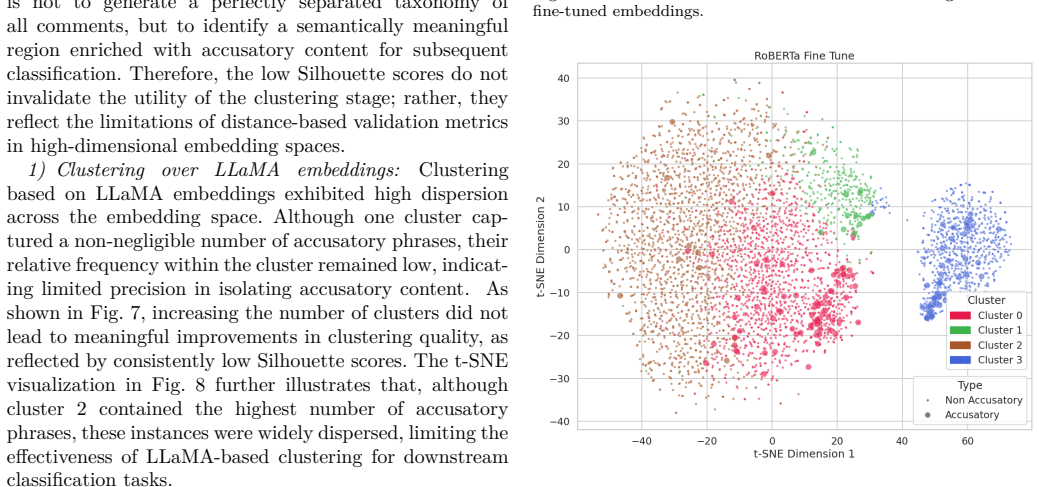
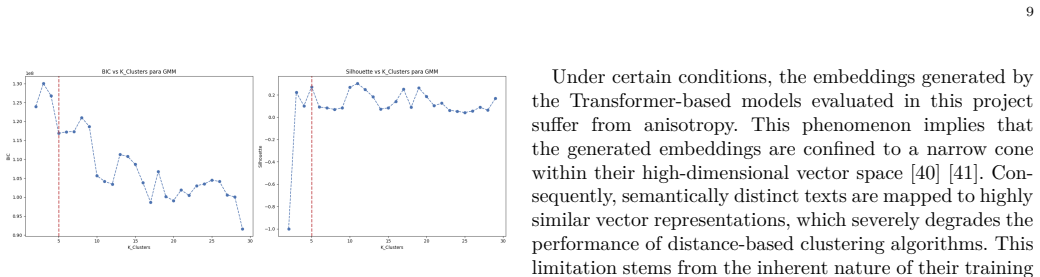
The load-bearing mechanism is the cascade itself: domain-trained Word2Vec embeddings (a shallow neural word-embedding model trained directly on the procurement corpus) are averaged over each comment, grouped by a Gaussian Mixture Model into clusters, and a keyword heuristic selects the single most accusatory cluster; a Random Forest classifier with SMOTE is then trained and applied only to that cluster. The mechanism works because the Word2Vec space is more isotropic than the Transformer spaces, so distance-based clustering separates the rare accusatory pattern from the bulk of routine comments.
What would settle it
Annotate a random sample of the 1,892 unlabeled comments the model flags as accusatory: if the observed precision falls well below the claimed 0.84, or if the five keywords stop concentrating in a single Word2Vec+GMM cluster when the pipeline is retrained on a new batch of procurement comments, the central claim fails.
Extended reading notes
Core claim
In the paper's own terms, the discovery is that a domain-trained Word2Vec embedding, combined with Gaussian Mixture Model clustering and a Random Forest classifier, outperforms Transformer-based embeddings for detecting accusatory language in short, noisy, user-generated procurement questions. The decisive empirical pattern is that clustering first, then classifying only the selected cluster, turns a severely imbalanced task into a tractable one: the Word2Vec+GMM step concentrates 122 of 143 accusatory phrases into one cluster, and Random Forest with SMOTE on that filtered set reaches precision 0.84, recall 0.91, and F1 0.87. The same keyword-based cluster selection appears to generalize from the labeled corpus to the unlabeled corpus, which supports the paper's semi-supervised claim.
Load-bearing premise
The pipeline stands on the assumption that in the unlabeled corpus the cluster with the most occurrences of at least four of five accusation keywords is the same kind of accusation-rich cluster found in the labeled data; if the unlabeled comments use those words in different proportions, the filter selects the wrong cluster and the reported precision and recall no longer apply.
Editorial extensions
If this is right
- Without any GPU, the full pipeline trains in about 11 minutes for the best configuration, and single predictions take 1-3 seconds, so continuous monitoring of procurement comments is feasible for oversight bodies.
- Cluster filtering cuts the training set from 4,841 to 962 samples while retaining 122 of 143 accusatory phrases, shrinking compute and improving class balance at once.
- The same keyword-based cluster identification applied to 92,579 unlabeled comments finds 1,892 candidate accusatory comments, a similar proportion to the labeled set, suggesting the approach transfers to unseen data.
- Because the pipeline is embedding- and model-agnostic, it can be ported to other Latin American procurement systems whenever structured Q&A comments are accessible, though zero-shot validation remains future work.
Reading between the lines
- If the pipeline's precision holds on live deployment, the same cascade could be repurposed for other rare classes in noisy user text, such as hate speech, safety incident reports, or discrimination complaints, where only a small labeled seed exists.
- The five-keyword heuristic is itself a testable design choice; a learned cluster-description step could make the method robust to vocabulary drift or to indirect language, which the paper acknowledges it currently misses.
- The near-identical proportions of accusations in the labeled and unlabeled clusters could support an early-warning audit tool that flags procurement processes with unusually many predicted accusatory comments, a use the paper only gestures at.
- A direct cross-country test on Chile or Costa Rica would isolate how much of the result depends on Ecuadorian lexical conventions; the paper's own survey suggests data availability, not modeling, is the main barrier.
Signed reviews
Editorial analysis
A structured set of objections, weighed in public.
Referee Report
Summary. The paper proposes a cascaded NLP pipeline for detecting accusatory or whistleblowing-style comments in Ecuador's public procurement system (SOCE). The pipeline embeds procurement comments with domain-trained Word2Vec, clusters them with a Gaussian Mixture Model, identifies the most accusatory cluster using a keyword-based heuristic, and then trains a Random Forest classifier (with SMOTE) on the cluster-filtered labeled subset. The authors compare Word2Vec against LLaMA and RoBERTa embeddings, report that Word2Vec+GMM gives the best cluster enrichment, and claim a precision of 0.84 and recall of 0.91 for the accusatory class. They also report a manual validation on unlabeled predictions, an analysis of computational efficiency, and a qualitative cross-country data-availability review for Latin America.
Significance. If the reported performance held end-to-end, this would be a practically useful, lightweight contribution to a real governance problem: detecting irregularity signals in public procurement with modest computational resources. The paper has concrete strengths: it ships reproducible code, it includes a manual validation of unlabeled predictions that partially addresses the precision question, and it provides a coherent comparison of embedding strategies with a clear discussion of anisotropy (Table V). The significance is, however, substantially tempered by the fact that the headline numbers are measured only on the cluster-filtered subset, not on the full labeled dataset, so the current framing overstates the pipeline's recall. The central idea is defensible, but the reporting and validation design need revision.
major comments (3)
- [Section III-D, Table VIII; Abstract; Section I (Contributions)] The reported precision of 0.84 and recall of 0.91 for Random Forest+SMOTE are measured only on the 962 rows inside the keyword-selected cluster, not on the full 4,841-sample labeled dataset. Since the cluster filter retains only 122 of 143 accusatory phrases (Table IV, MNAPK=122, 85.31% of TNAP), the deployed pipeline's recall on the full labeled set is capped at 122/143, and with the classifier's 0.91 recall on the filtered set, the expected end-to-end recall is approximately 0.78, with an F1 of roughly 0.81 if precision is unchanged. The abstract and the contribution bullet presenting 'precision of 0.84 and recall of 0.91' without this caveat misrepresent the pipeline-level performance. The authors should either report pipeline-level metrics computed on the full labeled set or clearly distinguish conditional classifier metrics from end-to-end metrics throughout the paper.
- [Section II-C, Table IV; Section II-E] The clustering configuration (GMM, k=5, Word2Vec) is selected using MNAPK, a label-dependent metric applied to the supervised set, and the same supervised set is then filtered by the selected cluster and used to train and evaluate the classifier. This creates a selection bias: the cluster filter is chosen to maximize the concentration of positive labels, and the classifier's reported recall is then measured on that enriched subset. The paper does not address this bias, e.g., with nested cross-validation or a held-out labeled test set. The manual validation on unlabeled data provides an independent precision check, but it does not yield a recall estimate for the deployed pipeline. At minimum, the authors should report the classifier's performance on the full labeled dataset after applying the cluster filter fitted only on the training folds, or otherwise quantify the optimism in the reported metrics.
- [Section II-D, Tables VI and VII; Section III-E] The keyword-based cluster identification assumes that the cluster with the highest cumulative frequency of at least four of five keywords is the accusatory cluster, with keywords chosen 'based on domain expertise and exploratory analysis' on the same data. The paper shows that the keyword distributions are consistent between the labeled and unlabeled datasets, but it does not assess the sensitivity of downstream performance to an incorrect cluster choice. Since deployment on unlabeled data relies entirely on this heuristic identifying the correct cluster, the authors should provide a concrete robustness test, for example re-running the pipeline with the second-most-keyword-rich cluster and reporting the resulting precision and recall, or an ablation varying the 'at least four of five' threshold. Without this, the claim that the pipeline is robust when transferred to new unlabeled corpora is not fully supported.
minor comments (6)
- [Section III-E, Table IX] Table IX reports 1,892 candidates on the unlabeled dataset, but without ground truth this supplies no end-to-end recall estimate; the manual validation describes only precision on a random subset of positives. This limitation should be stated explicitly in the text surrounding Table IX.
- [Section III-F and Table X] The text states that the complete Word2Vec-based pipeline required approximately 157 minutes, while the entries in Table X sum to 11 minutes. These numbers should be reconciled, or the text should clarify what is included in the 157-minute figure.
- [Section III-A, Table V] The average cosine similarity values are identical for the supervised and unsupervised datasets (0.36, 0.79, 0.91). Please confirm that this is not a typo and explain why the values coincide exactly, or label the table so that readers do not infer duplicated computations.
- [Section II-F, step 1] Section II-F refers to 'the keyword-based method described in Section III-C,' but the cluster identification method is described in Section II-D. Please correct the cross-reference.
- [Section I, Introduction] The contribution bullet reporting 'a precision of 0.84 and recall of 0.91' should add the qualifier that these numbers are obtained after cluster filtering, to avoid the overstatement identified in the major comments.
- [Reproducible Research and Section II-E] The code repository is referenced only as '<Kapak NLP Pipeline>'; please provide a working URL or explicit access instructions.
Circularity Check
No significant circularity: the pipeline stages are fitted and evaluated empirically, and no headline quantity is defined as its own input.
full rationale
The paper's derivation chain is self-contained rather than circular. The accusatory labels are produced by three annotators using an explicit operational definition (Section II-A, Table I), independent of the embeddings, clustering, and classifier. The Word2Vec embeddings are trained on the Kapak corpus; the GMM is fitted to those embeddings; the cluster is selected by a keyword heuristic (Section II-D) that is validated, not derived, against the labeled data (Tables VI and VII); and the Random Forest classifier is trained and evaluated with stratified k-fold cross-validation on labeled data (Table VIII). The manual validation on unlabeled positive predictions (Section III-E) provides an independent precision check. The headline precision/recall values are conditional on the cluster-filtered 962-row subset; the cluster filter was chosen with the aid of the labeled data via MNAPK (Table IV), so the reported metrics are not unbiased end-to-end pipeline estimates. That is an evaluation-overclaiming/leakage concern, not a circularity: the classifier's predictions are not equal to the cluster-selection labels by construction, and no equation in the paper reduces a predicted quantity to an input parameter. Self-citations to the Kapak project and local theses are background infrastructure references, not load-bearing uniqueness theorems or ansatz imports. No circular step meeting the required quote-and-reduction standard was found.
Assumptions & free parameters
free parameters (4)
- Number of GMM clusters k =
5
- Keyword match threshold =
at least 4 of 5 keywords
- Minimum comment length =
10 characters
- Word2Vec embedding dimensionality =
1000
assumptions (4)
- domain assumption Accusatory comments contain at least four of the five selected keywords
- domain assumption The labeled and unlabeled corpora share similar lexical and imbalance distributions
- domain assumption The operational definition of accusatory language and majority-vote annotation produce reliable ground truth
- ad hoc to paper GMM with k=5 on Word2Vec embeddings yields stable, meaningful clusters
Cite this review
Pith. "Pith review of A Cascaded Unsupervised-Supervised NLP Pipeline for Detecting Accusatory Language in Public Procurement." pith.science (2026). https://pith.science/paper/BITRIHL3
@misc{pith2026260812269,
  author       = {Pith},
  title        = {Pith review of: A Cascaded Unsupervised-Supervised NLP Pipeline for Detecting Accusatory Language in Public Procurement},
  year         = {2026},
  howpublished = {\url{https://pith.science/paper/BITRIHL3}},
  note         = {Machine review of arXiv:2608.12269}
}
read the original abstract
Public procurement involves the allocation of substantial financial resources; therefore, continuous oversight through audits, controls, and monitoring mechanisms is essential. However, stakeholder comments and publicly available government data are often underutilized, despite their potential to reveal procedural irregularities. To address this gap, this paper analyzes metadata from Ecuador's Sistema Oficial de Contrataci\'on P\'ublica (SOCE, Official Public Procurement System), with particular emphasis on participant comments generated during the pre-contractual phase. We propose a hybrid modeling framework that integrates unsupervised clustering and supervised classification within a natural language processing (NLP) pipeline to uncover latent patterns and detect potentially irregular procurement processes. Semantic embeddings are generated using Word2Vec, LLaMA, and RoBERTa, followed by Gaussian Mixture Models (GMMs) for unsupervised clustering. A supervised classification stage is then applied to identify accusatory or whistleblowing-style comments. Experimental results show that the combination of domain-trained Word2Vec embeddings, GMM-based clustering, and a Random Forest classifier achieves high precision and recall, even under severe class imbalance. These findings demonstrate that lightweight, domain-adapted NLP architectures can effectively support risk identification and enhance transparency in public procurement systems without requiring large-scale computational infrastructure.
Figures


Figures from the paper (9 more)




Reference graph
Works this paper leans on
-
[1]
Corruption perceptions index 2024 – ecuador,
Transparency International, “Corruption perceptions index 2024 – ecuador,” 2024. [Online]. Available: https://www. transparency.org/en/cpi/2024. Accessed: May 20, 2025
work page 2024
-
[2]
Informe de Rendi- cion de Cuentas 2024,
Servicio Nacional de Contratacion Publica, “Informe de Rendi- cion de Cuentas 2024,” tech. rep., Servicio Nacional de Con- tratacion Publica (SERCOP), Quito, Ecuador, 2025. [On- line]. Available: https://portal.compraspublicas.gob.ec/sercop/ rendicion-de-cuentas-2024/. Accessed: June 3, 2025
work page 2024
-
[3]
Ecuador design report 2019– 2021,
Open Government Partnership, “Ecuador design report 2019– 2021,” tech. rep., Open Government Partnership, Sept. 2021
work page 2019
-
[4]
Towards a methodology for analyzing pub- lic procurement data from kapak’s database,
I. S. Ulloa Miranda, “Towards a methodology for analyzing pub- lic procurement data from kapak’s database,” Master’s thesis, Universidad San Francisco de Quito, Quito, Ecuador, 2024
work page 2024
-
[5]
Kapak: Transparency in Public Procurement – Methodology
Universidad San Francisco de Quito, “Kapak: Transparency in Public Procurement – Methodology. ” [Online]. Available: https: //kapak.usfq.edu.ec/#/metodologia. Accessed: May 15, 2025
work page 2025
-
[6]
Deep learning based text classification: A comprehensive review,
S. Minaee, N. Kalchbrenner, E. Cambria, N. Nikzad, M. Chenaghlu, and J. Gao, “Deep learning based text classification: A comprehensive review,”ACM Computing Surveys (CSUR), vol. 54, no. 3, pp. 1–40, 2021
work page 2021
-
[7]
Senticnet 3: A common and common-sense knowledge base for cognition-driven sentiment analysis,
E. Cambria, D. Olsher, and D. Rajagopal, “Senticnet 3: A common and common-sense knowledge base for cognition-driven sentiment analysis,” inProceedings of the 28th AAAI Confer- ence on Artificial Intelligence, pp. 1515–1521, 2014
work page 2014
-
[8]
Sentiment analysis and topic detection of spanish tweets: A comparative study of nlp techniques,
A. Fernandez Anta, L. Nunez Chiroque, P. Morere, and A. San- tos, “Sentiment analysis and topic detection of spanish tweets: A comparative study of nlp techniques,”Procesamiento del Lenguaje Natural, no. 50, pp. 45–52, 2013
work page 2013
Show all 42 references
-
[9]
Clustering of scientific articles using natural language processing,
B. Probierz, J. Kozak, and A. Hrabia, “Clustering of scientific articles using natural language processing,”Procedia Computer Science, vol. 207, pp. 3449–3458, 2022
2022
-
[10]
Cluster- ing scientific documents with topic modeling,
C. Yau, A. Porter, N. Newman, and A. Suominen, “Cluster- ing scientific documents with topic modeling,”Scientometrics, vol. 100, no. 3, pp. 767–786, 2014
2014
-
[11]
Smart citizen control of public procure- ment in ecuador: Classification of accusatory comments from “sistema oficial de contrataci´ on p´ ublica del ecuador (soce)
B. P. N´ u˜ nez Alverca, “Smart citizen control of public procure- ment in ecuador: Classification of accusatory comments from “sistema oficial de contrataci´ on p´ ublica del ecuador (soce)” using llms,” m.s. thesis, Universidad San Francisco de Quito, Quito, Ecuador, 2024. A...
2024
-
[12]
Prediction of public procure- ment corruption indices using machine learning methods,
K. Rabuzin and N. Modruˇ san, “Prediction of public procure- ment corruption indices using machine learning methods,” in Proceedings of the 11th International Joint Conference on Knowledge Discovery, Knowledge Engineering and Knowledge Management (IC3K 2019), Volume 3: KMIS, p...
2019
-
[13]
Generative ai for anti-corruption and integrity in government: Taking stock of promise, perils and practice,
G. Ugale and C. Hall, “Generative ai for anti-corruption and integrity in government: Taking stock of promise, perils and practice,” Tech. Rep. No. 12, OECD Publishing, Paris, 2024
2024
-
[14]
A machine learning model to identify corruption in m´ exico’s public pro- curement contracts,
A. Aldana, A. Falc´ on-Cort´ es, and H. Larralde, “A machine learning model to identify corruption in m´ exico’s public pro- curement contracts,” 2022. arXiv:2211.01478
2022 arXiv
-
[15]
Survey article: Inter-coder agree- ment for computational linguistics,
R. Artstein and M. Poesio, “Survey article: Inter-coder agree- ment for computational linguistics,”Computational Linguistics, vol. 34, no. 4, pp. 555–596, 2008
2008
-
[16]
A review on word embedding tech- niques for text classification,
S. Birunda and K. Devi, “A review on word embedding tech- niques for text classification,” inInnovative Data Communi- cation Technologies and Application, pp. 267–281, Singapore: Springer, 2021
2021
-
[17]
Llama 3.2-1b
Meta AI, “Llama 3.2-1b. ” Model card. [Online]. Available: https: //huggingface.co/meta-llama/Llama-3.2-1B, 2024. 15
2024
-
[18]
Roberta: A robustly optimized bert pretraining approach,
Y. Liu, M. Ott, N. Goyal, J. Du, M. Joshi, D. Chen, O. Levy, M. Lewis, L. Zettlemoyer, and V. Stoyanov, “Roberta: A robustly optimized bert pretraining approach,”
-
[19]
Syntactic-aware text classifi- cation method embedding the weight vectors of feature words,
M. Wang, J. Kim, and Y. Yan, “Syntactic-aware text classifi- cation method embedding the weight vectors of feature words,” IEEE Access, vol. 13, pp. 37572–37590, 2025
2025
-
[20]
Advancing single and multi-task text classification through large language model fine-tuning,
H. Zhao, Q. P. Chen, Y. B. Zhang, and G. Yang, “Advancing single and multi-task text classification through large language model fine-tuning,” 2025. arXiv:2412.08587
2025 arXiv
-
[21]
Research on patent text classifi- cation based on word2vec and lstm,
L. Xiao, G. Wang, and Y. Zuo, “Research on patent text classifi- cation based on word2vec and lstm,” in2018 11th International Symposium on Computational Intelligence and Design (ISCID), vol. 01, pp. 71–74, 2018
2018
-
[22]
Support vector machines and word2vec for text classification with semantic features,
J. Lilleberg, Y. Zhu, and Y. Zhang, “Support vector machines and word2vec for text classification with semantic features,” in 2015 IEEE 14th International Conference on Cognitive Infor- matics & Cognitive Computing (ICCI*CC), pp. 136–140, 2015
2015
-
[23]
Detection of fraud in public procurement using data-driven methods: a systematic mapping study,
E. S. dos Santos, M. M. dos Santos, M. Castro, and J. T. Carvalho, “Detection of fraud in public procurement using data-driven methods: a systematic mapping study,”EPJ Data Science, vol. 14, no. 52, 2025
2025
-
[24]
Sentence-bert: Sentence embed- dings using siamese bert-networks,
N. Reimers and I. Gurevych, “Sentence-bert: Sentence embed- dings using siamese bert-networks,” inProceedings of the 2019 Conference on Empirical Methods in Natural Language Pro- cessing and the 9th International Joint Conference on Natural Language Processing, pp. 3982–3992, 2019
2019
-
[25]
Least squares quantization in pcm,
S. Lloyd, “Least squares quantization in pcm,”IEEE Transac- tions on Information Theory, vol. 28, no. 2, pp. 129–137, 1982
1982
-
[26]
Gaussian mixture models — scikit-learn 1.4.2 documentation
Scikit-learn Development Team, “Gaussian mixture models — scikit-learn 1.4.2 documentation. ” [Online]. Available: https:// scikit-learn.org/stable/modules/mixture.html, 2024. Accessed: May 26, 2025
2024
-
[27]
Ebk-means: A clustering tech- nique based on elbow method and k-means in wsn,
P. Bholowalia and A. Kumar, “Ebk-means: A clustering tech- nique based on elbow method and k-means in wsn,”Interna- tional Journal of Computer Applications, vol. 105, no. 9, pp. 17– 24, 2014
2014
-
[28]
Silhouettes: A graphical aid to the interpre- tation and validation of cluster analysis,
P. J. Rousseeuw, “Silhouettes: A graphical aid to the interpre- tation and validation of cluster analysis,”Journal of Computa- tional and Applied Mathematics, vol. 20, pp. 53–65, 1987
1987
-
[29]
Word embedding based clustering to detect topics in social media,
C. Comito, A. Forestiero, and C. Pizzuti, “Word embedding based clustering to detect topics in social media,” inProceedings of the 2019 IEEE/WIC/ACM International Conference on Web Intelligence, pp. 192–199, ACM, 2019
2019
-
[30]
Smote: Synthetic minority over-sampling technique,
N. V. Chawla, K. W. Bowyer, L. O. Hall, and W. P. Kegelmeyer, “Smote: Synthetic minority over-sampling technique,”Journal of Artificial Intelligence Research, vol. 16, pp. 321–357, 2002
2002
-
[31]
Stratifiedkfold — scikit-learn 1.6.1 documentation,
Scikit-learn Development Team, “Stratifiedkfold — scikit-learn 1.6.1 documentation,” 2025. Accessed: 2025-05-27
2025
-
[32]
Random forests,
L. Breiman, “Random forests,”Machine Learning, vol. 45, pp. 5–32, 2001
2001
-
[33]
Comparison between multinomial and bernoulli na¨ ıve bayes for text classifi- cation,
G. Singh, B. Kumar, L. Gaur, and A. Tyagi, “Comparison between multinomial and bernoulli na¨ ıve bayes for text classifi- cation,” in2019 International Conference on Automation, Com- putational and Technology Management (ICACTM), pp. 593– 596, 2019
2019
-
[34]
Text classification based on multi-word with support vector machine,
W. Zhang, T. Yoshida, and X. Tang, “Text classification based on multi-word with support vector machine,”Knowledge-Based Systems, vol. 21, no. 8, pp. 879–886, 2008
2008
-
[35]
Influence of various text embeddings on clustering performance in nlp,
R. Saha, “Influence of various text embeddings on clustering performance in nlp,”arXiv preprint arXiv:2305.03144, 2023
2023 arXiv
-
[36]
Glove word embedding and dbscan algorithms for semantic document clustering,
S. M. Mohammed, K. Jacksi, and S. R. M. Zeebaree, “Glove word embedding and dbscan algorithms for semantic document clustering,” inProceedings of the 2020 International Conference on Advanced Science and Engineering (ICOASE), pp. 211–216, IEEE, 2020
2020
-
[37]
Interpreting the curse of dimen- sionality from distance concentration and manifold effect,
D. Peng, Z. Gui, and H. Wu, “Interpreting the curse of dimen- sionality from distance concentration and manifold effect,” 2024. arXiv:2401.00422
2024 arXiv
-
[38]
Beyond words: A comparative analysis of llm embeddings for effective clustering,
I. Keraghel, S. Morbieu, and M. Nadif, “Beyond words: A comparative analysis of llm embeddings for effective clustering,” inAdvances in Intelligent Data Analysis XXII(I. Miliou, N. Pi- atkowski, and P. Papapetrou, eds.), vol. 14641 ofLecture Notes in Computer Science, (Cham), ...
2024
-
[39]
Text clustering with large language model embeddings,
A. Petukhova, J. P. Matos-Carvalho, and N. Fachada, “Text clustering with large language model embeddings,”Interna- tional Journal of Cognitive Computing in Engineering, vol. 6, pp. 100–108, 2025
2025
-
[40]
On the sentence embeddings from pre-trained language models,
B. Li, H. Zhou, J. He, M. Wang, Y. Yang, and L. Li, “On the sentence embeddings from pre-trained language models,” in Proceedings of the 2020 Conference on Empirical Methods in Natural Language Processing, pp. 9119–9130, 2020
2020
-
[41]
Sgpt: Gpt sentence embeddings for semantic search,
N. Muennighoff, “Sgpt: Gpt sentence embeddings for semantic search,” 2022. arXiv:2202.08904
2022 arXiv
-
[42]
Llm2vec: Large language mod- els are secretly powerful text encoders,
P. BehnamGhader, V. Adlakha, M. Mosbach, D. Bahdanau, N. Chapados, and S. Reddy, “Llm2vec: Large language mod- els are secretly powerful text encoders,” inProceedings of the Conference on Language Modeling, 2024. arXiv:2404.05961
2024 arXiv
Reviewed August 16, 2026 · model on record in the stance chip above.
Discussion (0). Continue with ORCID to comment.