REVIEW 3 major objections 6 minor 48 references
Dual Gauge Theory for Two Dimensional Superfluid Turbulence
T0 review · 3 major / 6 minor · reviewed 2026-08-16 · deepseek-v4-flash
Pith's one-line read Point vortices coupled to an emergent U(1) gauge field reproduce the hydrodynamics and turbulent cascades of a two-dimensional superfluid, including Kolmogorov's $k^{-5/3}$ scaling and an inverse energy cascade.
desk verdict The analytic dual-GP equivalence is clean and worth reading; the turbulence claim is carried by a stochastic vortex model that has not been shown to represent GP dynamics. read the letter →
The pith
A machine-rendered reading of the paper's core claim, the machinery that carries it, and where it could break.
The reading
What carries the argument
The load-bearing object is the dual gauge theory with action (12): a 2+1-dimensional non-relativistic Maxwell theory minimally coupled to vortex worldlines. The identity carrying the argument is $J^\mu = (1/2\pi)\epsilon^{\mu\nu\lambda}\partial_\nu a_\lambda$, with $b = 2\pi\rho$ and $e\times\hat z = 2\pi J$, so that superfluid density is the dual magnetic field and superfluid current is the rotated dual electric field. This mapping turns the incompressible kinetic-energy cascade into a cascade of electric-field energies, and the point-vortex guiding-center drift $\dot X = v(X)$ — the non-relativistic Lorentz-force law for an emergent gauge charge in the lowest Landau level — supplies the vortex dynamics. The explicit simulation algorithm, including the cloud-in-cell deposition and charge-conserving current construction, carries the numerical results.
What would settle it
Evolve the Gross–Pitaevskii equation on the same torus with the same forcing scale, dissipation rates, and stochastic pair-creation and annihilation protocol as the dual run; if its incompressible spectrum shows no $k^{-5/3}$ band below the forcing scale or its conservative flux $\Pi_i$ is not negative, the dual point-vortex model is not a faithful representation, and a cheaper check is to double grid resolution and halve the timestep in the dual run and require the spectrum and flux to be unchanged.
Extended reading notes
Core claim
The central claim is that Eqs. (13a)–(13c) — the Faraday, Gauss, and Ampère laws of an emergent non-relativistic U(1) gauge field whose magnetic field $b$ is the superfluid density and whose rotated electric field $e/b$ is the superfluid velocity — are the hydrodynamics of a two-dimensional superfluid. In the nearly incompressible limit $g\to\infty$, density fluctuations freeze, the dual electric field is determined by the instantaneous vortex configuration, and vortex motion redistributes electric-field energy across scales; the Kolmogorov cascade is thereby a cascade of dual electric-field energies. The authors further claim that numerically evolving this dual system, with point vortices drifting at the local superfluid velocity $\dot X = v(X)$ and stochastic dipole injection and annihilation, faithfully reproduces the characteristic features of two-dimensional superfluid turbulence: a $k^{-5/3}$ incompressible energy spectrum, vortex clustering, and an inverse energy cascade read off from the conservative transfer flux.
Load-bearing premise
The numerical results rest on the assumption that the point-vortex model with stochastic pair creation, annihilation thresholds, velocity cap, and compressible-mode damping faithfully represents what a full Gross–Pitaevskii superfluid would do at cascade scales, a comparison the paper does not make.
Editorial extensions
If this is right
- Below the forcing scale, the simulated incompressible kinetic-energy spectrum develops a power law consistent with $k^{-5/3}$, so the dual theory reproduces Kolmogorov scaling for a two-dimensional superfluid.
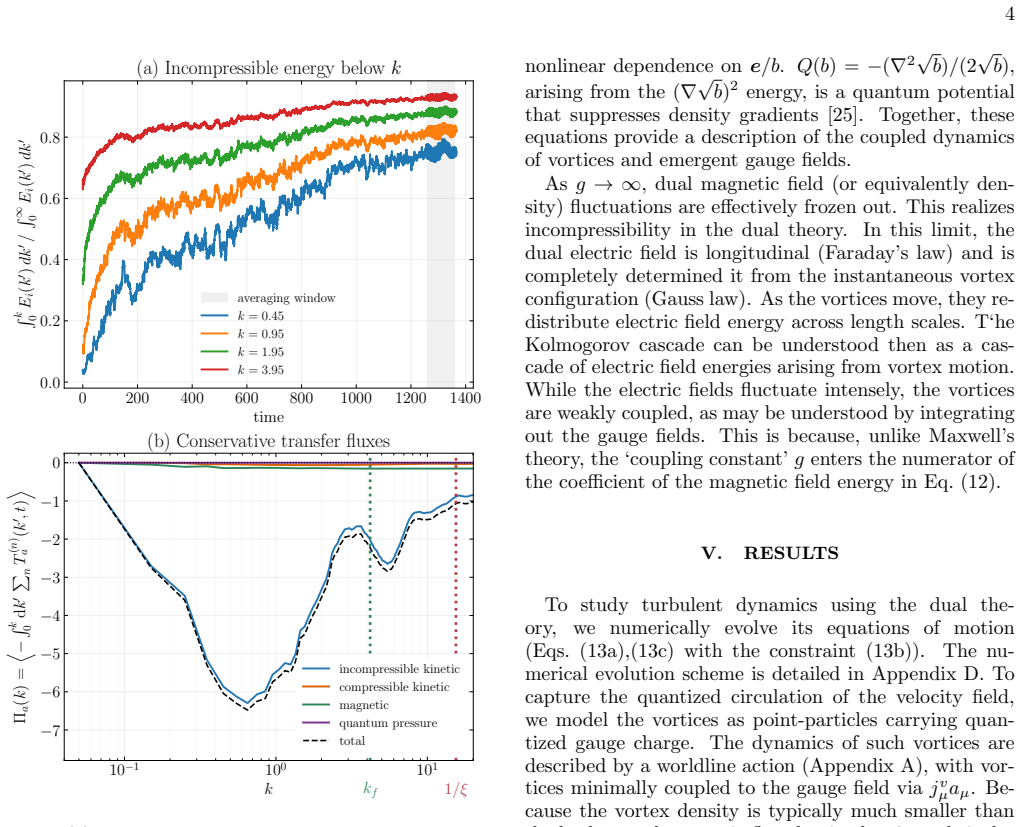
- The conservative transfer flux in the incompressible channel is negative and dominant within the scaling regime, indicating an inverse energy cascade toward large scales.
- Late-time vortex distributions show macroscopic clustering of like-signed vortices, consistent with earlier Gross–Pitaevskii simulations and with suppressed dipole annihilation.
- In the large-$g$ nearly incompressible limit, Faraday's law makes the dual electric field longitudinal, so the cascade can be viewed entirely as vortex-driven redistribution of electric-field energy.
- The same dual equations reproduce the $k^{-3}$ single-vortex spectrum at scales $k\xi\gg 1$, so the two known power-law regimes of two-dimensional superfluid turbulence appear in one framework.
Reading between the lines
- Beyond the paper: if the dual description is faithful, tuning the vortex nucleation or annihilation rates while leaving the gauge-field equations fixed should trace the same cascade family as changing the forcing scale in a Gross–Pitaevskii run; a testable prediction is that the effective spectrum and flux sign depend mainly on the ratio of forcing scale to healing length.
- Beyond the paper: the sign of the conservative flux $\Pi_i(k)$ could serve as a quantitative order parameter for the direct-to-inverse cascade crossover, which the paper notes may be reached by tuning compressibility but does not scan.
- Beyond the paper: because vortices are explicit and comparatively few, the dual formulation is a natural setting to measure vortex-gas statistics in the turbulent steady state, connecting the cascade to equilibrium vortex statistical mechanics.
Signed reviews
Editorial analysis
A structured set of objections, weighed in public.
Referee Report
Summary. The paper develops a dual 2+1D U(1) gauge-theory description of a two-dimensional superfluid, in which the superfluid density and current are expressed through dual magnetic and electric fields, and vortices appear as quantized gauge charges. The authors derive the dual equations of motion, show that they reduce to the superfluid hydrodynamic equations in the point-vortex limit, and use a numerical scheme combining the dual field equations with stochastic vortex pair creation and annihilation to study driven-dissipative turbulence. They report a k^-5/3 incompressible kinetic-energy spectrum at wavenumbers below the forcing scale, vortex clustering, and a negative incompressible kinetic-energy flux consistent with an inverse energy cascade. Appendices A-E provide the derivation of the dual action, the hydrodynamic reduction, a Berry-phase derivation of vortex guiding-center motion, the numerical algorithm, and the spectral flux decomposition.
Significance. If the numerical claims are reliable, the paper offers a useful reformulation of 2D superfluid turbulence in which the kinetic-energy cascade is equivalently described as a cascade of dual electric-field energy, with vortices as the fundamental degrees of freedom. The analytic part is a genuine strength: the dual action of Appendix A and the hydrodynamic reduction of Appendix B are internally consistent, and the relation v = z-hat × e/b makes the equivalence between the dual field energy and the superfluid kinetic energy explicit. The paper also makes a concrete, falsifiable contact with the k^-3 single-vortex regime in Fig. 4. However, the central numerical result is currently supported only by a single-resolution, single-realization stochastic vortex simulation with several phenomenological regulators, and the claim that this faithfully reproduces superfluid turbulence is not yet established. The novelty is therefore mostly conceptual and interpretational rather than a new quantitative prediction about GP turbulence.
major comments (3)
- [Section V and Appendix D] The central numerical claim is not established. The simulated system is not a direct solution of Eqs. (13) for a GP-equivalent forcing; it is a stochastic point-vortex model with Poisson pair injection (Gamma=10, d_f=1.5), annihilation threshold d_a=1.0, mutual friction alpha=1e-3, velocity cap w_c=10 c_s, magnetic core b_c=0.01, and compressible-mode damping gamma=3e-3. The observed k^-5/3 range in Fig. 1(c) is identified by eye, with no exponent fit, no error bars, and no ensemble or resolution study (N=256 is fixed). Fig. 3(b)'s negative incompressible flux is likewise a single realization. Since the paper's headline claim is that the model faithfully reproduces 2D superfluid turbulence, the absence of a direct comparison to GP simulation with analogous forcing and dissipation, and the absence of a parameter-robustness test, leave the load-bearing assertion unsupported.
- [Fig. 1(c) and Section V] The claimed inertial range is very narrow. With L approximately 618 xi and N=256, the grid spacing is h approximately 2.4 xi, and the forcing scale d_f=1.5 approximately 23 xi gives k_f approximately 4.2; the claimed k^-5/3 regime spans less than a decade in wavenumber. A power-law exponent cannot be reliably determined over such a short interval. The authors should provide a resolution study, report fitted exponents with confidence intervals, and identify a well-defined inertial range before claiming Kolmogorov scaling.
- [Appendix D, pair production and annihilation] The forcing mechanism is not characterized. Each injection event creates a neutral dipole at fixed separation and then projects w longitudinally to satisfy Gauss's law, which injects energy with a specific spectral signature; annihilation excises modes at a fixed separation d_a. These event terms enter the spectral balance in Eq. (E20) but are not measured or reported. Without showing that the injected energy is broadband or scale-localized in the intended way, and that the observed k^-5/3 is independent of the injection and annihilation protocol, the cascade claim risks being an artifact of the stochastic driving rather than a property of the dual superfluid dynamics.
minor comments (6)
- [Section II] The phrase 'Hamiltonianmartirosyan2026equation' appears to be an unresolved citation artifact and should be corrected.
- [Section IV] There are typos in the sentence containing 'T‘he Kolmogorov cascade' and in the phrase 'determined it from the instantaneous vortex configuration'; both should be fixed.
- [Section VII] 'compressiblity' should be 'compressibility'.
- [Appendix D] The text contains the typos 'satisified' and 'highlt'; these should be corrected.
- [Appendix E] The word 'evaluteT' in the flux discussion should be 'evaluate'.
- [Fig. 1 caption] The label 'k□5/3' appears to be a placeholder symbol and should be rendered as k^{-5/3}; additionally, the caption should state which vortex sign (unfilled or filled circles) corresponds to positive or negative circulation.
Circularity Check
No significant circularity: the dual-theory derivation is self-contained, and the electric-field/kinetic-energy equivalence is explicit rather than load-bearing.
full rationale
The paper's analytic core is self-contained: Appendix A derives the dual Lagrangian and equations of motion (13a)-(13c) from the same superfluid action used for GP, and Appendices B and C show that both GP and the dual equations reduce to the same hydrodynamic equations. The identity v = e×z/b (Eq. 11) combined with the (1/2)e^2/b term in Eq. (12) makes the 'dual electric field energy cascade' the same quantity as the superfluid kinetic energy cascade up to a constant; the paper states this equivalence explicitly ('equivalently described') and does not use it to infer an independent prediction, so this is a transparent reformulation, not a circular derivation. The numerical section measures, rather than fits, the k^-5/3 exponent and the inverse flux from a stochastic point-vortex model; the phenomenological parameters (Γ, d_f, d_a, α, γ) are inputs, not fitting targets, and the absence of a direct GP comparison or resolution study is a validation weakness and correctness risk, not a circularity. The only author self-citation, Ref. [37], appears in a discussion of future lattice/Mott-insulator work and is not load-bearing for any claim in this paper. No step reduces by construction to a fitted parameter or to a self-citation chain.
Assumptions & free parameters
free parameters (8)
- g (interaction strength, gb0/(2π)=119) =
500
- Γ (vortex pair nucleation rate) =
10
- d_f (dipole injection separation) =
1.5 (~23ξ)
- d_a (annihilation threshold) =
1.0 (~16ξ)
- α (mutual friction coefficient) =
1e-3
- γ (compressible mode damping) =
3e-3
- b_c, b_min (quantum pressure regulators) =
0.01
- w_c (velocity cap) =
10 c_s, c_s≈11
assumptions (5)
- standard math The conserved superfluid current J^μ on the torus can be written as (1/2π)ε^{μνλ}∂_ν a_λ
- domain assumption Vortices move with the guiding-center drift Ẋ=v(X) (lowest Landau level / M_v→0 limit)
- ad hoc to paper Stochastic pair creation and annihilation model the external forcing and dissipation of a turbulent superfluid
- ad hoc to paper Numerical regularizations (b_c, w_c cap, γ damping) do not alter the cascade at scales k << k_f
- domain assumption The GP equation with phenomenological damping is the correct low-temperature description of 2D superfluid turbulence
invented entities (1)
-
Emergent 2+1D U(1) gauge field a_μ with dual electric field e and magnetic field b
Cite this review
Pith. "Pith review of Dual Gauge Theory for Two Dimensional Superfluid Turbulence." pith.science (2026). https://pith.science/paper/HQTMXLX3
@misc{pith2026260812485,
  author       = {Pith},
  title        = {Pith review of: Dual Gauge Theory for Two Dimensional Superfluid Turbulence},
  year         = {2026},
  howpublished = {\url{https://pith.science/paper/HQTMXLX3}},
  note         = {Machine review of arXiv:2608.12485}
}
abstract
We describe turbulent hydrodynamics of superfluids in two spatial dimensions via the dynamics of point-like vortices coupled to an emergent 2+1 dimensional $U(1)$ gauge field. The cascade of superfluid kinetic energy is equivalently described by a cascade of dual electric field energies. We study superfluid turbulence using the equations of motion of the dual gauge theory in the presence of a drive and dissipation. In the limit that the vortices are point-like, the dual equations of motion directly yield the hydrodynamical equations of the superfluid. We obtain a turbulent cascade consistent with Kolmogorov's scaling law for two dimensional fluid turbulence. We observe clustering of like-signed vortices and compute the kinetic energy flux to show that the turbulent regime exhibits an inverse energy cascade.
Figures


Figures from the paper (2 more)


Reference graph
Works this paper leans on
-
[1]
L. D. Landau and E. M. Lifshitz,Fluid Mechanics: Vol- ume 6, Vol. 6 (Elsevier, 1987)
1987
-
[2]
M. Van Dyke and M. Van Dyke,An album of fluid mo- tion, Vol. 176 (Parabolic Press Stanford, 1982)
work page 1982
-
[3]
The precise value of Re where turbulent fluid motion en- sues depends on the shape and boundary conditions of the fluid and is not universal
-
[4]
L. F. Richardson,Weather prediction by numerical pro- cess(Cambridge university press, 2007)
work page 2007
-
[5]
W. D. McComb,The physics of fluid turbulence(Oxford university press, 1990)
work page 1990
-
[6]
A. N. Kolmogorov, The local structure of turbulence in incompressible viscous fluid for very large reynolds num- bers, Proceedings: Mathematical and Physical Sciences 434, 9 (1991)
1991
-
[7]
A more rigorous derivation of the Kolmogorov scal- ing law comes from the behavior of the velocity equal time correlatorC(r) = 1/2⟨v(r)·v(0)⟩under the pro- viso of spatial homogeneity and isotropy, where we de- fineC(0)≡ R dkE(k). In wavenumber space,E(k) can be written more explicitly and is given byE(k) = (Sd−1kd−1)⟨|v(k)|2⟩/(2(2π)dV) whereS d−1 is the ...
-
[8]
C. F. Barenghi, L. Skrbek, and K. R. Sreenivasan, In- troduction to quantum turbulence, Proceedings of the National Academy of Sciences111, 4647 (2014)
2014
Show all 48 references
-
[9]
P. W. Anderson, Considerations on the flow of superfluid helium, Rev. Mod. Phys.38, 298 (1966)
1966
-
[10]
R. P. Feynman, Chapter ii application of quantum me- chanics to liquid helium, inProgress in low temperature physics, Vol. 1 (Elsevier, 1955) pp. 17–53
1955
-
[11]
Maurer and P
J. Maurer and P. Tabeling, Local investigation of su- perfluid turbulence, EPL (Europhysics Letters)43, 29 (1998)
1998
-
[12]
Navon, A
N. Navon, A. L. Gaunt, R. P. Smith, and Z. Hadzibabic, Emergence of a turbulent cascade in a quantum gas, Na- ture539, 72 (2016)
2016
-
[13]
C. Nore, M. Abid, and M. E. Brachet, Kolmogorov tur- bulence in low-temperature superflows, Phys. Rev. Lett. 78, 3896 (1997)
1997
-
[14]
M. Zhao, J. Tao, and I. B. Spielman, Kolmogorov scal- ing in turbulent 2d bose-einstein condensates, Phys. Rev. Lett.134, 083402 (2025)
2025
-
[15]
E. P. Gross, Structure of a quantized vortex in boson systems, Il Nuovo Cimento (1955-1965)20, 454 (1961)
1961
-
[16]
L. P. Pitaevskii, Vortex lines in an imperfect bose gas, Sov. Phys. JETP13, 451 (1961)
1961
-
[17]
S. Choi, S. A. Morgan, and K. Burnett, Phenomenologi- cal damping in trapped atomic bose-einstein condensates, Phys. Rev. A57, 4057 (1998)
1998
-
[18]
Numasato and M
R. Numasato and M. Tsubota, Possibility of inverse en- ergy cascade in two-dimensional quantum turbulence, Journal of Low Temperature Physics158, 415 (2010)
2010
-
[19]
M. T. Reeves, T. P. Billam, B. P. Anderson, and A. S. Bradley, Inverse energy cascade in forced two- dimensional quantum turbulence, Phys. Rev. Lett.110, 104501 (2013)
2013
-
[20]
Numasato, M
R. Numasato, M. Tsubota, and V. S. L’vov, Direct en- ergy cascade in two-dimensional compressible quantum turbulence, Phys. Rev. A81, 063630 (2010)
2010
-
[21]
Kobayashi and M
M. Kobayashi and M. Tsubota, Kolmogorov spectrum of quantum turbulence, Journal of the Physical Society of Japan74, 3248 (2005)
2005
-
[22]
M. E. Peskin, Mandelstam-’t hooft duality in abelian lat- tice models, Annals of Physics113, 122 (1978)
1978
-
[23]
Dasgupta and B
C. Dasgupta and B. I. Halperin, Phase transition in a lattice model of superconductivity, Phys. Rev. Lett.47, 1556 (1981)
1981
-
[24]
Lee and M
D.-H. Lee and M. P. Fisher, Anyon superconductivity and charge-vortex duality, International Journal of Modern Physics B5, 2675 (1991)
1991
-
[25]
L. E. Ballentine,Quantum mechanics(Englewood Cliffs, New Jersey, 1989)
1989
-
[26]
Ao and D
P. Ao and D. J. Thouless, Berry’s phase and the magnus force for a vortex line in a superconductor, Phys. Rev. Lett.70, 2158 (1993)
1993
-
[27]
D. J. Thouless, P. Ao, and Q. Niu, Transverse force on a quantized vortex in a superfluid, Phys. Rev. Lett.76, 3758 (1996)
1996
-
[28]
Skaugen and L
A. Skaugen and L. Angheluta, Origin of the inverse en- ergy cascade in two-dimensional quantum turbulence, Phys. Rev. E95, 052144 (2017)
2017
-
[29]
Mehdi, J
Z. Mehdi, J. J. Hope, S. S. Szigeti, and A. S. Bradley, Mutual friction and diffusion of two-dimensional quan- tum vortices, Phys. Rev. Res.5, 013184 (2023)
2023
-
[30]
T. P. Billam, M. T. Reeves, B. P. Anderson, and A. S. Bradley, Onsager-kraichnan condensation in decaying two-dimensional quantum turbulence, Phys. Rev. Lett. 112, 145301 (2014)
2014
-
[31]
Skaugen and L
A. Skaugen and L. Angheluta, Vortex clustering and uni- versal scaling laws in two-dimensional quantum turbu- lence, Phys. Rev. E93, 032106 (2016)
2016
-
[32]
R. H. Kraichnan, Inertial ranges in two-dimensional tur- bulence, Physics of fluids10, 1417 (1967)
1967
-
[33]
This is because the vortices are in the lowest Landau level limit and hencej v =ρ vv
For point-vortices in the GP equation, the Lorentz force vanishes. This is because the vortices are in the lowest Landau level limit and hencej v =ρ vv
-
[34]
A. S. Bradley and B. P. Anderson, Energy spectra of vortex distributions in two-dimensional quantum turbu- lence, Phys. Rev. X2, 041001 (2012)
2012
-
[35]
Fouxon, A
I. Fouxon, A. G. Kritsuk, and M. Mond, Compressible two-dimensional turbulence: cascade reversal and sensi- tivity to imposed magnetic field, New Journal of Physics 25, 113005 (2023)
2023
-
[36]
Falkovich and A
G. Falkovich and A. G. Kritsuk, How vortices and shocks provide for a flux loop in two-dimensional compressible turbulence, Phys. Rev. Fluids2, 092603(R) (2017)
2017
- [37]
-
[38]
L. D. Landau, E. M. Lifshitz, and E. M. Lifshits, The Classical Theory of Fields: Volume 2, Vol. 2 (Butterworth-Heinemann, 1975)
1975
-
[39]
Hockney and J
R. Hockney and J. Eastwood,Computer Simulation Us- ing Particles (1st ed.)(CRC Press, 1988)
1988
-
[40]
gauge transformation
J. Villasenor and O. Buneman, Rigorous charge conser- vation for local electromagnetic field solvers, Computer Physics Communications69, 306 (1992). 8 Appendix A: Derivation of the dual theory We briefly discuss the derivation of the dual theory. More details can be found in R...
1992
-
[41]
Bianchi identity
Equations of motion The equations of motion of the dual theory are readily obtained by varying the action. Following the standard approach [38], we do so in two steps. First, we vary the vortex currents assuming the gauge fields are held fixed, and second, we vary the action w...
-
[42]
Hencegb 0/(2π) = 119
Numerical method The parameters used to produce the data are Lx =L y =L= 40, N x =N y =N= 256, h=L/N= 0.156, ∆t= 10−3, m= 1, b 0 = 1.5, g= 500, (D1) with periodic boundary conditions andNis the number of grid points. Hencegb 0/(2π) = 119. The run time is 1.36×10 6 timesteps of...
2000
-
[43]
Vortex pair production and annihilation Vortex creation and annihilation are applied after each successful ordinary field/particle step. Vortex pair production is implemented as a homogeneous Poisson process of rate Γ = 10: At every step, the number of generated vortex pairs i...
-
[44]
Evaluation of the tracked energies Observables are evaluated at integer times. Since the field integrator storeswat half times, the diagnostic velocity is reconstructed by a forward half kick, wn diag =w n−1/2 + ∆t 2 F(wn−1/2,bn,jn v,inst),(D21) wherej n v,inst is obtained by ...
-
[45]
Compressible and incompressible spectra Following the main text, we decomposeuas u=u c +ui,∇×u c = 0,∇·u i = 0 (E1) into the incompressible (u i) and compressible (u c) component. Fork̸= 0, the corresponding projectors in Fourier space are Pc αβ(k) = kαkβ k2 , P i αβ(k) =δ αβ−...
-
[46]
Equation of motion The equation of motion of the velocityvis ∂tv=−∇ v2 2 +gρ+Q(ρ) −2πˆz×j v,(E9) with the boson continuity equation ∂tρ+∇(ρv) = 0.(E10) Away from instantaneous pair-production and annihilation events, the vortex velocity including mutual friction is ˙Xa =v(X a)...
-
[47]
Shell transfers and cumulative fluxes For each nondissipative termχ∈{kin,g,Q,ρ,j v}, we define the shell-resolved kinetic transfer Ta χ(k,t)≡ Z Ω Re [u∗ a(k,t)·F[R χ](k,t)], a=c,i.(E16) 19 Explicitly, all of the evaluated transfer channels are therefore Ta kin = 1 2 Z Ω Im u∗ ...
-
[48]
Magnetic and quantum-pressure energy fluxes The interaction energy and the quantum-pressure energy are Eb = g 8π2 Z d2xb 2 = g 2 Z d2xρ 2,(E24) EQ = 1 2 Z d2x|∇√ρ|2.(E25) Their shell spectra are therefore Eb(k,t) = Z Ω g 2|ρ(k,t)| 2,(E26) EQ(k,t) = Z Ω k2 2|s(k,t)| 2, s= √ρ.(E...
Reviewed August 16, 2026 · model on record in the stance chip above.
Discussion (0). Continue with ORCID to comment.