REVIEW 2 major objections 5 minor 32 references
Weight Certificates for Convex Multi-Objective MPC: Geometric Characterization, $\ell^1$ Construction, and $\ell^2$ Foreclosure
T0 review · 2 major / 5 minor · reviewed 2026-08-16 · deepseek-v4-flash
Pith's one-line read A weighted sum reproduces a convex lexicographic optimum exactly when its weight supports the upper image at the lex point; membership is decidable by linear feasibility.
desk verdict Sound geometric core with a computable LP for exact weighted-sum weights under l1, honest persistence measurements showing certificates expire at native rate, but closed-loop divergence attribution is confounded by warm-start mismatch. read the letter →
The pith
A machine-rendered reading of the paper's core claim, the machinery that carries it, and where it could break.
The reading
What carries the argument
The central object is the upper image of the achievement map, $P=\operatorname{cl}\{(y,t):\exists z\in Z,\ V_i(z)\le y_i\ \forall i,\ J(z)\le t\}$, whose lexicographic point $p^{*}=(V^{*}_1,\dots,V^{*}_L,J^{*})$ is an extreme point under the convexity assumptions. The argument rides on the outward normal cone $N^{+}_{P}(p^{*})$ and its unit-performance slice $\Omega(p^{*})=\{w\in\mathbb{R}^{L}_{++}:(w,1)\in N^{+}_{P}(p^{*})\}$: a weight is exact exactly when the augmented vector $(w,1)$ is a supporting normal at $p^{*}$. For $\ell^1$ hinges the working construction is the scaled-KKT system, which replaces boundary-hinge subgradient terms $w_i\alpha_{i,j}$ by variables $\beta_{i,j}=w_i\alpha_{i,j}$ with $0\le\beta_{i,j}\le w_i$; projecting this affine system onto $w$ gives the polyhedral region, and a Chebyshev-centre linear program returns an interior certified weight with an inscribed-ball margin. For $\ell^2$ squared hinges the load-bearing mechanism is the vanishing boundary force $\nabla[g]^2_{+}=0$ at $g=0$, which drives the foreclosure theorem and the $O(1/w)$ local-minimizer branch. The online apparatus is a compliance-pattern monitor that compares realized per-tier compliance bits against the cached calibration pattern and triggers cascade fallback on mismatch.
What would settle it
Take a convex quadratic program with one binding squared-hinge constraint whose limiting multiplier is nonzero, as in the paper's closed-form example, and solve it at increasing finite weights: the theory predicts the constraint violation stays strictly positive at every finite weight, decaying as $\lambda^{*}/(2w)+O(w^{-2})$. Observing exact satisfaction (violation at machine zero) at any finite weight, or a decay rate that does not match the predicted leading term, would refute the $\ell^2$ foreclosure theorem.
Extended reading notes
Core claim
The paper's central claim is that, under convexity of the feasible set, the constraint functions, and the performance objective, the lexicographic optimum $z^{*}_{lex}$ is a minimizer of the weighted sum $J(z)+\sum_{i=1}^{L} w_i V_i(z)$ for a weight $w\in\mathbb{R}^{L}_{++}$ if and only if $w$ lies in $\Omega(p^{*})$, the unit-performance slice of the outward normal cone of the upper image $P=\operatorname{cl}\{(y,t):\exists z\in Z,\ V_i(z)\le y_i\ \forall i,\ J(z)\le t\}$ at the lexicographic image point $p^{*}=\Phi(z^{*}_{lex})$. Equivalence is therefore a membership question, not a magnitude question: the separation heuristic $w_1\gg w_2\gg\cdots\gg w_L$ answers the wrong question. In the $\ell^1$ hinge regime the slice is a polyhedron obtained by projecting a scaled-KKT system in the variables $\beta_{i,j}=w_i\alpha_{i,j}$, so a Chebyshev-centre linear program returns an interior weight with a certified margin; in the $\ell^2$ squared-hinge regime the boundary force vanishes, no finite weight is exact whenever the limiting multiplier is nonzero, and violation along the local minimizer branch decays as $\Theta(1/w_i)$ for the raw constraint and $\Theta(1/w_i^2)$ for the violation functional. The same construction yields the multi-instance intersection of pointwise slices, and the empirical campaign shows that intersection is empty across every sampled episode: the certificate is exact where it is issued and expires quickly, with persistence tracking active-set stability.
Load-bearing premise
The certificate is proved for one fixed convex decision instance, but the closed-loop planner solves a new locally linearized problem every tick, so a weight that is exact at the calibration tick need not be exact at the next, and the campaign does not isolate that expiry from divergence caused by different warm starts.
Editorial extensions
If this is right
- Exactness of a weighted-sum surrogate for a lexicographic cascade is decidable by a single linear feasibility check per decision instance, turning weight calibration from heuristic tuning into a convex computation.
- The separation heuristic $w_1\gg w_2\gg\cdots\gg w_L$ is neither necessary nor sufficient: certified weights in nine of eleven scenario classes are near-equal across tiers (ratios near $1:1:1$ or $2:1:1$), and where the region actively constrains the weights the comfort-tier lower bound is about 89, above the heuristic's 10.
- Under $\ell^2$ squared-hinge penalties, exact equivalence at finite weight is impossible whenever a limiting multiplier is nonzero, so smooth penalties can only approximate the priority order, with violation decaying as $O(1/w)$.
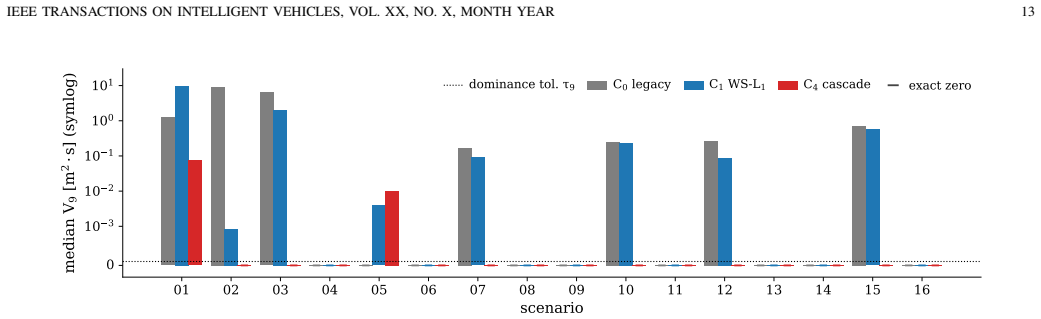
- Certificates are pointwise and expire quickly, with median lifetime one sampling interval and the multi-instance intersection empty in all fourteen sampled classes, so a deployable controller needs a validity check as the horizon evolves; the paper's monitored construction with selective cascade fallback is the proposed architecture.
- Per-tick compliance agreement can saturate at the top priority levels (median 1.000) while event-level divergence persists, so surrogate validation must track event precision and recall, not only tick-wise agreement.
Reading between the lines
- Because cross-tick validity was perfect for the two classes with stable active sets and at most 0.40 for the classes with churning active sets, a cheaper and possibly more sensitive expiry signal than the paper's compliance-pattern monitor (sensitivity 0.55) would be to detect active-set change itself and re-run the scaled-KKT feasibility check only when the active set moves.
- The $\ell^1$/ $\ell^2$ dichotomy is really a statement about boundary derivatives, so it should extend to any smooth surrogate: any penalty whose derivative vanishes at the constraint boundary (Huber, log-barrier, or $\ell^p$ with $p>1$) should require infinite weight for exactness, while any penalty keeping a nonzero boundary subgradient should admit finite exact weights, a testable generalizatio
- The polyhedral description of $\Omega(p^{*})$ together with its Chebyshev margin gives a natural convex formulation for inverse optimal control: recover rule priorities from demonstrated trajectories by fitting weights inside the certified region while maximizing the margin, rather than treating weight learning as a black-box regression.
Signed reviews
Editorial analysis
A structured set of objections, weighed in public.
Referee Report
Summary. This paper studies when a single weighted-sum minimization J(z)+Σ_i w_i V_i(z) reproduces the lexicographic optimum of a convex priority-ordered program. The central theoretical result, Theorem III.3, characterizes the admissible weights as the unit-performance slice of the outward normal cone of the upper image at the lexicographic point. For ℓ1 hinge penalties the paper gives a polyhedral description via a scaled-KKT projection (Theorem III.4, Proposition III.6, Algorithm 1); for ℓ2 squared-hinge penalties it proves a local foreclosure result with O(1/w) and O(1/w²) violation rates (Theorem III.9, Proposition III.10). The paper then presents a closed-loop nuPlan study on a 25-rule rulebook: calibrated weights often have near-equal tier components, the deployed heuristic weight typically lies outside the certified region, certificate lifetime is short and tracks active-set churn, and a monitored weighted solve with cascade fallback gives exploratory event-level gains. The authors are candid that certificates are pointwise and that the compliance-pattern monitor has sensitivity 0.55.
Significance. If the claims hold, the paper is a valuable and practical contribution: it converts the folklore 'separation heuristic' question into a well-posed membership problem, supplies a constructive LP-based calibration procedure with a certified margin for ℓ1 penalties, and gives a clean explanation of why squared-hinge penalties cannot be exact at finite weight. The theoretical core appears correct, and the paper supports it with machine-checkable randomized verification on 1000 instances and two worked examples. The authors are also unusually explicit about limitations: empty robust intersections, short certificate lifetimes, and the imperfect monitor. These strengths make the paper worth serious consideration; the main open question is whether the closed-loop attribution, rather than the pointwise theory, is supported by the experiments.
major comments (2)
- [Section III-B, Theorem III.3; Eq. (8)] The theorem's statement is an 'if and only if' for z*_lex being a member of the weighted-sum argmin set, but the paper's practical claim throughout the abstract and Section II.B is that a weight 'reproduces' the lexicographic optimum, i.e. that the WS solve returns z*_lex. When the WS minimizer is not unique, w ∈ Ω(p*) does not force every WS minimizer to equal z*_lex; the additional uniqueness hypothesis in the sentence after Theorem III.3 is therefore load-bearing. Because ℓ1 hinges are piecewise linear, J + Σ_i w_i V_i is generically not strictly convex, so non-uniqueness is not a measure-zero corner case in the deployed setting. Please either state all practical claims with the uniqueness qualifier, add a tie-breaking rule that selects the lexicographic point among WS minimizers, or prove a condition under which uniqueness holds; Algorithm 1's verification step currently only checks trajectory equality 'when the WS minimizer is unique'.
- [Section V-B; Section VIII, first divergence source] The certificate is issued for a fixed convex decision instance, namely the sequentially linearised problem produced from a particular warm start. The online WS solve and the cascade reference maintain their own warm starts, so at the same controller tick they can be solving different linearized instances. Theorem III.3 certifies only the instance at which it is evaluated. Consequently, the per-tick compliance match and event-level divergence in Section VII, and the certificate-lifetime measurements in Section VI-A, may be driven by warm-start mismatch rather than by w_dep lying outside Ω(p*) or by certificate expiry. The paper lists this as a source of divergence in Section VIII but does not separate it empirically. Please add an ablation that holds warm-start identity fixed between the WS and cascade solves (or computes the certificate for the exact linearization used by the online WS solve) and re-measures event-level divergence and certificate lifetime; without such a control, the monitored-deployment conclusion remains conditional.
minor comments (5)
- [Section II-B] The sentence 'because [a]_+^p is convex and Non-decreasing convexity for p in {1,2} ensures...' is ungrammatical and incomplete; it should say, for example, 'because [a]_+^p is convex and nondecreasing for p ∈ {1,2}, the composition V_i is convex.'
- [Section IV-B] The sentence beginning 'A dynamics-agnostic reference implementation reproduces both examples to 10^-6 and implements the scaled-subgradient formulation β_{i,j}=w_i α_{i,j}.10^-6 and implements...' contains a duplicated fragment and should be rewritten.
- [Section V-F, Definition V.1] The per-level tolerance is introduced as a scalar τ>0 but then used as a vector τ_ℓ; please define τ_ℓ explicitly before the definition of lex-Pareto dominance.
- [Abstract and Section VI-A] The phrase 'median lifetime is one sampling interval (zero subsequent ticks at the native rate)' conflates the 2.5 s sampled study, whose median lifetime is one 2.5 s interval, with the dense one-episode study, whose median lifetime is zero subsequent 0.1 s ticks; please state the two sampling rates and the sample sizes explicitly when this summary is given.
- [Table II] The eligibility column entries 'no a' are cryptic in the main text; the table caption should spell out the footnote that the notation refers to infeasible Chebyshev centre.
Circularity Check
One definitional step: the normal-cone equivalence restates the definition of Ω(p*); the ℓ1 projection, ℓ2 foreclosure, and closed-loop findings are independent, so overall circularity is minor.
-
self definitional
[Section III-A/III-B, Definitions II.2/III.2 and Theorem III.3 (Eqs. (8),(13))]
"Definition III.2: Ω(p⋆) := {w ∈ R^L_{++} : (w,1) ∈ N^+_P(p⋆)}. Theorem III.3: Under (A1)–(A3), for every w ∈ R^L_{++}, z⋆_lex ∈ arg min_z [J(z)+Σ_{i=1}^L w_i V_i(z)] ⇐⇒ w ∈ Ω(p⋆)."
Membership in Ω is defined as (w,1) lying in the outward normal cone of the upper image P at p*. By Definition II.2, P is the upward-closed epigraph of the achievable (V_1,...,V_L,J) vectors, so the normal-cone inequality ⟨(w,1), q−p*⟩ ≥ 0 for every q∈P is, up to the closure/limit argument supplied in the proof, exactly the statement that p* minimizes the linear functional J+Σ w_i V_i over the image of Z — i.e., that z*_lex minimizes the weighted-sum objective (8). Theorem III.3 therefore restates the defining property of Ω rather than deriving an independent condition from an external result; the computational content enters only in the later scaled-KKT projection and the ℓ2 branch analysis.
full rationale
The only reduction-by-construction I can exhibit is the central normal-cone equivalence: Ω(p*) is defined as the slice of the outward normal cone and Theorem III.3 states that membership in this slice is equivalent to weighted-sum recovery of the lexicographic optimum, a statement that follows immediately from the defining property of P as the upper image. This is a characterization by construction rather than an independent derived prediction. The remaining load-bearing content is independent: the ℓ1 polyhedral region is obtained from the scaled-KKT system (16)-(17) via first-order optimality and is verified on 1000 randomized instances; the ℓ2 impossibility and O(1/w) rates are derived from Lemma III.8 and the implicit-function theorem in Appendix A; and the empirical claims are internally contrasted with matched cascade/heuristic references, with pointwise expiry and warm-start sensitivity explicitly disclosed. The self-citation to W-SQP [2] is used for related-work positioning and is disclosed, not as evidence. Accordingly the score is 2: one near-definitional characterization, but no load-bearing circularity in the computational or empirical contributions.
Assumptions & free parameters
free parameters (6)
- Operator weight box [1, 1e8]^3 =
[1, 1e8]^3
- Per-tier tolerance vector epsilon =
(1e-4, 4e-2, 5e-1)
- SLP iteration cap =
1 (C1, C5, C6) and 3 (C2)
- Tikhonov parameter eta =
1e-6
- Lex-Pareto dominance tolerances tau =
per-level values (not fully listed in text)
- Event matching parameters =
debounce 10 Hz, temporal IoU >= 0.5
assumptions (7)
- domain assumption (A1) Z compact and all minima attained
- domain assumption (A2) lex optimum z*_lex unique and image point p* uniquely determined
- domain assumption (A3) Z, g_i,j, and J convex
- domain assumption Setting (P): Z polyhedral, g_i,j affine, J convex piecewise affine
- domain assumption Setting (Q): squared-hinge penalties, V_i continuously differentiable
- domain assumption Regularity (R1)-(R5) for the ℓ2 branch: stable sign classes, independent hinge gradients, regular limit problem with positive multipliers and strict complementarity
- standard math Standard convex analysis facts: supporting hyperplane theorem, normal cone calculus, KKT necessity and sufficiency for convex programs
Cite this review
Pith. "Pith review of Weight Certificates for Convex Multi-Objective MPC: Geometric Characterization, $\ell^1$ Construction, and $\ell^2$ Foreclosure." pith.science (2026). https://pith.science/paper/OPVZ2Z77
@misc{pith2026260812520,
  author       = {Pith},
  title        = {Pith review of: Weight Certificates for Convex Multi-Objective MPC: Geometric Characterization, $\ell^1$ Construction, and $\ell^2$ Foreclosure},
  year         = {2026},
  howpublished = {\url{https://pith.science/paper/OPVZ2Z77}},
  note         = {Machine review of arXiv:2608.12520}
}
abstract
Automated-driving rulebooks rank rule violations lexicographically, and model predictive control enforces that ranking either exactly, through $L{+}1$ sequential programs per tick, or approximately, through a weighted sum tuned by the separation heuristic $w_1\gg w_2\gg\cdots\gg w_L$. We show the heuristic answers the wrong question. For a convex priority-ordered program, a weighted sum reproduces the lexicographic optimum precisely when its weight, augmented by a unit performance coefficient, supports the upper image of the achievement map at the lexicographic point; the admissible weights form the unit-performance slice of an outward normal cone. Under hinge penalties this slice is a polyhedron obtained by projecting a scaled-KKT system, and a linear program returns an interior weight with a certified margin; under squared-hinge penalties no finite weight is exact whenever the limiting multiplier is nonzero, with violation along the local minimizer branch decaying as $O(1/w)$. Calibrated on held-out logs, the resulting weights have near-equal tier components in nine of eleven calibration-eligible scenario classes and roughly double legal-tier event precision against a matched heuristic weight in closed-loop nuPlan experiments on a 25-rule rulebook. The certificate is, however, pointwise: no single weight is valid across the sampled ticks of an episode, the median lifetime is one sampling interval (zero subsequent ticks at the native rate), and persistence tracks active-set stability. These findings motivate monitored weighted solves with selective cascade fallback, although the compliance-pattern monitor detects only a subset of measured lapses.
Figures


Figures from the paper (2 more)


Reference graph
Works this paper leans on
-
[1]
Liability, ethics, and culture-aware behavior specification using rulebooks,
A. Censi, K. Slutsky, T. Wongpiromsarn, D. Yershov, S. Pendleton, J. Fu, and E. Frazzoli, “Liability, ethics, and culture-aware behavior specification using rulebooks,” inICRA, 2019
work page 2019
-
[2]
Real-Time Rulebook-Aware Nonlinear MPC for Autonomous Driving with Priority-Biased Tiered Slacks
H. Hajieghrary, B. Walter, C. Shinde, P. Schmitt, and M. Hurtado, “Real-time rulebook-aware nonlinear MPC for autonomous driving with priority-biased tiered slacks,” arXiv:2607.10975, 2026
work page Pith review arXiv 2026
-
[3]
Boyd and L
S. Boyd and L. Vandenberghe,Convex Optimization. Cambridge University Press, 2004
2004
-
[4]
Equivalent weights for lexicographic multi-objective programs: characterizations and computations,
H. D. Sherali, “Equivalent weights for lexicographic multi-objective programs: characterizations and computations,”European Journal of Operational Research, vol. 11, no. 4, pp. 367–379, 1982
work page 1982
-
[5]
Explicit weight bounds for lexicographic optimization,
F. Eisenbrand, S. Niermann, and M. Skutella, “Explicit weight bounds for lexicographic optimization,”Mathematics of Operations Research, vol. 28, no. 4, pp. 791–801, 2003
work page 2003
-
[6]
Preemptive and nonpreemptive multi- objective programming: Relationship and counterexamples,
H. D. Sherali and A. L. Soyster, “Preemptive and nonpreemptive multi- objective programming: Relationship and counterexamples,”Journal of Optimization Theory and Applications, vol. 39, no. 2, pp. 173–186, 1983
1983
-
[7]
A theory of lexicographic multi-criteria optimization,
M. J. Rentmeesters, W. K. Tsai, and K.-J. Lin, “A theory of lexicographic multi-criteria optimization,” inProceedings of the 2nd IEEE Interna- IEEE TRANSACTIONS ON INTELLIGENT VEHICLES, VOL. XX, NO. X, MONTH YEAR 16 tional Conference on Engineering of Complex Computer Systems, 1996, pp. 76–79
work page 1996
-
[8]
Hard constraints for prioritized objective nonlinear MPC,
C. E. Long and E. P. Gatzke, “Hard constraints for prioritized objective nonlinear MPC,” inAssessment and Future Directions of Nonlinear Model Predictive Control. Springer, 2007, pp. 217–228
work page 2007
Show all 32 references
-
[9]
Objective prioritization using lexicographic minimizers for MPC of sewer networks,
C. Ocampo-Martinez, A. Ingimundarson, V . Puig, and J. Quevedo, “Objective prioritization using lexicographic minimizers for MPC of sewer networks,”IEEE Transactions on Control Systems Technology, vol. 16, no. 1, pp. 113–121, 2008
2008
-
[10]
Profile control in distributed parameter systems using lexicographic optimization based MPC,
N. Padhiyar and S. Bhartiya, “Profile control in distributed parameter systems using lexicographic optimization based MPC,”Journal of Pro- cess Control, vol. 19, no. 1, pp. 100–109, 2009
2009
-
[11]
Multi-objective nonlinear model predictive control: Lexicographic method,
T. Zheng, G. Wu, G.-H. Liu, and Q. Ling, “Multi-objective nonlinear model predictive control: Lexicographic method,” inModel Predictive Control. Sciyo, 2010
2010
-
[12]
Stability of multiobjective predictive control: A utopia-tracking approach,
V . M. Zavala and A. Flores-Tlacuahuac, “Stability of multiobjective predictive control: A utopia-tracking approach,”Automatica, vol. 48, no. 10, pp. 2627–2632, 2012
2012
-
[13]
Optimal prioritized in- feasibility handling in model predictive control: Parametric preemptive multiobjective linear programming approach,
J. Vada, O. Slupphaug, and T. A. Johansen, “Optimal prioritized in- feasibility handling in model predictive control: Parametric preemptive multiobjective linear programming approach,”Journal of Optimization Theory and Applications, vol. 109, no. 2, pp. 385–413, 2001
2001
-
[14]
Linear MPC with optimal prioritized infeasibility handling: application, computa- tional issues and stability,
J. Vada, O. Slupphaug, T. A. Johansen, and B. A. Foss, “Linear MPC with optimal prioritized infeasibility handling: application, computa- tional issues and stability,”Automatica, vol. 37, no. 11, pp. 1835–1843, 2001
2001
-
[15]
Kinematic control of redundant manipulators: Generalizing the task-priority framework to inequality task,
O. Kanoun, F. Lamiraux, and P.-B. Wieber, “Kinematic control of redundant manipulators: Generalizing the task-priority framework to inequality task,”IEEE Transactions on Robotics, vol. 27, no. 4, pp. 785–792, 2011
2011
-
[16]
Hierarchical quadratic programming: Fast online humanoid-robot motion generation,
A. Escande, N. Mansard, and P.-B. Wieber, “Hierarchical quadratic programming: Fast online humanoid-robot motion generation,”The International Journal of Robotics Research, vol. 33, no. 7, pp. 1006– 1028, 2014
2014
-
[17]
Comfortable and safe decel- erations for a self-driving transit bus,
A. Mifsud, M. Ciocca, and P.-B. Wieber, “Comfortable and safe decel- erations for a self-driving transit bus,” inIEEE International Conference on Robotics and Automation, 2021, pp. 1005–1011
2021
-
[18]
Nocedal and S
J. Nocedal and S. J. Wright,Numerical Optimization, 2nd ed. New York: Springer, 2006
2006
-
[19]
D. P. Bertsekas,Nonlinear Programming, 3rd ed. Athena Scientific, 2016
2016
-
[20]
Soft constraints and exact penalty functions in model predictive control,
E. C. Kerrigan and J. M. Maciejowski, “Soft constraints and exact penalty functions in model predictive control,” inProc. UKACC Int. Conf. Control, Cambridge, U.K., 2000, pp. 2319–2327
2000
-
[21]
The explicit linear quadratic regulator for constrained systems,
A. Bemporad, M. Morari, V . Dua, and E. N. Pistikopoulos, “The explicit linear quadratic regulator for constrained systems,”Automatica, vol. 38, no. 1, pp. 3–20, 2002
2002
-
[22]
Least- violating control strategy synthesis with safety rules,
J. Tumova, G. C. Hall, S. Karaman, E. Frazzoli, and D. Rus, “Least- violating control strategy synthesis with safety rules,” inProceedings of the 16th International Conference on Hybrid Systems: Computation and Control, 2013, pp. 1–10
2013
-
[23]
Formalizing traffic rules for machine interpretability,
K. Esterle, L. Gressenbuch, and A. Knoll, “Formalizing traffic rules for machine interpretability,” inProc. IEEE Conf. Connected and Automated Vehicles (CCTA), 2020, pp. 1–7
2020
-
[24]
Receding horizon planning with rule hierarchies for autonomous vehi- cles,
S. Veer, K. Leung, R. K. Cosner, Y . Chen, P. Karkus, and M. Pavone, “Receding horizon planning with rule hierarchies for autonomous vehi- cles,” inIEEE International Conference on Robotics and Automation, 2023, pp. 1507–1513
2023
-
[25]
Rule-based optimal control for autonomous driv- ing,
W. Xiao, N. Mehdipour, A. Collin, A. Y . Bin-Nun, E. Frazzoli, R. D. Tebbens, and C. Belta, “Rule-based optimal control for autonomous driv- ing,” inProceedings of the ACM/IEEE 12th International Conference on Cyber-Physical Systems, 2021, pp. 143–154
2021
-
[26]
Autonomous driving motion planning with obstacles prioritization using lexicographic opti- mization,
Y . Rasekhipour, I. Fadakar, and A. Khajepour, “Autonomous driving motion planning with obstacles prioritization using lexicographic opti- mization,”Control Engineering Practice, vol. 77, pp. 235–246, 2018
2018
-
[27]
On a formal model of safe and scalable self-driving cars,
S. Shalev-Shwartz, S. Shammah, and A. Shashua, “On a formal model of safe and scalable self-driving cars,”arXiv preprint arXiv:1708.06374, 2017
2017 arXiv
-
[28]
Responsibility-sensitive safety: an introduction with an eye to logical foundations and formalization,
I. Hasuo, “Responsibility-sensitive safety: an introduction with an eye to logical foundations and formalization,”arXiv preprint arXiv:2206.03418, 2022
2022 arXiv
-
[29]
IEEE 2846: Assumptions for models in safety-related automated vehicle behavior,
IEEE Vehicular Technology Society, “IEEE 2846: Assumptions for models in safety-related automated vehicle behavior,” IEEE Standard 2846-2022, 2022
2022
-
[30]
Ehrgott,Multicriteria Optimization, 2nd ed
M. Ehrgott,Multicriteria Optimization, 2nd ed. Berlin: Springer, 2005
2005
-
[31]
nuPlan: a closed-loop ML- based planning benchmark for autonomous vehicles,
H. Caesar, J. Kabzan, K. S. Tan, W. K. Fong, E. Wolff, A. Lang, L. Fletcher, O. Beijbom, and S. Omari, “nuPlan: a closed-loop ML- based planning benchmark for autonomous vehicles,” inConference on Neural Information Processing Systems Datasets and Benchmarks Track, 2021
2021
-
[32]
Parting with misconceptions about learning-based vehicle motion planning,
D. Dauner, M. Hallgarten, A. Geiger, and K. Chitta, “Parting with misconceptions about learning-based vehicle motion planning,” inCon- ference on Robot Learning (CoRL), 2023, introduces PDM-Closed, the canonical strong rule-based baseline on nuPlan (CoRL 2023 challenge winner;...
2023
Reviewed August 16, 2026 · model on record in the stance chip above.
Discussion (0). Continue with ORCID to comment.