REVIEW 5 major objections 5 minor 39 references
Analysis of Motor Signatures of Social Adaptation in Autism for Efficient Human-Centric Systems
T0 review · 5 major / 5 minor · reviewed 2026-08-16 · deepseek-v4-flash
Pith's one-line read Solo-to-social dance shift distinguishes autism at 79.2%
desk verdict A promising but under-validated biomarker: the new SCSI feature is interesting, but the statistical and construct-validity issues are substantial. read the letter →
The pith
A machine-rendered reading of the paper's core claim, the machinery that carries it, and where it could break.
The reading
What carries the argument
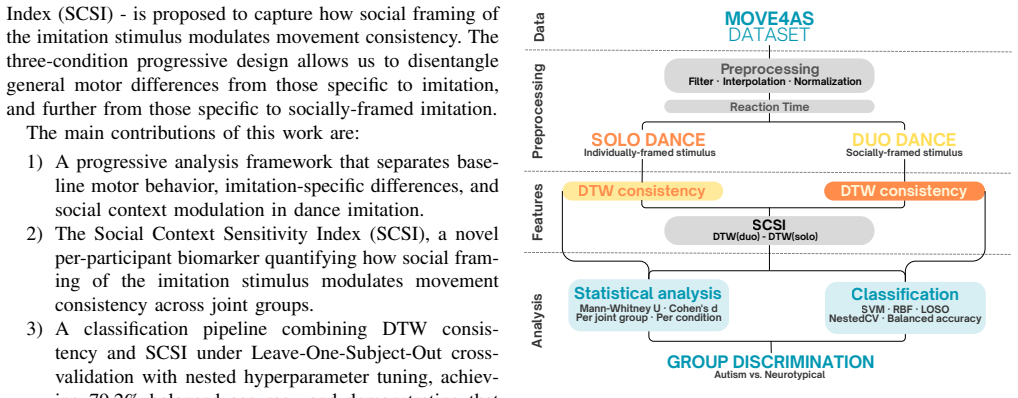
The central object is the Social Context Sensitivity Index (SCSI), a per-participant measure defined as the difference in mean pairwise Dynamic Time Warping (DTW) distance between the socially framed duo imitation condition and the solo imitation condition: $\text{SCSI} = \text{DTW}_{\text{duo}} - \text{DTW}_{\text{solo}}$. DTW consistency itself is computed as the average DTW distance across all unique pairs of a participant's trials within a condition, using the final three seconds of movement, so lower values indicate more stereotyped repetition. The SCSI isolates the within-subject shift in movement variability caused by social framing: a positive value means the participant varied more when the stimulus was social. In this paper the SCSI is the feature that carries the discriminative signal, and it is combined with per-joint-group DTW consistency scores and fed into an SVM classifier with leave-one-subject-out cross-validation.
What would settle it
Show the identical duo animation once with social framing and once with non-social instructions; if the SCSI group difference persists, the result is driven by stimulus properties rather than social context.
Extended reading notes
Core claim
The central finding is that autism-related motor differences appear in the modulation of movement variability by social framing, not in baseline motor ability or solitary imitation performance. In a motion-capture dance-imitation experiment, neurotypical adults produced significantly more variable movement across trials when the imitation stimulus was socially framed, while autistic adults produced nearly identical consistency in solo and duo conditions. The Social Context Sensitivity Index, defined as the difference between duo and solo DTW consistency, showed large group differences in upper (d = -1.107) and lower (d = -1.238) limbs, with autistic participants hovering near zero. The authors interpret this as attenuated top-down modulation of motor execution in response to socially embedded biological motion in autism. A classifier combining DTW consistency and SCSI reached 79.2% balanced accuracy, 75% sensitivity, and 83.3% specificity, and the authors conclude that the dynamic shift between solitary and social contexts is the strongest discriminative signature.
Load-bearing premise
The conclusion stands on the assumption that the solo and duo point-light animations are identical in movement content and differ only in social framing, so the observed contrast is attributed to social context rather than to differences in complexity, attention, or timing.
Editorial extensions
If this is right
- Motor assessments that include only solitary, non-social actions may miss the autism-related signal; the contrast between social and non-social contexts is what carries the discriminative information.
- The SCSI, as a per-participant measure, could serve as the basis for objective screening tools, though larger-sample validation is needed.
- The observation that autistic adults maintain stable movement across contexts suggests that interventions might aim to train flexible motor modulation rather than rote repetition.
- Interactive systems such as virtual agents and assistive robots should account for neurodivergent motor profiles, since social framing changes motor output differently across groups.
Reading between the lines
- We infer that the SCSI's sensitivity to social framing may depend on the stimulus being truly matched in motor demands; a control study that keeps the animation identical and only varies social instructions would separate social adaptation from task difficulty.
- The per-joint-group SCSI values shown in the paper could be used to explore individual differences in which body segments carry social adaptation, potentially revealing subtypes within the autistic group that group-level statistics obscure.
- If the solo-versus-social contrast works for point-light stimuli, the same logic could be extended to other modalities (e.g., a live partner or a more realistic avatar) and to other populations with social-cognition differences, as a transdiagnostic motor marker.
Signed reviews
Editorial analysis
A structured set of objections, weighed in public.
Referee Report
Summary. The paper proposes a computational pipeline for distinguishing autistic from neurotypical adults using 3D motion capture during dance imitation. The authors compute intra-participant Dynamic Time Warping (DTW) consistency scores for solo and socially-framed duo dance conditions, introduce a Social Context Sensitivity Index (SCSI) defined as the difference between duo and solo DTW consistency, and use these features in an SVM classifier with leave-one-subject-out cross-validation. They report that neurotypical adults increase movement variability in the duo condition, especially in upper and lower limbs, whereas autistic adults maintain consistency, with large SCSI effect sizes (d = -1.107 and -1.238) and a balanced classification accuracy of 79.2% for the combined feature set. The authors conclude that social context sensitivity in motor imitation is a robust biomarker of autism-related motor behavior and discuss implications for human-centric and assistive technologies.
Significance. If the central claims hold, the paper would offer a relatively interpretable, low-cost kinematic biomarker for autism that goes beyond single-condition motor assessments and connects social processing to motor variability. The use of DTW-based trial-to-trial consistency is sensible and the pipeline is described in enough detail to be reproduced, including LOSO cross-validation with nested hyperparameter tuning and within-fold standardization. The paper also points to a public dataset (Move4AS), which is a strength for future verification. However, the significance is currently constrained by three load-bearing concerns: the statistical evidence is marginal and uncorrected for multiple comparisons, the participant count in the analyses does not match the reported cohort sizes, and the SCSI is a deterministic function of the two DTW features used in the classifier, so the claim that the social contrast is the 'strongest discriminative signature' is not directly supported by the classification comparison.
major comments (5)
- [IV-C and IV-D] The main statistical claims rest on uncorrected multiple comparisons. Across Table II, Table III, and the SCSI comparisons in Section IV-D, at least 12 Mann-Whitney tests are reported with no multiple-comparison correction. The upper-body duo difference has p = 0.044, and the global duo difference is not significant (p = 0.066). With a Bonferroni correction for 12 tests, the upper-body p-value would not survive, and the SCSI upper/lower p-values (0.007 and 0.015) would be weakened. Please report the total number of tests, apply an appropriate correction (e.g., Benjamini-Hochberg), and interpret borderline effects accordingly. The current wording in Sections IV-D and V, which describes the effects as 'robust' and 'significantly lower,' overstates what the uncorrected p-values support.
- [III-A and Tables I-IV] The participant numbers are inconsistent. Section III-A1 states 20 neurotypical and 14 autistic participants, but all analyses use n = 18 and n = 12, and Table IV references n = 30. No exclusion criteria, missing-data handling, or attrition is described anywhere in the Methods. This mismatch affects every reported p-value, effect size, and classification result. The authors must specify exactly which participants were excluded and why, and confirm that the reported statistics are based on the full usable sample. Without this clarification, the validity of the results cannot be assessed.
- [III-F and Eq. (4)] The claim that the SCSI is the 'strongest discriminative signature' (Section V) is not supported by the classifier comparison. In the 'Solo+Duo' scenario, the feature set includes DTW_solo, DTW_duo, and SCSI = DTW_duo - DTW_solo per joint group. Since SCSI is a deterministic linear combination of the two DTW features, the SVM decision function on (solo, duo, duo-solo) is no more expressive than the same decision function on (solo, duo). Adding SCSI cannot therefore provide independent information, and the improved balanced accuracy over 'Duo only' cannot be attributed specifically to the social contrast. Please perform an ablation that isolates the contrast, for example by comparing a feature set of {DTW_solo, DTW_duo} with one of {DTW_solo, DTW_duo, SCSI}, and also report feature-importance or permutation-based measures that directly evaluate the contribution of the SCSI. Alternatively, reframe the classification result as showing that a combination of both conditions performs better than either alone.
- [I, III-A, and Table I] The central construct validity of the SCSI depends on the assumption that the solo and duo point-light animations differ only in social framing 'without changing the fundamental motor demands of the task' (Section I). No stimulus details are provided: the content of the animations, number of actors, movement speed, visual complexity, or interaction between actors. No manipulation check is reported. The descriptive increase in reaction time for both groups in the duo condition (Table I: clinical 311 to 378 ms, control 321 to 386 ms) is consistent with the duo stimulus being more complex or attentionally demanding for reasons unrelated to social cognition. The authors should provide stimulus properties, perceptual validation of matched motor demands, or at minimum a manipulation check of perceived social presence and difficulty. Without this, the SCSI may measure differential response to task difficulty rather than social adaptation, and the biomarker interpretation is underdetermined.
- [IV-E] The classification result of 79.2% balanced accuracy is presented without any uncertainty quantification or significance test. With n = 30 and LOSO cross-validation, the estimate has substantial variance, and it is not clear whether this performance is significantly above chance for this sample. Please report confidence intervals for balanced accuracy (e.g., via bootstrap over subjects) and a permutation-based p-value for the classifier against the null of no group difference. This is needed to support the strength of the biomarker claim.
minor comments (5)
- [Fig. 2] The scatterplot uses one point per participant, but with n = 12 and n = 18 points are heavily overlapped; consider adding horizontal jitter or a violin/boxplot overlay so the reader can see the distributional shape and the bootstrap confidence intervals.
- [IV-C] In Table III, the core body duo condition shows p = 0.363 but d = -0.588, which is an unusual pairing of a nonsignificant p-value with a moderate effect size; please report the bootstrap confidence interval for this and other effect sizes so the reader can appreciate the uncertainty.
- [III-A1] Please include demographic details (age and sex) for the analyzed subsample after any exclusions, not only for the original cohort, since the reported means and sex ratios in Section III-A1 may not describe the participants in the statistical analyses.
- [III-C] The reaction time threshold tau = mu_base + 3 sigma_base uses a participant-specific baseline; please state whether the baseline window was the same for all trials and report how many trials were excluded by the visual screening or by the reaction-time detection procedure.
- [VI] The conclusion calls the SCSI a 'robust biomarker,' but the paper contains no replication or external validation; consider softening this claim in the abstract and conclusion until confirmatory evidence is available.
Circularity Check
SCSI is constructed as duo-minus-solo DTW difference and then credited as the key discriminative signal in a classifier that already contains both components.
-
self definitional
[Section III-D.2 (Eq. 4), Section III-F (Solo+Duo scenario), Section IV-E (attribution)]
"SCSI=DTW duo−DTW solo (4) ... Solo + Duo: DTW consistency from both conditions combined with SCSI per joint group. ... Rather, it is the dynamic modulation between solitary and social contexts (captured by the SCSI) that serves as the strongest discriminative signature."
By Eq. (4), SCSI is exactly the arithmetic difference of the two DTW consistency features. Feeding {solo DTW, duo DTW, SCSI} to the SVM yields a feature vector carrying no information beyond {solo DTW, duo DTW}, because SCSI is a deterministic linear function of those two inputs. The paper then credits the combined model's performance to the 'dynamic modulation ... captured by the SCSI' and concludes that this contrast is 'the strongest discriminative signature.' Since the contrast was inserted into the classifier by construction as the difference of features already present, that attribution is not an independent empirical finding: the combined model's accuracy is equally explainable by the solo and duo features.
full rationale
The empirical core of the paper is self-contained: DTW consistency is computed from motion-capture trials, SCSI is a defined contrast score, and both the Mann-Whitney group comparisons and the leave-one-subject-out SVM accuracy are computed from participant data rather than from parameters fitted to the labels. The authors' prior Move4AS dataset and descriptor [16] are self-citations, but they only provide the raw data and preprocessing, not the target conclusions, so they are not load-bearing circularity. The concrete reduction-by-construction is in the classification feature set and its interpretation. Eq. (4) defines SCSI = DTW_duo - DTW_solo, and Section III-F adds SCSI to a feature vector that already contains both DTW scores, making the third coordinate redundant. The conclusion that the 'dynamic modulation between solitary and social contexts (captured by the SCSI)' is 'the strongest discriminative signature' therefore restates the feature construction rather than being demonstrated by the combined classifier; the same information is available without SCSI, and the improvement from Duo-only to Solo+Duo is not shown to be attributable to the contrast term. The stimulus-equivalence concern (solo vs duo animations may differ in complexity or attention load) is a validity risk, not a circularity, and is not scored here. Overall score 3: one partial self-definitional attribution, while the central biomarker claim retains independent statistical content.
Assumptions & free parameters
free parameters (4)
- SVM regularization parameter C =
not reported (grid {0.01,0.1,1,10,100})
- SVM RBF kernel width gamma =
not reported (grid {scale, auto, 0.001, 0.01, 0.1})
- Movement onset threshold multiplier =
3 (mean + 3 SD)
- DTW analysis window =
final 3 seconds of the 4 s execution period
assumptions (4)
- domain assumption DTW with Euclidean distance on raw 3D joint coordinates measures trial-to-trial movement consistency (motor noise).
- domain assumption The duo animation is socially-framed and the solo animation is individually-framed, with identical motor demands.
- domain assumption Skeletal standardization and spatial normalization preserve the kinematic variability of interest.
- domain assumption Diagnoses and group assignment (autistic vs neurotypical) are accurate and the groups are otherwise comparable.
invented entities (1)
-
Social Context Sensitivity Index (SCSI)
Cite this review
Pith. "Pith review of Analysis of Motor Signatures of Social Adaptation in Autism for Efficient Human-Centric Systems." pith.science (2026). https://pith.science/paper/N6IQZW55
@misc{pith2026260812548,
  author       = {Pith},
  title        = {Pith review of: Analysis of Motor Signatures of Social Adaptation in Autism for Efficient Human-Centric Systems},
  year         = {2026},
  howpublished = {\url{https://pith.science/paper/N6IQZW55}},
  note         = {Machine review of arXiv:2608.12548}
}
read the original abstract
Dance imitation integrates motor planning, sensorimotor integration, and social cognition, offering a sensitive framework to characterize motor behavior in autism. In this work, we explore a computational analysis framework to identify potential biomarkers that allow the design and development of improved medical and human-machine systems. We analyzed 3D motion capture data from autistic and neurotypical adults performing dance imitation under solo and socially-framed duo conditions. Methodologically, using Dynamic Time Warping, we quantified movement consistency and propose the Social Context Sensitivity Index (SCSI) to measure modulation of variability by social framing. These features were then used on a classifier to discriminate subjects into autistic or neurotypical groups. Results show that neurotypical adults exhibited increased movement variability in socially-framed imitation, especially in upper and lower limbs, whereas autistic adults maintained consistent movement across contexts. Classification achieved 79.2% balanced accuracy in distinguishing groups. These findings suggest that social context sensitivity in motor imitation constitutes a robust biomarker of autism-related motor behavior, highlighting the importance of social modulation in motor assessments and informing the development of inclusive human-centric technologies.
Figures


Reference graph
Works this paper leans on
-
[1]
Autism spectrum disorders: Diagnosis and treatment,
R. Lordan, C. Storni, and C. A. de Benedictis, “Autism spectrum disorders: Diagnosis and treatment,”Autism Spectrum Disorders, pp. 17–32, 8 2021
work page 2021
-
[2]
A. Vabalas, E. Gowen, E. Poliakoff, and A. J. Casson, “Applying ma- chine learning to kinematic and eye movement features of a movement imitation task to predict autism diagnosis,”Scientific Reports, vol. 10, 5 2020
work page 2020
-
[3]
R. Simeoli, A. Rega, M. Cerasuolo, R. Nappo, and D. Marocco, “Using machine learning for motion analysis to early detect autism spectrum disorder: A systematic review,”Review Journal of Autism and Developmental Disorders, 3 2024
work page 2024
-
[4]
Motor coordination in autism spectrum disorders: A synthesis and meta-analysis,
K. A. Fournier, C. J. Hass, S. K. Naik, N. Lodha, and J. H. Cau- raugh, “Motor coordination in autism spectrum disorders: A synthesis and meta-analysis,”Journal of Autism and Developmental Disorders, vol. 40, pp. 1227–1240, 10 2010
work page 2010
-
[5]
L. R. Dowell, E. M. Mahone, and S. H. Mostofsky, “Associations of postural knowledge and basic motor skill with dyspraxia in autism: implication for abnormalities in distributed connectivity and motor learning,”Neuropsychology, vol. 23, pp. 563–570, 9 2009
work page 2009
-
[6]
A scoping review of the motor impairments in autism spectrum disorder,
S. H. da Silva, M. R. Felippin, L. de Oliveira Medeiros, C. Hedin- Pereira, and A. A. Nogueira-Campos, “A scoping review of the motor impairments in autism spectrum disorder,”Neuroscience and Biobehavioral Reviews, vol. 169, 1 2025
work page 2025
-
[7]
Motor abilities in autism: a review using a computational context,
E. Gowen and A. Hamilton, “Motor abilities in autism: a review using a computational context,”Journal of autism and developmental disorders, vol. 43, pp. 323–344, 2 2013
work page 2013
-
[8]
A two-stage frame- work for neural processing of biological motion,
J. V . Duarte, R. Abreu, and M. Castelo-Branco, “A two-stage frame- work for neural processing of biological motion,”NeuroImage, vol. 259, 10 2022
work page 2022
Show all 39 references
-
[9]
Imitation from a joint action perspective,
L. McEllin, G. Knoblich, and N. Sebanz, “Imitation from a joint action perspective,”Mind and Language, vol. 33, pp. 342–354, 9 2018
2018
-
[10]
Gesture imitation performance and visual exploration in young children with autism spectrum disorder,
K. Latr `eche, N. Kojovic, I. Pittet, S. Natraj, M. Franchini, I. M. Smith, and M. Schaer, “Gesture imitation performance and visual exploration in young children with autism spectrum disorder,”Journal of Autism and Developmental Disorders, 2024
2024
-
[11]
Recognizing biological motion and emotions from point-light displays in autism spectrum disorders,
E. Nackaerts, J. Wagemans, W. Helsen, S. P. Swinnen, and N. Wen- deroth, “Recognizing biological motion and emotions from point-light displays in autism spectrum disorders,”PLoS ONE, vol. 7, p. 44473, 2012
2012
-
[12]
Motor development and motor resonance difficulties in autism: Rel- evance to early intervention for language and communication skills,
J. P. McCleery, N. A. Elliott, D. S. Sampanis, and C. A. Stefanidou, “Motor development and motor resonance difficulties in autism: Rel- evance to early intervention for language and communication skills,” Frontiers in Integrative Neuroscience, vol. 7, 4 2013
2013
-
[13]
Spatial temporal graph convolutional networks for skeleton-based action recognition,
S. Yan, Y . Xiong, and D. Lin, “Spatial temporal graph convolutional networks for skeleton-based action recognition,”32nd AAAI Conference on Artificial Intelligence, AAAI 2018, pp. 7444–7452, 1
2018
-
[14]
Understanding of machine learning with deep learning: Architectures, workflow, applications and future directions,
M. M. Taye, “Understanding of machine learning with deep learning: Architectures, workflow, applications and future directions,”Comput- ers, vol. 12, 4 2023
2023
-
[15]
Motion analysis in autism: Quantification and classification of dancing and walking tasks,
L. Pereira, T. Sousa, R. Vig ´ario, M. Castelo-Branco, and J. R. Paulo, “Motion analysis in autism: Quantification and classification of dancing and walking tasks,” inProceedings of the 8th IEEE Portuguese Meeting on Bioengineering (ENBENG 2025). IEEE, 2025
2025
-
[16]
A multimodal dataset addressing motor function in autism,
J. R. Paulo, T. Sousa, J. Perdiz, L. Pereira, M. Vasen, S. Mouga, G. Pires, and M. Castelo-Branco, “A multimodal dataset addressing motor function in autism,”Scientific Data, vol. 12, 6 2025
2025
-
[17]
A novel distance measure based on dynamic time warping to improve time series classification,
Y . Liu, Y . A. Zhang, M. Zeng, and J. Zhao, “A novel distance measure based on dynamic time warping to improve time series classification,” Information Sciences, vol. 656, p. 119921, 1 2024
2024
-
[18]
Subsequence dynamic time warping as a method for robust step segmentation using gyroscope signals of daily life activities,
J. Barth, C. Oberndorfer, P. Kugler, D. Schuldhaus, J. Winkler, J. Klucken, and B. M. Eskofier, “Subsequence dynamic time warping as a method for robust step segmentation using gyroscope signals of daily life activities,” 2013
2013
-
[19]
A method for selecting the optimal warping path of dynamic time warping in gait analysis,
H.-S. Lee, J.-H. Lee, and K.-R. Kim, “A method for selecting the optimal warping path of dynamic time warping in gait analysis,” 2024
2024
-
[20]
Observing and participating in social interactions: Action perception and action control across the autistic spectrum,
D. Bolis and L. Schilbach, “Observing and participating in social interactions: Action perception and action control across the autistic spectrum,”Developmental Cognitive Neuroscience, vol. 29, pp. 168– 175, 1 2018
2018
-
[21]
Commu- nicative intent modulates production and comprehension of actions and gestures: A kinect study,
J. P. Trujillo, I. Simanova, H. Bekkering, and A. ¨Ozy¨urek, “Commu- nicative intent modulates production and comprehension of actions and gestures: A kinect study,”Cognition, vol. 180, pp. 38–51, 11 2018
2018
-
[22]
Imitation, empathy, and mirror neurons,
M. Iacoboni, “Imitation, empathy, and mirror neurons,”Annual review of psychology, vol. 60, pp. 653–670, 1 2009
2009
-
[23]
Impairment of actions chains in autism and its possible role in intention understanding,
L. Cattaneo, M. Fabbri-Destro, S. Boria, C. Pieraccini, A. Monti, G. Cossu, and G. Rizzolatti, “Impairment of actions chains in autism and its possible role in intention understanding,”Proceedings of the National Academy of Sciences of the United States of America, vol. 104, p...
2007
-
[24]
Reduced mimicry to virtual reality avatars in autism spectrum disorder,
P. A. Forbes, X. Pan, and A. F. Antonia, “Reduced mimicry to virtual reality avatars in autism spectrum disorder,”Journal of Autism and Developmental Disorders, vol. 46, pp. 3788–3797, 12 2016
2016
-
[25]
Biological motion perception in autism spectrum disorder: A meta-analysis,
G. K. Todorova, R. E. M. B. Hatton, and F. E. Pollick, “Biological motion perception in autism spectrum disorder: A meta-analysis,” Molecular Autism, vol. 10, 12 2019
2019
-
[26]
From movement kinematics to social cognition: the case of autism
J. Cook, “From movement kinematics to social cognition: the case of autism.”
-
[27]
R., Sousa, T., Perdiz, J., Pereira, L., Vasen, M., Mouga, S., Pires, G., and Castelo-Branco, M
Paulo, J. R., Sousa, T., Perdiz, J., Pereira, L., Vasen, M., Mouga, S., Pires, G., and Castelo-Branco, M. Move4AS: A Multimodal Dataset Addressing Motor Function in Autism.figsharehttps://doi.org/10.6084/ m9.figshare.28296518
-
[28]
The moving pose: An efficient 3d kinematics descriptor for low-latency action recognition and detection,
M. Zanfir, M. Leordeanu, and C. Sminchisescu, “The moving pose: An efficient 3d kinematics descriptor for low-latency action recognition and detection,” inProceedings of the IEEE International Conference on Computer Vision. Institute of Electrical and Electronics Engineers Inc...
2013
-
[29]
Effective and efficient similarity searching in motion capture data,
J. Sedmidubsky, P. Elias, and P. Zezula, “Effective and efficient similarity searching in motion capture data,”Multimedia Tools and Applications, vol. 77, pp. 12 073–12 094, 5 2017
2017
-
[30]
How can you best measure reaction times?
E. Brenner and J. B. Smeets, “How can you best measure reaction times?”Journal of Motor Behavior, vol. 51, pp. 486–495, 9 2019
2019
-
[31]
Dynamic time warping in classification and selection of motion capture data,
A. Switonski, H. Josinski, and K. Wojciechowski, “Dynamic time warping in classification and selection of motion capture data,”Multi- dimensional Systems and Signal Processing, vol. 30, pp. 1437–1468, 7 2019
2019
-
[32]
Enhanced motor noise in an autism subtype with poor motor skills,
V . Mandelli, I. Landi, S. B. Ceccarelli, M. Molteni, M. Nobile, A. D’Ausilio, L. Fadiga, A. Crippa, and M. V . Lombardo, “Enhanced motor noise in an autism subtype with poor motor skills,”Molecular Autism, vol. 15, p. 36, 12 2024
2024
-
[33]
Metacognition and cognitive flexibility in autis- tic and neurotypically-developing populations,
M. Ordin, N. Barbarroja, L. Polyanskaya, H. M. Manrique, and M. Castelo-Branco, “Metacognition and cognitive flexibility in autis- tic and neurotypically-developing populations,”Brain and behavior, vol. 15, 7 2025
2025
-
[34]
Social top-down response modulation (storm): a model of the control of mimicry in social interaction,
Y . Wang and A. F. de Hamilton, “Social top-down response modulation (storm): a model of the control of mimicry in social interaction,” Frontiers in Human Neuroscience, vol. 6, p. 153, 6 2012
2012
-
[35]
The enactive mind, or from actions to cognition: lessons from autism,
A. Klin, W. Jones, R. Schultz, and F. V olkmar, “The enactive mind, or from actions to cognition: lessons from autism,”Philosophical transactions of the Royal Society of London. Series B, Biological sciences, vol. 358, pp. 345–360, 2 2003
2003
-
[36]
Computational measurement of motor imitation and imitative learning differences in autism spectrum disorder,
C. J. Zampella, E. Sariyanidi, A. G. Hutchinson, G. K. Bartley, R. T. Schultz, and B. Tunc ¸, “Computational measurement of motor imitation and imitative learning differences in autism spectrum disorder,” in ICMI 2021 Companion - Companion Publication of the 2021 In- ternation...
2021
-
[37]
Introducing 3dcnn resnets for asd full-body kinematic assessment: A comparison with hand-crafted features,
A. Altozano, M. E. Minissi, M. Alca ˜niz, and J. Mar ´ın-Morales, “Introducing 3dcnn resnets for asd full-body kinematic assessment: A comparison with hand-crafted features,”Expert Systems with Appli- cations, vol. 270, 1 2025
2025
-
[38]
Early detection of autism spectrum disorder: gait deviations and machine learning,
U. J. Ganai, A. Ratne, B. Bhushan, and K. S. Venkatesh, “Early detection of autism spectrum disorder: gait deviations and machine learning,”Scientific Reports, vol. 15, 1 2025
2025
-
[2018]
Available: http://arxiv.org/abs/1801.07455
[Online]. Available: http://arxiv.org/abs/1801.07455
Reviewed August 16, 2026 · model on record in the stance chip above.
Discussion (0). Continue with ORCID to comment.