REVIEW 2 major objections 4 minor 62 references
Pulse Engineering of Quantum Many-Body Dynamics: Emergent Scar States, Entanglement, and Nonstabilizerness
T0 review · 2 major / 4 minor · reviewed 2026-08-16 · deepseek-v4-flash
Pith's one-line read A periodic pulse sequence deforms a chaotic Heisenberg chain into the ZX chain, yielding exact atypical eigenstates in both limits: unit-entanglement valence-bond superpositions at $\beta=0$ and maximally entangled rainbow scar stabilizer…
desk verdict The claimed rainbow-scar eigenstates of H_ZX fail already at L=3, sinking the abstract's main claim, though the XXX-limit analysis is sound enough to salvage. read the letter →
The pith
A machine-rendered reading of the paper's core claim, the machinery that carries it, and where it could break.
The reading
What carries the argument
The load-bearing object is the effective Hamiltonian $H_{\mathrm{target}}=(1-\beta)H_{XXX}+2\beta H_{ZX}$, obtained from the zeroth-order average-Hamiltonian expansion of a three-pulse sequence of Clifford rotations interleaved with evolution under $H_{XXX}$. For the XXX-limit eigenstates, the key mechanism is an invariant Bell-pair subspace: basis states $|\phi_n\rangle$ each contain one singlet between mirror-symmetric sites and product states elsewhere, and within this subspace $H_{XXX}$ becomes a tridiagonal matrix that diagonalizes exactly, yielding the energies and wavefunctions of the $L-1$ plateau states. For the ZX limit, the key ansatz is the alternating-Bell-pair product state of Eqs. (46)-(47), whose mirror-symmetric entanglement pattern is claimed to survive action of the nearest-neighbor ZX couplings. The diagnostics used throughout are the half-chain von Neumann entropy $S$ and the stabilizer Rényi entropy $M$, which together characterize a state as atypical, entangled, and either stabilizer or magic.
What would settle it
Take the $L=3$ ZX Hamiltonian of Eq. (12), apply it to $|\chi_1\rangle=|\Psi^-\rangle_{13}|-\rangle_2$ from Eq. (42), and compute the squared norm of the component orthogonal to $|\chi_1\rangle$; any nonzero value shows this state is not an exact eigenstate. The same check can be repeated for general odd $L$ using Eqs. (46)-(47).
Extended reading notes
Core claim
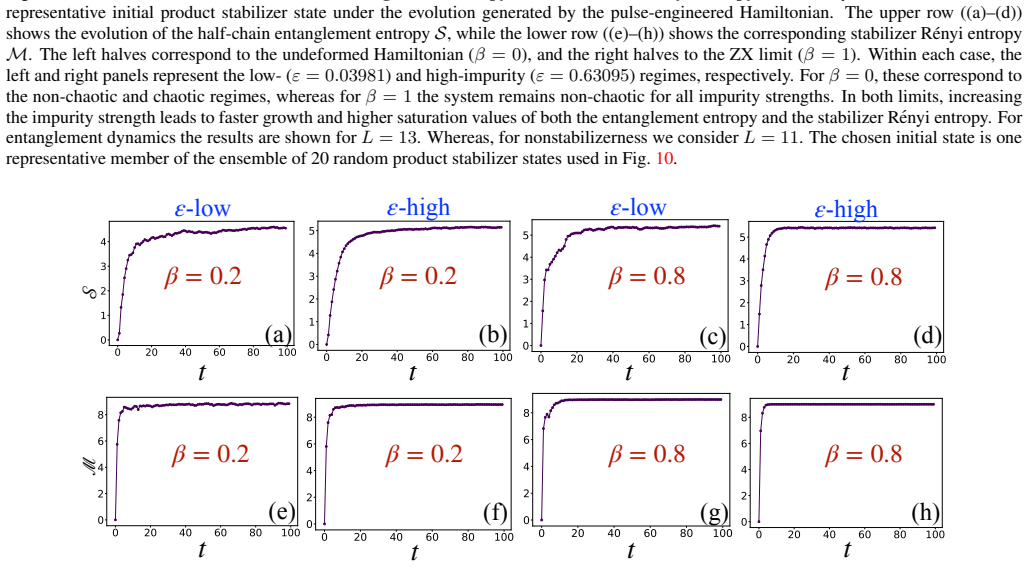
On the paper's own terms, the central discovery is that the one-parameter family of pulse-engineered Hamiltonians $H_{\mathrm{target}}(\beta)$ hosts two qualitatively different families of analytically tractable non-thermal eigenstates. At $\beta=0$, for odd system size $L$, there are $L-1$ eigenstates in the single- and $(L-1)$-excitation sectors, with energies $E_m=(L-5)+4\cos\big((2m+1)\pi/L\big)\pm\epsilon$ and half-chain entanglement entropy exactly $S=1$; their wavefunctions are coherent superpositions of mirror-symmetric long-range Bell pairs, and their stabilizer Rényi entropy grows with $L$ (vanishing at $L=3$). At $\beta=1$, the ZX Hamiltonian has two eigenstates of alternating-Bell-pair form with a central qubit in the $|\pm\rangle$ basis; they have maximal half-chain entanglement growing linearly with $L$ and zero stabilizer Rényi entropy, which the paper identifies as rainbow scar states. In between, the exact high-energy plateaus are replaced by a hierarchy of approximate entanglement plateaus in the low-energy spectrum. The paper also claims that the chaotic level statistics of the XXX chain survive under pulse engineering for $0<\beta<1$, while the dynamical generation of entanglement and nonstabilizerness becomes almost independent of the impurity strength, so spectral chaos and quantum-resource generation are only partially coupled.
Load-bearing premise
The proposed rainbow states are products of alternating two-qubit maximally entangled pairs between mirror-symmetric sites with one central spin in the $|\pm\rangle$ state, and the argument requires that the nearest-neighbor ZX Hamiltonian acting on such a state returns the same state up to a number, with every bond term cancelling or staying inside that subspace.
Editorial extensions
If this is right
- At $\beta=0$, the $L-1$ exact plateau states give an analytically controlled example of non-thermal excited eigenstates inside an otherwise chaotic spectrum, with half-chain entanglement exactly 1 for every odd $L$.
- The Clifford equivalence of these states means one can convert any one of them into another by Clifford circuits, so a single preparation plus Clifford operations yields the whole family.
- At $\beta=1$, the two rainbow scar states are exact stabilizer states with volume-law entanglement, so they offer a scalable, magic-free entanglement resource across the chain.
- For intermediate $\beta$, because entanglement and magic production are nearly impurity-independent while level statistics still differ, experiments can generate predictable resources without tuning into a chaotic regime.
- The hierarchy of approximate entanglement plateaus in low-energy sectors indicates that additional structured, partially non-thermal eigenstates persist under deformation, not just in the two endpoints.
Reading between the lines
- A direct experimental signature of the rainbow claim would be near-perfect revival of the Bell-pair product state under the pulse-engineered dynamics; the paper does not compute this survival probability, but it follows from exact eigenstate status.
- The reported decoupling suggests that the interaction structure set by the pulse sequence, rather than the local impurity, controls resource generation; replacing the impurity with disorder or moving it off-center would test whether the impurity-independent plateau persists.
- Because the three-pulse protocol uses only Clifford operations, the same construction could be applied to other base Hamiltonians with different symmetries to generate new families of stabilizer scar states; this generalization is not explored in the paper.
Signed reviews
Editorial analysis
A structured set of objections, weighed in public.
Referee Report
Summary. The manuscript introduces a pulse-engineering protocol, based on average Hamiltonian theory, that interpolates between a chaotic XXX spin chain with a local impurity and a ZX Hamiltonian with mixed σzσx couplings. It claims exact atypical eigenstates in the XXX limit with half-chain entanglement entropy S=1 and size-dependent stabilizer Rényi entropy, approximate entanglement plateaus for intermediate pulse strengths, and a pair of exact long-range-entangled stabilizer eigenstates ('rainbow scars') in the fully pulse-engineered ZX limit. It further reports numerical evidence that pulse engineering partially decouples spectral chaos from the dynamical generation of entanglement and nonstabilizerness.
Significance. The XXX-limit construction is a genuine strength: the reduction to the single-excitation subspace is explicit, the eigenvalues are derived in closed form, and the validity of the leading-order Magnus approximation is checked numerically in Appendix B. The pulse-engineering interpolation idea is appealing and the dynamical-resource results could be interesting. However, the central ZX-limit claim is disproved by direct algebra already at L=3, so the advertised exact rainbow-scar eigenstates do not exist for the Hamiltonian of Eq. (12). Because that claim is a headline result of the abstract and is presented as exact, the paper cannot be accepted in its present form.
major comments (2)
- [IV.B.3, Eqs. (42) and (46)] The claimed exact rainbow eigenstates fail already at L=3. Acting with H_ZX of Eq. (12) (setting J=1) on |χ1> of Eq. (42), |χ1>=(|010>−|011>−|100>+|101>)/2, gives H_ZX|χ1> = 1/2[(1+ε)|000> + (1−ε)|001> + |010> − |011> − |101> + (ε−1)|111> − ε|110>]. This vector has non-zero weight on |000>, |001>, |110>, and |111>, none of which appear in |χ1>, and it is not proportional to |χ1> for any ε. Since Eq. (42) is explicitly the L=3 representative of the general family in Eqs. (46)–(47), the universal claim that these alternating Bell-pair states are exact stabilizer eigenstates of H_ZX is false.
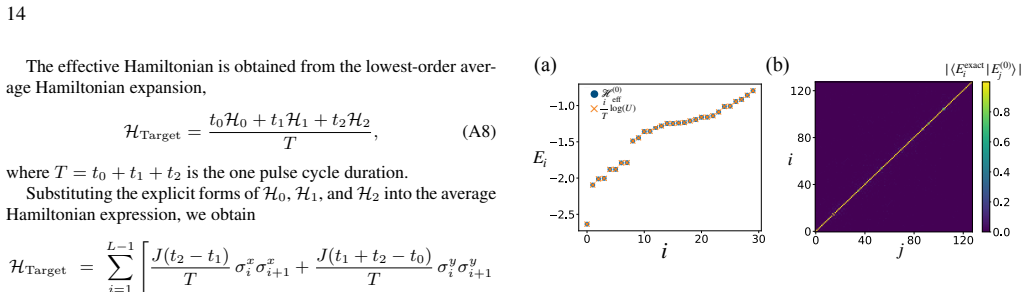
- [Appendix A, Eq. (A12), and main text Eq. (11)] The target Hamiltonian is defined inconsistently. Main-text Eq. (11) sets f_HXXX(β)=1−β and f_HZX(β)=2β, while Appendix A Eq. (A12) states H_Target=(1−2β)H_XXX+2βH_ZX. Moreover, inserting the pulse durations of Eq. (13) into the average-Hamiltonian expression (A9) gives H_Target=(t2/T)[(1−β)H_XXX+2βH_ZX] with t2/T=1/(1+3β), so Eq. (11) also omits a β-dependent global prefactor. The numerical results for 0<β<1 depend on which of these expressions is actually used; the paper should specify the precise Hamiltonian and correct the inconsistency.
minor comments (4)
- [After Eq. (13)] The text states that at β=1 'we obtain the ZX Hamiltonian,' but Eq. (11) gives H_Target=2H_ZX and the pulse durations give an additional prefactor t2/T=1/4; the convention for dropping global factors should be stated explicitly.
- [Appendix C, Eq. (C1)] The notation such as |1>_{2345689(10)(11)(12)} is ambiguous; the states should be written with explicit tensor products or a clear sublabel convention.
- [IV.B.1] The 'plateau' in the stabilizer Rényi entropy is not a constant value across system sizes (M=0 at L=3 and M=1.25154 at L=5); the text should clarify that the plateau refers to the energy-resolved distribution, not to the value of M versus L.
- [Figure 2 caption] The symmetry-sector restrictions differ between β=0 and β=1, and for β=0 a further sector restriction is applied; the level-spacing comparison would be more transparent if the same sector choice were used or the effect of the restrictions were discussed.
Circularity Check
No circular reduction found: the effective-Hamiltonian derivation and the XXX-limit eigenstate construction are self-contained, and the flagged issues are unsupported exact-eigenstate claims and an internal coefficient typo rather than circularity.
full rationale
The paper's central derivations do not reduce to their own inputs. The target Hamiltonian of Eq. (11) is obtained from a leading-order Magnus/average-Hamiltonian calculation in Appendix A, with the pulse intervals fixed by the stated parameterization and no quantity fitted to the later predicted eigenstate structure; Appendix B then independently benchmarks this truncation against the exact Floquet operator. The XXX-limit plateau states are derived by explicitly constructing an invariant single-excitation and (L-1)-excitation Bell-pair subspace, writing the action of H_XXX on that subspace, and diagonalizing the resulting finite effective Hamiltonian (Eqs. (22)-(37)); this is a standard invariant-subspace diagonalization, not an assumption of the target states. The only self-citation, Ref. [60], is used for the non-load-bearing remark that rainbow states have area-law entanglement under a different bipartition; it is external, peer-reviewed, and not used to force any of the paper's derived claims. The ZX-limit rainbow states in Eqs. (42)-(46) are asserted by extrapolating a pattern from small-L examples rather than proved; if incorrect, that is a correctness or omitted-proof concern, not a circular reduction. Similarly, the inconsistency between the main-text Eq. (11) coefficient (1-beta) and Appendix A Eq. (A12) coefficient (1-2beta) is an internal-consistency error. Under the rule that circularity requires a quoted equation or fitted parameter that makes the predicted quantity equal to its input by construction, no circular step is present.
Assumptions & free parameters
free parameters (3)
- J=0.6 =
0.6
- ε values =
0.03981 and 0.63095
- β interpolation parameter =
0 to 1
assumptions (4)
- standard math Average Hamiltonian theory truncated at leading order gives the effective Hamiltonian for the pulse sequence.
- domain assumption The pulse operations are ideal Clifford unitaries with no imperfections.
- ad hoc to paper The alternating Bell-pair product states in Eqs. (42)-(46) are eigenstates of H_ZX.
- domain assumption Level statistics are computed in the inversion-symmetric sector and for β=0 in a fixed particle sector, and these sectors are representative of the full model.
Cite this review
Pith. "Pith review of Pulse Engineering of Quantum Many-Body Dynamics: Emergent Scar States, Entanglement, and Nonstabilizerness." pith.science (2026). https://pith.science/paper/YNVJSSIC
@misc{pith2026260812559,
  author       = {Pith},
  title        = {Pith review of: Pulse Engineering of Quantum Many-Body Dynamics: Emergent Scar States, Entanglement, and Nonstabilizerness},
  year         = {2026},
  howpublished = {\url{https://pith.science/paper/YNVJSSIC}},
  note         = {Machine review of arXiv:2608.12559}
}
read the original abstract
Understanding and coherently controlling the properties of interacting quantum many-body systems is a central challenge in non-equilibrium quantum physics. While in the past decades, a wide range of many-body Hamiltonians have been introduced to study quantum chaos, atypical eigenstates, and quantum resources, systematically engineering and continuously tuning these properties within a single microscopic model remains largely unexplored. Here, we employ a pulse engineering scheme to construct an effective Hamiltonian that continuously interpolates between a chaotic Heisenberg (XXX) chain with a local impurity and the ZX Hamiltonian. Along this interpolation, we identify several families of analytically tractable atypical eigenstates embedded in the excited-state spectrum with distinct entanglement and nonstabilizerness properties. In the XXX limit, these states exhibit exact plateaus in both entanglement and stabilizer R\'enyi entropy and correspond to coherent superpositions of long-range valence-bond solid (VBS) states. As the pulse strength increases, the effective Hamiltonians exhibit a hierarchy of new set of approximate entanglement plateaus in the low-energy spectrum. Interestingly, in the fully pulse-engineered ZX limit, we uncover a distinct pair of long-range entangled stabilizer eigenstates, corresponding to rainbow scar states. We further show that pulse engineering preserves the distinct chaotic and non-chaotic regimes of the original model, while that is largely absent in the dynamical generation of entanglement and nonstabilizerness. The pulse-engineered models generate nearly identical quantum resources in both regimes, revealing a partial decoupling between quantum chaos and quantum-resource generation. Our results establish pulse engineering as a versatile framework for generating many-body Hamiltonians with structured eigenstates and tunable quantum resources.
Figures


Figures from the paper (8 more)



Reference graph
Works this paper leans on
-
[50]
C. J. Turner, A. A. Michailidis, D. A. Abanin, M. Serbyn, and Z. Papi´c, Weak ergodicity breaking from quantum many-body scars, Nature Physics14, 745–749 (2018)
2018
-
[1]
Although, spectral statistics shown in Fig. 2 indicates 5 ⟨r⟩ ε (a) s p(s) β=0.0 β=0.0 s p(s) p(s) s p(s) β=0.2 s p(s) s p(s) β=0.2 β=0.8 s p(s) s p(s) β=0.8 s β=1.0 β=1.0 (b) (c) (d) (e) (f) (g) (h) (i) Figure 2.Level statistics under pulse engineering.(a) Mean level-spacing ratio⟨r⟩as a function of impurity strengthεfor different values of the parameter...
-
[2]
L. M. K. Vandersypen and I. L. Chuang, Nmr techniques for quantum control and computation, Rev. Mod. Phys.76, 1037 (2005)
2005
-
[3]
U. Haeberlen and J. S. Waugh, Coherent averaging effects in magnetic resonance, Phys. Rev.175, 453 (1968)
work page 1968
-
[4]
Goldman and J
N. Goldman and J. Dalibard, Periodically driven quantum sys- tems: Effective hamiltonians and engineered gauge fields, Phys. Rev. X4, 031027 (2014)
2014
-
[5]
The eigen- states of this Hamiltonian are exactly the (L−1) 2 = 2atypical eigenstates with entanglement entropyS= 1, as defined in Eqs. (19) and (21). A pattern of theH eff XXX emerges when we look at higherL also. For instance, forL= 7, we can construct3such ba- sis vectors|ϕ 1⟩,|ϕ 2⟩,|ϕ 3⟩. The action of the Hamiltonian on these basis state is given by ...
-
[6]
L. D’Alessio and A. Polkovnikov, Many-body energy localiza- tion transition in periodically driven systems, Annals of Physics 333, 19 (2013)
work page 2013
-
[7]
Bukov, L
M. Bukov, L. D’Alessio, and A. Polkovnikov, Universal high- frequency behavior of periodically driven systems: from dynamical stabilization to floquet engineering, Advances in Physics64, 139 (2015)
2015
Show all 62 references
-
[8]
Poudel, G
A. Poudel, G. Ortiz, and L. Viola, Dynamical generation of floquet majorana flat bands in s-wave superconductors, Euro- physics Letters110, 17004 (2015)
2015
-
[9]
Oka and S
T. Oka and S. Kitamura, Floquet engineering of quantum mate- rials, Annual Review of Condensed Matter Physics10, 387–408 (2019)
2019
-
[10]
M. S. Rudner and N. H. Lindner, The floquet engi- neer’s handbook, arXiv preprint arXiv:2003.08252 (2020), arXiv:2003.08252 [cond-mat.mes-hall]
2020 arXiv
-
[11]
A. Sen, D. Sen, and K. Sengupta, Analytic approaches to peri- odically driven closed quantum systems: methods and applica- tions, Journal of Physics: Condensed Matter33, 443003 (2021)
2021
-
[12]
Viola, E
L. Viola, E. Knill, and S. Lloyd, Dynamical decoupling of open quantum systems, Phys. Rev. Lett.82, 2417 (1999)
1999
-
[13]
Khodjasteh and D
K. Khodjasteh and D. A. Lidar, Fault-tolerant quantum dynam- ical decoupling, Phys. Rev. Lett.95, 180501 (2005)
2005
-
[14]
G. S. Uhrig, Keeping a quantum bit alive by optimizedπ-pulse sequences, Phys. Rev. Lett.98, 100504 (2007)
2007
-
[15]
Khodjasteh and L
K. Khodjasteh and L. Viola, Dynamical quantum error correc- tion of unitary operations with bounded controls, Phys. Rev. A 80, 032314 (2009)
2009
-
[16]
J. Du, X. Rong, N. Zhao, Y . Wang, J. Yang, and R. Liu, Pre- serving electron spin coherence in solids by optimal dynamical decoupling, Nature461, 1265 (2009)
2009
-
[17]
Suter and G
D. Suter and G. A. ´Alvarez, Colloquium: Protecting quantum information against environmental noise, Rev. Mod. Phys.88, 041001 (2016)
2016
-
[18]
J. Choi, H. Zhou, H. S. Knowles, R. Landig, S. Choi, and M. D. Lukin, Robust dynamic hamiltonian engineering of many-body spin systems, Phys. Rev. X10, 031002 (2020)
2020
-
[19]
Sahay, F
R. Sahay, F. Machado, B. Ye, C. R. Laumann, and N. Y . Yao, Emergent ergodicity at the transition between many-body local- ized phases, Phys. Rev. Lett.126, 100604 (2021)
2021
-
[20]
Kranzl, A
F. Kranzl, A. Lasek, M. K. Joshi, A. Kalev, R. Blatt, C. F. Roos, and N. Yunger Halpern, Experimental observation of thermal- ization with noncommuting charges, PRX Quantum4, 020318 (2023)
2023
-
[21]
Nandy, M
S. Nandy, M. Schmitt, M. Bukov, and Z. Lenar ˇciˇc, Recon- structing effective hamiltonians from nonequilibrium thermal and prethermal steady states, Phys. Rev. Res.6, 023160 (2024)
2024
-
[22]
Brinkmann, Introduction to average hamiltonian theory
A. Brinkmann, Introduction to average hamiltonian theory. i. 17 basics, Concepts in Magnetic Resonance Part A45, e21414 (2016)
2016
-
[23]
M. J. Biercuk, H. Uys, A. P. VanDevender, N. Shiga, W. M. Itano, and J. J. Bollinger, Optimized dynamical decoupling in a model quantum memory, Nature458, 996 (2009)
2009
-
[24]
Khodjasteh, D
K. Khodjasteh, D. A. Lidar, and L. Viola, Arbitrarily accurate dynamical control in open quantum systems, Phys. Rev. Lett. 104, 090501 (2010)
2010
-
[25]
J. R. West, D. A. Lidar, B. H. Fong, and M. F. Gyure, High fidelity quantum gates via dynamical decoupling, Phys. Rev. Lett.105, 230503 (2010)
2010
-
[26]
C. Wu, C. Sun, J.-L. Chen, and X. Yi, Decoherence-protected implementation of quantum gates, Phys. Rev. Appl.19, 034069 (2023)
2023
-
[27]
P. Z. Zhao, T. Chen, S. Liu, and J. Gong, Higher-order pro- tection of quantum gates: Hamiltonian engineering coordinated with dynamical decoupling, Phys. Rev. A111, 022621 (2025)
2025
-
[28]
J. P. Peterson, R. S. Sarthour, and R. Laflamme, Enhancing quantum control by improving shaped-pulse generation, Phys. Rev. Appl.13, 054060 (2020)
2020
-
[29]
Fraval, M
E. Fraval, M. J. Sellars, and J. J. Longdell, Dynamic decoher- ence control of a solid-state nuclear-quadrupole qubit, Phys. Rev. Lett.95, 030506 (2005)
2005
-
[30]
Frydrych, G
H. Frydrych, G. Alber, and P. Ba ˇzant, Constructing pauli pulse schemes for decoupling and quantum simulation, Physical Re- view A89, 10.1103/physreva.89.022320 (2014)
2014 doi
-
[31]
Louzon, G
D. Louzon, G. T. Genov, N. Staudenmaier, F. Frank, J. Lang, M. L. Markham, A. Retzker, and F. Jelezko, Robust noise sup- pression and quantum sensing by continuous phased dynamical decoupling, Phys. Rev. Lett.134, 120802 (2025)
2025
-
[32]
A. F. Brown and D. A. Lidar, Efficient chromatic-number-based multiqubit decoherence and crosstalk suppression, PRX Quan- tum6, 020354 (2025)
2025
-
[34]
J. Naji, R. Jafari, L. Zhou, and A. Langari, Engineering flo- quet dynamical quantum phase transitions, Phys. Rev. B106, 094314 (2022)
2022
-
[35]
Jafari, A
R. Jafari, A. Akbari, U. Mishra, and H. Johannesson, Floquet dynamical quantum phase transitions under synchronized peri- odic driving, Phys. Rev. B105, 094311 (2022)
2022
-
[36]
D. Das, S. R. Das, A. Kundu, and K. Sengupta, Dynamical phases of higher dimensional Floquet CFTs, SciPost Phys.20, 045 (2026)
2026
-
[37]
Zhang, P
J. Zhang, P. W. Hess, A. Kyprianidis, P. Becker, A. Lee, J. Smith, G. Pagano, I.-D. Potirniche, A. C. Potter, A. Vish- wanath,et al., Observation of a discrete time crystal, Nature 543, 217 (2017)
2017
-
[38]
Randall, C
J. Randall, C. E. Bradley, F. V . van der Gronden, A. Galicia, M. H. Abobeih, M. Markham, D. J. Twitchen, F. Machado, N. Y . Yao, and T. H. Taminiau, Many-body–localized discrete time crystal with a programmable spin-based quantum simula- tor, Science374, 1474 (2021)
2021
-
[39]
M. P. Zaletel, M. Lukin, C. Monroe, C. Nayak, F. Wilczek, and N. Y . Yao, Colloquium: Quantum and classical discrete time crystals, Rev. Mod. Phys.95, 031001 (2023)
2023
-
[40]
Weitenberg and J
C. Weitenberg and J. Simonet, Tailoring quantum gases by flo- quet engineering, Nature Physics17, 1342–1348 (2021)
2021
-
[41]
L. B. Nguyen, Y . Kim, A. Hashim, N. Goss, B. Marinelli, B. Bhandari, D. Das, R. K. Naik, J. M. Kreikebaum, A. N. Jor- dan, D. I. Santiago, and I. Siddiqi, Programmable heisenberg in- teractions between floquet qubits, Nature Physics20, 240–246 (2024)
2024
-
[42]
Labuhn, D
H. Labuhn, D. Barredo, S. Ravets, S. de L ´es´eleuc, T. Macr `ı, T. Lahaye, and A. Browaeys, Tunable two-dimensional arrays of single rydberg atoms for realizing quantum ising models, Na- ture534, 667–670 (2016)
2016
-
[43]
Bluvstein, A
D. Bluvstein, A. Omran, H. Levine, A. Keesling, G. Semeghini, S. Ebadi, T. T. Wang, A. A. Michailidis, N. Maskara, W. W. Ho, S. Choi, M. Serbyn, M. Greiner, V . Vuleti´c, and M. D. Lukin, Controlling quantum many-body dynamics in driven rydberg atom arrays, Science371, 1355 (2021)
2021
-
[44]
Morong, K
W. Morong, K. Collins, A. De, E. Stavropoulos, T. You, and C. Monroe, Engineering dynamically decoupled quantum sim- ulations with trapped ions, PRX Quantum4, 010334 (2023)
2023
-
[45]
Kim and D
H. Kim and D. A. Huse, Ballistic spreading of entanglement in a diffusive nonintegrable system, Physical Review Letters111, 10.1103/physrevlett.111.127205 (2013)
2013 doi
-
[46]
Nahum, J
A. Nahum, J. Ruhman, S. Vijay, and J. Haah, Quantum entan- glement growth under random unitary dynamics, Phys. Rev. X 7, 031016 (2017)
2017
-
[47]
K. Goto, T. Nosaka, and M. Nozaki, Probing chaos by magic monotones, Phys. Rev. D106, 126009 (2022)
2022
-
[48]
Dowling, K
N. Dowling, K. Modi, and G. A. White, Bridging entanglement and magic resources within operator space, Physical Review Letters135, 10.1103/c7k1-xcwy (2025)
2025 doi
-
[49]
A. Gu, S. F. Oliviero, and L. Leone, Magic-induced compu- tational separation in entanglement theory, PRX Quantum6, 020324 (2025)
2025
-
[51]
Moudgalya, B
S. Moudgalya, B. A. Bernevig, and N. Regnault, Quantum many-body scars and hilbert space fragmentation: a review of exact results, Reports on Progress in Physics85, 086501 (2022)
2022
-
[52]
C. M. Langlett, Z.-C. Yang, J. Wildeboer, A. V . Gorshkov, T. Iadecola, and S. Xu, Rainbow scars: From area to volume law, Physical Review B105, 10.1103/physrevb.105.l060301 (2022)
2022 doi
-
[53]
Kerschbaumer, M
A. Kerschbaumer, M. Ljubotina, M. Serbyn, and J.-Y . Desaules, Quantum many-body scars beyond the pxp model in rydberg simulators, Phys. Rev. Lett.134, 160401 (2025)
2025
-
[54]
Moudgalya, N
S. Moudgalya, N. Regnault, and B. A. Bernevig,η-pairing in hubbard models: From spectrum generating algebras to quan- tum many-body scars, Physical Review B102, 10.1103/phys- revb.102.085140 (2020)
2020 doi
-
[55]
D. K. Mark and O. I. Motrunich,η-pairing states as true scars in an extended hubbard model, Phys. Rev. B102, 075132 (2020)
2020
-
[56]
Rabinovici, A
E. Rabinovici, A. S ´anchez-Garrido, R. Shir, and J. Sonner, Krylov complexity from integrability to chaos, Journal of High Energy Physics2022, 10.1007/jhep07(2022)151 (2022)
2022 doi
-
[57]
M. A. Nielsen and I. L. Chuang,Quantum Computation and Quantum Information, 10th ed. (Cambridge University Press, Cambridge, UK, 2010)
2010
-
[58]
V . Alba, M. Fagotti, and P. Calabrese, Entanglement entropy of excited states, Journal of Statistical Mechanics: Theory and Experiment2009, P10020 (2009)
2009
-
[59]
Leone, S
L. Leone, S. F. E. Oliviero, and A. Hamma, Stabilizer r ´enyi entropy, Phys. Rev. Lett.128, 050402 (2022)
2022
-
[60]
Ram ´ırez, J
G. Ram ´ırez, J. Rodr´ıguez-Laguna, and G. Sierra, From confor- mal to volume law for the entanglement entropy in exponen- tially deformed critical spin 1/2 chains, Journal of Statistical Mechanics: Theory and Experiment2014, P10004 (2014)
2014
-
[61]
Ram ´ırez, J
G. Ram ´ırez, J. Rodr´ıguez-Laguna, and G. Sierra, Entanglement over the rainbow, Journal of Statistical Mechanics: Theory and Experiment2015, P06002 (2015)
2015
-
[62]
Singha Roy, S
S. Singha Roy, S. N. Santalla, J. Rodr ´ıguez-Laguna, and 18 G. Sierra, Entanglement as geometry and flow, Physical Review B101, 10.1103/physrevb.101.195134 (2020)
2020 doi
-
[63]
Weinberg and M
P. Weinberg and M. Bukov, QuSpin: a Python package for dy- namics and exact diagonalisation of quantum many body sys- tems part I: spin chains, SciPost Phys.2, 003 (2017)
2017
Reviewed August 16, 2026 · model on record in the stance chip above.
Discussion (0). Continue with ORCID to comment.