REVIEW 4 major objections 4 minor 57 references
A Novel One-loop Model for Majorana Neutrino Mass and Dark Matter
T0 review · 4 major / 4 minor · reviewed 2026-08-16 · deepseek-v4-flash
Pith's one-line read The paper constructs the first complete field-theoretic realization of the one-loop T4-3-i topology for Majorana neutrino mass, with a Dirac mediator that eliminates the tree-level seesaw and an exact Z2 symmetry that stabilizes dark…
desk verdict A solid, careful T4-3-i model-building paper whose central 'first complete realization' claim is currently under-argued relative to Ref. [18]; worth refereeing, not desk-rejecting. read the letter →
The pith
A machine-rendered reading of the paper's core claim, the machinery that carries it, and where it could break.
The reading
What carries the argument
The load-bearing object is the T4-3-i topology, a one-loop realization of the Weinberg operator $LLHH$ in which a single fermion connects the two external lepton-Higgs pairs, together with the Dirac-mediator trick that prevents that fermion from generating a tree-level type-I seesaw. The second load-bearing element is the compact mass identity $M_\nu = \Lambda(Y y^T + y Y^T)$, where $\Lambda$ collects the trilinear scalar coupling, the Higgs VEV, the Majorana mass, and the loop function; this rank-two structure is what forces one neutrino mass to zero. The loop function, the $Z_2$ charges, and the field content (one Dirac singlet $N$, one Majorana singlet $\psi$, one inert doublet $\phi$, one inert singlet $\phi'$) are what carry the entire phenomenological analysis.
What would settle it
Computing the full renormalization of the dimension-five Weinberg operator in this model would settle the central claim: if a counterterm must be introduced to cancel a divergence, the one-loop diagram is not the leading source of neutrino mass, and separately a measurement of three nonzero neutrino masses would rule out the minimal rank-two prediction.
Extended reading notes
Core claim
The central claim is that the T4-3-i topology can be realized without a competing lower-order seesaw: with a Dirac singlet mediator N, a Majorana singlet psi inside the loop, inert scalar doublet and singlet, and an exact Z2 symmetry, the Weinberg operator is generated only at one loop. The resulting mass matrix takes the form $M_\nu = \Lambda (Y y^T + y Y^T)$; since it is a sum of two outer products it has rank at most two, so $\det M_\nu = 0$ and one neutrino is massless, with $m_1 = 0$ in normal ordering and $m_3 = 0$ in inverted ordering. The paper classifies the electroweak charge assignments of the loop fields into four model families, A, B, C, and D, and analyzes the minimal singlet-doublet case B1. In the numerical fit, both fermionic and scalar dark matter are viable: the fermion has only a loop-induced Higgs coupling and a spin-independent scattering rate below current sensitivity, while the scalar has a tree-level Higgs portal and can be as heavy as roughly 900 GeV while remaining below current direct-detection bounds. The same couplings that fix the neutrino mass matrix also control charged-lepton flavor violation, so oscillations, $\mu \to e \gamma$, $\mu \to 3e$, and $\mu$--$e$ conversion in nuclei are correlated predictions.
Load-bearing premise
The paper assumes, on the authority of the topology classification, that the one-loop diagram is genuinely finite and needs no Weinberg-operator counterterm, which is what makes the loop the leading source of neutrino mass.
Editorial extensions
If this is right
- The loop is the leading source of neutrino mass, so the smallness of neutrino masses is explained by the one-loop suppression plus the small Yukawa couplings, with no tree-level seesaw hidden in the model.
- The mass matrix has rank two, so the minimal model predicts exactly one massless neutrino: $m_1=0$ in normal ordering and $m_3=0$ in inverted ordering.
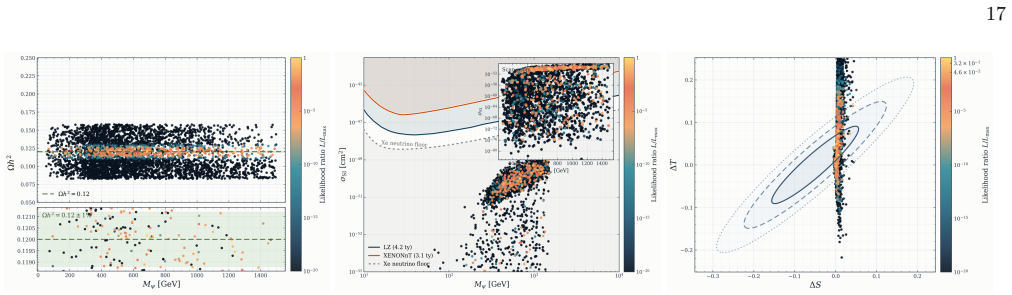
- The fermionic dark-matter candidate scatters off nuclei only through a loop-induced Higgs coupling, placing its spin-independent cross section below about $10^{-49}$ cm$^2$ in the accepted samples.
- The scalar dark-matter candidate annihilates efficiently in the Higgs-resonance region near $m_{H_1^0}\simeq m_h/2$ and through coannihilation with nearby inert scalars, with cross sections up to about $10^{-48}$ cm$^2$ that next-generation xenon experiments can probe.
- In inverted ordering the mass sum is near 0.1 eV and the neutrinoless-double-beta mass $m_{\beta\beta}$ lies in the range targeted by next-generation experiments, so lepton-number-violating searches are the sharpest test of that scenario.
Reading between the lines
- If the model is extended with additional Dirac or Majorana generations, the rank of the neutrino mass matrix can rise to three; this would be the natural way to make all three neutrino masses nonzero while keeping the same one-loop mechanism, at the cost of losing the massless-neutrino prediction.
- Because the fermionic dark-matter candidate is essentially invisible to current and planned direct-detection experiments, its discovery would have to come through indirect detection or collider production of the coannihilating inert scalars, a route the paper leaves for future work.
- The surviving charge-assignment families A, C, and D listed but not scanned could produce models with richer scalar spectra and different coannihilation channels; their cLFV rates and collider signatures are a direct testing ground for whether the T4-3-i idea generalizes.
Signed reviews
Editorial analysis
A structured set of objections, weighed in public.
Referee Report
Summary. This paper proposes a new radiative neutrino mass model based on the one-loop T4-3-i topology. The construction promotes the mediator fermion to a Dirac singlet N, places lepton-number violation in a separate Majorana singlet psi, and imposes an exact Z2 symmetry under which the new scalars and psi are odd. The resulting minimal model T4-3-i-B1 contains one Dirac fermion, one Majorana fermion, an inert doublet, and an inert singlet, and yields a neutrino mass matrix of the form Lambda(Y y^T + y Y^T), which has rank two and hence predicts one massless neutrino. The authors classify the allowed charge assignments, derive charged-lepton flavor violation, oblique parameters, Higgs diphoton, relic density, and direct detection observables, and perform numerical scans over the parameter space for fermionic and scalar dark matter in both normal and inverted neutrino mass orderings.
Significance. If the construction is correct and genuinely novel, the paper would provide the first complete symmetry-invariant realization of the finite T4-3-i topology, with a robust structural prediction of one massless neutrino and a broad phenomenological survey connecting neutrino mass, dark matter, and cLFV. The derivation of the rank-two mass matrix is clean, and the paper includes a number of machine-verifiable analytic formulas and a detailed set of constraints. However, the novelty claim relative to Ref. [18] is not convincingly argued, and the numerical evidence for global model viability rests on very sparse accepted samples. The paper is therefore of interest to the radiative neutrino mass community, but the central claims require further support before publication.
major comments (4)
- [Sec. I, Ref. [18]] The claim that this is the first complete field-theoretic realization of T4-3-i is not supported by the discussion of Ref. [18]. The paper states that the radiative linear-seesaw model with U(1)_B-L 'reduces to this topology after U(1)_B-L breaking,' but does not explain why a spontaneously broken Abelian symmetry is not a complete field-theoretic realization. If the low-energy content of Ref. [18] contains the same one-loop diagram without a tree-level Weinberg term, the central novelty claim collapses. A direct Lagrangian-level comparison of the two models, including the fate of the tree-level seesaw after symmetry breaking, is required.
- [Sec. III.A] The paper relies on the topology classification of Ref. [1] for the finiteness of the T4-3-i diagram, but does not demonstrate for the specific field content of T4-3-i-B1 that no Weinberg-operator counterterm is generated at one loop. Since the entire radiative mechanism depends on the loop being the leading source of neutrino mass, the authors should provide an explicit power-counting or counterterm analysis, or state clearly that the absence of a counterterm follows directly from the classification and verify that the specific couplings and quantum numbers do not alter this conclusion.
- [Sec. VI] The numerical evidence for model viability is based on very small accepted samples: 157, 156, 1641, and 1636 points out of 10^6 proposed points per scan in a parameter space with roughly 15-20 free parameters. No convergence diagnostics, coverage tests, or independent scan repetitions are provided, and no code or data are released. This is insufficient to establish that the reported best-fit points are global or representative. The authors should provide acceptance rates, a discussion of the effective number of independent parameters, and either multiple independent scans or a Markov-chain-based exploration to confirm the global character of the claimed best-fit regions.
- [Sec. VI and Table VII] The reported total chi-squared values (3.65, 4.69, 4.55, 3.80) are surprisingly small given the number of Gaussian observables included in the likelihood, such as the Higgs diphoton rate, oblique parameters, and relic abundance. The small values suggest either a high degree of fine-tuning or that the quoted chi-squared is not the full negative log-likelihood over all included observables. The authors should specify the number of effective data points, the degrees of freedom, and how the hard cuts and Gaussian terms are combined in the reported chi-squared.
minor comments (4)
- [Table III] The free-parameter table lists lambda_2, lambda_3 and kappa_1 twice, and also repeats Rey_alpha, Imy_alpha; the duplicate rows should be removed or merged into a single set of ranges for each scan type.
- [Sec. II.A] In the classification of models, the text lists T4-3-i-D3 with alpha=-3, but later states that 'the T4-3-i-D model with alpha=+3 is not included in this list' without having mentioned alpha=+3. Please clarify the quantum numbers and electric charges of the alpha=+3 case.
- [Eq. (V.63)] The loop-induced effective Higgs coupling for fermionic dark matter is given only for M_psi < m_phi^pm, but the numerical scan may explore points with M_psi > m_phi^pm. The domain of validity and the appropriate analytic continuation of the logarithm should be specified.
- [References] Several references are dated 2026 and may still be preprints; if the manuscript is intended for a journal, the authors should verify that all cited works have been accepted or are otherwise stable.
Circularity Check
No significant circularity: the rank-two mass structure and one-loop observables follow from the stated Lagrangian, and the numerical fit uses external data as constraints rather than renaming fitted inputs as predictions.
full rationale
The central derivation is self-contained. Eq. (III.29) gives M_nu = Lambda(Y y^T + y Y^T) directly from the Yukawa and mass terms of Eq. (III.26), so rank(M_nu) <= 2 and one massless neutrino is a mathematical consequence of the field content, not an input fitted to neutrino data. The oscillation parameters are used as likelihood inputs to constrain the complex Yukawa couplings; the resulting m_beta, m_betabeta, and sum m_i are then computed from the diagonalized matrix and are not themselves fitted, which is standard parameter estimation rather than circular "prediction". cLFV rates, h->gamma gamma, oblique parameters, relic density, and direct-detection rates are evaluated from the same fitted couplings and masses but are imposed as independent hard constraints or separate likelihood terms; no observable is used both to determine and to validate itself. The one-loop finiteness of the T4-3-i topology is imported from Ref. [1], an external classification, and is a stated premise rather than a circular derivation. The novelty claim that no fully symmetry-invariant realization existed before this work is an unsupported completeness assertion, especially relative to Ref. [18], but lack of proof of novelty is not logical circularity. Self-citations (Refs. [17], [78-80]) are present but merely support collider-phenomenology and previous T4-2-i constructions; they are not load-bearing for the neutrino-mass or dark-matter claims. Therefore no circular step is exhibited.
Assumptions & free parameters
free parameters (6)
- Yukawa vector Y_alpha (alpha = e, mu, tau) =
complex; benchmarks in Table VI
- Yukawa vector y_alpha (alpha = e, mu, tau) =
complex; benchmarks in Table VI
- y'_11 =
5.36e-6 (psiNO best fit)
- Scalar masses and mixings (m_H1, m_H2, m_A1, m_A2, m_phi+-, theta_H) =
see Table V
- Quartic couplings kappa1, kappa4, kappa5, lambda2, lambda3 =
see Table V
- Dirac fermion mass M_N =
1169 GeV (psiNO best fit)
assumptions (5)
- domain assumption The T4-3-i one-loop diagram is finite and requires no Weinberg-operator counterterm.
- domain assumption Lepton number is conserved by all couplings except the Majorana mass term of psi.
- domain assumption The universe underwent standard thermal freeze-out in a radiation-dominated cosmology.
- domain assumption All scalar potential parameters are real, so there is no explicit CP violation in the scalar sector.
- standard math The standard three-flavor neutrino oscillation framework with unitarity of the PMNS matrix.
invented entities (3)
-
Dirac fermion N, an SU(2)L singlet
independent evidence
-
Majorana fermion psi, an SM singlet
independent evidence
-
Inert scalar doublet phi and inert scalar singlet phi'
independent evidence
Cite this review
Pith. "Pith review of A Novel One-loop Model for Majorana Neutrino Mass and Dark Matter." pith.science (2026). https://pith.science/paper/M5A5YXNF
@misc{pith2026260812646,
  author       = {Pith},
  title        = {Pith review of: A Novel One-loop Model for Majorana Neutrino Mass and Dark Matter},
  year         = {2026},
  howpublished = {\url{https://pith.science/paper/M5A5YXNF}},
  note         = {Machine review of arXiv:2608.12646}
}
abstract
We present the first complete field-theoretic realization of the finite one-loop T4-3-i topology for Majorana neutrino mass. Here, T4-3-i denotes a one-loop realization of the Weinberg operator in which a fermion links the two external lepton--Higgs pairs. If this fermion is a Majorana singlet or triplet, the same interactions generate a tree-level type-I or type-III seesaw contribution, respectively, so that the loop is not the leading source of neutrino mass. This lower-order contribution is removed by taking the mediator to be a Dirac fermion $N$, placing lepton-number violation in a separate Majorana fermion $\psi$ inside the loop, and imposing an exact $Z_2$ symmetry that keeps the new scalars inert and stabilizes the lightest odd state. We classify the allowed electroweak charge assignments and study the minimal singlet-doublet realization, denoted T4-3-i-B1, which contains one Dirac fermion, one Majorana fermion, an inert scalar doublet, and an inert scalar singlet. The resulting rank-two neutrino mass matrix predicts one massless neutrino. We confront both normal and inverted neutrino-mass orderings with neutrino-oscillation and cosmological data, charged-lepton flavor violation, including $\mu-e$ conversion, electroweak precision observables, $h\to\gamma\gamma$, theoretical consistency conditions, the relic abundance, and direct-detection limits. Both fermionic and scalar dark matter are viable. The fermionic candidate has only a loop-induced Higgs coupling and consequently a strongly suppressed spin-independent scattering rate, whereas the scalar candidate couples through a tree-level Higgs portal and can lie above the neutrino floor while remaining compatible with current limits. In both cases, coannihilation with inert scalars is essential for reproducing the observed relic abundance.
Figures


Figures from the paper (11 more)


Reference graph
Works this paper leans on
-
[18]
M. A. Loualidi and M. Miskaoui,One-loop Type II Seesaw Neutrino Model with Stable Dark Matter Candidates,Nucl. Phys. B961(2020) 115219, [arXiv:2003.11434]
arXiv 2020
-
[1]
Un- like the fermionic case, its coupling to the Higgs is already present at the renormalizable level. The diagonal trilinear interaction controlling elastic Higgs-mediated scattering is ghH 0 1H 0 1 =− √ 2c HsHµϕ−υ c2 H(κ1 +κ 2 +κ 3)−υ s 2 Hκ4.(V.66) The scalar potential also contains the verticeshH 0 2H0 2 andhH 0 2H0
-
[2]
They are relevant for scalar sector interactions and may enter annihilation or coannihilation processes involvingH 0
-
[3]
ThehH 0 2H0 2 vertex contains twoH 0 2 fields and would be the diagonal portal for anH 0 2 DM assignment. The mixed vertexhH 0 1H0 2 changes the identity of the neutral scalar and corresponds, in DD, to an inelastic transitionH 0 1N→H 0 2Nrather than elastic scattering. Thus the standard elastic SI cross section forH 0 1 DM is governed byg hH 0 1H 0 1 . T...
- [4]
-
[5]
D. Aristizabal Sierra, A. Degee, L. Dorame, and M. Hirsch,Systematic classification of two-loop realizations of the Weinberg operator,JHEP03(2015) 040, [arXiv:1411.7038]
arXiv 2015
-
[6]
New Class of Two-Loop Neutrino Mass Models with Distinguishable Phenomenology
Q.-H. Cao, S.-L. Chen, E. Ma, B. Yan, and D.-M. Zhang,New Class of Two-Loop Neutrino Mass Models with Distinguishable Phenomenology,Phys. Lett. B779(2018) 430–435, [arXiv:1707.05896]
work page Pith review arXiv 2018
-
[7]
Systematic classification of three-loop realizations of the Weinberg operator
R. Cepedello, R. M. Fonseca, and M. Hirsch,Systematic classification of three-loop realizations of the Weinberg operator, JHEP10(2018) 197, [arXiv:1807.00629]. [Erratum: JHEP 06, 034 (2019)]
work page Pith review arXiv 2018
Show all 57 references
-
[8]
Y. Cai, J. Herrero-Garc´ ıa, M. A. Schmidt, A. Vicente, and R. R. Volkas,From the trees to the forest: a review of radiative neutrino mass models,Front. in Phys.5(2017) 63, [arXiv:1706.08524]
2017 arXiv
-
[9]
Ma,Verifiable radiative seesaw mechanism of neutrino mass and dark matter,Phys
E. Ma,Verifiable radiative seesaw mechanism of neutrino mass and dark matter,Phys. Rev. D73(2006) 077301, [hep-ph/0601225]
2006 arXiv
-
[10]
I. M. ´Avila, A. Karan, S. Mandal, S. Sadhukhan, and J. W. F. Valle,Dark matter as the source of neutrino mass: Theory overview and experimental prospects,Phys. Rept.1173(2026) 1–81, [arXiv:2506.24027]
2026
-
[11]
R. H. S. Budhi, S. Kashiwase, and D. Suematsu,Inflation in a modified radiative seesaw model,Phys. Rev. D90(2014), no. 11 113013, [arXiv:1409.6889]
2014 arXiv
-
[12]
Kashiwase and D
S. Kashiwase and D. Suematsu,Lepton number asymmetry via inflaton decay in a modified radiative seesaw model,Phys. Lett. B749(2015) 603–612, [arXiv:1507.06782]
2015 arXiv
-
[13]
R. H. S. Budhi, S. Kashiwase, and D. Suematsu,Inflation due to a nonminimal coupling of singlet scalars in the radiative seesaw model,Phys. Rev. D93(2016), no. 1 013022, [arXiv:1509.05841]
2016 arXiv
-
[14]
Zee,A Theory of Lepton Number Violation, Neutrino Majorana Mass, and Oscillation,Phys
A. Zee,A Theory of Lepton Number Violation, Neutrino Majorana Mass, and Oscillation,Phys. Lett. B93(1980) 389. [Erratum: Phys.Lett.B 95, 461 (1980)]
1980
-
[15]
Ma,Pathways to naturally small neutrino masses,Phys
E. Ma,Pathways to naturally small neutrino masses,Phys. Rev. Lett.81(1998) 1171–1174, [hep-ph/9805219]. 26
1998 arXiv
-
[16]
Restrepo, O
D. Restrepo, O. Zapata, and C. E. Yaguna,Models with radiative neutrino masses and viable dark matter candidates, JHEP11(2013) 011, [arXiv:1308.3655]
2013 arXiv
-
[17]
Darricau and A
A. Darricau and A. M. Teixeira,Revisiting cLFV in ”T1-2-A” scotogenic models: asymmetries in three-body lepton decays,arXiv:2607.07484
-
[19]
Kashav and S
M. Kashav and S. Verma,On minimal realization of topological Lorentz structures with one-loop seesaw extensions in A 4 modular symmetry,JCAP03(2023) 010, [arXiv:2205.06545]
2023 arXiv
-
[20]
M. A. Loualidi, M. Miskaoui, and S. Nasri,Radiative Neutrino Mass in a NonholomorphicT ′ Modular Invariant Model, arXiv:2606.11346
-
[21]
Wang and Z.-L
W. Wang and Z.-L. Han,Radiative linear seesaw model, dark matter, andU(1) B−L,Phys. Rev. D92(2015) 095001, [arXiv:1508.00706]
2015 arXiv
-
[22]
Autonne,Sur les matrices hypohermitiennes et sur les matrices unitaires
L. Autonne,Sur les matrices hypohermitiennes et sur les matrices unitaires. A. Rey, 1915
1915
-
[23]
T. Takagi,On an algebraic problem reluted to an analytic theorem of carath´ eodory and fej´ er and on an allied theorem of landau, inJapanese journal of mathematics: transactions and abstracts, vol. 1, pp. 83–93, The Mathematical Society of Japan, 1924
1924
-
[24]
de Gouvea and P
A. de Gouvea and P. Vogel,Lepton Flavor and Number Conservation, and Physics Beyond the Standard Model,Prog. Part. Nucl. Phys.71(2013) 75–92, [arXiv:1303.4097]
2013 arXiv
-
[25]
R. H. Bernstein and P. S. Cooper,Charged Lepton Flavor Violation: An Experimenter’s Guide,Phys. Rept.532(2013) 27–64, [arXiv:1307.5787]
2013 arXiv
-
[26]
Calibbi and G
L. Calibbi and G. Signorelli,Charged Lepton Flavour Violation: An Experimental and Theoretical Introduction,Riv. Nuovo Cim.41(2018), no. 2 71–174, [arXiv:1709.00294]
2018 arXiv
-
[27]
Ardu and G
M. Ardu and G. Pezzullo,Introduction to Charged Lepton Flavor Violation,Universe8(2022), no. 6 299, [arXiv:2204.08220]
2022 arXiv
-
[28]
Davidson, B
S. Davidson, B. Echenard, R. H. Bernstein, J. Heeck, and D. G. Hitlin,Charged Lepton Flavor Violation, arXiv:2209.00142. [26]MEG IICollaboration,New limit on theµ +→e +γdecay with the MEG II experiment,arXiv:2504.15711. [27]MEG IICollaboration, A. M. Baldini et al.,The design ...
2018 arXiv
-
[30]
M. Aoki, A. M. Baldini, R. H. Bernstein, C. Carloganu, S. Mihara, S. Miscetti, T. Mori, W. Ootani, F. Renga, S. Ritt, and A. Sch¨ oning,Charged Lepton Flavour Violations searches with muons: present and future,arXiv:2503.22461. [31]BelleCollaboration,Search for lepton-flavor-v...
2021 arXiv
-
[36]
Toma and A
T. Toma and A. Vicente,Lepton Flavor Violation in the Scotogenic Model,JHEP01(2014) 160, [arXiv:1312.2840]
2014 arXiv
-
[37]
Kuno and Y
Y. Kuno and Y. Okada,Muon decay and physics beyond the standard model,Rev. Mod. Phys.73(2001) 151–202, [hep-ph/9909265]
2001 arXiv
-
[38]
Kitano, M
R. Kitano, M. Koike, and Y. Okada,Detailed calculation of lepton flavor violating muon electron conversion rate for various nuclei,Phys. Rev. D66(2002) 096002, [hep-ph/0203110]. [Erratum: Phys. Rev. D 76, 059902 (2007)]
2002 arXiv
-
[39]
Abada, M
A. Abada, M. E. Krauss, W. Porod, F. Staub, A. Vicente, and C. Weiland,Lepton flavor violation in low-scale seesaw models: SUSY and non-SUSY contributions,JHEP11(2014) 048, [arXiv:1408.0138]
2014 arXiv
-
[40]
Lindner, M
M. Lindner, M. Platscher, and F. S. Queiroz,A Call for New Physics: The Muon Anomalous Magnetic Moment and Lepton Flavor Violation,Phys. Rept.731(2018) 1–82, [arXiv:1610.06587]
2018 arXiv
-
[41]
A. G. Akeroyd, A. Arhrib, and E.-M. Naimi,Note on tree level unitarity in the general two Higgs doublet model,Phys. Lett. B490(2000) 119–124, [hep-ph/0006035]
2000 arXiv
-
[42]
Kannike,Vacuum Stability Conditions From Copositivity Criteria,Eur
K. Kannike,Vacuum Stability Conditions From Copositivity Criteria,Eur. Phys. J. C72(2012) 2093, [arXiv:1205.3781]
2012 arXiv
-
[43]
B. W. Lee, C. Quigg, and H. B. Thacker,The Strength of Weak Interactions at Very High-Energies and the Higgs Boson Mass,Phys. Rev. Lett.38(1977) 883–885
1977
-
[44]
A. Arhrib,Unitarity constraints on scalar parameters of the standard and two Higgs doublets model, inWorkshop on Noncommutative Geometry, Superstrings and Particle Physics, 12, 2000.hep-ph/0012353
2000 arXiv
-
[45]
Arhrib, R
A. Arhrib, R. Benbrik, and N. Gaur,H→γγin Inert Higgs Doublet Model,Phys. Rev. D85(2012) 095021, [arXiv:1201.2644]
2012 arXiv
-
[46]
Arhrib, Y.-L
A. Arhrib, Y.-L. S. Tsai, Q. Yuan, and T.-C. Yuan,An Updated Analysis of Inert Higgs Doublet Model in light of the Recent Results from LUX, PLANCK, AMS-02 and LHC,JCAP06(2014) 030, [arXiv:1310.0358]. 27
2014 arXiv
-
[47]
Belyaev, G
A. Belyaev, G. Cacciapaglia, I. P. Ivanov, F. Rojas-Abatte, and M. Thomas,Anatomy of the Inert Two Higgs Doublet Model in the light of the LHC and non-LHC Dark Matter Searches,Phys. Rev. D97(2018), no. 3 035011, [arXiv:1612.00511]
2018 arXiv
-
[48]
J. F. Gunion, H. E. Haber, G. L. Kane, and S. Dawson,The Higgs Hunter’s Guide, vol. 80. 2000
2000
-
[49]
Djouadi,The Anatomy of electro-weak symmetry breaking
A. Djouadi,The Anatomy of electro-weak symmetry breaking. I: The Higgs boson in the standard model,Phys. Rept.457 (2008) 1–216, [hep-ph/0503172]
2008 arXiv
-
[50]
Chen, C.-Q
C.-S. Chen, C.-Q. Geng, D. Huang, and L.-H. Tsai,New Scalar Contributions toh→Zγ,Phys. Rev. D87(2013) 075019, [arXiv:1301.4694]. [51]ATLASCollaboration, G. Aad et al.,A detailed map of Higgs boson interactions by the ATLAS experiment ten years after the discovery,Nature607(202...
2013 arXiv
-
[52]
M. E. Peskin and T. Takeuchi,A New constraint on a strongly interacting Higgs sector,Phys. Rev. Lett.65(1990) 964–967
1990
-
[53]
M. E. Peskin and T. Takeuchi,Estimation of oblique electroweak corrections,Phys. Rev. D46(1992) 381–409
1992
-
[54]
Grimus, L
W. Grimus, L. Lavoura, O. M. Ogreid, and P. Osland,The Oblique parameters in multi-Higgs-doublet models,Nucl. Phys. B801(2008) 81–96, [arXiv:0802.4353]
2008 arXiv
-
[55]
Gondolo and G
P. Gondolo and G. Gelmini,Cosmic abundances of stable particles: Improved analysis,Nucl. Phys. B360(1991) 145–179
1991
-
[56]
Griest and D
K. Griest and D. Seckel,Three exceptions in the calculation of relic abundances,Phys. Rev. D43(1991) 3191–3203. [57]PlanckCollaboration, N. Aghanim et al.,Planck 2018 results. VI. Cosmological parameters,Astron. Astrophys.641 (2020) A6, [arXiv:1807.06209]. [Erratum: Astron.Ast...
1991 arXiv
-
[58]
Vicente and C
A. Vicente and C. E. Yaguna,Probing the scotogenic model with lepton flavor violating processes,JHEP02(2015) 144, [arXiv:1412.2545]
2015 arXiv
-
[59]
Hagedorn, J
C. Hagedorn, J. Herrero-Garc´ ıa, E. Molinaro, and M. A. Schmidt,Phenomenology of the Generalised Scotogenic Model with Fermionic Dark Matter,JHEP11(2018) 103, [arXiv:1804.04117]
2018 arXiv
-
[60]
Karan, S
A. Karan, S. Sadhukhan, and J. W. F. Valle,Phenomenological profile of scotogenic fermionic dark matter,JHEP12 (2023) 185, [arXiv:2308.09135]
2023 arXiv
-
[61]
Esteban, M
I. Esteban, M. C. Gonzalez-Garcia, M. Maltoni, I. Martinez-Soler, J. P. Pinheiro, and T. Schwetz,NuFit-6.0: updated global analysis of three-flavor neutrino oscillations,JHEP12(2024) 216, [arXiv:2410.05380]. [62]LZCollaboration, J. Aalbers et al.,Dark Matter Search Results fro...
2024 arXiv
-
[64]
C. A. J. O’Hare,New Definition of the Neutrino Floor for Direct Dark Matter Searches,Phys. Rev. Lett.127(2021), no. 25 251802, [arXiv:2109.03116]. [65]JUNOCollaboration, A. Abusleme et al.,First measurement of reactor neutrino oscillations at JUNO, arXiv:2511.14593. [66]KATRIN...
2021 arXiv
-
[78]
Jueid and S
A. Jueid and S. Nasri,Lepton portal dark matter at muon colliders: Total rates and generic features for phenomenologically viable scenarios,Phys. Rev. D107(2023), no. 11 115027, [arXiv:2301.12524]
2023 arXiv
-
[79]
Jueid, T
A. Jueid, T. A. Chowdhury, S. Nasri, and S. Saad,Probing Zee-Babu states at muon colliders,Phys. Rev. D109(2024), no. 7 075011, [arXiv:2306.01255]
2024 arXiv
-
[80]
Belfkir, A
M. Belfkir, A. Jueid, and S. Nasri,Boosting dark matter searches at muon colliders with machine learning: The mono-Higgs channel as a case study,PTEP2023(2023), no. 12 123B03, [arXiv:2309.11241]
2023 arXiv
Reviewed August 16, 2026 · model on record in the stance chip above.
Discussion (0). Continue with ORCID to comment.