REVIEW 3 major objections 6 minor 34 references
Finding the Needle in a Haystack: Test-Time Analog Circuit Representation Adaptation for Bayesian Optimization
T0 review · 3 major / 6 minor · reviewed 2026-08-16 · deepseek-v4-flash
Pith's one-line read TTARO claims that online retraining of a neural feature map and Gaussian-process surrogate on every accumulated figure-of-merit label improves Bayesian optimization sample efficiency, cutting regret AUC by 15.2% on average and up to 46.7%.
desk verdict A competent, unusually broad empirical study of a known idea (retraining DKL at each BO step) applied to analog topology search; the headline gains are plausible but the unreported initial sample size makes the DKL comparison hard to trust. read the letter →
The pith
A machine-rendered reading of the paper's core claim, the machinery that carries it, and where it could break.
The reading
What carries the argument
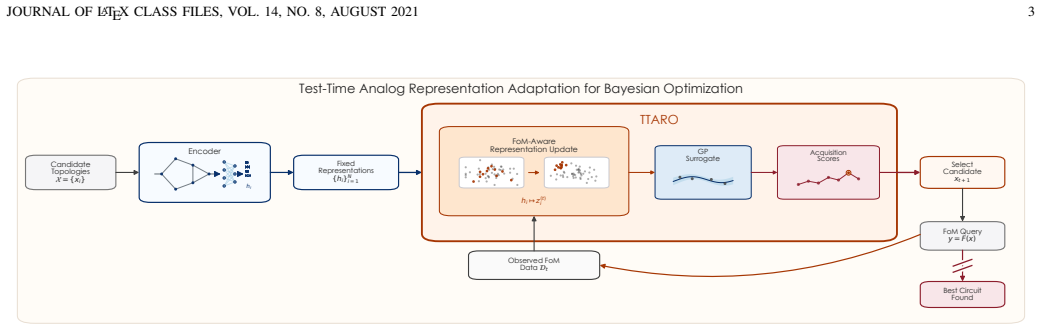
The load-bearing object is the learned feature map $\phi_{\theta_t}$, a two-layer multilayer perceptron that sends each normalized fixed embedding $\bar{h}_i$ to a 16-dimensional adapted representation $z^{(t)}_i = \phi_{\theta_t}(\bar{h}_i)$ at iteration $t$. It is fit together with the Gaussian-process hyperparameters by minimizing the negative log marginal likelihood on the accumulated labels $\mathcal{D}_t$, and the GP then acts on the adapted coordinates through a scaled linear kernel or a scaled RBF kernel. The mechanism does its work through the covariance: because the feature map enters every off-diagonal entry of the training covariance $K_t$ and every cross-covariance vector $k_{t,j}$, retraining $\theta_t$ rewires which circuits the surrogate treats as similar, and that rewired geometry is what changes the acquisition function's next pick.
What would settle it
Vary the initial sample size $n_0$ from very small to nearly the full budget while holding the evaluation budget fixed, and plot regret AUC for TTARO against the deep-kernel baseline that freezes its representation after the initial sample; if TTARO's advantage shrinks toward zero as $n_0$ grows, the reported gain is mostly extra training data, not online adaptation. Alternatively, give the frozen baseline access to the same total number of training labels that TTARO has at the end of the run and check whether the 20.7% average reduction survives.
Extended reading notes
Core claim
The paper's central discovery is that the surrogate's kernel geometry, not just the surrogate itself, should be updated during Bayesian optimization. Starting from any pretrained circuit embedding, TTARO normalizes the candidate bank and at each iteration fits a feature map -- a two-layer MLP mapping the normalized embedding into 16 adapted coordinates -- jointly with an exact Gaussian-process surrogate by minimizing the negative log marginal likelihood on the observed figure-of-merit labels. The adapted coordinates replace the original embeddings in the kernel, so every pairwise similarity, posterior mean, posterior variance, and acquisition score changes with each retraining. The comparison against deep kernel learning isolates the mechanism: DKL uses the same surrogate structure but trains its feature map only on the initial evaluated set and then freezes it, and on Ckt-Bench-301 DKL actually degrades relative to plain GP (regret AUC rising from 19,901 to 23,634 and final best FoM falling from 152.7 to 134.0), while TTARO improves both. The paper also reports that TTARO reaches 252.8 FoM by 60% of the budget on Ckt-Bench-101, already above GP's final value of 247.6, and matches GP's final 152.7 on Ckt-Bench-301 by 60% of the budget with 40% of evaluations still unused.
Load-bearing premise
The comparison assumes the initial sample size $n_0$ and evaluation budget $B$ are chosen so that the frozen-after-initial-sample deep-kernel baseline is fairly matched; the paper never reports $n_0$ or $B$, so if $n_0$ is small, TTARO's reported advantage over that baseline may reflect more training labels rather than online adaptation.
Editorial extensions
If this is right
- If TTARO is correct, latent-space BO pipelines for analog design should keep representation learning coupled to the search loop rather than treating the encoder as a frozen preprocessing step.
- The gains are not confined to one encoder or acquisition function: TTARO improves regret AUC in 37 of 40 settings, spanning learned GNN embeddings, graph-autoencoder embeddings, high-dimensional WL features, linear and RBF kernels, and EI, UCB, and Thompson sampling.
- Freezing a deep kernel after the initial sample can be actively harmful on larger, more heterogeneous search spaces: DKL degrades below plain GP on Ckt-Bench-301, whereas TTARO avoids the degradation.
- TTARO's benefit appears early enough to matter under a fixed budget: at 60% of the budget it already exceeds GP's final best FoM on Ckt-Bench-101 and matches it on Ckt-Bench-301.
Reading between the lines
- A natural extension, not tested in the paper, is that the same online-adaptation recipe transfers to any finite-bank search with pretrained embeddings and expensive labels, such as molecule selection, materials screening, or device sizing.
- Because the kernel changes at every iteration, standard GP regret bounds do not directly apply to TTARO; a regret analysis for a sequence of adaptively learned kernels is an open question the paper leaves implicit.
- The paper's own diagnostic suggests a testable mechanism: if Top-2% KNN@5 in the adapted space rises monotonically and predicts regret reduction across encoders, then objective-aligned geometry is the cause; if not, the gains may simply come from refitting the surrogate on more data.
- A cheap ablation would retrain the feature map on each iteration but with the FoM labels randomly permuted; if the regret reduction persists, the benefit is from surrogate retraining rather than from representation alignment.
Signed reviews
Editorial analysis
A structured set of objections, weighed in public.
Referee Report
Summary. The paper introduces TTARO, an online deep-kernel Bayesian optimization procedure for finite-bank analog circuit topology search. Starting from pretrained fixed circuit embeddings, TTARO retrains a two-layer MLP feature map jointly with a GP surrogate at each BO iteration on all FoM labels observed so far, then applies a standard acquisition function to select the next candidate. The method is compared against a fixed-embedding GP, a DKL baseline whose feature map is trained only on the initial sample and then frozen, and a GP-oracle whose feature map is trained on all labels before optimization. Experiments cover two OCB benchmarks, four encoders per benchmark, two kernels, and three acquisition functions (40 settings at 20 seeds), and report regret-AUC reductions of 19.6% over GP on Ckt-Bench-101 and 12.2% on Ckt-Bench-301, which the abstract aggregates to 15.2% vs GP and 20.7% vs DKL.
Significance. If the results hold, the contribution is a simple, general, and practically useful wrapper around standard BO: retraining the deep-kernel representation as FoM labels accumulate improves sample efficiency on a real analog-topology benchmark. The strengths of the paper are the breadth of the evaluation (40 settings x 20 seeds on public benchmarks), the method's agnosticism to encoders, kernels, and acquisition functions, and the clear separation of GP, DKL, and oracle baselines. The main weaknesses are that the headline comparison against DKL depends on unreported protocol parameters (n0 and B), the per-setting gains are not supported by significance tests, and the oracle condition is not consistently an upper bound. These issues are fixable with additional reporting and analysis.
major comments (3)
- [V.D and Algorithm 1] The initial sample size n0 and the total evaluation budget B are never reported, although Algorithm 1 lists both as inputs and Figure 5 and Table III implicitly use a budget expressed in percent. Because the DKL baseline trains its feature map only on the n0 initial FoM labels, an unreported small n0 would make the headline 20.7% regret-AUC reduction relative to DKL partly a data-quantity effect rather than an effect of online adaptation. Please state n0 and B for every configuration, and provide an ablation in which a retrained-DKL baseline receives additional training at the same checkpoints as TTARO (or otherwise controls for the number of training labels) to separate adaptation from increased training data.
- [VI, Tables I and II] The claim that TTARO 'outperforms prior art in most settings' is not supported by significance testing. In several settings the mean differences are smaller than the standard error, for example Ckt-Bench-101 D-VAE-GCN Linear/TS (29726.3±930.2 vs 31408.0±622.8) and Ckt-Bench-301 DAGNN Linear/EI (11183.7±1472.5 vs 12144.2±1253.1). Because the experiments use paired seeds, report paired tests (e.g., Wilcoxon signed-rank or paired t-test) across the 20 seeds, or at least report per-setting confidence intervals for the regret-AUC reduction, so that the 37-of-40 directional count can be interpreted as statistical evidence.
- [V.C and VI] The GP-oracle condition is described as an 'upper-reference condition,' but it is not consistently better than the fixed GP. For example, Ckt-Bench-101 CktGNN RBF/UCB has oracle regret AUC 30246.8±2835.0 vs GP 24013.6±1432.6, and several other oracle rows are worse than the corresponding GP row. If training the feature map on all available FoM labels can degrade BO performance, the paper's motivating claim that objective-aligned geometry improves the surrogate needs qualification (for example, overfitting or optimization difficulty of the MLP), and the term 'upper-reference' should be either justified or revised.
minor comments (6)
- [Abstract and Section I] The abstract contains LaTeX artifacts such as 'T est-Time' and 'O ptimization'; these should be fixed before publication.
- [Section I] The statement 'As far as we are aware, no prior art has explored this framework for analog circuit topologies' should be narrowed: Section II.D itself cites representation-adaptive BO methods (SILBO, CoBO, LOCo), so the novelty claim should explicitly be limited to the analog-topology finite-bank setting rather than suggesting no prior art exists for adaptive representations in BO generally.
- [Section IV.A, Eq. (10)] The dropout rate, optimizer, learning rate, number of training epochs, and stopping criterion for the MLP/GP fit are not reported. These details are needed for reproducibility, especially because the feature map is a roughly ten-thousand-parameter MLP trained on at most about one hundred labels.
- [Section V.D and Figure 4] The Top-2% KNN@5 diagnostic is computed from the same FoM labels that trained the feature map, so it is not an independent measure of representation quality. The text should state this circularity explicitly rather than only noting that the quantity is 'used only as a diagnostic.'
- [Table III] Because the budget is reported in percent, the caption should state the absolute evaluation budget B and the initial sample size n0.
- [References] References [19] and [25] are technical reports or non-standard venues; if published versions exist, the authors should cite those instead.
Circularity Check
Central regret-AUC claim is not circular: it is evaluated against fixed OCB FoM labels and external GP/DKL baselines. The only self-referential element is the Top-2% KNN@5 diagnostic, which the paper itself demotes to a visualization aid.
-
self definitional
[Section V-D (Optimization Protocol and Evaluation Metrics), Figure 4 caption]
"For each circuit whose FoM is in the top 2% of the candidate bank, Top-2% KNN@5 measures the fraction of its five nearest representation-space neighbors that are also top-2% FoM circuits. Higher values indicate that high-performing circuits are more locally concentrated in the learned representation. This quantity is used only as a diagnostic for the visualization; the primary optimization metrics are regret AUC and final best-so-far FoM."
The KNN@5 diagnostic is computed from the same top-2% FoM labels that TTARO uses to train its feature map and GP surrogate at every iteration (Eq. 15). An increase in top-2% neighbor concentration under the adapted representation is therefore partly a restatement of the fitting procedure rather than an independent confirmation of 'objective-aligned geometry.' Because the paper explicitly labels the metric 'only as a diagnostic,' and because the central regret-AUC comparisons rely on fixed OCB FoM labels against external baselines, this self-referentiality does not infect the main claim.
full rationale
The paper's core derivation chain is not circular. TTARO's representation update is trained on the FoM labels of circuits evaluated so far, and the reported optimization metrics (regret AUC, best-so-far FoM) are computed from the fixed, externally defined Open Circuit Benchmark FoM labels. The comparisons against fixed-representation GP, DKL, and the oracle representation are external baselines; none of these baselines is defined in terms of TTARO's outputs. The DKL comparison is a legitimate empirical ablation of 'retraining versus freezing the feature map' under the same kernel and network structure. The unreported initial sample size n0 and budget B could affect the fairness of the DKL comparison, but that is an experimental-protocol concern, not circularity. The paper's self-citations ([11], [14]) appear only in related-work context and are not load-bearing for the central claim. No uniqueness theorem, ansatz-smuggling citation, or fitted-input-called-prediction step is present. The only identifiable circular element is the Top-2% KNN@5 visualization diagnostic, which is self-referential because the labels used to measure concentration are the same labels used to train the representation; the paper explicitly demotes it, so the appropriate score is low.
Assumptions & free parameters
free parameters (6)
- Initial sample size n0
- BO budget B =
implied 100
- MLP hidden width =
128
- Adapted latent dimension d_z =
16
- Dropout rate
- Optimizer, learning rate, training steps
assumptions (5)
- domain assumption The candidate bank X is finite and fixed, with precomputed representations and deterministic stored FoM values.
- domain assumption Pretrained encoders (CktGNN, DAGNN, D-VAE, D-VAE-GCN, WL) produce representations faithful enough for topology search.
- ad hoc to paper A 2-layer MLP trained on at most about 100 labels can transform the embedding so that GP kernel similarity aligns with FoM without overfitting.
- domain assumption The FoM definition in Eq. 31 is a valid objective for analog circuit quality.
- standard math Gaussian process regression and the marginal likelihood in Eq. 15 are correctly computed by the implementation.
Cite this review
Pith. "Pith review of Finding the Needle in a Haystack: Test-Time Analog Circuit Representation Adaptation for Bayesian Optimization." pith.science (2026). https://pith.science/paper/CU4RKLHE
@misc{pith2026260812687,
  author       = {Pith},
  title        = {Pith review of: Finding the Needle in a Haystack: Test-Time Analog Circuit Representation Adaptation for Bayesian Optimization},
  year         = {2026},
  howpublished = {\url{https://pith.science/paper/CU4RKLHE}},
  note         = {Machine review of arXiv:2608.12687}
}
read the original abstract
Bayesian optimization (BO) is a sample-efficient framework for analog circuit topology search, where evaluating each candidate topology can require costly simulation. However, representation-based BO methods typically treat circuit embeddings as fixed after encoder training. This creates a mismatch between representation learning and optimization: embeddings learned to encode or reconstruct circuit structure are not necessarily organized according to the figure of merit (FoM) being optimized. This paper introduces Test-Time Analog Representation Adaptation for Bayesian Optimization (TTARO), an online deep-kernel BO framework that adapts circuit representations throughout the search process. Starting from pretrained circuit embeddings, TTARO jointly learns a nonlinear feature transformation and a Gaussian-process surrogate using the FoM labels of the circuits evaluated so far. Following each new evaluation, TTARO updates the representation and surrogate before selecting the next candidate. We compare TTARO with conventional Gaussian Process-based BO over fixed embeddings and with Deep Kernel Learning (DKL), which learns the representation only from the initial evaluated designs and keeps it fixed throughout the remainder of the search. By continually incorporating newly observed FoM labels into representation learning, TTARO aligns the search space with the optimization objective as BO progresses. In our experiments, TTARO reduces regret AUC by 15.2% on average relative to BO and by 20.7% relative to DKL across 40 encoder/kernel/acquisition settings, outperforming prior art in most settings with reductions as large as 46.7%.
Figures


Figures from the paper (3 more)


Reference graph
Works this paper leans on
-
[19]
Deep kernel bayesian optimization,
J. Bowden, J. Song, Y . Chen, Y . Yue, and T. A. Desautels, “Deep kernel bayesian optimization,” Lawrence Livermore National Laboratory, Tech. Rep. LLNL-CONF-819001, Feb. 2021, oSTI ID: 1811769. [Online]. Available: https://www.osti.gov/biblio/1811769
arXiv 2021
-
[1]
Umap: Uniform manifold approximation and projection for dimension reduction,
L. McInnes, J. Healy, and J. Melville, “Umap: Uniform manifold approximation and projection for dimension reduction,”arXiv preprint arXiv:1802.03426, 2018
arXiv 2018
-
[2]
ATOM: An automatic topology synthesis framework for operational amplifiers,
J. Shen, F. Yang, L. Shang, C. Yan, Z. Bi, D. Zhou, and X. Zeng, “ATOM: An automatic topology synthesis framework for operational amplifiers,”IEEE Transactions on Computer-Aided Design of Integrated Circuits and Systems, vol. 44, no. 3, pp. 1193–1198, 2025
work page 2025
-
[3]
CktGNN: Circuit graph neural network for electronic design automation,
Z. Dong, W. Cao, M. Zhang, D. Tao, Y . Chen, and X. Zhang, “CktGNN: Circuit graph neural network for electronic design automation,” in The Eleventh International Conference on Learning Representations (ICLR), 2023. [Online]. Available: https://openreview.net/forum?id= NE2911Kq1sp
work page 2023
-
[4]
Topology optimization of operational amplifier in continuous space via graph embedding,
J. Lu, L. Lei, F. Yang, L. Shang, and X. Zeng, “Topology optimization of operational amplifier in continuous space via graph embedding,” in 2022 Design, Automation & Test in Europe Conference & Exhibition (DATE), 2022, pp. 142–147
work page 2022
-
[5]
AnalogGenie: A generative engine for automatic discovery of analog circuit topologies,
J. Gao, W. Cao, J. Yang, and X. Zhang, “AnalogGenie: A generative engine for automatic discovery of analog circuit topologies,” in The Thirteenth International Conference on Learning Representations (ICLR), 2025. [Online]. Available: https://openreview.net/forum?id= jCPak79Kev JOURNAL OF LATEX CLASS FILES, VOL. 14, NO. 8, AUGUST 2021 11
work page 2025
-
[6]
Ckt2Vec: Efficient electrical encoding for analog circuit representations in vector space,
P. Xu, Y . Li, T. Chen, T.-Y . Ho, and B. Yu, “Ckt2Vec: Efficient electrical encoding for analog circuit representations in vector space,” IEEE Transactions on Computer-Aided Design of Integrated Circuits and Systems, 2025
work page 2025
-
[7]
A. G. Wilson, Z. Hu, R. Salakhutdinov, and E. P. Xing, “Deep kernel learning,” inProceedings of the 19th International Conference on Artificial Intelligence and Statistics, ser. Proceedings of Machine Learning Research, A. Gretton and C. C. Robert, Eds., vol. 51. PMLR, 2016, pp. 370–378. [Online]. Available: https://proceedings.mlr.press/ v51/wilson16.html
work page 2016
Show all 34 references
-
[8]
Bayesian optimization approach for analog circuit synthesis using neural network,
S. Zhang, W. Lyu, F. Yang, C. Yan, D. Zhou, and X. Zeng, “Bayesian optimization approach for analog circuit synthesis using neural network,” in2019 Design, Automation & Test in Europe Conference & Exhibition (DATE), 2019, pp. 1463–1468
2019
-
[9]
KATO: Knowledge alignment and transfer for transistor sizing of different design and technology,
W. W. Xing, W. Fan, Z. Liu, Y . Yao, and Y . Hu, “KATO: Knowledge alignment and transfer for transistor sizing of different design and technology,” inProceedings of the 61st ACM/IEEE Design Automation Conference, ser. DAC ’24. ACM, 2024, pp. 1–6. [Online]. Available: https://d...
2024
-
[10]
Reducing evaluation cost for circuit synthesis using active learning,
T. Guo, D. R. Herber, and J. T. Allison, “Reducing evaluation cost for circuit synthesis using active learning,” inASME 2018 International Design Engineering Technical Conferences and Computers and Information in Engineering Conference. Quebec City, Canada: American Society of...
2018 doi
-
[11]
Can an actor-critic optimization framework improve analog design?
S. Dutta, F. Amin, S. Panda, J. Rabe, Y . Wen, and P. Franzon, “Can an actor-critic optimization framework improve analog design?” 2026. [Online]. Available: https://arxiv.org/abs/2603.24714
2026 arXiv
-
[12]
The reduction of a graph to canonical form and the algebra which appears therein,
B. Weisfeiler and A. Leman, “The reduction of a graph to canonical form and the algebra which appears therein,”nti, Series, vol. 2, no. 9, pp. 12–16, 1968
1968
-
[13]
INTO- OA: Interpretable topology optimization for operational amplifiers,
J. Shen, F. Yang, L. Shang, Z. Bi, C. Yan, D. Zhou, and X. Zeng, “INTO- OA: Interpretable topology optimization for operational amplifiers,” in 2025 Design, Automation & Test in Europe Conference & Exhibition (DATE), 2025, pp. 1–7
2025
-
[14]
Depthgraphnet: Circuit graph isomorphism detection via siamese-graph neural networks,
F. Amin, S. Chatterjee, and P. D. Franzon, “Depthgraphnet: Circuit graph isomorphism detection via siamese-graph neural networks,” in2023 ACM/IEEE 5th Workshop on Machine Learning for CAD (MLCAD), 2023, pp. 1–6
2023
-
[15]
Efficient global optimiza- tion of expensive black-box functions,
D. R. Jones, M. Schonlau, and W. J. Welch, “Efficient global optimiza- tion of expensive black-box functions,”Journal of Global optimization, vol. 13, no. 4, pp. 455–492, 1998
1998
-
[16]
Information-theoretic regret bounds for gaussian process optimization in the bandit setting,
N. Srinivas, A. Krause, S. M. Kakade, and M. W. Seeger, “Information-theoretic regret bounds for gaussian process optimization in the bandit setting,”IEEE Transactions on Information Theory, vol. 58, no. 5, pp. 3250–3265, may 2012. [Online]. Available: https://doi.org/10.1109/...
2012
-
[17]
On the likelihood that one unknown probability exceeds another in view of the evidence of two samples,
W. R. Thompson, “On the likelihood that one unknown probability exceeds another in view of the evidence of two samples,”Biometrika, vol. 25, no. 3/4, pp. 285–294, 1933
1933
-
[18]
Input warping for bayesian optimization of non-stationary functions,
J. Snoek, K. Swersky, R. Zemel, and R. Adams, “Input warping for bayesian optimization of non-stationary functions,” inProceedings of the 31st International Conference on Machine Learning, ser. Proceedings of Machine Learning Research, E. P. Xing and T. Jebara, Eds., vol. 32. ...
2014
-
[20]
Semi-supervised embedding learning for high-dimensional bayesian optimization,
J. Chen, G. Zhu, C. Yuan, and Y . Huang, “Semi-supervised embedding learning for high-dimensional bayesian optimization,” arXiv preprint arXiv:2005.14601, 2020. [Online]. Available: https: //arxiv.org/abs/2005.14601
2005 arXiv
-
[21]
Contrastive embedding of structured space for bayesian optimization,
J. Tingey, C. M. Gilligan-Lee, and Z. Dai, “Contrastive embedding of structured space for bayesian optimization,” inNeurIPS 2021 Workshop on Meta-Learning, 2021. [Online]. Available: https://openreview.net/ forum?id=xFpkJUMS9te
2021
-
[22]
Learning representation for bayesian optimization with collision-free regularization,
F. Zhang, B. Nord, and Y . Chen, “Learning representation for bayesian optimization with collision-free regularization,”arXiv preprint arXiv:2203.08656, 2022. [Online]. Available: https://arxiv.org/abs/2203. 08656
2022 arXiv
-
[23]
Advancing bayesian optimization via learning correlated latent space,
S. Lee, J. Chu, S. Kim, J. Ko, and H. J. Kim, “Advancing bayesian optimization via learning correlated latent space,”Advances in Neural Information Processing Systems, vol. 36, pp. 48 906–48 917, 2023
2023
-
[24]
Accelerating bayesian optimization for bio- logical sequence design with denoising autoencoders,
S. Stanton, W. Maddox, N. Gruver, P. Maffettone, E. Delaney, P. Green- side, and A. G. Wilson, “Accelerating bayesian optimization for bio- logical sequence design with denoising autoencoders,” inInternational conference on machine learning. PMLR, 2022, pp. 20 459–20 478
2022
-
[25]
Deep kernel learning for reac- tion outcome prediction and optimization,
S. Singh and J. M. Hern ´andez-Lobato, “Deep kernel learning for reac- tion outcome prediction and optimization,”Communications Chemistry, vol. 7, no. 1, p. 136, 2024
2024
-
[26]
Directed acyclic graph neural networks,
V . Thost and J. Chen, “Directed acyclic graph neural networks,”arXiv preprint arXiv:2101.07965, 2021
2021 arXiv
-
[27]
D-vae: A variational autoencoder for directed acyclic graphs,
M. Zhang, S. Jiang, Z. Cui, R. Garnett, and Y . Chen, “D-vae: A variational autoencoder for directed acyclic graphs,”Advances in neural information processing systems, vol. 32, 2019
2019
-
[28]
Semi-supervised classification with graph convolutional networks,
T. N. Kipf and M. Welling, “Semi-supervised classification with graph convolutional networks,”arXiv preprint arXiv:1609.02907, 2016
2016 arXiv
-
[29]
Taking the human out of the loop: A review of bayesian optimization,
B. Shahriari, K. Swersky, Z. Wang, R. P. Adams, and N. De Freitas, “Taking the human out of the loop: A review of bayesian optimization,” Proceedings of the IEEE, vol. 104, no. 1, pp. 148–175, 2015
2015
-
[30]
Kernel interpolation for scalable structured gaussian processes (kiss-gp),
A. Wilson and H. Nickisch, “Kernel interpolation for scalable structured gaussian processes (kiss-gp),” inInternational conference on machine learning. PMLR, 2015, pp. 1775–1784
2015
-
[31]
Stochas- tic variational deep kernel learning,
A. G. Wilson, Z. Hu, R. R. Salakhutdinov, and E. P. Xing, “Stochas- tic variational deep kernel learning,”Advances in neural information processing systems, vol. 29, 2016
2016
-
[32]
Constant- time predictive distributions for gaussian processes,
G. Pleiss, J. Gardner, K. Weinberger, and A. G. Wilson, “Constant- time predictive distributions for gaussian processes,” inInternational Conference on Machine Learning. PMLR, 2018, pp. 4114–4123
2018
-
[33]
Gpytorch: Blackbox matrix-matrix gaussian process inference with gpu acceleration,
J. Gardner, G. Pleiss, K. Q. Weinberger, D. Bindel, and A. G. Wilson, “Gpytorch: Blackbox matrix-matrix gaussian process inference with gpu acceleration,”Advances in neural information processing systems, vol. 31, 2018
2018
-
[34]
Kernel interpolation for scalable online gaussian processes,
S. Stanton, W. Maddox, I. Delbridge, and A. G. Wilson, “Kernel interpolation for scalable online gaussian processes,” inInternational conference on artificial intelligence and statistics. PMLR, 2021, pp. 3133–3141
2021
Reviewed August 16, 2026 · model on record in the stance chip above.
Discussion (0). Continue with ORCID to comment.