REVIEW 3 major objections 6 minor 55 references
HybridSB-MoE: Dual-Domain Schr\"odinger Bridges with Scene-Adaptive Expert Routing for Speech Enhancement
T0 review · 3 major / 6 minor · reviewed 2026-08-16 · deepseek-v4-flash
Pith's one-line read Speech enhancement routes between two error types to reach PESQ 3.88
desk verdict A novel hybrid architecture with strong reported numbers, but the central Theorem 1 is not proved as written and the small-K guarantee is currently a heuristic. read the letter →
The pith
A machine-rendered reading of the paper's core claim, the machinery that carries it, and where it could break.
The reading
What carries the argument
The load-bearing identity is the discretization bound of Theorem 1, $W_2(\hat{p}_K, p^{\mathrm{br}}_0) \le C_1 K^{-\alpha} + C_2 \sqrt{L^*_{\mathrm{path}} + L^*_{\mathrm{traj}}}$, which decomposes the $K$-step sampling error into a schedule-controlled term and a training-controlled term. The schedule term $C_1 K^{-\alpha}$ with $\alpha=\min(1,\gamma)$ is driven by the front-loading exponent $\gamma$; the regularizer term is controlled by the path-consistency loss (cross-timestep agreement of clean predictions) and the trajectory loss (anchoring each state to the schedule-consistent reconstruction). The other load-bearing mechanism is the asymmetric fusion: the spectral MoE's top-$k$ expert disagreement $u_{\mathrm{epi}}$ is treated as epistemic uncertainty and the bridge's learned log-variance head $u_{\mathrm{ale}}$ as aleatoric uncertainty, and a two-layer MLP maps their z-scored values to a scalar weight that picks between the two reconstruction paths. These are coupled: the MoE produces the error $u_{\mathrm{epi}}$ detects, the regularized SB produces the error $u_{\mathrm{ale}}$ detects, and Theorem 1 controls the SB-side error at the deployment budget.
What would settle it
Estimate the Lipschitz constant of the trained U-Net denoiser on a batch of bridge states and plot the observed PESQ or Wasserstein gap against the number of sampling steps. If the curve saturates far earlier than the predicted $C_1K^{-\alpha}$ term with the estimated constant, or if retraining without the two regularizers still gives high PESQ at $K=8$, then Theorem 1 is not the mechanism that makes few-step inference work.
Extended reading notes
Core claim
The paper's central claim is that a speech enhancement system can profitably couple a spectral path and a waveform path if each carries a categorically different uncertainty signal, and that the waveform path's few-step inference cost can be tied to its training objective. The spectral path consists of five architecturally distinct experts with top-$k=2$ routing; disagreement among the selected experts yields an epistemic signal that indicates which inductive bias is failing. The waveform path is a Schrödinger bridge trained with path-consistency and trajectory regularizers; Theorem 1 states that with a front-loaded schedule $t_k=T(k/K)^\gamma$, the $2$-Wasserstein distance between the $K$-step rollout law and the continuous bridge marginal is bounded by $C_1 K^{-\alpha} + C_2 \sqrt{L^*_{\mathrm{path}} + L^*_{\mathrm{traj}}}$, $\alpha=\min(1,\gamma)$. This makes $K=8$ a consequence of minimizing the regularizers. An asymmetric fusion weight $w=\sigma(\mathrm{MLP}(\tilde{u}_{\mathrm{epi}},\tilde{u}_{\mathrm{ale}}))$ selects between the two pathways: high expert disagreement defers to the waveform branch and high bridge variance defers to the spectral branch. On VoiceBank+DEMAND the system reports PESQ 3.88, CBAK 3.85, and COVL 4.82.
Load-bearing premise
The argument assumes, without enforcing it during training, that the denoising network changes only a bounded amount when its input or the timestep changes; if that bound is much larger than expected, the guarantee about eight-step inference gives no practical control.
Editorial extensions
If this is right
- $K=8$ inference is tied to the training objective: if the two regularizers reach small terminal values, the schedule term saturates at modest $K$, so the system should not need diffusion-scale step counts.
- The fusion weight is interpretable: high spectral expert disagreement pushes the output toward the waveform reconstruction, and high bridge variance pushes it toward the spectral reconstruction, rather than averaging two predictions.
- On VoiceBank+DEMAND the system reports the top PESQ (3.88), CBAK (3.85), and COVL (4.82) among the compared diffusion-, bridge-, and consistency-distilled baselines under a unified evaluation protocol.
- The calibration loss yields a fusion-weight ECE of 0.042, an order-of-magnitude reduction over an uncalibrated single-pathway baseline, making the uncertainty signals usable downstream.
- The method runs at real-time factor 0.28 with 8 steps, giving a 4–5x speedup over diffusion- and bridge-based baselines at higher PESQ, and defines the quality-efficiency frontier together with a one-step consistency-distilled method.
Reading between the lines
- I infer that the bound's practical force depends on untested Lipschitz constants: the paper assumes $L_x$ and $L_t$ in Assumption 1(i) but does not enforce or measure them, so the sharpest reading of Theorem 1 is as a design-justifying inequality rather than a tight predictor of the PESQ-versus-$K$ curve.
- I infer that the same asymmetric-fusion design could transfer to other restoration tasks with two structurally different reconstructions, such as image deblurring with a frequency-domain and a spatial-domain branch, wherever one branch can produce disagreement and the other intrinsic stochasticity.
- I infer that a direct test of the rate $K^{-\alpha}$ is feasible: sweeping $K$ and fitting the empirical Wasserstein or PESQ gap against $C_1 K^{-\alpha}$ would confirm or refute whether the schedule term is the actual driver at small $K$.
- I infer that because the archetype set generalizes by adding new expert architectures per noise family, the scene-adaptivity claim would be stronger if tested on corpora with larger train/test noise distribution shift.
Signed reviews
Editorial analysis
A structured set of objections, weighed in public.
Referee Report
Summary. The paper proposes HybridSB-MoE, a dual-domain speech enhancement system that combines a heterogeneous mixture-of-experts spectral path with a Schrödinger-bridge waveform path, and fuses them through an asymmetric uncertainty mechanism that distinguishes epistemic disagreement in the spectral MoE from aleatoric variance in the waveform bridge. The central theoretical contribution is Theorem 1, which claims a K-step bridge-discretization bound in 2-Wasserstein distance in terms of the training-time path-consistency and trajectory regularizers, and is used to justify the K=8 inference budget as an objective-level guarantee rather than an empirical heuristic. The empirical section reports state-of-the-art PESQ of 3.88 on VoiceBank+DEMAND, along with ablations supporting the design and a calibration analysis for the fusion weights.
Significance. If the theoretical claim were fully established, the paper would make a useful conceptual contribution: linking the inference-time step budget to explicit training-time regularizers, rather than treating few-step sampling as a purely empirical choice. The empirical work is also credible in its breadth: unified baseline reproduction, ablations that isolate the three design components, scene-stratified results, and calibration measurements. The main weakness is that the central guarantee is not established as written: the proof has an endpoint gap at the first reverse step, and the bound's constants and residual terms are not estimated. These issues do not invalidate the empirical system, but they do undermine the paper's headline theoretical claim, so the manuscript needs substantive revision before the guarantee can be accepted.
major comments (3)
- [Appendix C.2/C.5, Eq. (8)] At t=T, Eq. (4) gives beta_T=0 and sigma_T=0, so the trajectory residual in Eq. (8) is identically zero for any value of the denoiser at (y,y,T). The path-consistency loss and data-prediction loss are expectations over continuous t, so the single point t=T has measure zero and does not constrain that value. Yet the K-step rollout of Eq. (5) initializes at x_T=y and evaluates the denoiser at exactly (y,y,T) in its first reverse step. Lemma 1's proof restricts Eq. (13) to [epsilon0,T-epsilon0], and the statement in Appendix C.5 that 'all sampling steps lie strictly in the interior' is false for the first update. Thus, as proved, Theorem 1 does not control the first reverse step, and the claimed objective-level justification for K=8 is not established. A fix would require either an explicit endpoint loss term, a rollout that starts at T-epsilon, or a separate Lipschitz-based argument covering t=T.
- [Appendix C.4] The synchronous coupling argument bounds W2 by accumulating per-step one-step errors delta_k, but Lemma 1 bounds those errors on true bridge states, whereas the rollout feeds the denoiser its own previous outputs. The proof asserts rather than demonstrates that the propagated states remain close enough for Lemma 1 to apply. The exp(L_x T) factor is absorbed into the unestimated constants C1 and C2, so the proof does not quantitatively control the accumulation of model error along the trajectory. Please provide a complete induction bounding the distance between the true bridge state and the rollout state at each step, or state the needed closeness condition as an explicit assumption.
- [Section 3, Theorem 1, Appendix C.6] The second term C2 sqrt(L*_path + L*_traj) in Eq. (9) is independent of K, and the paper never estimates C1, C2, or the achieved L* values. Moreover, Appendix C.6 states that Assumption 1(i) is 'assumed rather than explicitly imposed' and that no spectral normalization or other mechanism enforces a known Lipschitz constant. As a result, the bound cannot be checked numerically as presented, and the statement that small-K inference is 'a consequence of the training objective rather than an empirical heuristic' is stronger than the submitted result supports. The authors should either supply estimates or a mechanism for the constants, or explicitly downgrade the claim to a heuristic design principle with a proof sketch.
minor comments (6)
- [Section 3, Eq. (2), Table 3] The load-balancing loss notation is inconsistent: Eq. (2) uses lambda_I and lambda_L, while Eq. (12) and Table 3 refer to lambda_aux; please align these notations.
- [Appendix C.5] The sentence claiming that all sampling steps lie strictly in the interior of [0,T] contradicts t_K=T; please clarify that the endpoint is used only for initialization and state explicitly that the first reverse step is handled by a separate argument.
- [Figure 5] The ring axes in the scene-stratified plot are not labeled with units, and the caption does not explain the scaling of the inner versus outer rings; adding a brief axis explanation would improve readability.
- [Throughout] The name 'VoiceBank' is typeset with a stray space in several places (for example, in the Abstract and Section 4); this should be fixed.
- [Section 4, Table 1] Since all baseline numbers were reproduced by the authors, it would be helpful to report the number of evaluation runs and the variance of the metrics, so the reader can assess whether the reported differences are statistically meaningful.
- [Related Work] The paper states that this is 'the first joint MoE–SB framework for SE'; if this is intended as a novelty claim, please verify that no prior joint work exists and cite the closest alternatives.
Circularity Check
No significant circularity: Theorem 1 has the standard training-loss-controlled sampling bound form; the boundary t=T proof gap is a correctness/missing-support issue, not a circular reduction, and the only self-citations are non-load-bearing related-work mentions.
full rationale
The paper's central theoretical claim is Theorem 1, which bounds the 2-Wasserstein distance between the K-step rollout and the continuous-time bridge marginal by C1*K^(-alpha) + C2*sqrt(L*_path + L*_traj). This is the standard structure of a posterior-sampling discretization bound: sampling error is controlled by training-time quantities that the optimization actually minimizes. The regularizers in Eqs. (7)-(8) are not defined in terms of the test-time W2 metric, and Eq. (9) is a derived inequality (modulo the stated regularity assumptions), so the conditional guarantee does not reduce to a fit. The fusion calibration loss in Eq. (11) anchors the epistemic and aleatoric scalars to reconstruction errors, but the reported PESQ, STOI, and ECE are computed on the held-out test set with external metrics, so that is not a circular prediction either. Two caveats keep the score from being zero: (a) the paper cites two works by a co-author, references [12] and [41], as related work, although neither is load-bearing for the new contributions; and (b) the proof of Lemma 1 in Appendix C.2 restricts the one-step fidelity bound to [epsilon0, T-epsilon0], while the K-step rollout of Eq. (5) first evaluates the denoiser at t=T, where L_traj is identically zero by Eq. (8) because beta_T=0 and sigma_T=0. The paper's statement in Appendix C.5 that 'all sampling steps lie strictly in the interior' is internally inconsistent with t_K=T. This is an omitted-support/proof gap in the boundary step, not a circular reduction: it does not make Eq. (9) equal to its input, but it weakens the claimed objective-level justification of K=8. Because the remaining contributions are externally benchmarked and parameter-free relative to the test metric, the circularity is minimal.
Assumptions & free parameters
free parameters (6)
- sigma_max =
0.05
- gamma =
0.6
- K =
8
- Loss weights (lambda_SB, lambda_path, lambda_traj, lambda_aux, lambda_cal, lambda_I, lambda_L) =
1.0, 0.1, 0.05, 0.01, 0.05, 0.5, 0.5
- Ceilings M_max and phi_max =
5.0 and pi/4
- Gate blend alpha =
not specified
assumptions (4)
- domain assumption Assumption 1(i): the trained denoiser hat_x_theta is Lx-Lipschitz in its first argument and Lt-Lipschitz in t.
- standard math Assumption 1(ii): beta_bar_t and sigma_t are C1 with beta_bar_t monotone and bounded second derivative.
- standard math Assumption 1(iii): second moments of x_t and hat_x_theta(xt,y,t) are uniformly bounded in t.
- domain assumption The forward construction of Eq. (4) with sigma_max = 0.05 yields full-support marginals required for score-based reverse sampling.
Cite this review
Pith. "Pith review of HybridSB-MoE: Dual-Domain Schr\"odinger Bridges with Scene-Adaptive Expert Routing for Speech Enhancement." pith.science (2026). https://pith.science/paper/M3GKZ7SA
@misc{pith2026260812715,
  author       = {Pith},
  title        = {Pith review of: HybridSB-MoE: Dual-Domain Schr\"odinger Bridges with Scene-Adaptive Expert Routing for Speech Enhancement},
  year         = {2026},
  howpublished = {\url{https://pith.science/paper/M3GKZ7SA}},
  note         = {Machine review of arXiv:2608.12715}
}
read the original abstract
Generative speech enhancement faces three gaps: spectral models capture harmonic structure but often disrupt phase, waveform models preserve phase but miss harmonics, and Schr\"odinger Bridges (SB) shorten transport from noise to clean speech but leave inference cost only loosely tied to training. We propose HybridSB-MoE, a dual-domain framework that fills these gaps through three contributions unified by a single asymmetric design principle. (i) Asymmetric uncertainty fusion: The spectral path captures epistemic uncertainty via expert disagreement, while the waveform bridge models aleatoric variance through stochastic dynamics. We fuse them asymmetrically, allowing the mixing weight to adapt to distinct error regimes rather than average predictions. (ii) Heterogeneous MoE with top-k=2 routing across five distinct architectural archetypes, where architectural diversity makes the epistemic signal indicate which inductive bias fails rather than small perturbations among similar experts. (iii) Discretization bound (Theorem 1): path-consistency and trajectory regularizers together bound the K-step bridge sampling error in 2-Wasserstein distance at rate K-alpha, making small-K inference an objective-level guarantee rather than an empirical claim. On VoiceBank+DEMAND, HybridSB-MoE outperforms diffusion- and SB-based baselines at their step budgets while remaining competitive with consistency-distilled few-step methods.
Figures


Figures from the paper (3 more)


Reference graph
Works this paper leans on
-
[1]
Supervised speech separation based on deep learning: An overview,
D. Wang and J. Chen, “Supervised speech separation based on deep learning: An overview,” IEEE/ACM Transactions on Audio, Speech, and Language Processing, vol. 26, no. 10, pp. 1702–1726, 2018
2018
-
[2]
Real time speech enhancement in the waveform domain,
A. Defossez, G. Synnaeve, and Y . Adi, “Real time speech enhancement in the waveform domain,” arXiv preprint arXiv:2006.12847, 2020
arXiv 2006
-
[3]
A regression approach to speech enhancement based on deep neural networks,
Y . Xu, J. Du, L.-R. Dai, and C.-H. Lee, “A regression approach to speech enhancement based on deep neural networks,”IEEE/ACM Transactions on Audio, Speech, and Language Processing, vol. 23, no. 1, pp. 7–19, 2015
work page 2015
-
[4]
Segan: Speech enhancement generative adversarial network,
S. Pascual, A. Bonafonte, and J. Serra, “Segan: Speech enhancement generative adversarial network,”arXiv preprint arXiv:1703.09452, 2017
arXiv 2017
-
[5]
Conv-tasnet: Surpassing ideal time–frequency magnitude masking for speech separation,
Y . Luo and N. Mesgarani, “Conv-tasnet: Surpassing ideal time–frequency magnitude masking for speech separation,”IEEE/ACM Trans. Audio, Speech and Lang. Proc., vol. 27, no. 8, p. 1256–1266, Aug. 2019. [Online]. Available: https://doi.org/10.1109/TASLP.2019.2915167
arXiv 2019
-
[6]
Dual-path rnn: efficient long sequence modeling for time-domain single-channel speech separation,
Y . Luo, Z. Chen, and T. Yoshioka, “Dual-path rnn: efficient long sequence modeling for time-domain single-channel speech separation,” inICASSP, 2020, pp. 46–50
work page 2020
-
[7]
Fullsubnet+: Channel attention fullsubnet with complex spectrograms for speech enhancement,
J. Chen, Z. Wang, D. Tuo, Z. Wu, S. Kang, and H. Meng, “Fullsubnet+: Channel attention fullsubnet with complex spectrograms for speech enhancement,” inICASSP 2022-2022 IEEE International Conference on Acoustics, Speech and Signal Processing (ICASSP). IEEE, 2022, pp. 7857–7861
work page 2022
-
[8]
Tf-gridnet: Integrating full- and sub-band modeling for speech separation,
Z.-Q. Wang, S. Cornell, S. Choi, Y . Lee, B.-Y . Kim, and S. Watanabe, “Tf-gridnet: Integrating full- and sub-band modeling for speech separation,”IEEE/ACM Transactions on Audio, Speech, and Language Processing, vol. 31, pp. 3221–3236, 2023
work page 2023
Show all 55 references
-
[9]
Denoising diffusion probabilistic models,
J. Ho, A. Jain, and P. Abbeel, “Denoising diffusion probabilistic models,” inProceedings of the 34th International Conference on Neural Information Processing Systems, ser. NIPS ’20. Red Hook, NY , USA: Curran Associates Inc., 2020
2020
-
[10]
Speech enhancement with score-based generative models in the complex stft domain,
S. Welker, J. Richter, and T. Gerkmann, “Speech enhancement with score-based generative models in the complex stft domain,”arXiv preprint arXiv:2203.17004, 2022
2022 arXiv
-
[11]
Speech enhancement and dereverberation with diffusion-based generative models,
J. Richter, S. Welker, J.-M. Lemercier, B. Lay, and T. Gerkmann, “Speech enhancement and dereverberation with diffusion-based generative models,”IEEE/ACM Transactions on Audio, Speech, and Language Processing, vol. 31, pp. 2351–2364, 2023
2023
-
[12]
Sparse mixture of local experts for efficient speech enhancement,
A. Sivaraman and M. Kim, “Sparse mixture of local experts for efficient speech enhancement,” arXiv preprint arXiv:2005.08128, 2020
2005 arXiv
-
[13]
Speech enhancement with mixture of deep experts with clean clustering pre-training,
S. E. Chazan, J. Goldberger, and S. Gannot, “Speech enhancement with mixture of deep experts with clean clustering pre-training,” inICASSP 2021 - 2021 IEEE International Conference on Acoustics, Speech and Signal Processing (ICASSP), 2021, pp. 716–720
2021
-
[14]
Suppression of acoustic noise in speech using spectral subtraction,
S. Boll, “Suppression of acoustic noise in speech using spectral subtraction,”IEEE Transactions on Acoustics, Speech, and Signal Processing, vol. 27, no. 2, pp. 113–120, 1979
1979
-
[15]
Speech enhancement using a minimum-mean square error short-time spectral amplitude estimator,
Y . Ephraim and D. Malah, “Speech enhancement using a minimum-mean square error short-time spectral amplitude estimator,”IEEE Transactions on Acoustics, Speech, and Signal Processing, vol. 32, no. 6, pp. 1109–1121, 1984
1984
-
[16]
Sdr – half-baked or well done?
J. L. Roux, S. Wisdom, H. Erdogan, and J. R. Hershey, “Sdr – half-baked or well done?” in ICASSP 2019 - 2019 IEEE International Conference on Acoustics, Speech and Signal Processing (ICASSP), 2019, pp. 626–630
2019
-
[17]
An investigation of incorporating mamba for speech enhancement,
R. Chao, W.-H. Cheng, M. La Quatra, S. M. Siniscalchi, C.-H. H. Yang, S.-W. Fu, and Y . Tsao, “An investigation of incorporating mamba for speech enhancement,” in2024 IEEE Spoken Language Technology Workshop (SLT). IEEE, 2024, pp. 302–308. 10
2024
-
[18]
Mamba-seunet: Mamba unet for monaural speech enhancement,
J. Wang, Z. Lin, T. Wang, M. Ge, L. Wang, and J. Dang, “Mamba-seunet: Mamba unet for monaural speech enhancement,” inICASSP 2025 - 2025 IEEE International Conference on Acoustics, Speech and Signal Processing (ICASSP), 2025, pp. 1–5
2025
-
[19]
Diffusion-based speech enhancement with joint generative and predictive decoders,
H. Shi, K. Shimada, M. Hirano, T. Shibuya, Y . Koyama, Z. Zhong, S. Takahashi, T. Kawahara, and Y . Mitsufuji, “Diffusion-based speech enhancement with joint generative and predictive decoders,” inICASSP 2024 - 2024 IEEE International Conference on Acoustics, Speech and Signal...
2024
-
[20]
Speech enhancement algorithms: A systematic literature review,
S. T. Yousif and B. M. Mahmmod, “Speech enhancement algorithms: A systematic literature review,”Algorithms, vol. 18, no. 5, p. 272, 2025
2025
-
[21]
Likelihood training of schrödinger bridge using forward–backward sdes theory,
T. Chen, G.-H. Liu, and E. A. Theodorou, “Likelihood training of schrödinger bridge using forward–backward sdes theory,” inICLR, 2022
2022
-
[22]
Score-based generative modeling through stochastic differential equations,
Y . Song, J. Sohl-Dickstein, D. P. Kingma, A. Kumar, S. Ermon, and B. Poole, “Score-based generative modeling through stochastic differential equations,” inInternational Conference on Learning Representations, 2021. [Online]. Available: https://openreview.net/forum?id= PxTIG12RRHS
2021
-
[23]
Denoising diffusion implicit models,
J. Song, C. Meng, and S. Ermon, “Denoising diffusion implicit models,”arXiv preprint arXiv:2010.02502, 2020
2010 arXiv
-
[24]
Flow matching for generative modeling,
Y . Lipman, R. T. Q. Chen, H. Ben-Hamu, M. Nickel, and M. Le, “Flow matching for generative modeling,” inInternational Conference on Learning Representations, 2023
2023
-
[25]
Flow straight and fast: Learning to generate and transfer data with rectified flow,
X. Liu, C. Gong, and Q. Liu, “Flow straight and fast: Learning to generate and transfer data with rectified flow,” inInternational Conference on Learning Representations, 2023
2023
-
[26]
Diffusion Schrödinger bridge with applications to score-based generative modeling,
V . De Bortoli, J. Thornton, J. Heng, and A. Doucet, “Diffusion Schrödinger bridge with applications to score-based generative modeling,” inAdvances in Neural Information Processing Systems, vol. 34, 2021, pp. 17 695–17 709
2021
-
[27]
Diffusion schrödinger bridge matching,
Y . Shi, V . De Bortoli, A. Campbell, and A. Doucet, “Diffusion schrödinger bridge matching,” inAdvances in Neural Information Processing Systems, A. Oh, T. Naumann, A. Globerson, K. Saenko, M. Hardt, and S. Levine, Eds., vol. 36. Curran Associates, Inc., 2023, pp. 62 183–62 2...
2023
-
[28]
Schrödinger bridge for generative speech enhancement,
A. Juki´c, R. Korostik, J. Balam, and B. Ginsburg, “Schrödinger bridge for generative speech enhancement,”arXiv preprint arXiv:2407.16074, 2024
2024 arXiv
-
[29]
Diffusion-based speech enhancement with Schrödinger bridge and symmetric noise schedule,
S. Wang, S. Liu, A. Harper, P. Kendrick, M. Salzmann, and M. Cernak, “Diffusion-based speech enhancement with Schrödinger bridge and symmetric noise schedule,”arXiv preprint arXiv:2409.05116, 2024
2024 arXiv
-
[30]
Simplified diffusion schrödinger bridge,
Z. Tang, T. Hang, S. Gu, D. Chen, and B. Guo, “Simplified diffusion schrödinger bridge,”arXiv preprint arXiv:2403.14623, 2024
2024 arXiv
-
[31]
Schrödinger bridge mamba for one-step speech enhancement,
J. Yang, S. Wang, C. Wu, L. Guo, and F. Fan, “Schrödinger bridge mamba for one-step speech enhancement,”arXiv preprint arXiv:2510.16834, 2025
2025 arXiv
-
[32]
Sb-senet: Diffusion model based on schrödinger bridge for speech enhancement,
H. Zhang, G. Li, P. Wu, Y . Gao, and H. Zhang, “Sb-senet: Diffusion model based on schrödinger bridge for speech enhancement,”Applied Acoustics, vol. 236, p. 110742, 2025
2025
-
[33]
Robust one-step speech enhancement via consistency distillation,
L. Xu, L. F. Yan, and W. B. Kleijn, “Robust one-step speech enhancement via consistency distillation,”arXiv preprint arXiv:2507.05688, 2025
2025 arXiv
-
[34]
Consistency models,
Y . Song, P. Dhariwal, M. Chen, and I. Sutskever, “Consistency models,” inInternational Conference on Machine Learning, 2023
2023
-
[35]
Few-step adversarial schrödinger bridge for generative speech enhancement,
S. Han, S. Lee, J. Lee, and K. Lee, “Few-step adversarial schrödinger bridge for generative speech enhancement,”arXiv preprint arXiv:2506.01460, 2025. 11
2025 arXiv
-
[36]
Schrödinger bridge consistency trajectory models for speech enhancement,
S. Nishigori, K. Saito, N. Murata, M. Hirano, S. Takahashi, and Y . Mitsufuji, “Schrödinger bridge consistency trajectory models for speech enhancement,”arXiv preprint arXiv:2507.11925, 2025
2025 arXiv
-
[37]
Sampling is as easy as learning the score: theory for diffusion models with minimal data assumptions,
S. Chen, S. Chewi, J. Li, Y . Li, A. Salim, and A. R. Zhang, “Sampling is as easy as learning the score: theory for diffusion models with minimal data assumptions,” inInternational Conference on Learning Representations, 2023
2023
-
[38]
Outra- geously large neural networks: The sparsely-gated mixture-of-experts layer,
N. Shazeer, A. Mirhoseini, K. Maziarz, A. Davis, Q. Le, G. Hinton, and J. Dean, “Outra- geously large neural networks: The sparsely-gated mixture-of-experts layer,”arXiv preprint arXiv:1701.06538, 2017
2017 arXiv
-
[39]
Switch transformers: Scaling to trillion parameter models with simple and efficient sparsity,
W. Fedus, B. Zoph, and N. Shazeer, “Switch transformers: Scaling to trillion parameter models with simple and efficient sparsity,”Journal of Machine Learning Research, vol. 23, no. 120, pp. 1–39, 2022. [Online]. Available: http://jmlr.org/papers/v23/21-0998.html
2022
-
[40]
Gshard: Scaling giant models with conditional computation and automatic sharding,
D. Lepikhin, H. Lee, Y . Xu, D. Chen, O. Firat, Y . Huang, M. Krikun, N. Shazeer, and Z. Chen, “Gshard: Scaling giant models with conditional computation and automatic sharding,”arXiv preprint arXiv:2006.16668, 2020
2006 arXiv
-
[41]
Zero-shot personalized speech enhancement through speaker- informed model selection,
A. Sivaraman and M. Kim, “Zero-shot personalized speech enhancement through speaker- informed model selection,” in2021 IEEE Workshop on Applications of Signal Processing to Audio and Acoustics (WASPAA), 2021, pp. 171–175
2021
-
[42]
Adaptive slimming for scalable and efficient speech enhancement,
R. Miccini, M. Kim, C. Laroche, L. Pezzarossa, and P. Smaragdis, “Adaptive slimming for scalable and efficient speech enhancement,”arXiv preprint arXiv:2507.04879, 2025
2025
-
[43]
Simple and scalable predictive uncertainty estimation using deep ensembles,
B. Lakshminarayanan, A. Pritzel, and C. Blundell, “Simple and scalable predictive uncertainty estimation using deep ensembles,” inAdvances in Neural Information Processing Systems, vol. 30, 2017
2017
-
[44]
On calibration of modern neural networks,
C. Guo, G. Pleiss, Y . Sun, and K. Q. Weinberger, “On calibration of modern neural networks,” inProceedings of the 34th International Conference on Machine Learning - Volume 70, ser. ICML’17. JMLR.org, 2017, p. 1321–1330
2017
-
[45]
A unified approach to short-time fourier analysis and synthesis,
J. B. Allen and L. R. Rabiner, “A unified approach to short-time fourier analysis and synthesis,” Proceedings of the IEEE, vol. 65, no. 11, pp. 1558–1564, 1977
1977
-
[46]
The diverse environments multi-channel acoustic noise database (demand): A database of multichannel environmental noise recordings,
J. Thiemann, N. Ito, and E. Vincent, “The diverse environments multi-channel acoustic noise database (demand): A database of multichannel environmental noise recordings,” Proceedings of Meetings on Acoustics, vol. 19, no. 1, p. 035081, 05 2013. [Online]. Available: https://doi...
2013 doi
-
[47]
Group normalization,
Y . Wu and K. He, “Group normalization,” inProceedings of the European Conference on Computer Vision, 2018, pp. 3–19
2018
-
[48]
Computational optimal transport,
G. Peyre and M. Cuturi, “Computational optimal transport,”Foundations and Trends in Machine Learning, vol. 11, no. 5-6, pp. 355–607, 2019
2019
-
[49]
Improved denoising diffusion probabilistic models,
A. Nichol and P. Dhariwal, “Improved denoising diffusion probabilistic models,” 2021. [Online]. Available: https://arxiv.org/abs/2102.09672
2021 arXiv
-
[50]
Investigating rnn-based speech enhancement methods for noise-robust text-to-speech,
C. Valentini-Botinhao, X. Wang, S. Takaki, and J. Yamagishi, “Investigating rnn-based speech enhancement methods for noise-robust text-to-speech,” in9th ISCA Workshop on Speech Synthesis Workshop (SSW 9), 2016, pp. 146–152
2016
-
[51]
Perceptual evaluation of speech quality (pesq)-a new method for speech quality assessment of telephone networks and codecs,
A. Rix, J. Beerends, M. Hollier, and A. Hekstra, “Perceptual evaluation of speech quality (pesq)-a new method for speech quality assessment of telephone networks and codecs,” in2001 IEEE International Conference on Acoustics, Speech, and Signal Processing. Proceedings (Cat. No...
2001
-
[52]
An algorithm for intelligibility prediction of time–frequency weighted noisy speech,
C. H. Taal, R. C. Hendriks, R. Heusdens, and J. Jensen, “An algorithm for intelligibility prediction of time–frequency weighted noisy speech,”IEEE Transactions on Audio, Speech, and Language Processing, vol. 19, no. 7, pp. 2125–2136, 2011. 12
2011
-
[53]
Evaluation of objective quality measures for speech enhancement,
Y . Hu and P. C. Loizou, “Evaluation of objective quality measures for speech enhancement,” IEEE Transactions on Audio, Speech, and Language Processing, vol. 16, no. 1, pp. 229–238, 2008
2008
-
[54]
Deep learning and the information bottleneck principle,
N. Tishby and N. Zaslavsky, “Deep learning and the information bottleneck principle,” in2015 IEEE Information Theory Workshop (ITW), 2015, pp. 1–5. 13 A Heterogeneous Expert Architectures This appendix details the heterogeneous MoE layer described in Section 3 of the main pape...
2015
-
[55]
Y-axis ranges are zoomed for visibility of cross-scene variation
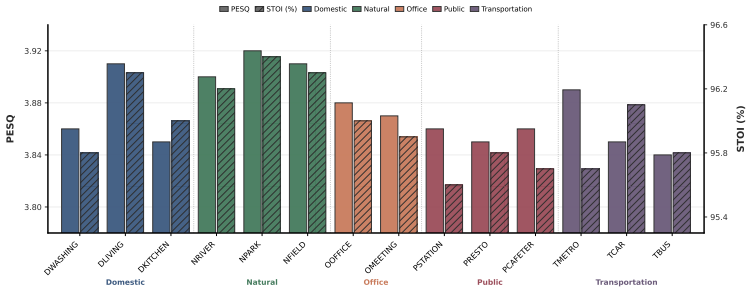
achieves a mean PESQ of 3.85 across these conditions; our method exceeds this in every scene, with PESQ ranging from 3.84 to 3.92 (mean 3.88, standard deviation<0.03 across scenes). Y-axis ranges are zoomed for visibility of cross-scene variation. observationy). Both moments a...
Reviewed August 16, 2026 · model on record in the stance chip above.
Discussion (0). Continue with ORCID to comment.