REVIEW 2 major objections 5 minor 24 references
Weighted Nuclear Elastic Net Estimation of (Near-) Low-Rank Drift Matrices in Ornstein-Uhlenbeck Processes
T0 review · 2 major / 5 minor · reviewed 2026-08-15 · deepseek-v4-flash
Pith's one-line read A ridge-weighted nuclear estimator recovers low-rank OU drift at the rd/T rate (up to log T).
desk verdict The paper genuinely breaks new ground on low-rank drift estimation in continuous-time OU, and the advertised rd log T/T rate is proved, but only under a symmetric PSD exact-low-rank assumption that the authors are upfront about. read the letter →
The pith
A machine-rendered reading of the paper's core claim, the machinery that carries it, and where it could break.
The reading
What carries the argument
The load-bearing object is the Weighted Nuclear Elastic Net Estimator, the minimizer of $L_T(A) + \frac{\eta}{2}\|A\|_F^2 + \lambda \|A B_{T,\eta}\|_*$ where $B_{T,\eta} = (C_T + \eta I_d)^{1/2}$ is the square root of the ridge-regularized empirical covariance. The key change of variables $\Theta = A B_{T,\eta}$ rewrites the criterion as a nuclear-norm denoising problem $\frac12\|\Theta - Z_T B_{T,\eta}^{-1}\|_F^2 + \lambda\|\Theta\|_*$, so a deterministic oracle inequality from matrix denoising applies directly. The argument then depends on two supporting mechanisms: a self-normalized martingale inequality controlling the score matrix under the spectral assumption, and a block-diagonal lower bound for $C_T$ proved by separating stable OU coordinates from Brownian coordinates and using Schur complements. The ridge term is essential, not merely a numerical crutch: it keeps $B_{T,\eta}$ invertible and regularizes the weakly identified directions.
What would settle it
Run the WNEE on simulated data with $A_0$ symmetric positive semidefinite of rank $r$ but with an eigenvector matrix of condition number far exceeding the constant $\kappa$, or with a single Jordan block of size two at eigenvalue zero; if the squared Frobenius error does not scale as $r d \log(T)/T$ when $T \ge K d$ (or if $\lambda_{\min}(C_T+\eta I_d)$ fails to stay above $c_0$ with high probability), the claimed range of validity is refuted.
Extended reading notes
Core claim
The paper's main result is a high-probability Frobenius-norm bound for the WNEE under Assumption 5.1: when $A_0 = P \,\mathrm{diag}(a_1,\ldots,a_r,0,\ldots,0)\,P^\top$ with $P$ orthogonal and $a_i \in [a_-, a_+]$, and when $T \ge K(d + \log(1/\delta))$, then with probability at least $1-\delta$ the estimator satisfies $\|\hat A_{\lambda,\eta} - A_0\|_F^2 \le C (r d \log T)/T$ after choosing $\eta = \beta/T$ and $\lambda$ at the explicit score level (59). The bound is proved from a general oracle inequality (Theorem 3.3) that holds without any curvature assumption in the weighted empirical metric, plus a verified empirical-curvature condition $\lambda_{\min}(C_T + \eta I_d) \ge c_0$ that converts the weighted bound into a Frobenius-norm bound. The non-ergodic nature of the problem is handled by splitting the state space into stable Ornstein–Uhlenbeck coordinates and Brownian coordinates, bounding each block separately, and controlling the stochastic score term with self-normalized martingale concentration.
Load-bearing premise
For the paper's sharp rate to hold, the true drift must be symmetric and positive semidefinite with all its nonzero eigenvalues staying away from both zero and infinity, and the eigenvectors must be well conditioned; if the drift has a Jordan block at zero or a wildly skewed eigenvector basis, the proof's central decomposition into stable and Brownian directions no longer works.
Editorial extensions
If this is right
- In the exact low-rank symmetric positive-semidefinite model, the WNEE achieves squared Frobenius error of order $r d \log(T)/T$ with high probability, so whenever $r d \log(T)/T \to 0$ the drift is consistently estimated.
- The estimator adapts to approximately low-rank drift: the oracle inequality replaces the rank-$r$ approximation error by the weighted tail $\sum_{j>r}\sigma_j^2(A_0 B_{T,\eta})$, so the natural measure of near low rank is decay in the empirical likelihood geometry.
- The ridge term contributes only a bias of order $\eta^2 r a_+^2/c_0^2$; choosing $\eta=\beta/T$ keeps this below the stochastic term $\lambda^2 r$, so ridge stabilization costs nothing at the rate level.
- The score tuning parameter can be chosen deterministically from $d, T, \eta, \delta$ and the spectral constant $\kappa$, giving a practical calibration that does not require knowing the rank or the singular vectors.
Reading between the lines
- The proof's reliance on the block decomposition suggests that the rate $r d \log(T)/T$ should degrade if $A_0$ has a nontrivial Jordan block at zero; in that case the Brownian coordinates acquire polynomial trends and the curvature event $\lambda_{\min}(C_T+\eta I_d)\ge c_0$ would likely fail at the same scaling.
- The oracle inequality's weighted approximation term predicts that for near low-rank drifts, directions with large empirical energy drive the error; a testable consequence is that pre-whitening the data before applying WNEE should change which tail is penalized, and the empirically observed error should follow the weighted tail rather than the unweighted one.
- The dimension-horizon condition $T \gtrsim d + \log(1/\delta)$ suggests that the estimator cannot work in the regime $d \gg T$; an open question is whether this is necessary for any procedure in this non-ergodic setting, since standard low-rank matrix completion often needs only $dr$ samples.
- Because the framework is stated for continuous observation, one natural extension is to discrete sampling; the self-normalized martingale arguments would need replacing by discrete-time versions, but the empirical-geometry weighting should survive.
Signed reviews
Editorial analysis
A structured set of objections, weighed in public.
Referee Report
Summary. The paper studies estimation of the drift matrix A0 in a d-dimensional Ornstein-Uhlenbeck process dXt = -A0 Xt dt + dWt observed continuously on [0,T], when A0 is exactly or approximately low rank. Exact low rank induces zero eigenvalues and hence a non-ergodic regime with poorly conditioned empirical covariance. The authors propose a Weighted Nuclear Elastic Net Estimator (WNEE) minimizing the negative log-likelihood plus a ridge penalty and a nuclear-norm penalty in the empirical likelihood geometry: LT(A) + (η/2)||A||_F^2 + λ||A (CT + ηI)^{1/2}||_*. Under a general diagonalizable spectral assumption (Assumption 2.2), they prove a high-probability oracle inequality (Theorem 3.3) in the weighted metric ||(A-A0)(CT+ηI)^{1/2}||_F, with a deterministic score-calibration level (Proposition 3.2). Under an additional empirical-curvature condition (Assumption 2.3), the weighted bound is converted into a Frobenius-norm bound. For the exact low-rank symmetric positive-semidefinite model (Assumption 5.1), the paper verifies Assumption 2.3 using block concentration inequalities (Lemmas 5.8-5.10, Theorem 5.5) and obtains, with high probability, squared Frobenius error of order r d log(T)/T under an explicit dimension-horizon condition T ≥ K(d + log(1/δ)). Numerical experiments compare WNEE with MLE, ridge, and nuclear-norm estimators.
Significance. If the results are correct, this is the first non-asymptotic oracle inequality for nuclear-norm-type estimation of a low-rank OU drift in the non-ergodic regime induced by zero eigenvalues, and the rd log(T)/T rate under Assumption 5.1 matches the usual rank-r matrix-estimation scaling. The paper's strengths are its self-contained proofs, explicit constants, a clean deterministic oracle inequality in the empirical geometry, and a transparent block decomposition into stable OU and Brownian directions for the curvature verification. The authors are also honest that the general near-low-rank Frobenius conclusion is conditional on Assumption 2.3, which is verified only for the symmetric PSD exact low-rank class. The main caveat is that the headline Frobenius rate is therefore not established for non-symmetric, non-PSD, or ill-conditioned eigenvector matrices; this is a scope limitation rather than a hidden mathematical flaw.
major comments (2)
- [Section 4.1, Lemma 4.3, Propositions 3.2 and 4.2] The notation for C_T and ε_T is internally inconsistent. Section 4.1 defines C_T := ∫_0^T X_t X_t^T dt = T C_T and ε_T := ∫_0^T dW_t X_t^T = T ε_T, but Lemma 4.3 and the proof of Proposition 3.2 use C_T as the normalized empirical covariance (the proof of Lemma 4.3 contains an explicit factor 1/T in the double integral). Under the Section 4.1 convention, E[tr C_T] would be of order κ^2 d T^2, not κ^2 d T /2, and the determinant in Proposition 4.2 should be det(I + (Tη)^{-1} ∫ X X^T), not det(I + η^{-1} ∫ X X^T). This makes the proof of the score concentration, which is load-bearing for the oracle inequality, impossible to verify as written. Please adopt one convention throughout Sections 4-5 and adjust equations (20), (28), (31), and (43)-(45) accordingly.
- [Sections 2.5, 3, and 5.1] The Frobenius-norm rate rd log(T)/T is proved only under Assumption 5.1 (symmetric PSD exact low-rank), because the empirical-curvature condition Assumption 2.3 is verified only in that model (Theorem 5.5). For a general diagonalizable near-low-rank A0, the paper proves oracle inequalities in the weighted empirical metric but leaves Assumption 2.3 as an unverified high-probability design condition. This is stated explicitly in the paper, but given the title and abstract emphasize '(Near-) Low-Rank', I recommend that the abstract and introduction state without ambiguity that the rd log(T)/T Frobenius bound is established for the exact low-rank symmetric PSD class (41), and that a remark in Section 5.1 note the verification of Assumption 2.3 outside this class remains open.
minor comments (5)
- [Section 3, after Proposition 3.2] The displayed line 'λ^2_{T,η,δ_T} ≲ dT logT / T' should read 'd logT / T'; the extra factor T in the numerator is a typo.
- [Section 4.2, Lemma 4.4] There is a typo in 'rank-struncation'; it should be 'rank-truncation'.
- [Assumption 5.1 and Section 5.1] Assumption 5.1 excludes the full-rank case r=d (m=0). Since the Brownian block argument in Section 5.2 requires m≥1, it would be helpful to add a remark that the full-rank positive definite case is covered by the classical ergodic theory rather than by Theorem 5.5.
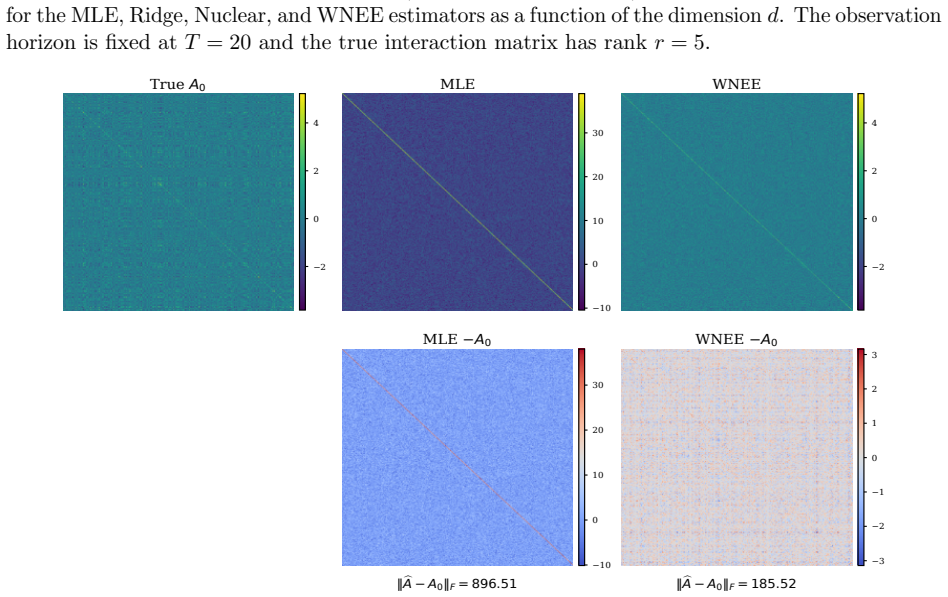
- [Section 6] The numerical study uses T=20 with d up to 500, which is far outside the theoretical condition T ≥ K(d+log(1/δ)); the paper should acknowledge this and clarify that the simulations are illustrative rather than a check of the finite-sample condition.
- [Corollary 5.7] The constants K and C are said to depend on a-, a+, c0, β, q; this should be stated explicitly in the corollary statement so the reader knows the dimension-horizon condition is not fully universal.
Circularity Check
No circularity: the derivation is self-contained, with the only caveat being an explicit scope restriction for the curvature verification, not a circular reduction.
full rationale
The paper's central chain is non-circular. Theorem 3.3 is proved from a deterministic nuclear-norm oracle inequality (Lemma 4.4), the self-normalized score bound (Proposition 3.2, Lemma 4.1), and the ridge-bias identity (Lemma 4.5); none of these ingredients assumes the target result. The tuning parameter lambda is chosen by explicit, data-independent formulas depending only on T, d, eta, delta, and stated constants (Eq. (20), Corollary 5.4, Corollary 5.7), so it is not fitted to A0 or to the estimator. The Frobenius-norm conclusion requires the curvature event R_T(c0), but this event is verified rather than assumed under Assumption 5.1: Theorem 5.5 proves it from blockwise concentration of the empirical covariance C_T (Lemmas 5.8-5.10) via a Schur-complement argument. The verification does not use bA or any fitted value. The limitation that Assumption 2.3 is not verified in the general diagonalizable near-low-rank framework is explicitly stated in Section 2.5 ('In the general near-low-rank framework, Assumption 2.3 is retained as a high-probability design condition') and in Section 5.1, where the symmetric PSD structure is introduced as 'the basis of the non-asymptotic argument below.' This is an honest scope restriction, not a circular step: it means the rd log(T)/T rate is proved only under Assumption 5.1, which is a mathematical completeness concern rather than a reduction of the output to the input. Self-citations appear only in literature review and in the numerical tuning heuristic, not as load-bearing evidence for the main theorems.
Assumptions & free parameters
free parameters (2)
- tuning parameters lambda and eta =
lambda and eta selected by cross-validation in simulations; in theory eta = beta/T with beta a fixed positive constant…
- constants a-, a+, kappa, c0, beta, q, delta =
unspecified, assumed fixed and not estimated from data
assumptions (4)
- domain assumption Assumption 2.2: A0 = P0 diag(theta_j) P0^{-1} with 0 <= theta_j <= a and ||P0||_op ||P0^{-1}||_op <= kappa
- domain assumption Assumption 5.1: exact low-rank symmetric positive-semidefinite A0 = P diag(a_i, 0) P^T with eigenvalues in [a-, a+] for i <= r
- standard math Standard probabilistic inequalities: Gaussian quadratic form tail bounds (Laurent-Massart), Gaussian smallest singular value bound (Davidson-Szarek), Karhunen-Loeve expansions, Ito isometry
- domain assumption Continuous observation of the full path on [0,T], with D = I_d (known diffusion coefficient)
Cite this review
Pith. "Pith review of Weighted Nuclear Elastic Net Estimation of (Near-) Low-Rank Drift Matrices in Ornstein-Uhlenbeck Processes." pith.science (2026). https://pith.science/paper/NMQSYRPL
@misc{pith2026260812838,
  author       = {Pith},
  title        = {Pith review of: Weighted Nuclear Elastic Net Estimation of (Near-) Low-Rank Drift Matrices in Ornstein-Uhlenbeck Processes},
  year         = {2026},
  howpublished = {\url{https://pith.science/paper/NMQSYRPL}},
  note         = {Machine review of arXiv:2608.12838}
}
abstract
We study estimation of the drift matrix in a continuously observed high-dimensional Ornstein-Uhlenbeck process when the drift is exactly or approximately low rank. In this setting, exact low rank induces non-stable directions and hence a non-ergodic regime, resulting in a poorly conditioned empirical covariance matrix. To address this difficulty, we introduce a Weighted Nuclear Elastic Net Estimator that combines ridge regularization with a nuclear-norm penalty expressed in the empirical likelihood geometry. Under a general diagonalizable spectral framework, we establish oracle inequalities relative to arbitrary low-rank comparison matrices. For near low-rank drifts, the approximation error is naturally measured through the singular-value decay of the drift after weighting by the regularized empirical covariance. The stochastic term is controlled by self-normalized martingale arguments under appropriate choice of the tuning parameter. For a symmetric positive-semidefinite exact low-rank model, we verify the empirical-curvature condition required to translate the weighted bound into a Frobenius-norm bound. With an appropriate choice of tuning parameters, the resulting estimator satisfies, up to a logarithmic factor, the standard rank-$r$ matrix-estimation scaling $r d/T$: specifically, its squared Frobenius error is of order $r d\log(T)/T$ with high probability, under an explicit dimension-horizon condition.
Figures


Reference graph
Works this paper leans on
-
[6]
doi: 10.3150/24-BEJ1781. Kenneth R. Davidson and Stanislaw J. Szarek. Local operator theory, random matrices and banach spaces. InHandbook of the Geometry of Banach Spaces, volume 1, pages 317–366. Elsevier,
-
[10]
doi: 10.1016/j.jeconom.2012.08
-
[14]
Vladimir Koltchinskii, Karim Lounici, and Alexandre B
doi: 10.1214/11-EJS637. Vladimir Koltchinskii, Karim Lounici, and Alexandre B. Tsybakov. Nuclear-norm penalization and optimal rates for noisy low-rank matrix completion.The Annals of Statistics, 39(5):2302 – 2329,
-
[15]
doi: 10.1214/11-AOS894. Yuri A. Kutoyants.Statistical Inference for Ergodic Diffusion Processes. Springer, London,
-
[16]
B´ eatrice Laurent and Pascal Massart
doi: 10.1007/978-1-4471-3866-2. B´ eatrice Laurent and Pascal Massart. Adaptive estimation of a quadratic functional by model selection.The Annals of Statistics, 28(5):1302–1338,
-
[19]
doi: 10.1002/sam.10138. Sahand Negahban and Martin J. Wainwright. Estimation of (near) low-rank matrices with noise and high-dimensional scaling.The Annals of Statistics, 39(2):1069–1097,
-
[20]
doi: 10.1214/ 10-AOS850. 29 Marina Palaisti. Low-rank and sparse drift estimation for high-dimensional L´ evy-driven Ornstein– Uhlenbeck processes.arXiv preprint arXiv:2603.12058,
-
[1930]
doi: 10.1103/PhysRev.36.823. Oldrich Vasicek. An equilibrium characterization of the term structure.Journal of Financial Economics, 5(2):177–188,
Show all 24 references
-
[1970]
Søren Johansen.Likelihood-Based Inference in Cointegrated Vector Autoregressive Models
doi: 10.1080/00401706.1970.10488634. Søren Johansen.Likelihood-Based Inference in Cointegrated Vector Autoregressive Models. Oxford University Press, Oxford,
1970
-
[1977]
Hui Zou and Trevor Hastie
doi: 10.1016/0304-405X(77)90016-2. Hui Zou and Trevor Hastie. Regularization and variable selection via the elastic net.Journal of the Royal Statistical Society: Series B, 67(2):301–320,
-
[1987]
Vicky Fasen
doi: 10.2307/1913236. Vicky Fasen. Statistical estimation of multivariate Ornstein–Uhlenbeck processes and applications to co-integration.Journal of Econometrics, 172(2):325–337,
-
[2000]
Marie Levakova and Susanne Ditlevsen
doi: 10.1214/aos/1015957395. Marie Levakova and Susanne Ditlevsen. Penalisation methods in fitting high-dimensional cointegrated vector autoregressive models: A review.International Statistical Review, 92(2):160–193,
-
[2001]
Victor H
doi: 10.1016/S1874-5849(01)80010-3. Victor H. de la Pe˜ na, Michael J. Klass, and Tze Leung Lai. Theory and applications of multivariate self-normalized processes.Stochastic Processes and their Applications, 119(12):4210–4227,
-
[2004]
Olga Klopp
doi: 10.1023/B:SISP.0000026044.28647.56. Olga Klopp. Rank penalized estimators for high-dimensional matrices.Electronic Journal of Statistics, 5:1161–1183,
-
[2005]
doi: 10.1111/j.1467-9868.2005.00503.x. 30
2005
-
[2008]
Florentina Bunea, Yiyuan She, and Marten H
doi: 10.1214/08-EJS290. Florentina Bunea, Yiyuan She, and Marten H. Wegkamp. Optimal selection of reduced rank estimators of high-dimensional matrices.The Annals of Statistics, 39(2):1282–1309,
-
[2009]
28 Niklas Dexheimer and Natalia Jeszka
doi: 10.1016/j.spa.2009.10.003. 28 Niklas Dexheimer and Natalia Jeszka. Sparse estimation for high-dimensional L´ evy-driven Ornstein– Uhlenbeck processes from discrete observations.arXiv preprint arXiv:2603.06176,
2009
-
[2010]
George E
doi: 10.1137/070697835. George E. Uhlenbeck and Leonard S. Ornstein. On the theory of the Brownian motion.Physical Review, 36(5):823–841,
-
[2011]
Kun Chen, Hongbo Dong, and Kung-Sik Chan
doi: 10.1214/11-AOS876. Kun Chen, Hongbo Dong, and Kung-Sik Chan. Reduced rank regression via adaptive nuclear norm penalization.Biometrika, 100(4):901–920,
-
[2013]
Gabriela Cio lek, Dmytro Marushkevych, and Mark Podolskij
doi: 10.1093/biomet/ast036. Gabriela Cio lek, Dmytro Marushkevych, and Mark Podolskij. On Dantzig and Lasso estimators of the drift in a high dimensional Ornstein–Uhlenbeck model.Electronic Journal of Statistics, 14(2): 4395–4420,
-
[2019]
jmva.2018.08.005
doi: 10.1016/j. jmva.2018.08.005. Crispin W. Gardiner.Stochastic Methods: A Handbook for the Natural and Social Sciences, volume
2018 doi
-
[2020]
Gabriela Cio lek, Dmytro Marushkevych, and Mark Podolskij
doi: 10.1214/20-EJS1775. Gabriela Cio lek, Dmytro Marushkevych, and Mark Podolskij. On Lasso estimator for the drift function in diffusion models.Bernoulli, 31(3):1811–1833,
-
[2024]
Dmytro Marushkevych, Francisco Pina, and Mark Podolskij
doi: 10.1111/insr.12553. Dmytro Marushkevych, Francisco Pina, and Mark Podolskij. Consistent support recovery for high-dimensional diffusions.arXiv preprint arXiv:2501.16703,
-
[2025]
doi: 10.1214/25-EJS2453. Gopal K. Basak and Philip Lee. Asymptotic properties of an estimator of the drift coefficients of multidimensional Ornstein–Uhlenbeck processes that are not necessarily stable.Electronic Journal of Statistics, 2:1309–1344,
Reviewed August 15, 2026 · model on record in the stance chip above.
Discussion (0). Continue with ORCID to comment.