REVIEW 3 major objections 5 minor 35 references
Entropy from inclusive scattering
T0 review · 3 major / 5 minor · reviewed 2026-08-15 · deepseek-v4-flash
Pith's one-line read Pomeron-model entropy peaks near rapidity 12–17 and then falls
desk verdict Eq. (16) is a clean new consistency condition, but the headline entropy turnover is very likely a truncation artifact from n_max=40. read the letter →
The pith
A machine-rendered reading of the paper's core claim, the machinery that carries it, and where it could break.
The reading
What carries the argument
The central object is the set of cut-pomeron diagrams (AGK cuts) in an eikonal sum of non-interacting pomeron exchanges, together with the assumption of independent Poisson emission from each cut pomeron, with mean $j=cY$. The argument is carried by the incomplete-Gamma identities $\Gamma(m,2r)$ for the cut-pomeron distribution and by the sum identity leading to $\sigma_{in}/\sigma_{tot}=F(2r(1-e^{-j}))/(2F(r))$, where $F(r)=\sum_{n\ge1}(-r)^n/(n\,n!)$ and $r(Y)$ is the energy-dependent rescattering parameter. This identity simultaneously yields the probabilities $P(n)$ by inversion of the inclusive moments and exposes the unitarity mismatch, since unitarity requires $F(2r)$ in the numerator. The BFKL version replaces $r$ by the BFKL growth factor and the emission constant $c$ by a number fixed by the gluon-emission vertex; dropping the non-leading factor $\varphi(y_i)$ is what allows the whole probabilistic construction to go through.
What would settle it
Measure (or compute without imposing the paper's Poisson ansatz) the entropy of the particle-number distribution from inclusive cross-sections at rapidities from $Y=5$ to $Y=30$: if the entropy keeps rising beyond $Y\approx 17$, or if the ratio $F(2r(1-e^{-j}))/(2F(r))$ fails to approach the unitary value with an $\exp(-cY)$ deficit, the central claim is wrong. In the BFKL case, retaining $\varphi(y_i)$ and computing the moments $I_n$ numerically should show growth like $e^{\gamma n^2/4}$; finding instead that the moment sum converges would falsify the claimed obstruction to defining probabilities.
Extended reading notes
Core claim
The central claim is that in unitary multi-pomeron exchange models the probability $P(n)$ of $n$ produced particles is $P(n)=\frac{a}{n!}\sum_{m\ge 1}\frac{1}{m!}(jm)^n e^{-jm}\Gamma(m,2r)$, the convolution of the cut-pomeron distribution with Poisson emission of mean $j=cY$ per pomeron. Summing $P(n)$ for $n\ge 1$ yields $\sigma_{in}/\sigma_{tot}=F(2r(1-e^{-j}))/(2F(r))$, which coincides with the eikonal unitary value $F(2r)/(2F(r))$ only when $j\to\infty$. Thus the probabilistic emission picture disagrees with unitarity at finite energies, with a relative error vanishing as $\exp(-cY)$; for a local pomeron with $c$ of order unity the discrepancy is already at the $10^{-4}$ level near $Y=10$, while for the BFKL pomeron, with its smaller $c$, it is still about 2% at $Y=20$. The numerical entropy from this probability distribution rises and then falls, with its maximum in the interval $Y\approx 12$–$17$, contradicting the logarithmic growth one would expect from crude large-energy asymptotics. For the BFKL pomeron, retaining the full rapidity-dependent factor $\varphi(y_i)$ in the n-gluon cross-section makes the moments $I_n$ grow like $e^{\gamma n^2/4}$, so the inversion used to build probabilities diverges and no probabilities can be constructed at all.
Load-bearing premise
The load-bearing premise is that each cut pomeron emits particles independently according to a Poisson law with mean $cY$, and, in the BFKL case, that the rapidity-dependent factor $\varphi(y_i)$ in the n-gluon cross-section can be set to zero; if emission is not Poisson or that factor is not negligible, the constructed probabilities and the entropy turnover do not follow.
Editorial extensions
If this is right
- If the probability formula is correct, the entropy of the produced-particle distribution is not monotonic: it peaks near $Y\approx 12$–$17$ and then falls, so fits that assume logarithmic growth will fail at high rapidity.
- The inelastic cross-section reconstructed from inclusive cross-sections underestimates the unitary inelastic cross-section at finite rapidity, with a deficit that scales as $\exp(-cY)$; a model that claims exact consistency at finite energy must account for this deficit.
- For BFKL pomerons the parameter $c$ is nearly twenty times smaller than in the local model, so the model becomes approximately unitary only above $Y\approx 20$; below that rapidity the deficit is large.
- In the BFKL case, the non-leading rapidity factor $\varphi(y_i)$, though beyond leading-logarithmic accuracy, cannot be dropped without losing the ability to define probabilities at all; keeping it makes the moment inversion divergent.
Reading between the lines
- Because the turnover comes from the balance between the growth of $r(Y)$ (which widens the cut-pomeron distribution) and the linear growth of the Poisson mean $j=cY$, it is a generic feature of independent-source emission models, not a detail specific to pomeron trajectories.
- If measured multiplicity distributions in high-energy hadron collisions show an entropy that keeps growing beyond the predicted interval, that would point either to pomeron–pomeron interactions or to a non-Poisson emission law, both outside this paper's model.
- The divergence of the moment inversion when $\varphi$ is retained suggests that entropy defined from inclusive cross-sections may require a regulator in any theory with long-range correlations, an issue the paper leaves open.
- One testable extension is to use the identity for $\sigma_{in}/\sigma_{tot}$ to estimate the unitarity deficit from measured inclusive multiplicities and compare its rapidity dependence with $\exp(-cY)$, separating the emission intensity $c$ from the trajectory parameters.
Signed reviews
Editorial analysis
A structured set of objections, weighed in public.
Referee Report
Summary. The manuscript studies the construction of probabilities P(n) for n produced particles from inclusive cross-sections in a unitary multi-pomeron exchange model without pomeron interactions. For both a Regge-Gribov pomeron and a BFKL pomeron, the author derives P(n) from k-fold inclusive moments via binomial inversion, expresses the inelastic cross-section ratio as F(2r(1-e^{-j}))/(2F(r)), and quantifies its deviation from the unitary value, which vanishes only as j=cY approaches infinity. The paper then computes P(n) numerically and reports that the Shannon entropy first rises, peaks at rapidity Y approximately 12-17, and then slowly falls, contrary to the analytic large-Y estimate E(Y) proportional to (Delta/4)Y. The BFKL case is additionally shown to fail probability construction when the exponential rapidity factor phi(y_i) is retained, because the moments grow too fast for the inversion to converge.
Significance. If the reported non-monotonic entropy were established, it would be a notable result: it contradicts the linear-in-rapidity entropy growth found in earlier one-dimensional pomeron studies and would imply that the naive probabilistic interpretation of inclusive cross-sections is only asymptotically consistent with unitarity. The derivation has genuine strengths: the relation between cut-pomeron probabilities and particle-emission probabilities is derived explicitly from the inclusive moments, and the unitarity inconsistency is reduced to a clean analytic expression with exponentially small large-Y discrepancy. However, the central quantitative claim rests on numerical sums that are truncated at a value below the mean multiplicity at the energies of interest, and no convergence analysis is provided. The BFKL corroboration is also confined to a rapidity range that the paper itself identifies as inconsistent with unitarity. Thus the headline claim is currently unsupported, although it may be salvageable with additional numerical evidence.
major comments (3)
- [Section 2.2, Eq. (15), Fig. 5] The entropy turnover is not supported without a convergence study. In Eq. (15) the sums over n and m are truncated at nmax=40, but for the RG parameters at Y=30 one has r approximately 6, F(2r)/(2F(r)) approximately 0.64 and <m> approximately 3.9, giving a mean multiplicity <n> approximately 0.64 times 30 times 3.9, which is approximately 75 and lies far above the cutoff. The omitted high-n tail therefore has non-negligible probability mass and contributes substantially to the Shannon entropy. The claimed maximum near Y=12 coincides with the rapidity at which the mean multiplicity crosses the truncation threshold, which is precisely the signature expected from a cutoff artifact. The paper's own asymptotic estimate (17)-(19) predicts linear growth E(Y) approximately (Delta/4)Y; dismissing this as 'too crude' is not sufficient without demonstrating numerical convergence. Please report the tail probability, the entropy as a function of nmax at fixed Y=20 and Y=30, and an extrapolated or analytically corrected result.
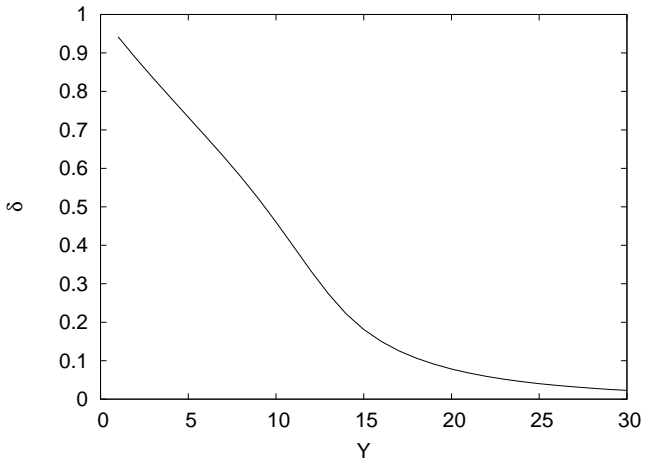
- [Sections 3.4-3.5, Eq. (43), Fig. 9, Fig. 11] The BFKL entropy result cannot serve as independent corroboration of a peak near Y=12. Equation (43) and Fig. 9 show that the model is inconsistent with unitarity for Y<20, with delta being large in precisely the region where the claimed maximum occurs. Since retaining phi(y_i) makes the moments grow as I_n proportional to e^(gamma n^2/4)/n! and the inversion (2) divergent, the calculable BFKL case is that with phi=0, and it is only physically admissible for Y>20. The entropy maximum at Y approximately 12 therefore lies outside the reliable domain. Please state explicitly which Y intervals are physically trustworthy for the BFKL model and separate the RG and BFKL claims in the abstract and conclusions.
- [Section 2.1, Eq. (11), Fig. 5] The predicted position of the entropy maximum is not parameter-free: it depends on the multiplicity parameter c through j=cY. For the RG model the paper adopts c=1 without showing how this value is extracted from data, and no sensitivity study in c is given. Since the abstract states a quantitative peak range 12-17, the dependence of the peak position and of the turnover on c should be established, or the abstract should be softened to a parametric statement. The same issue affects the comparison of RG and BFKL cases, where c differs by nearly a factor of 20.
minor comments (5)
- [Abstract] There are several typos in the abstract: 'achievung', 'cros s-sections', 'inelasic', and 'achievun g' should be corrected.
- [Section 2.1, after Eq. (8)] The sentence 'The elastic cross-section is evidently sigma_el = sigma_tot = sigma_in' is not correct as written; the intended relation is presumably sigma_tot = sigma_el + sigma_in, with sigma_in = 8*pi*lambda*F(2r)/2 and sigma_el = sigma_tot - sigma_in. Please rewrite this passage.
- [Section 2.1, Eq. (15)] In the text before Eq. (15) the reference to 'P(n) given by (40)' should be to Eq. (15), since (40) is in the BFKL section.
- [Eq. (18) and Figs. 5, 11] The entropy is denoted E(Y) in Eq. (18) but S(Y) in the figures and text; please unify the notation.
- [Section 2.1, Eq. (17)] The asymptotic expression for P(n) contains an internal inconsistency: theta(r-n) is first written and then theta(2r-n) is used. This should be clarified, since the normalization and the derivation of Eq. (19) depend on the correct upper limit.
Circularity Check
No circularity: entropy and consistency ratio are algebraic outputs of stated Poisson/AGK inputs, not fitted or self-referential.
full rationale
This paper's derivation chain is self-contained rather than circular. The inputs are stated explicitly: eikonal unitarization of multiple pomeron exchanges (Eqs. (3)-(8)), AGK cutting rules (Eq. (7)), and independent Poisson emission from each cut pomeron with mean j = cY (Eq. (11)). From these the paper derives the cut-pomeron distribution (10), the particle-number probabilities (15), the inelastic-fraction formula (16), and the entropy (18). None of these outputs is fed back into the model as an input; the parameters g^2 = 6, c = 1, and Δ = 0.13 are calibrated to total cross-section data and not to the entropy curve. The mismatch between σin/σtot = F(2r(1-e^{-j}))/(2F(r)) and the unitary value F(2r)/(2F(r)) is a derived consequence of the Poisson ansatz, not an imposed fit, and it vanishes only as exp(-cY). The BFKL branch borrows the n-gluon inclusive cross-section from [34], but that is an external published input, not the paper's conclusion; moreover the RG branch, which already shows the same non-monotonic entropy, is derived in full within the paper. The decision to drop the factor φ(y_i) is explicit and is discussed with both alternatives, so it is not a hidden ansatz. Self-citations [11], [34], [35] supply background or input formulas, but the central entropy result does not reduce to any of them. If the nmax=40 truncation in Sec. 2.2 distorts the large-Y tail, that would be a numerical correctness issue, not a circularity.
Assumptions & free parameters
free parameters (6)
- g^2 (pomeron-proton coupling) =
6 (dimensionless)
- c (multiplicity per unit rapidity) =
1 (RG, chosen by hand); 0.0574040 (BFKL, from natural cutoff)
- Delta = alpha_p(0) - 1 (pomeron intercept excess) =
0.13
- alpha' (pomeron slope) and impact-parameter slope =
0.2 GeV^-2 and 2.0 GeV^-2
- alpha_s, R1, R2 (BFKL parameters) =
0.15, 0.8 fm, 0.8 fm
- nmax (sum truncation) =
40
assumptions (6)
- domain assumption Eikonal resummation of multiple pomeron exchanges enforces unitarity and defines sigma_tot = 2*integral(db)(1 - e^{-rho(b)}).
- domain assumption AGK cancellation rules give the cross-section for n exchanged pomerons with k cut (Eq. 7) and identify integrated k-fold inclusive cross-sections with factorial moments.
- domain assumption Emissions from a single pomeron are independent and Poisson-distributed with mean j = cY.
- standard math The inversion (2) of the moment series determines probabilities P(n) uniquely, and the series converges for the phi = 0 case.
- ad hoc to paper The BFKL exponential factor phi(y_i) (Eq. 26) is dropped from the n-gluon cross-section.
- domain assumption Consistency requires the emission-based sigma_in to equal the eikonal sigma_in, which implies j = cY tends to infinity.
Cite this review
Pith. "Pith review of Entropy from inclusive scattering." pith.science (2026). https://pith.science/paper/CQUZ7DEH
@misc{pith2026260812923,
  author       = {Pith},
  title        = {Pith review of: Entropy from inclusive scattering},
  year         = {2026},
  howpublished = {\url{https://pith.science/paper/CQUZ7DEH}},
  note         = {Machine review of arXiv:2608.12923}
}
read the original abstract
Introduction of probabilities from multiple inclusive cross-sections is studied in the unitary pomeron exchange models with no interaction between the pomerons themselves. Discrepancy is observed between the emerging inelasic cross-section and the one following from unitarity. It diminishes with energy and disappears in the high-energy limit. Probabilities and entropy are calculated numerically. Contrary to naive predictions as a function of energy the entropy first rises and after achievung its maximum at rapidity 12-17 slowly falls for higher energies
Figures


Figures from the paper (8 more)




Reference graph
Works this paper leans on
-
[1]
V. Balasubramanian, M. B. McDermott and M. Van Raamsdonk , Phys. Rev. D 86 (2012),045014 [arXiv:1108.3568 /hep-th]
arXiv 2012
-
[2]
R. Peschanski, Phys.Rev. D 101 (2020) 034032, [1912.096 61/hep-th]
work page 2020
-
[3]
R. Peschanski and S. Seki, Phys. Lett. B 758 (2016) 89 [arX iv:1602.00720 /hep-th]
arXiv 2016
-
[4]
R. Peschanski and S. Seki, Phys. Rev. D 100 (2019) no.7, 07 6012 [arXiv:1906.09696 /hep-th]
arXiv 2019
- [5]
- [6]
-
[7]
E. Levin and M. Lublinsky, Nucl. Phys. A 730, 191 (2004) [a rXiv:hep-ph/0308279]
arXiv 2004
-
[8]
S.Bondarenko, S.Motyka, A.H. Mueller, A.I.Shoshi and B .-W. Xiao, Eur. Phys J. C 50 (2007) 593,[arXiv; 0609213/hep-ph]
work page 2007
Show all 35 references
-
[9]
D. E. Kharzeev and E. M. Levin, Phys. Rev. D 95, 114008 (201 7) [arXiv:1702.03489]
-
[10]
Caputa and K
P. Caputa and K. Kutak, Phys. Rev. D 110, 085011 (2024) [a rXiv:2404.07657/hep- ph]
2024 arXiv
-
[11]
M.A.Braun, Eur.Phys. J. P (2025) 140:829,[arXiv: 2409 .01620/hep-ph]
2025
-
[12]
Kutak and S
K. Kutak and S. L?ok?os, Phys. Rev. D 112, 096017 (2025) [ arXiv:2509.07898/hep- ph]
2025
-
[13]
Hentschinski, D
M. Hentschinski, D. E. Kharzeev, K. Kutak, and Z. Tu, Rep t. Prog. Phys. 87, 120501 (2024) [arXiv:2408.01259/hep-ph]
2024 arXiv
-
[14]
A8 13 (2008)1-13 [arXiv: 0807.3413/hep-ph]
A.Rormilitzin,E.Levin and A.Prygarin, Nucl.Phys. A8 13 (2008)1-13 [arXiv: 0807.3413/hep-ph]
2008 arXiv
-
[15]
Levin, Eur
E. Levin, Eur. Phys. J. C 84 (2024) no.7, 662, [arXiv: 230 6.12055/hep-ph]
2024
-
[16]
C.Contreras, E.Garrido and E.Levin, [arXiv: 2603.217 75 /hep-ph]
-
[17]
Contreras, J
C. Contreras, J. Garrido, Subatomic Part., Cosmol 6 (2026) 100417, [arXiv: 2605.27857/hep-ph]. 22
2026 arXiv
-
[18]
Rohrmoser [arXiv: 2607.18464/hep- ph]
M.Hentschinski, K.Kutak, W.Placzek, and M. Rohrmoser [arXiv: 2607.18464/hep- ph]
-
[19]
Balitsky, Phys
I. Balitsky, Phys. Rev. D60 (1999) 014020, [hep-ph/981 2311]
1999
-
[20]
Y. V. Kovchegov,Phys. Rev. D60 (1999) 034008,[hep-ph /9901281]
1999
-
[21]
Y. V. Kovchegov and K. Tuchin, Phys. Rev. D 65 (2002) 0740 26, [hep-ph/0111362]
2002 arXiv
-
[22]
Jalilian-Marian and Y
J. Jalilian-Marian and Y. V. Kovchegov, Phys. Rev. D 70 ( 2004) 114017 [Erratum- ibid. D 71 (2005) 079901], [hep-ph 0405266]
2005
-
[23]
Hladik, H.J
M. Hladik, H.J. Drescher, S. Ostapchenko, T. Pierog and K. Werner. [arXiv: hep-ph /0102194]
-
[24]
V. N. Gribov, Sov. Phys. JETP 26, 414 (1968); ibid. 29, 48 3 (1969)
1968
-
[25]
K. A. Ter-Martirosian, Phys. Lett. 44 B (1973) 317
1973
-
[26]
Baker and K
M. Baker and K. A. Ter-Martirosian, Phys. Rep. 28, 1 (197 6)
-
[27]
M.S.Dubovikov and K. A. Ter-Martirosian, Nucl Phys, 124 B (1977) 163
1977
-
[28]
Gribov, E
V. Gribov, E. M. Levin and M. G. Ryskin, Phys. Rep. 100, 1 ( 1983)
1983
-
[29]
A. B. Kaidalov, Phys. Rep. 50, 157 (1979)
1979
-
[30]
A. B. Kaidalov and K. A. Ter-Martirosyan, Phys. Lett. B 1 17, 247 (1982)
1982
-
[31]
Capella et al., Phys
A. Capella et al., Phys. Rep. 236, 225 (1994)
1994
-
[32]
Ostapchenko, Phys
S. Ostapchenko, Phys. Rev D 77 (2008) 034009, [arXiv: 0612175/hep-ph]
2008
-
[33]
V.A.Abramovsky, V.N.Gribov, O.V.Kancheli, Yad. Fiz. 18 (1973) 595-616 [Sov. J. Nucl. Phys. 18 (1974)]
1973
-
[34]
J C 4 (1998) 685; [arXiv: 9710263/hep-ph]
N.Braun and D.Treleani, Eur, Phys. J C 4 (1998) 685; [arXiv: 9710263/hep-ph]
1998
-
[35]
M.A.Braun, C.Pajares, V.V.Vechernin, Phys. Lett. B 49 3 (2000) 54 -64 [arXiv: 0007241/hep-ph]. 23
2000
Reviewed August 15, 2026 · model on record in the stance chip above.
Discussion (0). Continue with ORCID to comment.