REVIEW 4 major objections 5 minor 80 references
A Deep RL based Framework for Targeted White Matter Tractography
T0 review · 4 major / 5 minor · reviewed 2026-08-15 · deepseek-v4-flash
Pith's one-line read GPT-based sequence models can refine and fuse RL tracking policies for tract-specific brain tractography without ground-truth fibers.
desk verdict Solid engineering thesis with a plausible but statistically unsupported claim of improvement over base RL policies; worth refereeing with major revisions. read the letter →
The pith
A machine-rendered reading of the paper's core claim, the machinery that carries it, and where it could break.
The reading
What carries the argument
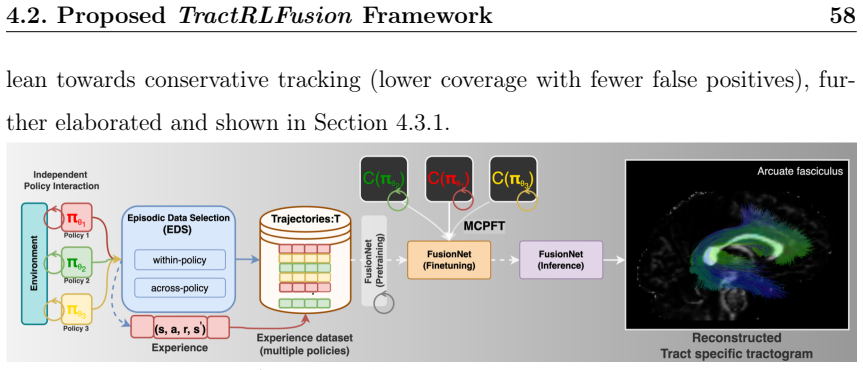
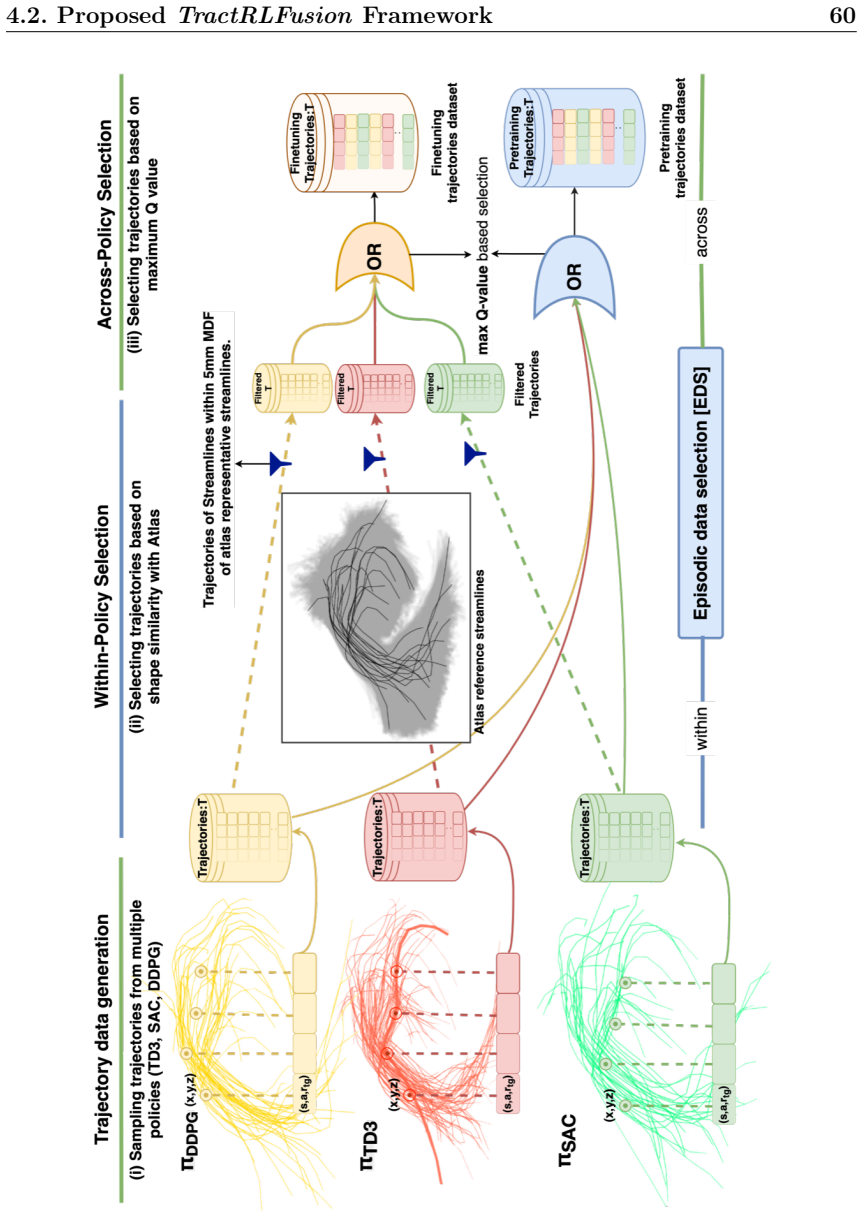
The central object is the trajectory token sequence: each timestep contributes a return-to-go scalar, a 334-dimensional state built from spherical-harmonic coefficients of a voxel and its neighbors, mask values, and the last four tracking directions, plus a 3-dimensional action, all processed by a causal decoder-only transformer with a 40-token context. This is the mechanism by which offline RL experience becomes a tract-specific policy: the transformer is pre-trained on mixed-tract trajectories and fine-tuned per tract, and at inference the return-to-go is fixed to a high expert value of 300 so the model generates actions conditioned on the promised return. Around this core, the Mask Refinement Module prunes dilated atlas masks into subject-specific tracking regions, Episodic Data Selection curates trajectories by MDF distance and Q-value, and Multi-Critic Policy Fine-Tuning anchors the fused actor with the original policies' critics.
What would settle it
Train the framework under two conditions: once with the true atlas reference streamlines and once with the same atlas rotated, warped, or replaced by a different bundle atlas, keeping all RL rollouts and training hyperparameters fixed. If Dice, overlap, and overreach on held-out subjects do not degrade substantially in the corrupted-atlas condition, the no-ground-truth claim stands; if they do, the reported gains are artifacts of atlas priors rather than evidence of learned policy refinement.
Extended reading notes
Core claim
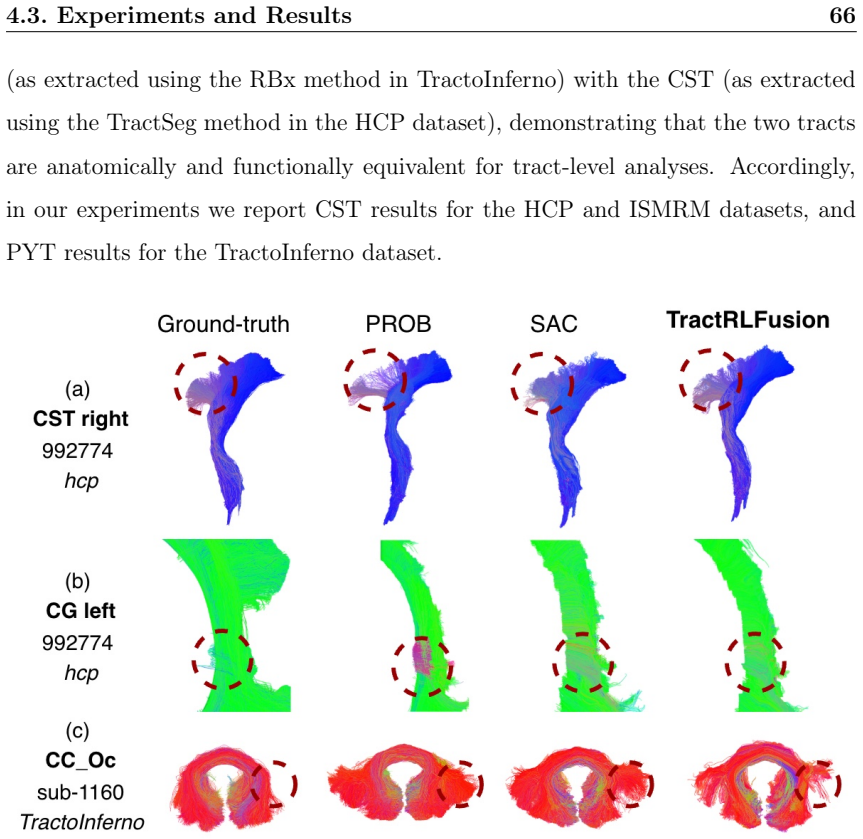
The central claim is that a trajectory-level sequence model can refine and fuse RL tracking policies more effectively than the policies can perform on their own. In Tract-RLFormer, a TD3 agent is trained per tract inside masks produced by the Mask Refinement Module; its rollouts are converted into return-to-go, state, and action trajectories; three decoder layers are pre-trained on a mixed-tract dataset of 150,000 trajectories, and a fourth layer is fine-tuned per tract with a five-step cosine angular loss. TractRLFusion repeats this idea across three policies: Episodic Data Selection keeps trajectories whose streamlines are within a 5 mm mean direct-flip distance of atlas reference streamlines and, across policies, selects the trajectories with the highest predicted Q-value; a GPT-based FusionNet is trained on the curated data and then refined by Multi-Critic Policy Fine-Tuning, in which the TD3, SAC, and DDPG critics add Q-value gradients to the five-step loss. The paper reports the highest Dice among the compared methods on nearly every tract and dataset, with lower overreach than the exploratory SAC policy and higher overlap than conservative TD3 and DDPG, and it attributes the gain to the balance the fused policy strikes between overlap and overreach.
Load-bearing premise
The load-bearing premise is that atlas-derived reference streamlines are accurate enough, after registration, to stand in for ground truth when generating masks, selecting training trajectories, and cleaning tracts; if they are wrong for a subject or tract, the claimed gains could come from the atlas prior rather than from learned policy improvement.
Editorial extensions
If this is right
- Tract-specific RL policies can be improved without ground-truth fibers, using only atlas-derived masks, RL rollouts, and a return-to-go conditioned sequence model.
- The same pre-trained GPT backbone, fine-tuned per tract, transfers from TractoInferno training data to HCP and ISMRM test data, so a single foundation model could cover many bundles.
- Fusing a conservative policy such as TD3 or DDPG with an exploratory policy such as SAC produces a better overlap–overreach balance than any single policy or decision-level voting or averaging.
- Tract-specific masks alone raise the Dice of even untrained classical DET and PROB trackers, so mask quality is a major lever on tractography accuracy.
- Because training is offline on rollouts, the framework can be extended to new RL policies or new datasets by re-running trajectory collection and fine-tuning, without re-training from scratch.
Reading between the lines
- If the no-ground-truth claim holds, the same offline trajectory-refinement recipe should transfer to other RL-based curve-tracing tasks in medical imaging, such as vessel or airway delineation, where annotated centerlines are scarce.
- The method's dependence on atlas reference streamlines means its no-ground-truth claim is really no subject-specific ground truth; a testable extension would be to measure how much of the reported Dice gain disappears when the atlas is swapped or misaligned.
- Because FusionNet outperforms TractSeg even inside TractSeg's own masks, the learned fused policy rather than the superior mask may be doing part of the work; this could be isolated by running the base policies inside the same masks.
- The return-to-go conditioning, fixed at 300 during inference, is a plausible control knob for the overlap–overreach trade-off; the paper does not explore it, but varying this value could offer a simple user-facing sensitivity dial.
Signed reviews
Editorial analysis
A structured set of objections, weighed in public.
Referee Report
Summary. The thesis proposes two tract-specific white-matter tractography frameworks built on a GPT decoder-only sequence model. Tract-RLFormer first trains a TD3 policy inside tract-specific masks generated by a Mask Refinement Module, collects rollouts as (return-to-go, state, action) trajectories, and trains a GPT model with mixed-tract pretraining followed by tract-specific finetuning to obtain a refined tracking policy. TractRLFusion extends this idea to fuse three policies (TD3, SAC, DDPG), using Episodic Data Selection to retain anatomically plausible high-Q trajectories, a FusionNet trained on those selected rollouts, and Multi-Critic Policy Fine-Tuning to refine the fused policy. The paper claims improvements in Dice, overlap, and overreach relative to the base and ensemble policies, and reports generalization across TractoInferno, HCP, and ISMRM datasets, all under a stated premise of not relying on ground-truth fibers for training.
Significance. If the reported improvements were statistically supported, the framework would be a useful contribution: it shows a way to reuse RL rollouts and anatomical atlases to obtain tract-specific tracking policies, and to combine complementary RL policies without a supervised fiber dataset for the final policy. The final evaluation is against external reference tracts, so the headline result is not definitionally circular. The paper also has concrete strengths: extensive validation on public benchmarks, comparison with classical, supervised, and RL baselines, and ablations of MRM, the two-stage training, EDS, and MCPFT. The central weakness is quantitative: most reported differences are small relative to the shown variability, no significance testing is provided, and overreach is not consistently reduced. The no-ground-truth claim also needs qualification because atlas-derived reference streamlines are used for mask supervision, trajectory selection, and final cleaning.
major comments (4)
- [§4.3.1, Tables 4.3–4.4] The claim that FusionNet consistently improves Dice and better balances overlap versus overreach is not established by the reported numbers. Several headline differences are within one standard deviation: HCP AF Dice is 55.5±4.8 for FusionNet versus 54.6±4.7 for SAC; HCP CST Dice is 69.4±1.3 versus 69.2±0.8 for πavg; TtoI AF Dice is 53.2±8.9 versus 52.3±8.9 for SAC. Overreach is also often higher for FusionNet than for the least-overreaching baseline: HCP AF OR is 12.3 versus 10.3 for DET, HCP CC OR is 44.8 versus 37.3 for DDPG, TtoI AF OR is 39.1 versus 37.6 for TD3, and TtoI CG OR is 41.6 versus 30.4 for DDPG. No p-values, confidence intervals, or paired tests are reported anywhere, and the Chapter 3 tables report no variability at all. Since the abstract and Section 1.5 state improvement as the contribution, the current evidence is insufficient to support the central claim.
- [Abstract; §1.5; §3.3.1.2; §4.2.3; §3.3.4] The claim of training 'without ground-truth fibers' and 'without ground-truth annotations' is misleading as stated. The Mask Refinement Module is trained with binary cross-entropy against a voxel-wise ground truth derived from RecobundlesX atlas reference streamlines, with the text explicitly calling this 'the ground truth for each voxel'. Episodic Data Selection filters trajectories by MDF distance to atlas reference streamlines, and the final tract cleaning uses Fast Streamline Search against atlas reference tracts. The accurate statement is that the method does not use subject-specific ground-truth fiber sets, not that it avoids reference/annotation data entirely. Because the same atlas prior appears in mask generation, trajectory selection, and cleaning, it needs a sensitivity analysis or an ablation that removes FSS/atlas-based selection to demonstrate that the reported gains are not largely attributable to the atlas prior rather than to learned policy refinement.
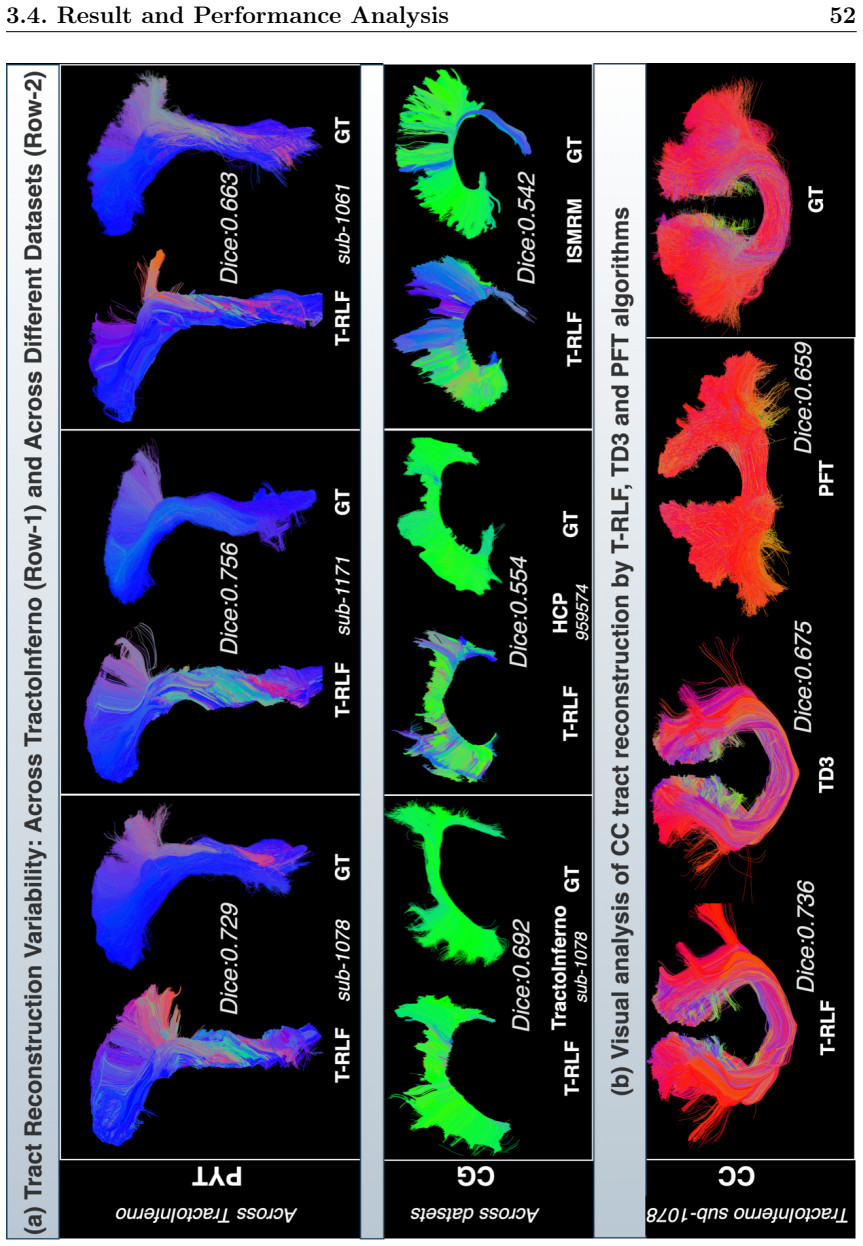
- [§3.4.3, Tables 3.3–3.4] Tract-RLFormer is described as consistently outperforming the TD3 policy from which it was trained, but the reported gaps are very small and no standard deviations or tests are given. Examples include HCP left CG Dice 53.3 versus 53.0 for TD3, HCP right CG Dice 45.6 versus 45.2, and TtoI AF Dice 52.7 versus 51.8. Overreach is not consistently reduced: T-RLF has higher OR than TD3 for TtoI CG left (28.6 versus 27.3), AF right (49.8 versus 46.9), PYT left (17.2 versus 15.9), and CC (32.6 versus 26.1). In several rows classical DET/PROB also exceed T-RLF. These results do not support the Section 3.5 summary statement that the framework improves performance and reduces false positives.
- [§4.2.3 and §4.2.5] The fusion mechanism assumes that Q-values from TD3, SAC, and DDPG are comparable across policies, since EDS selects the policy with the maximum expected Q-value and MCPFT aggregates the three critics through Eq. (4.2.3). The three policies were trained with different discount factors, learning rates, and exploration/entropy settings (Table 4.1), so their critic outputs are not calibrated to a common scale. The paper does not discuss this cross-policy comparability issue, which is load-bearing for both the selection and the combined actor loss. A concise experimental justification, for example a study of Q-value distributions per policy or a normalized variant of the selection criterion, is needed.
minor comments (5)
- [§3.4, §3.4.2] The text says seven principal tracts are used, but Section 3.4 then adds the Optical Radius tract as an eighth tract; the abbreviation list also defines OR as 'Optical Radius', whereas the standard term is optic radiation.
- [Table 3.3] There is a typo in the HCP DET overreach entry ('21..5'), and several other numbers use a non-standard notation for standard deviations in Chapter 4 tables; these should be cleaned up.
- [§3.4.4, Table 3.5] The caption refers to 'Section 3.2.1.2', which does not exist; this cross-reference should be corrected.
- [§4.3.1] The note explaining why PROB is omitted from some TractoInferno rows is informative, but it should be moved into the table caption or stated before the first table that uses this exclusion.
- [Figure 3.5] The caption contains the misspelling 'Tract-RLForemer' and should be corrected.
Circularity Check
No significant circularity: the central claims are evaluated against external ground-truth Dice/overlap metrics, and no prediction in the pipeline reduces by construction to its training inputs.
full rationale
The paper's headline results are not definitionally circular. Final evaluation metrics (Dice, Overlap, Overreach) are computed voxel-wise against external ground-truth tracts using Eqs. 3.4.3-3.4.5, not against the masks, rewards, Q-values, or trajectory-selection criteria used in training. The RL policies are trained with a reward based on fODF alignment and streamline continuity (Eq. 3.3.1/4.2.1), the T-RLF and FusionNet models are trained on RL rollouts with a cosine-distance action loss, and the EDS module selects trajectories using atlas MDF constraints and base-policy Q-values; all of these are inputs to the method rather than the evaluation quantities being claimed. The MRM uses atlas-derived masks as supervision, and FSS cleaning uses atlas reference tracts, but the reported Dice/overlap numbers are measured against held-out ground truth from TractoInferno, HCP, and ISMRM, so the claimed improvements are not forced by construction. Self-citations such as [74] are pointers to the thesis's own preceding chapter (Section 3.3.1.2) and do not supply an unverified load-bearing premise; no uniqueness theorem or ansatz is imported from the authors' prior work. Concerns about statistical significance and dependence on atlas priors are correctness or validation risks, not circularity. The derivation chain is therefore self-contained with respect to the evaluation protocol.
Assumptions & free parameters
free parameters (6)
- Initial return-to-go R0 for inference =
300
- Dataset-specific tracking step size =
0.375 mm (TractoInferno), 0.468 mm (HCP), 0.75 mm (ISMRM)
- MRM voxel retention threshold =
0.5
- Minimum trajectory length =
47 transitions (20 mm)
- MDF selection threshold and reference count in EDS =
5 mm, 15 streamlines
- T-RLF architecture context length, heads, and embedding =
K=40, n_heads=1, d=128
assumptions (5)
- domain assumption The MDP formulation of streamline tracking with state, action, reward, and termination criteria is a valid model for tractography.
- domain assumption Atlas reference streamlines from RecobundlesX are reliable anatomical priors for mask generation, trajectory selection, and cleaning.
- ad hoc to paper A 5-step cosine loss on predicted actions is a good proxy for policy quality.
- ad hoc to paper Behavior cloning on selected rollouts of a base RL policy can yield a policy that outperforms the base policy.
- domain assumption CSD-estimated fODF with 45 spherical harmonic coefficients and up to five peaks captures the fiber geometry needed for tractography.
Cite this review
Pith. "Pith review of A Deep RL based Framework for Targeted White Matter Tractography." pith.science (2026). https://pith.science/paper/LI4FQ5BB
@misc{pith2026260812960,
  author       = {Pith},
  title        = {Pith review of: A Deep RL based Framework for Targeted White Matter Tractography},
  year         = {2026},
  howpublished = {\url{https://pith.science/paper/LI4FQ5BB}},
  note         = {Machine review of arXiv:2608.12960}
}
read the original abstract
Fiber tractography's ability to reconstruct the brain's structural pathways, has made it a crucial component of modern neuroimaging, enabling detailed, non-invasive mapping of structural connectivity and supporting a wide range of neurological research and clinical applications. However, despite its importance, tractography remains a challenging task due to the inherent complexity of white matter structure and its susceptibility to false positives, which can lead to the misrepresentation of critical pathways. To overcome these limitations, in this thesis, we propose a hybrid framework that integrates reinforcement learning with supervised learning for refining RL policies, specifically tailored for tract-specific tractography. Notably, our framework does not rely on ground-truth fibers for training. Moreover, the tract-specific formulation bypasses the need for an explicit segmentation process, simplifying the overall pipeline. Our work includes two main contributions, each building upon the previous. First, we introduce a hybrid approach that combines reinforcement learning with supervised learning (specifically, GPT-based policy learning) to refine policies in a tract-specific context. Second, we propose a scalable framework for data-driven multi-policy fusion, which leverages the complementary strengths of multiple RL policies to improve tractography performance and robustness. We demonstrate the effectiveness of our framework through extensive validation on benchmark public datasets including TractoInferno, HCP, and ISMRM-2015, highlighting its ability to generalize across data sources and accurately reconstruct brain white matter tracts. We believe that these contributions represent significant advancements in the field of tractography, improving robustness, reliability, and accuracy while reducing dependence on ground-truth annotations.
Figures

Figures from the paper (17 more)



Reference graph
Works this paper leans on
-
[1]
Imagenet classification with deep convolutional neural networks,
A. Krizhevsky, I. Sutskever, and G. E. Hinton, “Imagenet classification with deep convolutional neural networks,”Advances in neural information processing systems, vol. 25, 2012
2012
-
[2]
Faster r-cnn: Towards real-time ob- ject detection with region proposal networks,
S. Ren, K. He, R. Girshick, and J. Sun, “Faster r-cnn: Towards real-time ob- ject detection with region proposal networks,”Advances in neural information processing systems, vol. 28, 2015
work page 2015
-
[3]
U-net: Convolutional networks for biomedical image segmentation,
O. Ronneberger, P. Fischer, and T. Brox, “U-net: Convolutional networks for biomedical image segmentation,” inInternational Conference on Medical image computing and computer-assisted intervention. Springer, 2015, pp. 234–241
2015
-
[4]
Photo-realistic single image super- resolution using a generative adversarial network,
C. Ledig, L. Theis, F. Huszár, J. Caballero, A. Cunningham, A. Acosta, A. Aitken, A. Tejani, J. Totz, Z. Wanget al., “Photo-realistic single image super- resolution using a generative adversarial network,” inProceedings of the IEEE conference on computer vision and pattern recognition, 2017, pp. 4681–4690
work page 2017
-
[5]
Siemens 3t mri scanners compared,
I. Block Imaging, “Siemens 3t mri scanners compared,” https://www. blockimaging.com/blog/siemens-3t-mri-scanners-compared, accessed: 2025-12- 07
work page 2025
-
[6]
R. H. Hashemi, W. G. Bradley, and C. J. Lisanti,MRI: the basics. Lippincott Williams & Wilkins, 2010
work page 2010
-
[7]
Computed tomography: principles, design, artifacts, and recent ad- vances,
J. Hsieh, “Computed tomography: principles, design, artifacts, and recent ad- vances,” 2003. 77 Bibliography 78
work page 2003
-
[8]
Molecular imaging and its biological applications,
M. E. Phelps, “Molecular imaging and its biological applications,”Eur J Nucl Med Mol Imaging, vol. 31, p. 1544, 2004
work page 2004
Show all 80 references
-
[9]
Multimodality assessment of brain tumors and tumor recurrence,
W.-D. Heiss, P. Raab, and H. Lanfermann, “Multimodality assessment of brain tumors and tumor recurrence,”Journal of Nuclear Medicine, vol. 52, no. 10, pp. 1585–1600, 2011
2011
-
[10]
A review of deep learning in medical imaging: Imaging traits, technology trends, case studies with progress highlights, and future promises,
S. K. Zhou, H. Greenspan, C. Davatzikos, J. S. Duncan, B. Van Ginneken, A. Madabhushi, J. L. Prince, D. Rueckert, and R. M. Summers, “A review of deep learning in medical imaging: Imaging traits, technology trends, case studies with progress highlights, and future promises,”Pr...
2021
-
[11]
The intelligent imaging revolution: artificial intelligence in mri and mrs acquisition and re- construction,
T. Küstner, C. Qin, C. Sun, L. Ning, and C. M. Scannell, “The intelligent imaging revolution: artificial intelligence in mri and mrs acquisition and re- construction,”Magnetic Resonance Materials in Physics, Biology and Medicine, vol. 37, no. 3, pp. 329–333, 2024
2024
-
[12]
Advances and challenges in fmri and dti techniques,
R. R. Jha, G. Jaswal, A. Nigam, and A. Bhavsar, “Advances and challenges in fmri and dti techniques,”Intelligent data security solutions for e-health applica- tions, pp. 77–90, 2020
2020
-
[13]
Mr diffusion tensor spectroscopy and imaging,
P. J. Basser, J. Mattiello, and D. LeBihan, “Mr diffusion tensor spectroscopy and imaging,”Biophysical journal, vol. 66, no. 1, pp. 259–267, 1994
1994
-
[14]
Robust determination of the fibre orientation distribution in diffusion mri: non-negativity constrained super- resolved spherical deconvolution,
J.-D. Tournier, F. Calamante, and A. Connelly, “Robust determination of the fibre orientation distribution in diffusion mri: non-negativity constrained super- resolved spherical deconvolution,”Neuroimage, vol. 35, no. 4, pp. 1459–1472, 2007
2007
-
[15]
Q-ball imaging,
D. S. Tuch, “Q-ball imaging,”Magnetic Resonance in Medicine: An Official Journal of the International Society for Magnetic Resonance in Medicine, vol.52, no. 6, pp. 1358–1372, 2004
2004
-
[16]
Regularized, fast, and robust analytical q-ball imaging,
M. Descoteaux, E. Angelino, S. Fitzgibbons, and R. Deriche, “Regularized, fast, and robust analytical q-ball imaging,”Magnetic Resonance in Medicine: An Of- Bibliography 79 ficial Journal of the International Society for Magnetic Resonance in Medicine, vol. 58, no. 3, pp. 497–...
2007
-
[17]
An integrated approach to correc- tion for off-resonance effects and subject movement in diffusion mr imaging,
J. L. Andersson and S. N. Sotiropoulos, “An integrated approach to correc- tion for off-resonance effects and subject movement in diffusion mr imaging,” Neuroimage, vol. 125, pp. 1063–1078, 2016
2016
-
[18]
N4itk: improved n3 bias correction,
N. J. Tustison, B. B. Avants, P. A. Cook, Y. Zheng, A. Egan, P. A. Yushkevich, and J. C. Gee, “N4itk: improved n3 bias correction,”IEEE transactions on medical imaging, vol. 29, no. 6, pp. 1310–1320, 2010
2010
-
[19]
Mrtrix3: A fast, flexi- bleandopensoftwareframeworkformedicalimageprocessingandvisualisation,
J.-D. Tournier, R. Smith, D. Raffelt, R. Tabbara, T. Dhollander, M. Pietsch, D. Christiaens, B. Jeurissen, C.-H. Yeh, and A. Connelly, “Mrtrix3: A fast, flexi- bleandopensoftwareframeworkformedicalimageprocessingandvisualisation,” Neuroimage, vol. 202, p. 116137, 2019
2019
-
[20]
The design of sim- pleitk,
B. C. Lowekamp, D. T. Chen, L. Ibáñez, and D. Blezek, “The design of sim- pleitk,”Frontiers in neuroinformatics, vol. 7, p. 45, 2013
2013
-
[21]
Advanced normalization tools,
B. B. Avantset al., “Advanced normalization tools,”Insight j, vol. 2, no. 365, pp. 1–35, 2009
2009
-
[22]
Freesurfer,
B. Fischl, “Freesurfer,”Neuroimage, vol. 62, no. 2, pp. 774–781, 2012
2012
-
[23]
Automated quality control for within and between studies diffusion mri data using a non-parametric framework for movement and distortion correction,
M. Bastiani, M. Cottaar, S. P. Fitzgibbon, S. Suri, F. Alfaro-Almagro, S. N. Sotiropoulos, S. Jbabdi, and J. L. Andersson, “Automated quality control for within and between studies diffusion mri data using a non-parametric framework for movement and distortion correction,”Neur...
2019
-
[24]
Dtiprep: quality control of diffusion-weighted images,
I. Oguz, M. Farzinfar, J. Matsui, F. Budin, Z. Liu, G. Gerig, H. J. Johnson, and M. Styner, “Dtiprep: quality control of diffusion-weighted images,”Frontiers in neuroinformatics, vol. 8, p. 4, 2014
2014
-
[25]
Microstructural and physiological features of tissues elucidated by quantitative-diffusion-tensor mri,
P. J. Basser and C. Pierpaoli, “Microstructural and physiological features of tissues elucidated by quantitative-diffusion-tensor mri,”Journal of magnetic res- onance, vol. 213, no. 2, pp. 560–570, 2011. Bibliography 80
2011
-
[26]
Toward a quantitative assessment of diffusion anisotropy,
C. Pierpaoli and P. J. Basser, “Toward a quantitative assessment of diffusion anisotropy,”Magnetic resonance in Medicine, vol. 36, no. 6, pp. 893–906, 1996
1996
-
[27]
Inference of a human brain fiber bundle atlas from high angular resolution diffusion imaging,
P. B. G. Alvez, “Inference of a human brain fiber bundle atlas from high angular resolution diffusion imaging,” Ph.D. dissertation, Université Paris Sud-Paris XI, 2011
2011
-
[28]
Tractseg-fast and accurate white matter tract segmentation,
J. Wasserthal, P. Neher, and K. H. Maier-Hein, “Tractseg-fast and accurate white matter tract segmentation,”NeuroImage, vol. 183, pp. 239–253, 2018
2018
-
[29]
The challenge of mapping the human connectome based on diffusion tractography,
K. H. Maier-Heinet al., “The challenge of mapping the human connectome based on diffusion tractography,”Nature communications, vol. 8, no. 1, p. 1349, 2017
2017
-
[30]
Diffusion mri fiber tractography of the brain,
B. Jeurissen, M. Descoteaux, S. Mori, and A. Leemans, “Diffusion mri fiber tractography of the brain,”NMR in Biomedicine, vol. 32, no. 4, p. e3785, 2019
2019
-
[31]
Challenges in diffusion mri tractography–lessons learned from international benchmark competitions,
K. G. Schilling, A. Daducci, K. Maier-Hein, C. Poupon, J.-C. Houde, V. Nath, A. W. Anderson, B. A. Landman, and M. Descoteaux, “Challenges in diffusion mri tractography–lessons learned from international benchmark competitions,” Magnetic resonance imaging, vol. 57, pp. 194–209, 2019
2019
-
[32]
Tractography and machine learning: Current state and open challenges,
P. Poulin, D. Jörgens, P.-M. Jodoin, and M. Descoteaux, “Tractography and machine learning: Current state and open challenges,”Magnetic resonance imag- ing, vol. 64, pp. 37–48, 2019
2019
-
[33]
Three-dimensional tracking of axonal projections in the brain by magnetic resonance imaging,
S. Mori, B. J. Crain, V. P. Chacko, and P. C. Van Zijl, “Three-dimensional tracking of axonal projections in the brain by magnetic resonance imaging,” Annals of Neurology: Official Journal of the American Neurological Association and the Child Neurology Society, vol. 45, no. 2...
1999
-
[34]
In vivo fiber tractography using dt-mri data,
P. J. Basser, S. Pajevic, C. Pierpaoli, J. Duda, and A. Aldroubi, “In vivo fiber tractography using dt-mri data,”Magnetic resonance in medicine, vol. 44, no. 4, pp. 625–632, 2000
2000
-
[35]
Characterization and Bibliography 81 propagation of uncertainty in diffusion-weighted mr imaging,
T. E. Behrens, M. W. Woolrich, M. Jenkinson, H. Johansen-Berg, R. G. Nunes, S. Clare, P. M. Matthews, J. M. Brady, and S. M. Smith, “Characterization and Bibliography 81 propagation of uncertainty in diffusion-weighted mr imaging,”Magnetic Reso- nance in Medicine: An Official ...
2003
-
[36]
Improved probabilistic streamlines tractography by 2nd order integration over fibre orientation distri- butions,
J. D. Tournier, F. Calamante, A. Connellyet al., “Improved probabilistic streamlines tractography by 2nd order integration over fibre orientation distri- butions,” inProceedings of the international society for magnetic resonance in medicine, vol. 1670. Stockholm, 2010, p. 2010
2010
-
[37]
A framework for a streamline-based probabilistic index of connectivity (pico) using a structural interpretation of mri diffusion measurements,
G. J. Parker, H. A. Haroon, and C. A. Wheeler-Kingshott, “A framework for a streamline-based probabilistic index of connectivity (pico) using a structural interpretation of mri diffusion measurements,”Journal of Magnetic Resonance Imaging: An Official Journal of the Internatio...
2003
-
[38]
Non-invasive mapping of connections between human thalamus and cortex using diffusion imaging,
T. E. Behrens, H. Johansen-Berg, M. W. Woolrich, S. M. Smith, C. A. Wheeler- Kingshott, P. A. Boulby, G. J. Barker, E. Sillery, K. Sheehan, O. Ciccarelliet al., “Non-invasive mapping of connections between human thalamus and cortex using diffusion imaging,”Nature neuroscience,...
2003
-
[39]
Gibbs tracking: a novel ap- proach for the reconstruction of neuronal pathways,
B. W. Kreher, I. Mader, and V. G. Kiselev, “Gibbs tracking: a novel ap- proach for the reconstruction of neuronal pathways,”Magnetic Resonance in Medicine: An Official Journal of the International Society for Magnetic Reso- nance in Medicine, vol. 60, no. 4, pp. 953–963, 2008
2008
-
[40]
Anatomically- constrained tractography: improved diffusion mri streamlines tractography through effective use of anatomical information,
R. E. Smith, J.-D. Tournier, F. Calamante, and A. Connelly, “Anatomically- constrained tractography: improved diffusion mri streamlines tractography through effective use of anatomical information,”Neuroimage, vol. 62, no. 3, pp. 1924–1938, 2012
1924
-
[41]
Towards quanti- tative connectivity analysis: reducing tractography biases,
G. Girard, K. Whittingstall, R. Deriche, and M. Descoteaux, “Towards quanti- tative connectivity analysis: reducing tractography biases,”Neuroimage, vol. 98, pp. 266–278, 2014. Bibliography 82
2014
-
[42]
Tractoinferno-a large-scale, open-source, multi-site database for machine learning dmri tractography,
P. Poulinet al., “Tractoinferno-a large-scale, open-source, multi-site database for machine learning dmri tractography,”Scientific Data, vol. 9, no. 1, p. 725, 2022
2022
-
[43]
A machine learning based approach to fiber tractography using classifier voting,
P. F. Neher, M. Götz, T. Norajitra, C. Weber, and K. H. Maier-Hein, “A machine learning based approach to fiber tractography using classifier voting,” in International Conference on Medical Image Computing and Computer-Assisted Intervention. Springer, 2015, pp. 45–52
2015
-
[44]
Learn to track: deep learning for tractography,
P. Poulinet al., “Learn to track: deep learning for tractography,” inMICCAI 2017: 20th International Conference, Quebec City, QC, Canada, September 11- 13, 2017, Proceedings, Part I 20. Springer, 2017, pp. 540–547
2017
-
[45]
Deeptract: A probabilistic deep learning frame- work for white matter fiber tractography,
I. Benou and T. Riklin Raviv, “Deeptract: A probabilistic deep learning frame- work for white matter fiber tractography,” inMICCAI: Shenzhen, China, Octo- ber 13–17, 2019. Springer, 2019, pp. 626–635
2019
-
[46]
Data-driven fiber tractography with neural networks,
V. Wegmayr, G. Giuliari, S. Holdener, and J. Buhmann, “Data-driven fiber tractography with neural networks,” in2018 IEEE 15th international symposium on biomedical imaging (ISBI 2018). IEEE, 2018, pp. 1030–1033
2018
-
[47]
Entrack: Probabilistic spherical regres- sion with entropy regularization for fiber tractography,
V. Wegmayr and J. M. Buhmann, “Entrack: Probabilistic spherical regres- sion with entropy regularization for fiber tractography,”International Journal of Computer Vision, vol. 129, no. 3, pp. 656–680, 2021
2021
-
[48]
Track-to-learn: A general framework for tractography with deep reinforcement learning,
A. Thébergeet al., “Track-to-learn: A general framework for tractography with deep reinforcement learning,”MIA, vol. 72, p. 102093, 2021
2021
-
[49]
What matters in reinforcement learning for tractography,
A. Théberge, C. Desrosiers, A. Boré, M. Descoteaux, and P.-M. Jodoin, “What matters in reinforcement learning for tractography,”MIA, vol. 93, p. 103085, 2024
2024
-
[50]
Tractoracle: towards an anatomically-informed reward function for rl-based tractography,
A. Théberge, M. Descoteaux, and P.-M. Jodoin, “Tractoracle: towards an anatomically-informed reward function for rl-based tractography,” inInterna- tional Conference on Medical Image Computing and Computer-Assisted Inter- vention. Springer, 2024, pp. 476–486. Bibliography 83
2024
-
[51]
Motor and language dti fiber tracking combined with intraoperative subcortical mapping for surgical removal of gliomas,
L. Bello, A. Gambini, A. Castellano, G. Carrabba, F. Acerbi, E. Fava, C. Gius- sani, M. Cadioli, V. Blasi, A. Casarottiet al., “Motor and language dti fiber tracking combined with intraoperative subcortical mapping for surgical removal of gliomas,”Neuroimage, vol. 39, no. 1, p...
2008
-
[52]
Bundle-specific tractography with incorporated anatomical and orientational priors,
F. Rheault, E. St-Onge, J. Sidhu, K. Maier-Hein, N. Tzourio-Mazoyer, L. Petit, and M. Descoteaux, “Bundle-specific tractography with incorporated anatomical and orientational priors,”Neuroimage, vol. 186, pp. 382–398, 2019
2019
-
[53]
Openai gym,
G. Brockman, V. Cheung, L. Pettersson, J. Schneider, J. Schulman, J. Tang, and W. Zaremba, “Openai gym,”arXiv preprint arXiv:1606.01540, 2016
2016 arXiv
-
[54]
Policy gradient meth- ods for reinforcement learning with function approximation,
R. S. Sutton, D. McAllester, S. Singh, and Y. Mansour, “Policy gradient meth- ods for reinforcement learning with function approximation,”Advances in neural information processing systems, vol. 12, 1999
1999
-
[55]
Continuous control with deep reinforcement learning,
T. Lillicrap, “Continuous control with deep reinforcement learning,”arXiv preprint arXiv:1509.02971, 2015
2015 arXiv
-
[56]
Addressing function approximation error in actor-critic methods,
S. Fujimoto, H. Hoof, and D. Meger, “Addressing function approximation error in actor-critic methods,” inICML. PMLR, 2018, pp. 1587–1596
2018
-
[57]
Soft actor-critic: Off-policy maximumentropydeepreinforcementlearningwithastochasticactor,
T. Haarnoja, A. Zhou, P. Abbeel, and S. Levine, “Soft actor-critic: Off-policy maximumentropydeepreinforcementlearningwithastochasticactor,” inICML. PMLR, 2018, pp. 1861–1870
2018
-
[58]
Learning internal repre- sentations by error propagation,
D. E. Rumelhart, G. E. Hinton, R. J. Williamset al., “Learning internal repre- sentations by error propagation,” 1985
1985
-
[59]
Long short-term memory,
S. Hochreiter and J. Schmidhuber, “Long short-term memory,”Neural compu- tation, vol. 9, no. 8, pp. 1735–1780, 1997
1997
-
[60]
Attention is all you need,
A. Vaswaniet al., “Attention is all you need,”Advances in neural information processing systems, vol. 30, 2017
2017
-
[61]
Improving lan- guage understanding by generative pre-training,
A. Radford, K. Narasimhan, T. Salimans, I. Sutskeveret al., “Improving lan- guage understanding by generative pre-training,” 2018. Bibliography 84
2018
-
[62]
Bert: Pre-training of deep bidirectional transformers for language understanding,
J. Devlin, M.-W. Chang, K. Lee, and K. Toutanova, “Bert: Pre-training of deep bidirectional transformers for language understanding,” inProceedings of the 2019 conference of the North American chapter of the association for com- putational linguistics: human language technolog...
2019
-
[63]
Informer: Beyond efficient transformer for long sequence time-series forecasting,
H. Zhou, Zhanget al., “Informer: Beyond efficient transformer for long sequence time-series forecasting,” inProceedings of the AAAI conference on artificial in- telligence, vol. 35, no. 12, 2021, pp. 11106–11115
2021
-
[64]
Highly accurate protein structure prediction with alphafold,
J. Jumper, R. Evans, A. Pritzel, T. Greenet al., “Highly accurate protein structure prediction with alphafold,”nature, vol. 596, no. 7873, pp. 583–589, 2021
2021
-
[65]
Evaluating large language models trained on code,
M. Chen, “Evaluating large language models trained on code,”arXiv preprint arXiv:2107.03374, 2021
2021 arXiv
-
[66]
An image is worth 16x16 words: Transformers for image recog- nition at scale,
A. Dosovitskiy, L. Beyer, A. Kolesnikov, D. Weissenborn, X. Zhai, T. Un- terthineret al., “An image is worth 16x16 words: Transformers for image recog- nition at scale,”arXiv preprint arXiv:2010.11929, 2020
2010 arXiv
-
[67]
The human connectome project: a data acquisition perspective,
D.C.VanEssen, K.Ugurbil, E.Auerbach, D.Barch, T.E.Behrens, R.Bucholz, A. Chang, L. Chen, M. Corbetta, S. W. Curtisset al., “The human connectome project: a data acquisition perspective,”Neuroimage, vol. 62, no. 4, pp. 2222– 2231, 2012
2012
-
[68]
“scilpy,” https://github.com/scilus/scilpy
-
[69]
Population average atlas for recobundlesx,
F. Rheault, “Population average atlas for recobundlesx,” May 2023. [Online]. Available: https://doi.org/10.5281/zenodo.7950602
2023 doi
-
[70]
Decision transformer: Reinforcement learning via sequence modeling,
L. Chenet al., “Decision transformer: Reinforcement learning via sequence modeling,”NeurIPS, vol. 34, pp. 15084–15097, 2021
2021
-
[71]
Fast streamline search: An exact technique for diffusion mri tractography,
E. St-Onge, E. Garyfallidis, and D. L. Collins, “Fast streamline search: An exact technique for diffusion mri tractography,”Neuroinformatics, vol. 20, no. 4, pp. 1093–1104, 2022. Bibliography 85
2022
-
[72]
Advancements in diffusion mri tractography for neurosurgery,
K. Kamagata, C. Andica, W. Uchida, K. Takabayashi, Y. Saito, M. Lukies, A. Hagiwara, S. Fujita, T. Akashi, A. Wadaet al., “Advancements in diffusion mri tractography for neurosurgery,”Investigative Radiology, vol. 59, no. 1, pp. 13–25, 2024
2024
-
[73]
Offline imitation learning from multiple baselines with applications to compiler optimization,
T. V. Marinov, A. Agarwal, and M. Trofin, “Offline imitation learning from multiple baselines with applications to compiler optimization,”arXiv preprint arXiv:2403.19462, 2024
2024 arXiv
-
[74]
Tract-rlformer: A tract-specific rl policy based decoder-only trans- former network,
A. Joshi, A. Sharma, A. Goel, R. R. Jha, C. K. Ahuja, A. Bhavsar, and A. Nigam, “Tract-rlformer: A tract-specific rl policy based decoder-only trans- former network,” inInternational Conference on Pattern Recognition. Springer, 2024, pp. 258–275
2024
-
[75]
Quickbundles, a method for tractography simplification,
E. Garyfallidis, M. Brett, M. M. Correia, G. B. Williams, and I. Nimmo-Smith, “Quickbundles, a method for tractography simplification,”Frontiers in neuro- science, vol. 6, p. 175, 2012
2012
-
[76]
Farthest streamline sampling for the uniform distribution of forearm muscle fiber tracts from diffusion tensor imaging,
Y. Li, S. Ma, J. Zhao, Q. Li, and X. Sheng, “Farthest streamline sampling for the uniform distribution of forearm muscle fiber tracts from diffusion tensor imaging,”arXiv preprint arXiv:2306.13969, 2023
2023 arXiv
-
[77]
Multi-critic actor learning: Teaching rl policies to act with style,
S. Mysore, G. Cheng, Y. Zhao, K. Saenko, and M. Wu, “Multi-critic actor learning: Teaching rl policies to act with style,” inInternational Conference on Learning Representations, 2022
2022
-
[78]
Mrtrix: diffusion tractography in crossing fiber regions,
J.-D. Tournier, F. Calamante, and A. Connelly, “Mrtrix: diffusion tractography in crossing fiber regions,”International journal of imaging systems and technol- ogy, vol. 22, no. 1, pp. 53–66, 2012
2012
-
[79]
Fiesta: Autoen- coders for accurate fiber segmentation in tractography,
F. Dumais, J. H. Legarreta, C. Lemaire, P. Poulin, F. Rheault, L. Petit, M. Barakovic, S. Magon, M. Descoteaux, P.-M. Jodoinet al., “Fiesta: Autoen- coders for accurate fiber segmentation in tractography,”NeuroImage, vol. 279, p. 120288, 2023. Bibliography 86
2023
-
[80]
On the opportunities and risks of foundation models,
R. Bommasani, “On the opportunities and risks of foundation models,”arXiv preprint arXiv:2108.07258, 2021
2021 arXiv
Reviewed August 15, 2026 · model on record in the stance chip above.
Discussion (0). Continue with ORCID to comment.