REVIEW 3 major objections 6 minor
Spatially-Grounded Text-to-Video Generation via Inference-Time Gradient-Free Optimization
T0 review · 3 major / 6 minor · reviewed 2026-08-15 · deepseek-v4-flash
Pith's one-line read GATO-Vid shows that spatial grounding in text-to-video generation can be achieved by a closed-form update to cross-attention query directions, with reported IoU gains from 0.154 to 0.363 on one benchmark at 0.4% added inference time.
desk verdict GATO-Vid reports large IoU gains for gradient-free spatial grounding on Wan2.2, but the pseudocode does not match the derived optimum, so the mechanism behind the gains is unclear as written. read the letter →
The pith
A machine-rendered reading of the paper's core claim, the machinery that carries it, and where it could break.
The reading
What carries the argument
The central object is the surrogate score $s = Q(M)\cdot\big(K(T)-K(T^c)\big) - Q(M^c)\cdot K(T)$, where $Q(M)$ and $Q(M^c)$ are mean query vectors inside and outside the target mask and $K(T)$, $K(T^c)$ are mean key vectors of the target and non-target text tokens. Its closed-form maximizers are $b_+ = (K(T)-K(T^c))/\|K(T)-K(T^c)\|$ for masked queries and $b_- = -K(T)/\|K(T)\|$ for background queries. The injection mechanism carries these directions into each early transformer block: edited queries become $q_j + \lambda_+ \|q_j\| b_+$ inside the mask and $q_j + \lambda_- P(b_-\|q_j\|, q_j)$ outside, with $P$ the orthogonal projection that strips the component parallel to the original query, followed by RMSNorm-style re-scaling with the block's gain vector so the edited query stays on the hyper-ellipsoid. A Gaussian-shaped $\lambda_+$ across the bounding box keeps the attention peak at the object center rather than flattening it.
What would settle it
On Wan2.2, compare three variants on Set 1: the implemented Algorithm 1, the same algorithm with the negative bias replaced by the derived $-K(T)/\|K(T)\|$, and the same with the RMS re-projection removed. If the derived-direction variant does not match or beat the reported 0.363 IoU, the paper's stated mechanism (the analytical surrogate) is not what the empirical gains test.
Extended reading notes
Core claim
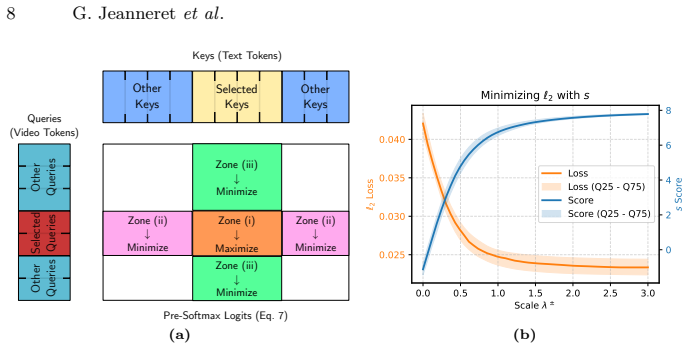
The paper's central claim is that gradient-based attention guidance can be replaced by an exact, analytically computed update to query vectors. Starting from the pre-softmax logits, it defines a score with three terms: raise the logits between target-region queries and target-word keys, lower the logits between target-region queries and non-target keys, and lower the logits between non-target queries and target keys. Because this score is a sum of separable inner products, its maximizer is explicit: inside the mask the query mean should move toward $K(T)-K(T^c)$, and outside the mask it should move against $K(T)$, where $K(T)$ denotes the mean key of the target text tokens. The paper's injection scheme adds these directions to the per-query vectors, keeps the background correction orthogonal to the original query, and re-projects onto the RMSNorm ellipsoid so the edits remain within the latent manifold the network expects. On Wan2.2, with two 400-video benchmarks and four seeds per prompt, the paper reports consistent gains on both IoU and center distance over Peekaboo, VideoTetris, and SwitchCraft, with a 0.4% inference-time overhead.
Load-bearing premise
The load-bearing premise is that the direction maximizing the simplified logit score, once added to the model's queries and re-normalized, actually moves objects toward the target box inside the full 40-block video transformer; the paper demonstrates this monotone link on a random three-layer toy attention model, not on the real network.
Editorial extensions
If this is right
- Object localization on Wan2.2 no longer requires a backward pass: a single backprop step costs +300% inference time and 26 GB extra VRAM, while GATO-Vid adds 0.4%.
- Steering the first 20 transformer blocks during the first 15% of denoising steps is as effective as steering all 40 blocks, so spatial layout is decided early in the network.
- Removing the negative bias (suppressing target tokens outside the mask) degrades localization more than removing the positive bias, making the negative term the main driver of grounding.
- Localization and quality are a tunable trade-off: increasing the number of guided iterations raises IoU but lowers aesthetic quality and dynamics.
Reading between the lines
- We infer that the implemented negative bias $\mathrm{Normalize}(\mathrm{mean}(k[T_c]))$ is not the derived optimum $-K(T)/\|K(T)\|$, so a head-to-head comparison would separate the analytical component from the empirical injection recipe.
- We infer that the same closed-form score and injection rule should transfer to any DiT with cross-attention and RMSNorm, including image generation, since the derivation uses only masks and mean keys, not video-specific structure.
- We infer that Fig. 1b's monotonicity result on a random three-layer model is the weakest empirical anchor; reproducing it on the first 20 blocks of Wan2.2 with real prompts would show whether the surrogate score, not the re-normalization, drives the reported gains.
- We infer that an adaptive injection policy—applying the bias only when early-block attention scores are high, per Fig. 4c—could keep the localization gains while recovering some of the lost dynamics and aesthetic quality.
Signed reviews
Editorial analysis
A structured set of objections, weighed in public.
Referee Report
Summary. The paper proposes GATO-Vid, a training-free and gradient-free method for spatially grounded text-to-video generation that steers cross-attention in a DiT-based video generator (Wan2.2). The authors introduce a surrogate score over pre-softmax logits (Eq. 9) that factorizes into three dot products, solve for the analytically optimal query directions (Eq. 13), and inject these directions into query tokens with an RMSNorm-aware renormalization (Eq. 16). On two new evaluation sets (400 videos each), GATO-Vid reports substantially higher IoU and lower Center Distance than gradient-free baselines Peekaboo, VideoTetris, and SwitchCraft, with only 0.4% added inference time, at the cost of some dynamic degree and aesthetic quality. The paper also presents ablations showing that the positive and negative bias components, the ellipsoid projection, and the Gaussian modulation each contribute to the reported localization gains.
Significance. If the claims hold, GATO-Vid would be a practical step: it avoids backpropagation through a large DiT, keeps inference overhead near zero, and achieves markedly better localization than existing training-free gradient-free alternatives. The analytical derivation is self-contained and verifiable, the experimental design includes a new benchmark and an ablation study, and the authors state that code will be released. However, the central theoretical narrative is not matched by the implemented algorithm (Algorithm 1 deviates from Eq. 13 and Eq. 16), and the evidence for the mechanism is limited to a toy model. The lack of statistical significance reporting weakens the empirical claim. These issues require major revision rather than acceptance.
major comments (3)
- [§3.3, Algorithm 1 vs. Eq. (13)] There is a direct contradiction between the derived optimal direction and the implemented negative bias. Equation (13) defines b^- = -K(T)/||K(T)||, whose action is to suppress, in the background region, the attention to target text tokens; Algorithm 1, however, defines b^- = Normalize(mean(k[Tc])) and injects q' ← q' - λ+||q'||b^-, which suppresses, in the background, the attention to complement text tokens. The pseudocode also uses λ+ for both injections and omits the orthogonal projection of Eq. (16). Because Table 2 shows that removing the background component decreases Set-1 IoU from 0.363 to 0.241, this component is load-bearing; as written, the mechanism that produces the reported gains is not the mechanism derived in Sec. 3.2. The authors should either implement the derived b^- (and the projection) or revise the theoretical claim and add experiments that identify which direction actually drives the improvement.
- [§3.3, Fig. 1b] The toy experiment validates the surrogate score on a random three-layer cross-attention model, but it does not validate that the analytically optimal direction survives the full injection pipeline in a 40-block DiT, including RMSNorm re-projection, softmax, and cross-attention interactions. Since the paper's central claim is that the closed-form optimum of Eq. (10) yields the effective steering direction, the authors should provide evidence that the score s in Eq. (9) actually increases after injection in Wan2.2 (e.g., a block-wise diagnostic of attention scores), or temper the claim to state that the empirical gains are observed for the implemented algorithm rather than for the derived optimum.
- [§4.2, Table 1] The central empirical claim that GATO-Vid 'significantly outperforms' existing baselines is supported only by point estimates with no error bars, confidence intervals, or significance tests. Given the high variance of text-to-video generation and the use of four seeds per prompt, the reader cannot determine whether the reported margins (e.g., Set-1 CD 0.059 vs. 0.103) are robust. The authors should report standard errors or confidence intervals, and ideally a paired significance test across the shared random seeds, to substantiate the claim of significance.
minor comments (6)
- [§1, Introduction] There are several typos and spacing errors, e.g., 'this a task' in the second paragraph and 'lessthan32GBavailableVRAM' in the first paragraph; the text should be carefully proofread.
- [§3.3, Eq. (14)] The display of Eq. (14) is difficult to parse due to missing parentheses and ambiguous placement of the denominator; please rewrite with a clear fraction notation for the normalization term.
- [§4.1, Implementation Details] The notation for the hidden dimension is inconsistent: the body of the paper uses d, while Algorithm 1 and parts of Sec. 4.1 use n; please unify the notation.
- [§4.1, Implementation Details] The hyperparameter λ± is described as 'set to 1.5 with a linear decay,' but the decay schedule (over iterations? to what final value?) is not specified; please clarify how λ+ and λ- are computed at each step.
- [§4.2, Evaluation Metrics] The CD and IoU metrics are computed only on videos with successful SAM 3 detections, which introduces a selection bias; please report the number of videos used for each metric or discuss the potential bias.
- [§5, Conclusion] The final sentence of the conclusion contains a doubled 'while' ('while our experiments suggest that while stronger spatial control...'); this should be corrected.
Circularity Check
No significant circularity: the analytical derivation is self-contained and empirically benchmarked; the Eq. (13)/Algorithm 1 discrepancy is a correctness concern, not a circular one.
full rationale
The paper's derivation chain is self-contained. Eq. (9) defines a surrogate score s over query and key means; Eq. (10) factorizes it into dot products; Eqs. (12)-(13) maximize the resulting linear form by Cauchy-Schwarz. The optimal b+ and b- are, by construction, the argmax of the paper's own surrogate, not a quantity imported from the evaluation data or from a self-citation. The link between this surrogate and actual ℓ2 localization loss is not assumed: it is tested in the toy experiment of Fig. 1b and, more importantly, the real-world localization claims are evaluated against external baselines on independently constructed benchmarks (Set 1 and Set 2). Hyperparameters such as λ± = 1.5, the first 20 blocks, the first 15% of iterations, and the Gaussian modulation are reported as implementation choices; they are tuned operating points, not presented as parameter-free predictions, so they do not constitute fitted-input-called-prediction. There is no load-bearing self-citation: the architectural claims rely on standard external references (DiT, cross-attention localization, RMSNorm), and no uniqueness theorem from the authors is invoked to forbid alternatives. I do note an internal consistency issue that is outside circularity: Algorithm 1 sets b- = Normalize(mean(k[Tc])) and subtracts λ+||q'||b- from background queries, whereas Eq. (13) defines b- = -K(T)/||K(T)|| and Eq. (16) applies the orthogonal projection. This discrepancy weakens the paper's explanatory attribution of its empirical gains to the derived optimum, but it is a correctness/mechanism concern rather than a reduction of the prediction to its own inputs. Therefore, the circularity score is 0.
Assumptions & free parameters
free parameters (4)
- Guidance scale lambda+- =
1.5 with linear decay
- Injection block window =
first 20 of 40 blocks
- Injection iteration window =
first 15% of flow-matching steps
- Gaussian modulation of lambda+ inside mask =
2D Gaussian fit to the bounding box (sigma not reported)
assumptions (6)
- standard math A linear functional over a sphere is maximized by a vector collinear with the functional's coefficient (Cauchy-Schwarz).
- standard math The softmax denominator is monotonically decreasing in each competing logit, and exp is strictly increasing.
- domain assumption Cross-attention maps in DiT blocks are the mechanism that determines object localization.
- domain assumption Injecting the derived direction only into early blocks (1-20) and the first 15% of steps is sufficient to steer the final object position.
- domain assumption Maximizing the surrogate score s is a faithful proxy for reducing the Dice/l2 localization loss in the real model.
- ad hoc to paper RMSNorm re-projection in Eq. (14)-(16) is the correct way to keep injected queries on the model's data distribution.
Cite this review
Pith. "Pith review of Spatially-Grounded Text-to-Video Generation via Inference-Time Gradient-Free Optimization." pith.science (2026). https://pith.science/paper/LJE5N6M3
@misc{pith2026260813037,
  author       = {Pith},
  title        = {Pith review of: Spatially-Grounded Text-to-Video Generation via Inference-Time Gradient-Free Optimization},
  year         = {2026},
  howpublished = {\url{https://pith.science/paper/LJE5N6M3}},
  note         = {Machine review of arXiv:2608.13037}
}
read the original abstract
Diffusion Transformer Text-to-Video models have achieved remarkable synthesis quality, yet fine-grained spatial controllability remains a significant challenge. While existing training-free methods produce solid overall results in spatially grounded generation, \ie, placing a specific object in a designated location, they rely on gradient-based optimization techniques that incur prohibitive computational overhead, a bottleneck amplified in modern large-scale architectures. To address this limitation, we present Gradient-free Analytical Trajectory Optimization Video Generation (GATO-Vid), a novel training-free and gradient-free approach for precise spatial guidance. Rather than relying on costly backward passes, we introduce an alternative cross-attention score and solve it analytically to obtain an exact, closed-form solution. To use our analytical solution, we propose an on-the-fly injection mechanism tailored to the topological manifold of the transformer's latent space. Our experiments demonstrate that GATO-Vid significantly outperforms existing baselines in localization accuracy while introducing minimal computational overhead.
Figures


Figures from the paper (1 more)

Reviewed August 15, 2026 · model on record in the stance chip above.
Discussion (0). Continue with ORCID to comment.