REVIEW 4 major objections 5 minor 86 references
Revisiting gravitational instability in protostellar discs with improved radiative cooling models
T0 review · 4 major / 5 minor · reviewed 2026-08-15 · deepseek-v4-flash
Pith's one-line read With a more accurate radiative cooling treatment, compact protostellar discs can fragment at moderate mass ratios while extended discs stay stable at much higher masses than earlier simulations found.
desk verdict A serious, wide-ranging GI parameter study with a plausible shift in the fragmentation boundary, but the core cooling equation (Eq. 8) has a wrong asymptotic limit as printed, so the quantitative results need a fix before I'd trust them. read the letter →
The pith
A machine-rendered reading of the paper's core claim, the machinery that carries it, and where it could break.
The reading
What carries the argument
The central object is the modified Lombardi radiative cooling approximation: the pseudo-mean column density $\bar{\Sigma}_i$ above a gas parcel is estimated from the local pressure gradient (Lombardi's method) and then averaged in inverse quadrature with a scale height $H_0$ reduced by self-gravity via Eq. (8), $H_0/H_* = \sqrt{\pi/2}/\sqrt{1+1/(Q_{3\rm D}\sqrt{\pi/2})}$. This lowers the estimated optical depth and therefore raises the mid-plane temperature from stellar irradiation, making discs harder to destabilise than the older Stamatellos method. Coupled to flux-limited diffusion, this method sets cooling and heating rates that respond to local structure, and the paper uses it to redraw the fragmentation and spiral-formation boundaries.
What would settle it
Take a 50 au disc around a 0.5 $M_\odot$ star at $M_d/M_* = 0.5$ and run it with full ray-tracing radiative transfer rather than the modified Lombardi cooling; if it stays axisymmetric while the modified-Lombardi version fragments (or vice versa), or if the mid-plane optical-depth profiles disagree, the claimed parameter-space shift does not survive.
Extended reading notes
Core claim
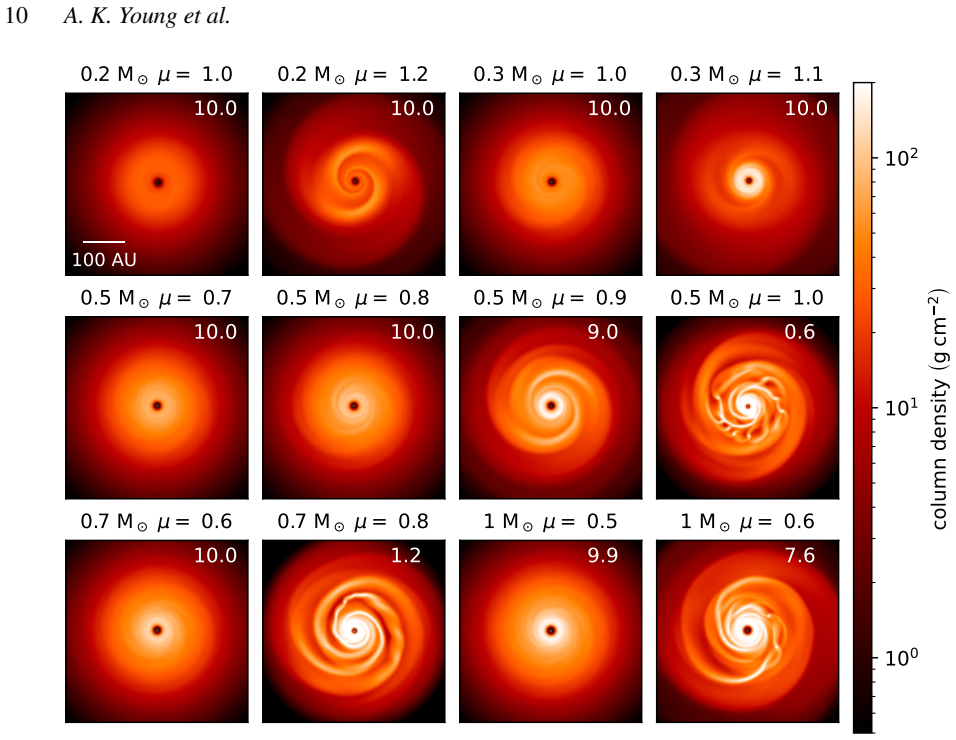
The paper argues that with the modified Lombardi radiative cooling approximation — an estimate of the column density above each gas parcel that accounts for the reduced scale height of a self-gravitating disc — the parameter space for gravitational instability changes materially. In simulations spanning 0.1 to 1 $M_\odot$ host stars and discs of 50, 100, and 200 au, discs remain stable to disc-to-star mass ratios $M_d/M_* \gtrsim 0.4$, and for low-mass stars extended discs can exceed $M_d/M_* = 1$ without fragmenting. The same models show fragmentation inside 50 au discs at $M_d/M_* \gtrsim 0.4$, placing GI-driven planet formation at 20–40 au rather than only beyond roughly 70–100 au. Large-scale, grand-design spiral arms form only for $M_* \lesssim 0.3\,M_\odot$ or in the most compact discs; long-lived spirals tend to be faint, flocculent, and hard to observe.
Load-bearing premise
All conclusions rest on the modified Lombardi approximation — especially the self-gravitating scale-height correction of Eq. (8) — being a faithful substitute for full radiative transfer in self-gravitating discs; the paper validates it against earlier approximations but not against full radiative transfer.
Editorial extensions
If this is right
- Fragmentation can occur in 50 au discs when $M_d/M_* \gtrsim 0.4$, so direct-collapse planet formation is not confined to very extended discs; fragments appear at 20–30 au in the most compact cases.
- Discs around young stars can remain gravitationally stable at $M_d/M_*$ at least 0.4, and above 1 for low-mass stars, retaining a large reservoir of solid material for planet formation.
- Large-scale grand-design spirals are rare under this cooling treatment; the typical long-lived GI signature is a faint, flocculent, low-contrast spiral, which may be hard to detect.
- GI can be active ($Q_{\rm min} \lesssim 1.5$) in discs whose spirals are so faint that no clear spiral is observable, which could explain the scarcity of observed GI spirals.
- Simulations should be run for at least 10 outer rotation periods before declaring a disc stable, since some discs develop spirals or fragments only after several ORPs.
Reading between the lines
- If the modified Lombardi estimate of optical depth is right, then constant-$\beta_{\rm cool}$ disc simulations — and the fragmentation thresholds derived from them — should be recalibrated, since the effective cooling slope in the outer disc is much steeper than a constant value.
- The shift of fragmentation inward to 20–40 au predicts that young discs around low-luminosity stars are the best targets for detecting GI-driven signatures, because only there are extended spirals long-lived enough to observe.
- A direct head-to-head against full ray-tracing radiative transfer for the same initial conditions, with and without dust settling, would test whether the remaining column-density approximation, not the underlying thermodynamics, is what moves the fragmentation boundary.
- The stable massive discs the paper finds would be the ones to host grain-growth-assisted planet formation; a long self-regulated phase gives dust time to grow and drift into the spiral arms.
Signed reviews
Editorial analysis
A structured set of objections, weighed in public.
Referee Report
Summary. This paper revisits the parameter space for gravitational instability (GI) in young protostellar discs using SPH simulations with four approximate radiative cooling methods. The authors introduce and promote a 'modified Lombardi' cooling approximation that adjusts the local column density estimate for the reduced scale height of a self-gravitating disc. After comparing the four methods on selected cases, they run a grid of over 60 simulations with stellar irradiation for stellar masses 0.1-1.0 Msun, disc outer radii 50/100/200 au, and disc-to-star mass ratios up to ~1.4. The central claims are that compact 50 au discs can fragment for Md/M* above about 0.4, that 100-200 au discs can remain stable up to Md/M* of about 0.4 and sometimes above 1, and that large-scale grand-design spirals are uncommon, forming mainly around the lowest-mass stars or in the most compact discs. The paper also compares its outcomes with earlier Stamatellos-method results and with Haworth et al. (2020), and includes appendices testing initial-condition sensitivity and resolution.
Significance. If the quantitative parameter-space shifts are correct, the paper would meaningfully change expectations for where and when GI-driven fragmentation and spiral structure operate in embedded protostellar discs, with direct implications for planet formation pathways and for interpreting observations of young discs. The method comparison in Section 3.1 and the appendices on initial conditions and resolution are useful and provide checks that are not always present in parameter studies of this kind. The public availability of the modified code is a further strength. However, the central quantitative conclusions rest on the modified Lombardi scale-height correction, and one load-bearing formula in the manuscript has an incorrect asymptotic limit as printed. Because the column-density estimate feeds directly into the optical depth, cooling/heating rates, and the Fig. 4 stability boundaries, the claims in their present form are not fully established.
major comments (4)
- [Section 2.1, Eq. (8)] As printed, Eq. (8) gives H0/H* = sqrt(pi/2) / sqrt(1 + 1/(Q3D sqrt(pi/2))), which tends to sqrt(pi/2) ~ 1.25 as Q3D -> infinity. The text states that H0 is the scale height of a self-gravitating disc and H* = c_s/Omega_K is the non-self-gravitating scale height, so the physically required limit is H0/H* -> 1; the usual vertical-hydrostatic result for this Q3D definition is H/H* = (1 + 1/Q3D)^(-1/2). The printed expression therefore contradicts its stated purpose and introduces a 25% error in the scale height in exactly the weakly self-gravitating limit. Since the modified Lombardi column density is obtained by averaging this H0 in inverse quadrature (Eq. 7), the pseudo-mean optical depth (Eq. 10), the radiative cooling and heating rates (Eqs. 11-12), and ultimately the fragmentation/stability classifications in Fig. 4 all inherit this offset. Please correct Eq. (8), and state explicitly whether the simulations used the printed expression or the corrected one; if the code used the corrected expression, a text-only fix and a statement to that effect would resolve this point.
- [Section 2.3, Eq. (19)] The prefactor in Eq. (19) is inconsistent with the accompanying text. The text says the factor 1/sqrt(pi/2) is from H/H* = sqrt(pi/2), but Eq. (19) divides by sqrt(pi/2), which would produce H/H* = 1/sqrt(pi/2) rather than sqrt(pi/2). This affects the normalization of the initial sound-speed profile and therefore the initial Toomre Q of the discs. Please correct either the equation or the explanation, and confirm that the initial-condition robustness tests in Appendix A remain valid under the corrected normalization.
- [Section 3.2 and Fig. 4] The main quantitative outcomes, such as the Md/M* ~ 0.4 fragmentation threshold for 50 au discs and the stability limits for 100-200 au discs, are presented as sharp parameter-space boundaries in Fig. 4, but the classification into axisymmetric, faint spiral, extended spiral, and fragmentation is visual rather than defined by reproducible quantitative criteria. Given that Fig. 3 shows the disc evolution is highly sensitive to the thermal state and optical depth, the boundaries in Fig. 4 have an unquantified classification uncertainty. Please provide explicit criteria (for example, clump formation and survival thresholds, or spiral amplitude/contrast measures) and, if possible, an indication of how the quoted Md/M* thresholds shift when those criteria are varied by reasonable amounts.
- [Section 2.1 and Section 4.4] The modified Lombardi approximation is the basis for the paper's central conclusions, but it is not benchmarked against a full radiative-transfer calculation in this work; the validation is in the self-cited Young et al. (2024), and Section 4.4 itself lists geometries, shadowing, and dust-density variations for which the method is not suitable. A direct comparison of the modified Lombardi method against ray-tracing or Monte Carlo radiative transfer for at least one representative self-gravitating disc, even in the optically thin outer regions that set the fragmentation boundaries, would substantially increase confidence that the Fig. 4 parameter-space shift is physical rather than an artifact of the approximation.
minor comments (5)
- [Section 2.1, Eq. (11) and Eq. (21)] The symbol u_i is described as internal energy in some equations and as internal energy density in Eq. (21); please make the notation consistent throughout.
- [Fig. 4] The black and red symbols in Fig. 4 are difficult to distinguish in the grayscale version of the manuscript; a legend with distinct marker sizes or shapes would help, since the comparison between the modified Lombardi and Stamatellos outcomes is central to the paper.
- [Section 3.2, paragraph before Fig. 4] The text says the simulations were evolved to at least 10 ORPs, but the Fig. 4 symbols do not indicate the simulation duration or the time at which the final classification was made; including this information would clarify cases where structure develops after several ORPs.
- [Appendix C] The comparison with Haworth et al. (2020) is useful, but it is shown only for 50 au and 200 au discs; extending it to 100 au, where the new stability thresholds are a key result, would make the comparison more complete.
- [Section 4.4] The statement that 'all codes that employ FLD' cannot model shadowing is correct, but the subsequent sentence about ray tracing should also mention that the present method's neglect of dust settling is shared with recent ray-tracing work; consider making this comparison explicit.
Circularity Check
No circularity: the parameter-space outcomes are simulation results, not predictions that reduce by construction to the cooling model's inputs.
full rationale
The paper's central claims are the fragmentation and stability boundaries in Fig. 4 and the spiral morphologies, and these are outputs of SPH simulations with a specified radiative cooling approximation. No fitted parameter is renamed as a prediction: the beta_cool profiles are fits to simulation diagnostics, but the fragmentation classifications are not derived from those fits. The modified Lombardi cooling model is adopted from the authors' prior work (Young et al. 2024), including the scale-height ratio in Eq. 8, but this is not a circular step under the stated rules: Eq. 8 is a parameter-free formula whose stated assumptions (vertical hydrostatic balance, local Q3D) do not include the fragmentation thresholds it later helps to produce, and the prior paper validated column-density estimates against the actual particle distribution rather than against the present paper's outcomes. The present paper also internally compares four cooling methods and checks resolution and initial-condition sensitivity (Appendices A and B), so the central parameter-space result has independent simulation content. One technical concern is that Eq. 8 as printed does not tend to unity in the weak-self-gravity limit Q3D to infinity, which could affect the quantitative boundaries in Fig. 4; however, this is a correctness issue, not circularity, because the formula is not defined in terms of, and is not fitted to, the fragmentation results. The limitations acknowledged in Section 4.4 (FLD shadowing, fixed dust-to-gas ratio, column-averaged opacities) are model restrictions, not circular reasoning. No step satisfies the requirement of exhibiting a specific reduction of a claimed prediction to its own input by construction, so the circularity score is 0.
Assumptions & free parameters
free parameters (5)
- T_floor =
5 K
- Stellar age for MIST luminosities =
0.5 Myr
- Surface density slope p and taper radius r_c =
p = 1.0, r_c = 0.9 r_out
- Simulation duration =
10 ORP
- SPH particle number =
5e5
assumptions (5)
- standard math The Toomre Q criterion (Eq. 1) is the correct local stability condition for razor-thin discs.
- domain assumption The precomputed Rosseland and Planck mean opacity tables are accurate for protostellar disc conditions.
- domain assumption Flux-limited diffusion adequately transports heat in optically thick regions of these discs.
- domain assumption The stellar irradiation attenuation exp(-Sigma kappa) in Eq. 12 is a valid treatment of mid-plane heating.
- domain assumption MIST stellar evolution tracks at 0.5 Myr give appropriate protostellar luminosities.
Cite this review
Pith. "Pith review of Revisiting gravitational instability in protostellar discs with improved radiative cooling models." pith.science (2026). https://pith.science/paper/PQG7CHAE
@misc{pith2026260813058,
  author       = {Pith},
  title        = {Pith review of: Revisiting gravitational instability in protostellar discs with improved radiative cooling models},
  year         = {2026},
  howpublished = {\url{https://pith.science/paper/PQG7CHAE}},
  note         = {Machine review of arXiv:2608.13058}
}
abstract
Young discs are expected to be significantly more massive than those observed at $>1$ Myr and it is at this earliest stage that planet formation likely begins. Such massive discs may be susceptible to the gravitational instability (GI), therefore we need to determine the disc and stellar properties for which the GI is active to understand its role in early disc evolution and planet formation. Prior work has been limited by model assumptions and inaccuracies due to the complex nature of the thermodynamics of protostellar discs so we now revisit this question using an improved method to approximate radiative cooling within hydrodynamics simulations. We have explored a wide parameter space, representative of young protostellar discs of 0.1 to 1 M$_{\odot}$ and include irradiation from the host star. The parameters for which discs form spirals and fragment were found to differ to those obtained from earlier simulations. The outer regions of discs with radii of 50 au may be susceptible to fragmentation, meaning that GI-driven planet formation is not restricted to only the most extended discs. The additional thermal support due to stellar irradiation increases the disc mass that remains stable against GI: discs may reach up to $\gtrsim 0.4$ M$_*$ without fragmenting, providing a considerable quantity of material for building planets. Large scale spiral arms only developed for $M_*\lesssim$ 0.3 M$_{\odot}$, except in the most compact discs. Furthermore, the long-lived spiral structures that form tend to be flocculent and compact, indicating that large-scale spiral arms should not be considered a typical outcome of GI.
Figures


Figures from the paper (9 more)




Reference graph
Works this paper leans on
-
[1]
arXiv , author =:2510.19915 , journal =
doi:10.3847/1538-4357/ae16a4 , eid =. arXiv , author =:2510.19915 , journal =
-
[5]
doi:10.1093/mnras/stab2657 , eprint =
, keywords =. doi:10.1093/mnras/stab2657 , eprint =
-
[6]
arXiv , author =:2401.08722 , journal =
doi:10.3847/1538-4357/ad1f57 , eid =. arXiv , author =:2401.08722 , journal =
-
[7]
arXiv , author =:2008.08106 , journal =
doi:10.3847/1538-4357/abb1a2 , eid =. arXiv , author =:2008.08106 , journal =
arXiv 2008
-
[8]
doi:10.1051/0004-6361/201425118 , eid =. arXiv , author =:1505.07761 , journal =
-
[9]
Unveiling the physical conditions of the youngest disks: A warm embedded disk in L1527
doi:10.1051/0004-6361/201732313 , eid =. arXiv , author =:1803.04515 , journal =
-
[10]
arXiv , author =:2504.18751 , journal =
doi:10.3847/1538-4357/add14b , eid =. arXiv , author =:2504.18751 , journal =
-
[11]
On the gravitational stability of gravito-turbulent accretion disks
doi:10.3847/0004-637X/824/2/91 , eid =. arXiv , author =:1603.01613 , journal =
Show all 86 references
-
[13]
doi:10.1038/s41550-020-01297-6 , eprint =
Nature Astronomy , keywords =. doi:10.1038/s41550-020-01297-6 , eprint =
- [14]
- [15]
-
[17]
doi:10.1086/150514 , journal =
-
[18]
Annales d'Astrophysique , month = feb, pages =
-
[19]
doi:10.1093/mnras/130.2.97 , journal =
- [20]
- [21]
-
[22]
doi:10.1093/mnras/157.1.1 , journal =
- [23]
-
[24]
arXiv , author =:2510.02437 , journal =
doi:10.1051/0004-6361/202556261 , eid =. arXiv , author =:2510.02437 , journal =
-
[25]
, keywords =
On Gas Drag-Induced Rapid Migration of Solids in a Nonuniform Solar Nebula. , keywords =. doi:10.1086/378950 , archivePrefix =. astro-ph/0305594 , primaryClass =
-
[26]
, keywords =
The Temporal Requirements of Directly Observing Self-gravitating Spiral Waves in Protoplanetary Disks with ALMA. , keywords =. doi:10.3847/1538-4357/aafac2 , archivePrefix =. 1901.02407 , primaryClass =
1901 arXiv
- [27]
- [28]
-
[29]
doi:10.1086/306036 , journal =
- [30]
-
[31]
Observational appearance
Black holes in binary systems. Observational appearance. , volume =. A&A , month =
-
[32]
, keywords =
Continuing to hide signatures of gravitational instability in protoplanetary discs with planets. , keywords =. doi:10.1093/mnras/stac3106 , archivePrefix =. 2210.17454 , primaryClass =
-
[34]
arXiv , author =:1901.06555 , journal =
doi:10.1051/0004-6361/201834760 , eid =. arXiv , author =:1901.06555 , journal =
1901 arXiv
-
[35]
doi:10.1038/s41550-022-01634-x , eprint =
Nature Astronomy , keywords =. doi:10.1038/s41550-022-01634-x , eprint =
-
[36]
doi:10.1086/176648 , journal =
-
[37]
arXiv , author =:2512.00498 , journal =
doi:10.48550/arXiv.2512.00498 , eid =. arXiv , author =:2512.00498 , journal =
-
[38]
arXiv , author =:2512.02237 , journal =
doi:10.48550/arXiv.2512.02237 , eid =. arXiv , author =:2512.02237 , journal =
- [39]
-
[40]
Harris and K
Charles R. Harris and K. Jarrod Millman and St. Array programming with. Nature , month =
- [41]
- [42]
-
[43]
doi:10.1038/s41550-025-02552-4 , eprint =
Nature Astronomy , keywords =. doi:10.1038/s41550-025-02552-4 , eprint =
- [44]
- [46]
- [47]
- [48]
-
[49]
doi:10.1051/0004-6361:20065806 , eprint =
, keywords =. doi:10.1051/0004-6361:20065806 , eprint =
-
[51]
doi:10.1063/1.3099172 , editor =
15th Cambridge Workshop on Cool Stars, Stellar Systems, and the Sun , date-added =. doi:10.1063/1.3099172 , editor =. arXiv , author =:0809.5042 , keywords =
-
[53]
doi:10.1111/j.1365-2966.2005.08875.x , eprint =
, keywords =. doi:10.1111/j.1365-2966.2005.08875.x , eprint =
2005
- [54]
-
[55]
arXiv , author =:1602.08390 , journal =
doi:10.1017/pasa.2016.12 , eid =. arXiv , author =:1602.08390 , journal =
2016 arXiv
-
[56]
arXiv , author =:2510.19635 , journal =
doi:10.1051/0004-6361/202556063 , eid =. arXiv , author =:2510.19635 , journal =
-
[57]
doi:10.1086/174909 , journal =
-
[58]
doi:10.1051/0004-6361/200912325 , eprint =
, keywords =. doi:10.1051/0004-6361/200912325 , eprint =
-
[59]
doi:10.1146/annurev-astro-081710-102548 , eprint =
, keywords =. doi:10.1146/annurev-astro-081710-102548 , eprint =
- [60]
- [61]
- [62]
- [63]
- [65]
- [66]
- [67]
-
[68]
doi:10.1111/j.1365-2966.2008.14373.x , eprint =
, keywords =. doi:10.1111/j.1365-2966.2008.14373.x , eprint =
2008
-
[69]
arXiv , author =:2001.10062 , journal =
doi:10.1051/0004-6361/201936954 , eid =. arXiv , author =:2001.10062 , journal =
2001 arXiv
-
[70]
arXiv , author =:1601.05144 , journal =
doi:10.3847/0067-0049/222/1/8 , eid =. arXiv , author =:1601.05144 , journal =
-
[71]
doi:10.1093/mnras/277.2.362 , journal =
-
[72]
doi:10.1111/j.1365-2966.2010.17158.x , eprint =
, keywords =. doi:10.1111/j.1365-2966.2010.17158.x , eprint =
2010
-
[73]
doi:10.1017/pasa.2018.25 , eid =
Publications of the Astronomical Society of Australia , keywords =. doi:10.1017/pasa.2018.25 , eid =
2018 doi
-
[74]
arXiv , author =:1604.08592 , journal =
doi:10.3847/0004-637X/823/2/102 , eid =. arXiv , author =:1604.08592 , journal =
- [75]
-
[76]
arXiv , author =:1107.0728 , journal =
doi:10.1088/0004-637X/740/1/1 , eid =. arXiv , author =:1107.0728 , journal =
-
[77]
doi:10.1088/0004-637X/710/2/1375 , eprint =
, keywords =. doi:10.1088/0004-637X/710/2/1375 , eprint =
-
[78]
doi:10.1111/j.1365-2966.2012.22035.x , eprint =
, keywords =. doi:10.1111/j.1365-2966.2012.22035.x , eprint =
2012
-
[79]
doi:10.1111/j.1365-2966.2011.18344.x , eprint =
, keywords =. doi:10.1111/j.1365-2966.2011.18344.x , eprint =
2011
-
[80]
doi:10.1111/j.1365-2966.2006.11119.x , eprint =
, keywords =. doi:10.1111/j.1365-2966.2006.11119.x , eprint =
2006
-
[81]
doi:10.1088/0004-637X/704/1/281 , eprint =
, keywords =. doi:10.1088/0004-637X/704/1/281 , eprint =
-
[82]
doi:10.1111/j.1365-2966.2009.14774.x , eprint =
, keywords =. doi:10.1111/j.1365-2966.2009.14774.x , eprint =
2009
- [83]
-
[84]
doi:10.1146/annurev-astro-081915-023307 , eprint =
, keywords =. doi:10.1146/annurev-astro-081915-023307 , eprint =
-
[85]
doi:10.1086/147861 , journal =
- [86]
- [87]
-
[88]
doi:10.1051/0004-6361:20077373 , eprint =
, keywords =. doi:10.1051/0004-6361:20077373 , eprint =
- [89]
-
[90]
arXiv , author =:2212.04986 , journal =
doi:10.1093/mnras/stac3653 , eid =. arXiv , author =:2212.04986 , journal =
-
[91]
doi:10.1111/j.1365-2966.2004.08339.x , eprint =
, keywords =. doi:10.1111/j.1365-2966.2004.08339.x , eprint =
2004
-
[92]
doi:10.1111/j.1745-3933.2006.00215.x , eprint =
, keywords =. doi:10.1111/j.1745-3933.2006.00215.x , eprint =
2006
-
[93]
doi:10.1086/312737 , journal =
- [94]
- [95]
- [96]
Reviewed August 15, 2026 · model on record in the stance chip above.
Discussion (0). Continue with ORCID to comment.