REVIEW 3 major objections 4 minor 15 references
SPADE: Speculative Decoding for Precise and Low Cost Distributed Edge Cloud Inference
T0 review · 3 major / 4 minor · reviewed 2026-08-15 · deepseek-v4-flash
Pith's one-line read SPADE cuts large-model cloud calls by 76% while preserving the verifier's output distribution.
desk verdict Straightforward edge-cloud application of speculative decoding; the call-count reduction is real but does not support the claimed cost/latency gains. read the letter →
The pith
A machine-rendered reading of the paper's core claim, the machinery that carries it, and where it could break.
The reading
What carries the argument
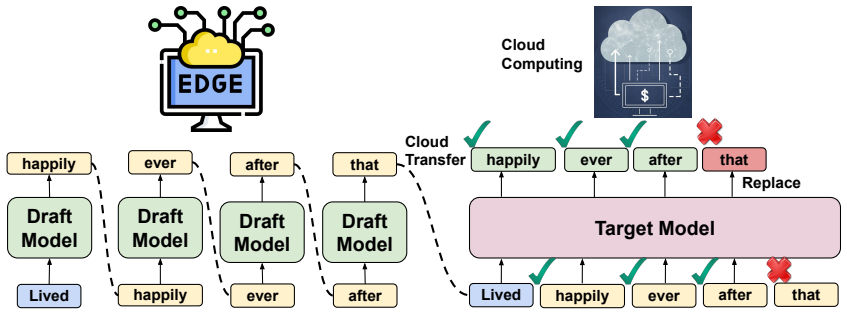
The load-bearing object is the speculative-decoding verification step, a Metropolis-Hastings-style acceptance rule: a draft token $x\sim q(x)$ is accepted with probability $\alpha(x)=\min(1,p(x)/q(x))$, and a rejected token is redrawn from the corrected distribution $\mathrm{norm}(\max(0,p(x)-q(x)))$. This identity ensures that accepting draft tokens early and correcting only at the first rejection reproduces sampling from the verifier's distribution $p$, which is what lets the edge draft freely without drifting from the big model's answers. The draft block size $d$ is the control parameter that trades verification frequency against communication and rejection costs, selected empirically on a small validation subset.
What would settle it
Instrument the same edge-cloud setup with a controllable network delay between the edge GPU and the cloud GPU (for example, 10 ms, 100 ms, and 500 ms round-trip times) and measure end-to-end wall-clock time per completed sequence. If the end-to-end runtime ratio stays near 0.24x as latency grows, the call-count proxy is sound; if the ratio rises toward 1x, the savings are partly an artifact of ignoring communication.
Extended reading notes
Core claim
On its own terms, the central discovery is that speculative decoding's two-model structure maps directly onto an edge-cloud split, and the split is what buys the savings. A lightweight edge model $M_q$ drafts $d$ tokens; the cloud model $M_p$ verifies the whole block in a single forward pass; tokens accepted under $\alpha(x)=\min(1,p(x)/q(x))$ are kept, and the first rejected token is resampled from $\mathrm{norm}(\max(0,p(x)-q(x)))$. Because this is exactly the speculative decoding correction, the output distribution of the composed system equals that of $M_p$ alone, so the paper's zero-loss accuracy claim holds by construction rather than by tuning. Empirically, mean target-model calls per sequence fall from roughly 133 to 30 on SpecBench and from 127 to 31 on CNN/DailyMail, giving 77.4% and 76% reductions, with reported cloud runtime at 0.23x and 0.24x and judge or lexical quality scores within a few points of the full model.
Load-bearing premise
The load-bearing premise is that the number of cloud model calls accurately stands in for cloud cost and latency, so a 76% reduction in calls means a 76% reduction in expense and a similar drop in runtime; if communication overhead or fixed per-request billing dominates, the claimed savings shrink.
Editorial extensions
If this is right
- Cloud billing falls by roughly three quarters on the tested workloads, because the number of verifier invocations is the dominant per-token cloud cost and it drops from one call per token to one call per accepted block.
- The framework is plug-and-play: the same edge draft model and cloud verifier require no retraining, so an existing large-model deployment could add a small edge drafter and immediately reduce per-request cloud compute.
- Output quality tracks the large model, not the small one; the paper's acceptance-correction rule makes the final sequence statistically identical to verifier-only decoding, so users keep full-model fidelity.
- The savings generalize across task types in the evaluation, including conversation, translation, summarization, question answering, mathematical reasoning, and retrieval-augmented generation, rather than being tuned to one dataset.
Reading between the lines
- Not explored in the paper: end-to-end wall-clock latency and dollar cost under realistic edge-cloud network delays; the reported 0.23x runtime is derived from call counts, so the headline savings would shrink if per-request communication overhead or fixed cloud billing charges dominate.
- A natural follow-up is a closed-form relation between the draft-verifier distribution mismatch (for example, their KL divergence), the block size $d$, and the expected cloud-call reduction; the paper tunes $d$ empirically but does not derive such a bound.
- One could replace the separate edge draft model with a self-drafting version of the verifier itself, using early layers to propose tokens, which would remove the need to find and deploy a matched small model; the paper cites self-speculative decoding in related work but does not implement this variant.
Signed reviews
Editorial analysis
A structured set of objections, weighed in public.
Referee Report
Summary. The paper proposes SPADE, a distributed edge-cloud inference framework that applies speculative decoding by running a small draft LLM on an edge device and a larger verifier LLM in the cloud. The edge model generates blocks of d draft tokens; the cloud verifies them in a single batched forward pass, accepting tokens with the standard modified rejection probability and correcting rejected tokens by sampling from a normalized max(0,p-q) distribution. This procedure inherits the distributional equivalence guarantee of Leviathan et al. [12]. Experiments on Spec-Bench and CNN/DailyMail report that SPADE reduces mean target model calls from 133.25 to 30.16 and from 127.30 to 30.79, respectively, while keeping task scores close to those of the target model. The abstract claims a 76% reduction in cloud calls with zero loss in accuracy and that SPADE significantly lowers inference time and cloud cost.
Significance. If the headline claims were supported by the measurements, SPADE would be a practical, plug-and-play contribution: it combines an established distributional guarantee with a plausible edge-cloud partitioning, requires no retraining, and achieves a large reduction in cloud invocations. The paper includes an anonymized code release and evaluates on two benchmarks. However, the current evidence supports only a narrower statement: SPADE reduces the number of cloud-side verifier calls by roughly three quarters while incurring small metric degradation. The central cost/latency claim is not substantiated by the reported experiments, and the accuracy claim is contradicted by the paper's own tables.
major comments (3)
- [§III-C, §V, Tables I-II, Algorithm 1] The reported 'Cloud runtime' reductions of 0.23x and 0.24x in Tables I and II are computed as ratios of mean target model calls (30.16/133.25 and 30.79/127.30). This conflates a verifier call with one autoregressive step. In Algorithm 1 (lines 8-9), the cloud receives a block of d draft tokens and verifies them in a single forward pass, i.e., a batched multi-token forward pass; GPU time, energy, and most cloud billing scale with the number of tokens processed and batch size, not merely with the number of service calls. The claim in Section III-C that 'cloud services often charge per model call' is not sufficient to justify using call count as the sole cost proxy. The paper reports no wall-clock time, no network round-trip time, and no GPU-second measurements. The end-to-end throughput figures in the same tables (3.25 vs 2.43 tokens/s on Spec-Bench; 1.95 vs 1.21 on CNN/DailyMail, i.e., 1.34x and 1.61x) are far below the implied ~4x cloud-runtime reduction. Consequently, the abstract and Section I claims that SPADE 'significantly lowers inference time and cloud cost' are not supported by the measurements as reported.
- [Abstract, Sections I and V, Tables I-II] The claim of 'zero loss in accuracy' is contradicted by the paper's own evaluation. On Spec-Bench, the overall score is 4.38 for SPADE versus 4.45 for the target model. On CNN/DailyMail, BLEU-1 (23.39 vs 23.76), BLEU-4 (6.98 vs 7.57), ROUGE-1 F1 (37.99 vs 38.38), and ROUGE-L F1 (23.92 vs 24.32) are all below the target, with only CIDEr-D higher (3.19 vs 2.50). These differences are small, but they are not zero. The authors should either soften the claim to 'near-target accuracy with small degradation' or report statistical tests, such as confidence intervals across multiple seeds, that establish equivalence within a stated tolerance. The statement in Section II that SPADE achieves 'zero performance loss relative to the large model as proven in [12]' is also imprecise: [12] proves distributional equivalence of the sampling procedure, not equality of finite-sample metric scores.
- [§III-C 'Draft token length' and Figure 2] The efficiency results depend on the draft length d, but the paper does not report the d values used for Tables I and II or the acceptance rates observed on the validation subset. Section III-C states that d is selected 'empirically by monitoring acceptance rates on an initial validation subset (typically ~10 samples)'; ten samples is a small basis for choosing a hyperparameter that controls the central efficiency claim, and without the chosen values, the reported call reductions are not reproducible. Figure 2 shows only a single trend line with no error bars or variance information. Reporting the selected d, the acceptance rates, and the sensitivity of both call count and throughput to d would materially strengthen the paper.
minor comments (4)
- [Abstract, Section I] There are several typographical errors: 'cloud model calls by76%' and 'by76%with' in the abstract, and 'fraft sequences' in the contributions list in Section I. These should be corrected.
- [Section IV, reference [10]] Reference [10] is a survey of speculative decoding, not the original source of the Spec-Bench benchmark. The authors should cite the actual Spec-Bench paper and clarify the task definitions and evaluation protocol.
- [Algorithm 1, line 12] The expression 'Sample y~ <- norm(max(0,p-q))' is undefined: 'norm' is not specified, and it should be stated that the sampling is over the token vocabulary after renormalizing the nonnegative part of p-q.
- [Section IV, Tables I-II] No standard deviations, number of runs, or inter-judge agreement metrics are reported for the LLM-as-a-judge scores or for the efficiency metrics. This makes it difficult to assess the stability of the reported differences.
Circularity Check
Cloud-runtime reduction is the call-count ratio relabeled; accuracy and call-count claims are otherwise independent of fitted inputs.
-
self definitional
[Table I and Section V (also Table II); efficiency rows 'Mean Target Model Calls' and 'Cloud runtime']
"Mean Target Model Calls (↓) 133.25 0.00 30.16 ... Cloud runtime (↓) 1.00× – 0.23×"
The SPADE 'Cloud runtime' value 0.23× is exactly 30.16/133.25, the ratio of the two 'Mean Target Model Calls' entries in the same table (and Table II gives 30.79/127.30 ≈ 0.24). The paper lists 'average throughput', 'average number of cloud model calls', and 'average cloud runtime reduction' as three separate efficiency indicators, but the runtime-reduction number is not an independent measurement; it is the call-count reduction renamed as runtime. Consequently the conclusion that SPADE 'significantly lowers inference time and cloud cost' is supported by a metric that is definitionally the same as its input call counts rather than by any wall-clock or GPU-time measurement.
full rationale
Apart from the relabeled cloud-runtime metric, the paper's derivation is self-contained. The acceptance rule α(x)=min(1,p(x)/q(x)) and correction p'(x)=norm(max(0,p−q)) are taken from the external speculative-decoding proof of Leviathan et al. [12], so the distribution-preservation guarantee is independent support, not a self-citation or a fitted result. The only tuned quantity, the draft length d, is a throughput/calls hyperparameter chosen on a validation subset and does not force the accuracy numbers. Authors' own prior early-exit papers appear only in related work. The 76% reduction in mean target-model calls is an empirical measurement (30.16 vs 133.25; 30.79 vs 127.30), not a fit renamed as a prediction. The circularity score is therefore low; the one reduction-by-construction step is the labeling of the call-count ratio as 'cloud runtime', which inflates the cost/latency claim without affecting the call-count or accuracy claims.
Assumptions & free parameters
free parameters (1)
- d (draft token block size) =
not reported
assumptions (3)
- domain assumption The target model's next-token distribution p(·) is exactly available to the cloud verifier in a batched forward pass, with no approximation.
- domain assumption The edge device has enough compute to run the draft model and communicate with the cloud at a latency that does not dominate the pipeline.
- standard math The distributional equivalence guarantee of speculative decoding from Leviathan et al. [12] applies without modification to the deployed sampling scheme.
Cite this review
Pith. "Pith review of SPADE: Speculative Decoding for Precise and Low Cost Distributed Edge Cloud Inference." pith.science (2026). https://pith.science/paper/5VJK7MZR
@misc{pith2026260813076,
  author       = {Pith},
  title        = {Pith review of: SPADE: Speculative Decoding for Precise and Low Cost Distributed Edge Cloud Inference},
  year         = {2026},
  howpublished = {\url{https://pith.science/paper/5VJK7MZR}},
  note         = {Machine review of arXiv:2608.13076}
}
abstract
Large Language Models (LLMs) have achieved remarkable success in natural language understanding and generation, but their deployment is constrained by high computational demands. Deploying smaller LLMs directly on the edge can circumvent this, but with degraded accuracy. Deploying smaller cloud-based big LLMs preserves performance, but at the cost of expensive per-token computation. We present a distributed inference framework, \our{}, that integrates speculative decoding (SD) across edge and cloud. A compact draft model deployed on the edge generates candidate tokens rapidly, and a large verifier model on the cloud validates these tokens in parallel. Accepted tokens are retained, while only rejections trigger verifier correction, substantially reducing the number of cloud queries. Our plug-and-play design shifts the bulk of computation to the edge, significantly lowers inference time and cloud cost, and preserves the accuracy of the big model without any retraining requirement. Our approach demonstrates a practical path toward scalable, cost-efficient, and accurate deployment of LLMs in real-world environments. Experimental results across multiple Natural Language Processing tasks using SpecBench and CNN/Dailymail datasets demonstrate that \our{} reduces the cloud model calls by $76\%$ with zero loss in accuracy as compared to the full model.
Figures

Reference graph
Works this paper leans on
-
[12]
Fast inference from trans- formers via speculative decoding,
Y . Leviathan, M. Kalman, and Y . Matias, “Fast inference from trans- formers via speculative decoding,” inInternational Conference on Machine Learning. PMLR, 2023, pp. 19 274–19 286
2023
-
[1]
Are sixteen heads really better than one?
P. Michel, O. Levy, and G. Neubig, “Are sixteen heads really better than one?”Advances in neural information processing systems, vol. 32, 2019
work page 2019
-
[2]
I-bert: Integer-only bert quantization,
S. Kim, A. Gholami, Z. Yao, M. W. Mahoney, and K. Keutzer, “I-bert: Integer-only bert quantization,” inInternational conference on machine learning. PMLR, 2021, pp. 5506–5518
2021
-
[3]
Tinybert: Distilling bert for natural language understanding,
X. Jiao, Y . Yin, L. Shang, X. Jiang, X. Chen, L. Li, F. Wang, and Q. Liu, “Tinybert: Distilling bert for natural language understanding,” arXiv preprint arXiv:1909.10351, 2019
arXiv 1909
-
[4]
Neurosurgeon: Collaborative intelligence between the cloud and mobile edge,
Y . Kang, J. Hauswald, C. Gao, A. Rovinskiet al., “Neurosurgeon: Collaborative intelligence between the cloud and mobile edge,” inACM Computer Architecture News, vol. 45, 2017, pp. 615–629
work page 2017
-
[5]
Y . Matsubara and M. Levorato, “Neural compression and filtering for edge-assisted real-time object detection in challenged networks,” in 2020 25th International Conference on Pattern Recognition (ICPR). IEEE, 2021, pp. 2272–2279
work page 2020
-
[6]
CeeBERT: Cross-domain inference in early exit BERT,
D. J. Bajpai and M. K. Hanawal, “CeeBERT: Cross-domain inference in early exit BERT,” inFindings of the Association for Computational Linguistics: ACL 2024, L.-W. Ku, A. Martins, and V . Srikumar, Eds. Bangkok, Thailand: Association for Computational Linguistics, Aug. 2024, pp. 1736–1748. [Online]. Available: https: //aclanthology.org/2024.findings-acl.101/
work page 2024
-
[7]
Splitee: Early exit in deep neural networks with split computing,
D. J. Bajpai, V . K. Trivedi, S. L. Yadav, and M. K. Hanawal, “Splitee: Early exit in deep neural networks with split computing,” inProceedings of the Third International Conference on AI- ML Systems, ser. AIMLSystems ’23. New York, NY , USA: Association for Computing Machinery, 2024. [Online]. Available: https://doi.org/10.1145/3639856.3639873
arXiv 2024
Show all 15 references
-
[8]
I-splitee: Image classi- fication in split computing dnns with early exits,
D. J. Bajpai, A. Jaiswal, and M. K. Hanawal, “I-splitee: Image classi- fication in split computing dnns with early exits,” inICC 2024 - IEEE International Conference on Communications, 2024, pp. 2658–2663
2024
-
[9]
Distributed inference on mobile edge and cloud: An early exit based clustering approach,
D. J. Bajpai and M. K. Hanawal, “Distributed inference on mobile edge and cloud: An early exit based clustering approach,” inICC 2025 - IEEE International Conference on Communications, 2025, pp. 5425–5430
2025
-
[10]
Unlocking efficiency in large language model inference: A comprehensive survey of speculative decoding,
H. Xia, Z. Yang, Q. Dong, P. Wang, Y . Li, T. Ge, T. Liu, W. Li, and Z. Sui, “Unlocking efficiency in large language model inference: A comprehensive survey of speculative decoding,”arXiv preprint arXiv:2401.07851, 2024
2024 arXiv
-
[11]
Layer skip: Enabling early exit inference and self-speculative decoding,
M. Elhoushi, A. Shrivastava, D. Liskovich, B. Hosmer, B. Wasti, L. Lai, A. Mahmoud, B. Acun, S. Agarwal, A. Romanet al., “Layer skip: Enabling early exit inference and self-speculative decoding,”arXiv preprint arXiv:2404.16710, 2024
2024 arXiv
-
[13]
Get to the point: Summarization with pointer-generator networks,
A. See, P. J. Liu, and C. D. Manning, “Get to the point: Summarization with pointer-generator networks,”arXiv preprint arXiv:1704.04368, 2017
2017 arXiv
-
[14]
The llama 3 herd of models,
A. Dubey, A. Jauhri, A. Pandey, A. Kadian, A. Al-Dahle, A. Letman, A. Mathur, A. Schelten, A. Yang, A. Fanet al., “The llama 3 herd of models,”arXiv e-prints, pp. arXiv–2407, 2024
2024
-
[15]
Gem- ini 2.5: Pushing the frontier with advanced reasoning, multimodality, long context, and next generation agentic capabilities,
G. Comanici, E. Bieber, M. Schaekermann, I. Pasupat, N. Sachdeva, I. Dhillon, M. Blistein, O. Ram, D. Zhang, E. Rosenet al., “Gem- ini 2.5: Pushing the frontier with advanced reasoning, multimodality, long context, and next generation agentic capabilities,”arXiv preprint arXiv...
2025 arXiv
Reviewed August 15, 2026 · model on record in the stance chip above.
Discussion (0). Continue with ORCID to comment.