REVIEW 2 major objections 4 minor 99 references
The atmospheric vertical structure of Uranus and Neptune from thermochemical models: the impact of model assumptions
T0 review · 2 major / 4 minor · reviewed 2026-08-15 · deepseek-v4-flash
Pith's one-line read Plausible changes in metallicity, element ratios, and 1-bar temperature shift Uranus and Neptune cloud decks by more than an order of magnitude and thermal profiles by tens of kelvins.
desk verdict A useful equilibrium sensitivity map for ice giants, but the fixed q_int=0.25 decouples the thermal profiles from composition, so the headline temperature claim is not implemented and the cloud-deck numbers need rechecking. read the letter →
The pith
A machine-rendered reading of the paper's core claim, the machinery that carries it, and where it could break.
The reading
What carries the argument
The argument runs on two coupled pieces. The first is FastChem, a chemical equilibrium code that solves the mass-action law and element conservation equations for a gas of roughly 500 species and iteratively selects the set of stable condensates, with a rainout approximation that removes condensed material from the overlying atmosphere and thus sets the cloud deck structure. The second is the single-vapor moist adiabat of Leconte et al. (2017), in which the lapse rate is dry where water is undersaturated and moist where water condenses, with a fixed deep water mixing ratio $q_{int}=0.25$; when the water mixing ratio reaches a critical value, convection is inhibited and the profile switches to a radiative gradient. The grid of metallicity, C/O, S/N, and 1-bar temperature inputs is scanned through this machinery, and the output mixing ratios, cloud decks, and thermal profiles are compared.
What would settle it
Recompute the full parameter grid with a multi-species moist adiabat that lets CH4, NH3, H2S, and H2O condense simultaneously, including the cross terms cited in the paper; if the predicted cloud deck altitudes and deep mixing ratios then vary by less than an order of magnitude across the same metallicity, C/O, S/N, and 1-bar temperature ranges, the paper's central claim of order-of-magnitude sensitivity would fail. A complementary check: an in-situ probe measuring the water abundance and the temperature profile down to 50 bar would show whether the H2O-only moist adiabat with $q_{int}=0.25$ matches the real lapse rate.
Extended reading notes
Core claim
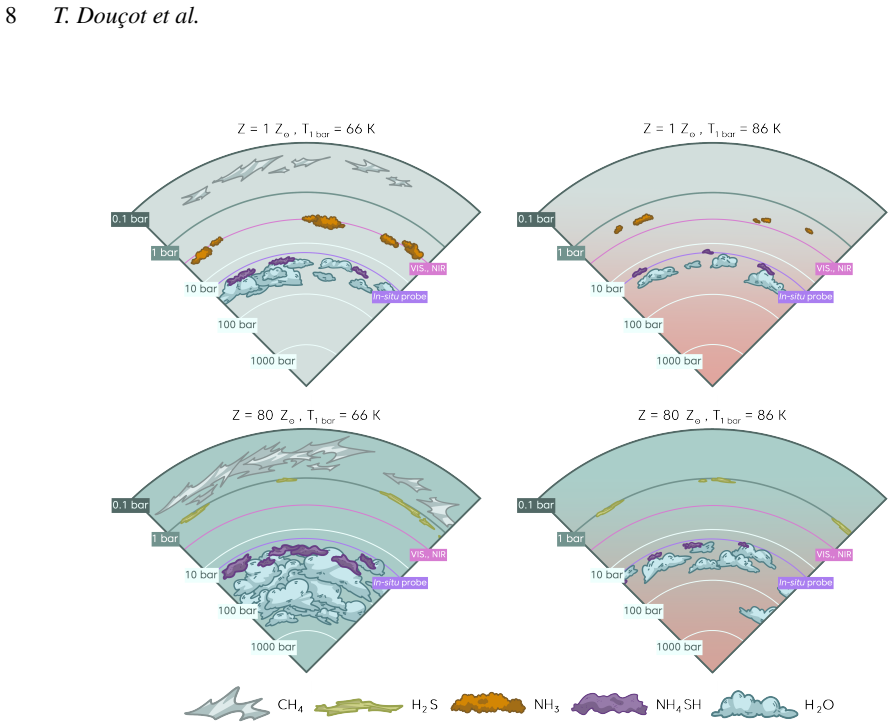
The paper's central claim is that the vertical structure of Uranus and Neptune is strongly non-unique under thermochemical equilibrium with currently plausible inputs. Over the stated grid, the deep mixing ratio of CH4 spans $3.16\times10^{-3}$ to $1.51\times10^{-1}$, H2S spans $3.23\times10^{-4}$ to $1.54\times10^{-2}$, and H2O spans $5.00\times10^{-3}$ to $2.38\times10^{-1}$, including a factor-of-about-50 increase from the lowest to highest metallicity, and the altitude of cloud decks shifts by more than an order of magnitude: water cloud bases move from 510 to 180 bar, methane clouds appear between 0.2 and 0.6 bar only at high metallicity or low temperature, and the S/N ratio decides whether NH3 or H2S is the condensing species. Thermal profiles built on the water moist adiabat differ by several tens of kelvins as composition and 1-bar temperature vary. The authors conclude that the data do not yet select a single atmospheric state, and that the possible range extends from cold, heavy-element-rich, cloudy atmospheres to warmer, heavy-element-poor, nearly cloud-free ones.
Load-bearing premise
The load-bearing premise is that the whole temperature-pressure profile can be generated from a single condensing vapor, water, with a fixed deep water mixing ratio $q_{int}=0.25$; if methane, ammonia, or hydrogen sulfide condensing at other levels changes the lapse rate, the predicted cloud decks would shift.
Editorial extensions
If this is right
- Inferred deep abundances of CH4, H2O, and H2S cannot be read off a single equilibrium model; the same observational constraints can be matched by different metallicity, C/O, S/N, and T1bar combinations, so bulk elemental ratios derived from equilibrium fits carry the model's parameter choice as an error bar.
- High metallicity alone, from about 40 solar, puts a methane cloud above 1 bar, higher than the 1-2 bar methane cloud in earlier models, meaning a detected methane cloud altitude can discriminate between metallicity regimes even with the same species mix.
- The S/N ratio is the switch for the upper cloud: with S/N below about 0.8, ammonia condenses between 3.6 and 8 bar, while with S/N above unity hydrogen sulfide condenses between 1.6 and 4 bar, matching the H2S detections reported for both planets.
- Because only cold models, with T1bar around 66-70 K at 30 solar, produce significant methane condensation, observing a persistent methane cloud at 1-2 bar would require either a colder or more metal-rich atmosphere than the warm end of the grid, or an additional non-equilibrium process.
- The authors conclude that distinguishing among these structures needs observations that can probe below the upper cloud deck, such as microwave mapping or an in-situ probe, since remote visible and near-infrared soundings stop within a few bars.
Reading between the lines
- If the same equilibrium sensitivity carries over to ice-giant exoplanets, then using a single observed tracer, such as a methane feature, to infer a sub-Neptune's metallicity is degenerate: several (Z, C/O, S/N, T1bar) combinations can reproduce the same tracer with very different deep compositions.
- The tens-of-kelvin spread in deep thermal profiles is large enough to alter interior boundary conditions; Uranus and Neptune evolution models that start from an atmospheric profile should therefore propagate this spread into thermal-cooling and radius estimates, which the paper does not do.
- A direct test of the paper's single-vapor lapse-rate assumption: recompute the grid with a multi-species moist adiabat including the cross terms cited in the paper. If the cloud-level shifts shrink below an order of magnitude, then much of the claimed sensitivity comes from the H2O-only thermal-profile approximation rather than from the composition grid.
- The models assume a fixed factor-of-ten nitrogen depletion; if Uranus or Neptune instead retains nitrogen near solar proportions, NH3 and NH4SH cloud levels would shift, which microwave observations at tens of bars could check.
Signed reviews
Editorial analysis
A structured set of objections, weighed in public.
Referee Report
Summary. The paper uses the FastChem chemical-equilibrium code to construct one-dimensional atmospheric models of Uranus and Neptune, varying metallicity (1–80 solar), C/O ratio (0.1–2.0), S/N ratio (0.19–1.6), and 1-bar temperature (66–86 K). It reports the resulting vertical mass mixing ratios and cloud decks of CH4, NH3, H2S, H2O, and NH4SH, and states that mixing ratios and cloud-deck altitudes vary by more than an order of magnitude while thermal profiles differ by tens of kelvins. The results are compared with the Hueso et al. (2020) model and with retrievals of H2S and CH4 abundances. The paper explicitly lists its equilibrium, single-vapor, rainout, and no-microphysics assumptions.
Significance. If the quantitative results were robust, the paper would provide a useful sensitivity envelope for ice-giant atmospheric structure that can be compared with ground-based and JWST observations and with future probe measurements. The use of an open-source equilibrium code, the broad parameter sweep, and the external comparisons against Hueso et al. (2020) and observed H2S/CH4 abundances are strengths. However, the central composition-dependence claim is weakened by an internal inconsistency in how the thermal profiles are constructed, so the quantitative cloud ranges and the claimed tens-of-kelvin composition effect need to be re-established.
major comments (2)
- [Sec. 2.4 and Appendix A, Eq. (4), Table A1] The thermal profiles are constructed with a fixed deep H2O abundance q_int = 0.25, while the FastChem equilibrium models in Table 2 have deep H2O mass mixing ratios from 5.0e-3 (1 Zsun) to 2.38e-1 (80 Zsun). For the low-metallicity end, the prescribed deep water abundance is about a factor of 50 larger than the model's own deep abundance, so the moist adiabat remains active to pressures where the equilibrated atmosphere is actually dry; for the high-metallicity end the two values are closer. Because the same q_int is used for all metallicity, C/O, and S/N cases, the thermal profile is effectively independent of elemental composition except through the radiative-gradient term used in the convection-inhibition case of Sec. 4.4. The abstract's statement that thermal profiles differ by several tens of kelvins 'due to composition' is therefore not implemented by the model as described. The authors should iterate q_int until it matches the deep H2O MMR for each case, or explicitly restrict the composition-driven temperature claim to the convection-inhibition scenario.
- [Sec. 3, Figs. 1-4, Table 2] The reported cloud-deck altitude ranges for metallicity, C/O, and S/N are computed on thermal profiles tied to q_int = 0.25 rather than to the actual equilibrium water abundance of the modelled atmosphere. Since the condensation levels of H2O, NH4SH, and, to a lesser extent, H2S respond to the deep temperature profile, the order-of-magnitude cloud-altitude variations in Table 2 are not a clean response to the varied elemental abundances. The central sensitivity conclusion must be re-evaluated with self-consistent thermal profiles, or the affected quantities must be shown to be insensitive to q_int over its plausible range.
minor comments (4)
- [Abstract] The phrase 'due to composition' in the abstract should be reworded or removed until the thermal profiles are actually made composition-dependent, as discussed in Major Comment 1.
- [Fig. 1 caption] The caption implies that each metallicity produces its own thermal profile, but with q_int fixed the orange profiles overplot; please state this explicitly and label the single profile when that is the case.
- [Sec. 3, Table 2] All cloud ranges use the arbitrary 10^-4 g/l cloud-top threshold; since the paper explicitly identifies this convention, a short sensitivity test at 10^-5 and 10^-3 g/l would let the reader judge how much of the reported order-of-magnitude variation comes from the threshold choice.
- [Sec. 5] The phrase 'characterizationsteptoward' appears to be a missing space, and the manuscript should be proofread for similar spacing errors in the typeset text.
Circularity Check
No significant circularity: forward equilibrium sensitivity study with stated input assumptions and external benchmarks; no fitted parameter is renamed as a prediction.
full rationale
This paper is a forward modeling sensitivity study, not a retrieval: it specifies a grid of elemental abundances, ratios, and 1-bar temperatures as inputs, computes equilibrium mixing ratios and cloud levels with FastChem, and reports how the outputs change across that grid. The main sensitivity claims therefore follow from the varied inputs through an independent equilibrium calculation, and the paper makes no attempt to tune an input to reproduce its own reported cloud altitudes or mixing ratios. The fixed deep water mass fraction q_int=0.25 (Appendix A, Table A1) is an explicit input assumption chosen from Leconte et al. (2017) and described as compatible with Hueso et al. (2020); it is not a parameter fitted to the paper's own output, so the reported cloud-deck ranges are not constructed to match it. External comparisons in Sec. 4.1 (Hueso et al. 2020) and Sec. 4.2 (Irwin et al. 2018, 2019; Sromovsky et al. 2019) show genuine disagreement in quantities such as the CH4 cloud altitude, confirming that the outputs are not calibrated to the benchmarks. The code is open source and its thermodynamic data are independently sourced (Sec. 4.1, Kitzmann et al. 2024), so the self-citation of FastChem is not load-bearing in a circular sense. The paper itself flags the single-species moist-adiabat simplification and its limitations in Sec. 2.4 and Sec. 4.3, and Appendix A explicitly lists q_int=0.25 as an assumed constant. One could argue that the abstract's phrase 'thermal profiles can differ by several tens of kelvins due to composition' overstates the implemented setup, since the thermal profile depends on T1bar and q_int rather than being recomputed self-consistently for each metallicity, but that is an internal-consistency or correctness concern, not a circular reduction of the prediction to its input. No equation in the paper defines an output in terms of the very quantity it is claimed to predict, and no fitted parameter is later presented as an independent result. Accordingly, the score is 0, with no circular steps identified.
Assumptions & free parameters
free parameters (3)
- q_int (deep H2O mass mixing ratio) =
0.25 (fixed; median from Leconte et al. 2017, compatible with Hueso et al. 2020)
- NH3 depletion factor =
10x reduction in nitrogen for metallicity runs with Z>1 Zsun
- Cloud density threshold for cloud top =
10^-4 g/l
assumptions (6)
- domain assumption The atmosphere is in thermochemical equilibrium with rainout condensation
- ad hoc to paper A single condensing vapor (H2O) controls the moist adiabatic thermal profile
- domain assumption Solar abundances from Asplund et al. (2009) provide the reference composition
- domain assumption The dry atmosphere is 85% H2 and 15% He by volume
- domain assumption The Rosseland opacity for the radiative gradient follows the analytical fit of Valencia et al. (2013)
- domain assumption Thermodynamic equilibrium constants are accurate as implemented in FastChem (NIST JANAF and related sources)
Cite this review
Pith. "Pith review of The atmospheric vertical structure of Uranus and Neptune from thermochemical models: the impact of model assumptions." pith.science (2026). https://pith.science/paper/TX25NSTN
@misc{pith2026260813157,
  author       = {Pith},
  title        = {Pith review of: The atmospheric vertical structure of Uranus and Neptune from thermochemical models: the impact of model assumptions},
  year         = {2026},
  howpublished = {\url{https://pith.science/paper/TX25NSTN}},
  note         = {Machine review of arXiv:2608.13157}
}
abstract
The composition and temperature-pressure profile of the atmospheres of Uranus and Neptune are not well-determined. As observational data are limited, we often rely on chemical equilibrium computations to infer atmospheric abundances and cloud formation. The inferred atmospheric structures, however, strongly depend on several fundamental assumptions such as the elemental abundances and ratios, the condensation properties of the assumed species, or a reference temperature for the adiabatic structure. In this study we investigate the effects of different metallicities (1 to 80 solar), element ratios (C/O and S/N, from 0.1 to 2 and 0.19 to 1.6) and 1 bar temperatures (66 to 86 K) on the vertical structure of ice giant atmospheres. In particular, we use the chemical equilibrium code \texttt{FastChem} to derive mixing ratios and cloud structures for CH$_4$, NH$_3$, H$_2$S, H$_2$O and NH$_4$SH. We find that the models are very sensitive to the assumed parameters, yielding drastically different possible atmospheric structures. For the cases considered here, we find that mixing ratios and cloud deck altitudes can vary by more than an order of magnitude. Additionally, thermal profiles can differ by several tens of kelvins due to composition and 1-bar temperature. We advise that future ground-based observations and a dedicated mission to Uranus and/or Neptune are required to better characterize the atmospheric structure and composition of ice giants.
Figures


Figures from the paper (3 more)


Reference graph
Works this paper leans on
-
[1]
Encyclopedia of Astrophysics, Volume 1 , year = 2026, volume =
Giant planet interiors and atmospheres. Encyclopedia of Astrophysics, Volume 1 , year = 2026, volume =. doi:10.1016/B978-0-443-21439-4.00013-4 , archivePrefix =. 2407.05853 , primaryClass =
arXiv 2026
-
[2]
Icy or rocky? Convective or stable?: New interior models of Uranus and Neptune. , keywords =. doi:10.1051/0004-6361/202556911 , archivePrefix =. 2510.00175 , primaryClass =
-
[3]
The possibility of hydrogen-water demixing in Uranus, Neptune, K2-18 b and TOI-270 d. , keywords =. doi:10.1051/0004-6361/202556322 , archivePrefix =. 2507.06288 , primaryClass =
-
[4]
EPSC-DPS Joint Meeting 2025 , year = 2025, volume =
Mass Spectrometry at Uranus: Scientific Rationale, Instrument Design, and Site Selection for the UOP Mission. EPSC-DPS Joint Meeting 2025 , year = 2025, volume =. doi:10.5194/epsc-dps2025-1453 , adsurl =
-
[5]
Unraveling the origin of giant exoplanets: Observational implications of convective mixing. , keywords =. doi:10.1051/0004-6361/202554506 , archivePrefix =. 2504.12118 , primaryClass =
-
[6]
Convective Mixing in Gas Giant Planets with Primordial Composition Gradients. , keywords =. doi:10.3847/1538-4357/ad8dd0 , archivePrefix =. 2407.09341 , primaryClass =
-
[7]
Storms and convection on Uranus and Neptune: Impact of methane abundance revealed by a 3D cloud-resolving model. , keywords =. doi:10.1051/0004-6361/202348936 , archivePrefix =. 2409.02091 , primaryClass =
-
[8]
The interior of Uranus: Thermal profile, bulk composition, and the distribution of rock, water, and hydrogen and helium. , keywords =. doi:10.1051/0004-6361/202450698 , archivePrefix =. 2408.10336 , primaryClass =
Show all 99 references
-
[9]
, keywords =
Mass Spectrometer Experiment for a Uranus Probe. , keywords =. doi:10.1007/s11214-024-01096-9 , adsurl =
-
[10]
, keywords =
Fundamental Science Achieved with a Single Probe in Each Giant Planet Atmosphere. , keywords =. doi:10.1007/s11214-024-01083-0 , adsurl =
-
[11]
, keywords =
The Solar System could have formed in a low-viscosity disc: A dynamical study from giant planet migration to the Nice model. , keywords =. doi:10.1051/0004-6361/202450340 , archivePrefix =. 2406.20075 , primaryClass =
-
[12]
Ground-based and Airborne Instrumentation for Astronomy X , year = 2024, editor =
ANDES, the high resolution spectrograph for the ELT: science goals, project overview, and future developments. Ground-based and Airborne Instrumentation for Astronomy X , year = 2024, editor =. doi:10.1117/12.3017966 , archivePrefix =. 2407.14601 , primaryClass =
2024 arXiv
-
[13]
, keywords =
A 3D picture of moist-convection inhibition in hydrogen-rich atmospheres: Implications for K2-18 b. , keywords =. doi:10.1051/0004-6361/202348928 , archivePrefix =. 2401.06608 , primaryClass =
-
[14]
, keywords =
Three-dimensional Atmospheric Dynamics of Jupiter from Ground-based Doppler Imaging Spectroscopy in the Visible. , keywords =. doi:10.3847/PSJ/ad3066 , archivePrefix =. 2312.16888 , primaryClass =
-
[15]
, keywords =
Heat-flux-limited Cloud Activity and Vertical Mixing in Giant Planet Atmospheres with an Application to Uranus and Neptune. , keywords =. doi:10.3847/PSJ/ad0ed3 , archivePrefix =. 2310.15267 , primaryClass =
-
[16]
, keywords =
Uranus's complex internal structure. , keywords =. doi:10.1051/0004-6361/202348028 , archivePrefix =. 2401.11769 , primaryClass =
-
[17]
, keywords =
Multiple Probe Measurements at Uranus Motivated by Spatial Variability. , keywords =. doi:10.1007/s11214-024-01050-9 , adsurl =
-
[18]
, keywords =
FASTCHEM COND: equilibrium chemistry with condensation and rainout for cool planetary and stellar environments. , keywords =. doi:10.1093/mnras/stad3515 , archivePrefix =. 2309.02337 , primaryClass =
-
[19]
, keywords =
Clouds and Clarity: Revisiting Atmospheric Feature Trends in Neptune-size Exoplanets. , keywords =. doi:10.3847/2041-8213/ad1b5c , archivePrefix =. 2310.07714 , primaryClass =
-
[20]
Journal of Geophysical Research (Planets) , keywords =
Latitudinal Variations in Methane Abundance, Aerosol Opacity and Aerosol Scattering Efficiency in Neptune's Atmosphere Determined From VLT/MUSE. Journal of Geophysical Research (Planets) , keywords =. doi:10.1029/2023JE007980 , archivePrefix =. 2310.13525 , primaryClass =
-
[21]
Universe , keywords =
Jupiter's Atmosphere Dynamics Based on High-Resolution Spectroscopy with VLT/ESPRESSO. Universe , keywords =. doi:10.3390/universe9120491 , adsurl =
-
[22]
, keywords =
Doppler wind measurements in Neptune's stratosphere with ALMA. , keywords =. doi:10.1051/0004-6361/202346621 , archivePrefix =. 2305.06787 , primaryClass =
-
[23]
Remote Sensing , keywords =
A Review of Radio Observations of the Giant Planets: Probing the Composition, Structure, and Dynamics of Their Deep Atmospheres. Remote Sensing , keywords =. doi:10.3390/rs15051313 , adsurl =
-
[24]
Experimental Astronomy , keywords =
In Situ exploration of the giant planets. Experimental Astronomy , keywords =. doi:10.1007/s10686-021-09775-z , adsurl =
-
[25]
, keywords =
FASTCHEM 2 : an improved computer program to determine the gas-phase chemical equilibrium composition for arbitrary element distributions. , keywords =. doi:10.1093/mnras/stac2623 , archivePrefix =. 2206.08247 , primaryClass =
-
[26]
Remote Sensing , keywords =
Moist Convection in the Giant Planet Atmospheres. Remote Sensing , keywords =. doi:10.3390/rs15010219 , adsurl =
-
[27]
Experimental Astronomy , keywords =
Uranus and Neptune are key to understand planets with hydrogen atmospheres. Experimental Astronomy , keywords =. doi:10.1007/s10686-021-09812-x , archivePrefix =. 1908.02092 , primaryClass =
1908 arXiv
-
[28]
European Planetary Science Congress , year = 2022, month = sep, eid =
The new Near-Infrared Adaptive-Optics assisted high-resolution NIRPS spectrograph on the ESO 3.6m. European Planetary Science Congress , year = 2022, month = sep, eid =. doi:10.5194/epsc2022-937 , adsurl =
2022 doi
-
[29]
Ground-based and Airborne Instrumentation for Astronomy IX , year = 2022, editor =
RISTRETTO: high-resolution spectroscopy at the diffraction limit of the VLT. Ground-based and Airborne Instrumentation for Astronomy IX , year = 2022, editor =. doi:10.1117/12.2627923 , archivePrefix =. 2208.14838 , primaryClass =
2022 arXiv
-
[30]
, keywords =
Empirical structure models of Uranus and Neptune. , keywords =. doi:10.1093/mnras/stac628 , archivePrefix =. 2203.02233 , primaryClass =
-
[31]
, keywords =
Tropospheric Composition and Circulation of Uranus with ALMA and the VLA. , keywords =. doi:10.3847/PSJ/abc48a , archivePrefix =. 2010.11154 , primaryClass =
2010 arXiv
-
[32]
Philosophical Transactions of the Royal Society of London Series A , keywords =
The interiors of Uranus and Neptune: current understanding and open questions. Philosophical Transactions of the Royal Society of London Series A , keywords =. doi:10.1098/rsta.2019.0474 , archivePrefix =. 2007.10783 , primaryClass =
2019
-
[33]
Philosophical Transactions of the Royal Society of London Series A , keywords =
Convective storms and atmospheric vertical structure in Uranus and Neptune. Philosophical Transactions of the Royal Society of London Series A , keywords =. doi:10.1098/rsta.2019.0476 , archivePrefix =. 2111.15494 , primaryClass =
2019
-
[34]
, keywords =
The Deep Composition of Uranus and Neptune from In Situ Exploration and Thermochemical Modeling. , keywords =. doi:10.1007/s11214-020-00677-8 , archivePrefix =. 2004.13987 , primaryClass =
2004 arXiv
-
[35]
, keywords =
Deep Atmosphere Composition, Structure, Origin, and Exploration, with Particular Focus on Critical in situ Science at the Icy Giants. , keywords =. doi:10.1007/s11214-020-0640-8 , archivePrefix =. 2006.13869 , primaryClass =
2006 arXiv
-
[36]
, keywords =
Ice Giant Circulation Patterns: Implications for Atmospheric Probes. , keywords =. doi:10.1007/s11214-020-00646-1 , archivePrefix =. 1907.02901 , primaryClass =
1907 arXiv
-
[37]
, keywords =
Atmospheric Dynamics and Vertical Structure of Uranus and Neptune's Weather Layers. , keywords =. doi:10.1007/s11214-019-0618-6 , adsurl =
-
[38]
, keywords =
Neptune's Latitudinal Variations as Viewed with ALMA. , keywords =. doi:10.3847/1538-3881/ab1fdf , archivePrefix =. 1905.03384 , primaryClass =
1905 arXiv
-
[39]
, keywords =
Probable detection of hydrogen sulphide (H _ 2 S) in Neptune's atmosphere. , keywords =. doi:10.1016/j.icarus.2018.12.014 , archivePrefix =. 1812.05382 , primaryClass =
2018 arXiv
-
[40]
, keywords =
The methane distribution and polar brightening on Uranus based on HST/STIS, Keck/NIRC2, and IRTF/SpeX observations through 2015. , keywords =. doi:10.1016/j.icarus.2018.06.026 , archivePrefix =. 1806.01154 , primaryClass =
2015 arXiv
-
[41]
, keywords =
FastChem: A computer program for efficient complex chemical equilibrium calculations in the neutral/ionized gas phase with applications to stellar and planetary atmospheres. , keywords =. doi:10.1093/mnras/sty1531 , archivePrefix =. 1804.05010 , primaryClass =
-
[42]
, keywords =
Toward Consistent Modeling of Atmospheric Chemistry and Dynamics in Exoplanets: Validation and Generalization of the Chemical Relaxation Method. , keywords =. doi:10.3847/1538-4357/aac834 , archivePrefix =. 1711.08492 , primaryClass =
-
[43]
, keywords =
Scientific rationale for Uranus and Neptune in situ explorations. , keywords =. doi:10.1016/j.pss.2017.10.005 , archivePrefix =. 1708.00235 , primaryClass =
2017 arXiv
-
[44]
Nature Astronomy , year = 2018, month = apr, volume =
Detection of hydrogen sulfide above the clouds in Uranus's atmosphere. Nature Astronomy , year = 2018, month = apr, volume =. doi:10.1038/s41550-018-0432-1 , adsurl =
2018 doi
-
[45]
Journal of the Atmospheric Sciences , keywords =
Moist Adiabats with Multiple Condensing Species: A New Theory with Application to Giant-Planet Atmospheres. Journal of the Atmospheric Sciences , keywords =. doi:10.1175/JAS-D-17-0257.1 , archivePrefix =. 1801.05529 , primaryClass =
-
[46]
Stability against double-diffusive processes and thermal profiles for Jupiter, Saturn, Uranus, and Neptune
Condensation-inhibited convection in hydrogen-rich atmospheres . Stability against double-diffusive processes and thermal profiles for Jupiter, Saturn, Uranus, and Neptune. , keywords =. doi:10.1051/0004-6361/201629140 , archivePrefix =. 1610.05506 , primaryClass =
-
[47]
, keywords =
Time variability of Neptune's horizontal and vertical cloud structure revealed by VLT/SINFONI and Gemini/NIFS from 2009 to 2013. , keywords =. doi:10.1016/j.icarus.2016.01.015 , adsurl =
2009 doi
-
[48]
, keywords =
High S/N Keck and Gemini AO imaging of Uranus during 2012-2014: New cloud patterns, increasing activity, and improved wind measurements. , keywords =. doi:10.1016/j.icarus.2015.05.029 , archivePrefix =. 1512.05009 , primaryClass =
2012 arXiv
-
[49]
, keywords =
Fresh clouds: A parameterized updraft method for calculating cloud densities in one-dimensional models. , keywords =. doi:10.1016/j.icarus.2014.09.042 , adsurl =
2014 doi
-
[50]
, keywords =
The Measured Compositions of Uranus and Neptune from their Formation on the CO Ice Line. , keywords =. doi:10.1088/0004-637X/793/1/9 , archivePrefix =. 1407.2568 , primaryClass =
-
[51]
, keywords =
Methane depletion in both polar regions of Uranus inferred from HST/STIS and Keck/NIRC2 observations. , keywords =. doi:10.1016/j.icarus.2014.05.016 , archivePrefix =. 1502.06480 , primaryClass =
2014 arXiv
-
[52]
, year = 2014, month = jul, volume =
Neptune s global circulation deduced from multi-wavelength observations. , year = 2014, month = jul, volume =. doi:10.1016/j.icarus.2014.02.030 , adsurl =
2014 doi
-
[53]
, keywords =
On the role of the H _ 2 ortho:para ratio in gravitational collapse during star formation. , keywords =. doi:10.1051/0004-6361/201322855 , archivePrefix =. 1401.4299 , primaryClass =
-
[54]
, year = 2014, month = feb, volume =
Numerical simulations of Jupiter s moist convection layer: Structure and dynamics in statistically steady states. , year = 2014, month = feb, volume =. doi:10.1016/j.icarus.2013.10.016 , adsurl =
2014 doi
-
[55]
, keywords =
Bulk Composition of GJ 1214b and Other Sub-Neptune Exoplanets. , keywords =. doi:10.1088/0004-637X/775/1/10 , archivePrefix =. 1305.2629 , primaryClass =
-
[56]
, keywords =
Post-equinox dynamics and polar cloud structure on Uranus. , keywords =. doi:10.1016/j.icarus.2012.05.029 , archivePrefix =. 1503.00592 , primaryClass =
2012 arXiv
-
[57]
, keywords =
Detection and Tracking of Subtle Cloud Features on Uranus. , keywords =. doi:10.1088/0004-6256/143/6/150 , adsurl =
-
[58]
, keywords =
Disequilibrium Carbon, Oxygen, and Nitrogen Chemistry in the Atmospheres of HD 189733b and HD 209458b. , keywords =. doi:10.1088/0004-637X/737/1/15 , archivePrefix =. 1102.0063 , primaryClass =
-
[59]
Atmospheric Chemistry in Giant Planets, Brown Dwarfs, and Low-mass Dwarf Stars. III. Iron, Magnesium, and Silicon. , keywords =. doi:10.1088/0004-637X/716/2/1060 , archivePrefix =. 1001.3639 , primaryClass =
-
[60]
, keywords =
The Chemical Composition of the Sun. , keywords =. doi:10.1146/annurev.astro.46.060407.145222 , archivePrefix =. 0909.0948 , primaryClass =
-
[61]
AAS/Division for Planetary Sciences Meeting Abstracts \#40 , year = 2008, series =
Uranus at Equinox: Cloud Morphology and Dynamics. AAS/Division for Planetary Sciences Meeting Abstracts \#40 , year = 2008, series =
2008
-
[62]
Atmospheric Chemistry in Giant Planets, Brown Dwarfs, and Low-Mass Dwarf Stars. II. Sulfur and Phosphorus. , keywords =. doi:10.1086/506245 , archivePrefix =. astro-ph/0511136 , primaryClass =
-
[63]
, keywords =
On measuring planetary winds using high-resolution spectroscopy in visible wavelengths. , keywords =. doi:10.1051/0004-6361:20041640 , adsurl =
-
[64]
, keywords =
Coupled Clouds and Chemistry of the Giant Planets A Case for Multiprobes. , keywords =. doi:10.1007/s11214-005-1951-5 , adsurl =
1951 doi
-
[65]
Annual Review of Earth and Planetary Sciences , keywords =
THE INTERIORS OF GIANT PLANETS: Models and Outstanding Questions. Annual Review of Earth and Planetary Sciences , keywords =. doi:10.1146/annurev.earth.32.101802.120325 , archivePrefix =. astro-ph/0502068 , primaryClass =
-
[66]
Atmospheric Chemistry in Giant Planets, Brown Dwarfs, and Low-Mass Dwarf Stars. I. Carbon, Nitrogen, and Oxygen. , year = 2002, month = feb, volume =. doi:10.1006/icar.2001.6740 , adsurl =
2002
-
[67]
, year = 1995, month = nov, volume =
A Jupiter-mass companion to a solar-type star. , year = 1995, month = nov, volume =. doi:10.1038/378355a0 , adsurl =
1995 doi
-
[68]
Science , year = 1995, month = sep, volume =
Condensation of Methane, Ammonia, and Water and the Inhibition of Convection in Giant Planets. Science , year = 1995, month = sep, volume =. doi:10.1126/science.7569896 , adsurl =
1995 doi
-
[69]
, keywords =
Chemical Models of the Deep Atmospheres of Jupiter and Saturn. , keywords =. doi:10.1006/icar.1994.1111 , adsurl =
1994
-
[70]
, keywords =
Possible microwave absorption by H _ 2 S gas in Uranus' and Neptune's atmospheres. , keywords =. doi:10.1016/0019-1035(91)90020-T , adsurl =
-
[71]
, keywords =
The atmosphere of Neptune: Results of radio occultation measurements with the Voyager 2 spacecraft. , keywords =. doi:10.1029/GL017i010p01733 , adsurl =
-
[72]
Science , keywords =
Voyager 2 at Neptune: Imaging Science Results. Science , keywords =. doi:10.1126/science.246.4936.1422 , adsurl =
-
[73]
, keywords =
The atmosphere of Uranus: Results of radio occultation measurements with Voyager 2. , keywords =. doi:10.1029/JA092iA13p14987 , adsurl =
-
[74]
Science , keywords =
Voyager 2 in the Uranian System: Imaging Science Results. Science , keywords =. doi:10.1126/science.233.4759.43 , adsurl =
-
[75]
Cambridge University Press
Photochemistry and clouds of Jupiter, Saturn and Uranus. Recent Advances in Planetary Meteorology , year = 1985, publisher = "Cambridge University Press", editor =
1985
-
[76]
, keywords =
Evidence for the depletion of ammonia in the Uranus atmosphere. , keywords =. doi:10.1016/0019-1035(78)90120-3 , adsurl =
-
[77]
, year = 1973, month = dec, volume =
Atmospheric and cloud structures of the Jovian planets. , year = 1973, month = dec, volume =. doi:10.1016/0019-1035(73)90019-5 , adsurl =
1973 doi
-
[78]
, year = 1958, month = may, volume =
Chemical Equilibrium in Complex Mixtures. , year = 1958, month = may, volume =. doi:10.1063/1.1744264 , adsurl =
1958 doi
-
[79]
, year = 1947, month = feb, volume =
Calculation of the Equilibrium Composition of Systems of Many Constituents. , year = 1947, month = feb, volume =. doi:10.1063/1.1746420 , adsurl =
1947 doi
-
[80]
, year = 1946, month = sep, volume =
Note on the Conditions of Equilibrium for Systems of Many Constituents. , year = 1946, month = sep, volume =. doi:10.1063/1.1724195 , adsurl =
1946 doi
-
[81]
Journal of Geophysical Research (Planets) , keywords =
Hazy Blue Worlds: A Holistic Aerosol Model for Uranus and Neptune, Including Dark Spots. Journal of Geophysical Research (Planets) , keywords =. doi:10.1029/2022JE007189 , archivePrefix =. 2201.04516 , primaryClass =
- [82]
-
[83]
, keywords =
Methane precipitation in ice giant atmospheres. , keywords =. doi:10.1051/0004-6361/202452521 , adsurl =
-
[84]
Origins, Worlds, and Life: A Decadal Strategy for Planetary Science and Astrobiology 2023-2032
National Academies of Sciences, Engineering, and Medicine. Origins, Worlds, and Life: A Decadal Strategy for Planetary Science and Astrobiology 2023-2032. doi:10.17226/26522
2023 doi
- [85]
-
[86]
Philosophical Transactions of the Royal Society of London Series A , keywords =
Atmospheric chemistry on Uranus and Neptune. Philosophical Transactions of the Royal Society of London Series A , keywords =. doi:10.1098/rsta.2019.0477 , archivePrefix =. 2006.11367 , primaryClass =
2019
-
[87]
, keywords =
Constraints on Uranus's haze structure, formation and transport. , keywords =. doi:10.1016/j.icarus.2019.05.018 , adsurl =
2019 doi
-
[88]
, keywords =
The helium abundance of Uranus from Voyager measurements. , keywords =. doi:10.1029/JA092iA13p15003 , adsurl =
-
[89]
, keywords =
Jupiter's Temperature Structure: A Reassessment of the Voyager Radio Occultation Measurements. , keywords =. doi:10.3847/PSJ/ac6956 , archivePrefix =. 2205.12926 , primaryClass =
- [90]
-
[91]
, keywords =
Future Missions to the Giant Planets that Can Advance Atmospheric Science Objectives. , keywords =. doi:10.1007/s11214-020-00710-w , adsurl =
-
[92]
, keywords =
On the Cool Side: Modeling the Atmospheres of Brown Dwarfs and Giant Planets. , keywords =. doi:10.1146/annurev-astro-082214-122522 , archivePrefix =. 1410.6512 , primaryClass =
-
[93]
Journal of the Atmospheric Sciences , keywords =
Cloud microphysics of the giant planets. Journal of the Atmospheric Sciences , keywords =. doi:10.1175/1520-0469(1988)045<2066:CMOTGP>2.0.CO;2 , adsurl =
1988 doi
-
[94]
Philosophical Transactions of the Royal Society of London Series A , year = 2013, month = jun, volume =
Modelling the formation of atmospheric dust in brown dwarfs and planetary atmospheres. Philosophical Transactions of the Royal Society of London Series A , year = 2013, month = jun, volume =. doi:10.1098/rsta.2011.0581 , adsurl =
2013
-
[95]
, keywords =
Precipitating Condensation Clouds in Substellar Atmospheres. , keywords =. doi:10.1086/321540 , archivePrefix =. astro-ph/0103423 , primaryClass =
-
[96]
, keywords =
The Ionosphere of Uranus as Revealed by JWST. , keywords =. doi:10.1029/2025GL118301 , adsurl =
-
[97]
EPSC-DPS Joint Meeting 2025 , year = 2025, volume =
Temperature, Composition, and Cloud structure in Atmosphere of Neptune from MIRI-MRS and NIRSpec-IFU Observations. EPSC-DPS Joint Meeting 2025 , year = 2025, volume =. doi:10.5194/epsc-dps2025-1261 , adsurl =
2025 doi
-
[98]
EPSC-DPS Joint Meeting 2025 , year = 2025, volume =
Temperature, Composition, and Cloud structure in Atmosphere of Uranus from MIRI-MRS and NIRSpec-IFU Spectra. EPSC-DPS Joint Meeting 2025 , year = 2025, volume =. doi:10.5194/epsc-dps2025-1210 , adsurl =
2025 doi
-
[99]
, keywords =
Neptune's Spatial Brightness Temperature Variations from the VLA and ALMA. , keywords =. doi:10.3847/PSJ/abf837 , archivePrefix =. 2104.06554 , primaryClass =
Reviewed August 15, 2026 · model on record in the stance chip above.
Discussion (0). Continue with ORCID to comment.