REVIEW 3 major objections 5 minor 50 references
Witnessing the architecture of quantum circuits
T0 review · 3 major / 5 minor · reviewed 2026-08-15 · deepseek-v4-flash
Pith's one-line read The paper claims that compatibility of a unitary with a circuit architecture can be certified by a fidelity optimization: when the relaxed optimum is below one, a witness operator proves the architecture cannot realize the target.
desk verdict A genuinely new witness framework with a clean analytical core, but the Clifford LP rests on an unproven diagonalisation step and the numerical certificates need reproducible support before the strongest claims hold. read the letter →
The pith
A machine-rendered reading of the paper's core claim, the machinery that carries it, and where it could break.
The reading
What carries the argument
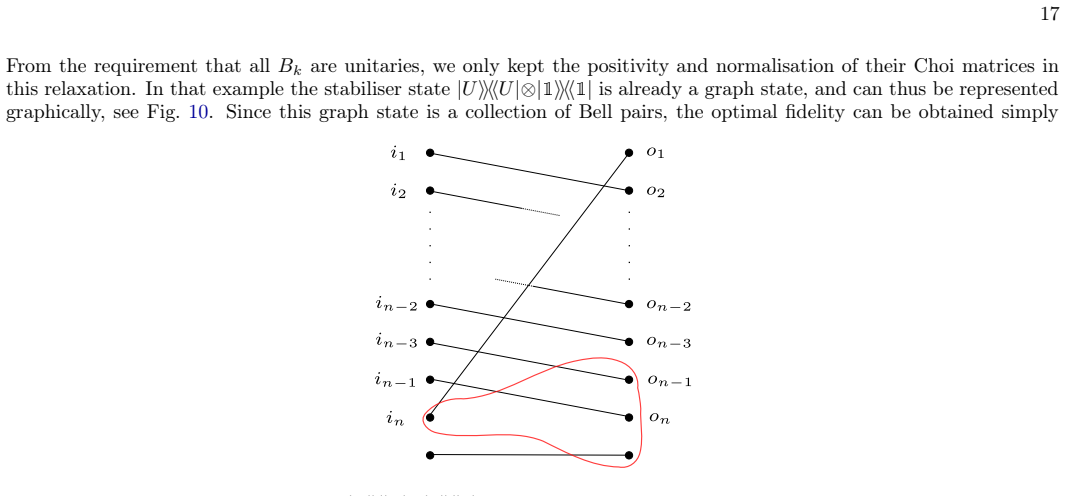
The central object is the optimised Choi-state fidelity $\alpha_\Gamma(U)$, the maximum overlap between the Choi vector of the target unitary and the Choi vector of circuits built from the allowed gates, normalised so that value $1$ means the target is realisable. Because the exact maximisation is non-convex, the machinery is a two-stage relaxation: a semidefinite program over a positive operator $\tau$ with PPT and CPTP-marginal constraints for general targets, and a linear program for Clifford targets obtained by writing the Choi state as a graph state and restricting, without loss of generality, to operators diagonal in the graph-state basis. The analytical variant counts the number of Bell pairs that cross the cut between the last gate and the rest of the circuit; each such pair contributes a factor at most $1/2$, yielding bounds such as $1/4$ for SWAP staircases of arbitrary length.
What would settle it
Run a high-precision numerical search over feasible circuits for one of the reported examples, such as the five-gate Clifford pair or the Toffoli two-gate bounds; the paper's see-saw checks reach the claimed bounds up to $10^{-5}$ or $10^{-6}$, so any feasible circuit found with fidelity above the claimed upper bound beyond that tolerance would refute the method, while reaching it closely supports the claim.
Extended reading notes
Core claim
The central claim is that $\alpha_\Gamma(U)$, the maximum fidelity between the Choi state of $U$ and the Choi states of circuits compatible with architecture $\Gamma$, can be bounded from above by a convex relaxation, and whenever that upper bound is strictly below $1$ the operator $W=\alpha_\Gamma(U)\mathbb{1}-\tfrac18|U\rangle\rangle\langle\langle U|$ is a valid circuit-architecture witness. For arbitrary targets the relaxation is a semidefinite program over a positive operator $\tau$ with PPT and CPTP-marginal constraints. For Clifford targets, the stabiliser formalism identifies the relevant Choi state with a graph state, and a depolarisation step lets the authors restrict to graph-diagonal $\tau$, reducing the SDP to a linear program. The paper proves, among other examples, that the Toffoli gate is incompatible with every three-qubit architecture made of two two-qubit gates (depth at least $3$) and with every one made of three such gates (depth at least $4$), and that a five-gate Clifford circuit is incompatible with the mirrored five-gate architecture at tight fidelity $0.5$. The analytical Bell-pair technique is demonstrated for staircase architectures with no-signalling relations between inputs and outputs, and the authors leave the generalization to arbitrary architectures as work in progress.
Load-bearing premise
The load-bearing premise, made in the paper's Appendix C2, is that for Clifford targets an optimisation variable can be restricted to its diagonal part in a basis built from the target's graph state without changing the optimum; if that reduction failed, the linear-program upper bounds would cease to be valid upper bounds.
Editorial extensions
If this is right
- The Toffoli gate cannot be implemented with two two-qubit gates on three qubits, so its circuit depth is at least 3, and it cannot be implemented with three such gates either, so the depth is at least 4.
- For a Clifford target unitary, the linear-program formulation certifies architecture incompatibility for circuits with on the order of seven two-qubit gates, far beyond the reach of the general semidefinite relaxation.
- An experimental measurement of the fidelity between the target and the implemented channel that exceeds the witness threshold is a quantitative certificate that the implemented channel goes beyond the tested architecture.
- Architecture incompatibility becomes a separability problem, so two architectures that allow the same input-output signalling can still be distinguished, as shown by the three-gate and five-gate examples.
Reading between the lines
- If the graph-diagonal reduction survives further scrutiny, the linear-program route should scale to Clifford circuits well past seven two-qubit gates, making architecture certificates practical for compiled Clifford subcircuits in error-correction pipelines; the paper demonstrates only the smaller cases.
- The Bell-pair-counting picture suggests a resource interpretation: a target fails an architecture because the architecture cannot supply enough Bell-pair-generating steps across a time cut; extending this to general architectures would require adding trace-preserving constraints that the current analytical method drops.
- Because the general semidefinite relaxation only enforces the PPT condition, tighter separability hierarchies should produce stronger witness thresholds for non-Clifford targets; the paper notes this possibility but does not test it.
Signed reviews
Editorial analysis
A structured set of objections, weighed in public.
Referee Report
Summary. The paper proposes a framework for certifying that a target unitary cannot be implemented within a prescribed quantum circuit architecture. The central quantity is α_Γ(U), the maximum fidelity between the Choi state of the target unitary and the Choi states of circuits compatible with architecture Γ. Since the exact optimization is nonconvex, the authors relax it to a semidefinite program (Eq. (4)) and, for Clifford target unitaries, to a linear program (Eq. (C14)) via graph-state depolarization. They also give an analytical Bell-pair-counting method for staircase architectures (Appendix D). Numerical results for two-, three-, and five-gate examples yield upper bounds below 1, and the Toffoli gate is claimed to require circuit depth at least 3 and then at least 4 based on exhaustive checks over all two- and three-gate architectures. The witness operator in Eq. (2) converts a bound α_Γ(U)<1 into a linear functional that is nonnegative on all Γ-compatible unitaries and negative on the target unitary.
Significance. If the central reduction is proved, the framework would be a useful contribution: it provides quantitative incompatibility certificates, connects circuit-architecture questions to separability theory and convex relaxations, and the Clifford LP simplification is a genuine practical advance. The analytical Bell-pair-counting arguments in Appendix D are clean and give parameter-free bounds that scale to arbitrarily many gates. The agreement with the known five-gate Toffoli lower bound is also encouraging. At present, however, the advertised rigor is not fully delivered because the graph-diagonal WLOG step is unproved, the exhaustive Toffoli checks are unreported, and the numerical solver outputs are not accompanied by certificates.
major comments (3)
- [Appendix C2, Eqs. (C9)-(C14)] The WLOG reduction to graph-diagonal operators is the load-bearing step for all Clifford results, but it is asserted rather than proved. The text states that the depolarisation procedure of Ref. [30] removes off-diagonal components while preserving the overlap with the graph state and the relevant positivity, normalisation, PPT and trace-preserving constraints. This is not immediate: the constraints in Eq. (C9) involve partial traces over specific subsystems B^O_k and partial transposes across the partitions B^IO_1|...|B^IO_m, whereas a stabilizer twirl acts globally on the full Hilbert space. One must prove that the twirl commutes with these subsystem operations, or otherwise exhibit a feasible graph-diagonal replacement for every feasible τ. Without such a proof, the LP in Eq. (C14) is not established as an upper bound on α_Γ(U), and the Clifford witnesses in Tables I and II, the five-gate example, and the Toffoli depth claims are unsupported. Please provide a complete proof of this reduction or replace it by a relaxation whose validity is proven.
- [Examples I and II, Toffoli depth claims] The claimed lower bounds on the Toffoli circuit depth rest on exhaustive checks that are not reported. The text states that 'we obtained for all the six possible circuit architectures made of 2 two-qubit gates the same upper bound' and that 'Checking analogously the incompatibility of the Toffoli gate with all the 12 possible circuit architectures...' yields depth at least 4, but no list of the architectures, no per-architecture upper bounds, no solver settings, and no code are given. These exhaustive statements are central advertised conclusions and must be independently reproducible. Please include the full enumeration data or a script that reproduces the checks and reports the certified upper bound for each architecture.
- [Tables I, II and the five-gate example] The numerical values are presented as rigorous upper bounds, but no certification is provided. The tables report approximate values such as ≃0.6366, ≤0.6798, and ≃0.857 obtained from LP/SDP/see-saw computations, without solver tolerances, dual certificates, or reproducible code. A floating-point optimum is not a mathematical certificate: for the witness construction one needs a guaranteed upper bound strictly below 1, and the see-saw tightness claims are likewise heuristic. Please provide either exact rational or interval-arithmetic-verified bounds, or make available code with fixed tolerances that yields certified values; the term 'rigorous certificate' should be reserved for data that actually certify the bound.
minor comments (5)
- [Abstract] The abstract claims that the LP enables 'more efficient numerical certification for circuits containing on the order of seven two-qubit gates', but the largest reported numerical LP example involves five gates; please add a seven-gate example or adjust the wording.
- [Eq. (C10)] The expression 'Tr[I_Γ]^2 diag(U†_LC τ U_LC) = ...' appears garbled; the normalisation factor Tr[I_Γ]^2 should be placed and defined explicitly.
- [Eq. (2)] The identity operator 1 in the witness definition is not defined; it should be the identity on H_{i1i2i3 o1o2o3} (or the corresponding full space in the general case).
- [Table I] The caption of Table I does not specify the composition convention for the gates A1 and A2; please state explicitly whether U = A2∘A1 or A1∘A2.
- [Appendix D2, Eq. (D7)] The sentence 'We thus retrieve the upper bound obtained in Appendix D1 for the case n=3' applies to the SWAP-SWAP example; the distinction from the general Clifford case should be made explicit to avoid overgeneralisation.
Circularity Check
No significant circularity: the witness upper bounds are computed from the stated SDP/LP relaxations and analytical stabilizer counting, not fitted to or defined by the conclusions.
full rationale
The paper's derivation chain is self-contained relative to its inputs. The exact fidelity problem (Eq. 1) is relaxed to the SDP of Eq. (4) by replacing product Choi states with a PPT-positive τ under CPTP marginal constraints; this is a genuine relaxation, and the claimed upper-bound status of the SDP optimum follows from the feasible set being enlarged, not from any fitted value. For Clifford targets, the LP of Eq. (C14) is obtained by mapping the stabilizer Choi state to a graph state and then invoking the graph-state-basis depolarization procedure of Ref. [30]. Although Ref. [30] shares an author, it is a general published mathematical result about twirling with the stabilizer group, and Appendix C2 explicitly translates the positivity, normalization, PPT, and partial-trace constraints into linear conditions; this is a legitimate external tool, not an ansatz that assumes the target incompatibility. The numerical values in Tables I and II are solver outputs for the stated optimization problems, and the analytical bound in Appendix D is derived by counting Bell pairs across a bipartition, not by fitting. The Toffoli depth statements are separate exhaustive checks of the listed architectures, and agreement with Ref. [32] is a consistency check rather than a load-bearing input. The only delicate step is the asserted preservation of the partial-trace constraints under the depolarization twirl, which is argued in one sentence with a citation rather than proved in the appendix; that is a correctness risk, not circularity, because the step is a standard twirling argument and is not equivalent to the paper's conclusions by construction.
Assumptions & free parameters
assumptions (6)
- domain assumption All internal wires of the circuit architecture carry a qubit (or d-dimensional) system.
- standard math The Choi-Jamiolkowski isomorphism and link product correctly represent unitary composition in the objective function.
- standard math Any stabiliser state is local-Clifford equivalent to a graph state, and any feasible tau can be depolarised to graph-diagonal form while preserving the relevant constraints.
- standard math A product of unitary Choi matrices satisfies the PPT and CPTP constraints of the SDP relaxation.
- domain assumption For the analytical method, staircase architectures have no-signalling relations between input and output systems, allowing unitary constraints to be dropped.
- standard math The maximum overlap between a Bell state and a two-qubit separable state is 1/2.
Cite this review
Pith. "Pith review of Witnessing the architecture of quantum circuits." pith.science (2026). https://pith.science/paper/5RDYNNCA
@misc{pith2026260813169,
  author       = {Pith},
  title        = {Pith review of: Witnessing the architecture of quantum circuits},
  year         = {2026},
  howpublished = {\url{https://pith.science/paper/5RDYNNCA}},
  note         = {Machine review of arXiv:2608.13169}
}
read the original abstract
Determining whether a target unitary can be implemented within a prescribed quantum circuit architecture is a fundamental problem in quantum information, with direct implications for optimisation and compilation of quantum circuits, and hardware-efficient quantum computation. While existing synthesis and compilation methods are primarily constructive, they generally do not provide rigorous certificates that a unitary cannot be realised using given implementation resources. Here we introduce a general framework to define quantum circuit architecture witnesses, which certify the incompatibility of a unitary transformation with a specified quantum circuit architecture. We formulate the witness construction as a semidefinite program by maximising the fidelity between the Choi state of the target unitary and those of tested circuits. The resulting witnesses provide practical and quantitative certificates of incompatibility, implying lower bounds on implementation resources such as the gate count or circuit depth, and can also be used experimentally to benchmark quantum devices by certifying that an implemented unitary channel goes beyond the capabilities of a given circuit architecture. For Clifford unitaries, we exploit the stabiliser formalism to reduce the construction to linear programming, enabling both more efficient numerical certification for circuits containing on the order of seven two-qubit gates, and analytical witnesses for some families of architectures made of an arbitrary number of gates.
Figures


Figures from the paper (7 more)


Reference graph
Works this paper leans on
-
[30]
B. Jungnitsch, T. Moroder, and O. Gühne, Entanglement witnesses for graph states: General theory and examples, Phys. Rev. A84(2011), arXiv:1106.1114 [quant-ph]
arXiv 2011
-
[32]
N. Yu, R. Duan, and M. Ying, Five two-qubit gates are nec- essary for implementing toffoli gate, Phys. Rev. A (2013), arXiv:1301.3372 [quant-ph]
work page Pith review arXiv 2013
-
[1]
Deutsch, Quantum theory, the church–turing principle and the universal quantum computer, Proceedings of the Royal Society of London
D. Deutsch, Quantum theory, the church–turing principle and the universal quantum computer, Proceedings of the Royal Society of London. A. Mathematical and Physical Sciences400, 97 (1985)
1985
-
[2]
A. Barenco, C. H. Bennett, R. Cleve, D. P. DiVincenzo, N. Margolus, P. Shor, T. Sleator, J. A. Smolin, and H. We- infurter, Elementary gates for quantum computation, Phys. Rev. A52, 3457–3467 (1995)
work page 1995
-
[3]
E. Bernstein and U. Vazirani, Quantum complexity theory, inProceedings of the twenty-fifth annual ACM symposium on Theory of computing(1993) pp. 11–20
work page 1993
-
[4]
I. L. Chuang, L. M. K. Vandersypen, X. Zhou, D. W. Le- ung, and S. Lloyd, Experimental realization of a quantum algorithm, Nature393, 143–146 (1998)
work page 1998
-
[5]
Fast parallel circuits for the quantum Fourier transform
R. Cleve and J. Watrous, Fast parallel circuits for the quantum fourier transform (2000), arXiv:quant-ph/0006004 [quant-ph]
work page Pith review arXiv 2000
-
[6]
M. A. Nielsen and I. L. Chuang,Quantum computation and quantum information, Vol. 2 (Cambridge university press Cambridge, 2001)
2001
Show all 50 references
-
[7]
Fenner, F
S. Fenner, F. Green, S. Homer, and Y. Zhang, Bounds on the power of constant-depth quantum circuits (2003), arXiv:quant-ph/0312209 [quant-ph]
2003 arXiv
-
[8]
L. G. Valiant, Quantum computers that can be simulated classically in polynomial time, inProceedings of the thirty- third annual ACM symposium on Theory of computing (2001) pp. 114–123
2001
-
[9]
L. G. Valiant, Quantum circuits that can be simulated clas- sically in polynomial time, SIAM Journal on Computing31, 1229 (2002)
2002
-
[10]
Jozsa and A
R. Jozsa and A. Miyake, Matchgates and classical simula- tion of quantum circuits, Proceedings of the Royal Society A: Mathematical, Physical and Engineering Sciences464, 3089 (2008), arXiv:0804.4050 [quant-ph]
2008 arXiv
-
[11]
Magesan, J
E. Magesan, J. M. Gambetta, and J. Emerson, Character- izing quantum gates via randomized benchmarking, Phys. Rev. A85(2012), arXiv:1109.6887 [quant-ph]
2012 arXiv
-
[12]
G. Yan, W. Wu, Y. Chen, K. Pan, X. Lu, Z. Zhou, Y. Wang, R. Wang, and J. Yan, Quantum circuit synthe- sis and compilation optimization: Overview and prospects (2025), arXiv:2407.00736 [quant-ph]
2025
-
[13]
F. T. Chong, D. Franklin, and M. Martonosi, Programming languages and compiler design for realistic quantum hard- ware, Nature549, 180 (2017)
2017
-
[14]
Maronese, L
M. Maronese, L. Moro, L. Rocutto, and E. Prati, Quantum compiling,inQuantum Computing Environments(Springer,
-
[15]
Karuppasamy, V
K. Karuppasamy, V. Puram, S. Johnson, and J. P. Thomas, A comprehensive review of quantum circuit optimization: Current trends and future directions, Quantum Reports7, 2 (2025), arXiv:2408.08941 [quant-ph]
2025 arXiv
-
[16]
Horodecki, P
M. Horodecki, P. Horodecki, and R. Horodecki, Separability of mixed states: necessary and sufficient conditions, Physics Letters A223, 1–8 (1996), arXiv:quant-ph/9605038 [quant- 7 ph]
1996 arXiv
-
[17]
B. M. Terhal, Bell inequalities and the separability crite- rion, Physics Letters A271, 319–326 (2000), arXiv:quant- ph/9911057 [quant-ph]
2000
-
[18]
Araújo, C
M. Araújo, C. Branciard, F. Costa, A. Feix, C. Giarmatzi, and Č. Brukner, Witnessing causal nonseparability, New J. Phys.17, 102001 (2015), arXiv:1506.03776 [quant-ph]
2015 arXiv
-
[19]
Branciard, Witnesses of causal nonseparability: an intro- duction and a few case studies, Sci
C. Branciard, Witnesses of causal nonseparability: an intro- duction and a few case studies, Sci. Rep.6, 26018 (2016), arXiv:1603.00043 [quant-ph]
2016 arXiv
-
[20]
X.-D. Yu, T. Simnacher, N. Wyderka, H. C. Nguyen, and O. Gühne, A complete hierarchy for the pure state marginal problem in quantum mechanics, Nature communications 12, 1012 (2021), arXiv:2008.02124 [quant-ph]
2021 arXiv
-
[21]
Chiribella, G
G. Chiribella, G. M. D’Ariano, and P. Perinotti, Quantum circuit architecture, Phys. Rev. Lett.101, 060401 (2008), arXiv:0712.1325 [quant-ph]
2008 arXiv
-
[22]
Chiribella, G
G. Chiribella, G. M. D’Ariano, and P. Perinotti, Theoretical framework for quantum networks, Phys. Rev. A80, 022339 (2009), arXiv:0904.4483 [quant-ph]
2009 arXiv
-
[23]
Wechs, H
J. Wechs, H. Dourdent, A. A. Abbott, and C. Bran- ciard, Quantum circuits with classical versus quantum con- trol of causal order, PRX Quantum2, 030335 (2021), arXiv:2101.08796 [quant-ph]
2021 arXiv
-
[24]
Pallister, N
S. Pallister, N. Linden, and A. Montanaro, Optimal verifi- cation of entangled states with local measurements, Phys. Rev.Lett.120,170502(2018),arXiv:1709.03353[quant-ph]
2018 arXiv
-
[25]
Bavaresco, N
J. Bavaresco, N. Herrera Valencia, C. Klöckl, M. Pivo- luska, P. Erker, N. Friis, M. Malik, and M. Huber, Mea- surements in two bases are sufficient for certifying high- dimensional entanglement, Nature Physics14, 1032 (2018), arXiv:1709.07344 [quant-ph]
2018 arXiv
-
[26]
Friis, G
N. Friis, G. Vitagliano, M. Malik, and M. Huber, Entangle- ment certification from theory to experiment, Nature Re- views Physics1, 72 (2019), arXiv:1906.10929 [quant-ph]
2019 arXiv
-
[27]
Gottesman, Stabilizer codes and quantum error correc- tion (1997), arXiv:quant-ph/9705052 [quant-ph]
D. Gottesman, Stabilizer codes and quantum error correc- tion (1997), arXiv:quant-ph/9705052 [quant-ph]
1997 arXiv
-
[28]
Roffe, Quantum error correction: an introduc- tory guide, Contemporary Physics60, 226–245 (2019), arXiv:1907.11157 [quant-ph]
J. Roffe, Quantum error correction: an introduc- tory guide, Contemporary Physics60, 226–245 (2019), arXiv:1907.11157 [quant-ph]
2019 arXiv
-
[29]
M. Hein, W. Dür, J. Eisert, R. Raussendorf, M. V. den Nest, and H. J. Briegel, Entanglement in graph states and its applications (2006), arXiv:quant-ph/0602096 [quant-ph]
2006 arXiv
-
[31]
Fattal, T
D. Fattal, T. S. Cubitt, Y. Yamamoto, S. Bravyi, and I. L. Chuang, Entanglement in the stabilizer formalism (2004), arXiv:quant-ph/0406168 [quant-ph]
2004 arXiv
-
[33]
Kökcü, D
E. Kökcü, D. Camps, L. Bassman Oftelie, J. K. Freericks, W. A. de Jong, R. Van Beeumen, and A. F. Kemper, Alge- braic compression of quantum circuits for hamiltonian evo- lution, Phys. Rev. A105(2022), arXiv:2108.03282 [quant- ph]
2022 arXiv
-
[34]
Camps, E
D. Camps, E. Kökcü, L. Bassman Oftelie, W. A. de Jong, A. F. Kemper, and R. Van Beeumen, An algebraic quan- tum circuit compression algorithm for hamiltonian simula- tion, SIAM Journal on Matrix Analysis and Applications 43, 1084–1108 (2022), arXiv:2108.03283 [Math.NA]
2022 arXiv
-
[35]
Morral-Yepes, M
R. Morral-Yepes, M. Langer, A. Gammon-Smith, B. Kraus, and F. Pollmann, Disentangling strategies and entangle- ment transitions in unitary circuit games with matchgates (2025), arXiv:2507.05055 [quant-ph]
2025 arXiv
-
[36]
O’Donoghue, E
B. O’Donoghue, E. Chu, N. Parikh, and S. Boyd, Conic op- timization via operator splitting and homogeneous self-dual embedding, Journal of Optimization Theory and Applica- tions169, 1042 (2016), arXiv:1312.3039 [Math.OC]
2016 arXiv
-
[37]
A. C. Doherty, P. A. Parrilo, and F. M. Spedalieri, A com- pletefamilyofseparabilitycriteria,Phys.Rev.A69,022308 (2003), arXiv:quant-ph/0308032 [quant-ph]
2003 arXiv
-
[38]
Berta, F
M. Berta, F. Borderi, O. Fawzi, and V. B. Scholz, Semidefi- nite programming hierarchies for constrained bilinear op- timization, Mathematical Programming194, 781 (2022), arXiv:1810.12197 [quant-ph]
2022 arXiv
-
[39]
Kretschmann and R
D. Kretschmann and R. F. Werner, Quantum channels with memory, Phys. Rev. A72, 062323 (2005), arXiv:quant- ph/0502106 [quant-ph]
2005
-
[40]
Gutoski and J
G. Gutoski and J. Watrous, Toward a general theory of quantum games, inProceedings of the 39th Annual ACM Symposium on Theory of Computing, STOC ’07 (2007) pp. 565–574, arXiv:quant-ph/0611234. 8 APPENDICES Appendix A: SDP relaxation of the architecture incompatibility optimisa...
2007 arXiv
-
[42]
decomposed
Fixing the dimension of the internal wires of the quantum circuit architecture We start by explaining with a concrete example why it is crucial to fix the dimension of the internal wires of the quantum circuit architecture. We consider the example of the incompatibility proble...
-
[43]
(1) into the SDP problem presented in Eq
SDP relaxation of Eq.(1)in the main text We derive the relaxation presented in the main text of the optimisation problem in Eq. (1) into the SDP problem presented in Eq. (4). As illustrated in Fig. 2, consider the two gatesB 1 :H i1i2 → Ho1c andB 2 :H c′i3 → Ho2o3 composed acc...
-
[44]
quantum combs
SDP relaxation for the general case We now show that the SDP relaxation provided above for the minimal quantum circuit architectureΓ = ({1,2},{2,3}) can be extended to any quantum circuit architecture. Consider a target unitary operatorU:H i1...in →H o1...on that transformsnin...
-
[45]
As illustrated in Fig
Quantum comb framework We consider the two gatesB1 :H i1i2→H o1c andB 2 :H ci3→H o2o3 composed according toΓ = ({1,2},{2,3}), where the systems inHc is a qubit. As illustrated in Fig. 7, the circuit obtained by composing the two gates can be rewritten in a quantum comb shape. ...
-
[46]
(1) in the main text
Building a witness We consider the architecture incompatibility problem presented in Eq. (1) in the main text. An upper bound on the optimal fidelity can thus be obtained by optimising over the Choi matrix of the quantum comb characterised in Eq. (B1) and solving the following...
-
[47]
[29] for a review
Graph States and the Stabiliser Formalism We review the basic features related to graph states and the stabiliser formalism that we employ in this paper, see Ref. [29] for a review. LetG= (V,E)be a simple undirected graph with|V|=n. To each vertexv∈Vwe associate a qubit. Thegr...
-
[48]
(A7) to witness the incompatibility with a general quantum circuit architecture can be turned to linear programming ifUis a Clifford unitary applied on qubits (d= 2)
Turning Eq.(4)in the main text and Eq.(A7)into LPs We show that the SDP problem defined in Eq. (A7) to witness the incompatibility with a general quantum circuit architecture can be turned to linear programming ifUis a Clifford unitary applied on qubits (d= 2). That Eq. (4) in...
-
[49]
3 for an illustration
A minimal example Weconsiderthefollowingincompatibilityproblem: givenaunitaryUmadeoftwoSWAPoperationscomposedaccording to the architectureΓtarget = ({2,3},{1,2}), show the incompatibility ofUwith the quantum circuit architectureΓ test = ({1,2},{2,3}), see Fig. 3 for an illustr...
-
[50]
Generalisation to am-gates architecture To illustrate this technique, we consider the example of a target unitaryUmade of the composition ofm=n−1SWAP gatesarrangedaccordingtoastaircasequantumcircuitarchitectureΓ n target = ({n−1,n},{n−2,n−1},...,{1,2}). Thetest circuit archite...
- [2022]
Reviewed August 15, 2026 · model on record in the stance chip above.
Discussion (0). Continue with ORCID to comment.