REVIEW 3 major objections 4 minor 59 references
Entanglement distribution and quantum storage of more than 8000 modes over a metropolitan network
T0 review · 3 major / 4 minor · reviewed 2026-08-15 · deepseek-v4-flash
Pith's one-line read A quantum memory stored one photon of an entangled pair across 16,340 temporal modes while its partner travelled 25.3 km of fiber.
desk verdict Credible entanglement storage with honest caveats; the 8,000-mode headline is a derived capacity, not a directly measured multiplexing count, and the paper's own discussion says so. read the letter →
The pith
A machine-rendered reading of the paper's core claim, the machinery that carries it, and where it could break.
The reading
What carries the argument
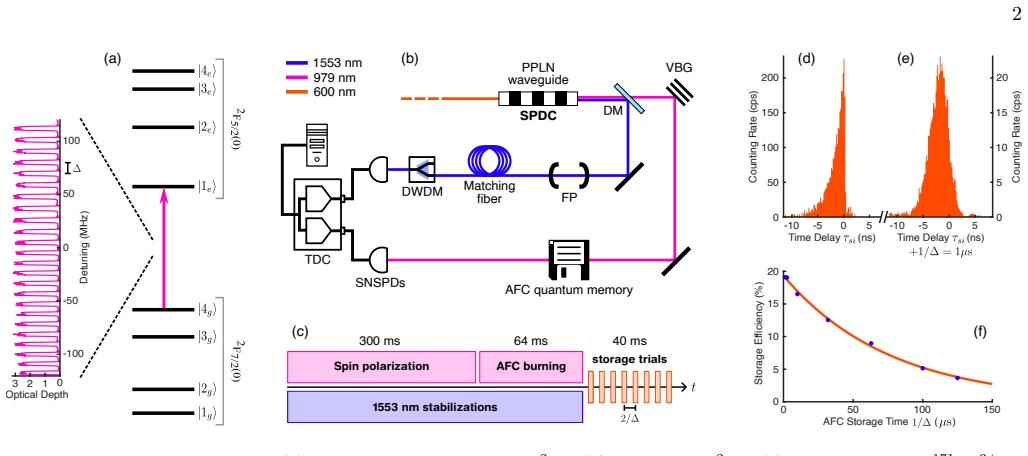
The central element is the atomic frequency comb (AFC) memory in a 171Yb3+:Y2SiO5 crystal: light is absorbed by a comb of narrow spectral peaks burned into an inhomogeneously broadened transition, and the comb spacing Δ dictates that the collective excitation re-emits after a time 1/Δ. The quantitative engine is the Schmidt decomposition of the joint temporal amplitude of the SPDC two-photon state; because the pump pulse is long and slowly varying, the Schmidt mode number reduces to N = T_pump / T_mode, with T_mode = 7.65 ns extracted from the measured g^(2) correlation width. The lower bound on N, computed from the measured joint temporal intensity, is what the paper reports as the stored mode count. A Franson-type setup with a Michelson interferometer at 1553 nm and a double-AFC analyzer at 979 nm certifies energy-time entanglement through a CHSH Bell test.
What would settle it
Set up a mode-selective readout that addresses one narrow time bin within the AFC echo and measure the CHSH parameter conditioned on that bin; if only a few bins violate the inequality while the rest contribute noise, the usable multiplexing capacity is far below the reported Schmidt count.
Extended reading notes
Core claim
The paper reports that a crystal-based atomic frequency comb memory can store a 979 nm photon entangled with a telecom photon at 1553 nm while that telecom photon propagates through optical fiber, and that the number of temporal modes over which this works can be quantified by a Schmidt decomposition. In the lab, with fiber spools up to 25.3 km, storage for 125 microseconds across 16,340 modes was achieved, with CHSH Bell parameters between S = 2.65 and 2.73 for all tested lengths, proving that entanglement survives both storage and propagation. In a field test using a 5.66 km dark fiber through the Geneva metropolitan network, storage for 63 microseconds across 8,235 modes gave S = 2.67 ± 0.04. The memory has a bandwidth of 250 MHz and a measured lifetime of (76.6 ± 11.0) microseconds, corresponding to an effective AFC coherence time of about 307 microseconds.
Load-bearing premise
The headline claim rests on treating the Schmidt mode number of the SPDC state, T_pump / T_mode, as the number of temporal modes the memory can store and a repeater could use for multiplexing; the paper itself notes that it is an open question whether this number equals the actual repeater speed-up.
Editorial extensions
If this is right
- A quantum repeater node can herald storage of a 979 nm photon entangled with a telecom photon that has propagated 25.3 km, holding 16,340 temporal modes for 125 microseconds with CHSH S = 2.70.
- At 10 microseconds storage and 2 km fiber, the memory still stores 1,307 modes at 88% of its maximum efficiency, so short-distance entanglement distribution pays almost no efficiency penalty for high multiplexing.
- In a metropolitan field test on 5.66 km of fiber, entanglement survives with 8,235 stored modes for 63 microseconds (S = 2.67), showing that a real fiber network does not destroy the effect.
- The measured AFC lifetime of 76.6 microseconds corresponds to an effective coherence time of about 307 microseconds, roughly one-third of the material's optical coherence time; closing that gap would directly raise the attainable storage time and mode count.
- The Schmidt mode number provides a simple quantitative benchmark for multimode capacity that can be computed from measured cross-correlation data, which the paper proposes as a standard comparison across repeater nodes.
Reading between the lines
- An implication the paper stops short of claiming: if the Schmidt modes are independently usable, a repeater node could schedule one entanglement attempt per ~7.65 ns bin, so a 125 microsecond storage window holds 16,340 parallel attempts instead of one.
- A testable extension: measure the CHSH violation for photons selected in narrow time bins across the echo window; if the violation and cross-correlation stay constant bin-by-bin, the operational mode count tracks the Schmidt count.
- A rate calculation that folds in the 76.6 microsecond memory decay and the detection window is still needed to convert 8,000+ modes into an actual repeater speed-up, as the paper notes when it calls the speed-up question open.
Signed reviews
Editorial analysis
A structured set of objections, weighed in public.
Referee Report
Summary. This manuscript reports a quantum repeater node built from a 171Yb3+:Y2SiO5 atomic frequency comb (AFC) memory and a bandwidth-matched SPDC entangled-photon source. The authors demonstrate energy-time entanglement between a telecom photon at 1553 nm transmitted through optical fiber (0.5–25.3 km spools and a 5.66 km deployed Geneva metropolitan link) and a 979 nm photon stored in the AFC memory for up to 125 µs, using Franson interferometry and CHSH Bell tests with S values between 2.65 and 2.73. They introduce a Schmidt decomposition of the joint temporal amplitude to estimate the effective temporal mode number N = T_pump/T_mode, with T_mode = 7.65 ns, and report up to 16,340 modes at 125 µs storage in the lab and 8,235 modes at 63 µs in the field. The paper also characterizes memory efficiency (η0 = (19±1)%) and coherence time (TM = (76.6±11.0) µs), and discusses the path toward spin-wave AFC repeaters.
Significance. Assuming the results hold, the work is significant: it provides credible CHSH-based evidence for light-matter entanglement after 25 km propagation and microsecond-scale storage in a rare-earth memory, and the deployed urban fiber test is an important step toward practical repeater nodes. The Schmidt-decomposition methodology is a useful quantitative tool, and the authors are careful to compare a measured lower bound with theory (Fig. 2(c)) and to report memory efficiency and lifetime in detail. However, the headline mode-count claim is not directly supported by the Bell tests: the CHSH analysis post-selects a single 7.65 ns window, and the N values are computed from the source joint temporal amplitude rather than measured as independently addressable storage modes. The authors themselves flag this as an open question in the Discussion. Because the paper's central contribution is advertised as 'more than 8000 modes,' the relationship between N and demonstrated multiplexing capacity needs to be clarified before publication.
major comments (3)
- [Multimode analysis through Schmidt decomposition, Eq. (2)–(3), Fig. 2(c), Table I] The headline 'storage of more than 8000 modes' is derived from N = T_pump/T_mode, where T_mode = 7.65 ns is extracted from the measured g2 correlation width. This N is the Schmidt number of the SPDC two-photon state, not a directly measured number of independently addressable temporal modes stored in the AFC memory. The CHSH tests in Table I post-select a single detection window of duration T_mode, so each S value certifies entanglement of the post-selected time-bin subspace and does not certify that all N computed modes are entangled or independently usable. Please either soften the wording to 'source Schmidt modes' or provide explicit evidence that the memory can store this many independent modes.
- [Table I and Fig. 2(c)] N is reported without any uncertainty. The field-test headline value N = 8235 = 63 µs / 7.65 ns exceeds the 'more than 8000' threshold by only about 4%, so a modest systematic error in T_mode (whose extraction shows a binning dependence in Fig. 2(c)) could invalidate the specific claim. Please provide an uncertainty analysis for T_mode and propagate it to N, or state the claim with a conservative margin.
- [Discussion, first paragraph] The authors state that 'it is an open question if this number represents the expected speed-up with respect to a single-mode repeater' and that filtering conditional modes is infeasible in practice. This caveat is not reflected in the abstract or title, which present the mode number as an achieved storage capacity. Since the abstract currently says 'storing 8235 modes,' I recommend the caveat be moved forward or the claim be explicitly qualified as a source-level estimate.
minor comments (4)
- [Fig. 1 caption, panel (f)] 'based on measurements as shown in (e) and (f)' should probably refer to (d) and (e), since (f) is the resulting efficiency plot.
- [Fig. 2(c) caption] The dashed line is described as 'the expected theoretical value of N,' while the text refers to it as 'the theoretical lower bound N'; please align the terminology.
- [Notation, Eq. (3)] The notation for the lower bound N is not visually distinct from the Schmidt number N in Eq. (2); consider using an underline or a different symbol to avoid confusion.
- [Table I] The row for the 32 µs field experiment lacks idler/signal/coincidence rates; please state explicitly in the caption why these are omitted.
Circularity Check
No significant circularity: the mode capacity is derived from a measured g2 width and validated against theory, while CHSH is an independent measurement.
full rationale
The central mode-count number is computed as N = T_pump/T_mode via Eqs. (2) and (3), with T_mode = 7.65 ns extracted from the measured cross-correlation function g2(si)(tau_si) and checked against the theoretical lower bound in Fig. 2(c). This is an inference from a measured quantity, not a parameter fitted to reproduce a claimed output; no equation defines the input in terms of the claimed result or vice versa. The CHSH S-values are obtained from raw coincidence histograms post-selected within a T_mode window and do not depend on the Schmidt-mode formula. The paper's self-citations, e.g., Refs. [23] and [35], describe prior construction and classical characterization of the source and memory, not the target entanglement-storage result; the memory efficiency is independently re-measured here in Fig. 1(f). The Discussion explicitly states that 'it is an open question if this number represents the expected speed-up with respect to a single-mode repeater,' which is a limitation on the operational interpretation of N rather than circular reasoning. No circular step satisfying the required quoted-reduction criterion was found.
Assumptions & free parameters
free parameters (2)
- Effective mode duration T_mode =
7.65 ns
- Memory coherence time T_M =
76.6 +/- 11.0 microseconds
assumptions (4)
- domain assumption The SPDC two-photon state can be described by a pure state with JTA Phi(ts,ti)=alpha(ti)*phi(ts-ti) for a long pump pulse (Eq. 1).
- domain assumption The AFC memory stores and re-emits the 979 nm photon with efficiency eta_AFC = eta_0 * exp(-1/(Delta*T_M)) and preserves the temporal mode structure of the input field.
- domain assumption The CHSH test is interpreted under the fair-sampling assumption.
- ad hoc to paper The Schmidt mode number of the biphoton wavefunction quantifies the number of independently usable temporal modes of the stored photon.
Cite this review
Pith. "Pith review of Entanglement distribution and quantum storage of more than 8000 modes over a metropolitan network." pith.science (2026). https://pith.science/paper/INB2QET3
@misc{pith2026260813177,
  author       = {Pith},
  title        = {Pith review of: Entanglement distribution and quantum storage of more than 8000 modes over a metropolitan network},
  year         = {2026},
  howpublished = {\url{https://pith.science/paper/INB2QET3}},
  note         = {Machine review of arXiv:2608.13177}
}
abstract
Entanglement generation between telecommunication photons and matter is central to fibre-based quantum repeaters. Achieving practical communication rates requires multiplexing, which multimode quantum memories can provide. Rare-earth-ion ensembles offer large temporal multimode storage by exploiting the numerous spectral channels within their absorption spectrum. Here, we report on a quantum repeater node comprised of a $^{171}$Yb$^{3+}$:Y$_2$SiO$_5$ multimode quantum memory, featuring a 250 MHz bandwidth and a $76.6~\mu\mathrm{s}$ lifetime, and a bandwidth-matched entangled photon-pair source. We introduce and validate a quantitative measure of the effective temporal mode capacity using a Schmidt decomposition. With this platform, we demonstrate entanglement between a telecom photon propagating through a 25.3 km fiber spool and a 979 nm photon stored for $125~\mu\mathrm{s}$ across 16340 temporal modes. Finally, we report a field deployment distributing entanglement over 5.66 km through the Geneva metropolitan fibre network while storing 8235 modes for $63~\mu\mathrm{s}$.
Figures


Reference graph
Works this paper leans on
-
[1]
S. Wehner, D. Elkouss, and R. Hanson, Science362, 10.1126/science.aam9288 (2018)
-
[2]
H.-J. Briegel, W. D¨ ur, J. I. Cirac, and P. Zoller, Phys. Rev. Lett.81, 5932 (1998)
work page 1998
-
[3]
L.-M. Duan, M. D. Lukin, J. I. Cirac, and P. Zoller, Na- ture414, 413 (2001)
2001
-
[4]
N. Sangouard, C. Simon, H. de Riedmatten, and N. Gisin, Rev. Mod. Phys.83, 33 (2011)
work page 2011
-
[5]
T. van Leent, M. Bock, R. Garthoff, K. Redeker, W. Zhang, T. Bauer, W. Rosenfeld, C. Becher, and H. Weinfurter, Physical Review Letters124, 010510 (2020)
work page 2020
-
[6]
D. Lago-Rivera, J. V. Rakonjac, S. Grandi, and H. d. Riedmatten, Nature Communications14, 10.1038/s41467-023-37518-5 (2023)
-
[7]
J. V. Rakonjac, S. Grandi, S. Wengerowsky, D. Lago- Rivera, F. Appas, and H. de Riedmatten, Optica Quan- tum1, 94 (2023)
work page 2023
-
[8]
S. Kucera, C. Haen, E. Arensk¨ otter, T. Bauer, J. Meiers, M. Sch¨ afer, R. Boland, M. Yahyapour, M. Lessing, R. Holzwarth, C. Becher, and J. Eschner, npj Quantum Information10, 10.1038/s41534-024-00886-x (2024)
Show all 59 references
-
[9]
Liu, X.-M
X. Liu, X.-M. Hu, T.-X. Zhu, C. Zhang, Y.-X. Xiao, J.- L. Miao, Z.-W. Ou, P.-Y. Li, B.-H. Liu, Z.-Q. Zhou, C.-F. Li, and G.-C. Guo, Nature Communications15, 10.1038/s41467-024-52912-3 (2024)
2024 doi
-
[10]
Krutyanskiy, M
V. Krutyanskiy, M. Canteri, M. Meraner, V. Krcmarsky, and B. Lanyon, PRX Quantum5, 020308 (2024)
2024
-
[11]
Y. Zhou, P. Malik, F. Fertig, M. Bock, T. Bauer, T. van Leent, W. Zhang, C. Becher, and H. Weinfurter, PRX Quantum5, 020307 (2024)
2024
-
[12]
Bersin, M
E. Bersin, M. Sutula, Y. Q. Huan, A. Suleymanzade, D. R. Assumpcao, Y.-C. Wei, P.-J. Stas, C. M. Knaut, E. N. Knall, C. Langrock, N. Sinclair, R. Murphy, R. Riedinger, M. Yeh, C. Xin, S. Bandyopadhyay, D. D. Sukachev, B. Machielse, D. S. Levonian, M. K. Bhaskar, S. Hamilton, H...
2024
-
[13]
Cui, Z.-Q
Z.-B. Cui, Z.-Q. Wang, P.-C. Lai, Y. Wang, J.-X. Shi, P.-Y. Liu, Y.-D. Sun, Z.-C. Tian, Y.-B. Liang, B.-X. Qi, Y.-Y. Huang, Z.-C. Zhou, Y.-K. Wu, Y. Xu, L.- M. Duan, and Y.-F. Pu, Nature Communications17, 10.1038/s41467-025-67311-5 (2025)
2025 doi
-
[14]
Lago-Rivera, S
D. Lago-Rivera, S. Grandi, J. V. Rakonjac, A. Seri, and H. de Riedmatten, Nature594, 37 (2021)
2021
-
[15]
van Leent, M
T. van Leent, M. Bock, F. Fertig, R. Garthoff, S. Eppelt, Y. Zhou, P. Malik, M. Seubert, T. Bauer, W. Rosenfeld, W. Zhang, C. Becher, and H. Weinfurter, Nature607, 69 (2022)
2022
-
[16]
Liu, X.-Y
J.-L. Liu, X.-Y. Luo, Y. Yu, C.-Y. Wang, B. Wang, Y. Hu, J. Li, M.-Y. Zheng, B. Yao, Z. Yan, D. Teng, J.-W. Jiang, X.-B. Liu, X.-P. Xie, J. Zhang, Q.-H. Mao, X. Jiang, Q. Zhang, X.-H. Bao, and J.-W. Pan, Nature 629, 579 (2024)
2024
-
[17]
C. M. Knaut, A. Suleymanzade, Y.-C. Wei, D. R. As- sumpcao, P.-J. Stas, Y. Q. Huan, B. Machielse, E. N. Knall, M. Sutula, G. Baranes, N. Sinclair, C. De- Eknamkul, D. S. Levonian, M. K. Bhaskar, H. Park, M. Lonˇ car, and M. D. Lukin, Nature629, 573 (2024)
2024
-
[18]
A. J. Stolk, K. L. van der Enden, M.-C. Slater, I. te Raa- Derckx, P. Botma, J. van Rantwijk, J. J. B. Biemond, R. A. J. Hagen, R. W. Herfst, W. D. Koek, A. J. H. Meskers, R. Vollmer, E. J. van Zwet, M. Markham, A. M. Edmonds, J. F. Geus, F. Elsen, B. Jungbluth, C. Haefner, C....
2024 doi
-
[19]
H¨ anni, A
J. H¨ anni, A. E. Rodr´ ıguez-Moldes, F. Appas, S. Wengerowsky, D. Lago-Rivera, M. Teller, S. Grandi, and H. de Riedmatten, Physical Review X15, 10.1103/wvv1-6lg8 (2025)
2025 doi
-
[20]
T.-X. Zhu, C. Zhang, Z.-W. Ou, X. Liu, P.-J. Liang, X.-M. Hu, Y.-F. Huang, Z.-Q. Zhou, C.-F. Li, and G.- C. Guo, Nature Photonics 10.1038/s41566-026-01911-5 (2026)
2026 doi
-
[21]
O. A. Collins, S. D. Jenkins, A. Kuzmich, and T. A. B. Kennedy, Phys. Rev. Lett.98, 060502 (2007)
2007
-
[22]
Simon, H
C. Simon, H. de Riedmatten, M. Afzelius, N. Sangouard, H. Zbinden, and N. Gisin, Phys. Rev. Lett.98, 190503 (2007)
2007
-
[23]
Businger, L
M. Businger, L. Nicolas, T. S. Mejia, A. Ferrier, P. Goldner, and M. Afzelius, Nature Communications13, 10.1038/s41467-022-33929-y (2022)
2022 doi
-
[24]
For some single quantum emitters, one can exploit multiqubit registers for multiplexing [10, 13, 27– 29]
or spatial modes [25, 26], which is known as multi- mode storage. For some single quantum emitters, one can exploit multiqubit registers for multiplexing [10, 13, 27– 29]. Whatever the physical platform and method, it is generally accepted that multiplexing is key to achieving...
2026 arXiv
-
[25]
Chakraborty, A
T. Chakraborty, A. Das, H. van Brug, O. Pietx- Casas, P.-C. Wang, G. C. d. Amaral, A. L. Tcheb- otareva, and W. Tittel, npj Quantum Information11, 10.1038/s41534-024-00946-2 (2025)
2025 doi
-
[26]
Zhang, J
S. Zhang, J. Shi, Z. Cui, Y. Wang, Y. Wu, L. Duan, and Y. Pu, Physical Review X14, 021018 (2024). 9
2024
-
[27]
Teller, S
M. Teller, S. Plascencia, S. Grandi, and H. de Riedmat- ten, Physical Review X15, 10.1103/z6lc-qw2d (2025)
2025 doi
- [28]
-
[29]
Ruskuc, C.-J
A. Ruskuc, C.-J. Wu, E. Green, S. L. N. Hermans, W. Pa- jak, J. Choi, and A. Faraon, Nature639, 54 (2025)
2025
-
[30]
Canteri, Z
M. Canteri, Z. Koong, J. Bate, A. Winkler, V. Krutyan- skiy, and B. Lanyon, Physical Review Letters135, 10.1103/v5k1-whwz (2025)
2025 doi
-
[31]
Afzelius, C
M. Afzelius, C. Simon, H. de Riedmatten, and N. Gisin, Phys. Rev. A79, 052329 (2009)
2009
-
[32]
A. Ortu, J. V. Rakonjac, A. Holz¨ apfel, A. Seri, S. Grandi, M. Mazzera, H. de Riedmatten, and M. Afzelius, Quan- tum Science and Technology7, 035024 (2022)
2022
-
[33]
A. Ortu, A. Tiranov, S. Welinski, F. Fr¨ owis, N. Gisin, A. Ferrier, P. Goldner, and M. Afzelius, Nature Materials 17, 671 (2018)
2018
-
[34]
J. M. Kindem, A. Ruskuc, J. G. Bartholomew, J. Rochman, Y. Q. Huan, and A. Faraon, Nature580, 201 (2020)
2020
-
[35]
Nicolas, M
L. Nicolas, M. Businger, T. Sanchez Mejia, A. Tiranov, T. Chaneli` ere, E. Lafitte-Houssat, A. Ferrier, P. Gold- ner, and M. Afzelius, npj Quantum Information9, 10.1038/s41534-023-00687-8 (2023)
2023 doi
-
[36]
Sanchez Mejia, L
T. Sanchez Mejia, L. Nicolas, A. Gelmini Rodriguez, P. Goldner, and M. Afzelius, Quantum Science and Tech- nology11, 015004 (2025)
2025
-
[37]
Rielander, K
D. Rielander, K. Kutluer, P. M. Ledingham, M. Gundo- gan, J. Fekete, M. Mazzera, and H. de Riedmatten, Phys. Rev. Lett.112, 040504 (2014)
2014
-
[38]
Jobez, N
P. Jobez, N. Timoney, C. Laplane, J. Etesse, A. Ferrier, P. Goldner, N. Gisin, and M. Afzelius, Phys. Rev. A93, 032327 (2016)
2016
-
[39]
Kuzucu, F
O. Kuzucu, F. N. C. Wong, S. Kurimura, and S. Tovstonog, Physical Review Letters101, 153602 (2008)
2008
-
[40]
J.-P. W. MacLean, J. M. Donohue, and K. J. Resch, Physical Review Letters120, 053601 (2018)
2018
-
[41]
Borghi, P
M. Borghi, P. L. Pagano, M. Liscidini, D. Bajoni, and M. Galli, Optics Letters49, 3966 (2024)
2024
-
[42]
H. Yu, A. O. Govorov, H.-Z. Song, and Z. Wang, Applied Physics Reviews11, 10.1063/5.0232085 (2024)
2024 doi
-
[43]
C. K. Law, I. A. Walmsley, and J. H. Eberly, Physical Review Letters84, 5304 (2000)
2000
-
[44]
C. K. Law and J. H. Eberly, Phys. Rev. Lett.92, 127903 (2004)
2004
-
[45]
G. B. Xavier, J.- ˚A. Larsson, P. Villoresi, G. Val- lone, and A. Cabello, npj Quantum Information11, 10.1038/s41534-025-01072-3 (2025)
2025 doi
-
[46]
J. D. Franson, Phys. Rev. Lett.62, 2205 (1989)
1989
-
[47]
Tittel, J
W. Tittel, J. Brendel, N. Gisin, and H. Zbinden, Physical Review A59, 4150 (1999)
1999
-
[48]
de Riedmatten, M
H. de Riedmatten, M. Afzelius, M. U. Staudt, C. Simon, and N. Gisin, Nature456, 773 (2008)
2008
-
[49]
J. F. Clauser, M. A. Horne, A. Shimony, and R. A. Holt, Phys. Rev. Lett.23, 880 (1969)
1969
-
[50]
Orsucci, J.-D
D. Orsucci, J.-D. Bancal, N. Sangouard, and P. Sekatski, Quantum4, 238 (2020)
2020
-
[51]
Tang, Z.-Q
J.-S. Tang, Z.-Q. Zhou, Y.-T. Wang, Y.-L. Li, X. Liu, Y.-L. Hua, Y. Zou, S. Wang, D.-Y. He, G. Chen, Y.-N. Sun, Y. Yu, M.-F. Li, G.-W. Zha, H.-Q. Ni, Z.-C. Niu, C.-F. Li, and G.-C. Guo, Nat. Commun.6, 9652 (2015)
2015
-
[52]
S.-H. Wei, B. Jing, X.-Y. Zhang, J.-Y. Liao, H. Li, L.- X. You, Z. Wang, Y. Wang, G.-W. Deng, H.-Z. Song, D. Oblak, G.-C. Guo, and Q. Zhou, npj Quantum Infor- mation10, 10.1038/s41534-024-00812-1 (2024)
2024 doi
-
[53]
E. R. Hellebek and A. S. Sørensen, (2025), arXiv:2511.15591 [quant-ph]
2025
-
[54]
Y. Wu, J. Liu, and C. Simon, Physical Review A101, 042301 (2020)
2020
-
[55]
Businger, A
M. Businger, A. Tiranov, K. T. Kaczmarek, S. Welinski, Z. Zhang, A. Ferrier, P. Goldner, and M. Afzelius, Phys. Rev. Lett.124, 053606 (2020)
2020
-
[56]
Businger, Moritz, 171Yb3+:Y2SiO5 for quantum memory applications, PhD Thesis (2023)
2023
-
[57]
Duranti, S
S. Duranti, S. Wengerowsky, L. Feldmann, A. Seri, B. Casabone, and H. de Riedmatten, Optics Express32, 26884 (2024)
2024
-
[58]
J. H. Davidson, P. Lefebvre, J. Zhang, D. Oblak, and W. Tittel, Physical Review A101, 042333 (2020)
2020
-
[59]
C. Li, C. Wyon, and R. Moncorge, IEEE Journal of Quantum Electronics28, 1209 (1992)
1992
Reviewed August 15, 2026 · model on record in the stance chip above.
Discussion (0). Continue with ORCID to comment.