REVIEW 4 major objections 4 minor 37 references
HPSD: Hybrid-Policy Self-Distillation for Text-Image-to-Video Diffusion Models
T0 review · 4 major / 4 minor · reviewed 2026-08-15 · deepseek-v4-flash
Pith's one-line read This paper claims that HPSD lets a text-image-to-video model internalize the quality its privileged image-and-prompt mode elicits, and reproduce it from text alone via hybrid-policy self-distillation.
desk verdict HPSD is a plausible and genuinely interesting hybrid-policy distillation idea with strong but under-validated numbers; the main risk is an unmeasured distribution assumption at the supervision state. read the letter →
The pith
A machine-rendered reading of the paper's core claim, the machinery that carries it, and where it could break.
The reading
What carries the argument
The load-bearing object is the hybrid-policy sub-trajectory. Starting from an anchor state $x^{\mathrm{Tea}}_{t_i}$ on the teacher's privileged TI2V trajectory, with the first frame re-noised so all frames share noise level $t_i$, the student evolves the state for $K$ steps under its own T2V velocity $v_\phi(\cdot \mid c_{\mathrm{txt}})$, producing $x^{\mathrm{Hyb}}_{t_{i+K}}$. The teacher is then queried at $\hat{x}^{\mathrm{Hyb}}_{t_{i+K}} = [c_{\mathrm{img}}, x^{\mathrm{Hyb},(2:F)}_{t_{i+K}}]$ in its own TI2V input format, and the student matches the teacher's velocity on frames $2{:}F$. The length $K$ is the interpolation dial: $K=0$ gives off-policy supervision on the teacher trajectory, large $K$ approaches on-policy supervision, and $K=3$ balances anchoring with policy alignment in the reported experiments.
What would settle it
Re-run HPSD with Equation 10 altered so the first frame fed to the teacher is the student's own denoised first frame rather than the privileged $c_{\mathrm{img}}$, keeping everything else fixed; if the reported VideoAlign gains vanish, the clean-frame re-imposition is what carries the method.
Extended reading notes
Core claim
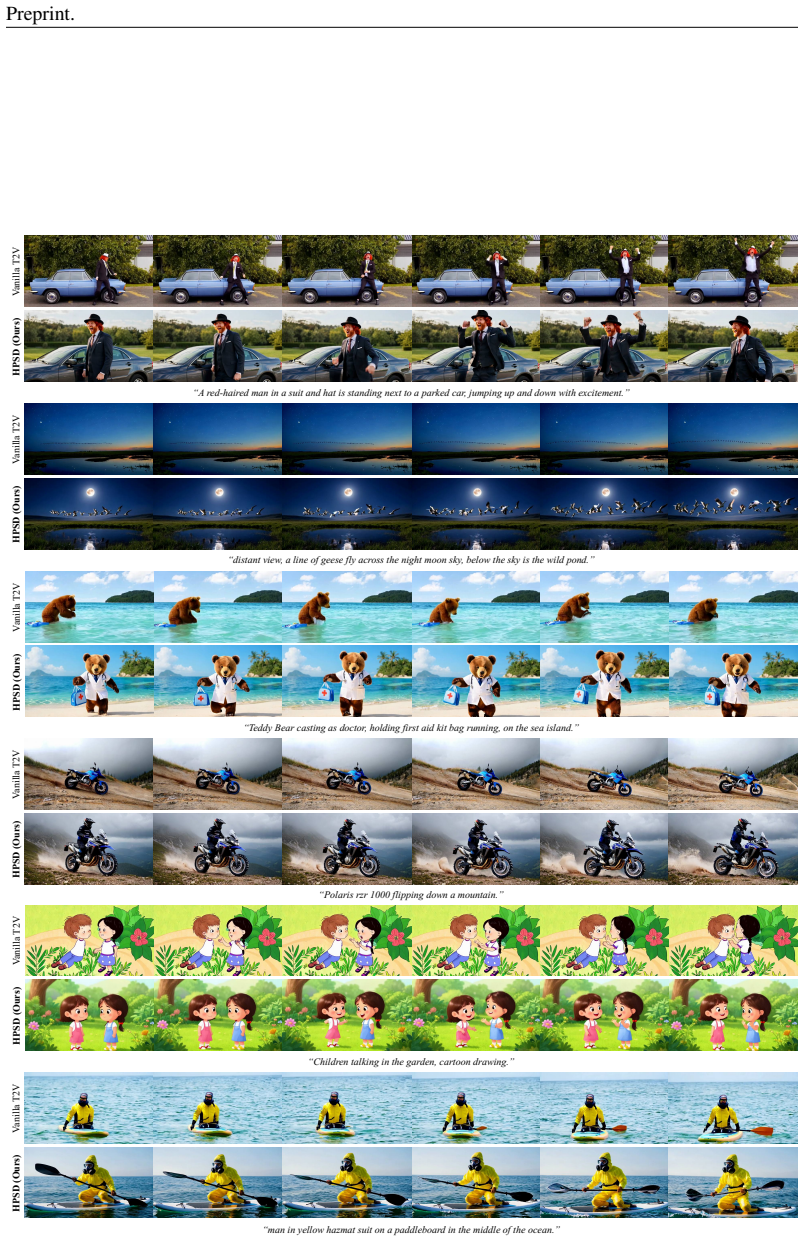
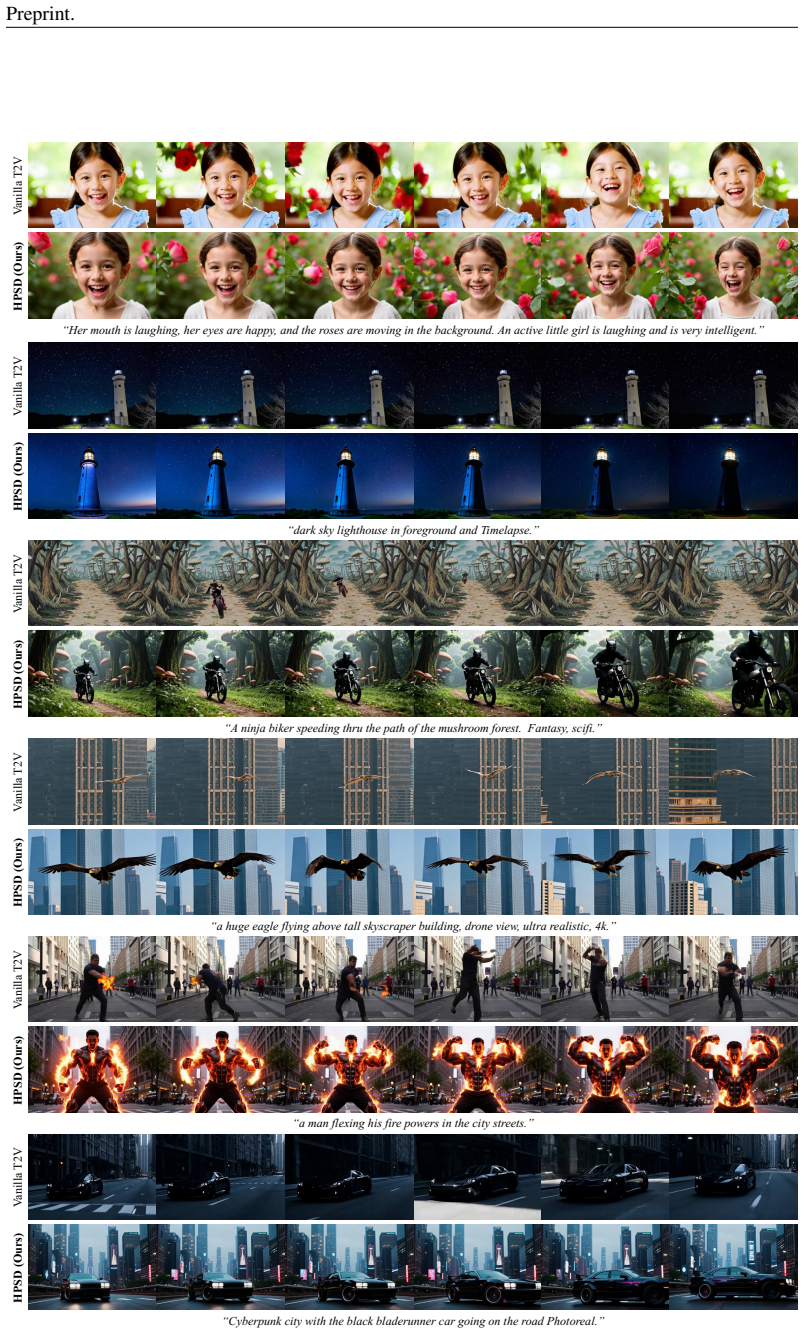
The central claim is that the quality gap between a TI2V model's privileged (first-frame + enhanced-prompt) mode and its text-only mode is not a fixed property of the architecture: by self-distilling with a hybrid-policy objective, the model can absorb the privileged mode's content and motion priors into its own T2V weights. Concretely, HPSD makes the same TI2V model serve as teacher under privileged conditions and as student under vanilla T2V conditions, supervises the student on states that begin on the teacher's denoising trajectory and then evolve under the student's own velocity, and matches the teacher's velocity field on those hybrid states. In experiments this raises WAN-2.2's T2V VideoAlign from 0.5335 to 1.8753, against 1.2046 for supervised fine-tuning and 0.2613 for on-policy distillation, and also lifts the model's TI2V VideoAlign from 0.7831 to 1.2139.
Load-bearing premise
The method assumes that a video whose first frame is the teacher's clean reference image and whose later frames come from the student's own rollout is a valid input that yields trustworthy teacher guidance; if that mixed state is off-distribution for the model, the teacher's correction signal is corrupted.
Editorial extensions
If this is right
- Base text-to-video quality of a TI2V model can be improved substantially (VideoAlign 0.5335 to 1.8753 on WAN-2.2) without video-level human annotations or an external video teacher.
- The same model's image-guided mode also improves after T2V-oriented distillation (VideoAlign 0.7831 to 1.2139), so the internalized capability is not purely a text-conditioning artifact.
- K is a genuine interpolation knob: K=0 reduces to off-policy distillation and large K approaches on-policy supervision, with K=3 optimal in the reported experiments.
- Privileged conditions act additively: distilling from an enhanced prompt plus a synthesized first frame outperforms first-frame-only guidance, so better auxiliary LLM and text-to-image tools should raise the achievable ceiling.
- Naively applying on-policy distillation to TI2V models can collapse T2V quality (VideoAlign drops to 0.2613 on WAN-2.2), making the hybrid-policy correction necessary rather than optional.
Reading between the lines
- A testable extension the paper does not report: compare the teacher's velocity error on hybrid states with its error on true TI2V rollouts at matched noise levels; if the error is much higher on hybrid states, the apparent gains may come from something other than trustworthy teacher correction.
- The same anchoring idea could apply whenever one conditioning modality is privileged over another in a shared generative model, such as distilling reference-image or depth-conditioned quality into a text-only mode, provided the privileged condition can be converted into a student-compatible state.
- The paper ablates K only on WAN-2.2; testing the K sweep on LTX-2.3 would show whether K=3 is a global optimum or a backbone-dependent choice.
- Because the offline stage relies on auxiliary LLM and text-to-image generators, HPSD's ceiling should scale with those generators' quality; this is implied by the paper's additivity ablation but not directly measured across generator strengths.
Signed reviews
Editorial analysis
A structured set of objections, weighed in public.
Referee Report
Summary. The paper proposes HPSD, a self-distillation framework for Text-Image-to-Video (TI2V) diffusion models, with the goal of internalizing the quality gains obtained from privileged conditioning (an enhanced prompt and a high-quality first frame) into the model's base text-to-video (T2V) mode. The teacher is the same TI2V model operating in TI2V mode, while the student operates in T2V mode. During training, the teacher first generates an off-policy anchor trajectory under privileged conditions; the student then rolls out a short K-step sub-trajectory from each anchor state using its own velocity field, and is supervised by the teacher at the resulting hybrid state, where the clean first frame is re-imposed. Experiments on WAN-2.2 and LTX-2.3 report consistent improvements over vanilla T2V, supervised fine-tuning, D-OPSD, and an on-policy distillation baseline on reward-model metrics and VBench.
Significance. The problem addressed is timely and well-motivated: unified TI2V models exhibit a large gap between their conditioned and base generation abilities, and distilling that ability into the base mode is practically valuable. The hybrid-policy idea—anchoring the student on teacher states while letting it evolve under its own policy—is a plausible and novel contribution that generalizes the off-policy/on-policy dichotomy. The paper provides two backbones, ablations on the key hyperparameter K, ablations on the privileged conditions, and a transfer study across first-frame generators, which is a reasonable experimental campaign. The main strengths are the clear formulation of the condition-state mismatch problem, the explicit algorithmic procedure, and the breadth of automatic metrics. However, the evidence for the central mechanism is incomplete: the validity of the hybrid state in Eq. (10) is assumed rather than demonstrated, the on-policy baseline is under-specified, and all quantitative claims rest on single-seed reward-model scores without human evaluation. These issues need to be addressed before the results can be considered robust.
major comments (4)
- [§4.1, Baselines] The core supervision target in Eq. (10) is the hybrid state [c_img, x^{Hyb,(2:F)}_{t_i+K}], which re-imposes the teacher's clean first frame onto the student's evolved frames. This is structurally identical to the invalid mixed state in Eq. (5) that the paper uses to reject on-policy distillation, except that the frames come from a roll-out anchored at the teacher's trajectory. The paper never measures whether this hybrid state is in-distribution for the teacher, nor whether the teacher's velocity at this state is a meaningful correction target. If the student's roll-out drifts from the teacher's content, the teacher's prediction is corrupted exactly as in Eq. (5), and the stated advantage of HPSD over OPD disappears. Please provide evidence that the hybrid state is plausible, for example by measuring the distribution gap (e.g., Fréchet distance of the mixed state versus the teacher's own TI2V states), by showing that the teacher's velocity at the hybrid state is consistent with the student's content (e.g., via denoising trajectory alignment), or by an ablation that replaces the re-imposed clean first frame with the student's own evolved first frame.
- [§4.2, Tab. 1] The on-policy distillation baseline is listed without specifying its conditioning inputs. Equation (4) defines OPD with a single condition c, but in this paper the teacher operates under privileged conditions while the student operates under the vanilla prompt. It is therefore unclear whether the OPD baseline (i) queries the teacher with c_img and the enhanced prompt at student T2V states (thereby inducing the condition-state mismatch), (ii) conditions the teacher on the enhanced prompt only, or (iii) uses some other configuration. This ambiguity matters because the paper attributes the collapse of OPD (VideoAlign 0.2613 on WAN-2.2 versus 0.5335 for vanilla T2V) to condition-state mismatch; under alternative (ii) the baseline would likely not collapse. Please state the exact conditions used for the OPD teacher and, if the mismatch is intended, show that this is the natural adaptation rather than a straw-man configuration.
- [§4.3, Tab. 3(a)] All quantitative results are reported as single point estimates, with no standard deviations, no number of seeds, and no significance tests. The headline claim that HPSD 'significantly improves' T2V performance rests on differences in reward-model scores that may be well within run-to-run variance, especially since training uses LoRA and 500 steps on 8 GPUs. In addition, Tab. 3(a) is used to select K=3, and the same evaluation prompt set (VideoDPO/VideoFeedback) appears to be used for both the ablation and the final reported numbers, raising the risk of selection on the test set. Please report means and variances over at least three independent runs, and clarify whether K is chosen on a held-out validation split that is disjoint from the final evaluation set.
- [§3.3, Eq. (11)] The loss in Eq. (11) uses the teacher's velocity at the hybrid state as the supervision target, but the paper does not analyze how the teacher improves during training when it is updated by EMA of the student. Since the teacher and student share weights, the teacher's velocity at the hybrid state is partly a function of the student's own policy. This self-referential loop is not circular in itself because the privileged conditions remain fixed, but the interaction between EMA updates and the hybrid state's distribution is not addressed. If the student policy drifts, the EMA teacher may gradually adapt to the student's distribution, weakening the anchoring effect. The paper should either provide a theoretical argument or an empirical diagnostic (e.g., plotting the teacher-student velocity discrepancy over training) to show that the hybrid supervision remains informative.
minor comments (4)
- [§4.1] The paper contains several typos and formatting issues, such as 'W AN-2.2' with a space in Table 1 and Figure captions, and 'UR-v2-A, UR-v2-P' expansions that are not consistently defined. Please proofread the manuscript carefully.
- [§B.2] The training curve in Figure 9 is described as converging around 500 steps, but the x-axis extends to 800 steps and the text in §B.2 says 'negligible fluctuation thereafter' without specifying the evaluation protocol. Please clarify how the VisionReward score is computed during training and whether the evaluation prompts overlap with the training prompts.
- [Related Work] The citation 'Daniel Verdú, 2024' in the related work appears as an author name; the reference entry is formatted as a paper title. Please correct the citation style to match the author-year format used elsewhere.
- [§4.1] The evaluation set of 500 prompts is sampled from VideoDPO and VideoFeedback, but the paper does not specify whether any of these prompts also appear in the training set (Pref-GRPO). If there is overlap, the reported numbers may be optimistic. Please state the overlap or ensure disjointness.
Circularity Check
No significant circularity: HPSD's central claim is an externally evaluated empirical result, and neither the method's equations nor its citations reduce the reported improvement to a fitted input or a self-referential definition.
full rationale
Walking the derivation chain: the paper's premise is that TI2V conditioning (enhanced prompt plus first frame) elicits higher-quality output from the same model, and HPSD trains the T2V student to match the teacher's velocity on hybrid states formed by anchoring on the teacher trajectory and rolling out K steps with the student's own policy. The loss in Eq. 11 is a standard velocity-matching objective; it does not by construction guarantee the reported gains. Evaluation is performed on held-out prompts from VideoDPO/VideoFeedback using external reward models (VideoAlign, VisionReward, UnifiedReward) and VBench, so the central claim is not a renamed fit or a self-citation chain. The structural resemblance between the criticized condition-state mismatch (Eq. 5) and the supervision state (Eq. 10) is a potential robustness limitation, not a circularity: it challenges the validity of the teacher target, but it is not a case of the paper defining its outcome in terms of its input. Hyperparameters such as K=3, EMA decay, and anchor steps are ablated or reported, and no parameter is fitted to the evaluation metric and then presented as a prediction. The EMA teacher makes the training signal partly self-referential, but that is a property of self-distillation rather than a circular derivation, and the paper's evidence is grounded in external benchmarks. Existing self-citations (e.g., Bytheway, Light-a-video, Pref-GRPO dataset) are contextual or data-source references, not load-bearing justifications of the HPSD mechanism.
Assumptions & free parameters
free parameters (4)
- Sub-trajectory length K =
3
- Number of anchor steps |A| =
6
- EMA decay rate =
0.999
- Training steps =
500
assumptions (5)
- standard math Flow-matching velocity field v_theta and ODE sampling (Eq. 1) describe the model's denoising process.
- domain assumption TI2V mode under privileged conditions (enhanced prompt plus first frame) genuinely outperforms base T2V mode for the same weights.
- domain assumption Re-noising the teacher's clean first frame to time t_i produces a valid student-compatible T2V state (Eq. 8).
- domain assumption The teacher's velocity at the re-imposed first-frame state (Eq. 10) is a useful, non-corrupt training target.
- domain assumption The EMA teacher remains a sufficiently accurate and stable target as the student updates.
Cite this review
Pith. "Pith review of HPSD: Hybrid-Policy Self-Distillation for Text-Image-to-Video Diffusion Models." pith.science (2026). https://pith.science/paper/EDXX3U3T
@misc{pith2026260813205,
  author       = {Pith},
  title        = {Pith review of: HPSD: Hybrid-Policy Self-Distillation for Text-Image-to-Video Diffusion Models},
  year         = {2026},
  howpublished = {\url{https://pith.science/paper/EDXX3U3T}},
  note         = {Machine review of arXiv:2608.13205}
}
read the original abstract
Text-Image-to-Video (TI2V) models are an emerging unified architecture, where a single model simultaneously supports text-to-video (T2V) and image-to-video (I2V) generation. Given a high-quality first frame or a detailed textual prompt, TI2V models unlock substantially better visual quality than their T2V mode, raising a natural question: can the capability elicited by such privileged conditions be internalized into the model's own base generation ability? A common approach toward this goal is model self-distillation. However, the most straightforward solution, supervised fine-tuning, follows an off-policy strategy: its supervision is confined to teacher-generated endpoints from a fixed offline distribution rather than student-visited states, lacking precise correction tailored to the evolving policy. Recent on-policy distillation methods instead suffer from condition-state mismatch, where supervision is steered toward the given first frame instead of the student's actual content, misleading the correction. To achieve self-distillation that absorbs the teacher's privileged prior while retaining precise policy correction, in this work, we propose Hybrid-Policy Self-Distillation (HPSD), a novel self-distillation framework where a single TI2V model acts as both teacher and student under different conditions: the teacher operates in TI2V mode with a high-quality first frame and an enhanced prompt, while the student runs in the base T2V mode with only the vanilla prompt. Specifically, the student inherits off-policy teacher trajectory points as anchors, locally refines them toward its own policy, and finally receives velocity-level supervision on these self-generated roll-outs. Extensive experiments demonstrate that HPSD significantly improves T2V performance while also delivering notable TI2V gains, effectively strengthening the model's base generation ability.
Figures


Figures from the paper (28 more)





Reference graph
Works this paper leans on
-
[1]
On-policy distillation of language models: Learning from self- generated mistakes
Rishabh Agarwal, Nino Vieillard, Yongchao Zhou, Piotr Stanczyk, Sabela Ramos Garea, Matthieu Geist, and Olivier Bachem. On-policy distillation of language models: Learning from self- generated mistakes. InInternational Conference on Learning Representations, volume 2024, pp. 21246–21263,
2024
-
[6]
Ltx-2: Efficient joint audio-visual foundation model.arXiv preprint arXiv:2601.03233,
Yoav HaCohen, Benny Brazowski, Nisan Chiprut, Yaki Bitterman, Andrew Kvochko, Avishai Berkowitz, Daniel Shalem, Daphna Lifschitz, Dudu Moshe, Eitan Porat, et al. Ltx-2: Efficient joint audio-visual foundation model.arXiv preprint arXiv:2601.03233,
-
[8]
URLhttps://arxiv.org/abs/2406.15252. Yinghui He, Simran Kaur, Adithya Bhaskar, Yongjin Yang, Jiarui Liu, Narutatsu Ri, Liam H Fowl, Abhishek Panigrahi, Danqi Chen, and Sanjeev Arora. Self-distillation zero: Self-revision turns binary rewards into dense supervision. InICML 2026 Workshop on Foundations of Deep Gener- ative Models: Understanding Memorization...
arXiv 2026
-
[9]
Stable on-policy distillation through adaptive target reformulation
Ijun Jang, Jewon Yeom, Juan Yeo, Hyunggyu Lim, and Taesup Kim. Stable on-policy distillation through adaptive target reformulation. InFindings of the Association for Computational Linguis- tics: ACL 2026, pp. 42217–42227,
work page 2026
-
[10]
Dengyang Jiang, Mengmeng Wang, Liuzhuozheng Li, Lei Zhang, Haoyu Wang, Wei Wei, Guang Dai, Yanning Zhang, and Jingdong Wang. No other representation component is needed: Diffusion transformers can provide representation guidance by themselves.arXiv preprint arXiv:2505.02831,
-
[11]
Dengyang Jiang, Xin Jin, Dongyang Liu, Zanyi Wang, Mingzhe Zheng, Ruoyi Du, Xiangpeng Yang, Qilong Wu, Zhen Li, Peng Gao, Harry Yang, and Steven Hoi. D-opsd: On-policy self-distillation for continuously tuning step-distilled diffusion models.arXiv preprint arXiv:2605.05204,
-
[12]
Weijie Kong, Qi Tian, Zijian Zhang, Rox Min, Zuozhuo Dai, Jin Zhou, Jiangfeng Xiong, Xin Li, Bo Wu, Jianwei Zhang, et al. Hunyuanvideo: A systematic framework for large video generative models.arXiv preprint arXiv:2412.03603,
-
[13]
Quanhao Li, Junqiu Yu, Kaixun Jiang, Yujie Wei, Zhen Xing, Pandeng Li, Ruihang Chu, Shiwei Zhang, Yu Liu, and Zuxuan Wu. Diffusionopd: A unified perspective of on-policy distillation in diffusion models.arXiv preprint arXiv:2605.15055,
Show all 37 references
-
[14]
Flow matching for generative modeling.arXiv preprint arXiv:2210.02747,
Yaron Lipman, Ricky TQ Chen, Heli Ben-Hamu, Maximilian Nickel, and Matt Le. Flow matching for generative modeling.arXiv preprint arXiv:2210.02747,
-
[16]
Improving video generation with human feedback.arXiv preprint arXiv:2501.13918,
Jie Liu, Gongye Liu, Jiajun Liang, Ziyang Yuan, Xiaokun Liu, Mingwu Zheng, Xiele Wu, Qiulin Wang, Wenyu Qin, Menghan Xia, et al. Improving video generation with human feedback.arXiv preprint arXiv:2501.13918,
-
[17]
Videodpo: Omni-preference alignment for video diffusion generation.arXiv preprint arXiv:2412.14167,
Runtao Liu, Haoyu Wu, Zheng Ziqiang, Chen Wei, Yingqing He, Renjie Pi, and Qifeng Chen. Videodpo: Omni-preference alignment for video diffusion generation.arXiv preprint arXiv:2412.14167,
-
[18]
Flow straight and fast: Learning to generate and transfer data with rectified flow.arXiv preprint arXiv:2209.03003,
Xingchao Liu, Chengyue Gong, and Qiang Liu. Flow straight and fast: Learning to generate and transfer data with rectified flow.arXiv preprint arXiv:2209.03003,
-
[19]
https://thinkingmachines.ai/blog/on-policy-distillation
doi: 10.64434/tml.20251026. https://thinkingmachines.ai/blog/on-policy-distillation. Simian Luo, Yiqin Tan, Longbo Huang, Jian Li, and Hang Zhao. Latent consistency models: Synthe- sizing high-resolution images with few-step inference.arXiv preprint arXiv:2310.04378,
-
[20]
Shuailei Ma, Jiaqi Liao, Xinyang Wang, Jingjing Wang, Chaoran Feng, Zijing Hu, Chong Bao, Zichen Xi, Yuqi Gan, Weisen Wang, et al
12 Preprint. Shuailei Ma, Jiaqi Liao, Xinyang Wang, Jingjing Wang, Chaoran Feng, Zijing Hu, Chong Bao, Zichen Xi, Yuqi Gan, Weisen Wang, et al. Scaling mixture-of-experts video pretraining for em- bodied intelligence.arXiv preprint arXiv:2607.07675,
-
[22]
Self-distillation enables con- tinual learning.arXiv preprint arXiv:2601.19897,
Idan Shenfeld, Mehul Damani, Jonas H ¨ubotter, and Pulkit Agrawal. Self-distillation enables con- tinual learning.arXiv preprint arXiv:2601.19897,
-
[23]
Denoising diffusion implicit models.arXiv preprint arXiv:2010.02502, 2020a
Jiaming Song, Chenlin Meng, and Stefano Ermon. Denoising diffusion implicit models.arXiv preprint arXiv:2010.02502, 2020a. Mingyang Song and Mao Zheng. A survey of on-policy distillation for large language models.arXiv preprint arXiv:2604.00626,
2010 arXiv
-
[24]
Score-based generative modeling through stochastic differential equations.arXiv preprint arXiv:2011.13456, 2020b
Yang Song, Jascha Sohl-Dickstein, Diederik P Kingma, Abhishek Kumar, Stefano Ermon, and Ben Poole. Score-based generative modeling through stochastic differential equations.arXiv preprint arXiv:2011.13456, 2020b. Meituan LongCat Team, Xunliang Cai, Qilong Huang, Zhuoliang Kang...
2011 arXiv
-
[25]
Z-Image Team
URLhttps://arxiv.org/abs/2510.22200. Z-Image Team. Z-image: An efficient image generation foundation model with single-stream diffu- sion transformer.arXiv preprint arXiv:2511.22699,
-
[26]
Wan: Open and advanced large-scale video generative models.arXiv preprint arXiv:2503.20314,
Team Wan, Ang Wang, Baole Ai, Bin Wen, Chaojie Mao, Chen-Wei Xie, Di Chen, Feiwu Yu, Haiming Zhao, Jianxiao Yang, et al. Wan: Open and advanced large-scale video generative models.arXiv preprint arXiv:2503.20314,
-
[27]
Promptenhancer: A simple approach to enhance text-to-image models via chain-of-thought prompt rewriting.arXiv preprint arXiv:2509.04545, 2025a
Linqing Wang, Ximing Xing, Yiji Cheng, Zhiyuan Zhao, Donghao Li, Tiankai Hang, Jiale Tao, Qixun Wang, Ruihuang Li, Comi Chen, et al. Promptenhancer: A simple approach to enhance text-to-image models via chain-of-thought prompt rewriting.arXiv preprint arXiv:2509.04545, 2025a. ...
-
[28]
Human preference score v2: A solid benchmark for evaluating human preferences of text-to- image synthesis.arXiv preprint arXiv:2306.09341,
Xiaoshi Wu, Yiming Hao, Keqiang Sun, Yixiong Chen, Feng Zhu, Rui Zhao, and Hongsheng Li. Human preference score v2: A solid benchmark for evaluating human preferences of text-to- image synthesis.arXiv preprint arXiv:2306.09341,
-
[29]
Dynamicrafter: Animating open-domain images with video diffusion priors.arXiv preprint arXiv:2310.12190,
Jinbo Xing, Menghan Xia, Yong Zhang, Haoxin Chen, Wangbo Yu, Hanyuan Liu, Xintao Wang, Tien-Tsin Wong, and Ying Shan. Dynamicrafter: Animating open-domain images with video diffusion priors.arXiv preprint arXiv:2310.12190,
-
[30]
Self-distilled rlvr.arXiv preprint arXiv:2604.03128,
Chenxu Yang, Chuanyu Qin, Qingyi Si, Minghui Chen, Naibin Gu, Dingyu Yao, Zheng Lin, Weip- ing Wang, Jiaqi Wang, and Nan Duan. Self-distilled rlvr.arXiv preprint arXiv:2604.03128,
-
[31]
Cogvideox: Text-to-video diffusion models with an expert transformer
Zhuoyi Yang, Jiayan Teng, Wendi Zheng, Ming Ding, Shiyu Huang, Jiazheng Xu, Yuanming Yang, Wenyi Hong, Xiaohan Zhang, Guanyu Feng, et al. Cogvideox: Text-to-video diffusion models with an expert transformer. InInternational Conference on Learning Representations, volume 2025, ...
2025
-
[32]
Improved distribution matching distillation for fast image synthesis
Tianwei Yin, Micha ¨el Gharbi, Taesung Park, Richard Zhang, Eli Shechtman, Fredo Durand, and William T Freeman. Improved distribution matching distillation for fast image synthesis. InThe Thirty-eighth Annual Conference on Neural Information Processing Systems, 2024a. Tianwei ...
-
[33]
I2vgen-xl: High-quality image-to-video synthesis via cascaded diffusion models.arXiv preprint arXiv:2311.04145,
Shiwei Zhang, Jiayu Wang, Yingya Zhang, Kang Zhao, Hangjie Yuan, Zhiwu Qin, Xiang Wang, Deli Zhao, and Jingren Zhou. I2vgen-xl: High-quality image-to-video synthesis via cascaded diffusion models.arXiv preprint arXiv:2311.04145,
-
[34]
Self-distilled reasoner: On-policy self-distillation for large language models.arXiv preprint arXiv:2601.18734,
Siyan Zhao, Zhihui Xie, Mengchen Liu, Jing Huang, Guan Pang, Feiyu Chen, and Aditya Grover. Self-distilled reasoner: On-policy self-distillation for large language models.arXiv preprint arXiv:2601.18734,
-
[35]
Open-sora: Democratizing efficient video production for all
Zangwei Zheng, Xiangyu Peng, Tianji Yang, Chenhui Shen, Shenggui Li, Hongxin Liu, Yukun Zhou, Tianyi Li, and Yang You. Open-sora: Democratizing efficient video production for all. arXiv preprint arXiv:2412.20404,
-
[36]
Danceopd: On-policy generative field distillation.arXiv preprint arXiv:2606.27377,
Wei Zhou, Xiongwei Zhu, Zelin Xu, Bo Dong, Lixue Gong, Yongyuan Liang, Meng Chu, Leigang Qu, Lingdong Kong, Wei Liu, et al. Danceopd: On-policy generative field distillation.arXiv preprint arXiv:2606.27377,
-
[37]
Four kittens jumping on the sofa
15 Preprint. PromptTemplate for EnhancedPromptGenerationYou are a prompt engineer specialized for TI2V (text-to-video with a given first frame).Your task is to rewrite a given Video Prompt into a motion-optimized TI2V prompt that works with an already provided high-quality fir...
-
[38]
To validate the generalizability of HPSD, we conduct an additional study by utilizing a different first-frame generator, specifically Flux.2-Klein-4B (Labs, 2025)
D ADDITIONALEXPERIMENTALRESULTS In the main experiments, we employed Z-Image-Turbo as the first-frame generator to construct the privileged image conditions. To validate the generalizability of HPSD, we conduct an additional study by utilizing a different first-frame generator...
2025
-
[2021]
Progressive distillation for fast sampling of diffusion models.arXiv preprint arXiv:2202.00512,
Tim Salimans and Jonathan Ho. Progressive distillation for fast sampling of diffusion models.arXiv preprint arXiv:2202.00512,
-
[2022]
Opsd-v: On-policy self-distillation for post-training few-step autoregressive video generators.arXiv preprint arXiv:2607.08766,
Hongyu Liu, Chun Wang, Feng Gao, Xuanhua He, Yue Ma, Ziyu Wan, Yong Zhang, Xiaoming Wei, and Qifeng Chen. Opsd-v: On-policy self-distillation for post-training few-step autoregressive video generators.arXiv preprint arXiv:2607.08766,
-
[2023]
Ltx-video: Realtime video latent diffusion
Yoav HaCohen, Nisan Chiprut, Benny Brazowski, Daniel Shalem, Dudu Moshe, Eitan Richardson, Eran Levin, Guy Shiran, Nir Zabari, Ori Gordon, et al. Ltx-video: Realtime video latent diffusion. arXiv preprint arXiv:2501.00103,
-
[2024]
Stable video diffusion: Scaling latent video diffusion models to large datasets.arXiv preprint arXiv:2311.15127,
Andreas Blattmann, Tim Dockhorn, Sumith Kulal, Daniel Mendelevitch, Maciej Kilian, Dominik Lorenz, Yam Levi, Zion English, Vikram V oleti, Adam Letts, et al. Stable video diffusion: Scaling latent video diffusion models to large datasets.arXiv preprint arXiv:2311.15127,
-
[2025]
Flow-opd: On-policy distillation for flow matching models.arXiv preprint arXiv:2605.08063,
Zhen Fang, Wenxuan Huang, Yu Zeng, Yiming Zhao, Shuang Chen, Kaituo Feng, Yunlong Lin, Lin Chen, Zehui Chen, Shaosheng Cao, et al. Flow-opd: On-policy distillation for flow matching models.arXiv preprint arXiv:2605.08063,
-
[2026]
Animatediff: Animate your personalized text-to-image diffu- sion models without specific tuning.arXiv preprint arXiv:2307.04725,
Yuwei Guo, Ceyuan Yang, Anyi Rao, Zhengyang Liang, Yaohui Wang, Yu Qiao, Maneesh Agrawala, Dahua Lin, and Bo Dai. Animatediff: Animate your personalized text-to-image diffu- sion models without specific tuning.arXiv preprint arXiv:2307.04725,
Reviewed August 15, 2026 · model on record in the stance chip above.
Discussion (0). Continue with ORCID to comment.