REVIEW 3 major objections 3 minor 58 references
Context-Matched Distillation: Teacher Causality for Autoregressive Video Distillation
T0 review · 3 major / 3 minor · reviewed 2026-08-14 · deepseek-v4-flash
Pith's one-line read Context-Matched Distillation claims that scoring a video generation target under the same causal information available to the student, with no future frames or controls, yields higher quality and more controllable few-step autoregressive…
desk verdict Real idea, promising results, and the camera-control gains look solid—but the paper's ablations don't isolate the context-matching mechanism it claims, and the headline numbers lack error bars. read the letter →
The pith
A machine-rendered reading of the paper's core claim, the machinery that carries it, and where it could break.
The reading
What carries the argument
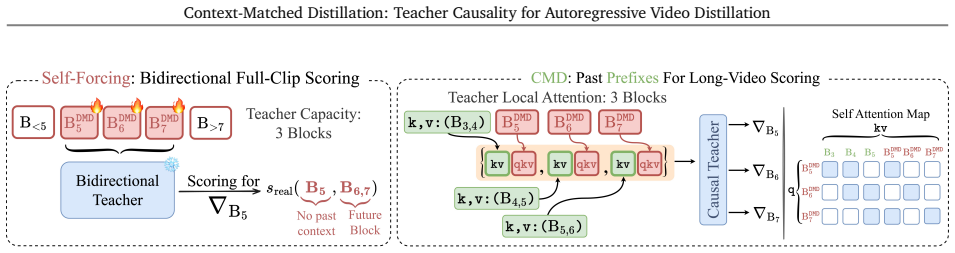
The load-bearing object is the multi-step causal teacher $\eta_\varphi$: a pretrained bidirectional video diffusion model fine-tuned with a Diffusion-Forcing flow-matching objective in which past frames are corrupted independently, teaching it to denoise each frame from its history alone. At distillation time, a block-causal attention mask packs each noised DMD target together with its cached student-generated prefix and controls, letting a target attend only to that prefix so all targets are scored in one forward pass without future lookahead. Prefix Scoring supplies the realized rollout context, and Prefix Corruption applies a controlled Gaussian perturbation $\mathcal{C}_\rho$ to stale prefixes so early student drift cannot dominate the score; the frame-dependent corruption schedule extends the same machinery to long videos.
What would settle it
Train the same student twice against the same frozen causal teacher with only the scoring context changed: one run conditions on preceding noised DMD targets (Base CMD) and the other on the exact cached student prefixes (Prefix Scoring). If the two runs land within about a tenth of a point on VBench-I2V Total, the context-matching mechanism is not carrying the result; if the prefix-conditioned run wins across corruption strengths that are not tuned on the evaluation benchmark, the claim survives.
Extended reading notes
Core claim
The central claim is that supervision for an autoregressive video student should be computed under the same causal information set that the student used to generate the target, not over a complete clip. Concretely, CMD replaces the bidirectional full-clip teacher score with a causal score $s_{\mathrm{real},t}(\hat{\mathbf{x}}^{\mathrm{DMD}}_{t,\tau}, \tau, h_t)$ for $h_t=(\mathcal{I}_0, \hat{\mathbf{x}}_{<t}, c_{\le t})$, so the gradient on frame $t$ can never depend on future latents or controls. The same causal teacher weights initialize the few-step student, and a block-causal attention mask scores every target in a single pass using its own cached prefix. For camera-conditioned generation the conditioning is a frame-relative ray map, so the teacher also cannot exploit future camera poses. In the paper's experiments this formulation achieves the best aggregate VBench-I2V and SANA-WM scores among the autoregressive baselines compared, with the largest gains in camera-motion compliance and substantially smaller camera-pose errors.
Load-bearing premise
The load-bearing premise is that the reported gains come from barring the teacher from seeing future frames and controls, rather than merely from retraining a new causal teacher with a different objective; the paper's ablations do not cleanly isolate the two.
Editorial extensions
If this is right
- A target's DMD gradient can no longer be contaminated by future frames or future controls, so the student is optimized under the same conditional distribution it faces during autoregressive inference.
- Because the same causal teacher also initializes the student, the pipeline needs no separate ODE-matching or consistency-distillation initialization, unlike several prior autoregressive distillation systems.
- All targets are scored in one teacher pass under a block-causal mask, so the causal alignment does not multiply the number of teacher evaluations with sequence length.
- For camera-conditioned generation, removing future-pose lookahead is reflected in substantially lower rotation, translation, and camera-matrix consistency errors on both SANA-WM splits.
Reading between the lines
- [Editorial inference] The cleanest mechanism test would freeze a pretrained bidirectional teacher, apply the same causal attention mask at scoring time, and compare against CMD's Diffusion-Forcing retrained teacher; if scores matched, retraining the teacher—not context matching—would be the active ingredient.
- [Editorial inference] If CMD's principle is general, it should transfer unchanged to any sequential generator where a lookahead teacher currently scores whole sequences—audio, embodied world models, or long-form video with richer controls—so a cross-modality replication would be a direct check.
- [Editorial inference] Prefix Corruption is currently set through a fixed hyperparameter tuned on the evaluation benchmark; an adaptive schedule that ties $\rho$ to a drift estimate of the student's cached prefix would test the robustness of the claim outside the benchmark configuration.
Signed reviews
Editorial analysis
A structured set of objections, weighed in public.
Referee Report
Summary. The paper proposes Context-Matched Distillation (CMD) for few-step autoregressive video generation. The method fine-tunes a pretrained bidirectional video diffusion model into a causal multi-step teacher using a Diffusion-Forcing objective, initializes a few-step student from that teacher, and then distills the student by scoring its generated targets with the causal teacher under student-cached prefixes. Prefix Scoring evaluates each target under the exact generated history that produced it, and Prefix Corruption perturbs that history during training to reduce sensitivity to early rollout artifacts. The same causal formulation is extended to frame-wise and chunk-wise generation, long-video rollouts with bounded local attention windows, and camera-conditioned generation with frame-relative ray-map conditioning. Experiments on VBench-I2V, SANA-WM short- and long-video splits, and SANA-WM camera-control splits compare against several autoregressive baselines and report aggregate improvements together with ablations over the scoring teacher, prefix scoring, and prefix-corruption level.
Significance. If the central mechanism were established, CMD would provide a clean unification of teacher training, student initialization, and distillation under one causal information boundary, with practical value for long-horizon and interactive camera-controlled video generation. The paper's strengths are the explicit information-set framing, the breadth of external benchmark evaluation (VBench-I2V, SANA-WM, 501-frame long videos, and camera-pose error metrics), and the unusually transparent ablation tables. However, the reported ablations do not isolate the context-matching mechanism from the causal teacher retraining and student initialization with which it is bundled, so the headline causal claim is not yet supported by the evidence as presented.
major comments (3)
- [§5.3, Table 4] The central claim that matching teacher supervision to the student's causal information set drives the gains is not isolated by the reported ablation. Moving from 'Bidir. teacher' (82.65 Total) to 'Base CMD' (88.33) changes three factors simultaneously: the teacher is fine-tuned with a Diffusion-Forcing objective, the scoring mask becomes causal, and the student is initialized from that causal teacher. Base CMD already captures 5.68 of the 5.81-point improvement. Adding Prefix Scoring with clean prefixes then reduces Total to 87.25, opposite to the stated mechanism, and only at the selected corruption level t_prefix=256 does Full CMD exceed Base CMD, by 0.13 points. With no error bars or repeated-seed statistics reported, this does not establish that context matching, rather than the retrained teacher and its initialization, is responsible. The authors should add crossing ablations that hold teacher retraining and initialization fixed while toggling the causal scoring mask, and that hold those fixed while toggling the prefix context, ideally with multiple seeds.
- [§5.3 and §4.2, Eq. (5)] The default prefix-corruption level is effectively selected on the evaluation benchmark. t_prefix=256 is reported as the default because it gives the best VBench-I2V aggregate and Camera Motion scores, while t_prefix=128 and t_prefix=512 both score below Base CMD (88.04 and 88.06 vs 88.33). The paper gives no validation protocol and no uncertainty quantification, so the 0.13-point Full-CMD advantage over Base CMD may be a post-selection artifact. In addition, Eq. (5) parameterizes corruption by rho, whereas the experiments are reported in terms of t_prefix; the mapping between the two is never given, so the default setting is not reproducible from the manuscript.
- [§5.3, Table 6] The camera-control claim has the same confound and is weaker for the prefix component. Base CMD with ray-map conditioning already reduces rotation error from 5.7306 to 1.7265 on Simple and from 7.1274 to 2.1606 on Hard relative to the bidirectional ray-map teacher; Full CMD's additional contribution is mostly on Semantic/Total scores. On the Hard split, Full CMD has larger camera errors than Base CMD (rotation 2.5607 vs 2.1606, translation 0.1447 vs 0.1257, CamMC 0.1698 vs 0.1468), which is consistent with the claim that causal teacher training helps but directly contradicts the stronger statement that matched prefixes improve camera adherence. The text should be revised to separate these claims.
minor comments (3)
- [§3, Eq. (1) and §4.2, Eq. (4)] The timestep notation is inconsistent: Eq. (1) suppresses τ after defining x_τ = (1−τ)x + τε, but Eq. (4) and Eq. (6) use τ again without specifying the distribution over τ or how the random timestep is sampled during training. Please clarify the sampling procedure.
- [§5.1] Training details are too sparse for reproduction: the student's number of denoising steps, optimizer settings, learning rate, and the exact mapping from t_prefix to ρ are not given, and the iteration counts are reported only with '∼' estimates. A code or checkpoint link would also help.
- [§5.4, Fig. 6] The LLM-preference evaluation uses 100 VBench-I2V prompts shared across all 1,200 pairwise trials, but the reported win percentages are not accompanied by confidence intervals or any test of sensitivity to the fixed prompt set. Please report a measure of variability.
Circularity Check
No circular derivation found; self-citations are non-load-bearing inputs and evaluation is external.
full rationale
CMD's derivation is self-contained as a distillation method: the causal teacher is obtained by fine-tuning a pretrained bidirectional model with the standard Diffusion-Forcing objective (Eq. 4), and the student is then distilled with the DMD score-difference update (Eqs. 1 and 6) using that causal teacher. Nothing in Equations 4-6 defines the teacher or the student in terms of the evaluation metrics (VBench-I2V, SANA-WM, camera errors), and those metrics are computed on external benchmarks against external baselines. The claimed improvements therefore are not forced by construction. The main non-circular weakness is experimental rather than definitional: in Table 4, 'Base CMD' already captures most of the gain over the bidirectional teacher, and the additional gain from Prefix Corruption appears only at t_prefix=256, a value selected on the same evaluation benchmark. That is a hyperparameter-selection concern, not a circular reduction. The paper's self-citations (Cosmos backbone [27], PRoPE/ray-map camera representations [20,29,30], SD3.5-flash [1]) supply implementation inputs and background, not the load-bearing claim that context-matched causal scoring helps; they do not constitute a self-justifying chain. Overall, the central derivation has independent content and is benchmarked externally, so circularity is minimal.
Assumptions & free parameters
free parameters (4)
- Prefix corruption level rho (via t_prefix) =
t_prefix = 256 (short video default)
- Long-video prefix corruption schedule rho_t =
not specified
- Local attention window size M =
not specified
- Training iteration counts =
Short chunk-1/chunk-4: ~3.2K/5.1K; long: +0.8K/0.9K; camera: ~3K/0.9K; teacher: ~8K/11K
assumptions (5)
- domain assumption A pretrained bidirectional video diffusion model (Cosmos-Predict2.5-2B) can be fine-tuned into a multi-step causal teacher with a Diffusion-Forcing flow-matching objective without losing generation quality.
- standard math The learned causal flow field eta_phi can be used as the score s_real in the DMD gradient update in Eq. (6).
- domain assumption Student-generated prefixes, possibly corrupted, are representative of the student's inference-time context, and the teacher's scores under these prefixes are informative for the DMD update.
- domain assumption VBench-I2V and SANA-WM metrics, including the LLM-based preference judge, measure the qualities the method claims to improve (camera adherence, continuity, quality).
- domain assumption The frame-relative ray-map camera representation in Eqs. (7)-(8) is a sufficient condition for both teacher and student to represent online camera control.
Cite this review
Pith. "Pith review of Context-Matched Distillation: Teacher Causality for Autoregressive Video Distillation." pith.science (2026). https://pith.science/paper/Q54UX4U6
@misc{pith2026260813391,
  author       = {Pith},
  title        = {Pith review of: Context-Matched Distillation: Teacher Causality for Autoregressive Video Distillation},
  year         = {2026},
  howpublished = {\url{https://pith.science/paper/Q54UX4U6}},
  note         = {Machine review of arXiv:2608.13391}
}
read the original abstract
Interactive autoregressive video generation demands both low-latency rollouts and precise online control. Few-step distillation accelerates generation by reducing denoising steps, while online control imposes a causal constraint: frames and blocks should depend on history and controls available during generation. Existing video distribution matching distillation (DMD) pipelines, however, often supervise causal few-step students using bidirectional teachers that score complete clips. The score for a target can therefore depend on future frames and controls that were unavailable when the student generated it, misaligning teacher supervision with the student's causal information set. We introduce Context-Matched Distillation (CMD), a causal DMD framework that aligns teacher supervision with the information available when each target is generated. CMD replaces bidirectional full-clip scoring with a causal teacher that evaluates each target without access to future frames or controls. The same causal teacher initializes the few-step student, establishing a consistent causal formulation across teacher training, student distillation, and inference. Beyond aligning the temporal information boundary, Prefix Scoring matches supervision to the student's realized rollout context by evaluating each target under the cached student-generated prefix that produced it. Prefix Corruption further stabilizes training by perturbing unreliable prefixes produced early in training while preserving this target-context alignment. With a simple causal formulation, CMD naturally extends to frame-wise and chunk-wise generation, long video distillation, and camera-conditioned distillation. Experiments demonstrate state-of-the-art aggregate performance among autoregressive methods on both short- and long-video benchmarks, together with substantially improved adherence to time-varying camera controls.
Figures


Figures from the paper (3 more)


Reference graph
Works this paper leans on
-
[1]
Sd3.5-flash: Distribution-guided distillation of generative flows
Hmrishav Bandyopadhyay, Rahim Entezari, Jim Scott, Reshinth Adithyan, Yi-Zhe Song, and Varun Jampani. Sd3.5-flash: Distribution-guided distillation of generative flows. InECCV, 2026. 4
work page 2026
-
[2]
Mode seeking meets mean seeking for fast long video generation.arXiv preprint arXiv:2602.24289, 2026
Shengqu Cai, Weili Nie, Chao Liu, Julius Berner, Lvmin Zhang, Nanye Ma, Hansheng Chen, Maneesh Agrawala, Leonidas Guibas, Gordon Wetzstein, et al. Mode seeking meets mean seeking for fast long video generation.arXiv preprint arXiv:2602.24289, 2026. 2, 4
arXiv 2026
-
[3]
Diffusion forcing: Next-token prediction meets full-sequence diffusion
Boyuan Chen, Diego Martí Monsó, Yilun Du, Max Simchowitz, Russ Tedrake, and Vincent Sitzmann. Diffusion forcing: Next-token prediction meets full-sequence diffusion. InNeurIPS, 2024. 2, 3, 5, 6
work page 2024
-
[4]
Skyreels-v2: Infinite-length film generative model.arXiv preprint arXiv:2504.13074, 2025
Guibin Chen, Dixuan Lin, Jiangping Yang, Chunze Lin, Junchen Zhu, Mingyuan Fan, Hao Zhang, Sheng Chen, Zheng Chen, Chengcheng Ma, et al. Skyreels-v2: Infinite-length film generative model.arXiv preprint arXiv:2504.13074, 2025. 4
arXiv 2025
-
[5]
Shuo Chen, Cong Wei, Sun Sun, Tiancheng Shen, Ping Nie, Kai Zou, Ge Zhang, Ming-Hsuan Yang, and Wenhu Chen. Context forcing: Consistent autoregressive video generation with long context.arXiv preprint arXiv:2602.06028, 2026. 3, 4, 9, 10, 11, 14
arXiv 2026
-
[6]
Lol: Longer than longer, scaling video generation to hour.arXiv preprint arXiv:2601.16914, 2026
Justin Cui, Jie Wu, Ming Li, Tao Yang, Xiaojie Li, Rui Wang, Andrew Bai, Yuanhao Ban, and Cho-Jui Hsieh. Lol: Longer than longer, scaling video generation to hour.arXiv preprint arXiv:2601.16914, 2026. 4
arXiv 2026
-
[7]
Flashattention-2: Faster attention with better parallelism and work partitioning
Tri Dao. Flashattention-2: Faster attention with better parallelism and work partitioning. InICLR, 2024. 3
work page 2024
-
[8]
Jiaqi Feng, Justin Cui, Yuanhao Ban, and Cho-Jui Hsieh. One-forcing: Towards stable one-step autore- gressive video generation.arXiv preprint arXiv:2605.23458, 2026. 3, 4, 5
arXiv 2026
Show all 58 references
-
[9]
Ca2-vdm: Ef- ficient autoregressive video diffusion model with causal generation and cache sharing.arXiv preprint arXiv:2411.16375, 2024
Kaifeng Gao, Jiaxin Shi, Hanwang Zhang, Chunping Wang, Jun Xiao, and Long Chen. Ca2-vdm: Ef- ficient autoregressive video diffusion model with causal generation and cache sharing.arXiv preprint arXiv:2411.16375, 2024. 3, 5, 7
2024 arXiv
-
[10]
Infinite worlds with versatile interactions.arXiv preprint arXiv:2607.07534, 2026
Zelin Gao, Qiuyu Wang, Jiapeng Zhu, Jingye Chen, Zichen Liu, Qingyan Bai, Jiahao Wang, Yufeng Yuan, Hanlin Wang, Yichong Lu, Ka Leong Cheng, Haojie Zhang, Jian Gao, Tianrui Feng, Yuzheng Liu, Yao Yao, Yinghao Xu, Xing Zhu, Yujun Shen, and Hao Ouyang. Infinite worlds with versa...
2026 arXiv
-
[11]
End-to-endtrainingforautoregressivevideodiffusionviaself-resampling
Yuwei Guo, Ceyuan Yang, Hao He, Yang Zhao, Meng Wei, Zhenheng Yang, Weilin Huang, and Dahua Lin. End-to-endtrainingforautoregressivevideodiffusionviaself-resampling. arXivpreprintarXiv:2512.15702 ,
-
[12]
CameraCtrl: Enabling camera control for text-to-video generation.arXiv preprint arXiv:2404.02101, 2024
Hao He, Yinghao Xu, Yuwei Guo, Gordon Wetzstein, Bo Dai, Hongsheng Li, and Ceyuan Yang. CameraCtrl: Enabling camera control for text-to-video generation.arXiv preprint arXiv:2404.02101, 2024. 2, 4, 8
2024 arXiv
-
[13]
Cameractrl ii: Dynamic scene exploration via camera-controlled video diffusion models
Hao He, Ceyuan Yang, Shanchuan Lin, Yinghao Xu, Meng Wei, Liangke Gui, Qi Zhao, Gordon Wetzstein, Lu Jiang, and Hongsheng Li. Cameractrl ii: Dynamic scene exploration via camera-controlled video diffusion models. InICCV, 2025. 4, 8
2025
-
[14]
Streamingt2v: Consistent, dynamic, and extendable long video generation from text.arXiv preprint arXiv:2403.14773, 2024
Roberto Henschel, Levon Khachatryan, Hayk Poghosyan, Daniil Hayrapetyan, Vahram Tadevosyan, Zhangyang Wang, Shant Navasardyan, and Humphrey Shi. Streamingt2v: Consistent, dynamic, and extendable long video generation from text.arXiv preprint arXiv:2403.14773, 2024. 4
2024 arXiv
-
[15]
Self forcing: Bridging the train-test gap in autoregressive video diffusion.arXiv preprint arXiv:2506.08009, 2025
Xun Huang, Zhengqi Li, Guande He, Mingyuan Zhou, and Eli Shechtman. Self forcing: Bridging the train-test gap in autoregressive video diffusion.arXiv preprint arXiv:2506.08009, 2025. 2, 3, 4, 5, 6, 7, 9, 14 15 Context-Matched Distillation: Teacher Causality for Autoregressive ...
2025 arXiv
-
[16]
Vbench++: Comprehensive and versatile benchmark suite for video generative models.IEEE TPAMI, 2025
Ziqi Huang, Fan Zhang, Xiaojie Xu, Yinan He, Jiashuo Yu, Ziyue Dong, Qianli Ma, Nattapol Chanpaisit, Chenyang Si, Yuming Jiang, et al. Vbench++: Comprehensive and versatile benchmark suite for video generative models.IEEE TPAMI, 2025. 11
2025
-
[17]
Fifo-diffusion: Generating infinite videos from text without training
Jihwan Kim, Junoh Kang, Jinyoung Choi, and Bohyung Han. Fifo-diffusion: Generating infinite videos from text without training. InNeurIPS, 2024. 4
2024
-
[18]
Hunyuanvideo: A systematic framework for large video generative models.arXiv preprint arXiv:2412.03603, 2024
Weijie Kong, Qi Tian, Zijian Zhang, Rox Min, Zuozhuo Dai, Jin Zhou, Jiangfeng Xiong, Xin Li, Bo Wu, Jianwei Zhang, et al. Hunyuanvideo: A systematic framework for large video generative models.arXiv preprint arXiv:2412.03603, 2024. 3
2024 arXiv
-
[19]
Eschernet: A generative model for scalable view synthesis
Xin Kong, Shikun Liu, Xiaoyang Lyu, Marwan Taher, Xiaojuan Qi, and Andrew J Davison. Eschernet: A generative model for scalable view synthesis. InCVPR, 2024. 4
2024
-
[20]
Cameras as relative positional encoding
Ruilong Li, Brent Yi, Junchen Liu, Hang Gao, Yi Ma, and Angjoo Kanazawa. Cameras as relative positional encoding. InNeurIPS, 2025. 4, 8, 14
2025
-
[21]
Autoregressive adversarial post-training for real-time interactive video generation
Shanchuan Lin, Ceyuan Yang, Hao He, Jianwen Jiang, Yuxi Ren, Xin Xia, Yang Zhao, Xuefeng Xiao, and Lu Jiang. Autoregressive adversarial post-training for real-time interactive video generation. InNeurIPS,
-
[22]
Dl3dv-10k: A large-scale scene dataset for deep learning-based 3d vision
Lu Ling, Yichen Sheng, Zhi Tu, Wentian Zhao, Cheng Xin, Kun Wan, Lantao Yu, Qianyu Guo, Zixun Yu, Yawen Lu, et al. Dl3dv-10k: A large-scale scene dataset for deep learning-based 3d vision. InCVPR, 2024. 9
2024
-
[23]
Gamma-world: Generative multi-agent world modeling beyond two players
Fangfu Liu, Kai He, Tianchang Shen, Tianshi Cao, Sanja Fidler, Yueqi Duan, Jun Gao, Igor Gilitschenski, Zian Wang, and Xuanchi Ren. Gamma-world: Generative multi-agent world modeling beyond two players. arXiv preprint arXiv:2605.28816, 2026. 3
2026 arXiv
-
[24]
Rolling forcing: Autoregressive long video diffusion in real time.arXiv preprint arXiv:2509.25161, 2025
Kunhao Liu, Wenbo Hu, Jiale Xu, Ying Shan, and Shijian Lu. Rolling forcing: Autoregressive long video diffusion in real time.arXiv preprint arXiv:2509.25161, 2025. 3, 4, 7, 9, 10, 11
2025 arXiv
-
[25]
Packforcing: Short video training suffices for long video sampling and long context inference.arXiv preprint arXiv:2603.25730, 2026
Xiaofeng Mao, Shaohao Rui, Kaining Ying, Bo Zheng, Chuanhao Li, Mingmin Chi, and Kaipeng Zhang. Packforcing: Short video training suffices for long video sampling and long context inference.arXiv preprint arXiv:2603.25730, 2026. 4, 7
2026
-
[26]
Gta: A geometry-aware attention mechanism for multi-view transformers
Takeru Miyato, Bernhard Jaeger, Max Welling, and Andreas Geiger. Gta: A geometry-aware attention mechanism for multi-view transformers. InICLR, 2024. 4
2024
-
[27]
World simulation with video foundation models for physical ai.arXiv preprint arXiv:2511.00062, 2025
NVIDIA, Arslan Ali, Junjie Bai, Maciej Bala, Yogesh Balaji, Aaron Blakeman, Tiffany Cai, Jiaxin Cao, Tianshi Cao, Elizabeth Cha, Yu-Wei Chao, et al. World simulation with video foundation models for physical ai.arXiv preprint arXiv:2511.00062, 2025. 9
2025 arXiv
-
[28]
Freenoise: Tuning-free longer video diffusion via noise rescheduling
Haonan Qiu, Menghan Xia, Yong Zhang, Yingqing He, Xintao Wang, Ying Shan, and Ziwei Liu. Freenoise: Tuning-free longer video diffusion via noise rescheduling. InICLR, 2024. 4
2024
-
[29]
Gen3c: 3d-informed world-consistent video generation with precise camera control
Xuanchi Ren, Tianchang Shen, Jiahui Huang, Huan Ling, Yifan Lu, Merlin Nimier-David, Thomas Müller, Alexander Keller, Sanja Fidler, and Jun Gao. Gen3c: 3d-informed world-consistent video generation with precise camera control. In2025 IEEE/CVF Conference on Computer Vision and ...
2025
-
[30]
Lyra 2.0: Explorable generative 3d worlds.arXiv preprint arXiv:2604.13036, 2026
Tianchang Shen, Sherwin Bahmani, Kai He, Sangeetha Grama Srinivasan, Tianshi Cao, Jiawei Ren, Ruilong Li, Zian Wang, Nicholas Sharp, Zan Gojcic, Sanja Fidler, Jiahui Huang, Huan Ling, Jun Gao, and Xuanchi Ren. Lyra 2.0: Explorable generative 3d worlds.arXiv preprint arXiv:2604...
2026 arXiv
-
[31]
Worldplay: Towards long-term geometric consistency for real-time interactive world modeling.arXiv preprint arXiv:2512.14614, 2025
Wenqiang Sun, Haiyu Zhang, Haoyuan Wang, Junta Wu, Zehan Wang, Zhenwei Wang, Yunhong Wang, Jun Zhang, Tengfei Wang, and Chunchao Guo. Worldplay: Towards long-term geometric consistency for real-time interactive world modeling.arXiv preprint arXiv:2512.14614, 2025. 4, 10
2025 arXiv
-
[32]
Advancing open-source world models.arXiv preprint arXiv:2601.20540, 2026
Robbyant Team, Zelin Gao, Qiuyu Wang, Yanhong Zeng, Jiapeng Zhu, Ka Leong Cheng, Yixuan Li, Hanlin Wang, Yinghao Xu, Shuailei Ma, et al. Advancing open-source world models.arXiv preprint arXiv:2601.20540, 2026. 2, 3, 4, 8, 9, 10, 11, 14
2026 arXiv
-
[33]
Magi-1: Autoregressive video generation at scale
Hansi Teng, Hongyu Jia, Lei Sun, Lingzhi Li, Maolin Li, Mingqiu Tang, Shuai Han, Tianning Zhang, WQ Zhang, Weifeng Luo, et al. Magi-1: Autoregressive video generation at scale. arXiv preprint arXiv:2505.13211, 2025. 3
2025 arXiv
-
[34]
Least-squares estimation of transformation parameters between two point patterns
Shinji Umeyama. Least-squares estimation of transformation parameters between two point patterns. IEEE TPAMI, 1991. 11
1991
-
[35]
Wan: Open and advanced large-scale video generative models.arXiv preprint arXiv:2503.20314, 2025
Team Wan, Ang Wang, Baole Ai, Bin Wen, Chaojie Mao, Chen-Wei Xie, Di Chen, Feiwu Yu, Haiming Zhao, Jianxiao Yang, et al. Wan: Open and advanced large-scale video generative models.arXiv preprint arXiv:2503.20314, 2025. 3, 9, 10
2025 arXiv
-
[36]
Yifan Wang, Jianjun Zhou, Haoyi Zhu, Wenzheng Chang, Yang Zhou, Zizun Li, Junyi Chen, Jiangmiao Pang, Chunhua Shen, and Tong He.𝜋3: Permutation-equivariant visual geometry learning.arXiv preprint arXiv:2507.13347, 2025. 11
2025 arXiv
-
[37]
Motionctrl: A unified and flexible motion controller for video generation
Zhouxia Wang, Ziyang Yuan, Xintao Wang, Yaowei Li, Tianshui Chen, Menghan Xia, Ping Luo, and Ying Shan. Motionctrl: A unified and flexible motion controller for video generation. InACM SIGGRAPH, 2024. 2, 4, 8
2024
-
[38]
Worldmem: Long-term consistent world simulation with memory
ZeqiXiao,YushiLan,YifanZhou,WenqiOuyang,ShuaiYang,YanhongZeng,andXingangPan. Worldmem: Long-term consistent world simulation with memory. InNeurIPS, 2025. 4, 7
2025
-
[39]
Camco: Camera-controllable 3d-consistent image-to-video generation.arXiv preprint arXiv:2406.02509, 2024
Dejia Xu, Weili Nie, Chao Liu, Sifei Liu, Jan Kautz, Zhangyang Wang, and Arash Vahdat. Camco: Camera-controllable 3d-consistent image-to-video generation.arXiv preprint arXiv:2406.02509, 2024. 4
2024 arXiv
-
[40]
Realcam: Real-time novel-view video generation with interactive camera control.arXiv preprint arXiv:2605.06051, 2026
Youcan Xu, Jiaxin Shi, Zhen Wang, Wensong Song, Feifei Shao, Chen Liang, Jun Xiao, and Long Chen. Realcam: Real-time novel-view video generation with interactive camera control.arXiv preprint arXiv:2605.06051, 2026. 4, 8
2026 arXiv
-
[41]
Qwen3 technical report.arXiv preprint arXiv:2505.09388, 2025
An Yang, Anfeng Li, Baosong Yang, Beichen Zhang, Binyuan Hui, Bo Zheng, Bowen Yu, Chang Gao, Chengen Huang, Chenxu Lv, et al. Qwen3 technical report.arXiv preprint arXiv:2505.09388, 2025. 9
2025 arXiv
-
[42]
Longlive: Real-time interactive long video generation.arXiv preprint arXiv:2509.22622, 2025
Shuai Yang, Wei Huang, Ruihang Chu, Yicheng Xiao, Yuyang Zhao, Xianbang Wang, Muyang Li, Enze Xie, Yingcong Chen, Yao Lu, et al. Longlive: Real-time interactive long video generation.arXiv preprint arXiv:2509.22622, 2025. 2, 3, 4, 7, 9, 10, 11
2025 arXiv
-
[43]
Infinity-rope: Action- controllable infinite video generation emerges from autoregressive self-rollout
Hidir Yesiltepe, Tuna Meral, Adil Kaan Akan, Kaan Oktay, and Pinar Yanardag. Infinity-rope: Action- controllable infinite video generation emerges from autoregressive self-rollout. InCVPR, 2026. 4, 7
2026
-
[44]
Deep forc- ing: Training-free long video generation with deep sink and participative compression.arXiv preprint arXiv:2512.05081, 2025
Jung Yi, Wooseok Jang, Paul Hyunbin Cho, Jisu Nam, Heeji Yoon, and Seungryong Kim. Deep forc- ing: Training-free long video generation with deep sink and participative compression.arXiv preprint arXiv:2512.05081, 2025. 4, 7
2025
-
[45]
Raype: Ray-space positional encoding for 3d-aware video generation.arXiv preprint arXiv:2606.27345, 2026
Minghao Yin, Jiahao Lu, Wenbo Hu, Wang Zhao, Shan Ying, and Kai Han. Raype: Ray-space positional encoding for 3d-aware video generation.arXiv preprint arXiv:2606.27345, 2026. 4 17 Context-Matched Distillation: Teacher Causality for Autoregressive Video Distillation
2026 arXiv
-
[46]
Improved distribution matching distillation for fast image synthesis
Tianwei Yin, Michaël Gharbi, Taesung Park, Richard Zhang, Eli Shechtman, Fredo Durand, and William T Freeman. Improved distribution matching distillation for fast image synthesis. InNeurIPS, 2024. 2, 4, 6
2024
-
[47]
One-step diffusion with distribution matching distillation
Tianwei Yin, Michaël Gharbi, Richard Zhang, Eli Shechtman, Fredo Durand, William T Freeman, and Taesung Park. One-step diffusion with distribution matching distillation. InCVPR, 2024. 2, 3, 4, 6
2024
-
[48]
From slow bidirectional to fast autoregressive video diffusion models
Tianwei Yin, Qiang Zhang, Richard Zhang, William T Freeman, Fredo Durand, Eli Shechtman, and Xun Huang. From slow bidirectional to fast autoregressive video diffusion models. InCVPR, 2025. 2, 3, 4, 5, 6, 9, 10
2025
-
[49]
Videossm: Autoregressive long video generation with hybrid state-space memory
Yifei Yu, Xiaoshan Wu, Xinting Hu, Tao Hu, Yangtian Sun, Xiaoyang Lyu, Bo Wang, Lin Ma, Yuewen Ma, Zhongrui Wang, et al. Videossm: Autoregressive long video generation with hybrid state-space memory. arXiv preprint arXiv:2512.04519, 2025. 4, 7
2025
-
[50]
Frame context packing and drift prevention in next-frame-prediction video diffusion models
Lvmin Zhang, Shengqu Cai, Muyang Li, Gordon Wetzstein, and Maneesh Agrawala. Frame context packing and drift prevention in next-frame-prediction video diffusion models. InNeurIPS, 2025. 4, 7
2025
-
[51]
Fast video generation with sliding tile attention.arXiv preprint arXiv:2502.04507, 2025
Peiyuan Zhang, Yongqi Chen, Runlong Su, Hangliang Ding, Ion Stoica, Zhengzhong Liu, and Hao Zhang. Fast video generation with sliding tile attention.arXiv preprint arXiv:2502.04507, 2025. 4
2025 arXiv
-
[52]
minWM: A full-stack open-source framework for real-time interactive video world models.arXiv preprint arXiv:2605.30263, 2026
Min Zhao, Hongzhou Zhu, Bokai Yan, Zihan Zhou, Yimin Chen, Wenqiang Sun, Kaiwen Zheng, Guande He, Xiao Yang, Chongxuan Li, Fan Bao, and Jun Zhu. minWM: A full-stack open-source framework for real-time interactive video world models.arXiv preprint arXiv:2605.30263, 2026. 4, 10
2026 arXiv
-
[53]
Causal forcing++: Scalable few-step autoregressive diffusion distillation for real-time interactive video generation.arXiv preprint arXiv:2605.15141, 2026
Min Zhao, Hongzhou Zhu, Kaiwen Zheng, Zihan Zhou, Bokai Yan, Xinyuan Li, Xiao Yang, Chongxuan Li, and Jun Zhu. Causal forcing++: Scalable few-step autoregressive diffusion distillation for real-time interactive video generation.arXiv preprint arXiv:2605.15141, 2026. 2, 3, 4, 5...
2026 arXiv
-
[54]
Kaiwen Zheng, Guande He, Min Zhao, Jintao Zhang, Huayu Chen, Jianfei Chen, Chen-Hsuan Lin, Ming-Yu Liu, Jun Zhu, and Qianli Ma. Causal-rcm: A unified teacher-forcing and self-forcing open recipe for autoregressive diffusion distillation in streaming video generation and intera...
2026 arXiv
-
[55]
Taming teacher forcing for masked autoregressive video generation
Deyu Zhou, Quan Sun, Yuang Peng, Kun Yan, Runpei Dong, Duomin Wang, Zheng Ge, Nan Duan, and Xiangyu Zhang. Taming teacher forcing for masked autoregressive video generation. InCVPR, 2025. 3
2025
-
[56]
SANA-WM: Efficient minute-scale world modeling with hybrid linear diffusion transformer
Haoyi Zhu, Haozhe Liu, Yuyang Zhao, Tian Ye, Junsong Chen, Jincheng Yu, Tong He, Song Han, and Enze Xie. SANA-WM: Efficient minute-scale world modeling with hybrid linear diffusion transformer. arXiv preprint arXiv:2605.15178, 2026. 2, 3, 4, 10, 11, 12, 14
2026 arXiv
-
[57]
Causal forcing: Autore- gressive diffusion distillation done right for high-quality real-time interactive video generation.arXiv preprint arXiv:2602.02214, 2026
Hongzhou Zhu, Min Zhao, Guande He, Hang Su, Chongxuan Li, and Jun Zhu. Causal forcing: Autore- gressive diffusion distillation done right for high-quality real-time interactive video generation.arXiv preprint arXiv:2602.02214, 2026. 2, 3, 4, 5, 6, 9, 10, 14
2026 arXiv
-
[58]
Self gradient forcing: Native long video extrapolation.arXiv preprint arXiv:2607.20368, 2026
Junhao Zhuang, Shiyi Zhang, Yuxuan Bian, Yaowei Li, Yawen Luo, Yijun Liu, Weiyang Jin, Songchun Zhang, Xianglong He, Xuying Zhang, et al. Self gradient forcing: Native long video extrapolation.arXiv preprint arXiv:2607.20368, 2026. 3, 6, 7 18
2026 arXiv
Reviewed August 14, 2026 · model on record in the stance chip above.
Discussion (0). Continue with ORCID to comment.