REVIEW 2 major objections 5 minor 43 references
Landau theory and exchange instabilities in Mn$_5$Si$_3$: A case against altermagnetism
T0 review · 2 major / 5 minor · reviewed 2026-08-14 · deepseek-v4-flash
Pith's one-line read This paper argues that the zone-center spin mode that would make Mn5Si3 an altermagnet is substantially weaker than the bulk M-point antiferromagnetic instability, and epitaxial strain typical of films suppresses it further, so the film's…
desk verdict A careful DLM-based argument that the Gamma-point altermagnetic mode in Mn5Si3 is far less competitive than the M-point AFM2 mode; the one real gap is that finite Mn1 moments are never tested. read the letter →
The pith
A machine-rendered reading of the paper's core claim, the machinery that carries it, and where it could break.
The reading
What carries the argument
The load-bearing object is the Fourier-transformed exchange kernel $J_{\alpha\beta}(\mathbf{q})$ on the six Mn2 sublattices, computed in the disordered-local-moment paramagnetic reference state; its largest eigenvalue $\lambda_{\max}(\mathbf{q})$ locates the leading spin instability. Landau theories for the $\mathbf{M}$ star and the zone center place the same $(1,-1,0)$ intracell pattern at a permutation-odd mode of a single $\mathbf{M}$ arm and in the collinear $E_{2g}$ order-parameter sector at $\Gamma$, respectively, with higher-order terms deciding the final phase. The comparison of $\lambda_{\max}(\Gamma)$ with $\lambda_{\max}(\mathbf{M})$, together with its response to epitaxial strain, carries the argument.
What would settle it
Measure the magnetic ordering wave vector of a Mn5Si3 film that shows the anomalous Hall effect in the high-temperature regime: M-point magnetic scattering persisting above 200 K would rule out the zone-center altermagnet, while a Gamma-point (0,1,-1) order would overturn the paper's case. A numerical alternative is a first-principles study that includes Mn1 moments or non-Heisenberg correlations and finds $\lambda_{\max}(\Gamma) > \lambda_{\max}(\mathbf{M})$.
Extended reading notes
Core claim
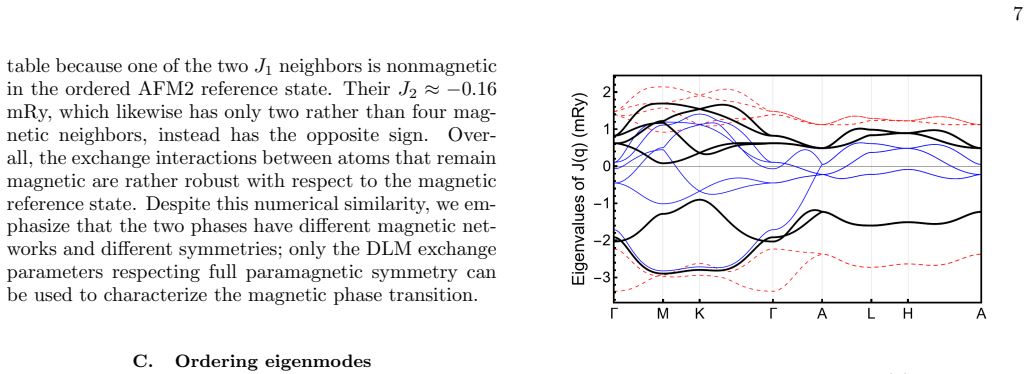
The central discovery is a quantitative comparison of the two candidate magnetic instabilities of Mn5Si3 within a disordered-local-moment (DLM) description of the paramagnet. The exchange kernel $J_{\alpha\beta}(\mathbf{q})$, evaluated from density functional theory in the DLM reference state, has its largest eigenvalue at the $\mathbf{M}$ star, with an eigenvector matching the experimentally observed AFM2 pattern $(0,1,-1)$ on the three inversion-even Mn2 sublattice pairs. The same intracell pattern at the zone center belongs to the collinear branch of the $E_{2g}$ representation, so a Landau theory could produce an altermagnet from that mode; but $\lambda_{\max}(\Gamma)$ is significantly below $\lambda_{\max}(\mathbf{M})$ and is a global minimum within the $q_z=0$ plane. This ordering of instabilities is robust to Mn2 local moments between 2.14 and 2.54 $\mu_B$ and to a 1% in-plane tensile strain with 0.3% $c$-axis contraction, which further suppresses the $\Gamma$ mode. The paper concludes that the zone-center altermagnetic phase is not a close competitor in stoichiometric bulklike Mn5Si3.
Load-bearing premise
The conclusion rests on the disordered-local-moment paramagnetic state with Mn2 moments of 2.14 to 2.54 mu_B and no Mn1 moment being a faithful model of the real fluctuating-moment state above the ordering temperature, so that the classical Heisenberg exchange kernel correctly ranks the competing instabilities.
Editorial extensions
If this is right
- Bulk AFM2 ordering is explained: the M-star eigenmode is the leading paramagnetic instability, with single-site entropy and magnetoelastic coupling able to select the single-arm AFM2 phase over the orthogonal 3M state.
- The proposed altermagnetic phase of thin Mn5Si3 films is unlikely to be stabilized by moderate epitaxial strain of a stoichiometric bulklike film, since such strain reduces the leading M-point exchange eigenvalue by about 20% and suppresses the Gamma mode further.
- Classical Monte Carlo simulations using the DLM exchange parameters order near 73 K into an equal-amplitude orthogonal 3M state, in reasonable agreement with the experimental $T_{N2}\approx 100$ K given that quartic phase-selection terms lie beyond the Heisenberg model.
- The high-temperature anomalous Hall and Nernst signals in films cannot be attributed to a nearby Gamma-point instability; if they are magnetic in origin, they require off-stoichiometry, intercalation, interfacial, or other non-bulklike physics.
- The estimated magnetoelastic coupling is consistent with the measured orthorhombic exchange striction, identifying a concrete mechanism that favors the bulk AFM2 phase.
Reading between the lines
- Because $\lambda_{\max}(\mathbf{q})$ flattens near the zone boundary under tensile strain, order-by-disorder or quartic corrections could in principle stabilize a multi-M or $\mathbf{q}\ne\mathbf{M}$ state in films, but with essentially the same exchange scale; such a state still could not explain Hall signals at more than twice the bulk ordering temperature.
- The negative result shifts the burden to film-specific chemistry: testing carbon-intercalated, off-stoichiometric, or Mn1-active films would directly probe whether the Hall-active state comes from a non-bulklike magnetic phase.
- A straightforward experimental falsifier would be magnetic scattering on the AHE-active film: observation of M-point magnetic peaks persisting above 200 K would rule out the Gamma-altermagnet, while observation of a Gamma-point (0,1,-1) mode would overturn the paper's conclusion.
- The Landau analysis shows the (0,1,-1) direction at Gamma is selected only by sixth-order terms whose sign is not fixed by symmetry, so the negative result is robust within the DLM/Heisenberg model family but could be sensitive to correlations beyond it.
Editorial analysis
A structured set of objections, weighed in public.
Referee Report
Summary. The paper examines whether the altermagnetic phase proposed for thin-film Mn5Si3, with the same (1,-1,0) Mn2 intracell pattern as the bulk AFM2 phase but at the zone center, is supported by first-principles exchange calculations. The authors construct Landau theories for both the M-star AFM2 ordering and the zone-center E2g ordering, showing that both contain the same AFM2-like pattern but differ in symmetry and order-parameter structure. They then compute the disordered-local-moment (DLM) exchange kernel J_alpha beta(q) for the paramagnetic state using TB-LMTO within LDA, scaled LDA, and GGA, and find that the leading instability is at the M point for LDA-based potentials, whereas the GGA gives a K-point instability. In all cases the largest eigenvalue at Gamma belongs to the E2g representation, but it is far below the M-point eigenvalue and is a supposed global minimum in the q_z=0 plane. Monte Carlo simulations using the LDA exchange parameters yield an orthogonal 3M ordered state with T_N about 73 K, consistent with the bulk ordering scale. Epitaxial tensile strain representative of Mn5Si3 films on Si(111) further suppresses the Gamma-point mode and reduces the M-point eigenvalue. A magnetoelastic estimate explains the experimental exchange striction and supports the single-arm AFM2 selection. The paper concludes that the high-temperature Hall-active state in Mn5Si3 films cannot be a weakly strained perturbation of bulk stoichiometric Mn5Si3.
Significance. If the conclusions hold, this is an important negative result for the altermagnetism field, providing a concrete counterexample to the widely discussed altermagnetic candidate Mn5Si3 and a physically transparent explanation of its bulk magnetic ordering. The paper's strengths are the combination of Landau-theory analysis, parameter-free DLM exchange calculations with multiple potentials and local-moment variations, Monte Carlo simulations that reproduce the experimental ordering temperature scale, and a magnetoelastic consistency check using the measured exchange striction. The central negative claim is falsifiable: it predicts that no Gamma-point E2g instability appears in the DLM kernel of stoichiometric Mn5Si3 under moderate strain. The main weakness is that the DLM reference state fixes Mn1 moments to zero, and the robustness of the Gamma-versus-M ranking to finite Mn1 fluctuations is not tested.
major comments (2)
- [§II.A, §II.B, §III.A] The manuscript states that interactions mediated by Mn1 can only renormalize higher-order terms in the Landau free energy, but this is not correct for the quadratic exchange kernel. Integrating out finite Mn1 fluctuations generates an effective Mn2–Mn2 exchange contribution of the form ΔJ_{αβ}(q) ~ Σ_{γδ} J_{αγ}(q) χ_{γδ}(q) J_{δβ}(q), which respects the full paramagnetic symmetry and contributes to the quadratic kernel K(q) on the same footing as the direct Mn2 exchange. The DLM calculation sets the Mn1 moment to zero self-consistently, so this term is entirely absent from the computed eigenvalues, and the sensitivity analysis varies only the Mn2 moment (2.14–2.85 μB) and strain, never the Mn1 susceptibility. Since the Mn1 sites carry ordered moments in the low-temperature AFM1 phase, finite Mn1 fluctuations in the paramagnet are physically plausible. The central claim that λ_max(Γ) is a global minimum in the q_z=0 plane is therefore not yet shown to be robust against a relevant axis of the reference-state assumption. Please provide a quantitative test, such as a constrained DLM calculation with nonzero Mn1 moments or a perturbative estimate of ΔJ using a model Mn1 susceptibility, or explicitly narrow the conclusion to the case of vanishing Mn1 moments.
- [§III.C and Fig. 3] The text claims that in all three potentials the largest eigenvalue λ_max(q) has a global minimum at Γ in the whole q_z=0 plane, but Fig. 3 only displays eigenvalues along a high-symmetry path (Γ–M–K–Γ). This path samples only the boundary of the irreducible wedge of the q_z=0 plane, not the interior. No numerical scan of the full plane or analytic argument is presented. If the interior was sampled, the claim should be stated with that evidence; otherwise the strongest conclusion supported by the figure is that Γ is the minimum along the displayed path. Because the global-minimum statement is part of the argument that Γ is uniquely disfavored, this gap should be fixed either by adding a full-plane map or by softening the wording.
minor comments (5)
- [§II.B, Eq. (10)] The symbol Q_{μν} is used both for the matrix of dot products and for its individual components; please clarify the notation, e.g., by defining Q as the matrix with elements Q_{μν}.
- [Table I and §III.B] The DLM value J2 ≈ +0.055 mRy has the opposite sign from the J2 ≈ −0.16 mRy reported in Ref. [14] for the symmetry-broken reference state. This sign difference is mentioned in passing but not discussed; a short comment on its origin would help the reader.
- [§V] The sign of d∆λ/dε1 is given as approximately −6.0 mRy, and Eq. (19) yields γ ≈ 0.27 eV. Please check that the sign convention is consistent with the definition of ε1 in Eq. (17) and with the statement that AFM2 ordering contracts the bonds between ordered sublattices.
- [§II.C] The analogy with the stacked triangular Ising antiferromagnet (STAFI) is helpful, but the order-parameter space here is continuous in spin space; the phrase 'identical to that of the STAFI model' might be clarified as 'identical in its E2g angular sector'.
- [Throughout] There are a few typographical issues, such as inconsistent use of 'AFM2' versus 'AF2' and the missing accent in 'Néel' in a few places. These are cosmetic and do not affect the science.
Circularity Check
No circularity: the exchange eigenvalues and ordering rankings are computed from a self-consistent DLM kernel, not fitted to the target conclusion.
full rationale
The paper's central claims are derived from an independent computational chain. The Landau classifications of the M-point AFM2 mode and the Gamma-point E2g mode are group-theoretic decompositions based on standard external references; they do not presuppose which instability has the larger eigenvalue. The exchange kernel J_alpha_beta(q) is obtained from self-consistent DLM linear-response calculations with LDA, scaled LDA, and GGA, and the eigenvalue ranking lambda_max(M) >> lambda_max(Gamma) follows from the computed kernel rather than from any parameter adjusted to produce that ranking. The Monte Carlo ordering temperature T_N ~ 73 K is an output of the same kernel and is compared with the experimental T_N2 ~ 100 K as an external benchmark. The strain dependence is also computed, not chosen, and the magnetoelastic estimate is checked against the measured exchange striction rather than fitted to the altermagnetism conclusion. Self-citations appear only as code/method references (Questaal, TB-LMTO) and are not load-bearing for the physics. The DLM reference state fixing Mn1 moments to zero is a modeling assumption: if significant Mn1 fluctuations renormalize the Mn2 kernel, the Gamma-vs-M ranking could change. That is a legitimate correctness concern about the reference state, but it is not circularity, because no equation in the paper defines the target result in terms of itself and no fitted parameter is renamed as a prediction. The conclusion that Gamma-point E2g ordering is disfavored is a genuine computed prediction from a stated microscopic model.
Assumptions & free parameters
assumptions (6)
- domain assumption The Landau free energy expansions (Eqs. 10, 13, 15) truncated at quartic/sixth order are sufficient for phase selection of the M-star and E2g order parameters.
- domain assumption The DLM state is a valid reference for the paramagnetic phase of Mn5Si3, with fixed local moments on all six Mn2 sublattices and no moments on Mn1.
- domain assumption Classical Heisenberg exchange with the pair interactions of Table I captures the magnetic ordering of Mn5Si3.
- domain assumption The reported epitaxial strain (about 1% in-plane tensile, 0.3% c-axis contraction) is representative of Mn5Si3 films on Si(111).
- standard math The little-cogroup projective representation analysis (Eqs. 1-3) correctly classifies the ordering instabilities of the paramagnetic space group.
- standard math The M-star Landau phase diagram from Ref. [20] applies to Mn5Si3.
Cite this review
Pith. "Pith review of Landau theory and exchange instabilities in Mn$_5$Si$_3$: A case against altermagnetism." pith.science (2026). https://pith.science/paper/3NSDPSSX
@misc{pith2026260813483,
  author       = {Pith},
  title        = {Pith review of: Landau theory and exchange instabilities in Mn$_5$Si$_3$: A case against altermagnetism},
  year         = {2026},
  howpublished = {\url{https://pith.science/paper/3NSDPSSX}},
  note         = {Machine review of arXiv:2608.13483}
}
abstract
Thin-film Mn$_5$Si$_3$ is one of the most studied altermagnetic candidates thanks to its metallicity, demonstrated anomalous transport properties, and assumed $d$-wave exchange splitting pattern enabling spin-polarized transport and various spintronic applications. Its postulated altermagnetic structure has zero propagation vector, in contrast to the collinear antiferromagnetic bulk phase (AFM2) which orders at the $M$ star. In this work, the two phases are analyzed using Landau theories, first-principles calculations of the paramagnetic instabilities, and Monte Carlo simulations. AFM2 appears in a Landau theory as a symmetry-protected inversion-even, permutation-odd mode at a single arm of the $M$ star. At $\Gamma$, the same intracell ordering pattern belongs to the collinear branch of an $E_{2g}$ order parameter. In both cases, higher-order terms are required for the phase selection. First-principles calculations for the paramagnetic, disordered-local-moment state correctly identify the leading exchange instability at the $M$ star, and the resulting classical Heisenberg model orders at a reasonable temperature into the orthogonal $3M$ phase favored by single-site entropy. The $\Gamma$-point $E_{2g}$ mode, whose Landau theory contains the altermagnetic sector, is substantially weaker and further suppressed by epitaxial strain representative of Mn$_5$Si$_3$ films exhibiting anomalous transport. The same strain reduces the leading magnetic exchange scale. These results provide a natural explanation for the bulk $M$-point instability but strongly disfavor the postulated relocation of the propagation vector from $M$ to $\Gamma$ in a moderately strained bulklike Mn$_5$Si$_3$ film, suggesting that the corresponding altermagnetic phase is unlikely to be stabilized without additional physics.
Figures


Figures from the paper (1 more)

Reference graph
Works this paper leans on
-
[1]
P. J. Brown, J. B. Forsyth, V. Nunez, and F. Tasset, The low-temperature antiferromagnetic structure of Mn 5Si3 revised in the light of neutron polarimetry, J. Phys.: Con- dens. Matter4, 10025 (1992)
work page 1992
-
[2]
BecauseQ 2 =L 4 −4C ×, it makes a positive contribution tov Γ
due to ordering striction. BecauseQ 2 =L 4 −4C ×, it makes a positive contribution tov Γ. Various mechanisms contribute tow 6. Single-site en- tropy givesw ent 6 =−(11/700)k BT <0 per primitive cell, favoring the (0,1,−1) pattern. A third-order term inL can couple to the uniform magnetization mode, which in the collinear case (14) results in the free-ener...
-
[3]
We now consider how this ordering could emerge from a Landau theory
that magnetic ordering in thin Mn 5Si3 films switches from the bulk AFM2 phase considered in Section II B to a zone-center pattern with the same (1,−1,0) sublattice amplitudes. We now consider how this ordering could emerge from a Landau theory. In the parity-even sector, the three ordering vectors m+ A,m + B,m + C transform under the permutation rep- res...
-
[4]
I. Kounta, H. Reichlova, D. Kriegner, R. Lopes Seeger, A. Bad’ura, M. Leiviska, A. Boussadi, V. Heresanu, S. Bertaina, M. Petit, E. Schmoranzerova, L. Smejkal, J. Sinova, T. Jungwirth, V. Baltz, S. T. B. Goennen- wein, and L. Michez, Competitive actions of MnSi in the epitaxial growth of Mn 5Si3 thin films on Si(111), Phys. Rev. Mater.7, 024416 (2023)
work page 2023
-
[5]
P. J. Brown and J. B. Forsyth, Antiferromagnetism in Mn5Si3: The magnetic structure of the AF2 phase at 70 K, J. Phys.: Condens. Matter7, 7619 (1995)
work page 1995
-
[6]
H. Reichlov´ a, R. Lopes Seeger, R. Gonz´ alez-Hern´ andez, I. Kounta, R. Schlitz, D. Kriegner, P. Ritzinger, M. Lammel, M. Leivisk¨ a, A. Birk Hellenes, K. Olejn ´ ık, V. Petˇ r ´ ıˇ cek, P. Doleˇ zal, L. Hor´ ak, E. Schmoranzerov´ a, A. Badura, S. Bertaina, A. Thomas, V. Baltz, L. Michez, J. Sinova, S. T. B. Goennenwein, T. Jungwirth, and L. ˇSmejkal, O...
work page 2024
-
[7]
A. Badura, W. H. Campos, V. K. Bharadwaj, I. Kounta, L. Michez, M. Petit, J. Rial, M. Leiviska, V. Baltz, F. Krizek, D. Kriegner, J. Zelezny, J. Zemen, S. Telkamp, S. Sailler, M. Lammel, R. Jaeschke-Ubiergo, A. B. Hel- 11 lenes, R. Gonzalez-Hernandez, J. Sinova, T. Jungwirth, S. T. B. Goennenwein, L. Smejkal, and H. Reichlova, Ob- servation of the anomalo...
work page 2025
-
[8]
M. Leivisk¨ a, J. Rial, A. Bad’ura, R. L. Seeger, I. Kounta, S. Beckert, D. Kriegner, I. Joumard, E. Schmoranzerov´ a, J. Sinova, O. Gomonay, A. Thomas, S. T. B. Goennen- wein, H. Reichlov´ a, L.ˇSmejkal, L. Michez, T. Jungwirth, and V. Baltz, Anisotropy of the anomalous Hall effect in thin films of the altermagnet candidate Mn 5Si3, Phys. Rev. B109, 2244...
work page 2024
Show all 43 references
-
[9]
L. Han, X. Fu, R. Peng, X. Cheng, J. Dai, L. Liu, Y. Li, Y. Zhang, W. Zhu, H. Bai, Y. Zhou, S. Liang, C. Chen, Q. Wang, X. Chen, L. Yang, Y. Zhang, C. Song, J. Liu, and F. Pan, Electrical 180 ◦ switching of N´ eel vector in spin-splitting antiferromagnet, Science Advances10, e...
2024
-
[10]
L. Han, X. Fu, C. Song, Y. Zhu, X. Li, Z. Zhu, H. Bai, R. Chu, J. Dai, S. Liang, M. Sawicki, J. Liu, and F. Pan, Discovery of a large magnetic nonlinear Hall effect in an altermagnet (2025), arXiv:2502.04920
2025 arXiv
-
[11]
L. Han, X. Fu, W. He, J. Dai, Y. Zhu, W. Yang, Y. Chen, J. Zhang, W. Zhu, H. Bai, C. Chen, D. Hou, C. Wan, X. Han, C. Song, J. Liu, and F. Pan, Nonvolatile anoma- lous Nernst effect in Mn 5Si3 with a collinear N´ eel vector, Phys. Rev. Appl.23, 044066 (2025)
2025
-
[12]
J. Rial, M. Leivisk¨ a, G. Skobjin, A. Bad’ura, G. Gaudin, F. Disdier, R. Schlitz, I. Kounta, S. Beckert, D. Kriegner, A. Thomas, E. Schmoranzerov´ a, L. ˇSmejkal, J. Sinova, T. Jungwirth, L. Michez, H. Reichlov´ a, S. T. B. Goen- nenwein, O. Gomonay, and V. Baltz, Altermagnet...
2024
-
[13]
Jungwirth, J
T. Jungwirth, J. Sinova, P. Wadley, D. Kriegner, H. Re- ichlova, F. Krizek, H. Ohno, and L. Smejkal, Altermag- netic spintronics, Nat. Phys.22, 1012 (2026)
2026
-
[14]
Skobjin, J
G. Skobjin, J. Rial, S. Beckert, H. Reichlova, V. Baltz, L. Michez, R. Schlitz, M. Lammel, and S. T. B. Goen- nenwein, Magnetic aftereffect and Barkhausen jumps in thin altermagnetic Mn 5Si3 films, Appl. Phys. Lett.128, 102407 (2026)
2026
-
[15]
Mencos, A
J. Mencos, A. Badura, E. Dolan, S. Beckert, R. Gonzalez- Hernandez, I. Kounta, M. Petit, C. Guillemard, A. B. Hellenes, W. Campos, J. Rial, D. Kriegner, V. Baltz, L. E. Hueso, J. Sinova, O. Gomonay, T. Jung- wirth, L. Smejkal, L. Michez, H. Reichlova, and F. Casanova, Direct d...
2025 arXiv
-
[16]
Gajdzik, C
M. Gajdzik, C. S¨ urgers, M. Kelemen, and H. v. L¨ ohneysen, Ferromagnetism in carbon-doped Mn 5Si3 films, J. Appl. Phys.87, 6013 (2000)
2000
-
[17]
F. J. dos Santos, N. Biniskos, S. Raymond, K. Schmalzl, M. dos Santos Dias, P. Steffens, J. Persson, S. Bl¨ ugel, S. Lounis, and T. Br¨ uckel, Spin waves in the collinear antiferromagnetic phase of Mn 5Si3, Phys. Rev. B103, 024407 (2021)
2021
-
[18]
J. D. Corbett, E. Garcia, A. M. Guloy, W.-M. Hurng, Y.-U. Kwon, and E. A. Leon-Escamilla, Widespread in- terstitial chemistry of Mn 5Si3-type and related phases. Hidden impurities and opportunities, Chem. Mater.10, 2824 (1998)
1998
-
[19]
Lifshitz, Theory of color symmetry for periodic and quasiperiodic crystals, Rev
R. Lifshitz, Theory of color symmetry for periodic and quasiperiodic crystals, Rev. Mod. Phys.69, 1181 (1997)
1997
-
[20]
S¨ urgers, G
C. S¨ urgers, G. Fischer, P. Winkel, and H. v. L¨ ohneysen, Large topological Hall effect in the non-collinear phase of an antiferromagnet, Nat. Commun.5, 3400 (2014)
2014
-
[21]
Harker, The three-colored three-dimensional space groups, Acta Crystallogr
D. Harker, The three-colored three-dimensional space groups, Acta Crystallogr. A37, 286 (1981)
1981
-
[22]
Biniskos, K
N. Biniskos, K. Schmalzl, S. Raymond, S. Petit, P. Stef- fens, J. Persson, and T. Br¨ uckel, Spin fluctuations drive the inverse magnetocaloric effect in Mn 5Si3, Phys. Rev. Lett.120, 257205 (2018)
2018
-
[23]
Jin and Y
J.-T. Jin and Y. Zhou, Phenomenological Ginzburg- Landau theory for triple-Q magnetic orders on a hexag- onal lattice, Phys. Rev. B112, 224434 (2025)
2025
-
[24]
Mendoza-Estrada, R
V. Mendoza-Estrada, R. Gonz´ alez-Hern´ andez, B. Uribe, and L. ˇSmejkal, Eightfold degenerate Dirac nodal line in the collinear antiferromagnet Mn5Si3, Phys. Rev. B111, 085147 (2025)
2025
-
[25]
P. A. McClarty and J. G. Rau, Landau theory of alter- magnetism, Phys. Rev. Lett.132, 176702 (2024)
2024
-
[26]
Biniskos, F
N. Biniskos, F. J. dos Santos, M. dos Santos Dias, S. Ray- mond, K. Schmalzl, P. Steffens, J. Persson, N. Marzari, S. Bl¨ ugel, S. Lounis, and T. Br¨ uckel, An overview of the spin dynamics of antiferromagnetic Mn 5Si3, APL Mater. 11, 081103 (2023)
2023
-
[27]
Todoroki and S
N. Todoroki and S. Miyashita, Ordered phases and phase transitions in the stacked triangular antiferromagnet CsCoCl3 and CsCoBr 3, Journal of the Physical Society of Japan73, 412 (2004)
2004
-
[28]
Ondr´ aˇ cek, O
M. Ondr´ aˇ cek, O. Bengone, J. Kudrnovsk´ y, V. Drchal, F. M´ aca, and I. Turek, Magnetic phase stability of mono- layers: Fe on a Ta xW1−x(001) random alloy as a case study, Phys. Rev. B81, 064410 (2010)
2010
-
[29]
Schiff, P
H. Schiff, P. McClarty, J. G. Rau, and J. Romh´ anyi, Collinear altermagnets and their Landau theories, Phys. Rev. Res.7, 033301 (2025)
2025
-
[30]
Liechtenstein, M
A. Liechtenstein, M. Katsnelson, V. Antropov, and V. Gubanov, Local spin density functional approach to the theory of exchange interactions in ferromagnetic met- als and alloys, J. Magn. Magn. Mater.67, 65 (1987)
1987
-
[31]
Turek, V
I. Turek, V. Drchal, J. Kudrnovsk´ y, M.ˇSob, and P. Wein- berger,Electronic Structure of Disordered Alloys, Sur- faces and Interfaces(Springer, New York, 1997)
1997
-
[32]
order from disorder
along with the DLM technique [31] implemented in the Questaal code [33, 34]. We used the experimen- tal structural parametersa= 6.910 ˚A,c= 4.814 ˚A, xMn2 = 0.2360, andx Si = 0.5991 [35]. The atomic sphere radii were chosen as 1.411, 1.420, and 1.435 ˚A for Mn2, Mn1, and Si at...
-
[33]
Oguchi, K
T. Oguchi, K. Terakura, and N. Hamada, Magnetism of iron above the Curie temperature, J. Phys. F: Metal Phys.13, 145 (1983)
1983
-
[34]
B. L. Gy¨ orffy, A. J. Pindor, J. Staunton, G. M. Stocks, and H. Winter, A first-principles theory of ferromagnetic phase transitions in metals, J. Phys. F: Metal Phys.15, 1337 (1985)
1985
-
[35]
O. K. Andersen, Linear methods in band theory, Phys. Rev. B12, 3060 (1975)
1975
-
[36]
L. Ke, K. D. Belashchenko, M. van Schilfgaarde, T. Kotani, and V. P. Antropov, Effects of alloying and strain on the magnetic properties of Fe 16N2, Phys. Rev. B88, 024404 (2013)
2013
-
[37]
Pashov, S
D. Pashov, S. Acharya, W. R. Lambrecht, J. Jackson, K. D. Belashchenko, A. Chantis, F. Jamet, and M. van Schilfgaarde, Questaal: A package of electronic structure methods based on the linear muffin-tin orbital technique, Comput. Phys. Commun.249, 107065 (2020)
2020
-
[38]
G. H. Lander and P. J. Brown, Electron density distri- bution in the alloy Mn 5Si3, Philos. Mag.16, 521 (1967)
1967
-
[39]
von Barth and L
U. von Barth and L. Hedin, A local exchange-correlation potential for the spin polarized case. I, J. Phys. C: Solid State Phys.5, 1629 (1972)
1972
-
[40]
J. P. Perdew, K. Burke, and M. Ernzerhof, Generalized gradient approximation made simple, Phys. Rev. Lett. 77, 3865 (1996)
1996
-
[41]
de Jong, W
M. de Jong, W. Chen, T. Angsten, A. Jain, R. Notes- tine, A. Gamst, M. Sluiter, C. K. Ande, S. van der Zwaag, J. J. Plata, C. Toher, S. Curtarolo, G. Ceder, K. A. Pers- son, and M. Asta, Charting the complete elastic proper- ties of inorganic crystalline compounds, Scientific ...
2015
-
[42]
de Jong, W
M. de Jong, W. Chen, T. Angsten,et al., Data from: Charting the complete elastic properties of inorganic crystalline compounds, 10.5061/dryad.h505v (2016)
2016 doi
-
[43]
Skubic, J
B. Skubic, J. Hellsvik, L. Nordstr¨ om, and O. Eriksson, A 12 method for atomistic spin dynamics simulations: imple- mentation and examples, J. Phys.: Condens. Matter20, 315203 (2008)
2008
Reviewed August 14, 2026 · model on record in the stance chip above.
Discussion (0). Continue with ORCID to comment.