REVIEW 3 major objections 5 minor 44 references
GS$^{2}$CI: Robust Gaussian Splatting For Snapshot Compressive Imaging via Large Vision Model Priors
T0 review · 3 major / 5 minor · reviewed 2026-08-14 · deepseek-v4-flash
Pith's one-line read One snapshot compressive measurement, plus the known coding masks, suffices to recover a high-quality 3D scene and an accurate camera trajectory through foundation-model priors and an opacity-guided densification rule.
desk verdict A well-engineered SCI-to-3D pipeline with a genuinely new densification rule, but the load-bearing VGGT-on-proxy initialization is never validated against ground-truth views or poses. read the letter →
The pith
A machine-rendered reading of the paper's core claim, the machinery that carries it, and where it could break.
The reading
What carries the argument
The load-bearing mechanism is the pairing of a proxy-view initialization chain with a densification rule named OSGR (Opacity-Guided Splitting and Growth Regulation). Proxy construction turns the single measurement $Y$ into $N$ complete RGB grids: ENI normalizes each pixel by its mask multiplicity and interpolates mask-omitted locations when the average multiplicity is below a threshold, while AMDI solves small local least-squares systems for per-view contributions when the multiplicity is high. A frozen 3D vision foundation model maps those proxies to a sparse point set and initial poses, giving the later optimization a geometry to hold onto. OSGR then guards the Gaussian optimization against the degeneracy that a single multiplexed residual can be explained by raising opacity instead of moving geometry: each Gaussian with $\alpha_i > \bar{\alpha}_i$, where $\bar{\alpha}_i$ is the mean opacity of its three nearest neighbors, enters the split-candidate set; the loss carries a mean-opacity penalty; extra split candidates are capped at five percent of the population; and the population at iteration 7,000 becomes a hard upper bound for all later splitting and duplication. A frozen 2D diffusion prior adds the final stage, proposing pseudo-view targets at interpolated and extrapolated poses whose influence is weighted by accumulated $\alpha$.
What would settle it
Take one benchmark scene, synthesize its SCI measurement, and run the full pipeline twice, once with the proxy views fed to the vision model and once with the same measurement but ground-truth poses and geometry as the initialization: a nearly identical result would show the claimed prior is not load-bearing, whereas a collapse would confirm the dependence. A sharper check is to feed the proxy pipeline a scene with repetitive texture or strong specularity and compare the vision model's pose estimates against the known trajectory before any Gaussian optimization; if the trajectory error spikes on such scenes, the end-to-end gains are hostage to the model's out-of-distribution behavior on invented proxy images.
Extended reading notes
Core claim
The paper's central claim is that the snapshot compressive imaging equation $Y = \sum_{i=1}^N X_i \odot M_i + Z$, the coded sum of $N$ masked views plus noise, can be inverted jointly for a static 3D Gaussian scene and for the $N$ camera poses, rather than merely for a stack of 2D frames. Because the masks are known but the sum destroys view identity, the authors supply structure from outside the measurement: a feed-forward 3D vision foundation model ingests proxy views (energy-normalized when mask overlap is low, locally decoded by regularized least squares when overlap is high) and returns initial sparse geometry and poses, which are then refined by optimizing the Gaussian scene directly against the coded sum while pose corrections are learned in the Lie algebra. The paper's own contribution to stability is OSGR, which adds to the split candidate set any Gaussian whose opacity exceeds the mean opacity of its nearest neighbors, penalizes global mean opacity in the loss, caps additional candidates, and freezes the Gaussian count after a reference iteration, preventing the optimizer from absorbing the multiplexed residual by inflating opacity instead of moving geometry. In the reported experiments this configuration gives the best or near-best reconstruction quality on six standard scenes, the best coarse-stage novel-view quality, the best results across mask ratios from 0.125 to 0.75 and compression ratios 8, 16, and 32, the lowest trajectory error among the compared methods, and a 3.29 dB PSNR gain with a 32-minute training saving over the authors' own reproduction of the closest published pipeline. The paper also reports that dynamic scenes remain beyond the static formulation, where a Markov-chain densification baseline scores higher on two video sequences.
Load-bearing premise
The pipeline assumes that a vision model trained on ordinary photos will return reliable camera poses and geometry even when its input is a sequence of proxy views stitched or inverted out of one multiplexed measurement, and the paper does not compare that initialization against ground-truth views or poses; if the model misreads those proxies, the scene and trajectory have nothing else to anchor them.
Editorial extensions
If this is right
- A single coded exposure taken during camera–scene motion becomes a substitute for a multi-camera array: the measured sum plus the known masks carries enough multi-view information to reproduce both the static 3D scene and the camera trajectory.
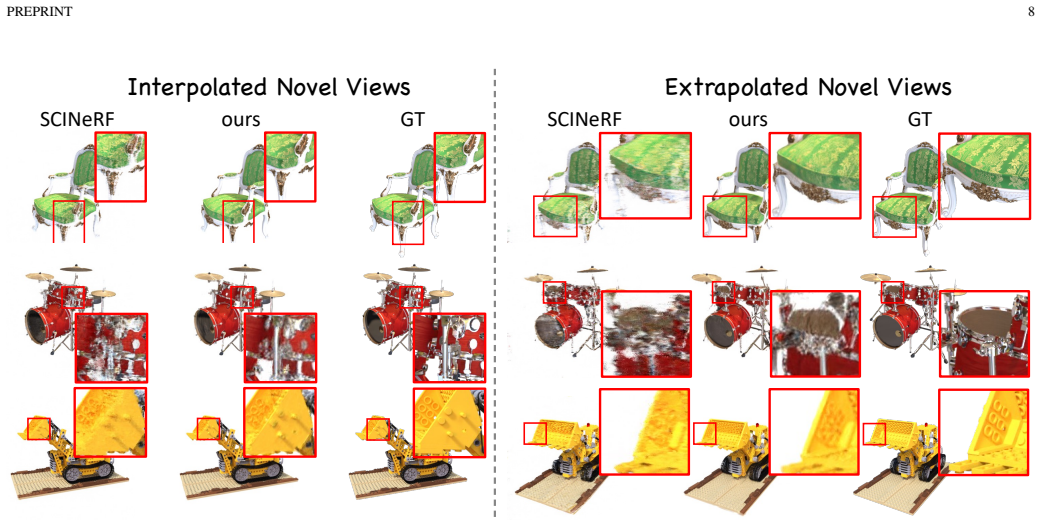
- The recovered scene supports novel-view synthesis at unseen poses, with the auxiliary 2D prior contributing mainly at extrapolated viewpoints where the measurement itself offers the least guidance.
- SCI reconstruction shifts from decoding a stack of 2D frames to jointly recovering a 3D scene and poses, at a training cost of roughly one hour per scene rather than the twelve-plus hours reported for the NeRF-based baseline.
- The ablations attribute the stability to the OSGR rule and pose refinement specifically: removing the opacity regulation or the count cap degrades quality or exhausts memory, so the gains do not come from the foundation-model initialization alone.
- The improvements persist across mask ratios from 0.125 to 0.75 and compression ratios of 8, 16, and 32, which the paper takes as evidence that the approach is not tuned to a single acquisition regime.
Reading between the lines
- The reported headline margins come from the first-stage reconstruction in the controlled comparisons, so they measure the proxy initialization plus OSGR, not the diffusion-based refinement; the auxiliary 2D-prior stage contributes only small additional gains in the component study.
- An oracle experiment replacing the proxy-derived poses with ground-truth poses would quantify how much of the success is the vision model's generalization to out-of-distribution proxy images; the paper does not run it, and the answer would determine whether the method transfers to scenes unlike its benchmarks.
- The same recipe, build proxy views that respect a known forward model, let a large pretrained model propose geometry, then optimize a differentiable scene against the true measurement, should carry over to rolling-shutter video, motion-blurred captures, or coded-aperture systems wherever one measurement multiplexes several viewpoints.
- The dynamic-scene failure and the paper's own opacity-peak explanation suggest a concrete extension: tag Gaussians whose local opacity contrast persists after several densification steps, and route only those into a motion-aware representation such as 4D Gaussians, which would test whether the static-scene assumption is the actual bottleneck.
Signed reviews
Editorial analysis
A structured set of objections, weighed in public.
Referee Report
Summary. The paper proposes GS2CI, a framework for reconstructing a static 3D Gaussian scene and the camera trajectory from a single snapshot compressive imaging (SCI) measurement and known binary masks. It constructs proxy views from the measurement via energy-normalized initialization (ENI) or adaptive mask-decoding initialization (AMDI), feeds them to the frozen 3D vision foundation model VGGT to obtain initial poses and sparse geometry, and then jointly optimizes 3D Gaussians and per-view SE(3) adjustments under an SCI forward-model loss augmented by a mean-opacity regularizer. A new densification rule, OSGR, augments split candidates using local opacity statistics and bounds Gaussian growth. After coarse convergence, a frozen 2D diffusion model (DiFix3D+) generates pseudo-view targets at interpolated and extrapolated poses for a weighted fine-stage loss. Experiments on simulated and real SCI data compare against GAP-TV, PnP methods, EfficientSCI, SCINeRF, SCIGS, controlled 3DGS variants, and a reproduced SCISplat, reporting PSNR/SSIM/LPIPS and trajectory metrics. The paper also reports run-to-run stability for the coarse stage and acknowledges that dynamic scenes remain a limitation.
Significance. If the central claim holds, the paper would be a significant step: single-measurement SCI-to-3D reconstruction with foundation-model priors, at about 68 minutes of training versus about 746 minutes for SCINeRF. The work has clear strengths: the controlled Gaussian variants (SCI-3DGS, SCI-MCMC, SCI-RevADC) isolate OSGR from the shared reconstruction framework, trajectory accuracy is evaluated against ground-truth poses, Table XII provides three-seed variance for the coarse stage, code is released, and the static-scene limitation is stated explicitly. However, the central claim is not fully established because the load-bearing VGGT initialization is applied to out-of-distribution proxy views without an oracle comparison, and one core OSGR hyperparameter (the Gaussian-count reference iteration) was selected on the main evaluation set. The contribution is promising but conditional on these points being addressed.
major comments (3)
- [Section III-B, Eq. (3)-(4); Table XIII; Table VII] The paper's central claim depends on VGGT returning reliable poses and geometry from proxy views that are not view-resolved RGB images, yet this transfer is never validated against an oracle initialization. Eq. (3) constructs proxies from a single multiplexed measurement via ENI or AMDI, and Table XIII compares only proxy-construction strategies; it never compares against initialization from ground-truth latent views or ground-truth poses. Table VII shows this is load-bearing: removing VFM poses drops PSNR from 35.57 to 30.30 dB, and pose refinement in Section III-C is only an identity-initialized SE(3) adjustment, so a biased VGGT trajectory cannot be corrected downstream. I request an explicit experiment that initializes the same pipeline from ground-truth views and/or ground-truth poses, plus reporting of how often each initialization branch (PreBA, post-BA, dense fallback) is selected per scene; without this, the end-to-end success could rest on unmeasured generalization of a frozen model.
- [Appendix B] The Gaussian-count reference iteration is selected on the same six-scene set used for the main results. Appendix B states that "we compare reference iterations of 5,000, 6,000, 7,000, 8,000, and 9,000. The 7,000-iteration setting gives the best overall result among these capped configurations and is fixed for all reported experiments." Because the count cap is a core component of OSGR and the six scenes are also the evaluation set of Tables I and VII, this is a test-set hyperparameter choice and can inflate the reported gains. The revision should select this iteration on a held-out validation split or report results for all candidate iterations on the test scenes, and should clarify how the claim that "hyperparameters remain unchanged across standard and extended evaluations" is compatible with this selection.
- [Table IX and Section IV-D] The comparison against SCISplat† is computed on only 17 of 20 cases because "SCISplat† fails to initialize on three" cases, but the paper does not report which scenes fail, the failure criteria, or whether the failure is due to the SCI input or to the reproduction itself. Since Table IX is the basis for the headline 3.29 dB PSNR improvement and the best-ATE claim, failure-dependent selection can bias the comparison. Please report the scene identities and failure reasons, provide results on all 20 cases under a predefined handling rule, and state whether the reproduction was checked against the published SCISplat outputs on any common scene.
minor comments (5)
- [Tables I and III] The captions state that bold and underlined values denote best and second-best results, but many entries in the tables appear with neither formatting; please ensure the final PDF renders the formatting consistently.
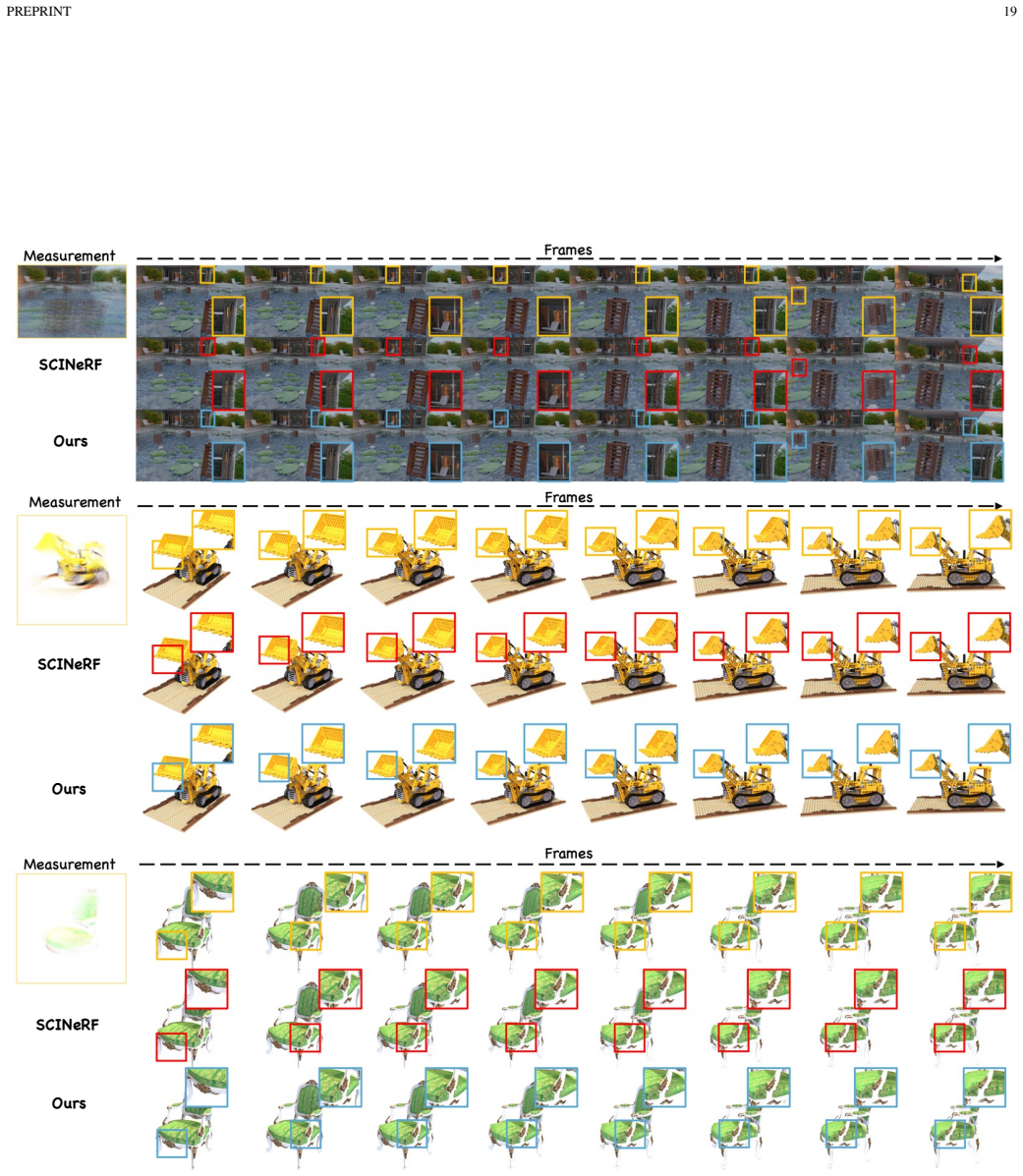
- [Section IV-B and Fig. 4] The real-data evaluation is qualitative only; adding a quantitative metric on the real SCI data, even a limited one, would strengthen the claim that the method transfers beyond simulation.
- [Section IV-E and Abstract] The paper should add the static-scene qualifier to the abstract's single-measurement claim, since Table XI shows that SCI-MCMC outperforms the proposed method on both dynamic sequences and the limitation is acknowledged only later in the paper.
- [Table XII and main tables] Three-seed variance is reported only for the coarse stage on six scenes; the main tables and the challenging-setting tables are single-seed, so please report variance or seed sensitivity for at least the key claims in Tables I, III, and VIII.
- [Appendix A, Eq. (18)] The sentence "for larger inputs, odd window sizes grow geometrically until full-image coverage" is ambiguous because Eq. (18) gives a finite list; please specify exactly how the list is extended for larger images.
Circularity Check
No significant circularity: the SCI forward model, metrics, and external baselines are independent of the method's outputs, and the only self-referential component (2D VFM pseudo-view refinement) is an auxiliary regularizer, not a fitted encoder of the benchmark answers.
full rationale
The derivation chain is not circular. The core objective (Eq. 5) fits the rendered Gaussian scene to the fixed SCI forward model (Eq. 1) using the observed measurement Y and known masks M; neither the input nor the loss is defined in terms of the output 3D scene, and all reported metrics compare against external ground-truth views/poses or independently implemented baselines. The VGGT initialization (Eq. 4) applies a frozen external model to proxy views constructed from Y and M; this is an out-of-distribution generalization concern, not a tautology, because the proxies are not derived from the benchmark answers. OSGR is a densification regularizer: its opacity statistics come from the current Gaussians and it encodes no target quantity. The auxiliary 2D VFM stage (Eqs. 6-9) generates pseudo-targets from the model's own coarse renderings, but through an external frozen diffusion model, so it is a self-distillation regularizer rather than a fitted constant that supplies the evaluated answers; moreover, Table X uses held-out poses disjoint from the pseudo-view supervision, and the controlled Gaussian comparisons explicitly use first-stage outputs to keep attribution clear. The paper cites and reproduces baselines from the same group (SCINeRF [14], SCISplat [15] share author X. Yuan), but this is not load-bearing: SCIGS is external, the controlled SCI-3DGS/SCI-MCMC/SCI-RevADC variants share the same protocol, and the reported improvements are measured rather than imported from the self-citations. The honest finding is therefore a low circularity score reflecting only minor self-citation and self-reproduction, not any reduction of the central claim to its own inputs.
Assumptions & free parameters
free parameters (7)
- Gaussian-count cap reference iteration =
7,000
- SCI objective weights (lambda_ssim, lambda_opacity) =
0.1 and 0.01
- Proxy routing threshold tau_mu =
4
- AMDI ridge and conditioning parameters (eta, tau_lambda, gamma) =
1e-3, 1, 2
- Pseudo-view support weighting (tau_v, beta_v, w_min) =
0.25, 0.08, 0.10
- Fine-stage loss weights (lambda_syn, l1, perceptual) =
0.006, 0.8, 0.01
- OSGR candidate budget and neighborhood size (K) =
K=3, 5% population cap
assumptions (6)
- domain assumption The scene is static during the SCI exposure; all inter-mask variation is rigid camera-scene motion.
- domain assumption The N binary coding masks M_i are known exactly and pixel-aligned with the measurement.
- domain assumption VGGT, a frozen 3D vision foundation model, transfers from natural image inputs to geometry-oriented proxy views built from a multiplexed snapshot.
- domain assumption DiFix3D+ generates trustworthy appearance targets at interpolated and extrapolated poses.
- ad hoc to paper The AMDI local-constant model Y(q) approximately equals U(p)^T m(q) plus noise holds within the chosen window.
- domain assumption The measurement noise Z is additive and the sensor has no saturation or mask misalignment.
Cite this review
Pith. "Pith review of GS$^{2}$CI: Robust Gaussian Splatting For Snapshot Compressive Imaging via Large Vision Model Priors." pith.science (2026). https://pith.science/paper/3YEFYLOE
@misc{pith2026260813502,
  author       = {Pith},
  title        = {Pith review of: GS$^2$CI: Robust Gaussian Splatting For Snapshot Compressive Imaging via Large Vision Model Priors},
  year         = {2026},
  howpublished = {\url{https://pith.science/paper/3YEFYLOE}},
  note         = {Machine review of arXiv:2608.13502}
}
read the original abstract
Snapshot Compressive Imaging (SCI) offers an efficient solution for high-speed video acquisition and, under exposure-time camera--scene relative motion, multi-view scene capture by compressing temporal or spatial information into a single 2D measurement. While recent studies have explored SCI for 3D scene reconstruction, existing methods struggle with significant challenges due to information loss, limited viewpoint diversity, and the computational burden of jointly optimizing 3D representations and camera poses. In this work, we propose a novel framework that reconstructs high-quality 3D scenes from a single SCI measurement by leveraging 3D Gaussian Splatting (3DGS) and the powerful priors of large-scale vision foundation models (VFMs). Our primary reconstruction combines measurement-derived 3D VFM initialization with SCI-aware Gaussian optimization. After coarse-stage convergence, an auxiliary 2D VFM provides pseudo-view supervision at synthesized viewpoints for local appearance refinement. To further address the instability caused by ambiguous SCI supervision during 3DGS optimization, we introduce Opacity-Guided Splitting and Growth Regulation (OSGR), an SCI-specific densification strategy that augments split candidates using local opacity statistics, discourages loss-compensating opacity inflation through mean-opacity regulation, and bounds representation growth with explicit candidate-ratio and Gaussian-count constraints. Extensive experiments across multiple benchmarks demonstrate that our method achieves the strongest overall performance, combining leading reconstruction quality and robustness to viewpoint variation with competitive computational efficiency.
Figures


Figures from the paper (9 more)



Reference graph
Works this paper leans on
-
[16]
SCI- Gaussian: Optimizing 3D gaussian radiance fields from a snapshot com- pressive image,
X. Li, Y . Li, X. Wang, X. Yuan, M. D. Butala, and G. Wang, “SCI- Gaussian: Optimizing 3D gaussian radiance fields from a snapshot com- pressive image,” inICASSP 2025 - 2025 IEEE International Conference on Acoustics, Speech and Signal Processing (ICASSP), 2025, pp. 1–5
work page 2025
-
[1]
Rank minimization for snapshot compressive imaging,
Y . Liu, X. Yuan, J. Suo, D. J. Brady, and Q. Dai, “Rank minimization for snapshot compressive imaging,”IEEE Transactions on Pattern Analysis and Machine Intelligence, vol. 41, no. 12, pp. 2990–3006, Dec. 2019. [Online]. Available: http://dx.doi.org/10.1109/TPAMI.2018.2873587
-
[2]
Deep tensor ADMM-Net for snapshot compressive imaging,
J. Ma, X.-Y . Liu, Z. Shou, and X. Yuan, “Deep tensor ADMM-Net for snapshot compressive imaging,” in2019 IEEE/CVF International Conference on Computer Vision (ICCV), 2019, pp. 10 222–10 231
work page 2019
-
[3]
Z. Cheng, R. Lu, Z. Wang, H. Zhang, B. Chen, Z. Meng, and X. Yuan, “BIRNAT: Bidirectional recurrent neural networks with adversarial training for video snapshot compressive imaging,” inComputer Vision – ECCV 2020, ser. Lecture Notes in Computer Science, vol. 12369. Springer, 2020, pp. 258–275
work page 2020
-
[4]
Memory-efficient network for large-scale video compressive sensing,
Z. Cheng, B. Chen, G. Liu, H. Zhang, R. Lu, Z. Wang, and X. Yuan, “Memory-efficient network for large-scale video compressive sensing,” inProceedings of the IEEE/CVF Conference on Computer Vision and Pattern Recognition (CVPR), June 2021, pp. 16 246–16 255
work page 2021
-
[5]
Spatial-temporal transformer for video snapshot compressive imaging,
L. Wang, M. Cao, Y . Zhong, and X. Yuan, “Spatial-temporal transformer for video snapshot compressive imaging,”IEEE Transactions on Pattern Analysis and Machine Intelligence, vol. 45, no. 7, pp. 9072–9089, July 2023. PREPRINT 13
work page 2023
-
[6]
Hierarchical separable video transformer for snapshot compressive imaging,
P. Wang, Y . Zhang, L. Wang, and X. Yuan, “Hierarchical separable video transformer for snapshot compressive imaging,” inComputer Vision – ECCV 2024, ser. Lecture Notes in Computer Science, vol. 15139. Springer, 2025, pp. 104–122
work page 2024
-
[7]
L. Wang, M. Cao, and X. Yuan, “EfficientSCI: Densely connected network with space-time factorization for large-scale video snapshot compressive imaging,” inProceedings of the IEEE/CVF Conference on Computer Vision and Pattern Recognition (CVPR), June 2023, pp. 18 477–18 486
work page 2023
Show all 44 references
-
[8]
Plug-and-play algorithms for large- scale snapshot compressive imaging,
X. Yuan, Y . Liu, J. Suo, and Q. Dai, “Plug-and-play algorithms for large- scale snapshot compressive imaging,” inProceedings of the IEEE/CVF Conference on Computer Vision and Pattern Recognition (CVPR), June 2020, pp. 1444–1454
2020
-
[9]
Plug-and-play algorithms for video snapshot compressive imaging,
X. Yuan, Y . Liu, J. Suo, F. Durand, and Q. Dai, “Plug-and-play algorithms for video snapshot compressive imaging,”IEEE Transactions on Pattern Analysis and Machine Intelligence, vol. 44, no. 10, pp. 7093– 7111, October 2022
2022
-
[10]
The 2017 DA VIS challenge on video object segmentation,
J. Pont-Tuset, F. Perazzi, S. Caelles, P. Arbel ´aez, A. Sorkine-Hornung, and L. V . Gool, “The 2017 DA VIS challenge on video object segmentation,” 2018. [Online]. Available: https://arxiv.org/abs/1704. 00675
2017
-
[11]
NeRF: Representing scenes as neural radiance fields for view synthesis,
B. Mildenhall, P. P. Srinivasan, M. Tancik, J. T. Barron, R. Ramamoorthi, and R. Ng, “NeRF: Representing scenes as neural radiance fields for view synthesis,” inComputer Vision – ECCV 2020, ser. Lecture Notes in Computer Science, vol. 12346. Springer, 2020, pp. 405–421
2020
-
[12]
3D gaussian splatting for real-time radiance field rendering,
B. Kerbl, G. Kopanas, T. Leimk ¨uhler, and G. Drettakis, “3D gaussian splatting for real-time radiance field rendering,”ACM Transactions on Graphics, vol. 42, no. 4, July 2023
2023
-
[13]
SCIGS: 3D gaussians splatting from a snapshot compressive image,
Z. Wang, H. Yang, Y . Guo, and F. Wang, “SCIGS: 3D gaussians splatting from a snapshot compressive image,” in2025 IEEE International Conference on Image Processing (ICIP), 2025, pp. 1013–1018
2025
-
[14]
SCINeRF: Neural radiance fields from a snapshot compressive image,
Y . Li, X. Wang, P. Wang, X. Yuan, and P. Liu, “SCINeRF: Neural radiance fields from a snapshot compressive image,” inProceedings of the IEEE/CVF Conference on Computer Vision and Pattern Recognition (CVPR), June 2024, pp. 10 542–10 552
2024
-
[15]
Learning radiance fields from a single snapshot compressive image,
Y . Li, X. Liu, X. Wang, X. Yuan, and P. Liu, “Learning radiance fields from a single snapshot compressive image,” 2024. [Online]. Available: https://arxiv.org/abs/2412.19483
2024 arXiv
-
[17]
VGGT: Visual geometry grounded transformer,
J. Wang, M. Chen, N. Karaev, A. Vedaldi, C. Rupprecht, and D. Novotny, “VGGT: Visual geometry grounded transformer,” inProceedings of the IEEE/CVF Conference on Computer Vision and Pattern Recognition (CVPR), June 2025, pp. 5294–5306
2025
-
[18]
Snapshot compressive imaging: Theory, algorithms, and applications,
X. Yuan, D. J. Brady, and A. K. Katsaggelos, “Snapshot compressive imaging: Theory, algorithms, and applications,”IEEE Signal Processing Magazine, vol. 38, no. 2, pp. 65–88, 2021
2021
-
[19]
Shearlet enhanced snapshot compressive imaging,
P. Yang, L. Kong, X.-Y . Liu, X. Yuan, and G. Chen, “Shearlet enhanced snapshot compressive imaging,”IEEE Transactions on Image Process- ing, vol. 29, pp. 6466–6481, 2020
2020
-
[20]
Generalized alternating projection based total variation mini- mization for compressive sensing,
X. Yuan, “Generalized alternating projection based total variation mini- mization for compressive sensing,” in2016 IEEE International Confer- ence on Image Processing (ICIP), 2016, pp. 2539–2543
2016
-
[21]
Hybrid CNN-Transformer architecture for efficient large-scale video snapshot compressive imag- ing,
M. Cao, L. Wang, M. Zhu, and X. Yuan, “Hybrid CNN-Transformer architecture for efficient large-scale video snapshot compressive imag- ing,”International Journal of Computer Vision, vol. 132, no. 10, pp. 4521–4540, 2024
2024
-
[22]
Attention is all you need,
A. Vaswani, N. Shazeer, N. Parmar, J. Uszkoreit, L. Jones, A. N. Gomez, L. Kaiser, and I. Polosukhin, “Attention is all you need,” inAdvances in Neural Information Processing Systems, vol. 30, 2017, pp. 5998–6008
2017
-
[23]
VGGSfM: Visual geometry grounded deep structure from motion,
J. Wang, N. Karaev, C. Rupprecht, and D. Novotny, “VGGSfM: Visual geometry grounded deep structure from motion,” inProceedings of the IEEE/CVF Conference on Computer Vision and Pattern Recognition (CVPR), June 2024, pp. 21 686–21 697
2024
-
[24]
MonST3R: A simple approach for estimating geometry in the presence of motion,
J. Zhang, C. Herrmann, J. Hur, V . Jampani, T. Darrell, F. Cole, D. Sun, and M.-H. Yang, “MonST3R: A simple approach for estimating geometry in the presence of motion,” 2024. [Online]. Available: https://arxiv.org/abs/2410.03825
2024 arXiv
-
[25]
Pow3R: Empowering unconstrained 3D reconstruction with camera and scene priors,
W. Jang, P. Weinzaepfel, V . Leroy, L. Agapito, and J. Revaud, “Pow3R: Empowering unconstrained 3D reconstruction with camera and scene priors,” inProceedings of the IEEE/CVF Conference on Computer Vision and Pattern Recognition (CVPR), June 2025, pp. 1071–1081
2025
-
[26]
Fast3R: Towards 3D reconstruction of 1000+ images in one forward pass,
J. Yang, A. Sax, K. J. Liang, M. Henaff, H. Tang, A. Cao, J. Chai, F. Meier, and M. Feiszli, “Fast3R: Towards 3D reconstruction of 1000+ images in one forward pass,” inProceedings of the IEEE/CVF Conference on Computer Vision and Pattern Recognition (CVPR), June 2025, pp. 21 9...
2025
-
[27]
MegaSaM: Accurate, fast and robust structure and motion from casual dynamic videos,
Z. Li, R. Tucker, F. Cole, Q. Wang, L. Jin, V . Ye, A. Kanazawa, A. Holynski, and N. Snavely, “MegaSaM: Accurate, fast and robust structure and motion from casual dynamic videos,” inProceedings of the IEEE/CVF Conference on Computer Vision and Pattern Recognition (CVPR), June ...
2025
-
[28]
DUSt3R: Geometric 3D vision made easy,
S. Wang, V . Leroy, Y . Cabon, B. Chidlovskii, and J. Revaud, “DUSt3R: Geometric 3D vision made easy,” inProceedings of the IEEE/CVF Conference on Computer Vision and Pattern Recognition (CVPR), June 2024, pp. 20 697–20 709
2024
-
[29]
π 3: Scalable permutation-equivariant visual geometry learning,
Y . Wang, J. Zhou, H. Zhu, W. Chang, Y . Zhou, Z. Li, J. Chen, J. Pang, C. Shen, and T. He, “π 3: Scalable permutation-equivariant visual geometry learning,” 2025. [Online]. Available: https://arxiv.org/ abs/2507.13347
2025 arXiv
-
[30]
DIFIX3D+: Improving 3D reconstructions with single-step diffusion models,
J. Z. Wu, Y . Zhang, H. Turki, X. Ren, J. Gao, M. Z. Shou, S. Fidler, Z. Gojcic, and H. Ling, “DIFIX3D+: Improving 3D reconstructions with single-step diffusion models,” inProceedings of the IEEE/CVF Conference on Computer Vision and Pattern Recognition (CVPR), June 2025, pp. ...
2025
-
[31]
Breaking the vicious cycle: Coherent 3D gaussian splatting from sparse and motion-blurred views,
Z. Xu, C. Feng, Y . Li, J. Zhao, J. Yang, W. Yu, L. Yuan, and Y . Tian, “Breaking the vicious cycle: Coherent 3D gaussian splatting from sparse and motion-blurred views,”arXiv preprint arXiv:2512.10369, 2025
2025
-
[32]
GSFixer: Improving 3D gaussian splatting with reference-guided video diffusion priors,
X. Yin, Q. Zhang, J. Chang, Y . Feng, Q. Fan, X. Yang, C.-M. Pun, H. Zhang, and X. Cun, “GSFixer: Improving 3D gaussian splatting with reference-guided video diffusion priors,”arXiv preprint arXiv:2508.09667, 2025
2025 arXiv
-
[33]
FixingGS: Enhancing 3D gaussian splatting via training-free score distillation,
Z. Wang, Y . Gu, D. Zhou, and R. Xu, “FixingGS: Enhancing 3D gaussian splatting via training-free score distillation,”arXiv preprint arXiv:2509.18759, 2025
2025
-
[34]
VideoScene: Distilling video diffusion model to generate 3D scenes in one step,
H. Wang, F. Liu, J. Chi, and Y . Duan, “VideoScene: Distilling video diffusion model to generate 3D scenes in one step,” in2025 IEEE/CVF Conference on Computer Vision and Pattern Recognition (CVPR), June 2025, pp. 16 475–16 485
2025
-
[35]
Structure-from-motion revisited,
J. L. Sch ¨onberger and J.-M. Frahm, “Structure-from-motion revisited,” in2016 IEEE Conference on Computer Vision and Pattern Recognition (CVPR), 2016, pp. 4104–4113
2016
-
[36]
Deblur-NeRF: Neural radiance fields from blurry images,
L. Ma, X. Li, J. Liao, Q. Zhang, X. Wang, J. Wang, and P. V . Sander, “Deblur-NeRF: Neural radiance fields from blurry images,” in Proceedings of the IEEE/CVF Conference on Computer Vision and Pattern Recognition (CVPR), June 2022, pp. 12 861–12 870
2022
-
[37]
Large scale multi-view stereopsis evaluation,
R. Jensen, A. Dahl, G. V ogiatzis, E. Tola, and H. Aanæs, “Large scale multi-view stereopsis evaluation,” in2014 IEEE Conference on Computer Vision and Pattern Recognition. IEEE, 2014, pp. 406–413
2014
-
[38]
Local light field fusion: Practical view synthesis with prescriptive sampling guidelines,
B. Mildenhall, P. P. Srinivasan, R. Ortiz-Cayon, N. K. Kalantari, R. Ra- mamoorthi, R. Ng, and A. Kar, “Local light field fusion: Practical view synthesis with prescriptive sampling guidelines,”ACM Transactions on Graphics (TOG), 2019
2019
-
[39]
Nerfstudio: A modular framework for neural radiance field development,
M. Tancik, E. Weber, E. Ng, R. Li, B. Yi, T. Wang, A. Kristoffersen, J. Austin, K. Salahi, A. Ahuja, D. Mcallister, J. Kerr, and A. Kanazawa, “Nerfstudio: A modular framework for neural radiance field development,” inSpecial Interest Group on Computer Graphics and Interactive ...
2023
-
[40]
Revising densification in gaussian splatting,
S. Rota Bul `o, L. Porzi, and P. Kontschieder, “Revising densification in gaussian splatting,” inComputer Vision – ECCV 2024, ser. Lecture Notes in Computer Science, vol. 15121. Springer, 2025, pp. 347–362
2024
-
[41]
3D gaussian splatting as markov chain monte carlo,
S. Kheradmand, D. Rebain, G. Sharma, W. Sun, Y .-C. Tseng, H. Isack, A. Kar, A. Tagliasacchi, and K. M. Yi, “3D gaussian splatting as markov chain monte carlo,” inAdvances in Neural Information Processing Systems, vol. 37, 2024
2024
-
[42]
Tanks and temples: Benchmarking large-scale scene reconstruction,
A. Knapitsch, J. Park, Q.-Y . Zhou, and V . Koltun, “Tanks and temples: Benchmarking large-scale scene reconstruction,”ACM Transactions on Graphics, vol. 36, no. 4, July 2017
2017
-
[43]
Mip-NeRF 360: Unbounded anti-aliased neural radiance fields,
J. T. Barron, B. Mildenhall, D. Verbin, P. P. Srinivasan, and P. Hedman, “Mip-NeRF 360: Unbounded anti-aliased neural radiance fields,” in Proceedings of the IEEE/CVF Conference on Computer Vision and Pattern Recognition (CVPR), June 2022, pp. 5470–5479
2022
-
[44]
4d gaussian splatting for real-time dynamic scene rendering,
G. Wu, T. Yi, J. Fang, L. Xie, X. Zhang, W. Wei, W. Liu, Q. Tian, and X. Wang, “4d gaussian splatting for real-time dynamic scene rendering,” inProceedings of the IEEE/CVF Conference on Computer Vision and Pattern Recognition, 2024, pp. 20 310–20 320. PREPRINT 14 GS2CI: Robust...
2024 arXiv
Reviewed August 14, 2026 · model on record in the stance chip above.
Discussion (0). Continue with ORCID to comment.