REVIEW 3 major objections 6 minor 78 references
Kinematic Fingerprints of a Nucleon-Triggered $V_{\mathcal{B}}$ in Rare $\eta^{(\prime)}\to\pi^0(\eta)\gamma\gamma$ Decays on Nucleon Targets
T0 review · 3 major / 6 minor · reviewed 2026-08-14 · deepseek-v4-flash
Pith's one-line read The paper predicts that a nucleon-triggered $V_{\mathcal B}$ leaves 4–23 events beyond the kinematic boundary in $\eta\to\pi^0\gamma\gamma$, correlated with the recoil proton.
desk verdict The off-shell Rubicon prediction is genuinely new and worth examining, but the headline yield rests on an unquantified principal-value residual that should be computed before the number is trusted. read the letter →
The pith
A machine-rendered reading of the paper's core claim, the machinery that carries it, and where it could break.
The reading
What carries the argument
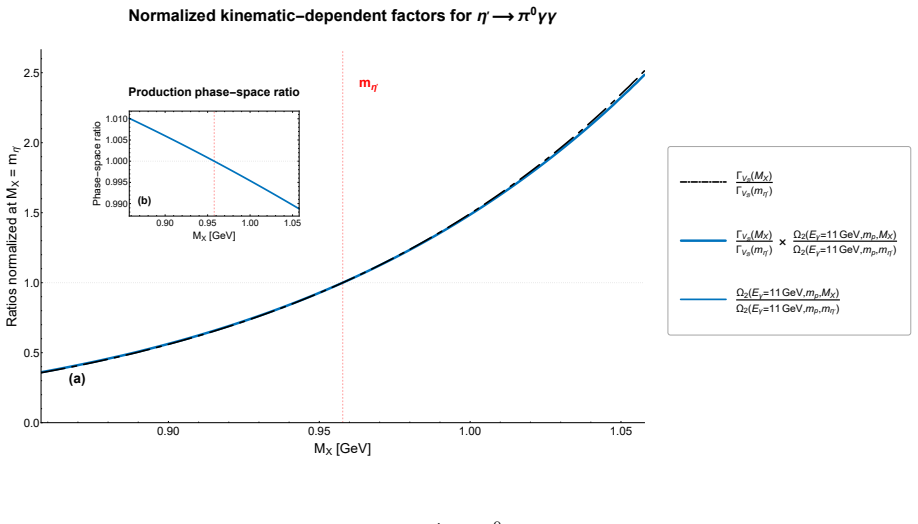
The load-bearing object is the decomposition of the squared nucleon-activated amplitude into a pole piece and a continuum piece, $|M_{\rm nucleon}|^2 \simeq W_{\rm pole} + W_{\rm cont}$, with $W_{\rm cont}(M_X,\Omega)=|M_{V_{\mathcal B}}(M_X,\Omega)|^2$. The pole piece is production-independent and confined to the $\eta$ (or $\eta'$) resonance; the continuum piece lets the reconstructed invariant mass $M_X\equiv M_{\pi^0(\eta)\gamma\gamma}$ float and is the only term that reaches beyond the on-shell endpoints. The 'kinematic Rubicon' is the boundary set by an on-shell decay, $m^2_{\gamma\gamma}\le(m_{\eta'}-m_f)^2$ and $m^2_{f\gamma}\le m^2_{\eta'}$ with $f=\pi^0,\eta$; the paper shows the continuum populates the complementary tails and derives the minimum $M_X$ needed to cross two Rubicons at once ($\Delta_{\rm cut}\ge 146$ MeV for $\eta\to\pi^0\gamma\gamma$). The production phase-space factor $\Omega_2(E_\gamma,m_p,M_X)$ carries the difference between the near-threshold ($E_\gamma=1.4$ GeV) and higher-energy ($E_\gamma=11$ GeV) regimes.
What would settle it
Reanalyze the low-energy photoproduction dataset with the reconstructed mass left free and count events with $m^2_{\gamma\gamma}>(m_\eta-m_{\pi^0})^2$ or $m^2_{\pi^0\gamma}>m_\eta^2$; the model predicts 4–23 such events per 1200 signal events depending on the window, so a 95% confidence upper limit below 4 events in those tails would falsify the central prediction. A higher-energy photoproduction branching fraction equal to the leptonic $e^+e^-$ value would be an independent falsifier.
Extended reading notes
Core claim
The central claim is that the $V_{\mathcal B}$ amplitude contains a piece $|M_{V_{\mathcal B}}|^2$ that is not anchored to the $\eta$ pole; through energy–momentum exchange with the recoil nucleon, this continuum extends into regions of the $\gamma\gamma$ and $\pi^0\gamma$ invariant-mass spectra that a genuinely on-shell $\eta\to\pi^0\gamma\gamma$ decay cannot reach. For $\eta\to\pi^0\gamma\gamma$ the paper predicts a Rubicon-crossing fraction $f_R = 0.351$–$1.92\%$ (about 4–23 events in 1200) for window half-widths $\Delta_{\rm cut}=50$–$100$ MeV, with the $\gamma\gamma$ tail dominant because crossing the $\pi^0\gamma$ boundary requires an extremely soft photon. The same calculation yields a positive reconstructed-mass shift $\langle M_{\pi^0\gamma\gamma}\rangle - m_\eta \simeq 2$–$7$ MeV, a less-than-1\% difference between the two photoproduction energy regimes, and a recoil-proton angular displacement that reaches about $-5^\circ$ in the near-threshold regime but only about $-0.2^\circ$ at the higher energy. For $\eta'\to\pi^0\gamma\gamma$ the corresponding tails are roughly two orders of magnitude smaller. The paper also sketches $V_{\mathcal B}$-mediated two-nucleon topologies that could act as an alternative source for the flat deuteron angular distributions in $\gamma d\to\pi^0\eta d$ and $\gamma d\to\pi^0\pi^0 d$, deferring their quantitative evaluation.
Load-bearing premise
The calculation depends on the unquantified assumption that the principal-value interference term integrates to zero over the experimental window, so that the whole off-shell signal is the $|M_{V_{\mathcal B}}|^2$ continuum, even though the window is symmetric in $M_X$ rather than in the offset $\Delta$ where that cancellation is argued.
Editorial extensions
If this is right
- If the higher-energy photoproduction experiment measures a branching fraction matching the leptonic $e^+e^-$ value, the $V_{\mathcal B}$ scenario is ruled out or at least severely constrained.
- A future leptonic $J/\psi\to\gamma\eta$ measurement of $\eta\to\pi^0\gamma\gamma$ that agrees with the nucleon-target value rather than the earlier leptonic value would disfavor the environment-dependent mechanism; agreement with the leptonic value would confirm its qualitative pattern.
- Reanalyzing existing near-threshold photoproduction data without fixing the on-shell $\eta$ signal template should reveal roughly 10 Rubicon-crossing events in a 1200-event sample at $\Delta_{\rm cut}=75$ MeV, with a recoil-proton angular shift that can exceed $-5^\circ$.
- Widening the reconstructed-mass window from 50 to 100 MeV raises the predicted effective branching fraction by about 3–4% and increases the predicted Rubicon yield from about 4 to about 23 events in $\eta\to\pi^0\gamma\gamma$.
- For $\eta'\to\pi^0\gamma\gamma$ the predicted Rubicon yield is about one event in a 3500-event sample even at $\Delta_{\rm cut}=100$ MeV, so that channel is not the discovery channel.
Reading between the lines
- Because the principal-value interference term is left unquantified, the 4–23 event prediction is conditional on that cancellation; computing the residual would either firm up or shift the central yield.
- The same operator implies an $A$-dependent enhancement of the effective $\eta\to\pi^0\gamma\gamma$ branching on heavy nuclear targets; a quantitative light-versus-heavy target comparison is a testable extension the paper only sketches qualitatively.
- The recoil-proton correlation could be turned into a selection variable: requiring each candidate's measured proton angle to match the predicted $\theta_p$–$|t|$ relation for its $M_X$ would suppress detector-migration backgrounds beyond what the paper quantifies.
Signed reviews
Editorial analysis
A structured set of objections, weighed in public.
Referee Report
Summary. The paper extends a previously proposed nucleon-triggered leptophobic vector-boson scenario, V_B, introduced to explain the discrepancy between the KLOE and MAMI determinations of BR(η→π^0γγ). The central new step is to relax the on-shell condition M_X = m_η(′) for the reconstructed π^0(η)γγ subsystem, retaining the off-shell continuum term |M_VB|^2 while neglecting the principal-value part of the SM–V_B interference. From this setup the author derives several observable signatures: invariant-mass tails beyond the on-shell kinematic endpoints (the 'Rubicon' regions), recoil-proton angular shifts relative to the on-shell hypothesis, an upward shift of the reconstructed mass, and weak dependence of the effective branching fraction on the MAMI- versus JEF-like production energy. The headline numerical result is 4–23 Rubicon-crossing events in a reference sample of 1200 η→π^0γγ events, depending on the selection window, with much smaller yields in η′→π^0γγ. The paper closes with a qualitative suggestion that V_B-mediated two-nucleon diagrams could contribute to the flat deuteron angular distributions in γd→π^0ηd and γd→π^0π^0d.
Significance. If the central derivation were sound, the paper would provide a genuinely falsifiable observable: events populating kinematic regions that are forbidden for an isolated on-shell η decay, with a predicted correlation to the recoil-proton kinematics. The phase-space factorization in Appendix B is a useful technical contribution, and the public code together with the explicit cut and energy scans in Tables I–II are strengths that make the numerical results checkable. However, the quantitative predictions are not parameter-free: the single new coefficient C_eff is fitted to the MAMI differential width, and the headline Rubicon yields rest on an unquantified principal-value approximation. The deuteron discussion is illustrative rather than quantitative. The paper is therefore best viewed as a proposal of a new observable with provisional numerics, not as a closed prediction.
major comments (3)
- [Section III, Eqs. (15), (17), (20)] The neglect of the principal-value (PV) interference term is not justified by the cancellation argument given in the text. The experimental selection window is symmetric in M_X, namely M_X^2 ∈ [(m_η−Δcut)^2, (m_η+Δcut)^2], which is not an interval symmetric in Δ = M_X^2 − m_η^2. The PV term 2 PV[Re C/(M^2−m^2)] is odd in Δ, so its integral over this window does not cancel at leading order; the residual is of order Re C evaluated at the endpoints times 4m_η Δcut. Moreover, Re C(M,Ω) is not slowly varying, since it contains the production phase-space factor Ω2 and the continuum width Γ_VB(M), both of which vary appreciably over the 50–100 MeV windows (Figs. 3–4). No numerical estimate of this residual is provided. Because Re C involves the same SM and V_B amplitudes whose interference produces the main 2.6-fold enhancement, the residual PV contribution could be comparable to or larger than the |M_VB|^2 continuum that drives all Rubicon predictions in Tables I–II and Figs. 8–10. This needs to be quantified or removed by a more careful treatment before the headline yields can be considered reliable.
- [Section V, Eqs. (57)–(58)] The single model parameter C_eff is obtained from a χ^2 fit to the MAMI differential width dΓ(η→π^0γγ)/dm^2_γγ. Consequently, the on-shell branching fractions in Tables I–II are not independent predictions of the model; they are a re-description of the fitted channel. The Rubicon yields are shape predictions conditional on the fitted C_eff and on the assumed functional form of M_VB, rather than parameter-free predictions. This distinction should be stated in the abstract and conclusions, since the quoted '4–23 events' could otherwise be misread as an absolute test of the normalization of the V_B contribution.
- [Section III, Eqs. (26)–(28)] The definition of Γ_eff_VB as a production-phase-space average (Ω2-weighted and normalized by ∫Ω2) is not compatible with the definition of Γ_pole as an unweighted Dalitz-integrated decay width, yet Eq. (28) sums them as the total observed width. According to the factorization in Eq. (21), the pole contribution should enter with the factor Ω2(Eγ,m_η), while the continuum contribution should enter as ∫ dM_X^2/(2π) Ω2(Eγ,m_p,M_X) Γ_VB(M_X). Using a normalized average changes the relative weight of pole and continuum, and therefore affects the cut dependence and the MAMI-versus-JEF comparison. Please specify the event-rate normalization explicitly or correct the formula.
minor comments (6)
- [Section III, Eq. (26)] The displayed formula for Γ_eff_VB appears as two integrals on the same line without a clear fraction bar; this should be typeset explicitly as a ratio to avoid ambiguity.
- [Captions of Figs. 11 and 12] The captions reference 'Fig. (68)' where they presumably mean Eq. (68); please correct the cross-reference.
- [Fig. 1 and text] The notation is not uniform: the figure labels use 'η0' in some places where 'η′' is intended; please unify the notation throughout.
- [Abstract] The sentence 'The cleanest discriminator of the model is a kinematically forbidden tail in the γγ and π^0γ spectra, and for η→π^0γγ, and we predict 4–23 events...' has a grammatical break; please rephrase.
- [Section V, after Eq. (58)] The fitted C_eff differs by about 10% from the value reported in the earlier paper [9] because of a numerical bug. Please state explicitly whether the figures and tables of [9] are superseded by the present results, since readers comparing the two papers will otherwise see an unexplained shift.
- [Section VII] The deuteron diagrams are presented without a quantitative estimate, and the text correctly defers their evaluation to future work; please state even more explicitly that these plots do not yet provide evidence for or against the V_B model.
Circularity Check
On-shell branching fractions restate the MAMI fit used to fix C_eff; the Rubicon-tail predictions are out-of-sample and not circular.
-
fitted input called prediction
[Section V, Eqs. (57)-(58), Table I]
"The single parameter in our model C_eff, which determines the contribution of V_B for all three decays, is obtained by minimizing χ2: ... which yields: C_eff = (8.54±1.08)×10−5 GeV−8"
C_eff is fitted to the MAMI differential spectrum dΓ(η→π0γγ)/dmγγ² (Eq. 57). The 'On-shell V_B' branching-fraction row in Table I, 2.59(30)×10⁻⁴, is the integral and normalization of that same fitted spectrum with that same C_eff, so it restates the MAMI input rather than independently predicting it. The Rubicon-tail yields and recoil-angle correlations also use this fitted C_eff, but they probe kinematically different, out-of-sample configurations (M_X≠mη, beyond the on-shell endpoints), so their predicted magnitudes do not reduce to the fit by construction.
full rationale
The headline claim, 4-23 Rubicon-crossing events with recoil-proton correlations, is computed from the fitted C_eff in a genuinely out-of-sample kinematic region: the fit uses the on-shell MAMI dΓ/dmγγ² spectrum, whereas the Rubicon yield is an integral of |M_VB|² for M_X≠mη beyond the on-shell endpoints. That central prediction is therefore not circular. The circularity burden is limited to the on-shell rows of Tables I-II, where the η→π0γγ branching fraction merely re-expresses the MAMI spectrum used in the χ² fit of Eq. (57); this is a fitted input relabeled as a prediction. I also flag the neglected principal-value interference term in Eq. (15), marked 'Neglected in this work': its claimed cancellation assumes a symmetric window in Δ=M²−mη², while the experimental window in Eq. (20) is symmetric in M_X, so the residual is unquantified. That is a numerical-accuracy risk for the Rubicon yields, not a circularity. The self-citations to [9] are normal follow-up use of the proposed model; the prior numerical value of C_eff is explicitly refitted and corrected here. Overall, the central kinematic-fingerprint derivation has independent content, so the score is moderate rather than high.
Assumptions & free parameters
free parameters (3)
- C_eff =
8.54 +/- 1.08 x 10^-5 GeV^-8
- m_VB (vector boson mass) =
1.5-5 GeV (assumed range)
- VMD-LsigmaM benchmark couplings =
g=0.70(1) GeV^-1, phi_P=41.4(5) deg, z_NS=0.83(2), r_s=0.65(1), phi_V=3.3(1) deg
assumptions (6)
- domain assumption The VMD + Linear Sigma Model provides the correct SM baseline for eta and eta-prime decays to pi0(eta) gamma gamma.
- ad hoc to paper V_B couples only to nucleons and pseudoscalars via Eq. (4), with no coupling to leptons, and the vacuum condition <S>=0 kills nucleon-independent mixing.
- domain assumption The contact approximation M_VB^2 >> |t|,|u| and Gamma_VB/M_VB << 1 (Eq. 7) holds over the kinematic range studied.
- domain assumption V_B is isoscalar and the isospin limit holds, so a single coefficient C_eff parametrizes the nucleon matrix elements (Eq. 8).
- domain assumption The narrow-width limit holds for eta and eta-prime, and the principal-value interference term in Eq. (15) is negligible over the selection windows.
- domain assumption The PDG 2026 world average for BR(eta to pi0 gamma gamma) is nucleon-derived and excludes the KLOE measurement.
invented entities (3)
-
V_B: leptophobic, isoscalar vector boson with mass 1.5-5 GeV
independent evidence
-
S: real CP-even nucleophilic scalar with m_S about 1 GeV
independent evidence
-
pi_D: CP-odd dark pion
Cite this review
Pith. "Pith review of Kinematic Fingerprints of a Nucleon-Triggered $V_{\mathcal{B}}$ in Rare $\eta^{(\prime)}\to\pi^0(\eta)\gamma\gamma$ Decays on Nucleon Targets." pith.science (2026). https://pith.science/paper/MWVHAT6C
@misc{pith2026260813537,
  author       = {Pith},
  title        = {Pith review of: Kinematic Fingerprints of a Nucleon-Triggered $V_\mathcalB$ in Rare $\eta^(\prime)\to\pi^0(\eta)\gamma\gamma$ Decays on Nucleon Targets},
  year         = {2026},
  howpublished = {\url{https://pith.science/paper/MWVHAT6C}},
  note         = {Machine review of arXiv:2608.13537}
}
abstract
The nucleon-triggered vector-boson scenario $V_{\mathcal B}$ was motivated by a statistically significant discrepancy between the KLOE measurement, $\mathrm{BR}^{\eta\rightarrow\pi^{0}\gamma\gamma}_{\text{KLOE}} = \left(0.98\pm0.11_{\text{stat}}\pm0.14_{\text{syst}}\right)\times10^{-4}$, and the current world average, $\left(2.55\pm0.22\right)\times10^{-4}$, dominated by MAMI photoproduction data. In this model, the new interaction is activated by external nucleons, which causes deviations from the Standard Model predictions, while leaving leptonic measurements, such as KLOE and BESIII, unaffected. We quantify the residual kinematic and cut-dependent effects that make the MAMI- and JEF-like predictions close but not identical due to their different production-energy regimes. The cleanest discriminator of the model is a kinematically forbidden tail in the $\gamma\gamma$ and $\pi^0\gamma$ spectra, and for $\eta\rightarrow\pi^0\gamma\gamma$, and we predict 4--23 events in a sample of 1200, depending on the selection window, in these regions. These events correlate with the kinematics of the recoil proton, and the polar angle relative to the on-shell hypothesis can reach $\approx-5^\circ$ or below at MAMI energies, but only $\approx -0.2^\circ$ at JEF. For identical selection windows, the JEF-like effective branching fraction exceeds the MAMI-like prediction by less than $1\%$, while widening the window increases both predictions by up to $\sim4\%$. Both energy regimes produce a similar upward shift of the mean reconstructed mass, $\langle M_{\pi^0\gamma\gamma}\rangle-m_\eta\simeq 2$--$7~\mathrm{MeV}$. Finally, we identify representative $V_{\mathcal B}$-induced topologies that could contribute to recently reported discrepancies in the angular distributions of $\gamma d\to\pi^0\eta d$ and $\gamma d\to\pi^0\pi^0 d$, leaving their quantitative investigation to future work.
Figures


Figures from the paper (10 more)


Reference graph
Works this paper leans on
-
[9]
Di Miccoet al.(KLOE Collaboration), Acta Phys
B. Di Miccoet al.(KLOE Collaboration), Acta Phys. Slovaca56, 403 (2006)
work page 2006
-
[1]
L. Gan, B. Kubis, E. Passemar, and S. Tulin, Phys. Rep.945, 1 (2022)
2022
-
[2]
Babusciet al.(KLOE-2 Collaboration), J
D. Babusciet al.(KLOE-2 Collaboration), J. High Energy Phys.01(2026) 091
work page 2026
-
[3]
× 10-9 mπ0 γ 2 GeV2 dΓη → π 0 γ γ dmπ0 γ 2 GeV-1 Eγ =11 GeV(JEF-like) on-shell constraint Kinematically prohibited≃0.1% (b) On-shell SM + Vℬ Continuum, Δcut = 75 MeV On-shell±1σ Δcut=75 MeV±1σ FIG. 8. Kinematic distributions forη→π 0γγ, evaluated both under the on-shell assumption and with off-shell kinematics included, for the mass-window selection...
-
[4]
× 10-9 mγ γ 2 GeV2 dΓη → π 0 γ γ dmγ γ 2 GeV-1 Eγ =1.4 GeV(MAMI-like) on-shell constraint Kinematically prohibited ≃1% (a) On-shell SM + Vℬ Continuum, Δcut = 75 MeV On-shell±1σ Δcut=75 MeV±1σ 0.05 0.10 0.15 0.20 0.25 0.30 0.35 0.400
-
[5]
× 10-9 mπ0 γ 2 GeV2 dΓη → π 0 γ γ dmπ0 γ 2 GeV-1 Eγ =1.4 GeV(MAMI-like) on-shell constraint Kinematically prohibited≃0.1% (b) On-shell SM + Vℬ Continuum, Δcut = 75 MeV On-shell±1σ Δcut=75 MeV±1σ FIG. 9. Kinematic distributions forη→π 0γγ, evaluated both under the on-shell assumption and with off-shell kinematics included, for the mass-window selecti...
-
[6]
× 10-9 mγ γ 2 GeV2 dΓη → π 0 γ γ dmγ γ 2 GeV-1 Eγ =11 GeV(JEF-like) on-shell constraint Kinematically prohibited ≃1% (a) On-shell SM + Vℬ Continuum, Δcut = 75 MeV On-shell±1σ Δcut=75 MeV±1σ 0.05 0.10 0.15 0.20 0.25 0.30 0.35 0.400
-
[7]
× 10-6 mγ γ 2 GeV2 dΓη ′ → π0 γ γ dmγ γ 2 GeV-1 Eγ =11 GeV(JEF-like) on-shell constraint Kinematically prohibited, 0.01% (a) On-shell SM + Vℬ Continuum, Δcut = 75 MeV On-shell±1σ Δcut=75 MeV±1σ 0.0 0.2 0.4 0.6 0.8 1.00.000000
Show all 78 references
-
[8]
The centroid and width of the Gaussian were fixed to the values obtained from the previous fit to the MC simulation for γp→ηp→π 0γγp
× 10-6 0.000010 0.000015 mπ0 γ 2 GeV2 dΓη ′ → π0 γ γ dmπ0 γ 2 GeV-1 Eγ =11 GeV(JEF-like) on-shell constraint Kinematically prohibited, 0.001% (b) On-shell SM + Vℬ Continuum, Δcut = 75 MeV On-shell±1σ Δcut=75 MeV±1σ FIG. 10. Kinematic distributions forη ′ →π 0γγ, evaluate...
-
[10]
Takahashiet al.(Particle Data Group), to be published in Int
F. Takahashiet al.(Particle Data Group), to be published in Int. J. Mod. Phys. A41, 2630011 (2026)
2026
-
[11]
B. M. K. Nefkenset al.(A2 at MAMI Collaboration), Phys. Rev. C90, 025206 (2014)
2014
-
[12]
Prakhovet al., Phys
S. Prakhovet al., Phys. Rev. C72, 025201 (2005). 37
2005
-
[13]
Prakhovet al., Phys
S. Prakhovet al., Phys. Rev. C78, 015206 (2008)
2008
-
[14]
Knechtet al., Phys
N. Knechtet al., Phys. Lett. B589, 14 (2004)
2004
-
[15]
Balytskyi, J
Y. Balytskyi, J. High Energy Phys.02(2026) 053
2026
-
[16]
Aldeet al.(Serpukhov-Brussels-Annecy (LAPP) and Soviet-CERN Collaborations), Z
D. Aldeet al.(Serpukhov-Brussels-Annecy (LAPP) and Soviet-CERN Collaborations), Z. Phys. C25, 225 (1984)
1984
-
[17]
L. G. Landsberg, Phys. Rep.128, 301 (1985)
1985
-
[18]
Ablikimet al.(BESIII Collaboration), Phys
M. Ablikimet al.(BESIII Collaboration), Phys. Rev. D96, 012005 (2017)
2017
-
[19]
Ablikimet al.(BESIII Collaboration), Phys
M. Ablikimet al.(BESIII Collaboration), Phys. Rev. D100, 052015 (2019)
2019
-
[20]
Aldeet al.(Serpukhov-Brussels-Los Alamos-Annecy (LAPP) Collaboration), Z
D. Aldeet al.(Serpukhov-Brussels-Los Alamos-Annecy (LAPP) Collaboration), Z. Phys. C 36, 603 (1987)
1987
-
[21]
Escribano, S
R. Escribano, S. Gonzalez-Solis, R. Jora, and E. Royo, Phys. Rev. D102, 034026 (2020)
2020
-
[22]
Ablikimet al.(BESIII Collaboration), Phys
M. Ablikimet al.(BESIII Collaboration), Phys. Rev. D108, 092002 (2023)
2023
-
[23]
Update to the JEF Pro- posal (PR12-14-004),
H. Al Ghoulet al.(GlueX Collaboration and other participants), “Update to the JEF Pro- posal (PR12-14-004),” Jefferson Lab Proposal C12-14-004 (2017),https://www.jlab.org/ exp_prog/proposals/17/C12-14-004.pdf
2017
-
[24]
JEF-II: An Extension of the JLab Eta Factory Experiment,
L. Ganet al., “JEF-II: An Extension of the JLab Eta Factory Experiment,” Jefferson Lab Pro- posal E12-24-006A (2026),https://www.jlab.org/exp_prog/proposals/26/E12-24-006A. pdf
2026
-
[25]
Ishikawaet al., Phys
T. Ishikawaet al., Phys. Rev. C105, 045201 (2022)
2022
-
[26]
A. J. C. Figueiredoet al., Phys. Lett. B873, 140189 (2026)
2026
-
[27]
Mart ´ ınez Torres, K
A. Mart ´ ınez Torres, K. P. Khemchandani, and E. Oset, Phys. Rev. C107, 025202 (2023)
2023
-
[28]
Ishikawa, Acta Phys
T. Ishikawa, Acta Phys. Pol. A146, 687 (2024)
2024
-
[29]
Ishikawa, Proc
T. Ishikawa, Proc. Sci. HADRON2025, 090 (2026)
2026
-
[30]
Ishikawaet al., Phys
T. Ishikawaet al., Phys. Lett. B772, 398 (2017)
2017
-
[31]
Ishikawaet al., Phys
T. Ishikawaet al., Phys. Lett. B789, 413 (2019)
2019
-
[32]
T. C. Judeet al., Phys. Lett. B832, 137277 (2022)
2022
-
[33]
Fix and H
A. Fix and H. Arenh¨ ovel, Eur. Phys. J. A25, 115 (2005)
2005
-
[34]
Egorov and A
M. Egorov and A. Fix, Nucl. Phys. A933, 104 (2015)
2015
-
[35]
Joseph, S
M. Joseph, S. Liebersbach, A. A. Madathil, and G. Marques-Tavares, arXiv:2603.04513 [hep- ph] (2026)
2026
-
[36]
Epelbaum, U.-G
E. Epelbaum, U.-G. Meißner, W. Gl¨ ockle, and C. Elster, Phys. Rev. C65, 044001 (2002). 38
2002
-
[37]
Kamiya, K
Y. Kamiya, K. Itagaki, M. Tani, G. N. Kim, and S. Komamiya, Phys. Rev. Lett.114, 161101 (2015)
2015
-
[38]
Xu, B.-A
J. Xu, B.-A. Li, L.-W. Chen, and H. Zheng, J. Phys. G40, 035107 (2013)
2013
-
[39]
P. S. B. Dev, R. N. Mohapatra, and Y. Zhang, J. Cosmol. Astropart. Phys.08, 003 (2020)
2020
-
[40]
Hardy, A
E. Hardy, A. Sokolov, and H. Stubbs, J. High Energy Phys.04, 013 (2025)
2025
-
[41]
Epelbaum, H.-W
E. Epelbaum, H.-W. Hammer, and U.-G. Meißner, Rev. Mod. Phys.81, 1773 (2009)
2009
-
[42]
M. W. Winkler, Phys. Rev. D99, 015018 (2019)
2019
-
[43]
Boiarska, K
I. Boiarska, K. Bondarenko, A. Boyarsky, V. Gorkavenko, M. Ovchynnikov, and A. Sokolenko, J. High Energy Phys.11, 162 (2019)
2019
-
[44]
Batell, A
B. Batell, A. Freitas, A. Ismail, and D. McKeen, Phys. Rev. D100, 095020 (2019)
2019
-
[45]
Kling, S
F. Kling, S. Li, H. Song, S. Su, and W. Su, J. High Energy Phys.08, 001 (2023)
2023
-
[46]
M. J. Strassler and K. M. Zurek, Phys. Lett. B651, 374 (2007)
2007
-
[47]
Kuwahara and S.-R
T. Kuwahara and S.-R. Yuan, J. High Energy Phys.06(2023) 208
2023
-
[48]
S. A. Graham-Howard, APS Global Physics Summit 2026, contribution APR-R90.1 (2026)
2026
-
[49]
https://github.com/BalytskyiJaroslaw/Hypothesis
- [50]
-
[51]
Roos and J
M. Roos and J. Piˇ s´ ut, Nucl. Phys. B10(1969) 563–577
1969
-
[52]
Bramon, R
A. Bramon, R. Escribano and M. D. Scadron, Phys. Lett. B503(2001) 271–276
2001
-
[53]
Escribano and E
R. Escribano and E. Royo, Phys. Lett. B807(2020) 135534
2020
-
[54]
Escribano, Phys
R. Escribano, Phys. Rev. D74(2006) 114020
2006
-
[55]
Oppo and S
G. Oppo and S. Oneda, Phys. Rev.160(1967) 1397
1967
-
[56]
Baracca and A
A. Baracca and A. Bramon, Nuovo Cim. A69(1970) 613
1970
-
[57]
Ametller, J
L. Ametller, J. Bijnens, A. Bramon and F. Cornet, Phys. Lett. B276(1992) 185
1992
-
[58]
Ko, Phys
P. Ko, Phys. Rev. D47(1993) 3933
1993
-
[59]
Ko, Phys
P. Ko, Phys. Lett. B349(1995) 555
1995
-
[60]
E. Oset, J. R. Pel´ aez and L. Roca, Phys. Rev. D67(2003) 073013
2003
-
[61]
E. Oset, J. R. Pel´ aez and L. Roca, Phys. Rev. D77(2008) 073001
2008
-
[62]
Danilkin, O
I. Danilkin, O. Deineka and M. Vanderhaeghen, Phys. Rev. D96(2017) 114018
2017
-
[63]
Lu and B
J. Lu and B. Moussallam, Eur. Phys. J. C80(2020) 436
2020
-
[64]
J. N. Ng and D. J. Peters, Phys. Rev. D47(1993) 4939
1993
-
[65]
Nemoto, M
Y. Nemoto, M. Oka and M. Takizawa, Phys. Rev. D54(1996) 6777. 39
1996
-
[66]
A. A. Bel’kov, A. V. Lanyov and S. Scherer, J. Phys. G22(1996) 1383
1996
-
[67]
Bellucci and C
S. Bellucci and C. Bruno, Nucl. Phys. B452(1995) 626
1995
-
[68]
Bijnens, A
J. Bijnens, A. Fayyazuddin and J. Prades, Phys. Lett. B379(1996) 209
1996
-
[69]
M. K. Volkov, A. A. Pivovarov and K. Nurlan, Phys. Part. Nucl. Lett.23(2026) 259–265
2026
-
[70]
Escribano, PoSQNP2012(2012) 079
R. Escribano, PoSQNP2012(2012) 079
2012
-
[71]
Jora, Nucl
R. Jora, Nucl. Phys. B Proc. Suppl.207–208(2010) 224
2010
- [72]
-
[73]
Balytskyi, LHEP2020(2020) 156
Y. Balytskyi, LHEP2020(2020) 156
2020
-
[74]
Sch¨ afer, M
H. Sch¨ afer, M. Zanke, Y. Korte and B. Kubis, Phys. Rev. D108(2023) 074025
2023
-
[75]
Escribano, S
R. Escribano, S. Gonz` alez-Sol ´ ıs and E. Royo, Phys. Rev. D112(2025) 114009
2025
-
[76]
Balytskyi, Phys
Y. Balytskyi, Phys. Lett. B838(2023) 137668
2023
-
[77]
Byckling and K
E. Byckling and K. Kajantie, Nucl. Phys. B9, 568 (1969)
1969
-
[78]
Byckling and K
E. Byckling and K. Kajantie,Particle Kinematics(Wiley, London, 1973). 40
1973
Reviewed August 14, 2026 · model on record in the stance chip above.
Discussion (0). Continue with ORCID to comment.