REVIEW 2 major objections 4 minor 50 references
Clifford Circuit Synthesis for Distributed Quantum Architectures with Arbitrary Network Topology
T0 review · 2 major / 4 minor · reviewed 2026-08-14 · deepseek-v4-flash
Pith's one-line read Block-matrix Gaussian elimination compiles distributed CNOT and Clifford circuits with at most 2n(k−1) non-local gates on any connected partition topology, and matches the lower bound when k grows slowly relative to n.
desk verdict Solid distributed-CNOT/Clifford synthesis paper with a correct central theorem; the lower-bound constant needs a small fix but the asymptotics hold. read the letter →
The pith
A machine-rendered reading of the paper's core claim, the machinery that carries it, and where it could break.
The reading
What carries the argument
The load-bearing object is the generalized CNOT gate $C(A,B)=e^{i\pi/4 (A\wedge B)}$, a Clifford gate between two partitions whose Pauli strings $A$ and $B$ can be made to look like $Z$ and $X$ by local Cliffords, so each one costs exactly one physical non-local CNOT. The algorithm's workhorse is the block row addition on a parity matrix or tableau: a binary coefficient matrix $R$ describing which rows of one partition are added to rows of another. ZX-type generalized CNOT gates act as rank-one block row additions, and the rank factorization of $R$ turns any block row addition into $\mathrm{rank}(R)$ such gates. Steiner trees route the elimination through the partition connectivity graph while the row-space lemmas maintain the required inclusions, and for Clifford circuits a symplectic analogue supplies the anticommuting Pauli strings needed to disentangle one partition at a time.
What would settle it
Pick two partitions of size $n/k \ge 2$, choose random Pauli strings $A$ and $B$, and synthesize the generalized CNOT gate $C(A,B)$ down to physical CNOTs using the local-Clifford construction of [15]; if any such gate requires more than one CNOT between the partitions, then the quantity being minimized is not the physical non-local gate count, and the paper's bounds and optimality theorems would be stated about the wrong quantity.
Extended reading notes
Core claim
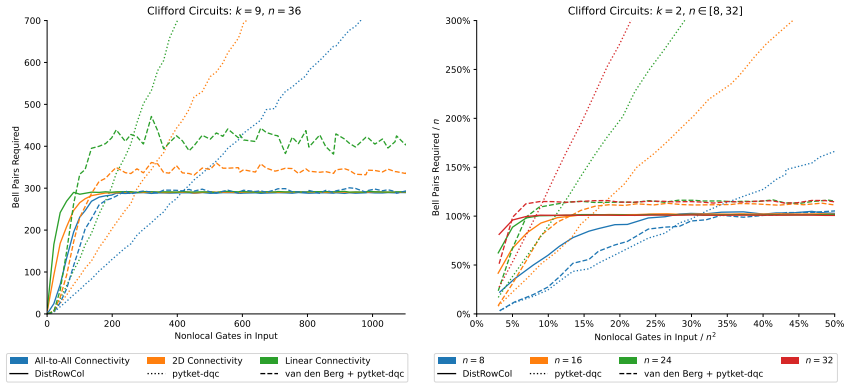
The central discovery is that the hard part of distributed CNOT synthesis—eliminating the interaction between partitions—reduces to block Gaussian elimination on the parity matrix. Off-diagonal blocks are cleared by block row additions, and a ZX-type generalized CNOT gate performs exactly a rank-one block row addition, so any block row addition with coefficient matrix $R$ costs $\mathrm{rank}(R)$ such gates. The resulting algorithms, BlockRowCol and its Clifford analogue DistRowCol working on stabilizer tableaux, use at most $2n(k-1)$ non-local gates on any connected inter-partition graph; the paper proves this as Theorems 3.1 and 4.1. A counting argument shows this is asymptotically optimal whenever $k=o(n/\log n)$, and running the better of this method and standard linear-reversible synthesis is asymptotically optimal for every $k$. For $k=2$ the algorithm is within a factor of two of optimal on every input. The representation also extends to Clifford+RZ circuits by generalizing the Pauli exponential representation, and to CSS codes, where any logical CNOT circuit can be implemented with $O(k^2)$ inter-block transversal CNOTs and $O(nk)$ intra-block Pauli measurements.
Load-bearing premise
The cost model assumes every generalized CNOT gate $C(A,B)$ can be implemented with exactly one non-local CNOT plus local Clifford operations; if that implementation ever required a non-constant number of non-local CNOTs, the $2n(k-1)$ bounds, the CSS-code operation counts, and the asymptotic optimality claims would all need to be rescaled.
Editorial extensions
If this is right
- For any connected graph between partitions, every CNOT circuit on $n$ qubits in $k$ blocks can be compiled to at most $2n(k-1)$ non-local gates, and when $k=o(n/\log n)$ no asymptotically better worst-case bound is possible.
- The same $2n(k-1)$ guarantee holds for full Clifford circuits through DistRowCol, independent of inter-partition connectivity.
- For $k=2$, BlockRowCol is a factor-2 approximation of the optimal non-local gate count for every individual CNOT circuit, not just in the worst case.
- In a CSS code with one ancilla per block, any logical CNOT circuit can be implemented with at most $6k(k-1)$ inter-block transversal CNOTs and $O(nk)$ intra-block Pauli measurements, regardless of inter-block connectivity.
- For Clifford+RZ circuits with $r$ phase gates, the distribution procedure introduces at most $2(k-1)(r+n)$ generalized CNOT gates, and the representation plugs into phase-folding and T-count optimization.
Reading between the lines
- Beyond the paper: because block row addition is a generic primitive on parity matrices and tableaux, other synthesis engines—SAT-based, template-based, or peephole optimizers—could likely be given the same block treatment rather than being restricted to Gaussian elimination.
- Beyond the paper: the CSS-code translation suggests a compiler recipe for any code with a transversal gate: express block row additions in that inter-block primitive and pay a cost depending on the number of blocks rather than the number of qubits, which could generalize to codes with other transversal primitives.
- Beyond the paper: the benchmarks' suggestion that Clifford+RZ resynthesis rarely beats the input circuit points to a testable hypothesis—for T-rich circuits the bottleneck is phase structure, not inter-block connectivity—which could be checked by fixing T-count and increasing block size while watching whether non-local gates per phase gate saturate.
Editorial analysis
A structured set of objections, weighed in public.
Referee Report
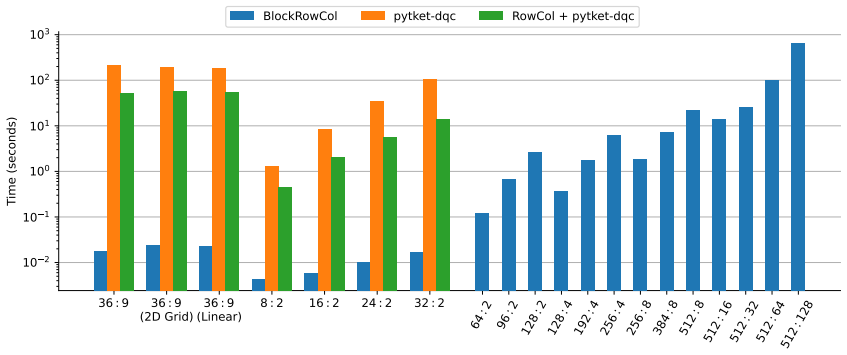
Summary. This paper develops methods for minimizing non-local gates in distributed CNOT, Clifford, and Clifford+RZ circuits when qubits are partitioned into k blocks with arbitrary inter-block connectivity. The central construction is a representation in which non-local Clifford operations are written as generalized CNOT gates C(A,B), each costing one physical non-local CNOT. The main results are BlockRowCol for CNOT circuits and DistRowCol for Clifford circuits, both using at most 2n(k−1) generalized CNOT gates regardless of partition connectivity, with a counting lower bound showing asymptotic optimality when k=o(n/log n), and a constant-factor approximation for k=2. The paper also presents a Clifford+RZ resynthesis heuristic with generalized-CNOT folding, a DAG bin-packing method for finding Clifford/CNOT subcircuits, benchmarks against pytket-dqc, and applications to CSS codes, phantom codes, the bicycle architecture, and tree tensor networks.
Significance. Assuming the main theorems are correct, this is a substantial contribution to distributed quantum compilation: it replaces topology-dependent routing heuristics with a tableau/linear-algebra method whose non-local gate count depends only on n and k, rather than on the inter-block graph. The proofs are explicit and the pseudocode is complete enough to reimplement; the counting lower bounds are parameter-free, and the claims are accompanied by a public implementation and benchmarks. The paper is appropriately cautious about the Clifford+T regime, where it reports worse performance than existing tools. The main advertised asymptotic claim concerns k=o(n/log n), and for that regime the argument is convincing. The main weaknesses are an overreach in the 'any k' optimality theorem and an error in the tree tensor network application.
major comments (2)
- [§3.4, Theorem 3.2 (and §4.3, Theorem 4.1)] The claim that running Patel–Markov–Hayes (or Aaronson–Gottesman) and choosing the better result gives asymptotic optimality for any value of k is not supported for arbitrarily restricted partition connectivity. Those algorithms synthesize circuits in an all-to-all qubit model; when k is large and the partition graph is not complete, their output can contain CNOTs between non-adjacent partitions, which are not valid non-local gates in the stated architecture. As written, the theorem either needs an explicit all-to-all connectivity assumption for this sentence, or it needs a connectivity-respecting O(n^2/log n) synthesis algorithm. The k=O(n/log n) part of the theorem is unaffected.
- [§8.4] The cost model for tree tensor networks is inconsistent. With n=2^a leaves and the cited scaling 2^{2l}, a highest-level gate (l≈a) has cost polynomial in n, not 2^{n/2}; writing '2^{n/2}' for the cost and calling 2^{2l} 'super-exponential' does not follow. The recurrence and the claimed O(2^{n/2} n log n) bound therefore need to be redone. The qualitative comparison with Patel–Markov–Hayes may survive with different exponents, but the current asymptotic statement is not justified.
minor comments (4)
- [§3.4, Lemma 3.7] The count of possible generalized CNOT gates uses 4^{n/k} for each Pauli string, but P^±_{n/k} has 2·4^{n/k} elements; the constant in the lower-bound estimate should be adjusted. The asymptotic conclusion is unchanged.
- [§2] The condition 'i_1 ≠ ±I_2' appears to be a typo for i_1 ≠ i_2.
- [§8.4] The phrase 'super-exponential in the level' misdescribes 2^{2l}, which is exponential in l.
- [§3.4, discussion before Theorem 3.3] The statement that non-ZX-type gates provide no benefit for CNOT unitaries is phrased as an expectation based on [31]; please state explicitly that Theorem 3.3 is restricted to ZX-type circuits and that the broader optimality claim is conditional.
Circularity Check
No significant circularity: the derivation is self-contained, with no fitted parameters, renamed inputs, or load-bearing self-citations.
full rationale
The central claims follow from rank-factorization and counting arguments: Theorem 3.1 uses Lemma 3.4 (any block row addition can be realized by rank(R) ZX-type generalized CNOT gates, with rank(R) ≤ n/k) and the 2k(k−1) block eliminations of BlockRowCol; Theorem 4.1 uses the analogous DistRowCol elimination. The lower bound in Lemma 3.7 is a counting bound that relies only on the elementary fact that any invertible parity matrix can be expressed as a CNOT circuit, with crossing CNOTs written as generalized CNOT gates; it does not reuse the algorithm being proved. The cost-model assumption that each generalized CNOT gate costs exactly one non-local CNOT is justified in Section 2.2 by local-Clifford conjugation of A to Z and B to X, with [15] as an external standard result and the construction sketched in the paper itself; this is not a circular ansatz. The only self-citation is [16], the public GitHub implementation used for benchmarks and scaling tests; it supplies no mathematical premise and is not load-bearing for Theorems 3.1, 3.2, 4.1, or 8.1. Lemma 5.1 is used only for optional CNOT-subcircuit detection, not for the main optimality claims. No equation is equal to its inputs by construction, and no predicted bound is a renamed fit.
Assumptions & free parameters
assumptions (6)
- domain assumption Generalized CNOT gates C(A,B) can be implemented with exactly one non-local CNOT plus local Cliffords.
- domain assumption The partition connectivity graph is connected, and a non-articulation point can always be chosen at each elimination step.
- domain assumption All partitions have equal size n/k.
- standard math Standard F2 linear algebra facts: rank factorization, row and column operations, block inversion identities in Lemmas 3.1, 3.2, 3.4 through 3.6.
- standard math Polynomial-time constant-factor Steiner tree approximations exist, and any tree subgraph of the induced graph has at most k-1 edges.
- standard math Stabilizer tableau facts: any anticommuting Pauli pair maps to Z1 and X1; centralizer dimension bounds of Lemmas 4.1 and 4.3.
Cite this review
Pith. "Pith review of Clifford Circuit Synthesis for Distributed Quantum Architectures with Arbitrary Network Topology." pith.science (2026). https://pith.science/paper/64MF2RND
@misc{pith2026260813543,
  author       = {Pith},
  title        = {Pith review of: Clifford Circuit Synthesis for Distributed Quantum Architectures with Arbitrary Network Topology},
  year         = {2026},
  howpublished = {\url{https://pith.science/paper/64MF2RND}},
  note         = {Machine review of arXiv:2608.13543}
}
read the original abstract
To achieve large-scale fault-tolerant quantum computation, it may be easier to combine many small sets of qubits than to construct a single large set. For example via quantum error correction with block codes, or distributed quantum processors utilizing shared entanglement. In these regimes, the time or error budget of the overall quantum computation may be dominated by non-local operations. Hence, it is worthwhile to minimize the number of these operations. We consider the case where both non-local and local connectivity may be arbitrarily restricted, and give an asymptotically optimal synthesis method for distributed CNOT and Clifford circuits, based on block-matrix Gaussian elimination. We extend this to all Clifford+RZ circuits by generalizing the Pauli exponential circuit representation; this naturally integrates with existing methods for optimizing T-count. As an application, we show how to implement CNOT circuits in a CSS code encoding n logical qubits in k blocks using O(nk) inter-block transversal CNOTs and intra-block Pauli measurements.
Figures


Figures from the paper (6 more)



Reference graph
Works this paper leans on
-
[1]
Distributed quantum computing: A survey
Marcello Caleffi, Michele Amoretti, Davide Ferrari, Jessica Illiano, Antonio Manzalini, and Angela Sara Cacciapuoti. “Distributed quantum computing: A survey”. Computer Networks 254, 110672 (2024)
2024
-
[2]
Distributed quantum computing across an optical network link
D. Main, P. Drmota, D. P. Nadlinger, E. M. Ainley, A. Agrawal, B. C. Nichol, R. Srinivas, G. Araneda, and D. M. Lucas. “Distributed quantum computing across an optical network link”. Nature638, 383–388 (2025)
work page 2025
-
[3]
Tour de gross: A modular quantum computer based on bivariate bicycle codes
Theodore J. Yoder, Eddie Schoute, Patrick Rall, Emily Pritchett, Jay M. Gambetta, An- drew W. Cross, Malcolm Carroll, and Michael E. Beverland. “Tour de gross: A modular quantum computer based on bivariate bicycle codes” (2025). [2506.03094]
arXiv 2025
-
[4]
Distributed arith- metic on a quantum multicomputer
Rodney Van Meter, Kae Nemoto, W. J. Munro, and Kohei M. Itoh. “Distributed arith- metic on a quantum multicomputer”. ACM SIGARCH Computer Architecture News34, 354–365 (2006)
work page 2006
-
[5]
Distributing circuits over heterogeneous, mod- ular quantum computing network architectures
Pablo Andres-Martinez, Tim Forrer, Daniel Mills, Jun-Yi Wu, Luciana Henaut, Kentaro Ya- mamoto, Mio Murao, and Ross Duncan. “Distributing circuits over heterogeneous, mod- ular quantum computing network architectures”. Quantum Science and Technology9, 045021 (2024)
work page 2024
-
[6]
Entanglement-efficient bipartite-distributed quantum com- puting
Jun-Yi Wu, Kosuke Matsui, Tim Forrer, Akihito Soeda, Pablo Andr´ es-Mart ´ ınez, Daniel Mills, Luciana Henaut, and Mio Murao. “Entanglement-efficient bipartite-distributed quantum com- puting”. Quantum7, 1196 (2023)
work page 2023
-
[7]
Distribution of quantum circuits over general quantum networks
Ranjani G. Sundaram, Himanshu Gupta, and C. R. Ramakrishnan. “Distribution of quantum circuits over general quantum networks”. In 2022 IEEE International Conference on Quantum Computing and Engineering (QCE). Page 415–425. IEEE (2022)
work page 2022
-
[8]
Picturing Quantum Software: An Introduction to the ZX-Calculus and Quantum Compilation
Aleks Kissinger and John van de Wetering. “Picturing Quantum Software: An Introduction to the ZX-Calculus and Quantum Compilation”. Preprint. (2024). url:https://zxcalc. github.io/book/
work page 2024
Show all 50 references
-
[9]
A game of surface codes: Large-scale quantum computing with lattice surgery
Daniel Litinski. “A game of surface codes: Large-scale quantum computing with lattice surgery”. Quantum3, 128 (2019)
2019
-
[10]
Improved simulation of stabilizer circuits
Scott Aaronson and Daniel Gottesman. “Improved simulation of stabilizer circuits”. Physical Review A70(2004)
2004
-
[11]
Optimization of cnot circuits on limited-connectivity architecture
Bujiao Wu, Xiaoyu He, Shuai Yang, Lifu Shou, Guojing Tian, Jialin Zhang, and Xiaoming Sun. “Optimization of cnot circuits on limited-connectivity architecture”. Physical Review Research5(2023)
2023
-
[12]
Architecture-aware synthesis of stabilizer circuits from clifford tableaus
David Winderl, Qunsheng Huang, Arianne Meijer-van de Griend, and Richie Yeung. “Architecture-aware synthesis of stabilizer circuits from clifford tableaus” (2023). [2309.08972]
2023 arXiv
-
[13]
Quantum circuit optimizations for nisq architectures
Beatrice Nash, Vlad Gheorghiu, and Michele Mosca. “Quantum circuit optimizations for nisq architectures”. Quantum Science and Technology5, 025010 (2020)
2020
-
[14]
Phase polynomials synthesis algorithms for nisq architectures and beyond
Vivien Vandaele, Simon Martiel, and Timoth´ ee Goubault de Brugi` ere. “Phase polynomials synthesis algorithms for nisq architectures and beyond”. Quantum Science and Technology7, 045027 (2022). 40
2022
-
[15]
A simple method for sampling random clifford operators
Ewout van den Berg. “A simple method for sampling random clifford operators” (2020). [2008.06011]
2020 arXiv
-
[16]
“dgpe”.https://github.com/tlaakkonen/dgpe(2026)
Tuomas Laakkonen. “dgpe”.https://github.com/tlaakkonen/dgpe(2026)
2026
-
[17]
How to factor 2048 bit rsa integers with less than a million noisy qubits
Craig Gidney. “How to factor 2048 bit rsa integers with less than a million noisy qubits” (2025). [2505.15917]
2025 arXiv
-
[18]
Entangling logical qubits without physical operations
Jin Ming Koh, Anqi Gong, Andrei C. Diaconu, Daniel Bochen Tan, Alexandra A. Geim, Michael J. Gullans, Norman Y. Yao, Mikhail D. Lukin, and Shayan Majidy. “Entangling logical qubits without physical operations” (2026). [2601.20927]
2026
-
[19]
Sim- ulating quantum circuits using tree tensor networks
Philipp Seitz, Ismael Medina, Esther Cruz, Qunsheng Huang, and Christian B. Mendl. “Sim- ulating quantum circuits using tree tensor networks”. Quantum7, 964 (2023)
2023
-
[20]
An introduction to quantum error correction and fault-tolerant quantum computation
Daniel Gottesman. “An introduction to quantum error correction and fault-tolerant quantum computation” (2009). [0904.2557]
2009 arXiv
-
[21]
Reducing the number of non-clifford gates in quantum circuits
Aleks Kissinger and John van de Wetering. “Reducing the number of non-clifford gates in quantum circuits”. Physical Review A102(2020)
2020
-
[22]
Optimizing t gates in clifford+t circuit as pi/4 rotations around paulis
Fang Zhang and Jianxin Chen. “Optimizing t gates in clifford+t circuit as pi/4 rotations around paulis” (2019). [1903.12456]
2019 arXiv
-
[23]
The classification of clifford gates over qubits
Daniel Grier and Luke Schaeffer. “The classification of clifford gates over qubits”. Quantum 6, 734 (2022)
2022
-
[24]
A comparison of quantum compilers using a dag-based or phase polynomial-based intermediate representation
Arianne Meijer-van de Griend. “A comparison of quantum compilers using a dag-based or phase polynomial-based intermediate representation” (2023). [2304.08814]
2023 arXiv
-
[25]
Nontrivial multi-product commutation relation toward reducing t-count in sequential pauli-based computation
Yusei Mori, Hideaki Hakoshima, and Keisuke Fujii. “Nontrivial multi-product commutation relation toward reducing t-count in sequential pauli-based computation” (2025). [2509.20052]
2025 arXiv
-
[26]
Cnot circuit extraction for topologically- constrained quantum memories
Aleks Kissinger and Arianne Meijer-van de Griend. “Cnot circuit extraction for topologically- constrained quantum memories” (2019). [1904.00633]
2019 arXiv
-
[27]
Efficient synthesis of linear reversible cir- cuits
K. N. Patel, I. L. Markov, and J. P. Hayes. “Efficient synthesis of linear reversible cir- cuits” (2003). arXiv:quant-ph/0302002
2003 arXiv
-
[28]
A fast algorithm for steiner trees
L. Kou, G. Markowsky, and L. Berman. “A fast algorithm for steiner trees”. Acta Informatica 15, 141–145 (1981)
1981
-
[29]
Improved steiner tree approximation in graphs
Gabriel Robins and Alexander Zelikovsky. “Improved steiner tree approximation in graphs”. In Proceedings of the Eleventh Annual ACM-SIAM Symposium on Discrete Algorithms. Page 770–779. SODA ’00USA (2000). Society for Industrial and Applied Mathematics
2000
-
[30]
Full rank factorization of matrices
R. Piziak and P. L. Odell. “Full rank factorization of matrices”. Mathematics Magazine72, 193–201 (1999)
1999
-
[31]
Hadamard-free circuits expose the structure of the clifford group
Sergey Bravyi and Dmitri Maslov. “Hadamard-free circuits expose the structure of the clifford group”. IEEE Transactions on Information Theory67, 4546–4563 (2021)
2021
-
[32]
An efficient quantum compiler that reducest count
Luke Heyfron and Earl T. Campbell. “An efficient quantum compiler that reducest count” (2018). arXiv:1712.01557
2018 arXiv
-
[33]
Dynamic transitive closure via dynamic matrix inverse (extended abstract)
P. Sankowski. “Dynamic transitive closure via dynamic matrix inverse (extended abstract)”. In 45th Annual IEEE Symposium on Foundations of Computer Science. Page 509–517. IEEE (2004)
2004
-
[34]
Acyclic partitioning of large directed acyclic graphs
Julien Herrmann, Jonathan Kho, Bora Ucar, Kamer Kaya, and Umit V. Catalyurek. “Acyclic partitioning of large directed acyclic graphs”. In 2017 17th IEEE/ACM International Sym- posium on Cluster, Cloud and Grid Computing (CCGRID). IEEE (2017)
2017
-
[35]
Breaking paragraphs into lines
Donald E. Knuth and Michael F. Plass. “Breaking paragraphs into lines”. Software: Practice and Experience11, 1119–1184 (1981)
1981
-
[36]
Reducing circuit depth with qubitwise diagonal- ization
Edison M. Murairi and Michael J. Cervia. “Reducing circuit depth with qubitwise diagonal- ization”. Physical Review A108(2023)
2023
-
[37]
Worst-case analysis of set union algorithms
Robert E. Tarjan and Jan van Leeuwen. “Worst-case analysis of set union algorithms”. Journal of the ACM31, 245–281 (1984). 41
1984
-
[38]
Quizx: a quick rust port of pyzx
QuiZX Contributors. “Quizx: a quick rust port of pyzx”.https://github.com/zxcalc/ quizx(2019)
2019
-
[39]
High-quality hypergraph partitioning
Sebastian Schlag, Tobias Heuer, Lars Gottesb¨ uren, Yaroslav Akhremtsev, Christian Schulz, and Peter Sanders. “High-quality hypergraph partitioning”. ACM J. Exp. Algorithmics (2022)
2022
-
[40]
Good quantum error-correcting codes exist
A. R. Calderbank and Peter W. Shor. “Good quantum error-correcting codes exist”. Physical Review A54, 1098–1105 (1996)
1996
-
[41]
The pinnacle architecture: Reducing the cost of breaking rsa-2048 to 100 000 physical qubits using quantum ldpc codes
Paul Webster, Lucas Berent, Omprakash Chandra, Evan T. Hockings, Nou´ edyn Baspin, Felix Thomsen, Samuel C. Smith, and Lawrence Z. Cohen. “The pinnacle architecture: Reducing the cost of breaking rsa-2048 to 100 000 physical qubits using quantum ldpc codes” (2026). [2602.11457]
2026 arXiv
-
[42]
Css codes are the only stabilizer codes with transversal cnot?
Adam Zalcman. “Css codes are the only stabilizer codes with transversal cnot?”. Quan- tum Computing Stack Exchange (2023).https://quantumcomputing.stackexchange.com/ a/32823(Accessed: 2026-07-30)
2023
-
[43]
Parallel logical measurements via quantum code surgery
Alexander Cowtan, Zhiyang He, Dominic J. Williamson, and Theodore J. Yoder. “Parallel logical measurements via quantum code surgery”. PRX Quantum7(2026)
2026
-
[44]
Decomposition of clifford gates
Tefjol Pllaha, Kalle Volanto, and Olav Tirkkonen. “Decomposition of clifford gates”. In 2021 IEEE Global Communications Conference (GLOBECOM). Page 01–06. IEEE (2021)
2021
-
[45]
Dynamic qubit routing with cnot circuit synthesis for quantum compilation
Arianne Meijer-van de Griend and Sarah Meng Li. “Dynamic qubit routing with cnot circuit synthesis for quantum compilation”. Electronic Proceedings in Theoretical Computer Science 394, 363–399 (2023)
2023
-
[46]
Tackling the qubit mapping problem for nisq-era quan- tum devices
Gushu Li, Yufei Ding, and Yuan Xie. “Tackling the qubit mapping problem for nisq-era quan- tum devices”. In Proceedings of the Twenty-Fourth International Conference on Architectural Support for Programming Languages and Operating Systems. Page 1001–1014. ASPLOS ’19. ACM (2019)
2019
-
[47]
Cnot-optimal clifford synthesis as sat
Irfansha Shaik and Jaco van de Pol. “Cnot-optimal clifford synthesis as sat” (2025). [2504.00634]
2025 arXiv
-
[48]
Architecture aware compilation of quan- tum circuits via lazy synthesis
Simon Martiel and Timoth´ ee Goubault de Brugi` ere. “Architecture aware compilation of quan- tum circuits via lazy synthesis”. Quantum6, 729 (2022)
2022
-
[49]
Clifford circuit opti- mization with templates and symbolic pauli gates
Sergey Bravyi, Ruslan Shaydulin, Shaohan Hu, and Dmitri Maslov. “Clifford circuit opti- mization with templates and symbolic pauli gates”. Quantum5, 580 (2021)
2021
-
[50]
Optimization of clifford circuits
Vadym Kliuchnikov and Dmitri Maslov. “Optimization of clifford circuits”. Physical Review A88(2013). 42
2013
Reviewed August 14, 2026 · model on record in the stance chip above.
Discussion (0). Continue with ORCID to comment.