REVIEW 5 major objections 5 minor 1 cited by
Causal DAG Summarization (Full Version)
T0 review · 5 major / 5 minor · reviewed 2026-08-16 · deepseek-v4-flash
Pith's one-line read This paper claims that a causal DAG compressed by node contraction can be used directly for causal inference, because its recursive basis of conditional independencies matches that of the expanded canonical DAG.
desk verdict Good theory, honest experiments in places, but the headline robustness claim rests on an unproven over-adjustment premise—send to review with a hard push on Section 7. read the letter →
The pith
A machine-rendered reading of the paper's core claim, the machinery that carries it, and where it could break.
The reading
What carries the argument
The load-bearing object is the canonical causal DAG $G_H$: expand every summary node (cluster) into its constituent original nodes, order them topologically, add edges from earlier to later nodes inside each cluster, and lift cluster edges to all ordered pairs between clusters. The recursive basis $\Sigma_{RB}$ is the set of at most $n$ conditional independencies stating that each node is independent of its non-descendants given its parents; Theorem 4.1 shows $\Sigma_{RB}(H) \equiv \Sigma_{RB}(G_H)$, which turns node contraction into a precise statement about added edges. This equivalence powers the s-separation algorithm (run d-separation on $G_H$) and the soundness and completeness of do-calculus on summaries, and it motivates CaGreS's merge cost: the number of edges the contraction would add to the canonical DAG.
What would settle it
Simulate data from a DAG in which merging nodes puts a mediator or collider inside the treatment's cluster, then compute the average treatment effect using the adjustment set that the summary DAG's do-calculus procedure returns; if that estimate differs systematically from the true effect in a way that adjusting for the original DAG would not, the robustness premise fails.
Extended reading notes
Core claim
The central claim is that a summary causal DAG $H$, built by contracting groups of nodes of a causal DAG $G$, carries enough causal information to be used directly for inference. Formally, if $G_H$ is the canonical causal DAG obtained by expanding each cluster of $H$ into a complete directed acyclic subgraph and inheriting cluster-level edges, then $\Sigma_{RB}(H) \equiv \Sigma_{RB}(G_H)$: the recursive bases are equivalent, so every conditional independence that can be read from one can be read from the other. Because the canonical DAG is a supergraph of the original DAG, any do-calculus derivation that succeeds on $H$ also succeeds on $G$, and the paper shows the three do-calculus rules remain sound and complete over summary DAGs. The paper further shows that contracting nodes is safest when it adds few edges, and packages this into CaGreS, which greedily merges the pair with the smallest canonical-edge cost. If these claims hold, a user can verify a small summary instead of a large DAG and still perform causal estimation.
Load-bearing premise
The claim that summaries are robust to misspecification assumes that the extra adjustment sets created by merging nodes are always harmless, never a collider or a descendant of treatment that would bias the estimate, and the paper does not prove that do-calculus on a summary DAG cannot select such a harmful set.
Editorial extensions
If this is right
- Summary DAGs can be handed directly to do-calculus and backdoor-adjustment routines, so users can reason about interventions without expanding clusters.
- Verification cost drops: checking a $k$-node summary replaces inspecting all $n(n-1)/2$ possible edges of the original DAG.
- A summary is compatible with many original DAGs, so causal statements made from it hold in every compatible DAG; this is the sense in which summaries are robust to missed or spurious edges in the input.
- CaGreS gives a practical route to summaries with $k$ nodes in $O((n-k)n^3)$ time, with caching and low-cost-merge optimizations that preserve quality.
Reading between the lines
- If Theorem 4.1 is right, the same equivalence should let summaries be composed: summarizing a summary along a coarser partition should yield a DAG whose canonical expansion is a supergraph of the previous canonical expansion, so inference remains sound under repeated compression.
- The robustness claim suggests a concrete trade-off: larger clusters shrink the graph but enlarge adjustment sets and may hide which compatible DAG generated the data; comparing CaGreS summaries against an oracle that picks the best compatible DAG would quantify that cost.
- The contraction-as-edge-addition view points to a natural weighted generalization: assign costs to lost bidirected or directed edges and use the same greedy merge for mixed graphs, a direction the paper's appendix begins.
Signed reviews
Editorial analysis
A structured set of objections, weighed in public.
Referee Report
Summary. The paper proposes a method for summarizing causal DAGs by contracting nodes into 'summary causal DAGs,' with the goal of reducing graph size while preserving enough conditional-independence information for sound causal inference. The central theoretical contributions are: (i) a connection between node contraction and edge addition via a 'canonical causal DAG' G_H, leading to an equivalence between the recursive basis of a summary DAG H and that of G_H (Theorem 4.1); (ii) a notion of s-separation with a sound and complete algorithm based on d-separation in G_H (Theorem 4.2); (iii) soundness and completeness claims for do-calculus in summary DAGs (Theorems 6.1 and 6.2); and (iv) an NP-hardness result for the summarization problem (Theorem 3.2). The paper also introduces a greedy algorithm, CaGreS, and evaluates it on six datasets, including a GPT-4-based case study arguing that summaries are robust to misspecification of the input DAG. The overarching claim is that summary causal DAGs can be used directly for causal inference and are more robust to errors in the original DAG.
Significance. If the theoretical results hold, the paper addresses a genuinely useful problem: causal DAGs in high-dimensional settings are hard to verify, and a principled summarization framework could help analysts inspect and reason about them. The core idea of encoding a summary's CI information through a canonical supergraph is natural and the proofs of Theorem 4.1 and the s-separation results appear plausible and are presented in detail. The experiments cover six datasets and include a comparison against several baselines; the authors also ship code and data, which supports reproducibility. However, the advertised robustness property ('more robust to misspecification') rests on unproved over-adjustment claims, and the formal problem definition and NP-hardness proof contain inconsistencies. These issues are central to the paper's framing and need repair. The contribution is potentially useful for the data-management and causal-inference communities, but the current version does not fully support its strongest claims.
major comments (5)
- [Section 3.2, Definition 3 and Example 8] The formal definition of the superiority order is reversed relative to the informal explanation and the example. The text before Definition 3 says H1 is superior to H2 if the RB of H2 is implied by the RB of H1, and Example 8 uses H1 ≻ H2 because Σ_RB(H1) implies Σ_RB(H2). However, Definition 3 states that G2 ≻ G1 if for every σ ∈ Σ_RB(G1), Σ_RB(G2) implies σ. Under this formal definition, a DAG with a stronger RB (i.e., fewer CIs, more edges) would be called superior, which contradicts the paper's own goal of preserving CIs and contradicts Example 8. Because the definition of 'maximal' in Problem 1 relies on this order, the formal problem statement is incoherent as written. Please correct the direction of the implication and ensure that Example 8 and the NP-hardness discussion are consistent with the corrected definition.
- [Section 3.2 and Appendix B.1, Theorem 3.2] The NP-hardness proof does not establish Theorem 3.2 as stated. The appendix proves (Lemma B.2 and Theorem B.3) that it is NP-hard to decide whether the number of within-cluster non-edges (or, equivalently, a related within-cluster quantity) is below a threshold τ. The proof then argues that since the within-cluster count lower-bounds the total number of added edges |E(G_H)| − |E(G)|, NP-hardness of the total follows. This implication is logically invalid: NP-hardness of a necessary condition for a property does not imply NP-hardness of the property itself. Moreover, the reduction targets the edge-count objective, not the RB-implication maximality objective of Problem 1, so even a correct edge-count hardness result would not directly prove Problem 1 NP-hard. A new proof, or a revised theorem statement that explicitly targets the edge-count formulation as a separate result, is needed.
- [Section 3.2 (Example 2) and Section 7] The robustness claim that summarization-induced over-adjustment 'will only be ones that do not hurt the analysis' is asserted without proof and is not implied by the paper's theorems. In the canonical DAG G_H, added edges can create new backdoor paths or cause variables in a treatment's cluster to become descendants of the treatment; standard causal inference shows that adjusting for descendants of treatment or for colliders can induce bias. The do-calculus soundness results (Theorems 6.1 and 6.2) guarantee that if a do-calculus derivation succeeds on H, the corresponding interventional equality holds in every compatible DAG, but they do not constrain which adjustment set a user or automated procedure will select on H. Section 7 provides only a qualitative GPT-4 case study and does not characterize the set of adjustment sets that summaries can produce. Please either provide a formal characterization of when over-adjustment is harmless, or revise the robustness claim to a provable statement (e.g., identifiability on H implies identifiability on every compatible DAG, which is a conservative robustness property rather than a claim that larger adjustment sets are always safe).
- [Section 6, 'ATE Computation over Summary DAGs'] The suggestion to order the treatment U before all other nodes in its cluster when computing ATE over G_H conflicts with Definition 5, which requires the ordering ⟨X1,...,Xn⟩ to be a topological order of the original DAG G. If U has ancestors (e.g., confounders) within its cluster, a topological order of G must place those ancestors before U; reordering U first can produce a canonical DAG that is not a supergraph of G, in which case E(G) ⊆ E(G_H) fails and Theorem 4.1, Theorem 6.1, and Lemma B.6 no longer apply. This makes the ATE computation procedure unsupported. Please specify how ATE is computed when treatment or outcome is part of a cluster while preserving the supergraph property used in the soundness proofs.
- [Section 4.2.1, s-separation algorithm] The algorithm description says that a topological order for the nodes of H is established and that the order of nodes within a cluster is 'arbitrary,' but the equivalence and soundness results of Theorem 4.1 and Theorem 4.2 require the within-cluster order to be a topological order of the original DAG G. If the within-cluster order is arbitrary, the canonical DAG G_H may not be a supergraph of every DAG compatible with H, and d-separation over G_H can return CIs that are not valid in H. Concretely, for a cluster {A,B} with an edge to C, ordering A before B yields (A ⊥ C | B) in G_H, but this CI does not hold in a compatible DAG with edges B→A→C. The paper should state that the s-separation algorithm assumes the within-cluster order is inherited from the original DAG's topological order, or should prove that the output is independent of that order under the given definition of compatibility.
minor comments (5)
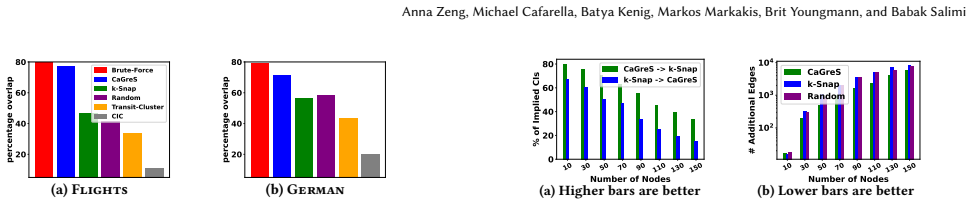
- [Section 8.3 and 8.4] The primary quality metric, 'number of additional edges in the canonical causal DAG,' is exactly the cost function that CaGreS minimizes. Comparisons against baselines on this metric are therefore partly self-referential, even though the C1 overlap experiments and the percentage-of-implied-CIs metric provide independent evidence. Please present the independent metrics as the headline results, or add a statement acknowledging the circularity and justifying why edge count is still a meaningful comparison.
- [Section 3.2, Definition 3] The notation G(P) is used in the definition of maximality ('G′ ∈ G(P)') but is never defined. Please define the set of I-Maps or the set of candidate DAGs explicitly.
- [Section 4.2, Definition 7] Definition 7 defines s-separation for subsets X,Y,Z ⊆ V(H) but the written condition 'f^{-1}(X) and f^{-1}(Y) are d-separated by f^{-1}(Z)' uses f on cluster nodes; this is fine once f is understood to map cluster nodes to their constituent original nodes, but the notation should be made explicit for readers, especially because f is overloaded in the paper.
- [Section 6, Theorem 6.2] Theorem 6.2 establishes only the existence of a compatible DAG G′ in which the relevant d-connection holds; it does not explicitly construct a distribution or interventional model in which the do-calculus equality fails. If 'completeness' is intended in the standard sense of do-calculus completeness, the proof should be extended by invoking the completeness of d-separation for DAGs to produce a distribution that is Markov for G′ (and hence for H).
- [Section 7] The statement 'resulting in 55 detected edges' followed by the counts 21 correct, 1 inverted, 1 missed, and 33 additional is arithmetically consistent (21+1+33=55), but the sentence structure could be clearer; it should explicitly note that the 55 detected edges include the 33 extra edges and exclude the missed one.
Circularity Check
Primary quality metric is the CaGreS objective itself; central causal-inference theorems remain independently grounded.
-
self definitional
[Section 5 (CaGreS cost), Section 8.1 (Metrics of evaluation), Section 8.3 (Quality Evaluation)]
"It counts the number of edges to be added in the canonical causal DAGfor each node pair (a proxy for the RB’s effect, as discussed in Section 4). In each iteration, the algorithm contracts the node pair resulting in the minimal number of additional edges. // To assess quality, we count additional edges in the canonical causal DAG absent from the original DAG—fewer edges indicate a sparser summary DAG encoding more CIs. // Since these metrics are closely interrelated, we deduce that it is appropriate to use the count of additional edges for comparing quality."
The number of additional edges in the canonical DAG is both the per-merge cost that CaGreS greedily minimizes (Algorithm 2, GetCost) and the headline quality metric used to declare CaGreS superior to k-Snap, Random, Transit-Cluster, and CIC. Comparing methods on this metric therefore measures whether the optimizer optimized its own objective, not whether the summaries are independently better by an external standard. The paper's own justification is a correlation claim ('these metrics are closely interrelated') plus the separate C1 interval-overlap experiments, which compare against the original DAG's causal-effect intervals and thus do provide external grounding. The circularity is confined to the C2/C3 quality evaluation; it does not feed into Theorems 4.1, 4.2, 6.1, or 6.2.
full rationale
The central derivation chain is self-contained: Theorem 4.1 is proved from the semigraphoid axioms using Lemmas B.4-B.5; Theorem 4.2 follows from Theorem 4.1 and Lemma B.6; Theorems 6.1-6.2 reduce to Pearl's do-calculus soundness/completeness for ordinary DAGs via the supergraph Lemma B.7 and Corollary B.7.1. No load-bearing self-citation is present: the only cited same-author work is used to build input DAGs ([113]) or to motivate applications, while the identification and do-calculus results cited are external ([9], [74], [104]). The one genuine circularity is evaluation-level: the primary quality metric, number of additional edges in the canonical DAG, is exactly the cost CaGreS minimizes, so CaGreS's superiority on that metric (Section 8.3, Figures 10-15) is partly by construction. This is mitigated by the independent C1 overlap experiments against the original DAG's causal-effect intervals, which support the central utility claim. Flagged for completeness but not counted as circularity: the robustness assertion in Example 2 and Section 7 that the 'more conservative set of confounders... will only be ones that do not hurt the analysis' is an unproven premise, and the size-constraint dependence is acknowledged in Section 10; these are correctness/limitation concerns rather than reductions to the paper's own inputs. Overall score 3 reflects one self-referential evaluation metric amid an otherwise independent theoretical derivation.
Assumptions & free parameters
assumptions (5)
- standard math Pearl's causal DAG model and the soundness and completeness of do-calculus for ordinary DAGs
- standard math The semi-graphoid axioms are sound and complete for deriving conditional independencies from a recursive basis
- domain assumption The input causal DAG G is an I-Map for the true joint distribution P
- domain assumption Preserving conditional independencies (maximal I-Map) is the right objective for causal inference utility
- ad hoc to paper Over-adjustment induced by summarizing a DAG does not hurt causal inference
Cite this review
Pith. "Pith review of Causal DAG Summarization (Full Version)." pith.science (2026). https://pith.science/paper/266REUGY
@misc{pith2026250414937,
  author       = {Pith},
  title        = {Pith review of: Causal DAG Summarization (Full Version)},
  year         = {2026},
  howpublished = {\url{https://pith.science/paper/266REUGY}},
  note         = {Machine review of arXiv:2504.14937}
}
read the original abstract
Causal inference aids researchers in discovering cause-and-effect relationships, leading to scientific insights. Accurate causal estimation requires identifying confounding variables to avoid false discoveries. Pearl's causal model uses causal DAGs to identify confounding variables, but incorrect DAGs can lead to unreliable causal conclusions. However, for high dimensional data, the causal DAGs are often complex beyond human verifiability. Graph summarization is a logical next step, but current methods for general-purpose graph summarization are inadequate for causal DAG summarization. This paper addresses these challenges by proposing a causal graph summarization objective that balances graph simplification for better understanding while retaining essential causal information for reliable inference. We develop an efficient greedy algorithm and show that summary causal DAGs can be directly used for inference and are more robust to misspecification of assumptions, enhancing robustness for causal inference. Experimenting with six real-life datasets, we compared our algorithm to three existing solutions, showing its effectiveness in handling high-dimensional data and its ability to generate summary DAGs that ensure both reliable causal inference and robustness against misspecifications.
Figures


Figures from the paper (12 more)





Forward citations
Cited by 1 Pith paper
-
Graph-of-Causal Evolution: Challenging Chain-of-Model for Reasoning
GoCE swaps CoM's chain structure for a differentiable causal graph and reports accuracy gains on CLUTRR, CLadder, EX-FEVER, and CausalQA, but the evidence is sandbox-generated and unauditable.
Reference graph
Works this paper leans on
-
[1]
Adult Census Income Dataset
2016. Adult Census Income Dataset. https://www.kaggle.com/datasets/uciml/ adult-census-income. Accessed: 2024-04-04
2016
-
[2]
Kaggle Datasets: Flights Delay
2020. Kaggle Datasets: Flights Delay. https://www.kaggle.com/usdot/flight- delays
2020
-
[3]
Code Repository
2024. Code Repository. https://github.com/TechnionTDK/causalens. Accessed: 2024-07-30
2024
-
[4]
Kaggle Datasets: malicious url detection
2024. Kaggle Datasets: malicious url detection. https://www.kaggle.com/ datasets/pilarpieiro/tabular-dataset-ready-for-malicious-url-detection. Ac- cessed: 2024-04-04
2024
-
[5]
OpenAI ChatGPT (3.5) [Large language model]
2024. OpenAI ChatGPT (3.5) [Large language model]. https://openai.com/blog/ chatgpt. Accessed: 2024-04-04
2024
-
[6]
SYS_QUERY_HISTORY - Amazon Redshift
2024. SYS_QUERY_HISTORY - Amazon Redshift. https://docs.aws.amazon. com/redshift/latest/dg/SYS_QUERY_HISTORY.html. Accessed: 2024-04-04
2024
-
[7]
Abdullah Alomar, Pouya Hamadanian, Arash Nasr-Esfahany, Anish Agarwal, Mohammad Alizadeh, and Devavrat Shah. 2023. CausalSim: A Causal Frame- work for Unbiased Trace-Driven Simulation. In 20th USENIX Symposium on Networked Systems Design and Implementation (NSDI 23) . 1115–1147
2023
-
[8]
Amazon Web Services. 2024. Amazon Redshift Serverless. https://aws.amazon. com/redshift/redshift-serverless/
2024
Show all 122 references
-
[9]
Tara V Anand, Adele H Ribeiro, Jin Tian, and Elias Bareinboim. 2023. Causal Effect Identification in Cluster DAGs. In Proceedings of the AAAI Conference on Artificial Intelligence
2023
-
[10]
Arthur Asuncion and David Newman. 2007. UCI machine learning repository
2007
-
[11]
Sander Beckers. 2022. Causal explanations and XAI. In Conference on causal learning and reasoning. PMLR, 90–109
2022
-
[12]
Sander Beckers and Joseph Y Halpern. 2019. Abstracting causal models. In Proceedings of the aaai conference on artificial intelligence , Vol. 33. 2678–2685
2019
-
[13]
Leopoldo Bertossi and Babak Salimi. 2017. From causes for database queries to repairs and model-based diagnosis and back. Theory of Computing Systems 61 (2017), 191–232
2017
-
[14]
Sourav S Bhowmick and Byron Choi. 2022. Data-driven visual query inter- faces for graphs: Past, present, and (near) future. In Proceedings of the 2022 International Conference on Management of Data . 2441–2447
2022
-
[15]
Paolo Boldi and Sebastiano Vigna. 2004. The webgraph framework I: compres- sion techniques. In Proceedings of the 13th international conference on World Wide Web. 595–602
2004
-
[16]
Alessandro Castelnovo, Riccardo Crupi, Fabio Mercorio, Mario Mezzanzanica, Daniele Potertì, and Daniele Regoli. 2024. Marrying LLMs with Domain Expert Validation for Causal Graph Generation. (2024)
2024
-
[17]
Krzysztof Chalupka, Frederick Eberhardt, and Pietro Perona. 2016. Multi-level cause-effect systems. In Artificial intelligence and statistics. PMLR, 361–369
2016
-
[18]
Krzysztof Chalupka, Pietro Perona, and Frederick Eberhardt. 2015. Visual causal feature learning. In Proceedings of the Thirty-First Conference on Uncertainty in Artificial Intelligence. AUAI Press, 181–190
2015
-
[19]
Wenyu Chen, Mathias Drton, and Ali Shojaie. 2023. Causal Structural Learning via Local Graphs. SIAM Journal on Mathematics of Data Science 5, 2 (2023), 280–305
2023
-
[20]
D.M Chickering. 2002. Optimal structure identification with greedy search. JMLR 3, Nov (2002), 507–554
2002
-
[21]
Anthony C Constantinou, Yang Liu, Kiattikun Chobtham, Zhigao Guo, and Neville K Kitson. 2021. Large-scale empirical validation of Bayesian Network structure learning algorithms with noisy data. International Journal of Approxi- mate Reasoning 131 (2021), 151–188
2021
-
[22]
Diane J Cook and Lawrence B Holder. 1993. Substructure discovery using minimum description length and background knowledge. Journal of Artificial Intelligence Research 1 (1993), 231–255
1993
-
[23]
Nilesh Dalvi and Dan Suciu. 2007. Efficient query evaluation on probabilistic databases. The VLDB Journal 16 (2007), 523–544
2007
-
[24]
Cody Dunne and Ben Shneiderman. 2013. Motif simplification: improving network visualization readability with fan, connector, and clique glyphs. In Proceedings of the SIGCHI Conference on Human Factors in Computing Systems . 3247–3256
2013
-
[25]
Wenfei Fan, Jianzhong Li, Xin Wang, and Yinghui Wu. 2012. Query preserving graph compression. In Proceedings of the 2012 ACM SIGMOD international conference on management of data . 157–168
2012
-
[26]
Sainyam Galhotra, Amir Gilad, Sudeepa Roy, and Babak Salimi. 2022. Hyper: Hypothetical reasoning with what-if and how-to queries using a probabilistic causal approach. In Proceedings of the 2022 International Conference on Manage- ment of Data. 1598–1611
2022
-
[27]
Sainyam Galhotra, Yue Gong, and Raul Castro Fernandez. 2023. Metam: Goal- oriented data discovery. In 2023 IEEE 39th International Conference on Data Engineering (ICDE). IEEE, 2780–2793
2023
-
[28]
Sainyam Galhotra, Romila Pradhan, and Babak Salimi. 2021. Explaining black- box algorithms using probabilistic contrastive counterfactuals. In Proceedings of the 2021 International Conference on Management of Data . 577–590
2021
-
[29]
Yu Gan, Mingyu Liang, Sundar Dev, David Lo, and Christina Delimitrou. 2021. Sage: Practical and Scalable ML-Driven Performance Debugging in Microser- vices. In Proceedings of the 26th ACM International Conference on Architectural Support for Programming Languages and Operating...
2021
-
[30]
Markus Gangl. 2010. Causal inference in sociological research. Annual review of sociology 36 (2010), 21–47
2010
-
[31]
M. R. Garey, David S. Johnson, and Larry J. Stockmeyer. 1976. Some Simplified NP-Complete Graph Problems. Theor. Comput. Sci. 1, 3 (1976), 237–267
1976
-
[32]
Dan Geiger and Judea Pearl. 1988. On the logic of causal models. In UAI ’88: Proceedings of the Fourth Annual Conference on Uncertainty in Artificial Intelligence, Minneapolis, MN, USA, July 10-12, 1988 . 3–14
1988
-
[33]
Dan Geiger, Thomas Verma, and Judea Pearl. 1990. Identifying independence in bayesian networks. Networks 20, 5 (1990), 507–534
1990
-
[34]
Robert Geisberger, Peter Sanders, Dominik Schultes, and Christian Vetter. 2012. Exact Routing in Large Road Networks Using Contraction Hierarchies. Trans- portation Science 46, 3 (2012), 388–404
2012
-
[35]
Clark Glymour, Kun Zhang, and Peter Spirtes. 2019. Review of causal discovery methods based on graphical models. Frontiers in genetics 10 (2019), 524
2019
-
[36]
Helga Gudmundsdottir, Babak Salimi, Magdalena Balazinska, Dan RK Ports, and Dan Suciu. 2017. A demonstration of interactive analysis of performance mea- surements with viska. In Proceedings of the 2017 ACM International Conference on Management of Data . 1707–1710
2017
-
[37]
Sébastien Harispe, Sylvie Ranwez, Stefan Janaqi, and Jacky Montmain. 2015. Semantic Similarity from Natural Language and Ontology Analysis. ArXiv abs/1704.05295 (2015)
2015 arXiv
-
[38]
Juris Hartmanis. 1982. Computers and intractability: a guide to the theory of np-completeness (michael r. garey and david s. johnson). Siam Review 24, 1 (1982), 90
1982
-
[39]
Weidong Huang, Peter Eades, and Seok-Hee Hong. 2009. Measuring effec- tiveness of graph visualizations: A cognitive load perspective. Information Visualization 8, 3 (2009), 139–152
2009
-
[40]
Johannes Huegle, Christopher Hagedorn, Lukas Boehme, Mats Poerschke, Jonas Umland, and Rainer Schlosser. 2021. MANM-CS: Data generation for bench- marking causal structure learning from mixed discrete-continuous and nonlin- ear data. WHY-21 at NeurIPS 2021 (2021)
2021
-
[41]
Lisa Jin and Danai Koutra. 2017. Ecoviz: Comparative vizualization of time- evolving network summaries. In ACM SIGKDD 2017 Workshop on Interactive Data Exploration and Analytics
2017
-
[42]
Bhowmick, and Francesco Bonchi
Arijit Khan, Sourav S. Bhowmick, and Francesco Bonchi. 2017. Summarizing Static and Dynamic Big Graphs. Proc. VLDB Endow. 10, 12 (2017), 1981–1984
2017
-
[43]
Samantha Kleinberg and George Hripcsak. 2011. A review of causal inference for biomedical informatics. Journal of biomedical informatics 44, 6 (2011), 1102– 1112
2011
-
[44]
Danai Koutra, U Kang, Jilles Vreeken, and Christos Faloutsos. 2014. Vog: Sum- marizing and understanding large graphs. In Proceedings of the 2014 SIAM international conference on data mining . SIAM, 91–99
2014
-
[45]
Oliver Kramer and Oliver Kramer. 2013. K-nearest neighbors. Dimensionality reduction with unsupervised nearest neighbors (2013), 13–23
2013
-
[46]
Steffen L Lauritzen and Thomas S Richardson. 2002. Chain graph models and their causal interpretations. Journal of the Royal Statistical Society Series B: Statistical Methodology 64, 3 (2002), 321–348
2002
-
[47]
Kyuhan Lee, Hyeonsoo Jo, Jihoon Ko, Sungsu Lim, and Kijung Shin. 2020. Ssumm: Sparse summarization of massive graphs. In Proceedings of the 26th ACM SIGKDD International Conference on Knowledge Discovery & Data Mining . 144–154
2020
-
[48]
Chenhui Li, George Baciu, and Yunzhe Wang. 2015. Modulgraph: modularity- based visualization of massive graphs. In SIGGRAPH Asia 2015 Visualization in High Performance Computing. 1–4
2015
-
[49]
Aristidis Likas, Nikos Vlassis, and Jakob J Verbeek. 2003. The global k-means clustering algorithm. Pattern recognition 36, 2 (2003), 451–461
2003
-
[50]
Xingjie Liu, Yuanyuan Tian, Qi He, Wang-Chien Lee, and John McPherson. 2014. Distributed graph summarization. In Proceedings of the 23rd ACM International Conference on Conference on Information and Knowledge Management . 799–808
2014
-
[51]
Yike Liu, Tara Safavi, Abhilash Dighe, and Danai Koutra. 2018. Graph summa- rization methods and applications: A survey. ACM computing surveys (CSUR) 51, 3 (2018), 1–34
2018
-
[52]
Antonio Maccioni and Daniel J Abadi. 2016. Scalable pattern matching over compressed graphs via dedensification. In Proceedings of the 22nd ACM SIGKDD International Conference on Knowledge Discovery and Data Mining . 1755–1764
2016
-
[53]
Sara Magliacane, Thijs Van Ommen, Tom Claassen, Stephan Bongers, Philip Versteeg, and Joris M Mooij. 2018. Domain adaptation by using causal inference to predict invariant conditional distributions. Advances in neural information processing systems 31 (2018)
2018
-
[54]
Sebastian Maneth and Fabian Peternek. 2016. Compressing graphs by grammars. In 2016 IEEE 32nd International Conference on Data Engineering (ICDE) . IEEE, 109–120
2016
-
[55]
Markos Markakis, An Bo Chen, Brit Youngmann, Trinity Gao, Ziyu Zhang, Rana Shahout, Peter Baile Chen, Chunwei Liu, Ibrahim Sabek, and Michael Anna Zeng, Michael Cafarella, Batya Kenig, Markos Markakis, Brit Youngmann, and Babak Salimi Cafarella. 2024. Sawmill: From Logs to Cau...
2024
-
[56]
Markos Markakis, Brit Youngmann, Trinity Gao, Ziyu Zhang, Rana Shahout, Peter Baile Chen, Chunwei Liu, Ibrahim Sabek, and Michael Cafarella. 2024. From Logs to Causal Inference: Diagnosing Large Systems. Proceedings of the VLDB Endowment 18, 2 (2024), 158–172
2024
-
[57]
Markos Markakis, Ziyu Zhang, Rana Shahout, Trinity Gao, Chunwei Liu, Ibrahim Sabek, and Michael Cafarella. 2024. Press ECCS to Doubt (Your Causal Graph). In Proceedings of the Conference on Governance, Understand- ing and Integration of Data for Effective and Responsible AI (S...
2024
-
[58]
Yasir Mehmood, Nicola Barbieri, Francesco Bonchi, and Antti Ukkonen. 2013. Csi: Community-level social influence analysis. InMachine Learning and Knowl- edge Discovery in Databases: European Conference, ECML PKDD 2013, Prague, Czech Republic, September 23-27, 2013, Proceedings...
2013
-
[59]
Alexandra Meliou, Wolfgang Gatterbauer, Joseph Y Halpern, Christoph Koch, Katherine F Moore, and Dan Suciu. 2010. Causality in databases. IEEE Data Engineering Bulletin 33, 3 (2010), 59–67
2010
-
[60]
Alexandra Meliou, Wolfgang Gatterbauer, Katherine F Moore, and Dan Suciu
-
[61]
Alexandra Meliou, Sudeepa Roy, and Dan Suciu. 2014. Causality and explana- tions in databases. Proceedings of the VLDB Endowment 7, 13 (2014), 1715–1716
2014
-
[62]
Arpit Merchant, Michael Mathioudakis, and Yanhao Wang. 2023. Graph Summa- rization via Node Grouping: A Spectral Algorithm. InProceedings of the Sixteenth ACM International Conference on Web Search and Data Mining . 742–750
2023
-
[63]
Tomas Mikolov, Kai Chen, Greg Corrado, and Jeffrey Dean. 2013. Efficient esti- mation of word representations in vector space. arXiv preprint arXiv:1301.3781 (2013)
2013 arXiv
-
[64]
Tim Miller. 2019. Explanation in artificial intelligence: Insights from the social sciences. Artificial intelligence 267 (2019), 1–38
2019
-
[65]
Karthika Mohan, Judea Pearl, and Jin Tian. 2013. Graphical models for inference with missing data. Advances in neural information processing systems 26 (2013)
2013
-
[66]
Sobhan Moosavi, Mohammad Hossein Samavatian, Srinivasan Parthasarathy, Radu Teodorescu, and Rajiv Ramnath. 2019. Accident risk prediction based on heterogeneous sparse data: New dataset and insights. In Proceedings of the 27th ACM SIGSPATIAL international conference on advance...
2019
-
[67]
Saket Navlakha, Rajeev Rastogi, and Nisheeth Shrivastava. 2008. Graph sum- marization with bounded error. In Proceedings of the 2008 ACM SIGMOD inter- national conference on Management of data . 419–432
2008
-
[68]
Xueyan Niu, Xiaoyun Li, and Ping Li. 2022. Learning Cluster Causal Diagrams: An Information-Theoretic Approach. (2022)
2022
-
[69]
Chris J Oates, Jessica Kasza, Julie A Simpson, and Andrew B Forbes. 2017. Repair of partly misspecified causal diagrams. Epidemiology 28, 4 (2017), 548–552
2017
-
[70]
OpenAI. 2023. GPT-4 Technical Report. arXiv:2303.08774 [cs.CL]
2023 arXiv
-
[71]
RT O’donnell, Ann E Nicholson, B Han, Kevin B Korb, MJ Alam, and LR Hope
-
[72]
Pekka Parviainen and Samuel Kaski. 2016. Bayesian networks for variable groups. In Conference on Probabilistic Graphical Models . PMLR, 380–391
2016
-
[73]
Sepideh Pashami, Anders Holst, Juhee Bae, and Sławomir Nowaczyk. 2018. Causal discovery using clusters from observational data. In FAIM’18 Workshop on CausalML, Stockholm, Sweden, July 15, 2018
2018
-
[74]
Judea Pearl. 2000. Causality : models, reasoning, and inference . Cambridge University Press
2000
-
[75]
Pearl and D
J. Pearl and D. Mackenzie. 2018. The book of why: the new science of cause and effect. Basic books
2018
-
[76]
Sriram Pemmaraju, Steven Skiena, et al. 2003. Computational discrete mathemat- ics: Combinatorics and graph theory with mathematica ®. Cambridge university press
2003
-
[77]
Jose M Peña. 2016. Learning acyclic directed mixed graphs from observations and interventions. In Conference on Probabilistic Graphical Models . PMLR, 392– 402
2016
-
[78]
Emilija Perkovic. 2020. Identifying causal effects in maximally oriented partially directed acyclic graphs. In Conference on Uncertainty in Artificial Intelligence . PMLR, 530–539
2020
-
[79]
Alireza Pirhadi, Mohammad Hossein Moslemi, Alexander Cloninger, Mostafa Milani, and Babak Salimi. 2024. Otclean: Data cleaning for conditional in- dependence violations using optimal transport. Proceedings of the ACM on Management of Data 2, 3 (2024), 1–26
2024
-
[80]
Meikel Poess, Bryan Smith, Lubor Kollar, and Paul Larson. 2002. TPC-DS, Taking Decision Support Benchmarking to the Next Level. In Proceedings of the 2002 ACM SIGMOD international conference on Management of data . 582–587
2002
-
[81]
Cristina Puente, José Angel Olivas, E Garrido, and R Seisdedos. 2013. Compress- ing the representation of a causal graph. In 2013 Joint IFSA World Congress and NAFIPS Annual Meeting (IFSA/NAFIPS). IEEE, 122–127
2013
-
[82]
Sriram Raghavan and Hector Garcia-Molina. 2003. Representing web graphs. In Proceedings 19th International Conference on Data Engineering (Cat. No. 03CH37405). IEEE, 405–416
2003
-
[83]
Ryan A Rossi and Rong Zhou. 2018. Graphzip: a clique-based sparse graph compression method. Journal of Big Data 5, 1 (2018), 1–14
2018
-
[84]
Sudeepa Roy. 2022. Toward interpretable and actionable data analysis with explanations and causality. Proc. VLDB Endow. 15, 12 (2022), 3812–3820
2022
-
[85]
Sudeepa Roy and Dan Suciu. 2014. A formal approach to finding explanations for database queries. In Proceedings of the 2014 ACM SIGMOD international conference on Management of data . 1579–1590
2014
-
[86]
Paul K Rubenstein, Sebastian Weichwald, Stephan Bongers, Joris M Mooij, Do- minik Janzing, Moritz Grosse-Wentrup, and Bernhard Schölkopf. 2017. Causal consistency of structural equation models. arXiv preprint arXiv:1707.00819 (2017)
2017 arXiv
-
[87]
Donald B Rubin. 2005. Causal inference using potential outcomes: Design, modeling, decisions. J. Amer. Statist. Assoc. 100, 469 (2005), 322–331
2005
-
[88]
Babak Salimi, Johannes Gehrke, and Dan Suciu. 2018. Bias in olap queries: Detection, explanation, and removal. In SIGMOD. 1021–1035
2018
-
[89]
Babak Salimi, Harsh Parikh, Moe Kayali, Lise Getoor, Sudeepa Roy, and Dan Suciu. 2020. Causal relational learning. In Proceedings of the 2020 ACM SIGMOD international conference on management of data . 241–256
2020
-
[90]
Babak Salimi, Luke Rodriguez, Bill Howe, and Dan Suciu. 2019. Interventional fairness: Causal database repair for algorithmic fairness. In Proceedings of the 2019 International Conference on Management of Data . 793–810
2019
-
[91]
Bernhard Schölkopf, Francesco Locatello, Stefan Bauer, Nan Rosemary Ke, Nal Kalchbrenner, Anirudh Goyal, and Yoshua Bengio. 2021. Toward causal representation learning. Proc. IEEE 109, 5 (2021), 612–634
2021
-
[92]
Neil Shah, Danai Koutra, Lisa Jin, Tianmin Zou, Brian Gallagher, and Christos Faloutsos. 2017. On Summarizing Large-Scale Dynamic Graphs. IEEE Data Eng. Bull. 40, 3 (2017), 75–88
2017
-
[93]
Amit Sharma and Emre Kiciman. 2020. DoWhy: An End-to-End Library for Causal Inference. arXiv preprint arXiv:2011.04216 (2020)
2020 arXiv
-
[94]
Zeqian Shen, Kwan-Liu Ma, and Tina Eliassi-Rad. 2006. Visual analysis of large heterogeneous social networks by semantic and structural abstraction. IEEE transactions on visualization and computer graphics 12, 6 (2006), 1427–1439
2006
-
[95]
Shohei Shimizu, Patrik O Hoyer, Aapo Hyvärinen, Antti Kerminen, and Michael Jordan. 2006. A linear non-Gaussian acyclic model for causal discovery. Journal of Machine Learning Research 7, 10 (2006)
2006
-
[96]
Kijung Shin, Amol Ghoting, Myunghwan Kim, and Hema Raghavan. 2019. Sweg: Lossless and lossy summarization of web-scale graphs. In The World Wide Web Conference. 1679–1690
2019
-
[97]
Maryam Shoaran, Alex Thomo, and Jens H Weber-Jahnke. 2013. Zero- knowledge private graph summarization. In 2013 IEEE International Conference on Big Data. IEEE, 597–605
2013
-
[98]
Karamjit Singh, Garima Gupta, Vartika Tewari, and Gautam Shroff. 2018. Com- parative benchmarking of causal discovery algorithms. In Proceedings of the ACM India Joint International Conference on Data Science and Management of Data. Association for Computing Machinery, 46–56
2018
-
[99]
Qi Song, Yinghui Wu, Peng Lin, Luna Xin Dong, and Hui Sun. 2018. Mining summaries for knowledge graph search. IEEE Transactions on Knowledge and Data Engineering 30, 10 (2018), 1887–1900
2018
-
[100]
Daniel A Spielman and Nikhil Srivastava. 2008. Graph sparsification by effective resistances. In Proceedings of the fortieth annual ACM symposium on Theory of computing. 563–568
2008
-
[101]
Spirtes et al
P. Spirtes et al. 2000. Causation, prediction, and search . MIT press
2000
-
[102]
Xinwei Sun, Botong Wu, Xiangyu Zheng, Chang Liu, Wei Chen, Tao Qin, and Tie-Yan Liu. 2021. Recovering latent causal factor for generalization to distributional shifts. Advances in Neural Information Processing Systems 34 (2021), 16846–16859
2021
-
[103]
Yuanyuan Tian, Richard A Hankins, and Jignesh M Patel. 2008. Efficient ag- gregation for graph summarization. In Proceedings of the 2008 ACM SIGMOD international conference on Management of data . 567–580
2008
-
[104]
Santtu Tikka, Jouni Helske, and Juha Karvanen. 2021. Clustering and Structural Robustness in Causal Diagrams. arXiv preprint arXiv:2111.04513 (2021)
2021 arXiv
-
[105]
Hal R Varian. 2016. Causal inference in economics and marketing. Proceedings of the National Academy of Sciences 113, 27 (2016), 7310–7315
2016
-
[106]
Aniket Vashishtha, Abbavaram Gowtham Reddy, Abhinav Kumar, Saketh Bachu, Vineeth N Balasubramanian, and Amit Sharma. 2023. Causal inference using llm-guided discovery. arXiv preprint arXiv:2310.15117 (2023)
2023 arXiv
-
[107]
Thomas Verma and Judea Pearl. 1988. Causal networks: semantics and expres- siveness. In UAI ’88: Proceedings of the Fourth Annual Conference on Uncertainty in Artificial Intelligence, Minneapolis, MN, USA, July 10-12, 1988, Ross D. Shachter, Tod S. Levitt, Laveen N. Kanal, and...
1988
-
[108]
Marco A Wiering et al. 2002. Evolving causal neural networks. In Benelearn’02: Proceedings of the Twelfth Belgian-Dutch Conference on Machine Learning . 103– 108. Causal DAG Summarization (Full Version)
2002
-
[109]
Raymond W. Yeung. 2008. Information Theory and Network Coding (1 ed.). Springer Publishing Company, Incorporated
2008
-
[110]
Quinton Yong, Mahdi Hajiabadi, Venkatesh Srinivasan, and Alex Thomo. 2021. Efficient graph summarization using weighted lsh at billion-scale. InProceedings of the 2021 International Conference on Management of Data . 2357–2365
2021
-
[111]
Brit Youngmann, Michael Cafarella, Amir Gilad, and Sudeepa Roy. 2024. Sum- marized Causal Explanations For Aggregate Views. Proceedings of the ACM on Management of Data 2, 1 (2024), 1–27
2024
-
[112]
Brit Youngmann, Michael Cafarella, Yuval Moskovitch, and Babak Salimi. 2023. On Explaining Confounding Bias. In 2023 IEEE 39th International Conference on Data Engineering (ICDE). IEEE, 1846–1859
2023
-
[113]
Brit Youngmann, Michael Cafarella, Babak Salimi, and Zeng Anna. 2023. Causal Data Integration. Proceedings of the VLDB Endowment 16, 1- (2023), 2665–2659
2023
-
[114]
Jiji Zhang. 2008. On the completeness of orientation rules for causal discovery in the presence of latent confounders and selection bias. Artificial Intelligence 172, 16-17 (2008), 1873–1896
2008
-
[115]
Boxiang Zhao, Shuliang Wang, Lianhua Chi, Qi Li, Xiaojia Liu, and Jing Geng
-
[116]
Yang Zhou, Hong Cheng, and Jeffrey Xu Yu. 2009. Graph clustering based on structural/attribute similarities. Proceedings of the VLDB Endowment 2, 1 (2009), 718–729
2009
-
[117]
Jiongli Zhu, Sainyam Galhotra, Nazanin Sabri, and Babak Salimi. 2023. Con- sistent Range Approximation for Fair Predictive Modeling. Proceedings of the VLDB Endowment 16, 11 (2023), 2925–2938
2023
-
[118]
Jiongli Zhu and Babak Salimi. 2024. Overcoming Data Biases: Towards Enhanced Accuracy and Reliability in Machine Learning. IEEE Data Eng. Bull. 47, 1 (2024), 18–35
2024
-
[119]
standard
Shengyu Zhu, Ignavier Ng, and Zhitang Chen. 2020. Causal Discovery with Reinforcement Learning. In 8th International Conference on Learning Represen- tations, ICLR 2020, Addis Ababa, Ethiopia, April 26-30, 2020 . OpenReview.net. A SEMIGRAPHOID-AXIOMS The semi-graphoid axioms a...
2020
-
[2006]
In Proceedings of the 19th Australian Joint Conference on Artificial Intelligence: Advances in Artificial Intelligence
Incorporating expert elicited structural information in the CaMML causal discovery program. In Proceedings of the 19th Australian Joint Conference on Artificial Intelligence: Advances in Artificial Intelligence . 1–16
-
[2009]
arXiv preprint arXiv:0912.5340 (2009)
Why so? or why no? functional causality for explaining query answers. arXiv preprint arXiv:0912.5340 (2009)
2009 arXiv
-
[2023]
Causal Discovery via Causal Star Graphs.ACM Transactions on Knowledge Discovery from Data 17, 7 (2023), 1–24
2023
Reviewed August 16, 2026 · model on record in the stance chip above.
Discussion (0). Continue with ORCID to comment.