REVIEW 4 major objections 5 minor 53 references
SPROUT: A Scalable Diffusion Foundation Model for Agricultural Vision
T0 review · 4 major / 5 minor · reviewed 2026-08-02 · deepseek-v4-flash
Pith's one-line read SPROUT shows that denoising pixels, not web-scale invariance, transfers best to crop phenotyping.
desk verdict SPROUT is a promising diffusion-based agri foundation model with a credible head-to-head win over FOMO4Wheat, but the broad dense-task superiority claim is weakened by an unfair decoder comparison and some inconsistent small-model results. read the letter →
The pith
A machine-rendered reading of the paper's core claim, the machinery that carries it, and where it could break.
The reading
What carries the argument
UDiT, a pixel-space Diffusion Transformer without a VAE. Instead of encoding images into a compressed latent space, UDiT denoises RGB pixels directly; instead of patchify/unpatchify it uses CNN down/up-sampling so the Transformer attends to semantics while CNNs carry high-frequency detail. The regression target is epsilon (the Gaussian noise added at timestep t), which the authors argue forces high-rank internal features because epsilon lives in full pixel space. The other load-bearing component is the effective-rank criterion: compute the Shannon entropy of the singular-value distribution of features at each timestep and pick the timestep with maximum entropy. This is a training-free proxy
What would settle it
A controlled rerun where MAE, DINOv2, and CLIP baselines receive per-model hyperparameter search and enough training to reach their own plateau under the same 256×256 protocol. If, say, MAE-ViT-B's apple-flower IoU jumps from 3.98 toward SPROUT's 65.92 while SPROUT stays put, the central claim of consistent superiority collapses. A simpler diagnostic is the training curves of those baselines: if they were still improving when evaluation stopped, the comparison is not apples-to-apples.
Extended reading notes
Core claim
SPROUT establishes that a structure-preserving denoising objective can be turned into a domain-specific vision foundation model for agriculture. The architecture is a VAE-free pixel-space Diffusion Transformer trained with epsilon-prediction—the network learns to predict the noise added to an image—and a training-free effective-rank criterion selects which denoising timestep's features to use. The paper reports that SPROUT-L achieves the highest IoU on organ-level segmentation across apple, peach, pear, grape, wheat, and rice; leads on crop-weed segmentation across ten crops; gives the lowest error on sugar-beet depth estimation; and has the lowest MAE/MSE on wheat-spike and soybean-pod coun
Load-bearing premise
The evaluation assumes every baseline received equally careful fine-tuning; the near-zero segmentation scores reported for some MAE baselines suggest they may have been under-fitted, so SPROUT's consistent margin could reflect an uneven comparison rather than a genuinely better representation.
Editorial extensions
If this is right
- Dense phenotyping benchmarks—organ segmentation, crop-weed parsing, depth, counting—are where SPROUT's margin is largest, so label-efficient phenotyping is the immediate practical payoff.
- SPROUT's reported label efficiency, matching or beating DINOv2 with roughly 1/50 of the annotated examples, suggests diffusion-pretrained encoders can cut annotation costs in crop science.
- The reported compute advantage (UDiT-S matching FOMO4Wheat-ViT-G on wheat organ segmentation at about 1/22 the parameters and roughly 1/37 the GPU-hours) implies agricultural foundation models do not require web-scale or ViT-G-scale budgets.
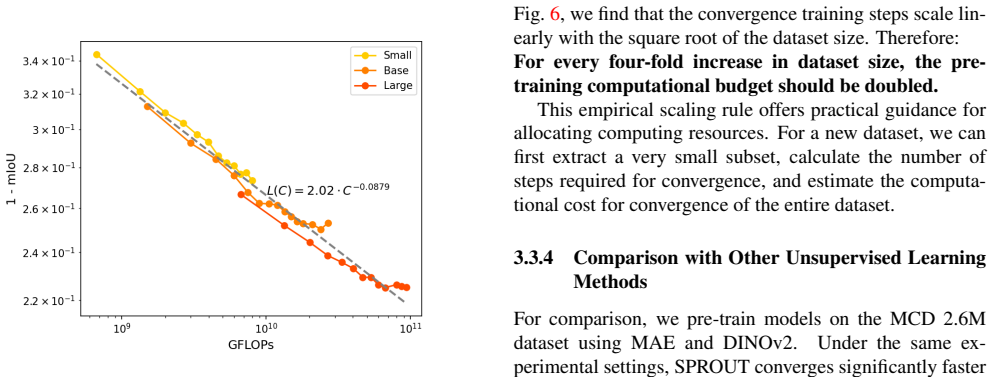
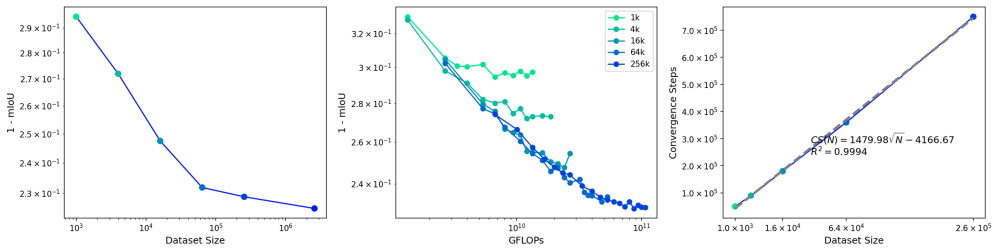
- The scaling analysis gives a concrete rule: quadrupling pretraining data should double training iterations; downstream gains saturate near roughly 64K images, so dataset diversity matters more than volume.
- The tradeoff the paper accepts is real: on classification tasks CLIP and DINOv3 sometimes score slightly higher, so SPROUT is positioned for structure-heavy tasks, not generic image classification.
Reading between the lines
- An implication the paper leaves implicit: if the effective-rank criterion generalizes, it gives any diffusion-pretrained encoder a cheap way to choose a transferable feature layer, not just for agriculture—this is an inference, not tested in the paper.
- The likely driver of the gains is the conjunction of epsilon-prediction and pixel-space training; separating those two factors with ablations would tell whether the benefit comes from the objective, the architecture, or the data curation.
- The dataset saturation result hints that small, highly diverse pretraining sets (tens of thousands of images) may be enough for similar domain-specific foundation models, which would lower the barrier for other specialty domains.
- A natural next step the paper leaves implicit is multi-timestep feature aggregation or a lightweight decoder; since only single-timestep features were used, the reported numbers may be a lower bound on what the representation can do.
Editorial analysis
A structured set of objections, weighed in public.
Referee Report
Summary. The paper introduces SPROUT, a diffusion-based agricultural vision foundation model pre-trained on 2.6M unlabeled field images. The architecture replaces DiT's patchify/unpatchify with CNN down/up-sampling, trains with epsilon-parameterization in pixel space, and selects a transfer timestep by maximizing the effective rank of the pretrained features. The authors evaluate on organ segmentation, plant/weed parsing, depth estimation, counting, and classification, reporting consistent gains over web-pretrained baselines (DINOv2, DINOv3, CLIP, SigLIP, MAE, MSN) and against the agricultural FOMO4Wheat model, with substantially lower pre-training cost.
Significance. If the dense-task gains are real, SPROUT would be a valuable first multi-crop diffusion-based agricultural foundation model, with clear practical relevance for phenotyping, weeding, and yield estimation. The paper ships code and model, reports a large curated dataset, and includes scaling analyses and a controlled comparison with FOMO4Wheat that supports the efficiency claim. The central weakness is that the dense evaluation protocol is asymmetric: SPROUT uses learned CNN up/down-sampling modules while all non-FOMO baselines receive only a single convolutional projection on ViT patch features. This confounds representation quality with decoder capacity and needs to be resolved before the headline claim is accepted.
major comments (4)
- [§2.2 vs §3.1] The dense-task evaluation is not a matched comparison of encoders. SPROUT replaces patchify/unpatchify with CNN down/up-sampling modules (§2.2), so its final features are high-resolution, learned dense maps. In §3.1, all non-FOMO baselines use only a single convolutional layer on their final output features; for ViT backbones these are low-resolution patch tokens (stride 16). Thus the reported IoU/depth gains may reflect additional learned decoder capacity and a custom head, not better representations from diffusion pretraining. To support the representational claim, either (a) give all baselines the same lightweight decoder (e.g., a simple FPN or the SPROUT upsampling head), or (b) evaluate SPROUT's raw ViT-stage features with the same single-conv head. Also report per-baseline fine-tuning epochs and learning rates so the reader can rule out undertuning.
- [Table 1] The text claims SPROUT 'consistently achieves the best performance' across all crops and organs, but Table 1 contradicts this for the smallest variant: UDiT-S scores 34.34 on Pear Flower and 51.19 on Grape Flower, far below DINOv2-S (57.86 and 63.12) and several other baselines. Only UDiT-L dominates every column. The claim of consistent improvement therefore depends on model scale/architecture, not on the pretraining objective per se. Moreover, the MAE rows (e.g., 3.98 on Apple Flower, 2.71 on Pear Flower, 2.08 on Wheat Stem) are implausibly low for a model with the head described; these values strongly suggest severe undertuning or another evaluation mismatch. Please report the fine-tuning budget for every baseline and analyze the results per model size, not only as an aggregate.
- [§3.3.3] The central efficiency/scaling claim — 'convergence training steps scale linearly with the square root of dataset size' and hence a four-fold data increase should double compute — is stated without a fitted equation, confidence intervals, or a formal definition of 'convergence.' Figure 6 shows three points and a line but no error analysis or extrapolation check. Since this scaling rule is used to advise resource allocation for future datasets, please report the fitted exponent, the goodness of fit, and the convergence criterion; otherwise the rule is an informal observation, not a quantitative result.
- [§2.4] The dataset size is reported inconsistently. The abstract and introduction state 2.6M images; §2.4 describes a pool of 4.3M images, with filter stages removing 250K + 1.2M + 335K = 1.785M, leaving 2.515M, not 2.6M. The introduction also says 'distilled from an initial pool of 4 million samples,' which conflicts with the 4.3M figure. Please reconcile these numbers and state the exact final count used for pretraining.
minor comments (5)
- [Eq. (4)–(5)] The effective-rank criterion is label-free but not fully 'training-free' in the sense of not requiring the pretrained model; it requires the model's features at candidate timesteps. Please specify which layer's features are used and over which candidate timestep set the maximization is performed. Also clarify why maximizing rank over the pretrained model's own features does not overfit to that model's idiosyncrasies; the downstream benchmarks are external, but a short discussion would help.
- [§3.1.4] The sentence 'all models were initialized randomly prior to pre-training' is ambiguous: does it apply to SPROUT, FOMO4Wheat, or both? If both, this is a strong point and should be stated explicitly for all models in the table; if only SPROUT, the FOMO comparison is less controlled than implied.
- [Figure 5] The power-law scaling plot is presented without the underlying data points or fit parameters. Please show the points and report the fitted exponent and R², so readers can assess the strength of the trend.
- [Tables 5–6] Classification results are acknowledged as not consistently superior, which is honest. However, several numbers appear at ceiling (100% on Dragon Fruit) with no variance; consider reporting standard deviations over multiple runs for all fine-tuning results.
- [References] References [33] and [34] are the same paper (Peebles & Xie, 2023) and should be merged. Also check the numbering of diffusion parameterization references: Ho et al. [17] and Peebles & Xie [33] are cited for both epsilon-prediction and DiT, but the distinction is clear only if the citations are placed carefully.
Circularity Check
No significant circularity: SPROUT's claims are empirical and externally benchmarked; the evaluation-fairness confound is not a circular step.
full rationale
SPROUT's central claims are empirical outcomes of a pre-training strategy and are validated against external benchmarks. There is no derivation chain in which a fitted value is renamed as a prediction: the effective-rank timestep selection (Eq. 5) is computed from the pretrained model's unlabeled features, and the downstream IoU, depth, and counting numbers come from independent labeled test sets that are not used in choosing t*. The scaling-law and saturation statements are descriptive fits to the paper's own training/fine-tuning curves, not predictions derived from the pretraining objective, and are not used to obtain the headline results. The self-citations (e.g., YOLO pod for the soybean counting dataset, FOMO4Wheat as a baseline) are not load-bearing premises; FOMO4Wheat is an external comparison benchmark rather than a justification for the claimed superiority. The strongest concern—that SPROUT's CNN upsampling modules give it a decoder advantage relative to a single-conv head on ViT patch tokens—is an evaluation-fairness/correctness issue, not a circularity: the paper's architecture does not define either the baseline outcomes or the segmentation metrics by construction. Therefore no step reduces to its own input, and the circularity score is 0.
Assumptions & free parameters
free parameters (1)
- Scaling-law exponent for training steps vs dataset size =
≈0.5
assumptions (5)
- domain assumption Diffusion denoising with epsilon-prediction in pixel space yields representations that transfer well to dense downstream tasks.
- domain assumption Effective rank of features correlates with downstream transferability, so maximizing erank selects the optimal timestep.
- domain assumption The curated 2.6M-image dataset is diverse and representative enough to support multi-crop transfer.
- domain assumption Single-layer convolutional head and full fine-tuning at 256x256 yields a fair comparison across all baselines.
- domain assumption The scaling laws observed for SPROUT-L generalize beyond the specific training runs.
Cite this review
Pith. "Pith review of SPROUT: A Scalable Diffusion Foundation Model for Agricultural Vision." pith.science (2026). https://pith.science/paper/267OAEG3
@misc{pith2026260327519,
  author       = {Pith},
  title        = {Pith review of: SPROUT: A Scalable Diffusion Foundation Model for Agricultural Vision},
  year         = {2026},
  howpublished = {\url{https://pith.science/paper/267OAEG3}},
  note         = {Machine review of arXiv:2603.27519}
}
read the original abstract
Image-based plant phenotyping depends on dense structural understanding of crops, yet pixel-level annotation remains expensive across species, organs, growth stages, and field conditions. General-purpose vision foundation models offer a natural route to label efficiency, but their web-scale pretraining objectives transfer weakly to agricultural imagery, where semantics are often determined by fine organ geometry inside repetitive, texture-dominated scenes. We introduce SPROUT, a diffusion foundation model for multi-crop plant phenotyping. SPROUT learns from 2.6~million unlabeled open-field images using a VAE-free pixel-space Diffusion Transformer, and selects transferable features with a label-free effective-rank criterion over denoising timesteps. This design shifts pretraining from crop-based invariance to structure-preserving denoising, making the representation better aligned with dense phenotyping tasks. We evaluate SPROUT across dense phenotyping tasks, including organ segmentation, crop-weed parsing, depth estimation, and counting. SPROUT consistently improves over strong web-pretrained baselines, with the largest gains on dense structural prediction, and shows favorable label and compute efficiency compared with general-purpose and crop-specific foundation models.
Figures


Figures from the paper (4 more)


Reference graph
Works this paper leans on
-
[1]
Masked siamese networks for label-efficient learning
Mahmoud Assran, Mathilde Caron, Ishan Misra, Piotr Bo- janowski, Florian Bordes, Pascal Vincent, Armand Joulin, Mike Rabbat, and Nicolas Ballas. Masked siamese networks for label-efficient learning. InEuropean conference on com- puter vision, pages 456–473. Springer, 2022. 7, 9
2022
-
[2]
Beit: Bert pre-training of image transformers.arXiv preprint arXiv:2106.08254, 2021
Hangbo Bao, Li Dong, Songhao Piao, and Furu Wei. Beit: Bert pre-training of image transformers.arXiv preprint arXiv:2106.08254, 2021. 2
arXiv 2021
-
[3]
Leire Benito-Del-Valle, Artzai Pic ´on, Daniel Mugica, Manuel Ramos, Eva Portillo, Javier Romero, Carlos Javier Jimenez, and Ram ´on Navarra-Mestre. Vision founda- tion models in agriculture: Toward domain-specific adap- tation for weed herbicide trials assessment.arXiv preprint arXiv:2511.04288, 2025. 2 10 Figure 6. Scaling the Pre-training Dataset Size....
arXiv 2025
-
[4]
End-to- end object detection with transformers
Nicolas Carion, Francisco Massa, Gabriel Synnaeve, Nicolas Usunier, Alexander Kirillov, and Sergey Zagoruyko. End-to- end object detection with transformers. InEuropean confer- ence on computer vision, pages 213–229. Springer, 2020. 9
2020
-
[5]
Emerg- ing properties in self-supervised vision transformers
Mathilde Caron, Hugo Touvron, Ishan Misra, Herv ´e J´egou, Julien Mairal, Piotr Bojanowski, and Armand Joulin. Emerg- ing properties in self-supervised vision transformers. InPro- ceedings of the IEEE/CVF international conference on com- puter vision, pages 9650–9660, 2021. 2
2021
-
[6]
Agri- cultural robot dataset for plant classification, localization and mapping on sugar beet fields.The International Journal of Robotics Research, 36(10):1045–1052, 2017
Nived Chebrolu, Philipp Lottes, Alexander Schaefer, Wera Winterhalter, Wolfram Burgard, and Cyrill Stachniss. Agri- cultural robot dataset for plant classification, localization and mapping on sugar beet fields.The International Journal of Robotics Research, 36(10):1045–1052, 2017. 7
2017
-
[7]
A simple framework for contrastive learning of visual representations
Ting Chen, Simon Kornblith, Mohammad Norouzi, and Ge- offrey Hinton. A simple framework for contrastive learning of visual representations. InInternational conference on ma- chine learning, pages 1597–1607. PmLR, 2020. 2
2020
-
[8]
Orochi: Versatile biomedical image pro- cessor.arXiv preprint arXiv:2509.22583, 2025
Gaole Dai, Chenghao Zhou, Yu Zhou, Rongyu Zhang, Yuan Zhang, Chengkai Hou, Tiejun Huang, Jianxu Chen, and Shanghang Zhang. Orochi: Versatile biomedical image pro- cessor.arXiv preprint arXiv:2509.22583, 2025. 2
arXiv 2025
Show all 53 references
-
[9]
Global wheat head detection 2021: An improved dataset for benchmarking wheat head detection methods.Plant Phenomics, 2021
Etienne David, Mario Serouart, Daniel Smith, Simon Madec, Kaaviya Velumani, Shouyang Liu, Xu Wang, Francisco Pinto, Shahameh Shafiee, Izzat SA Tahir, et al. Global wheat head detection 2021: An improved dataset for benchmarking wheat head detection methods.Plant Phenomics, 2021. 9
2021
-
[10]
Inversion by di- rect iteration: An alternative to denoising diffusion for image restoration.arXiv preprint arXiv:2303.11435, 2023
Mauricio Delbracio and Peyman Milanfar. Inversion by di- rect iteration: An alternative to denoising diffusion for image restoration.arXiv preprint arXiv:2303.11435, 2023. 4
2023 arXiv
-
[11]
Diamos plant: A dataset for diagnosis and monitoring plant disease.Agron- omy, 11(11):2107, 2021
Gianni Fenu and Francesca Maridina Malloci. Diamos plant: A dataset for diagnosis and monitoring plant disease.Agron- omy, 11(11):2107, 2021. 8
2021
-
[12]
Rankme: Assessing the downstream perfor- mance of pretrained self-supervised representations by their rank
Quentin Garrido, Randall Balestriero, Laurent Najman, and Yann Lecun. Rankme: Assessing the downstream perfor- mance of pretrained self-supervised representations by their rank. InInternational conference on machine learning, pages 10929–10974. PMLR, 2023. 5
2023
-
[13]
Fomo4wheat: Toward reliable crop vision foundation models with globally curated data.arXiv preprint arXiv:2509.06907, 2025
Bing Han, Chen Zhu, Dong Han, Rui Yu, Songliang Cao, Jianhui Wu, Scott Chapman, Zijian Wang, Bangyou Zheng, Wei Guo, et al. Fomo4wheat: Toward reliable crop vision foundation models with globally curated data.arXiv preprint arXiv:2509.06907, 2025. 2, 7
2025 arXiv
-
[14]
Minneapple: a benchmark dataset for apple detection and segmentation
Nicolai H ¨ani, Pravakar Roy, and V olkan Isler. Minneapple: a benchmark dataset for apple detection and segmentation. IEEE Robotics and Automation Letters, 5(2):852–858, 2020. 7
2020
-
[15]
Deep residual learning for image recognition
Kaiming He, Xiangyu Zhang, Shaoqing Ren, and Jian Sun. Deep residual learning for image recognition. InProceed- ings of the IEEE conference on computer vision and pattern recognition, pages 770–778, 2016. 8, 9
2016
-
[16]
Masked autoencoders are scalable vision learners
Kaiming He, Xinlei Chen, Saining Xie, Yanghao Li, Piotr Doll´ar, and Ross Girshick. Masked autoencoders are scalable vision learners. InProceedings of the IEEE/CVF conference on computer vision and pattern recognition, pages 16000– 16009, 2022. 2, 7
2022
-
[17]
Denoising dif- fusion probabilistic models.Advances in neural information processing systems, 33:6840–6851, 2020
Jonathan Ho, Ajay Jain, and Pieter Abbeel. Denoising dif- fusion probabilistic models.Advances in neural information processing systems, 33:6840–6851, 2020. 4 11
2020
-
[18]
A comprehensive dragon fruit image dataset for detecting the maturity and quality grading of dragon fruit.Data in Brief, 52:109936, 2024
Tania Khatun, Md Asraful Sharker Nirob, Prayma Bishshash, Morium Akter, and Mohammad Shorif Uddin. A comprehensive dragon fruit image dataset for detecting the maturity and quality grading of dragon fruit.Data in Brief, 52:109936, 2024. 8
2024
-
[19]
Auto-encoding varia- tional bayes.arXiv preprint arXiv:1312.6114, 2013
Diederik P Kingma and Max Welling. Auto-encoding varia- tional bayes.arXiv preprint arXiv:1312.6114, 2013. 4
2013 arXiv
-
[20]
Banana and guava dataset for machine learning and deep learning-based quality classification.Data in Brief, 57:111025, 2024
Abiban Kumari and Jaswinder Singh. Banana and guava dataset for machine learning and deep learning-based quality classification.Data in Brief, 57:111025, 2024. 8
2024
-
[21]
Weed detection dataset with rgb images taken under variable light conditions
Petre Lameski, Eftim Zdravevski, Vladimir Trajkovik, and Andrea Kulakov. Weed detection dataset with rgb images taken under variable light conditions. InInternational Con- ference on ICT Innovations, pages 112–119. Springer, 2017. 6
2017
-
[22]
Back to basics: Let denoising generative models denoise.arXiv preprint arXiv:2511.13720, 2025
Tianhong Li and Kaiming He. Back to basics: Let denoising generative models denoise.arXiv preprint arXiv:2511.13720, 2025. 4
2025 arXiv
-
[23]
Csrnet: Di- lated convolutional neural networks for understanding the highly congested scenes
Yuhong Li, Xiaofan Zhang, and Deming Chen. Csrnet: Di- lated convolutional neural networks for understanding the highly congested scenes. InProceedings of the IEEE con- ference on computer vision and pattern recognition, pages 1091–1100, 2018. 9
2018
-
[24]
Csnet: A count-supervised network via multiscale mlp-mixer for wheat ear counting
Yaoxi Li, Xingcai Wu, Qi Wang, Zhixun Pei, Kejun Zhao, Panfeng Chen, and Gefei Hao. Csnet: A count-supervised network via multiscale mlp-mixer for wheat ear counting. Plant Phenomics, 6:0236, 2024. 9
2024
-
[25]
Transcrowd: weakly-supervised crowd counting with transformers.Science China Information Sciences, 65(6): 160104, 2022
Dingkang Liang, Xiwu Chen, Wei Xu, Yu Zhou, and Xiang Bai. Transcrowd: weakly-supervised crowd counting with transformers.Science China Information Sciences, 65(6): 160104, 2022. 9
2022
-
[26]
Flow matching for generative mod- eling.arXiv preprint arXiv:2210.02747, 2022
Yaron Lipman, Ricky TQ Chen, Heli Ben-Hamu, Maximil- ian Nickel, and Matt Le. Flow matching for generative mod- eling.arXiv preprint arXiv:2210.02747, 2022. 4
2022 arXiv
-
[27]
Deco: Frequency-decoupled pixel diffusion for end- to-end image generation.arXiv preprint arXiv:2511.19365,
Zehong Ma, Longhui Wei, Shuai Wang, Shiliang Zhang, and Qi Tian. Deco: Frequency-decoupled pixel diffusion for end- to-end image generation.arXiv preprint arXiv:2511.19365,
-
[28]
icassava 2019 fine- grained visual categorization challenge.arXiv preprint arXiv:1908.02900, 2019
Ernest Mwebaze, Timnit Gebru, Andrea Frome, Solomon Nsumba, and Jeremy Tusubira. icassava 2019 fine- grained visual categorization challenge.arXiv preprint arXiv:1908.02900, 2019. 8
2019 arXiv
-
[29]
Out- door oil palm fruit ripeness dataset.Data in brief, 55:110667,
Zaid Omar, Anwar PP Abdul Majeed, Munirah Rosbi, Shuwaibatul Aslamiah Ghazalli, and Hazlina Selamat. Out- door oil palm fruit ripeness dataset.Data in brief, 55:110667,
-
[30]
Dinov2: Learning robust visual features without supervision
Maxime Oquab, Timoth ´ee Darcet, Th ´eo Moutakanni, Huy V o, Marc Szafraniec, Vasil Khalidov, Pierre Fernandez, Daniel Haziza, Francisco Massa, Alaaeldin El-Nouby, et al. Dinov2: Learning robust visual features without supervision. arXiv preprint arXiv:2304.07193, 2023. 2, 7
2023 arXiv
-
[31]
Astroclip: a cross-modal foundation model for galaxies
Liam Parker, Francois Lanusse, Siavash Golkar, Leopoldo Sarra, Miles Cranmer, Alberto Bietti, Michael Eickenberg, Geraud Krawezik, Michael McCabe, Rudy Morel, et al. Astroclip: a cross-modal foundation model for galaxies. Monthly Notices of the Royal Astronomical Society, 531(...
2024
-
[32]
Rocole: A robusta coffee leaf images dataset for evaluation of machine learning based methods in plant diseases recognition.Data in brief, 25:104414, 2019
Jorge Parraga-Alava, Kevin Cusme, Ang ´elica Loor, and Es- neider Santander. Rocole: A robusta coffee leaf images dataset for evaluation of machine learning based methods in plant diseases recognition.Data in brief, 25:104414, 2019. 8
2019
-
[34]
Scalable diffusion models with transformers
William Peebles and Saining Xie. Scalable diffusion models with transformers. InProceedings of the IEEE/CVF inter- national conference on computer vision, pages 4195–4205,
-
[35]
Exploring scalable medical image encoders beyond text supervision.Nature Machine Intelligence, 7(1): 119–130, 2025
Fernando Perez-Garcia, Harshita Sharma, Sam Bond-Taylor, Kenza Bouzid, Valentina Salvatelli, Maximilian Ilse, Shruthi Bannur, Daniel C Castro, Anton Schwaighofer, Matthew P Lungren, et al. Exploring scalable medical image encoders beyond text supervision.Nature Machine Intelli...
2025
-
[36]
Learning transferable visual models from natural language supervi- sion
Alec Radford, Jong Wook Kim, Chris Hallacy, Aditya Ramesh, Gabriel Goh, Sandhini Agarwal, Girish Sastry, Amanda Askell, Pamela Mishkin, Jack Clark, et al. Learning transferable visual models from natural language supervi- sion. InInternational conference on machine learning, p...
2021
-
[37]
Faster r-cnn: Towards real-time object detection with region proposal networks.IEEE transactions on pattern analysis and machine intelligence, 39(6):1137–1149, 2016
Shaoqing Ren, Kaiming He, Ross Girshick, and Jian Sun. Faster r-cnn: Towards real-time object detection with region proposal networks.IEEE transactions on pattern analysis and machine intelligence, 39(6):1137–1149, 2016. 9
2016
-
[38]
High-resolution image synthesis with latent diffusion models
Robin Rombach, Andreas Blattmann, Dominik Lorenz, Patrick Esser, and Bj ¨orn Ommer. High-resolution image synthesis with latent diffusion models. InProceedings of the IEEE/CVF conference on computer vision and pattern recognition, pages 10684–10695, 2022. 4
2022
-
[39]
The effective rank: A mea- sure of effective dimensionality
Olivier Roy and Martin Vetterli. The effective rank: A mea- sure of effective dimensionality. In2007 15th European sig- nal processing conference, pages 606–610. IEEE, 2007. 4
2007
-
[40]
Grape detection, segmentation, and tracking using deep neural networks and three-dimensional association.Computers and Electronics in Agriculture, 170: 105247, 2020
Thiago T Santos, Leonardo L De Souza, Andreza A dos San- tos, and Sandra Avila. Grape detection, segmentation, and tracking using deep neural networks and three-dimensional association.Computers and Electronics in Agriculture, 170: 105247, 2020. 7
2020
-
[41]
Weednet: A foundation model-based global- to-local ai approach for real-time weed species identification and classification.arXiv preprint arXiv:2505.18930, 2025
Yanben Shen, Timilehin T Ayanlade, Venkata Naresh Bodde- palli, Mojdeh Saadati, Ashlyn Rairdin, Zi K Deng, Muham- mad Arbab Arshad, Aditya Balu, Daren Mueller, Asheesh K Singh, et al. Weednet: A foundation model-based global- to-local ai approach for real-time weed species ide...
2025 arXiv
-
[42]
Dinov3.arXiv preprint arXiv:2508.10104, 2025
Oriane Sim ´eoni, Huy V V o, Maximilian Seitzer, Federico Baldassarre, Maxime Oquab, Cijo Jose, Vasil Khalidov, Marc Szafraniec, Seungeun Yi, Micha ¨el Ramamonjisoa, et al. Dinov3.arXiv preprint arXiv:2508.10104, 2025. 2, 7, 9
2025 arXiv
-
[43]
The cropandweed dataset: A multi-modal learning approach for efficient crop and weed 12 manipulation
Daniel Steininger, Andreas Trondl, Gerardus Croonen, Julia Simon, and Verena Widhalm. The cropandweed dataset: A multi-modal learning approach for efficient crop and weed 12 manipulation. InProceedings of the IEEE/CVF Winter Con- ference on Applications of Computer Vision, pag...
2023
-
[44]
Apple, peach, and pear flower detection using semantic segmentation network and shape constraint level set.Com- puters and Electronics in Agriculture, 185:106150, 2021
Kaiqiong Sun, Xuan Wang, Shoushuai Liu, and ChangHua Liu. Apple, peach, and pear flower detection using semantic segmentation network and shape constraint level set.Com- puters and Electronics in Agriculture, 185:106150, 2021. 7
2021
-
[45]
Is noise conditioning necessary for denoising genera- tive models?arXiv preprint arXiv:2502.13129, 2025
Qiao Sun, Zhicheng Jiang, Hanhong Zhao, and Kaiming He. Is noise conditioning necessary for denoising genera- tive models?arXiv preprint arXiv:2502.13129, 2025. 3
2025
-
[46]
Sugarcane leaf dataset: A dataset for disease de- tection and classification for machine learning applications
Sandip Thite, Yogesh Suryawanshi, Kailas Patil, and Prawit Chumchu. Sugarcane leaf dataset: A dataset for disease de- tection and classification for machine learning applications. Data in Brief, 53:110268, 2024. 8
2024
-
[47]
Jamie Tolan, Hung-I Yang, Benjamin Nosarzewski, Guil- laume Couairon, Huy V V o, John Brandt, Justine Spore, Sayantan Majumdar, Daniel Haziza, Janaki Vamaraju, et al. Very high resolution canopy height maps from rgb imagery using self-supervised vision transformer and convolut...
2024
-
[48]
Yolov8: A novel object detection algorithm with enhanced performance and robust- ness
Rejin Varghese and M Sambath. Yolov8: A novel object detection algorithm with enhanced performance and robust- ness. In2024 International conference on advances in data engineering and intelligent computing systems (ADICS), pages 1–6. IEEE, 2024. 9
2024
-
[49]
Diffusion as self- distillation: End-to-end latent diffusion in one model.arXiv preprint arXiv:2511.14716, 2025
Xiyuan Wang and Muhan Zhang. Diffusion as self- distillation: End-to-end latent diffusion in one model.arXiv preprint arXiv:2511.14716, 2025. 4
2025
-
[50]
The global wheat full semantic organ seg- mentation (gwfss) dataset.Plant Phenomics, 7(3):100084,
Zijian Wang, Radek Zenkl, Latifa Greche, Benoit De Solan, Lucas Bernigaud Samatan, Safaa Ouahid, Andrea Visioni, Carlos A Robles-Zazueta, Francisco Pinto, Ivan Perez- Olivera, et al. The global wheat full semantic organ seg- mentation (gwfss) dataset.Plant Phenomics, 7(3):100084,
-
[51]
Yolo pod: a fast and accurate multi-task model for dense soybean pod counting.Plant methods, 19(1):8,
Shuai Xiang, Siyu Wang, Mei Xu, Wenyan Wang, and Weiguo Liu. Yolo pod: a fast and accurate multi-task model for dense soybean pod counting.Plant methods, 19(1):8,
-
[52]
Sigmoid loss for language image pre-training
Xiaohua Zhai, Basil Mustafa, Alexander Kolesnikov, and Lucas Beyer. Sigmoid loss for language image pre-training. InProceedings of the IEEE/CVF international conference on computer vision, pages 11975–11986, 2023. 7
2023
-
[53]
ibot: Image bert pre-training with online tokenizer.arXiv preprint arXiv:2111.07832,
Jinghao Zhou, Chen Wei, Huiyu Wang, Wei Shen, Cihang Xie, Alan Yuille, and Tao Kong. ibot: Image bert pre-training with online tokenizer.arXiv preprint arXiv:2111.07832,
-
[54]
Junchi Zhou, Haozhou Wang, Yoichiro Kato, Tejasri Nam- pally, P Rajalakshmi, M Balram, Keisuke Katsura, Hao Lu, Yue Mu, Wanneng Yang, et al. Global rice multi-class seg- mentation dataset (riceseg): A comprehensive and diverse high-resolution rgb-annotated images for the devel...
2025 arXiv
Reviewed August 2, 2026 · model on record in the stance chip above.
Discussion (0). Sign in to comment.