Entanglement Scaling and Problem Structure in Quantum Approximate and Adiabatic Optimization Algorithms
Pith reviewed 2026-06-26 20:32 UTC · model grok-4.3
The pith
QAOA entanglement scales like that of fermionic Gaussian states on MaxCut instances when parameters are optimized well.
A machine-rendered reading of the paper's core claim, the machinery that carries it, and where it could break.
Core claim
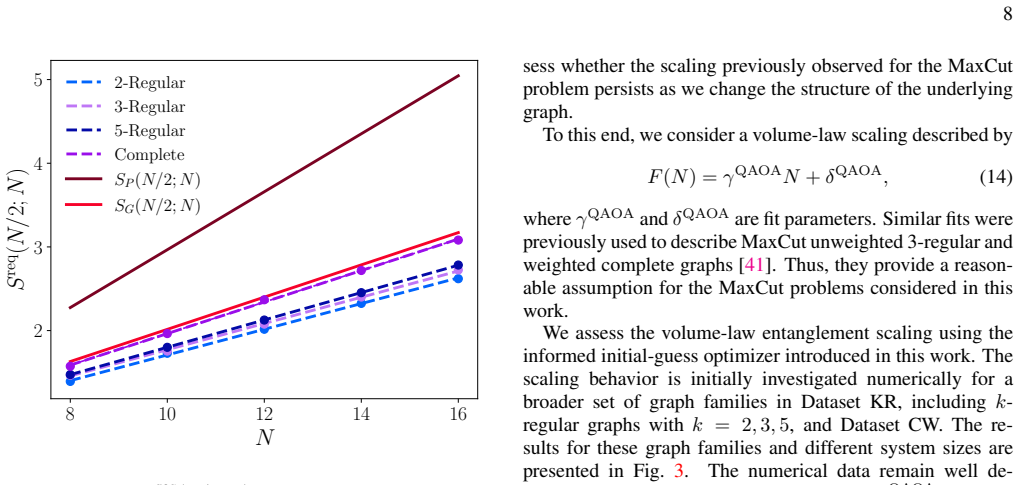
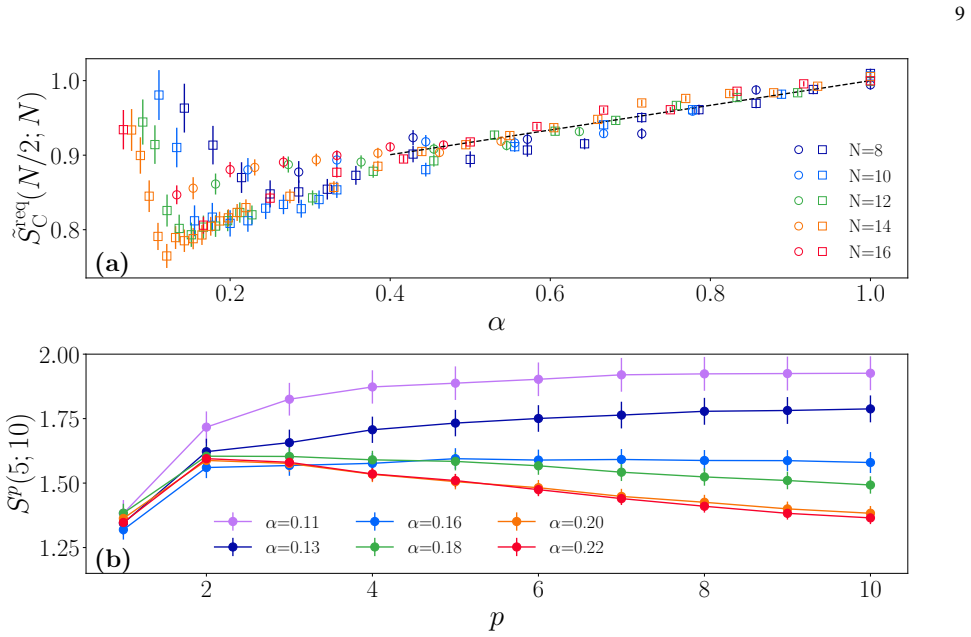
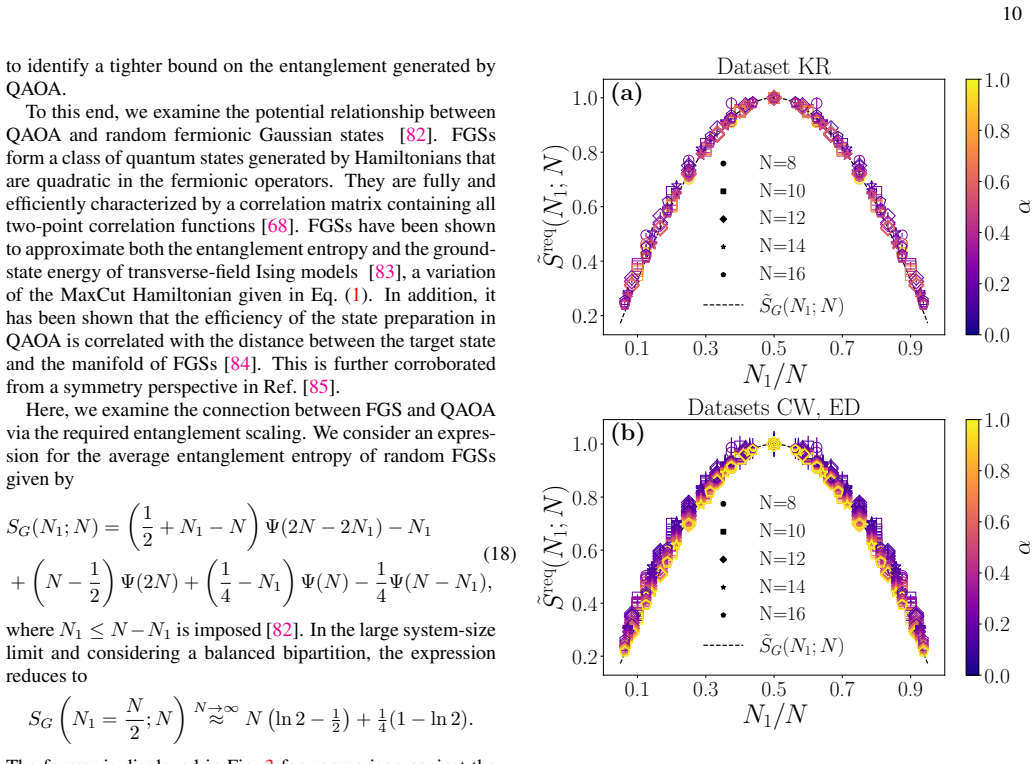
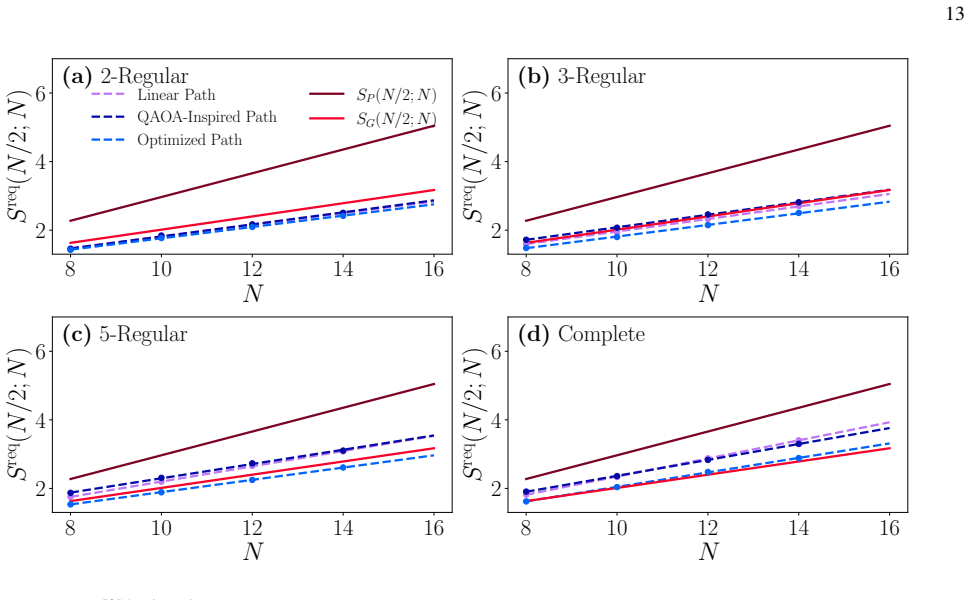
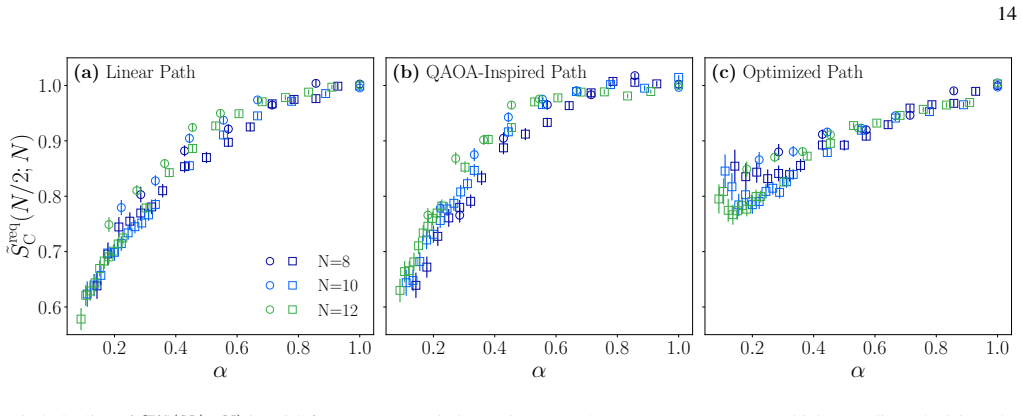
Using a high-performance optimizer reveals that QAOA exhibits entanglement scaling consistent with fermionic Gaussian states up to a scaling factor across a broad range of MaxCut instances, while adiabatic quantum computation produces annealing-schedule-dependent profiles whose scaling differs markedly.
What carries the argument
Entanglement scaling profile of variational states or annealing trajectories on MaxCut graphs, measured as a function of problem size.
If this is right
- Suboptimal training masks the true entanglement scaling in QAOA.
- QAOA and adiabatic computation manifest entanglement in distinct ways tied to their schedules and parameters.
- Entanglement scaling in these algorithms links directly to problem structure in MaxCut.
- The observed QAOA scaling suggests a connection between variational performance and Gaussian-state properties.
Where Pith is reading between the lines
- The scaling match may indicate that QAOA effectively samples states with limited entanglement structure similar to free fermions.
- Testing the same optimizer protocol on other combinatorial problems could show whether the scaling is MaxCut-specific or more general.
- If the scaling persists at larger sizes, it could constrain how much quantum advantage QAOA can achieve beyond classical Gaussian approximations.
Load-bearing premise
A high-performance optimizer can reliably reach parameters that expose the true underlying entanglement scaling rather than a distorted one from poor training.
What would settle it
A set of MaxCut instances where even the best available optimizer produces QAOA entanglement scaling that deviates from the fermionic Gaussian form by more than a constant factor.
Figures
read the original abstract
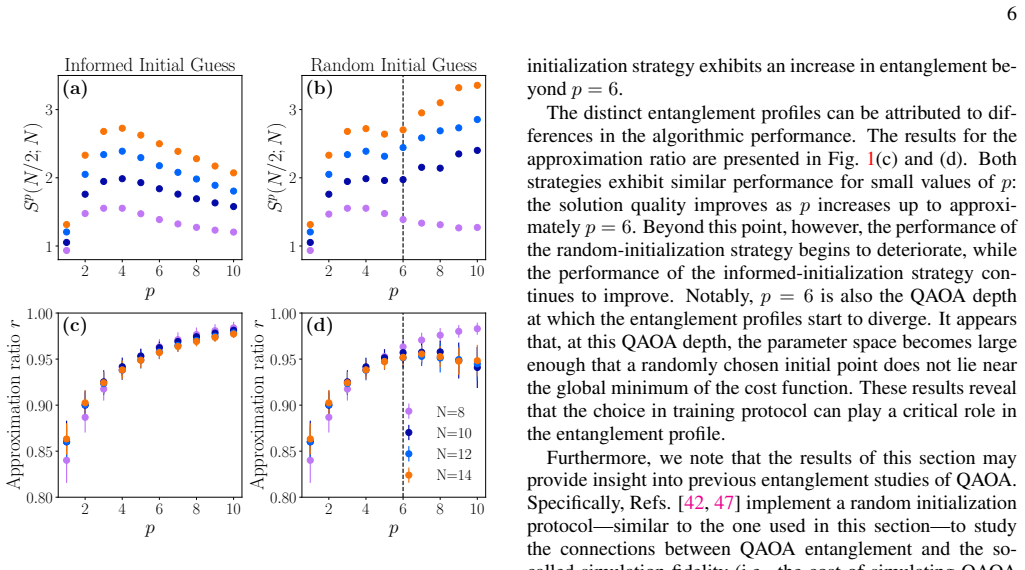
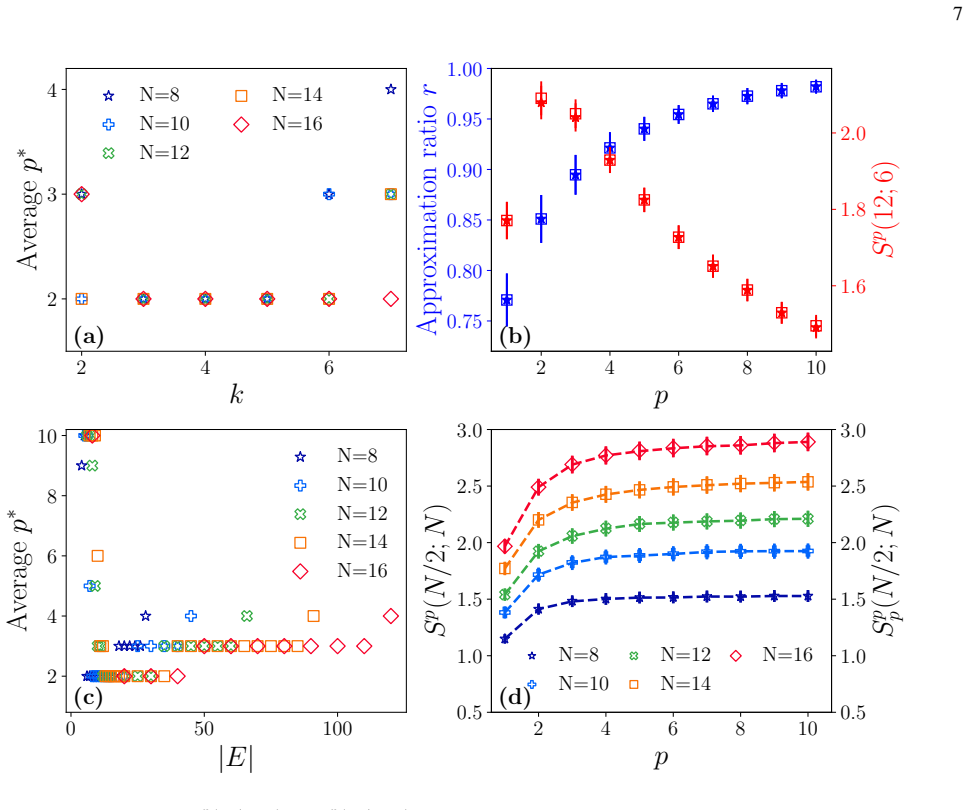
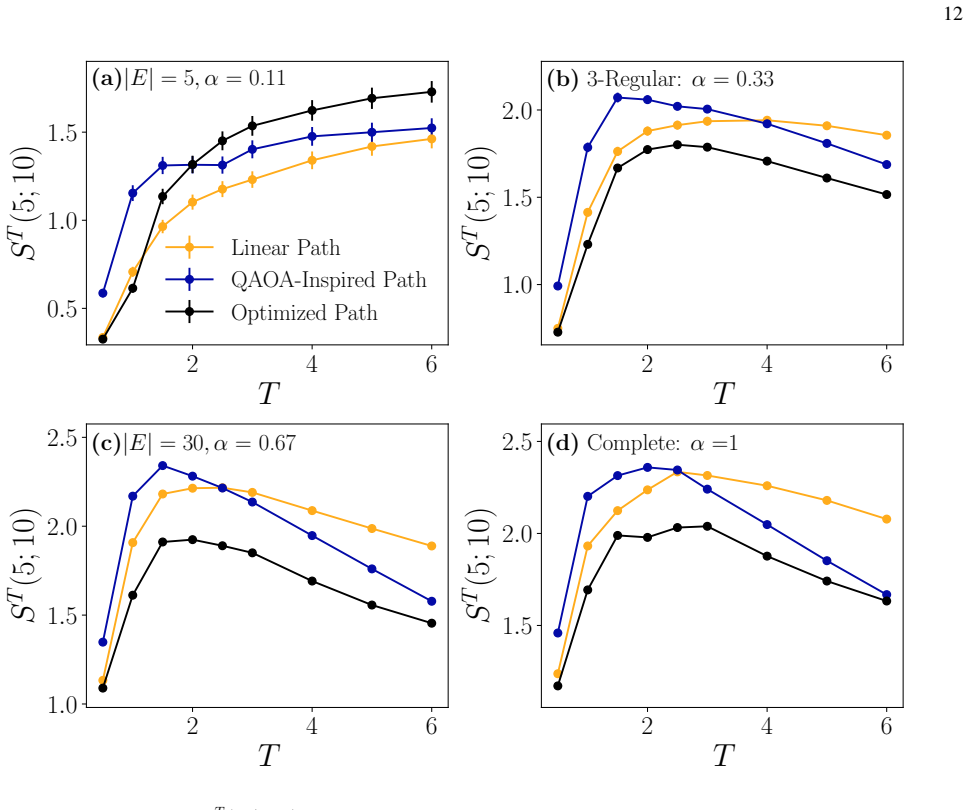
Entanglement is widely regarded as a key resource underlying the power of quantum algorithms and their potential to achieve quantum advantage. With the emergence of variational quantum algorithms, however, questions have arisen regarding how entanglement relates to problem structure and algorithmic performance in near-term quantum applications. Here, we examine this relationship through the Quantum Approximate Optimization Algorithm (QAOA), a specific class of variational algorithms, applied to the MaxCut problem. We show that suboptimal variational parameter training can significantly modify the observed entanglement profile, obscuring its scaling behavior. By employing a high-performance optimizer, we find empirical evidence that QAOA exhibits entanglement scaling consistent with that of fermionic Gaussian states (up to a scaling factor) across a broad range of MaxCut instances. We further compare these results with adiabatic quantum computation, observing annealing-schedule-dependent entanglement profiles whose scaling behavior differs markedly from that of QAOA. Together, these findings provide new insight into how entanglement manifests in and distinguishes these two algorithmic paradigms, highlighting its connection to both computational performance and problem structure.
Editorial analysis
A structured set of objections, weighed in public.
Referee Report
Summary. The paper empirically studies entanglement in QAOA applied to MaxCut instances. It reports that suboptimal variational parameter training alters the observed entanglement profile, while a high-performance optimizer yields scaling consistent with fermionic Gaussian states (up to a constant factor) across a broad ensemble. It further contrasts this with AQC, where entanglement profiles and scaling depend on the annealing schedule and differ from QAOA.
Significance. If the empirical results are robust, the work offers concrete insight into how entanglement manifests differently in variational versus adiabatic paradigms and its relation to problem structure. The observation that QAOA scaling aligns with a known fermionic form (up to rescaling) across many instances, when properly optimized, is a potentially useful benchmark for understanding resources in near-term algorithms. The explicit demonstration that training quality affects the profile is also a constructive cautionary result.
major comments (1)
- [Abstract] Abstract: The central empirical claim—that QAOA exhibits fermionic-Gaussian entanglement scaling when a high-performance optimizer is used—rests on the unverified assumption that the optimizer reaches parameters whose profile matches the true scaling rather than a suboptimal local minimum (whose qualitatively different profile is acknowledged in the same paragraph). No independent validation (e.g., success probability on small instances, comparison against exact diagonalization, or convergence diagnostics) is described, which is load-bearing for the reported scaling observation.
Simulated Author's Rebuttal
We thank the referee for their careful reading of the manuscript and for highlighting this important point regarding validation of the optimizer. We address the major comment below.
read point-by-point responses
-
Referee: [Abstract] Abstract: The central empirical claim—that QAOA exhibits fermionic-Gaussian entanglement scaling when a high-performance optimizer is used—rests on the unverified assumption that the optimizer reaches parameters whose profile matches the true scaling rather than a suboptimal local minimum (whose qualitatively different profile is acknowledged in the same paragraph). No independent validation (e.g., success probability on small instances, comparison against exact diagonalization, or convergence diagnostics) is described, which is load-bearing for the reported scaling observation.
Authors: We agree that the central claim would be strengthened by explicit, independent validation that the high-performance optimizer reaches high-quality parameters rather than local minima. The manuscript currently relies on the optimizer's established performance and the observed consistency of scaling across a broad ensemble, but does not report convergence diagnostics, success probabilities on small instances, or comparisons to exact diagonalization. In the revised manuscript we will add these elements: (i) convergence plots and final cost values for representative instances, (ii) approximation ratios achieved on small MaxCut instances compared against exact solutions, and (iii) a brief discussion of how these metrics support the reliability of the reported entanglement scaling. We will also adjust the abstract wording to reflect the added validation. revision: yes
Circularity Check
No circularity; empirical scaling observation from direct simulation
full rationale
The paper's central claim is an empirical observation obtained by running QAOA on MaxCut instances with a high-performance optimizer and measuring entanglement scaling. No derivation chain, first-principles result, or fitted parameter is presented that reduces by construction to its own inputs. The note on suboptimal training altering the profile is a methodological observation, not a self-referential definition or prediction. The comparison to fermionic Gaussian states is a consistency check against an external benchmark, not a renaming or self-citation load-bearing step. The work is therefore self-contained as numerical evidence.
Axiom & Free-Parameter Ledger
Reference graph
Works this paper leans on
-
[1]
Cerezo, A
M. Cerezo, A. Arrasmith, R. Babbush, S. C. Benjamin, S. Endo, K. Fujii, J. R. McClean, K. Mitarai, X. Yuan, L. Cincio, and P. J. Coles, Variational quantum algorithms, Nature Reviews Physics3, 625 (2021)
2021
-
[2]
Abbas, A
A. Abbas, A. Ambainis, B. Augustino, A. B¨artschi,et al., Chal- lenges and opportunities in quantum optimization, Nature Re- views Physics6, 718 (2024)
2024
-
[3]
M. Mohseni, A. Scherer, K. G. Johnson, O. Wertheim,et al., How to Build a Quantum Supercomputer: Scaling from Hun- dreds to Millions of Qubits (2025), arXiv:2411.10406 [quant- ph]
Pith/arXiv arXiv 2025
-
[4]
Langfitt, J
Q. Langfitt, J. Falla, I. Safro, and Y . Alexeev, Parameter Trans- ferability in QAOA Under Noisy Conditions, in2023 IEEE In- ternational Conference on Quantum Computing and Engineer- ing (QCE), V ol. 02 (2023) pp. 300–301
2023
-
[5]
Huang, Q
Y . Huang, Q. Li, X. Hou, R. Wu, M.-H. Yung, A. Bayat, and X. Wang, Robust resource-efficient quantum variational ansatz through an evolutionary algorithm, Phys. Rev. A105, 052414 (2022)
2022
-
[6]
Biamonte, Universal variational quantum computation, Phys
J. Biamonte, Universal variational quantum computation, Phys. Rev. A103, L030401 (2021)
2021
-
[7]
X. Yuan, S. Endo, Q. Zhao, Y . Li, and S. C. Benjamin, Theory of variational quantum simulation, Quantum3, 191 (2019)
2019
-
[8]
Li and S
Y . Li and S. C. Benjamin, Efficient Variational Quantum Simu- lator Incorporating Active Error Minimization, Phys. Rev. X7, 021050 (2017)
2017
-
[9]
A. D. McLachlan, A variational solution of the time-dependent Schrodinger equation, Molecular Physics8, 39 (1964)
1964
-
[10]
McArdle, T
S. McArdle, T. Jones, S. Endo, Y . Li, S. C. Benjamin, and X. Yuan, Variational ansatz-based quantum simulation of imag- inary time evolution, npj Quantum Information5, 75 (2019)
2019
-
[11]
S. Endo, J. Sun, Y . Li, S. C. Benjamin, and X. Yuan, Varia- tional Quantum Simulation of General Processes, Phys. Rev. Lett.125, 010501 (2020)
2020
-
[12]
Y .-X. Yao, N. Gomes, F. Zhang, C.-Z. Wang, K.-M. Ho, T. Iadecola, and P. P. Orth, Adaptive Variational Quantum Dy- namics Simulations, PRX Quantum2, 030307 (2021)
2021
-
[13]
Zhang, J
Z.-J. Zhang, J. Sun, X. Yuan, and M.-H. Yung, Low-Depth Hamiltonian Simulation by an Adaptive Product Formula, Phys. Rev. Lett.130, 040601 (2023)
2023
-
[14]
Peruzzo, J
A. Peruzzo, J. McClean, P. Shadbolt, M.-H. Yung, X.-Q. Zhou, P. J. Love, A. Aspuru-Guzik, and J. L. O’Brien, A variational eigenvalue solver on a photonic quantum processor, Nature Communications5, 4213 (2014)
2014
-
[15]
K. M. Nakanishi, K. Mitarai, and K. Fujii, Subspace-search variational quantum eigensolver for excited states, Phys. Rev. Res.1, 033062 (2019)
2019
-
[16]
R. M. Parrish, E. G. Hohenstein, P. L. McMahon, and T. J. Mart´ınez, Quantum Computation of Electronic Transitions Us- ing a Variational Quantum Eigensolver, Phys. Rev. Lett.122, 230401 (2019)
2019
-
[17]
J. R. McClean, M. P. Harrigan, M. Mohseni, N. C. Ru- bin, Z. Jiang, S. Boixo, V . N. Smelyanskiy, R. Babbush, and H. Neven, Low-Depth Mechanisms for Quantum Optimization, PRX Quantum2, 030312 (2021)
2021
-
[18]
D. Wang, O. Higgott, and S. Brierley, Accelerated Variational Quantum Eigensolver, Phys. Rev. Lett.122, 140504 (2019)
2019
-
[19]
G. Wang, D. E. Koh, P. D. Johnson, and Y . Cao, Minimizing Es- timation Runtime on Noisy Quantum Computers, PRX Quan- tum2, 010346 (2021)
2021
-
[20]
N. Moll, P. Barkoutsos, L. S. Bishop, J. M. Chow,et al., Quantum optimization using variational algorithms on near- term quantum devices, Quantum Science and Technology3, 030503 (2018)
2018
-
[21]
Z. Wang, S. Hadfield, Z. Jiang, and E. G. Rieffel, Quantum approximate optimization algorithm for Maxcut: A fermionic view, Phys. Rev. A97, 022304 (2018)
2018
-
[22]
Romero, R
J. Romero, R. Babbush, J. R. McClean, C. Hempel, P. J. Love, and A. Aspuru-Guzik, Strategies for quantum comput- ing molecular energies using the unitary coupled cluster ansatz, Quantum Science and Technology4, 014008 (2018)
2018
-
[23]
Wurtz and P
J. Wurtz and P. Love, MaxCut quantum approximate optimiza- tion algorithm performance guarantees forp >1, Phys. Rev. A 103, 042612 (2021)
2021
-
[24]
Wecker, M
D. Wecker, M. B. Hastings, and M. Troyer, Training a quantum optimizer, Phys. Rev. A94, 022309 (2016)
2016
-
[25]
Khairy, R
S. Khairy, R. Shaydulin, L. Cincio, Y . Alexeev, and P. Bal- aprakash, Learning to Optimize Variational Quantum Circuits to Solve Combinatorial Problems, Proceedings of the AAAI Conference on Artificial Intelligence34, 2367–2375 (2020)
2020
-
[26]
E. Farhi, J. Goldstone, and S. Gutmann, A Quantum Approxi- mate Optimization Algorithm (2014), arXiv:1411.4028 [quant- ph]
Pith/arXiv arXiv 2014
-
[27]
Shaydulin and M
R. Shaydulin and M. Pistoia, QAOA withN·p≥200, in 2023 IEEE International Conference on Quantum Computing and Engineering (QCE), V ol. 01 (2023) pp. 1074–1077
2023
-
[28]
M. P. Harrigan, K. J. Sung, M. Neeley, K. J. Satzinger,et al., Quantum approximate optimization of non-planar graph prob- lems on a planar superconducting processor, Nature Physics17, 332 (2021)
2021
-
[29]
Leontica and D
S. Leontica and D. Amaro, Exploring the neighborhood of 1- layer QAOA with instantaneous quantum polynomial circuits, Phys. Rev. Res.6, 013071 (2024)
2024
-
[30]
Pagano, A
G. Pagano, A. Bapat, P. Becker, K. S. Collins,et al., Quantum approximate optimization of the long-range Ising model with a trapped-ion quantum simulator, Proceedings of the National Academy of Sciences117, 25396 (2020)
2020
-
[31]
Lykov, J
D. Lykov, J. Wurtz, C. Poole, M. Saffman, T. Noel, and Y . Alex- eev, Sampling frequency thresholds for the quantum advantage of the quantum approximate optimization algorithm, npj Quan- tum Information9, 73 (2023)
2023
-
[32]
Shaydulin, C
R. Shaydulin, C. Li, S. Chakrabarti, M. DeCross,et al., Evi- 17 dence of scaling advantage for the quantum approximate op- timization algorithm on a classically intractable problem, Sci- ence Advances10(2024)
2024
-
[33]
Z. He, D. Amaro, R. Shaydulin, and M. Pistoia, Performance of quantum approximate optimization with quantum error detec- tion, Communications Physics8, 217 (2025)
2025
- [34]
-
[35]
Albash and D
T. Albash and D. A. Lidar, Adiabatic quantum computation, Rev. Mod. Phys.90, 015002 (2018)
2018
-
[36]
Zhou, S.-T
L. Zhou, S.-T. Wang, S. Choi, H. Pichler, and M. D. Lukin, Quantum Approximate Optimization Algorithm: Performance, Mechanism, and Implementation on Near-Term Devices, Phys. Rev. X10, 021067 (2020)
2020
-
[37]
S. H. Sack and M. Serbyn, Quantum annealing initialization of the quantum approximate optimization algorithm, Quantum5, 491 (2021)
2021
-
[38]
Wurtz and P
J. Wurtz and P. J. Love, Counterdiabaticity and the quantum approximate optimization algorithm, Quantum6, 635 (2022)
2022
-
[39]
Headley, T
D. Headley, T. M¨uller, A. Martin, E. Solano, M. Sanz, and F. K. Wilhelm, Approximating the quantum approximate optimiza- tion algorithm with digital-analog interactions, Phys. Rev. A 106, 042446 (2022)
2022
-
[40]
Chandarana, N
P. Chandarana, N. N. Hegade, K. Paul, F. Albarr ´an- Arriagada, E. Solano, A. del Campo, and X. Chen, Digitized- counterdiabatic quantum approximate optimization algorithm, Phys. Rev. Res.4, 013141 (2022)
2022
-
[41]
Dupont, N
M. Dupont, N. Didier, M. J. Hodson, J. E. Moore, and M. J. Reagor, Entanglement perspective on the quantum approximate optimization algorithm, Phys. Rev. A106, 022423 (2022)
2022
-
[42]
Dupont, N
M. Dupont, N. Didier, M. J. Hodson, J. E. Moore, and M. J. Reagor, Calibrating the Classical Hardness of the Quantum Ap- proximate Optimization Algorithm, PRX Quantum3, 040339 (2022)
2022
-
[43]
R. Sreedhar, P. Vikst ˚al, M. Svensson, A. Ask, G. Johansson, and L. Garc´ıa-´Alvarez, The Quantum Approximate Optimiza- tion Algorithm performance with low entanglement and high circuit depth (2022), arXiv:2207.03404 [quant-ph]
arXiv 2022
-
[44]
G. Miki and Y . Tokura, A New Scaling Function for QAOA Tensor Network Simulations (2025), arXiv:2505.23256 [quant- ph]
arXiv 2025
-
[45]
A. J. C. Woitzik, P. K. Barkoutsos, F. Wudarski, A. Buchleitner, and I. Tavernelli, Entanglement production and convergence properties of the variational quantum eigensolver, Phys. Rev. A102, 042402 (2020)
2020
-
[46]
Wiersema, C
R. Wiersema, C. Zhou, Y . de Sereville, J. F. Carrasquilla, Y . B. Kim, and H. Yuen, Exploring Entanglement and Optimization within the Hamiltonian Variational Ansatz, PRX Quantum1, 020319 (2020)
2020
-
[47]
A. C. Nakhl, T. Quella, and M. Usman, Calibrating the Role of Entanglement in Variational Quantum Circuits, Phys. Rev. A 109, 032413 (2024)
2024
-
[48]
Y . Chen, L. Zhu, C. Liu, N. J. Mayhall, E. Barnes, and S. E. Economou, How Much Entanglement Do Quantum Optimiza- tion Algorithms Require? (2023), arXiv:2205.12283 [quant- ph]
arXiv 2023
-
[49]
S. Sim, P. D. Johnson, and A. Aspuru-Guzik, Expressibility and Entangling Capability of Parameterized Quantum Circuits for Hybrid Quantum-Classical Algorithms, Advanced Quantum Technologies2, 1900070 (2019)
2019
-
[50]
Wiersema, C
R. Wiersema, C. Zhou, J. F. Carrasquilla, and Y . B. Kim, Measurement-induced entanglement phase transitions in vari- ational quantum circuits, SciPost Phys.14, 147 (2023)
2023
-
[51]
J. I. Latorre and R. Or ´us, Adiabatic quantum computation and quantum phase transitions, Phys. Rev. A69, 062302 (2004)
2004
-
[52]
Or ´us and J
R. Or ´us and J. I. Latorre, Universality of entanglement and quantum-computation complexity, Phys. Rev. A69, 052308 (2004)
2004
-
[53]
B. Bauer, L. Wang, I. Pi ˇzorn, and M. Troyer, Entangle- ment as a resource in adiabatic quantum optimization (2015), arXiv:1501.06914 [cond-mat.dis-nn]
Pith/arXiv arXiv 2015
-
[54]
Batle, C
J. Batle, C. H. R. Ooi, A. Farouk, M. Abutalib, and S. Abdalla, Do multipartite correlations speed up adiabatic quantum com- putation or quantum annealing?, Quantum Information Process- ing15, 3081 (2016)
2016
-
[55]
Sch ¨utzhold and G
R. Sch ¨utzhold and G. Schaller, Adiabatic quantum algorithms as quantum phase transitions: First versus second order, Phys. Rev. A74, 060304 (2006)
2006
-
[56]
M. A. Nielsen and I. L. Chuang,Quantum Computation and Quantum Information: 10th Anniversary Edition(Cambridge University Press, 2010)
2010
-
[57]
Horodecki, P
R. Horodecki, P. Horodecki, M. Horodecki, and K. Horodecki, Quantum entanglement, Rev. Mod. Phys.81, 865 (2009)
2009
-
[58]
Laflorencie, Quantum entanglement in condensed matter systems, Physics Reports646, 1 (2016)
N. Laflorencie, Quantum entanglement in condensed matter systems, Physics Reports646, 1 (2016)
2016
-
[59]
Xu and B
S. Xu and B. Swingle, Locality, Quantum Fluctuations, and Scrambling, Phys. Rev. X9, 031048 (2019)
2019
-
[60]
Nahum, S
A. Nahum, S. Vijay, and J. Haah, Operator Spreading in Ran- dom Unitary Circuits, Phys. Rev. X8, 021014 (2018)
2018
-
[61]
Nagano, A
L. Nagano, A. Bapat, and C. W. Bauer, Quench dynamics of the Schwinger model via variational quantum algorithms, Phys. Rev. D108, 034501 (2023)
2023
- [62]
-
[63]
D. N. Page, Average entropy of a subsystem, Phys. Rev. Lett. 71, 1291 (1993)
1993
-
[64]
L. Zhu, H. L. Tang, G. S. Barron, F. A. Calderon-Vargas, N. J. Mayhall, E. Barnes, and S. E. Economou, Adaptive quantum approximate optimization algorithm for solving combinatorial problems on a quantum computer, Phys. Rev. Res.4, 033029 (2022)
2022
-
[65]
Qian, W.-F
C. Qian, W.-F. Zhuang, R.-C. Guo, M.-J. Hu, and D. E. Liu, Information scrambling and entanglement in quantum approx- imate optimization algorithm circuits, The European Physical Journal Plus139, 14 (2024)
2024
-
[66]
C. W. Commander, Maximum Cut Problem, MAX-CUT, inEn- cyclopedia of Optimization(2009)
2009
-
[67]
Nahum, J
A. Nahum, J. Ruhman, S. Vijay, and J. Haah, Quantum Entan- glement Growth under Random Unitary Dynamics, Phys. Rev. X7, 031016 (2017)
2017
-
[68]
Surace and L
J. Surace and L. Tagliacozzo, Fermionic Gaussian states: an in- troduction to numerical approaches, SciPost Phys. Lect. Notes , 54 (2022)
2022
-
[69]
Farhi, J
E. Farhi, J. Goldstone, S. Gutmann, J. Lapan, A. Lundgren, and D. Preda, A Quantum Adiabatic Evolution Algorithm Applied to Random Instances of an NP-Complete Problem, Science292, 472–475 (2001)
2001
-
[70]
Jansen, M.-B
S. Jansen, M.-B. Ruskai, and R. Seiler, Bounds for the adiabatic approximation with applications to quantum computation, Jour- nal of Mathematical Physics48, 102111 (2007)
2007
-
[71]
Suzuki, Fractal decomposition of exponential operators with applications to many-body theories and Monte Carlo simula- tions, Physics Letters A146, 319 (1990)
M. Suzuki, Fractal decomposition of exponential operators with applications to many-body theories and Monte Carlo simula- tions, Physics Letters A146, 319 (1990)
1990
- [72]
- [73]
-
[74]
Larocca, S
M. Larocca, S. Thanasilp, S. Wang, K. Sharma, J. Bia- monte, P. J. Coles, L. Cincio, J. R. McClean, Z. Holmes, and M. Cerezo, Barren plateaus in variational quantum computing, Nature Reviews Physics7, 174 (2025)
2025
-
[75]
Akshay, D
V . Akshay, D. Rabinovich, E. Campos, and J. Biamonte, Pa- rameter concentrations in quantum approximate optimization, Phys. Rev. A104, L010401 (2021)
2021
-
[76]
Z. He, R. Shaydulin, D. Herman, C. Li, R. Raymond, S. H. Sureshbabu, and M. Pistoia, Parameter Setting Heuris- tics Make the Quantum Approximate Optimization Algorithm Suitable for the Early Fault-Tolerant Era, in2024 ACM/IEEE International Conference on Computer-Aided Design(2024) arXiv:2408.09538 [quant-ph]
arXiv 2024
-
[77]
Blekos, D
K. Blekos, D. Brand, A. Ceschini, C.-H. Chou, R.-H. Li, K. Pandya, and A. Summer, A review on Quantum Approxi- mate Optimization Algorithm and its variants, Physics Reports 1068, 1 (2024)
2024
-
[78]
X. Lee, N. Xie, Y . Saito, and N. Asai, A Depth-Progressive Initialization Strategy for Quantum Approximate Optimization Algorithm, Mathematics11, 2176 (2023)
2023
-
[79]
S. K. Foong and S. Kanno, Proof of Page’s conjecture on the av- erage entropy of a subsystem, Phys. Rev. Lett.72, 1148 (1994)
1994
-
[80]
Sen, Average Entropy of a Quantum Subsystem, Phys
S. Sen, Average Entropy of a Quantum Subsystem, Phys. Rev. Lett.77, 1 (1996)
1996
discussion (0)
Sign in with ORCID, Apple, or X to comment. Anyone can read and Pith papers without signing in.