REVIEW 3 major objections 5 minor 39 references
Microscopic toy model for magnetoelectric effect in polar Fe$_2$Mo$_3$O$_8$
T0 review · 3 major / 5 minor · reviewed 2026-08-14 · deepseek-v4-flash
Pith's one-line read The giant magnetoelectric signal of Fe2Mo3O8 is reproduced by the spin-dependent electronic polarization alone, with the crystal structure held fixed.
desk verdict Solid downfolding study with a real semi-quantitative match, but the polarization numbers hinge on an unvalidated four-parameter bilinear fit; still worth refereeing. read the letter →
The pith
A machine-rendered reading of the paper's core claim, the machinery that carries it, and where it could break.
The reading
What carries the argument
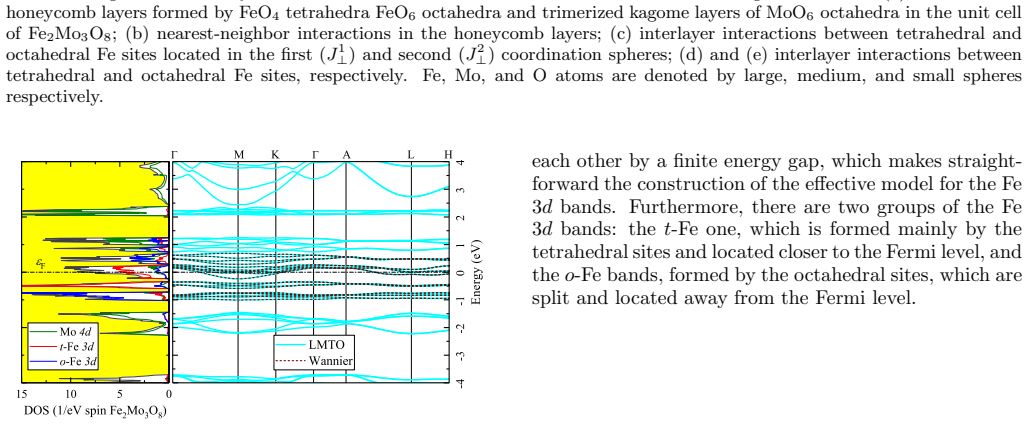
The load-bearing object is a minimal interacting-electron model for the Fe 3d electrons, built from localized basis functions and solved in a mean-field self-consistent approximation. From its solutions the paper extracts interatomic exchange couplings $J_{ij}$ and, separately, polarization parameters $P_{ij}$ by assuming that the magnetic part of the polarization has the same bilinear form as the spin Hamiltonian: $P_z=\frac{1}{2}\sum_{ij}P_{ij}\mathbf e_i\cdot\mathbf e_j$, with only four independent parameters $P_\parallel$, $P_\perp$, $P^o_\perp$, and $P^t_\perp$. These parameters are fixed by mapping the polarization computed for the antiferromagnetic and ferrimagnetic configurations onto that form, in exact analogy to the mapping of total energies onto the spin model. The four-parameter polarization form is what carries the argument: exchange couplings come out almost identical for the two charge scenarios, while the polarization parameters differ strongly, and that difference is traced to the different bond polarity of Fe2+–Fe2+ versus Fe1+–Fe3+ pairs.
What would settle it
Measure the low-temperature net magnetization of the honeycomb layers: the charge-disproportionated $\mathrm d^7_t\mathrm d^5_o$ scenario predicts a finite net moment that persists as $T\to 0$, while the homogeneous $\mathrm d^6_t\mathrm d^6_o$ scenario predicts it to vanish at $T=0$ and appear only at elevated temperature. The shape of $P_z(T)$—nearly monotonic for $\mathrm d^7_t\mathrm d^5_o$, peaked near half the magnetic ordering temperature for $\mathrm d^6_t\mathrm d^6_o$—also distinguishes the two.
Extended reading notes
Core claim
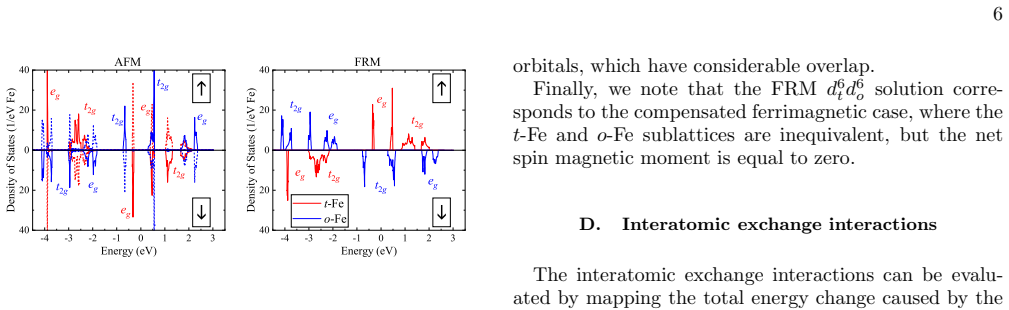
The central claim is that the giant magnetoelectric response of Fe2Mo3O8 can be understood without invoking atomic displacements or antisymmetric spin-orbit exchange: the electric polarization acquires a spin-dependent part $P_z=\frac{1}{2}\sum_{ij}P_{ij}\mathbf e_i\cdot\mathbf e_j$ because the electronic structure of the Fe 3d shell changes with the magnetic pattern, even with the crystal structure fixed. The polarization parameters $P_\parallel$, $P_\perp$, $P^o_\perp$, and $P^t_\perp$ are obtained by mapping self-consistent mean-field polarizations of the antiferromagnetic and ferrimagnetic states onto this bilinear form. In the homogeneous $\mathrm d^6_t\mathrm d^6_o$ scenario the in-plane $P_\parallel$ is small and the octahedral interlayer term dominates; in the charge-disproportionated $\mathrm d^7_t\mathrm d^5_o$ scenario all four parameters are large, with $P_\parallel$ strongly enhanced because the large Fe1+–Fe3+ ionic charge difference compensates for the small vertical separation within the bond. The two scenarios are nearly indistinguishable magnetically, yet they give different $P_z(T)$. Molecular-field evaluation for $\mathrm d^7_t\mathrm d^5_o$ yields $P_z(0)\approx 0.27\,\mu\mathrm C/\mathrm{cm}^2$, close to the measured $\approx 0.34\,\mu\mathrm C/\mathrm{cm}^2$, and a jump $\Delta P_z\approx -0.1\,\mu\mathrm C/\mathrm{cm}^2$ near the magnetic ordering temperature, matching the experimental magnitude and sign.
Load-bearing premise
The whole quantitative result depends on the assumption that the spin-dependent polarization is described by four pairwise spin-alignment coefficients fitted from two magnetic configurations, with lattice, orbital, and spin-orbit contributions either absent or fixed; if any of those contributes substantially, the predicted magnitudes and temperature dependence change.
Editorial extensions
If this is right
- If the electronic mechanism is right, the giant polarization jump does not require magnetostriction; a magnetic field that switches antiferromagnetic order to ferrimagnetic order should switch the polarization through the spin-dependent electronic term.
- Because the two charge scenarios give almost identical exchange couplings, magnetic measurements alone cannot easily tell them apart; the temperature dependence of the electric polarization is the discriminating observable.
- In the charge-disproportionated scenario, a finite net magnetization appears already at low temperature, making the antiferromagnetic-to-ferrimagnetic transition field-driven, with the model estimating critical fields of order tens of tesla.
- The sign pattern—positive $P_z$ and negative $\Delta P_z$—comes out consistent with experiment in both scenarios, so sign compatibility alone is not sufficient to select between them.
- The model predicts a noncollinear magnetic ground state with wave vector near $\mathbf q=(0,0,1/2)$, a testable neutron-scattering signature.
Reading between the lines
- A natural extension is to apply the same four-parameter polarization construction to other polar $Me_1Me_2Mo_3O_8$ compounds; the Fe2Mo3O8 result suggests that a large difference in formal charge between tetrahedral and octahedral cations is a generic amplifier for spin-driven electric polarization.
- If lattice relaxation were included, it could enhance or partially cancel the electronic polarization found here; comparing the fixed-lattice prediction with measurements under hydrostatic pressure could isolate the electronic contribution.
- The paper's preliminary discussion of spin-orbit coupling implies that in the homogeneous $\mathrm d^6_t\mathrm d^6_o$ scenario a canted magnetic state—antiferromagnetic $c$-axis components, ferrimagnetic $ab$-plane components—may allow continuous tuning of the polarization by an in-plane magnetic field, a consequence the paper does not quantify.
- The paper itself notes in Sec. II C that the charge-disproportionated solution could be an artifact of neglecting a double-counting correction; if that artifact is real, the homogeneous $\mathrm d^6_t\mathrm d^6_o$ scenario remains the operative one, and the predicted peak shape of $P_z(T)$ would identify it experimentally.
Signed reviews
Editorial analysis
A structured set of objections, weighed in public.
Referee Report
Summary. The manuscript constructs a first-principles-derived Hubbard model for the Fe 3d electrons of the polar magnetoelectric Fe2Mo3O8, treating the Mo3 trimers as nonmagnetic spectators. The model is solved in Hartree-Fock for two charge states: the symmetry-preserving charge-disproportionated d7_t d5_o state and the constrained homogeneous d6_t d6_o state with orbital order. Exchange parameters are extracted both by mapping total energies of collinear configurations and by Green's-function perturbation theory; the two scenarios give nearly identical Jij, and RPA estimates of TN (54–55 K) are close to the experimental 60 K. The spin-dependent electric polarization is parametrized by the bilinear form Pz = (1/2) sum_ij Pij e_i·e_j (Eq. (4)), with four Pij fitted to the Hartree-Fock polarizations. Molecular-field theory then yields Pz(T) and the AFM-to-FRM polarization jump ΔPz ≈ −0.1 µC/cm², which agrees in sign and order of magnitude with experiment. The authors conclude that the isotropic electronic polarization at fixed crystal structure can account for the magnetoelectric effect, while lattice, orbital, and spin-orbit effects are deferred to future work.
Significance. The paper is a valuable contribution because it offers a transparent microscopic mechanism for a material whose magnetoelectric effect has been alternatively attributed to magnetostriction or to Dzyaloshinskii-Moriya coupling. Its strengths are the downfolding to a minimal Fe-3d model, the double validation of Jij by total-energy mapping and the Green's-function method, the reproduction of TN within about 10% in RPA without fitting to experimental magnetic data, and the prediction of a distinguishing low-temperature net-magnetization signature for the two charge scenarios. Both charge scenarios give ΔPz of the correct sign and magnitude, suggesting that the qualitative mechanism is robust. The main weakness is that the Pij parameters are fitted to the same magnetic configurations whose polarization difference is the target of the prediction; an out-of-sample check is needed before the quantitative claim is fully supported. If such a check confirms the bilinear ansatz, the result would be a clear demonstration that an isotropic electronic mechanism can explain the giant magnetoelectric effect in Fe2Mo3O8.
major comments (3)
- [Sec. II E, Eq. (4), Table III] The central quantitative comparison with experiment is not independent of the inputs used to build the model. The Pij in Table III are obtained by mapping the Hartree-Fock polarizations of a limited set of collinear magnetic configurations (including the AFM and FRM states) onto the four-parameter bilinear form of Eq. (4). Since Eqs. (7)–(9) are then evaluated with these same Pij, the resulting Pz(0) = 0.27 µC/cm² and ΔPz ≈ −0.1 µC/cm² are at least partially a reconstruction of the polarizations of those fitted configurations, rather than a genuine prediction. The paper states that Eq. (4) can be derived rigorously in the large-U limit (Refs. [34,35]), but it does not present or compare with such a derivation. I request an out-of-sample test: compute the Berry-phase polarization for at least one additional magnetic configuration not used in the mapping (for example a noncollinear state or a different collinear order) and verify Eq. (4); alternatively, derive the Pij from the large-U expansion and compare with Table III. Without this, the claim that the order of magnitude is reproduced is vulnerable to circularity.
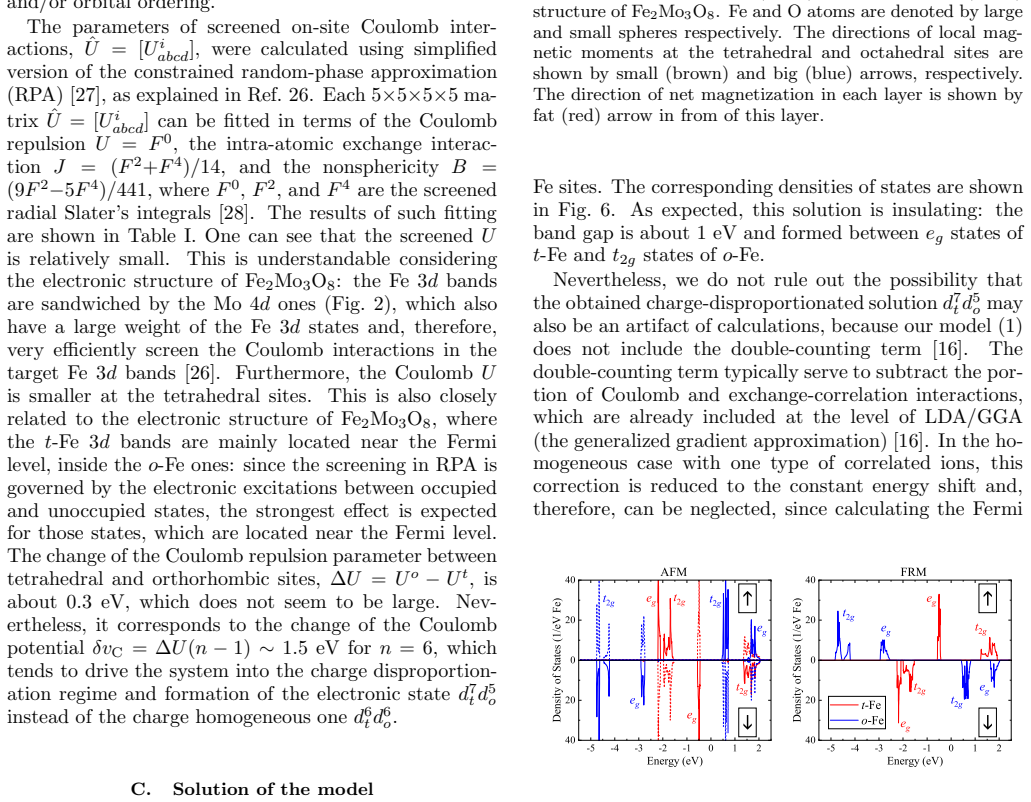
- [Sec. II C and II E, Fig. 8] For the d6_t d6_o scenario, the orbital order differs between the AFM and FRM states (Fig. 8), so the orbital state is not fixed when the spin order changes. For the exchange couplings the authors provide a state-dependence test through the Green's-function analysis of Sec. II D, but no analogous test is given for the polarization parameters. The large difference between the Pij sets for d7_t d5_o and d6_t d6_o in Table III shows that Pij are highly sensitive to the local electronic state. If Pij themselves depend on the magnetic state through orbital order, a single set of Pij inserted into Eqs. (7)–(9) is not justified, and the d6 panel of Fig. 11 would not be a valid molecular-field prediction. Please provide evidence that the bilinear Pij are transferable between magnetic states, or restrict the quantitative polarization analysis to the case where orbital order is absent.
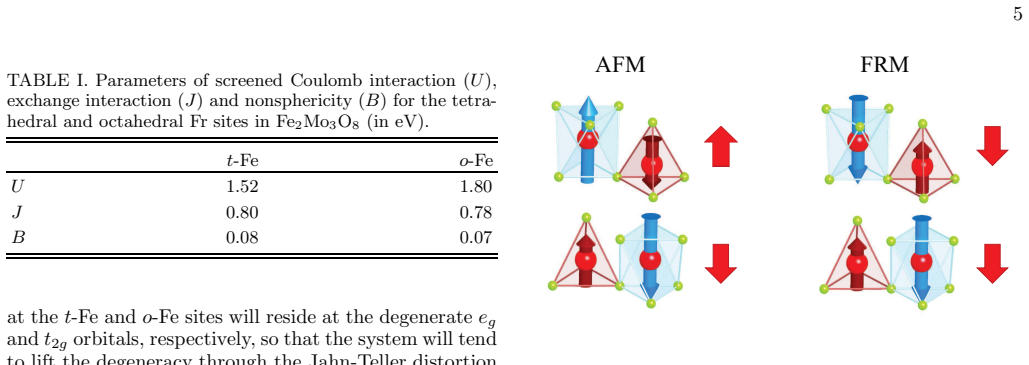
- [Sec. II C, Table I] The paper's most favorable comparison for the zero-temperature polarization (Pz(0) = 0.27 µC/cm² versus the experimental 0.34 µC/cm²) comes from the d7_t d5_o solution, which is obtained without a double-counting correction and with screened Coulomb parameters U ≈ 1.5–1.8 eV that are not in the strongly correlated limit. The authors explicitly note that this solution "may also be an artifact of calculations." Because the two scenarios differ in Pz by a factor of about four, the numerical agreement for Pz(0) is not robust against this ambiguity. For ΔPz the two scenarios are similar, so the issue is less severe for the AFM-FRM jump, but the Pz(0) comparison in the text is affected. A sensitivity analysis (for example varying the t-o level offset or including a double-counting term) is needed to show that the order-of-magnitude conclusion does not depend on the choice of d7_t d5_o.
minor comments (5)
- [Throughout] There are several typos and grammatical errors: "scenaria" in the abstract, "tends to low" in the abstract, "chesk" in Sec. II D, "nagnetization" in Sec. IV, "spites" in Sec. IV, "Fr sites" in the Table I caption, and "antiferromagnetic d5_t d7_o" for "d7_t d5_o" in the Fig. 9 caption. These should be corrected.
- [Sec. II E] In the paragraph before Table III, the sentence listing the four independent parameters says "J‖, J⊥, J⊥^o, and J⊥^t" but should refer to the polarization parameters P‖, P⊥, P⊥^o, and P⊥^t. This is confusing and should be fixed.
- [Sec. III] The statement that the RPA estimate TN = 55 K is close to the experimental 60 K should be qualified: this agreement holds for the reduced four-parameter exchange set, whereas using the full Green's-function exchange set yields TN = 32 K for d7_t d5_o. Please make this explicit so the reader does not overestimate the accuracy of the full calculation.
- [Fig. 11] Fig. 11 would be substantially more informative if the experimental Pz(T) and ΔPz data from Refs. [4,5] were overlaid on the theoretical curves; currently the experimental values appear only in the text.
- [Ref. [25]] The statement in Ref. [25] that all model parameters are available upon request is a reproducibility concern; I encourage providing the parameters and the Wannier-model construction details as ancillary files with the arXiv submission.
Circularity Check
No circularity: the model parameters are downfolded from first-principles Hartree-Fock calculations and the final comparison is against experimental polarization and Neel temperature, not against any fitted target.
full rationale
The derivation chain is self-contained and externally benchmarked. The Hubbard model (1) is built from LDA Wannier functions and constrained-RPA screened Coulomb parameters (Secs. II A-II B); the Hartree-Fock solutions for the d7t d5o and d6t d6o configurations are independent electronic-structure outputs. The exchange parameters Jij are obtained by mapping total-energy differences or Green's-function infinitesimal rotations (Sec. II D) and are checked against the experimental TN through MFA and RPA. The polarization parameters Pij are likewise obtained by mapping the Berry-phase HF polarizations of the same collinear configurations onto the bilinear form Eq. (4) (Sec. II E). This is a downfolding step, not a fit to experiment: no experimental value of Pz, Delta Pz, or TN entered the determination of Pij or Jij. The subsequent MFA evaluation of Pz(T) and Delta Pz (Eqs. (7)-(9)) is therefore a genuine model prediction whose finite-temperature shape contains nontrivial sublattice-magnetization input. The only mild caveat is that Pz(0) and the zero-temperature Delta Pz are linear combinations of the same HF-derived Pij that were mapped onto Eq. (4), so those particular values are a re-expression of the HF polarizations rather than an independent test of the bilinear ansatz. However, the paper does not disguise this: it states explicitly that the parameters are obtained by mapping the calculated polarizations onto Eq. (4), and the quantitative comparison with experiment is made for the first-principles result itself. The self-citations to Refs. [26] and [33]-[35] are methodological and do not carry the central argument alone. The explicit caveats about lattice, spin-orbit, and orbital contributions further show that the authors do not claim the ansatz is complete. No step in the claimed derivation is equivalent to its input by construction, and no fitted experimental quantity is relabeled as a prediction.
Assumptions & free parameters
assumptions (6)
- domain assumption The Fe 3d Wannier subspace is an isolated low-energy manifold; O 2p and Mo 4d states can be integrated out with only cRPA-screened interactions.
- domain assumption Hartree-Fock mean-field solutions of the Hubbard model provide reliable densities of states, exchange parameters, and electric polarizations.
- domain assumption The isotropic Heisenberg model (2) with one in-plane and three inter-plane couplings captures the magnetic energetics, including the AFM-FRM competition.
- domain assumption The electric polarization can be described by the isotropic bilinear form of Eq. (4) with four independent Pij parameters, and lattice and spin-orbit effects can be neglected for the leading magnetoelectric contribution.
- ad hoc to paper The site-dependent screened Coulomb U from constrained RPA (U_t = 1.52 eV, U_o = 1.80 eV), and the neglect of a double-counting correction, are adequate to determine the charge state.
- domain assumption The experimental crystal structure from Ref. 9 is used without relaxation for both AFM and FRM phases.
Cite this review
Pith. "Pith review of Microscopic toy model for magnetoelectric effect in polar Fe$_2$Mo$_3$O$_8$." pith.science (2026). https://pith.science/paper/26O7M4Q3
@misc{pith2026190804946,
  author       = {Pith},
  title        = {Pith review of: Microscopic toy model for magnetoelectric effect in polar Fe$_2$Mo$_3$O$_8$},
  year         = {2026},
  howpublished = {\url{https://pith.science/paper/26O7M4Q3}},
  note         = {Machine review of arXiv:1908.04946}
}
abstract
The kamiokite, Fe$_2$Mo$_3$O$_8$, is regarded as a promising material exhibiting giant magnetoelectric (ME) effect at the relatively high temperature $T$. Here, we explore this phenomenon on the basis of first-principles electronic structure calculations. For this purpose we construct a realistic model describing the behavior of magnetic Fe $3d$ electrons and further map it onto the isotropic spin model. Our analysis suggests two possible scenaria for Fe$_2$Mo$_3$O$_8$. The first one is based on the homogeneous charge distribution of the Fe$^{2+}$ ions amongst tetrahedral ($t$) and octahedral ($o$) sites, which tends to low the crystallographic P6$_3$mc symmetry through the formation of an orbitally ordered state. Nevertheless, the effect of the orbital ordering on interatomic exchange interactions does not seem to be strong, so that the magnetic properties can be described reasonably well by averaged interactions obeying the P6$_3$mc symmetry. The second scenario, which is supported by obtained parameters of on-site Coulomb repulsion and respects the P6$_3$mc symmetry, implies the charge disproportionation involving somewhat exotic $1+$ ionization state of the $t$-Fe sites (and $3+$ state of the $o$-Fe sites). Somewhat surprisingly, these scenarios are practically indistinguishable from the viewpoint of exchange interactions, which are practically identical in these two cases. However, the spin-dependent properties of the electric polarization are expected to be different due to the strong difference in the polarity of the Fe$^{2+}$-Fe$^{2+}$ and Fe$^{1+}$-Fe$^{3+}$ bonds. Our analysis uncovers the basic aspects of the ME effect in Fe$_2$Mo$_3$O$_8$. Nevertheless, the quantitative description should involve other ingredients, apparently related to the lattice and orbitals degrees of freedom.
Figures


Figures from the paper (8 more)



Reference graph
Works this paper leans on
-
[1]
Y. Haraguchi, C. Michioka, M. Imai, H. Ueda, and K. Yoshimura, Phys. Rev. B 92, 014409 (2015)
work page 2015
-
[2]
S. Yu, B. Gao, J. W. Kim, S.-W. Cheong, M. K. L. Man, J. Mad´ eo, K. M. Dani, and D. Talbayev, Phys. Rev. Lett. 120, 037601 (2018)
work page 2018
-
[3]
J. P. Sheckelton, J. R. Neilson, D. G. Soltan, and T. M. Mcqueen, Nature Mater. 11, 493 (2012)
work page 2012
-
[4]
Y. Wang, G. L. Pascut, B. Gao, T. A. Tyson, K. Haule, V. Kiryukhin, and S.-W. Cheong, Sci. Rep. 5, 12268 (2015)
work page 2015
- [5]
- [6]
-
[7]
S. V. Streltsov and D. I. Khomskii, Physics-Uspekhi 60, 1121 (2017)
work page 2017
- [8]
Show all 39 references
-
[9]
Le Page and P
Y. Le Page and P. Strobel, Acta Crystallographica Sec- tion B 38, 1265 (1982)
1982
-
[10]
Czeskleba, P
H. Czeskleba, P. Imbert, and F. Varret, AIP Conf. Proc. 5, 811 (1972)
1972
-
[11]
Bertrand and H
D. Bertrand and H. Kerner-Czeskleba, Le J. Phys. Col- loq. 36, 379 (1975)
1975
-
[12]
Kurumaji, Y
T. Kurumaji, Y. Takahashi, J. Fujioka, R. Masuda, H. Shishikura, S. Ishiwata, and Y. Tokura, Phys. Rev. B 95, 020405(R) (2017)
2017
-
[13]
Kurumaji, Y
T. Kurumaji, Y. Takahashi, J. Fujioka, R. Masuda, H. Shishikura, S. Ishiwata, and Y. Tokura, Phys. Rev. Lett. 119, 077206 (2017)
2017
-
[14]
T. N. Stanislavchuk, G. L. Pascut, A. P. Litvinchuk, Z. Liu, S. Choi, M. J. Gutmann, B. Gao, K. Haule, V. Kiryukhin, S.-W. Cheong, A. A. Sirenko, arXiv:1902.02325
1902 arXiv
-
[15]
Y. Li, G. Gao, and K. Yao, Europhys. Lett. 118, 37001 (2017)
2017
-
[16]
I. V. Solovyev, P. H. Dederichs, and V. I. Anisimov, Phys . Rev. B 50, 16861 (1994)
1994
-
[17]
I. V. Solovyev and K. Terakura, Phys. Rev. B 58, 15496 (1998)
1998
-
[18]
O. K. Andersen, Phys. Rev. B 12, 3060 (1975)
1975
-
[19]
Gunnarsson, O
O. Gunnarsson, O. Jepsen, and O. K. Andersen, Phys. Rev. B 27, 7144 (1983)
1983
-
[20]
https://www2.fkf.mpg.de/andersen/LMTODOC/LMTODO C.html
-
[21]
Blaha, K
P. Blaha, K. Schwarz, G. K. H. Madsen, D. Kvasnicka, J. Luitz, R. Laskowski, F. Tran, and L. D. Marks, WIEN2k, An Augmented Plane Wave + Local Orbitals Program- for Calculating Crystal Properties (Karlheinz Schwarz, Techn. Universit¨ at Wien, Austria, 2018)
2018
-
[22]
See Supplemented Material for the electronic structur e in Wien2k, mapping of total energies and electric polar- izations onto the isotropic spin model, magnetic state de- pendence of exchange interactions, spin-wave dispertion in the antiferromagnetic state, and the random-ph...
-
[23]
C. J. Bradley and A. P. Cracknell, The Mathematical Theory of Symmetry in Solids (Clarendon Press, Oxford, 1972)
1972
-
[24]
Marzari, A
N. Marzari, A. A. Mostofi, J. R. Yates, I. Souza, and D. Vanderbilt, Rev. Mod. Phys. 84, 1419 (2012)
2012
-
[25]
All model parameters are available upon request
-
[26]
I. V. Solovyev, J. Phys.: Condens. Matter 20, 293201 (2008)
2008
-
[27]
Aryasetiawan, M
F. Aryasetiawan, M. Imada, A. Georges, G. Kotliar, S. Biermann, and A. I. Lichtenstein, Phys. Rev. B 70, 195104 (2004)
2004
-
[28]
Solovyev, J
I. Solovyev, J. Phys. Soc. Jpn. 78, 054710 (2009)
2009
-
[29]
K. I. Kugel and D. I. Khomskii, Sov. Phys. Usp. 25, 231 (1982)
1982
-
[30]
A. I. Liechtenstein, M. I. Katsnelson, V. P. Antropov, a nd V. A. Gubanov, J. Magn. Magn. Matter. 67, 65 (1987)
1987
-
[31]
Menyuk, K
N. Menyuk, K. Dwight, and D. G. Wickham, Phys. Rev. Lett. 4, 119 (1960)
1960
-
[32]
R. D. King-Smith and D. Vanderbilt, Phys. Rev. B 47, 1651 (1993); D. Vanderbilt and R. D. King-Smith, ibid. 48, 4442 (1993); R. Resta, J. Phys.: Condens. Matter 22, 123201 (2010)
1993
-
[33]
I. V. Solovyev, M. V. Valentyuk, and V. V. Mazurenko, Phys. Rev. B 86, 144406 (2012)
2012
-
[34]
I. V. Solovyev and S. A. Nikolaev, Phys. Rev. B 90, 184425 (2014)
2014
-
[35]
S. A. Nikolaev and I. V. Solovyev, Phys. Rev. B 99, 100401(R) (2019)
2019
-
[36]
D. C. Mattis, The Theory of Magnetism Made Simple (World Scientific, Singapore, 2006)
2006
-
[37]
S. V. Tyablikov, Methods of Quantum Theory of Mag- netism, Nauka, Moscow, (1975)
1975
-
[38]
J. Rusz, I. Turek, and M. Diviˇ s, Phys. Rev. B 71, 174408 (2005)
2005
-
[39]
Picozzi, K
S. Picozzi, K. Yamauchi, B. Sanyal, I. A. Sergienko, and E. Dagotto, Phys. Rev. Lett. 99, 227201 (2007)
2007
Reviewed August 14, 2026 · model on record in the stance chip above.
Discussion (0). Continue with ORCID to comment.