REVIEW 3 major objections 5 minor 1 cited by
Magnetic dynamos powered by white dwarf superficial convection
T0 review · 3 major / 5 minor · reviewed 2026-08-07 · deepseek-v4-flash
Pith's one-line read Cooling white dwarfs should spend about a gigayear magnetized by a surface dynamo.
desk verdict Clean scaling analysis, but the kG numbers rest on an unmodeled dynamo; the paper honestly says so. read the letter →
The pith
A machine-rendered reading of the paper's core claim, the machinery that carries it, and where it could break.
The reading
What carries the argument
The load-bearing identity is the equipartition relation $B\sim \rho_{\rm conv}^{1/6}F^{1/3}$ between magnetic and kinetic energy densities at the base of the surface convection zone, where the flux $F$ is carried by mixing-length convective eddies. It converts the standard degenerate-core cooling law $T_{\rm eff}\propto M^{5/12}t^{-7/20}$ and the inward growth of the convection zone $\rho_{\rm conv}\propto t^{7/10}$ into a predicted field that tracks the effective temperature, $B\propto T_{\rm eff}\propto t^{-7/20}$. The timing argument rests on comparing three power-law clocks: the onset of convection $t_{\rm conv}\propto M^{25/21}$, core crystallization $t_{\rm cryst}\propto M^{-5/3}$, and convective coupling to the degenerate core $t_{\rm coup}\propto M^0$; their ordering isolates a clean, roughly Gyr-long dynamo epoch that precedes the breakout of any crystallization dynamo field.
What would settle it
A decisive test would be a spectropolarimetric and Zeeman-broadening survey of a dozen cool DA white dwarfs with $T_{\rm eff}$ between roughly 8,000 and 10,000 K and masses 0.5-0.9 $M_\odot$: the predicted few-kG fields should appear with $B\propto T_{\rm eff}$ in stars older than $t_{\rm conv}$ and younger than the crystallization-dynamo breakout time. Alternatively, a direct magnetohydrodynamic simulation of the surface convection zone that shows no dynamo amplification (subcritical behaviour) would falsify the mechanism; the paper explicitly leaves that dynamo question open.
Extended reading notes
Core claim
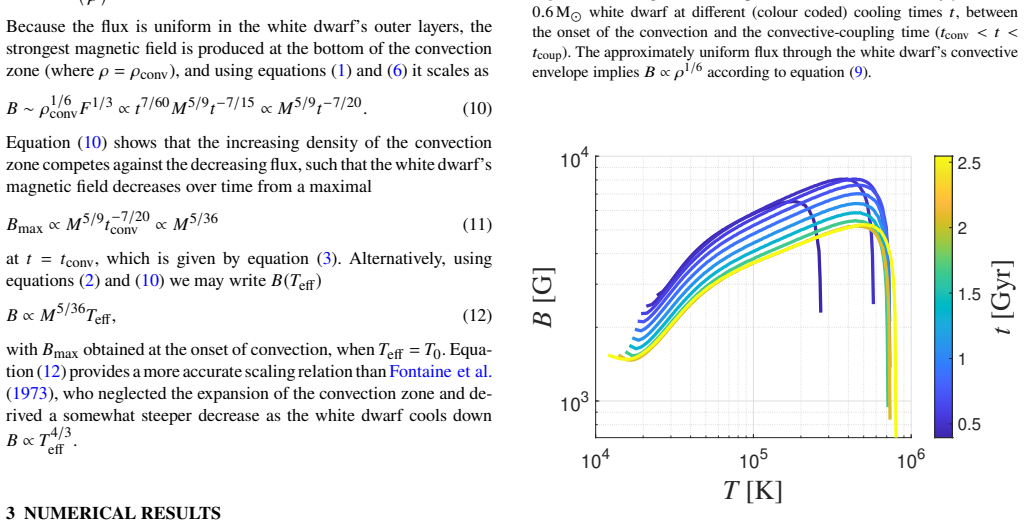
The paper's central claim is that surface convection dynamos producing kG-strength magnetic fields are a likely by-product of ordinary white dwarf cooling. Convection begins when $T_{\rm eff}$ falls below the ionization temperature; the partial-ionization opacity change creates a thin, inward-expanding convection zone whose base density grows as $\rho_{\rm conv}\propto t^{7/10}$. In that zone, the convective flux is carried by fluid motions with velocity $v_{\rm conv}\sim (F/\rho)^{1/3}$ from mixing-length theory, and the dynamo-saturated field is set by equipartition between kinetic and magnetic energy densities, $B^2/8\pi \sim \tfrac12 \rho v_{\rm conv}^2$, giving $B\sim \rho_{\rm conv}^{1/6}F^{1/3}$. Because the flux is roughly uniform through the envelope, the strongest field sits at the base of the convection zone; it reaches several kG just after $t_{\rm conv}$ and then declines as $B\propto T_{\rm eff}\propto t^{-7/20}$, refining the older $B\propto T_{\rm eff}^{4/3}$ prediction of Fontaine et al. (1973) that neglected the zone's expansion. Comparing the three clock times, $t_{\rm conv}\propto M^{25/21}$, $t_{\rm cryst}\propto M^{-5/3}$, and $t_{\rm coup}\propto M^0$, the authors find $t_{\rm conv}<t_{\rm cryst}<t_{\rm coup}$ for $0.5\,M_\odot<M<0.9\,M_\odot$, so the surface dynamo always has a window of about a gigayear before the crystallization dynamo field can reach the surface.
Load-bearing premise
The load-bearing premise is that the thin surface convection zone actually operates as a dynamo and reaches equipartition field strengths; the paper does not model the dynamo or check whether conditions such as magnetic Reynolds number are met.
Editorial extensions
If this is right
- Every DA white dwarf in the $0.5\text{--}0.9\,M_\odot$ range should exhibit a weakly magnetized phase lasting roughly $\Delta t \approx t_{\rm cryst}-t_{\rm conv}\sim 1\,\text{Gyr}$, with shorter durations at higher mass.
- During this phase the surface field should track effective temperature linearly, $B\propto T_{\rm eff}$, so a measurable prediction is that kG fields are confined to the coolest, oldest white dwarfs and fade smoothly as the white dwarf cools.
- The surface dynamo always precedes the crystallization dynamo, so the two mechanisms predict distinct epochs: kG fields first, then stronger fields after crystallization and field breakout.
- Hydrogen-atmosphere (DA) and helium-atmosphere (DB) white dwarfs both show the ordering $t_{\rm conv}<t_{\rm cryst}<t_{\rm coup}$, with DB stars producing stronger maximal fields around $3\times 10^4$ G because their convection begins at $T_{\rm eff}\approx 3\times 10^4$ K.
- If these fields exist, they are strong enough to affect white dwarf accretion and pulsation seismology, and may erase weaker fossil fields before the crystallization dynamo takes over.
Reading between the lines
- The paper leaves implicit that a small-scale, tangled field would make polarimetry systematically miss the true field; if the eddy scale is much smaller than the stellar radius, the expected true $B\sim 5\,\text{kG}$ could coexist with longitudinal measurements $B_l\ll B$, which may explain why no unambiguous candidate has been found.
- Extending the same equipartition argument to magnetic F stars, which have similar convective depth and Rossby number, suggests a common dynamo threshold; checking whether F-star activity follows the same $B\propto T_{\rm eff}$ track would provide an independent test while white dwarf samples grow.
- A testable extension is to target ZZ Ceti stars near the blue edge of the instability strip, where the dynamo is freshly activated and the field is maximal; pulsation mode splittings there should reveal the field before the long decline sets in.
Editorial analysis
A structured set of objections, weighed in public.
Referee Report
Summary. The paper revisits the idea that cooling white dwarfs develop surface convection zones that power magnetic dynamos, and derives a simple analytical scaling for the resulting field strength together with MESA stellar evolution models. For DA (hydrogen-atmosphere) white dwarfs in the 0.5-0.9 Msun mass range, the authors find that once a surface convection zone appears at a cooling time t_conv, an equipartition magnetic field reaches a maximum of several kG and then declines as B proportional to T_eff proportional to t^{-7/20} until the convective envelope couples to the degenerate core at t_coup. They also compare t_conv with the crystallization time t_cryst and find t_conv < t_cryst < t_coup across this mass range, implying a surface-dynamo phase lasting roughly a Gyr before any crystallization-dynamo field reaches the surface. The observational comparison identifies two tentative candidates among weakly magnetized white dwarfs but concludes that both are probably ruled out by stronger total fields inferred from spectroscopy, so no confirmed empirical support is found. The paper concludes that surface convection dynamos generating kG fields are a likely by-product of white dwarf cooling.
Significance. The analytical scaling is clean, parameter-free in its exponents, and independently reproduced by the MESA models, which is a genuine strength; if the underlying dynamo operates at equipartition, the paper provides a useful and falsifiable prediction for the time-dependence and mass-dependence of weak magnetic fields in cooling white dwarfs, with potential implications for accretion and seismology. The paper is also admirably honest about the lack of confirmed observational candidates and about the limits of its model. The significance is nevertheless conditional, because the central quantitative claim rests on an unmodeled equipartition assumption: the paper does not compute magnetic Reynolds numbers, dynamo numbers, or saturation mechanisms, and its own introduction states that determining whether white dwarfs satisfy the conditions for any of these dynamos is beyond the scope of the work. Thus the main contribution is a robust scaling law for an upper-limit field, not a demonstration that the dynamo operates.
major comments (3)
- [Section 2.2, Eq. (8)] The entire kG normalization of the field prediction is set by the assumed equipartition between magnetic and kinetic energy density, B^2/8pi ~ (1/2) rho v_conv^2. The paper explicitly states in the Introduction that determining whether white dwarfs satisfy the conditions for dynamo action is beyond its scope, and no induction equation, magnetic Reynolds number, dynamo number, or saturation mechanism is computed. The MESA simulations therefore verify the scaling of an assumed equipartition formula, not the existence of a dynamo. Since the surface convection zone is thin and partially ionized, the magnetic diffusivity may be large enough that a plausible dynamo is subcritical or saturates at a small fraction of equipartition, in which case the predicted fields would fall far below kG. I recommend either tempering the conclusion that surface dynamos are a 'likely by-product' to a conditional statement, or adding a quantitative dynamo-viability estimate (e.g., a mixing-length-based magnetic Reynolds number and a discussion of saturation fractions) to support the kG normalization.
- [Abstract and Section 4] There is an internal inconsistency about how long the surface dynamo remains active. The abstract states that surface dynamos are active for a period Delta t approximately t_cryst - t_conv, and the conclusions repeat that the convection zone is overrun by a crystallization dynamo field after t_cryst. However, Section 4 treats WD 2359-434, whose age satisfies t > t_cryst, as a viable surface-dynamo candidate precisely because the crystallization dynamo field remains buried until a breakout time t_break approximately 3 Gyr, and the body (Section 3, Figs. 3-4) describes the field evolution as continuing until t_coup. If the crystallization field reaches the surface only at t_break, then the surface dynamo's active lifetime is not set by t_cryst, and the 'about a Gyr' interval in the abstract needs to be reconciled with the t_break argument or explicitly redefined.
- [Section 3, Figs. 3-4] The numerical 'verification' of the power laws is obtained by evaluating Eq. (8) in every convective cell of the MESA model, i.e., by post-processing the assumed equipartition relation rather than by simulating a dynamo. The agreement between MESA and the analytical scaling therefore confirms the exponents of the assumed relation and the time-evolution of the convection zone, but it cannot validate the kG normalization or the claim that a dynamo actually operates. This distinction should be stated prominently in the text and conclusions, because the current phrasing ('MESA simulations reproduce the power laws' together with 'surface dynamos are a likely by-product') may be read as stronger evidence than the simulations actually provide.
minor comments (5)
- [Section 2.1] In the sentence 'Assuming that heat is transported trough the ideal gas envelope', 'trough' should be 'through'.
- [Section 4] The terms 'two candidates' and 'probably ruled out' are used in close succession. Consider calling them 'tentative candidates' or restructuring the text so that the abstract's statement that no observed candidates fit the theory is clearly reflected in the section.
- [Equation (12)] Equation (12) is garbled in the preprint typesetting; it should read B(T_eff) proportional to M^{5/36} T_eff, with B_max evaluated at T_eff = T_0. Please correct the displayed formula.
- [Section 3, Fig. 5] The text notes that t_coup deviates from the analytical estimate t_coup proportional to M^0 but does not quantify or explain the deviation. A brief comment on the physical reason would help readers understand the limits of the analytical model.
- [Appendix A] The appendix mentions non-monotonic jumps at low T_eff that are probably numerical artifacts. It would be helpful to mark the affected range in Fig. A1 or state explicitly which portions should not be interpreted physically.
Circularity Check
No significant circularity: the kG-field scaling is derived from an explicit equipartition ansatz plus independently computed stellar structures, not from fitted data or load-bearing self-citations.
full rationale
The paper's central derivation is self-contained. The magnetic-field scaling B ~ rho_conv^{1/6} F^{1/3} follows directly from the mixing-length flux relation (Eq. 7) and the equipartition assumption (Eq. 8), and the exponents are propagated through the Mestel cooling scalings (Eqs. 1-6) to obtain B ~ t^{-7/20} and B ~ T_eff. The MESA simulations compute the stellar structure (rho_conv, F) and then evaluate the same equipartition relation ("we compute the magnetic field B in each convective cell in the simulation using equation (8)"), so they are not an independent measurement of B, but they do independently verify the analytical exponents against a detailed numerical model rather than being fitted to observed fields. The observational comparison finds no candidates that fit the theory, so the prediction is not reverse-engineered from data. The cited same-group works (Blatman & Ginzburg 2024 for crystallization scaling and breakout, Rui et al. 2025 for seismology upper limits, Ginzburg 2024 for convective coupling) are auxiliary inputs or checks, and the decisive ordering t_conv < t_cryst < t_coup is also evaluated directly in MESA via Gamma > 200; none of these self-citations carries the central claim by itself. The main weakness—that dynamo action is assumed rather than demonstrated, as the authors state explicitly ("Determining whether white dwarfs satisfy the conditions for any of these dynamos to operate is beyond the scope of this work")—is a modeling assumption and correctness risk, not a circularity.
Assumptions & free parameters
free parameters (1)
- Equipartition coefficient C_eq =
~1 (order unity)
assumptions (6)
- domain assumption A dynamo operates in the surface convection zone and reaches equipartition field strength.
- standard math Convective flux follows mixing-length theory: F ~ rho v^3.
- standard math The Mestel (1952) cooling model describes the white dwarf core and envelope.
- domain assumption Ionization temperature T_0 is approximately constant and the recombination front is sharp.
- standard math Kramer's opacity law kappa proportional to rho T^{-7/2} holds in the envelope.
- domain assumption Convection zone thickness is set by the pressure scale height.
Cite this review
Pith. "Pith review of Magnetic dynamos powered by white dwarf superficial convection." pith.science (2026). https://pith.science/paper/27MJR3OY
@misc{pith2026250518257,
  author       = {Pith},
  title        = {Pith review of: Magnetic dynamos powered by white dwarf superficial convection},
  year         = {2026},
  howpublished = {\url{https://pith.science/paper/27MJR3OY}},
  note         = {Machine review of arXiv:2505.18257}
}
abstract
When the effective temperature of a cooling white dwarf $T_{\rm eff}$ drops below the ionization limit, it develops a surface convection zone that may generate a magnetic field $B$ through one of several dynamo mechanisms. We revisit this possibility systematically using detailed stellar evolution computations, as well as a simple analytical model that tracks the expansion of the convection zone. The magnetic field reaches a maximum of several kG (for a hydrogen atmosphere) shortly after a convection zone is established at a cooling time $t=t_{\rm conv}$. The field then declines as $B\propto T_{\rm eff}\propto t^{-7/20}$ until the convective envelope couples to the degenerate core at $t=t_{\rm coup}$. We compare the onset of convection $t_{\rm conv}\propto M^{25/21}$ to the crystallization of the white dwarf's core $t_{\rm cryst}\propto M^{-5/3}$, and find that in the mass range $0.5\,{\rm M}_\odot<M<0.9\,{\rm M}_\odot$ the order of events is $t_{\rm conv}<t_{\rm cryst}<t_{\rm coup}$. Specifically, surface dynamos are active for a period $\Delta t\approx t_{\rm cryst}-t_{\rm conv}$ of about a Gyr (shorter for higher masses), before the convection zone is overrun by a stronger magnetic field emanating from the crystallizing core. Our predicted magnetic fields are at the current detection limit, and we do not find any observed candidates that fit the theory. None the less, surface dynamos may be an inevitable outcome of white dwarf cooling, significantly affecting white dwarf accretion and seismology.
Figures


Figures from the paper (1 more)

Forward citations
Cited by 1 Pith paper
-
Seismology and diffusion of ultramassive white dwarf magnetic fields
Seismic non-detection of magnetic g-mode suppression in WD J0135+5722 limits its internal magnetic field to below 0.6 MG (CO core) or below 7 kG (ONe core), disfavoring an ONe composition or an intense crystallization dynamo.
Reference graph
Works this paper leans on
-
[1]
Angel J. R. P., Borra E. F., Landstreet J. D., 1981, @doi [ ] 10.1086/190720 , https://ui.adsabs.harvard.edu/abs/1981ApJS...45..457A 45, 457
doi:10.1086/190720 1981
-
[2]
Augustson K. C., Brun A. S., Toomre J., 2016, @doi [ ] 10.3847/0004-637X/829/2/92 , https://ui.adsabs.harvard.edu/abs/2016ApJ...829...92A 829, 92
-
[3]
Augustson K. C., Brun A. S., Toomre J., 2019, @doi [ ] 10.3847/1538-4357/ab14ea , https://ui.adsabs.harvard.edu/abs/2019ApJ...876...83A 876, 83
-
[4]
Aznar Cuadrado R., Jordan S., Napiwotzki R., Schmid H. M., Solanki S. K., Mathys G., 2004, @doi [ ] 10.1051/0004-6361:20040355 , https://ui.adsabs.harvard.edu/abs/2004A&A...423.1081A 423, 1081
-
[5]
Bagnulo S., Landstreet J. D., 2018, @doi [ ] 10.1051/0004-6361/201833235 , https://ui.adsabs.harvard.edu/abs/2018A&A...618A.113B 618, A113
-
[6]
Bagnulo S., Landstreet J. D., 2019, @doi [ ] 10.1051/0004-6361/201936068 , https://ui.adsabs.harvard.edu/abs/2019A&A...630A..65B 630, A65
-
[7]
Bagnulo S., Landstreet J. D., 2022, @doi [ ] 10.3847/2041-8213/ac84d3 , https://ui.adsabs.harvard.edu/abs/2022ApJ...935L..12B 935, L12
-
[8]
Blatman D., Ginzburg S., 2024, @doi [ ] 10.1093/mnras/stae222 , https://ui.adsabs.harvard.edu/abs/2024MNRAS.528.3153B 528, 3153
Show all 84 references
-
[9]
B \"o hm K.-H., 1968, @doi [ ] 10.1007/BF00650915 , https://ui.adsabs.harvard.edu/abs/1968Ap&SS...2..375B 2, 375
1968 doi
-
[10]
C., 2004, @doi [ ] 10.1038/nature02934 , https://ui.adsabs.harvard.edu/abs/2004Natur.431..819B 431, 819
Braithwaite J., Spruit H. C., 2004, @doi [ ] 10.1038/nature02934 , https://ui.adsabs.harvard.edu/abs/2004Natur.431..819B 431, 819
2004 doi
-
[11]
Brandenburg A., 2017, @doi [ ] 10.1051/0004-6361/201630033 , https://ui.adsabs.harvard.edu/abs/2017A&A...598A.117B 598, A117
2017 doi
-
[12]
R., Schreiber M
Camisassa M., Fuentes J. R., Schreiber M. R., Rebassa-Mansergas A., Torres S., Raddi R., Dominguez I., 2024, @doi [ ] 10.1051/0004-6361/202452539 , https://ui.adsabs.harvard.edu/abs/2024A&A...691L..21C 691, L21
2024 doi
-
[13]
K., 2023, @doi [ ] 10.1093/mnras/stac3733 , https://ui.adsabs.harvard.edu/abs/2023MNRAS.519.4529C 519, 4529
Caron A., Bergeron P., Blouin S., Leggett S. K., 2023, @doi [ ] 10.1093/mnras/stac3733 , https://ui.adsabs.harvard.edu/abs/2023MNRAS.519.4529C 519, 4529
2023 doi
-
[14]
R., 2024a, @doi [ ] 10.3847/1538-4357/ad4152 , https://ui.adsabs.harvard.edu/abs/2024ApJ...969...10C 969, 10
Castro-Tapia M., Cumming A., Fuentes J. R., 2024a, @doi [ ] 10.3847/1538-4357/ad4152 , https://ui.adsabs.harvard.edu/abs/2024ApJ...969...10C 969, 10
-
[15]
Castro-Tapia M., Zhang S., Cumming A., 2024b, @doi [ ] 10.3847/1538-4357/ad7a6a , https://ui.adsabs.harvard.edu/abs/2024ApJ...975...63C 975, 63
-
[16]
Cattaneo F., 1999, @doi [ ] 10.1086/311962 , https://ui.adsabs.harvard.edu/abs/1999ApJ...515L..39C 515, L39
1999 doi
-
[17]
Charpinet S., Fontaine G., Brassard P., 2009, @doi [ ] 10.1038/nature08307 , https://ui.adsabs.harvard.edu/abs/2009Natur.461..501C 461, 501
2009 doi
-
[18]
R., Holzwarth V., Reiners A., 2009, @doi [ ] 10.1038/nature07626 , https://ui.adsabs.harvard.edu/abs/2009Natur.457..167C 457, 167
Christensen U. R., Holzwarth V., Reiners A., 2009, @doi [ ] 10.1038/nature07626 , https://ui.adsabs.harvard.edu/abs/2009Natur.457..167C 457, 167
2009 doi
-
[19]
H., Althaus L
C \'o rsico A. H., Althaus L. G., Kawaler S. D., Miller Bertolami M. M., Garc \' a-Berro E., Kepler S. O., 2011, @doi [ ] 10.1111/j.1365-2966.2011.19642.x , https://ui.adsabs.harvard.edu/abs/2011MNRAS.418.2519C 418, 2519
2011
-
[20]
H., et al., 2022, @doi [ ] 10.1051/0004-6361/202142153 , https://ui.adsabs.harvard.edu/abs/2022A&A...659A..30C 659, A30
C \'o rsico A. H., et al., 2022, @doi [ ] 10.1051/0004-6361/202142153 , https://ui.adsabs.harvard.edu/abs/2022A&A...659A..30C 659, A30
2022 doi
-
[21]
Cunningham T., et al., 2021, @doi [ ] 10.1093/mnras/stab553 , https://ui.adsabs.harvard.edu/abs/2021MNRAS.503.1646C 503, 1646
2021 doi
-
[22]
E., Gaensicke B., Marsh T., eds, Astronomical Society of the Pacific Conference Series Vol
Dufour P., Blouin S., Coutu S., Fortin-Archambault M., Thibeault C., Bergeron P., Fontaine G., 2017, in Tremblay P. E., Gaensicke B., Marsh T., eds, Astronomical Society of the Pacific Conference Series Vol. 509, 20th European White Dwarf Workshop. p. 3 ( @eprint arXiv 1610.00...
-
[23]
Farihi J., et al., 2018, @doi [ ] 10.1093/mnras/stx2664 , https://ui.adsabs.harvard.edu/abs/2018MNRAS.474..947F 474, 947
2018 doi
-
[24]
T., 2015, @doi [ ] 10.1007/s11214-015-0152-0 , https://ui.adsabs.harvard.edu/abs/2015SSRv..191..111F 191, 111
Ferrario L., de Martino D., G \"a nsicke B. T., 2015, @doi [ ] 10.1007/s11214-015-0152-0 , https://ui.adsabs.harvard.edu/abs/2015SSRv..191..111F 191, 111
2015 doi
-
[25]
Ferrario L., Wickramasinghe D., Kawka A., 2020, @doi [Advances in Space Research] 10.1016/j.asr.2019.11.012 , https://ui.adsabs.harvard.edu/abs/2020AdSpR..66.1025F 66, 1025
2020 doi
-
[26]
Fontaine G., Brassard P., 2008, @doi [ ] 10.1086/592788 , https://ui.adsabs.harvard.edu/abs/2008PASP..120.1043F 120, 1043
2008 doi
-
[27]
H., van Horn H
Fontaine G., Thomas J. H., van Horn H. M., 1973, @doi [ ] 10.1086/152381 , https://ui.adsabs.harvard.edu/abs/1973ApJ...184..911F 184, 911
1973 doi
-
[28]
Fontaine G., Brassard P., Bergeron P., 2001, @doi [ ] 10.1086/319535 , https://ui.adsabs.harvard.edu/abs/2001PASP..113..409F 113, 409
2001 doi
-
[29]
E., Reifenstein S
Fraser A. E., Reifenstein S. A., Garaud P., 2024, @doi [ ] 10.3847/1538-4357/ad26fe , https://ui.adsabs.harvard.edu/abs/2024ApJ...964..184F 964, 184
2024 doi
-
[30]
R., Cumming A., Castro-Tapia M., Anders E
Fuentes J. R., Cumming A., Castro-Tapia M., Anders E. H., 2023, @doi [ ] 10.3847/1538-4357/accb56 , https://ui.adsabs.harvard.edu/abs/2023ApJ...950...73F 950, 73
2023 doi
-
[31]
R., Castro-Tapia M., Cumming A., 2024, @doi [ ] 10.3847/2041-8213/ad3100 , https://ui.adsabs.harvard.edu/abs/2024ApJ...964L..15F 964, L15
Fuentes J. R., Castro-Tapia M., Cumming A., 2024, @doi [ ] 10.3847/2041-8213/ad3100 , https://ui.adsabs.harvard.edu/abs/2024ApJ...964L..15F 964, L15
2024 doi
-
[32]
L., Jermyn A
Fuller J., Piro A. L., Jermyn A. S., 2019, @doi [ ] 10.1093/mnras/stz514 , https://ui.adsabs.harvard.edu/abs/2019MNRAS.485.3661F 485, 3661
2019 doi
-
[33]
Garc \' a-Berro E., et al., 2012, @doi [ ] 10.1088/0004-637X/749/1/25 , https://ui.adsabs.harvard.edu/abs/2012ApJ...749...25G 749, 25
2012 doi
-
[34]
Giammichele N., Fontaine G., Brassard P., Charpinet S., 2016, @doi [ ] 10.3847/0067-0049/223/1/10 , https://ui.adsabs.harvard.edu/abs/2016ApJS..223...10G 223, 10
2016 doi
-
[35]
Giammichele N., et al., 2018, @doi [ ] 10.1038/nature25136 , https://ui.adsabs.harvard.edu/abs/2018Natur.554...73G 554, 73
2018 doi
-
[36]
Ginzburg S., 2024, @doi [ ] 10.1093/mnrasl/slae082 , https://ui.adsabs.harvard.edu/abs/2024MNRAS.534L..65G 534, L65
2024 doi
-
[37]
Ginzburg S., Fuller J., Kawka A., Caiazzo I., 2022, @doi [ ] 10.1093/mnras/stac1363 , https://ui.adsabs.harvard.edu/abs/2022MNRAS.514.4111G 514, 4111
2022 doi
-
[38]
Z., Garaud P., 2019, @doi [ ] 10.3847/2041-8213/aaf812 , https://ui.adsabs.harvard.edu/abs/2019ApJ...870L...5H 870, L5
Harrington P. Z., Garaud P., 2019, @doi [ ] 10.3847/2041-8213/aaf812 , https://ui.adsabs.harvard.edu/abs/2019ApJ...870L...5H 870, L5
2019 doi
-
[39]
J., et al., 2017, @doi [ ] 10.3847/1538-4365/aa8bb5 , https://ui.adsabs.harvard.edu/abs/2017ApJS..232...23H 232, 23
Hermes J. J., et al., 2017, @doi [ ] 10.3847/1538-4365/aa8bb5 , https://ui.adsabs.harvard.edu/abs/2017ApJS..232...23H 232, 23
2017 doi
-
[40]
Isern J., Garc \' a-Berro E., K \"u lebi B., Lor \'e n-Aguilar P., 2017, @doi [ ] 10.3847/2041-8213/aa5eae , https://ui.adsabs.harvard.edu/abs/2017ApJ...836L..28I 836, L28
2017 doi
-
[41]
S., Schwab J., Bauer E., Timmes F
Jermyn A. S., Schwab J., Bauer E., Timmes F. X., Potekhin A. Y., 2021, @doi [ ] 10.3847/1538-4357/abf48e , https://ui.adsabs.harvard.edu/abs/2021ApJ...913...72J 913, 72
2021 doi
-
[42]
S., et al., 2023, @doi [ ] 10.3847/1538-4365/acae8d , https://ui.adsabs.harvard.edu/abs/2023ApJS..265...15J 265, 15
Jermyn A. S., et al., 2023, @doi [ ] 10.3847/1538-4365/acae8d , https://ui.adsabs.harvard.edu/abs/2023ApJS..265...15J 265, 15
2023 doi
-
[43]
M., Solanki S
Jordan S., Aznar Cuadrado R., Napiwotzki R., Schmid H. M., Solanki S. K., 2007, @doi [ ] 10.1051/0004-6361:20066163 , https://ui.adsabs.harvard.edu/abs/2007A&A...462.1097J 462, 1097
2007 doi
-
[44]
D., Sekii T., Gough D., 1999, @doi [ ] 10.1086/307087 , https://ui.adsabs.harvard.edu/abs/1999ApJ...516..349K 516, 349
Kawaler S. D., Sekii T., Gough D., 1999, @doi [ ] 10.1086/307087 , https://ui.adsabs.harvard.edu/abs/1999ApJ...516..349K 516, 349
1999 doi
-
[46]
Springer, @doi 10.1007/978-3-642-30304-3
Kippenhahn R., Weigert A., Weiss A., 2012, Stellar Structure and Evolution . Springer, @doi 10.1007/978-3-642-30304-3
2012 doi
-
[47]
F., 1998, , https://ui.adsabs.harvard.edu/abs/1998A&A...338..612K 338, 612
Koester D., Dreizler S., Weidemann V., Allard N. F., 1998, , https://ui.adsabs.harvard.edu/abs/1998A&A...338..612K 338, 612
1998
-
[48]
Koester D., Voss B., Napiwotzki R., Christlieb N., Homeier D., Lisker T., Reimers D., Heber U., 2009, @doi [ ] 10.1051/0004-6361/200912531 , https://ui.adsabs.harvard.edu/abs/2009A&A...505..441K 505, 441
2009 doi
-
[49]
D., Bagnulo S., Valyavin G
Landstreet J. D., Bagnulo S., Valyavin G. G., Fossati L., Jordan S., Monin D., Wade G. A., 2012, @doi [ ] 10.1051/0004-6361/201219829 , https://ui.adsabs.harvard.edu/abs/2012A&A...545A..30L 545, A30
2012 doi
-
[50]
D., Bagnulo S., Valyavin G
Landstreet J. D., Bagnulo S., Valyavin G. G., Gadelshin D., Martin A. J., Galazutdinov G., Semenko E., 2015, @doi [ ] 10.1051/0004-6361/201526434 , https://ui.adsabs.harvard.edu/abs/2015A&A...580A.120L 580, A120
2015 doi
-
[51]
D., Bagnulo S., Valyavin G., Valeev A
Landstreet J. D., Bagnulo S., Valyavin G., Valeev A. F., 2017, @doi [ ] 10.1051/0004-6361/201731432 , https://ui.adsabs.harvard.edu/abs/2017A&A...607A..92L 607, A92
2017 doi
-
[52]
H., Rose W
Levy E. H., Rose W. K., 1974, @doi [ ] 10.1086/153177 , https://ui.adsabs.harvard.edu/abs/1974ApJ...193..419L 193, 419
1974 doi
-
[53]
A., Thomas J
Markiel J. A., Thomas J. H., van Horn H. M., 1994, @doi [ ] 10.1086/174454 , https://ui.adsabs.harvard.edu/abs/1994ApJ...430..834M 430, 834
1994 doi
-
[54]
Mathur S., et al., 2014, @doi [ ] 10.1051/0004-6361/201322707 , https://ui.adsabs.harvard.edu/abs/2014A&A...562A.124M 562, A124
2014 doi
-
[55]
Mestel L., 1952, @doi [ ] 10.1093/mnras/112.6.583 , https://ui.adsabs.harvard.edu/abs/1952MNRAS.112..583M 112, 583
1952 doi
-
[56]
D., Rafikov R
Metzger B. D., Rafikov R. R., Bochkarev K. V., 2012, @doi [ ] 10.1111/j.1365-2966.2012.20895.x , https://ui.adsabs.harvard.edu/abs/2012MNRAS.423..505M 423, 505
2012
-
[57]
u ller W. C., Sch \
Moll R., Pietarila Graham J., Pratt J., Cameron R. H., M \"u ller W. C., Sch \"u ssler M., 2011, @doi [ ] 10.1088/0004-637X/736/1/36 , https://ui.adsabs.harvard.edu/abs/2011ApJ...736...36M 736, 36
2011 doi
-
[58]
H., Dunlap B
Montgomery M. H., Dunlap B. H., 2024, @doi [ ] 10.3847/1538-4357/ad16dc , https://ui.adsabs.harvard.edu/abs/2024ApJ...961..197M 961, 197
2024 doi
-
[59]
S., Metzger B
Nordhaus J., Wellons S., Spiegel D. S., Metzger B. D., Blackman E. G., 2011, @doi [Proceedings of the National Academy of Science] 10.1073/pnas.1015005108 , https://ui.adsabs.harvard.edu/abs/2011PNAS..108.3135N 108, 3135
2011 doi
-
[60]
W., et al., 2024, @doi [ ] 10.1093/mnras/stad3773 , https://ui.adsabs.harvard.edu/abs/2024MNRAS.527.8687O 527, 8687
O'Brien M. W., et al., 2024, @doi [ ] 10.1093/mnras/stad3773 , https://ui.adsabs.harvard.edu/abs/2024MNRAS.527.8687O 527, 8687
2024 doi
-
[61]
O., Soethe L
Oliveira da Rosa G., Kepler S. O., Soethe L. T. T., Romero A. D., Bell K. J., 2024, @doi [ ] 10.3847/1538-4357/ad6987 , https://ui.adsabs.harvard.edu/abs/2024ApJ...974..314O 974, 314
2024 doi
-
[62]
N., 1955, @doi [ ] 10.1086/146087 , https://ui.adsabs.harvard.edu/abs/1955ApJ...122..293P 122, 293
Parker E. N., 1955, @doi [ ] 10.1086/146087 , https://ui.adsabs.harvard.edu/abs/1955ApJ...122..293P 122, 293
1955 doi
-
[63]
Paxton B., Bildsten L., Dotter A., Herwig F., Lesaffre P., Timmes F., 2011, @doi [ ] 10.1088/0067-0049/192/1/3 , https://ui.adsabs.harvard.edu/abs/2011ApJS..192....3P 192, 3
2011 doi
-
[64]
Paxton B., et al., 2013, @doi [ ] 10.1088/0067-0049/208/1/4 , https://ui.adsabs.harvard.edu/abs/2013ApJS..208....4P 208, 4
2013 doi
-
[65]
Paxton B., et al., 2015, @doi [ ] 10.1088/0067-0049/220/1/15 , https://ui.adsabs.harvard.edu/abs/2015ApJS..220...15P 220, 15
2015 doi
-
[66]
Paxton B., et al., 2018, @doi [ ] 10.3847/1538-4365/aaa5a8 , https://ui.adsabs.harvard.edu/abs/2018ApJS..234...34P 234, 34
2018 doi
-
[67]
Paxton B., et al., 2019, @doi [ ] 10.3847/1538-4365/ab2241 , https://ui.adsabs.harvard.edu/abs/2019ApJS..243...10P 243, 10
2019 doi
-
[68]
H., 1980, @doi [Astronomische Nachrichten] 10.1002/asna.2103010302 , https://ui.adsabs.harvard.edu/abs/1980AN....301..101R 301, 101
Raedler K. H., 1980, @doi [Astronomische Nachrichten] 10.1002/asna.2103010302 , https://ui.adsabs.harvard.edu/abs/1980AN....301..101R 301, 101
1980 doi
-
[69]
A., 1995, @doi [ ] 10.1093/mnras/273.1.146 , https://ui.adsabs.harvard.edu/abs/1995MNRAS.273..146R 273, 146
Reg o s E., Tout C. A., 1995, @doi [ ] 10.1093/mnras/273.1.146 , https://ui.adsabs.harvard.edu/abs/1995MNRAS.273..146R 273, 146
1995 doi
-
[70]
Z., Fuller J., Hermes J
Rui N. Z., Fuller J., Hermes J. J., 2025, @doi [ ] 10.3847/1538-4357/adaf9e , https://ui.adsabs.harvard.edu/abs/2025ApJ...981...72R 981, 72
2025 doi
-
[71]
R., Belloni D., G \"a nsicke B
Schreiber M. R., Belloni D., G \"a nsicke B. T., Parsons S. G., Zorotovic M., 2021, @doi [Nature Astronomy] 10.1038/s41550-021-01346-8 , https://ui.adsabs.harvard.edu/abs/2021NatAs...5..648S 5, 648
2021 doi
-
[72]
M., Marsden S
Seach J. M., Marsden S. C., Carter B. D., Neiner C., Folsom C. P., Mengel M. W., Oksala M. E., Buysschaert B., 2020, @doi [ ] 10.1093/mnras/staa1107 , https://ui.adsabs.harvard.edu/abs/2020MNRAS.494.5682S 494, 5682
2020 doi
-
[73]
C., 2002, @doi [ ] 10.1051/0004-6361:20011465 , https://ui.adsabs.harvard.edu/abs/2002A&A...381..923S 381, 923
Spruit H. C., 2002, @doi [ ] 10.1051/0004-6361:20011465 , https://ui.adsabs.harvard.edu/abs/2002A&A...381..923S 381, 923
2002 doi
-
[74]
Steenbeck M., Krause F., 1969a, @doi [Astronomische Nachrichten] 10.1002/asna.19692910201 , https://ui.adsabs.harvard.edu/abs/1969AN....291...49S 291, 49
-
[75]
Steenbeck M., Krause F., 1969b, Astronomische Nachrichten, https://ui.adsabs.harvard.edu/abs/1969AN....291..271S 291, 271
-
[76]
H., Markiel J
Thomas J. H., Markiel J. A., van Horn H. M., 1995, @doi [ ] 10.1086/176400 , https://ui.adsabs.harvard.edu/abs/1995ApJ...453..403T 453, 403
1995 doi
-
[78]
A., Wickramasinghe D
Tout C. A., Wickramasinghe D. T., Liebert J., Ferrario L., Pringle J. E., 2008, @doi [ ] 10.1111/j.1365-2966.2008.13291.x , https://ui.adsabs.harvard.edu/abs/2008MNRAS.387..897T 387, 897
2008
-
[79]
E., Fontaine G., Freytag B., Steiner O., Ludwig H
Tremblay P. E., Fontaine G., Freytag B., Steiner O., Ludwig H. G., Steffen M., Wedemeyer S., Brassard P., 2015, @doi [ ] 10.1088/0004-637X/812/1/19 , https://ui.adsabs.harvard.edu/abs/2015ApJ...812...19T 812, 19
2015 doi
-
[80]
M., 1970, @doi [ ] 10.1086/180523 , https://ui.adsabs.harvard.edu/abs/1970ApJ...160L..53V 160, L53
Van Horn van Horn van Horn H. M., 1970, @doi [ ] 10.1086/180523 , https://ui.adsabs.harvard.edu/abs/1970ApJ...160L..53V 160, L53
1970 doi
-
[81]
M., 1971, in Luyten W
Van Horn van Horn van Horn H. M., 1971, in Luyten W. J., ed., IAU Symp. Vol. 42, White Dwarfs. p. 97
1971
-
[82]
A., Jordan S., Mander C., Bergeron P., Dufour P., 2024, @doi [ ] 10.1051/0004-6361/202347694 , https://ui.adsabs.harvard.edu/abs/2024A&A...682A...5V 682, A5
Vincent O., Barstow M. A., Jordan S., Mander C., Bergeron P., Dufour P., 2024, @doi [ ] 10.1051/0004-6361/202347694 , https://ui.adsabs.harvard.edu/abs/2024A&A...682A...5V 682, A5
2024 doi
-
[83]
o gler A., Sch \
V \"o gler A., Sch \"u ssler M., 2007, @doi [ ] 10.1051/0004-6361:20077253 , https://ui.adsabs.harvard.edu/abs/2007A&A...465L..43V 465, L43
2007 doi
-
[84]
T., Ferrario L., 2005, @doi [ ] 10.1111/j.1365-2966.2004.08603.x , https://ui.adsabs.harvard.edu/abs/2005MNRAS.356.1576W 356, 1576
Wickramasinghe D. T., Ferrario L., 2005, @doi [ ] 10.1111/j.1365-2966.2004.08603.x , https://ui.adsabs.harvard.edu/abs/2005MNRAS.356.1576W 356, 1576
2005
-
[85]
E., Kepler S
Winget D. E., Kepler S. O., 2008, @doi [ ] 10.1146/annurev.astro.46.060407.145250 , https://ui.adsabs.harvard.edu/abs/2008ARA&A..46..157W 46, 157
2008
-
[86]
E., et al., 1994, @doi [ ] 10.1086/174455 , https://ui.adsabs.harvard.edu/abs/1994ApJ...430..839W 430, 839
Winget D. E., et al., 1994, @doi [ ] 10.1086/174455 , https://ui.adsabs.harvard.edu/abs/1994ApJ...430..839W 430, 839
1994 doi
Reviewed August 7, 2026 · model on record in the stance chip above.
Discussion (0). Sign in to comment.